anaheim-gazette 1920-02-12
Scanned page
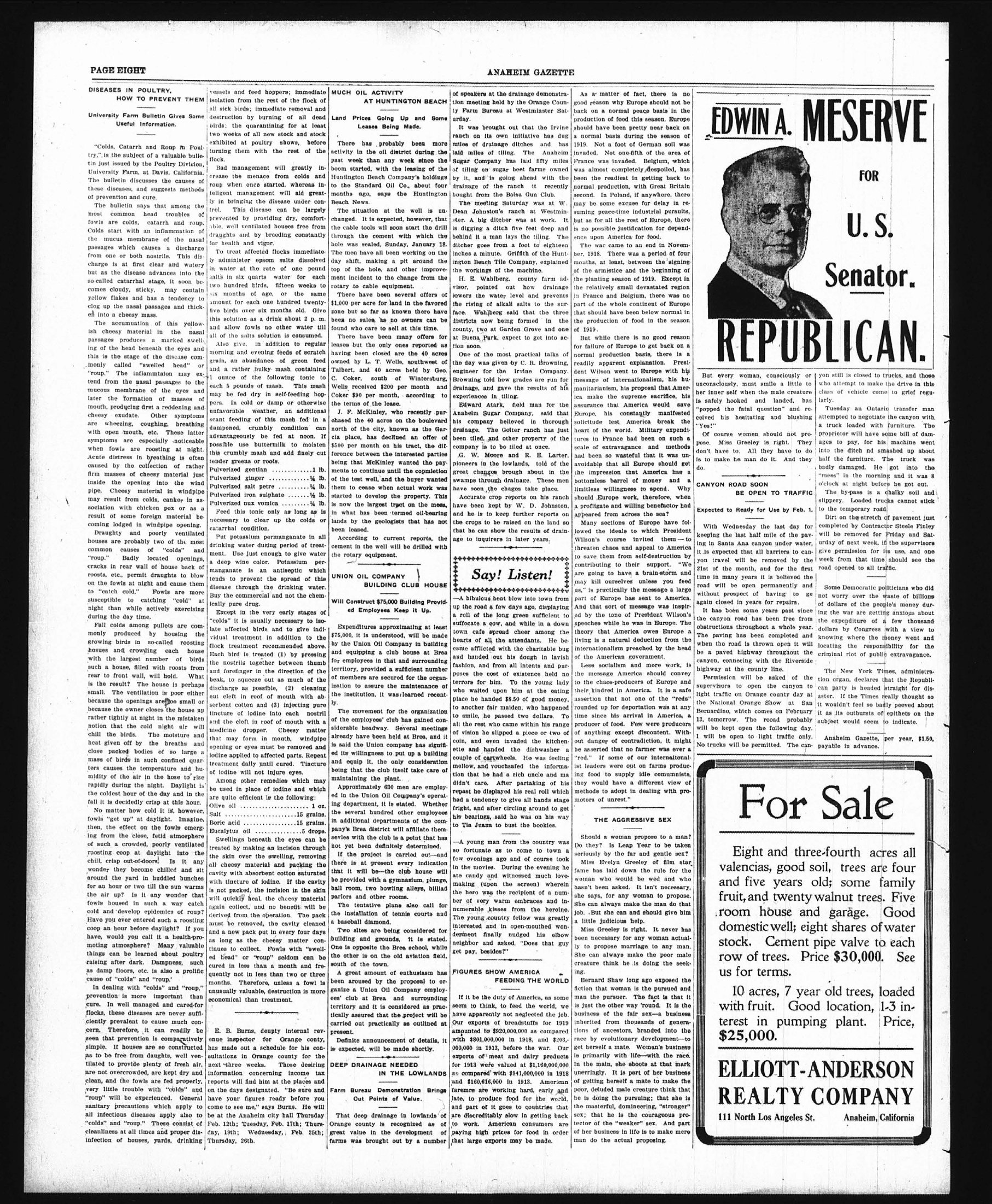
Searchable text
DISEASES IN POULTRY,
HOW TO PREVENT THEM
University Farm Bulletin Gives Some Useful Information.
"Colds, Catarrh and Roup in Poultry," is the subject of a valuable bulletin just issued by the Poultry Division, University Farm, at Davis, California. The bulletin discusses the causes of these diseases, and suggests methods of prevention and cure.
The bulletin says that among the most common head troubles of fowls are colds, catarrh and roup. Colds start with an inflammation of the mucus membrane of the nasal passages which causes a discharge from one or both nostrils. This discharge is at first clear and watery but as the disease advances into the so-called catarrhal stage, it soon becomes cloudy, sticky, may contain yellow flakes and has a tendency to clog up the nasal passages and thicken into a cheesy mass.
The accumulation of this yellowish cheesy material in the nasal passages produces a marked swelling of the head beneath the eyes and this is the stage of the disease commonly called "swelled head" or "roup." The inflammatation may extend from the nasal passages to the mucous membrane of the eyes and later the formation of masses of mouth, producing first a reddening and cheesy exudate. Other symptoms are wheezing, coughing, breathing with open mouth, etc. These latter symptoms are especially noticeable when fowls are roosting at night vessels and feed hoppers; immediate isolation from the rest of the flock of all sick birds; immediate removal and destruction by burning of all dead birds; the quarantining for at least two weeks of all new stock and stock exhibited at poultry shows, before turning them with the rest of the flock.
Bad management will greatly increase the menace from colds and roup when once started, whereas intelligent management will aid greatly in bringing the disease under control. This disease can be largely prevented by providing dry, comfortable, well ventilated houses free from draughts and by breeding constantly for health and vigor.
To treat affected flocks immediately administer epsom salts dissolved in water at the rate of one pound salts in six quarts water for each two hundred birds, fifteen weeks to six months of age, or the same amount for each one hundred twenty-five birds over six months old. Give this solution as a drink about 2 p.m. and allow fowls no other water till all of the salts solution is consumed.
Also give, in addition to regular morning and evening feeds of scratch grain, an abundance of green feed and a rather bulky mash containing 1 ounce of the following tonic to each 5 pounds of mash. This mash may be fed dry in self-feeding hoppers. In cold or damp or otherwise unfavorable weather, an additional scant feeding of this mash fed in a dampened, crumbly condition can advantageously be fed at noon. If possible use buttermilk to moisten vessels and feed hoppers; immediate isolation from the rest of the flock of all sick birds; immediate removal and destruction by burning of all dead birds; the quarantining for at least two weeks of all new stock and stock exhibited at poultry shows, before turning them with the rest of the flock.
There has been activity in the past week that boom started Huntington Bay to the Standard months ago, Beach News.
The situation changed. It was cable too through the hole was sealed. The men have day shift, most top of the building incident rotary to call. There have $1,000 per-acre zone but so been no sales found who can.
There have leases but they having been owned by L.A. Talbert, and C. Coker. Wells received Coker $90 per term of J. F. McKenzie chased the 4 north of the cia place, he $500 per month.
this is the stage of the disease commonly called "swelled head" or "roup." The inflammaction may extend from the pasal passages to the mucous membrane of the eyes and later the formation of masses of mouth, producing first a reddening and cheesy exudate. Other symptoms are wheezing, coughing, breathing with open mouth, etc. These latter symptoms are especially noticeable when fowls are roosting at night. Acute distress in breathing is often caused by the collection of rather firm masses of cheesy material just inside the opening into the wind pipe. Cheesy material in windpipe may result from colds, canker in association with chicken pox or as a result of some foreign material becoming lodged in windpipe opening.
Draughty and poorly ventilated houses are probably two of the most common causes of "colds" and "roup." Badly located openings, cracks in rear wall of house back of roosts, etc., permit draughts to blow on the fowls at night and cause them to "catch cold." Fowls are more susceptible to catching "cold" at night than while actively exercising during the day time.
Fall colds among pullets are commonly produced by housing the growing birds in so-called roosting houses and crowding each house with the largest number of birds such a house, filled with roosts from rear to front wall, will hold. What is the result? The house is perhaps small. The ventilation is poor either because the openings are too small or because the owner closes the house up rather tightly at night in the mistaken notion that the cold night air will chill the birds. The moisture and heat given off by the breaths and close packed bodies of so large a mass of birds in such confined quarters causes the temperature and humidity of the air in the hose to rise rapidly during the night. Daylight is the coldest hour of the day and in the fall it is decidedly crisp at this hour.
No matter how cold it is, however, fowls "get up" at daylight. Imagine, then, the effect on the fowls emerging from the close, fetid atmosphere of such a crowded, poorly ventilated grain, an abundance of green feed and a rather bulky mash containing 1 ounce of the following tonic to each 5 pounds of mash. This mash may be fed dry in self-feeding hoppers. In cold or damp or otherwise unfavorable weather, an additional scant feeding of this mash fed in a dampened, crumbly condition can advantageously be fed at noon. If possible use buttermilk to moisten this crumbly mash and add finely cut tender greens or roots.
Pulverized gentian . . . . . . . . . . . . . . . . . . . . . . . . . . . . 1 lb.
Pulverized ginger . . . . . . . . . . . . . . . . . . . . . . . . . . . . ¼ lb.
Pulverized salt petre . . . . . . . . . . . . . . . . . . . . . . . . . ¼ lb.
Pulverized iron sulphate . . . . . . . . . . . . . . . . . . . ½ lb.
Pulverized nux vomica . . . . . . . . . . . . . . . . . . ¼ lb.
Feed this tonic only as long as is necessary to clear up the colds or catarrhal condition.
Put potassium permanganate in all drinking water during period of treatment. Use just enough to give water a deep wine color. Potassium permanganate is an antiseptic which tends to prevent the spread of this disease through the drinking water. Buy the commercial and not the chemically pure drug.
Except in the very early stages of "colds" it is usually necessary to isolate affected birds and to give individual treatment in addition to the flock treatment recommended above. Each bird is treated (1) by pressing the nostrils together between thumb and forefinger in the direction of the beak, to squeeze out as much of the discharge as possible, (2) cleaning out cleft in roof of mouth with absorbent cotton and (3) injecting pure tincture of iodine into each nostril and the cleft in roof of mouth with a medicine dropper. Cheesy matter that may form in mouth, windpipe opening or eyes must be removed and iodine applied to affected parts. Repeat treatment daily until cured. Tincture of iodine will not injure eyes.
Among other remedies which may be used in place of iodine and which are quite efficient is the following:
Olive oil ..... 1 oz.
Salt ..... 15 grains.
Boric acid ..... 15 grains.
Eucalypt oil ..... 5 drops.
Swellings beneath the eyes can be treated by making an incision through
mass of birds in such confined quarters causes the temperature and humidity of the air in the hose to rise rapidly during the night. Daylight is the coldest hour of the day and in the fall it is decidedly crisp at this hour.
No matter how cold it is, however, fowls "get up" at daylight. Imagine, then, the effect on the fowls emerging from the close, fetid atmosphere of such a crowded, poorly ventilated roosting coop at daylight into the chill, crisp out-of-doors. Is it any wonder they become chilled and sit around the yard in huddled bunches for an hour or two till the sun warms the air up? Is it any wonder that fowls housed in such a way catch cold and develop epidemics of roup? Have you ever entered such a roosting coop an hour before daylight? If you have, would you call it a health-promoting atmosphere? Many valuable things can be learned about poultry raising after dark. Dampness, such as damp floors, etc. is also a prolific cause of "colds" and "roup."
In dealing with "colds" and "roup," prevention is more important than cure. In well managed and cared-for flocks, these diseases are never sufficiently prevalent to cause much concern. Therefore, it can readily be seen that prevention is comparatively simple. If houses are so constructed as to be free from daughts, well ventilated to provide plenty of fresh air, are not overcrowded, are kept dry and clean, and the fowls are fed properly, very little trouble with "colds" and "roup" will be experienced. General sanitary precautions which apply to all infectious diseases apply also to "colds" and "roup." These consist of cleanliness at all times and proper disinfection of houses, yards, drinking
E. B. Burns, depty internal revenue inspector for Orange county, has made out a schedule for his consultations in Orange county for the next three weeks. Those desiring information concerning income tax reports will find him at the places and on the days designated. "Be sure and have your figures ready before you come to see me," says Burns. He will be at the Anaheim city hall Thursday Feb. 12th; Tuesday, Feb. 17th; Thursday, 19th; Wednesday, Feb. 25th; Thursday, 26th.
ANAHEIM GAZETTE
THE immediate flock of removal and of all dead stock and stock news, before rest of the greatly injured colds and whereas in aid great under condition be largely comforts free from constantly immediate dissolved one pound for each ten weeks to the same freed twenty old. Give about 2 p.m. water till consumed. To regular uses of scratch green feed containing ing toxic to this mash needing hopper otherwise additional fish fed in a addition can get noon. If to molten
MUCH OIL ACTIVITY AT HUNTINGTON BEACH
Land Prices Going Up and Some Leases Being Made.
There has probably been more activity in the oil district during the past week than any week since the boom started, with the leasing of the Huntington Beach Company's holdings to the Standard Oil Co., about four months ago, says the Huntington Beach News.
The situation at the well is unchanged. It is expected, however, that the cable tools will soon start the drill through the cement with which the hole was sealed, Sunday, January 18. The men have all been working on the day shift, making a pit around the top of the hole, and other improvement incident to the change from the rotary to cable equipment.
There have been several offers of $1,000 per acre for land in the favored zone but so far as known there have been no sales, as no owners can be found who care to sell at this time.
There have been many offers for leases but the only ones reported as having been closed are the 40 acres owned by L. T. Wells, southwest of Talbert, and 40 acres held by Geo. C. Coker, south of Wintersburg, Wells received $200 per month and Coker $90 per month, according to the terms of the lease.
J. F. McKinley, who recently purchased the 40 acres on the boulevard north of the city, known as the Garcia place, has declined an offer of $500 per month on his tract, the dif-
of speakers at the drainage demonstration meeting held by the Orange County Farm Bureau at Westminster Saturday.
It was brought out that the Irvine ranch on its own initiative has dug miles of drainage ditches and has laid miles of tiling. The Anaheim Sugar Company has laid fifty miles of tiling on sugar beet farms owned by it, and is going ahead with the drainage of the ranch it recently bought from the Bolsa Gun Club.
The meeting Saturday was at W. Dean Johnston's ranch at Westminster. A bigditch was at work. It is digging a ditch five feet deep and behind it a man lays the tiling. The ditcher goes from a foot to eighteen inches a minute. Griffith of the Huntington Beach Tile Company, explained the workings of the machine.
H. E. Wahlberg, county farm advisor, pointed out how drainage lowers the water level and prevents the rising of alkali salts to the surface. Wahlberg said that the three districts now being formed in the county, two at Garden Grove and one at Buena Park, expect to get into action soon.
One of the most practical talks of the day was given by C. R. Browning, engineer for the Irvine Company. Browning told how grades are run for drainage, and gave the results of his experiences in tiling.
Edward Atark, field man for the Anabeim Sugar Company, said that his company believed in thorough drainage. The Golter ranch has just been tiled, and other property of the company is to be tiled at once.
As a matter of fact, there is no good reason why Europe should not be back on a normal peace basis in the production of food this season. Europe should have been pretty near back on a normal basis during the season of 1919. Not a foot of German soil was invaded. Not one-fifth of the area of France was invaded. Belgium, which was almost completely despoiled, has been the readiest in getting back to normal production, with Great Britain second. In Poland, if anywhere, there may be some excuse for delay in resuming peace-time industrial pursuits, but as for all the rest of Europe, there is no possible justification for dependence upon America for food.
The war came to an end in November, 1918. There was a period of four months, at least, between the signing of the armistice and the beginning of the planting season of 1919. Except in relatively small devastated region in France and Belgium, there was no part of the whole continent of Europe that should have been below normal in the production of food in the season of 1919.
But while there is no good reason for failure of Europe to get back on a normal production basis, there is a readily apparent explanation. President Wilson went to Europe with his message of internationalism, his humanitarianism, his proposal that America make the supreme sacrifice, his assurance that America would save Europe, his constantly manifested solicitude lest America break the heart of the world. Military expenditures in France had been on such a scale of extravagance and methods
having been closed are the 40 acres owned by L. T. Wells, southwest of Talbert, and 40 acres held by Geo. C. Coker, south of Wintersburg, Wells received $200 per month and Coker $90 per month, according to the terms of the lease.
J. F. McKinley, who recently purchased the 40 acres on the boulevard north of the city, known as the Garcia place, has declined an offer of $500 per month on his tract, the difference between the interested parties being that McKinley wanted the payments to continue until the copayment of the test well, and the buyer wanted them to cease when actual work was started to develop the property. This is now the largest tract on the mesa, in what has been termed oil-bearing lands by the geologists that has not been leased.
According to current reports, the cement in the well will be drilled with the rotary equipment.
UNION OIL COMPANY
BUILDING CLUB HOUSE
Will Construct $75,000 Building Provided Employees Keep It Up.
Expenditures approximating at least $75,000, it is understood, will be made by the Union Oil Company in building and equipping a club house at Brea for employees in that and surrounding territory, provided a sufficient number of members are secured for the organization to assure the maintenance of the institution, it was learned recently.
The movement for the organization of the employees' club has gained considerable headway. Several meetings already have been held at Brea, and it is said the Union company has signified its willingness to put up a building and equip it, the only consideration being that the club itself take care of maintaining the plant.
Approximately 630 men are employed in the Union Oil Company's operating department, it is stated. Whether the several hundred other employees in additional departments of the company's Brea district will affiliate themselves with the club is a point that has not yet been definitely determined.
One of the most practical talks of the day was given by C. R. Browning, engineer for the Irvine Company. Browning told how grades are run for drainage, and gave the results of his experiences in tiling.
Edward Atark, field man for the Anabeim Sugar Company, said that his company believed in thorough drainage. The Golter ranch has just been tiled, and other property of the company is to be tiled at once.
G. W. Moore and R. E. Larter, pioneers in the lowlands, told of the great changes brought about in the swamps through drainage. These men have seen the chages take place.
Accurate crop reports on his ranch have been kept by W. D. Johnston, and he is to keep further reports on the crops to be raised on the land so that he can show the results of drainage to inquirers in later years.
Say! Listen!
A bibulous bent blew into town from up the road a few days ago, displaying a roll of the long green sufficient to suffocate a cow, and while in a down town cafe spread cheer among the hearts of all the attendants. He became afflicted with the charitable bug and handed out his dough in lavish fashion, and from all intents and purposes the cost of existence held no terrors for him. To the young lady who waited upon him at the eating place he handed $8.50 of good money, to another fair malden, who happened to smile, he passed two dollars. To all the rest who came within his range of vision he slipped a piece or two of coin, and even invaded the kitchenette and handed the dishwasher a couple of cartwheels. He was feeling mellow, and vouchsafed the information that he had a rich uncle and ma didn't care. After partaking of his repast he displayed his real roll which had a tendency to give all hands stage fright, and after circling around to get his bearings, said he was on his way to Tla Juana to bust the bookies.
A young man from the country was so fortunate as to come to town a normal production basis, there is a readily apparent explanation. President Wilson went to Europe with his message of internationalism, his humanitarianism, his proposal that America make the supreme sacrifice, his assurance that America would save Europe, his constantly manifested solicitude lest America break the heart of the world. Military expenditures in France had been on such a scale of extravagance and methods had been so wasteful that it was unavoidable that all Europe should get the impression that America has a bottomless barrel of money and a limitless willingness to spend. Why should Europe work, therefore, when a profligate and willing benefactor had appeared from across the sea?
Many sections of Europe have followed the ideals to which President Wilson's course invited them—to threaten chaos and appeal to America to save them from self-destruction by contributing to their support. "We are going to have a brain-storm and may kill ourselves unless you feed us," is practically the message a large part of Europe has sent to America. And that sort of message was inspired by the tone of President Wilson's speeches while he was in Europe. The theory that America owes Europe a living is a natural deduction from the internationalism preached by the head of the American government.
Less socialism and more work, is the message America should convey to the chaos-producers of Europe and their kindred in America. It is a safe assertion that not one of the "reds" rounded up for deportation was at any time since his arrival in America, a producer of food. Few were producers of anything except discontent. Without danger of contradiction, it might be asserted that no farmer was ever a "red." If some of our internaitonalist leaders were out on farms producing food to supply idle commumnists, they would have a different view of methods to adopt in dealing with promotors of unrest."
THE AGGRESSIVE SEX
Should a woman propose to a man? Do they? Is Leap Year to be taken
DEEP DRAINAGE NEEDED IN THE LOWLANDS
Farm Bureau Demonstration Brings Out Points of Value.
That deep drainage in lowlands of Orange county is recognized as of great value in the development of farms was brought out by a number and equip it, the only consideration being that the club itself take care of maintaining the plant.
Approximately 630 men are employed in the Union Oil Company's operating department, it is stated. Whether the several hundred other employees in additional departments of the company's Brea district will affiliate themselves with the club is a point that has not yet been definitely determined.
If the project is carried out—and there is at present every indication that it will be—the club house will be provided with a gymnasium, plunge, ball room, two bowling alleys, billiard parlors and other rooms.
The tentative plans also call for the installation of tennis courts and a baseball diamond.
Two sites are being considered for building and grounds, it is stated. One is opposite the Brea school, while the other is on the old aviation field, south of the town.
A great amount of enthusiasm has been aroused by the proposal to organize a Union Oil Company employees' club at Brea and surrounding territory and it is considered as practically assured that the project will be carried out practically as outlined at present.
Definite announcement of details, it is expected, will be made shortly.
DEEP DRAINAGE NEEDED IN THE LOWLANDS
Farm Bureau Demonstration Brings Out Points of Value.
That deep drainage in lowlands of Orange county is recognized as of great value in the development of farms was brought out by a number
—A young man from the country was so fortunate as to come to town a few evenings ago and of course took in the movies. During the evening he ate candy and witnessed much love-making (upon the screen) wherein the hero was the recipient of a number of very warm embraces and innumerable kisses from the heroine. The young country fellow was greatly interested and in open-mouthed wonder finally nudged his elbow neighbor and asked, "Does that guy get pay, besides?"
FIGURES SHOW AMERICA FEEDING THE WORLD
If it be the duty of America, as some seem to think, to feed the world, we have apparently not neglected the job. Our exports of breadstuffs for 1919 amounted to $920,000,000 as compared with $801,000,000 in 1918, and $203,000,000 in 1913, before the war. Our exports of meat and dairy products for 1913 were valued at $1,160,000,000 as compared with $941,000,000 in 1918 and $160,616,000 in 1913. American farems are working hard, early and late, to produce food for the world, and part of it goes to countries that are discreditably slow in getting back to work. American consumers are paying high prices for food in order that large exports may be made.
Should a woman propose to a man? Do they? Is Leap Year to be taken seriously by the far and gentle sex?
Miss Evelyn Greeley of film star fame has laid down the rule for the woman who would be wed and who hasn't been asked. It isn't necessary, she says, for any woman to propose. She can always make the man do that job. But she can and should give him a little judicious help.
Miss Greeley is right. It never has been necessary for any woman actually to propose marriage to any man. She can always make the poor male creature think he is doing the seeking.
Bernard Shaw long ago exposed the fiction that woman is the pursued and man the pursuer. The fact is that it is just the other way round. It is the business of the fair sex—a business inherited from thousands of generations of ancestors, branded into the race by evolutionary development—to get herself a mate. Woman's business is primarily with life—with the race. In the main, she shoots at that mark unerringly. It is part of her business of getting herself a mate to make the poor, deluded male creature think that he is doing the pursuing; that she is the masterful, domineering, "stronger" sex; that he is the courageous protector of the "weaker" sex. And part of her business in life is to make mere man do the actual proposing.
EDWIN A. MESERVE
FOR
U.S.
Senator.
REPUBLICAN.
But every woman, consciously or unconsciously, must smile a little to her inner self when the male creature is safely hooked and landed, has "popped the fatal question" and received his hesitating and blushing "Yes!"
Of course women should not propose. Miss Greeley is right. Theyyon still is closed to trucks, and those who attempt to make the drive in this class of vehicle come to grief regularly.
Tuesday an Ontario transfer man attempted to negotiate the canyon with a truck loaded with furniture. The proprietor will have some bill of damages to pay, for his machine went
But every woman, consciously or unconsciously, must smile a little to her inner self when the male creature is safely hooked and landed, has "popped the fatal question" and received his hesitating and blushing "Yes!"
Of course women should not propose. Miss Greeley is right. They don't have to. All they have to do is to make he man do it. And they do.
CANYON ROAD SOON
BE OPEN TO TRAFFIC
Expected to Ready for Use by Feb. 1.
With Wednesday the last day for keeping the last half mile of the paving in Santa Ana canyon under water, it is expected that all barriers to canyon travel will be removed by the 21st of the month, and for the first time in many years it is believed the road will be open permanently and without prospect of having to go again closed in years for repairs.
It has been some years past since the canyon road has been free from obstructions throughout a whole year. The paving has been completed and when the road is thrown open it will be a paved highway throughout the canyon, connecting with the Riverside highway at the county line.
Permission will be asked of the supervisors to open the canyon to light traffic on Orange county day at the National Orange Show at San Bernardino, which comes on February 13, tomorrow. The rooad probably will be kept open the following day. I will be open to light traffic only. No trucks will be permitted. The canyon still is closed to trucks, and those who attempt to make the drive in this class of vehicle come to grief regularly.
Tuesday an Ontario transfer man attempted to negotiate the canyon with a truck loaded with furniture. The proprietor will have some bill of damages to pay, for his machine went into the ditch and smashed up about half the furniture. The truck was badly damaged. He got into the "mess" in the morning and it was 8 o'clock at night before he got out.
The by-pass is a chalky soil and slippery. Loaded trucks cannot stick to the temporary road.
Dirt on the stretch of pavement just completed by Contractor Steele Finley will be removed for Friday and Saturday of next week, if the supervisors give permission for its use, and one week from that time should see the road opened to all traffic.
Some Democratic politicians who did not worry over the waste of billions of dollars of people's money during the war are getting anxious about the expenditure of a few thousand dollars by Congress with a view to knowing where the money went and locating the responsibility for the criminal riot of public extravagance.
The New York Times, administration organ, declares that the Republican party is headed straight for disaster. If the Times really thought so it wouldn't feel so badly peeved about it as its outbursts of epithets on the subject would seem to indicate.
Anaheim Gazette, per year, $1.50, payable in advance.
For Sale
For Sale
Eight and three-fourth acres all valencias, good soil, trees are four and five years old; some family fruit, and twenty walnut trees. Five room house and garage. Good domestic well; eight shares of water stock. Cement pipe valve to each row of trees. Price $30,000. See us for terms.
10 acres, 7 year old trees, loaded with fruit. Good location, 1-3 interest in pumping plant. Price, $25,000.
ELLIOTT-ANDERSON REALTY COMPANY
111 North Los Angeles St. Anaheim, California