anaheim-gazette 1920-02-05
Scanned page
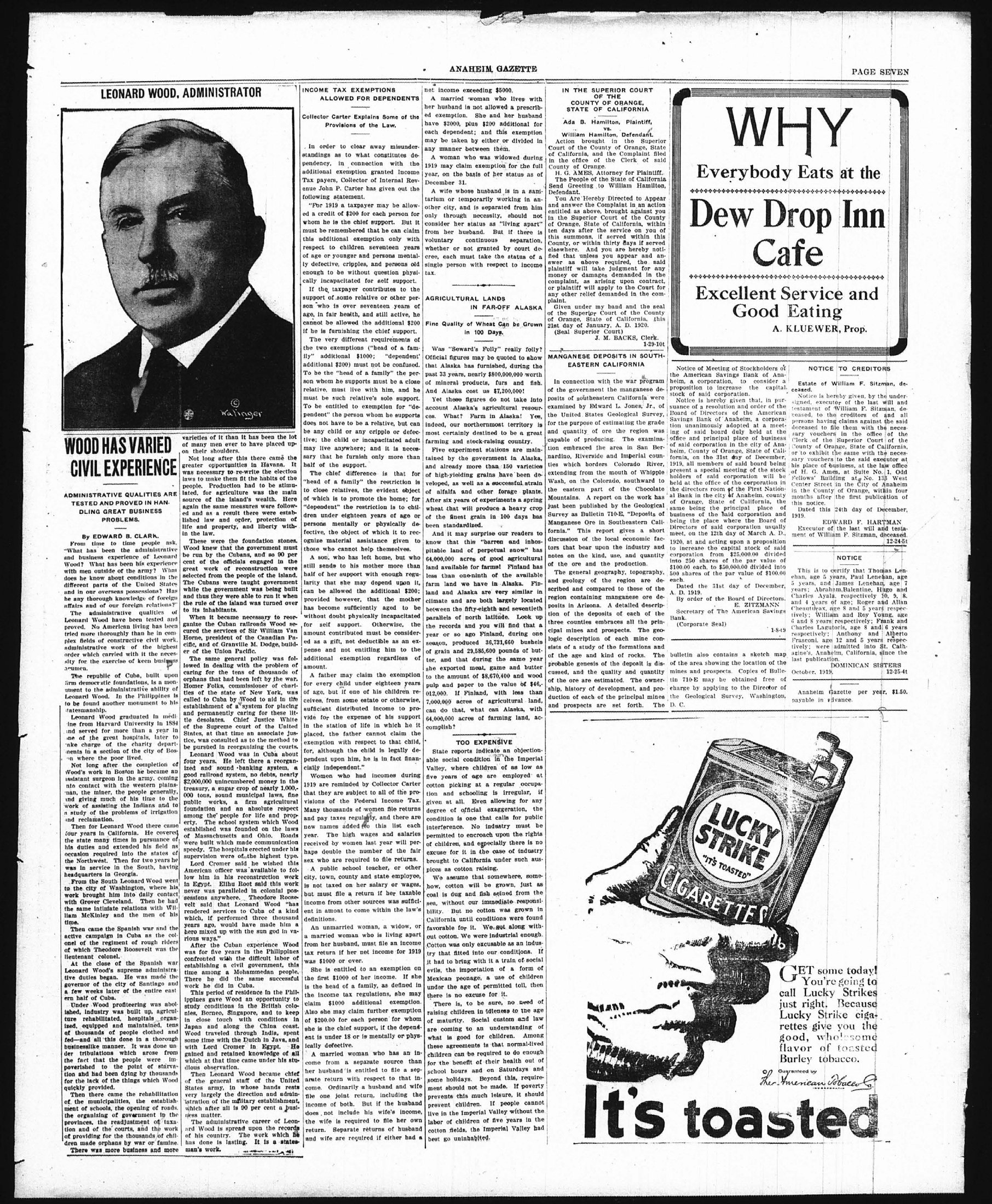
Searchable text
LEONARD WOOD, ADMINISTRATOR
WOOD HAS VARIED
INCOME TAX EXEMPTION ALLOWED FOR
Collector Carter Explains Provisions of the
In order to clear standings as to what pendency, in connection with additional exemption from Tax payers, Collector Carter enue John P. Carter has following statement.
"For 1919 a taxpayer deduced a credit of $200 for whom he is the chief must be remembered that this additional exemption respects to children of age or younger and likely defective, cripples, enough to be without cally incapacitated for.
If the taxpayer con-support of some relative son who is over seventy age, in fair health, and cannot be allowed the if he is furnishing the
The very different the two exemptions (finally) additional $1000 additional $200) must be To be the "head of a son whom he supports relative, must live w must be such relative To be entitled to ex-pendent" the person who does not have to be able any child or any active; the child or inc- may live anywhere:
WOOD HAS VARIED CIVIL EXPERIENCE
ADMINISTRATIVE QUALITIES ARE TESTED AND PROVED IN HANDLING GREAT BUSINESS PROBLEMS.
By EDWARD B. CLARK.
From time to time people ask, "What has been the administrative and business experience of Leonard Wood? What has been his experience with men outside of the army? What does he know about conditions in the different parts of the United States and in our overseas possessions? Has he any thorough knowledge of foreign affairs and of our foreign relations?"
The administrative qualities of Leonard Wood have been tested and proved. No American living has been tried more thoroughly than he in complex fields of constructive civil work. Administrative work of the highest order which carried with it the necessity for the exercise of keen business acumen.
The republic of Cuba, built upon firm democratic foundations, is a monument to the administrative ability of Leonard Wood. In the Philippines is to be found another monument to his statesmanship.
Leonard Wood graduated in medicine from Harvard University in 1884 and served for more than a year in one of the great hospitals, later to take charge of the charity departments in a section of the city of Boston where the poor lived.
Not long after the completion of Wood's work in Boston he became an assistant surgeon in the army, coming into contact with the western plainsman, the miner, the people generally, and giving much of his time to the work of assisting the Indians and to a study of the problems of irrigation and reclamation.
Then for Leonard Wood there came four years in California. He covered the state many times in pursuance of his duties and extended his field as varieties of it than it has been the lot of many men ever to have placed upon their shoulders.
Not long after this there came the greater opportunities in Havana. It was necessary to re-write the election laws to make them fit the habits of the people. Production had to be stimulated, for agriculture was the main source of the island's wealth. Here again the same measures were followed and as a result there were established law and order, protection of life and property, and liberty within the law.
These were the foundation stones. Wood knew that the government must be run by the Cubans, and so 90 per cent of the officials engaged in the great work of reconstruction were selected from the people of the island. The Cubans were taught government while the government was being built and thus they were able to run it when the rule of the island was turned over to its inhabitants.
When it became necessary to reorganize the Cuban railroads Wood secured the services of Sir William Van Horne, president of the Canadian Pacific, and of Granville M. Dodge, builder of the Union Pacific.
The same general policy was followed in dealing with the problem of caring for the tens of thousands of orphans that had been left by the war. Homer Folks, commissioner of charities of the state of New York, was called to Cuba by Wood to aid in the establishment of a system for placing and permanently caring for these little desolates. Chief Justice White of the Supreme court of the United States, at that time an associate justice, was consulted as to the method to be pursued in reorganizing the courts.
Leonard Wood was in Cuba about four years. He left there a reorganized and sound banking system, a good railroad system, no debts, nearly $2,000,000 unincumbered money in the treasury, a sugar crop of nearly 1,000,000 tons, sound municipal laws, fine public works, a firm agricultural foundation and an absolute respect among the people for life and property. The school system which Wood established was founded on the laws of Massachusetts and Ohio. Roads were built which made communication speedy. The hospitals erected under his additional $200) must be entitled to expenditure" the person who does not have to be a child or any relative; the child or incarnate may live anywhere; sary that he furnish half of the support.
The chief difference "head of a family" tends to close relatives, that of which is to promote "dependent" the restraint under eighteen persons mentally or affective, the object of ognize material assistance those who cannot help.
A son, who has left still sends to his mother half of her support wlararity that she may can be allowed to provided however, that has become sufficient without doubt physical for self support. amount contributed med as a gift, not deduced pense and not entitle additional exemption amount.
A father may claim for every child under age, but if one receives from some estates sufficient distributed vide for the expense in the station of life placed, the father can exemption with respect for, although the child pendent upon him, he socially independent."
Women who had 1919 are reminded by that they are subject visions of the Federal Many thousands of women and pay taxes regularly new names added two year. The high wage received by women la
Not long after the completion of Wood's work in Boston he became an assistant surgeon in the army, coming into contact with the western plainsman, the miner, the people generally, and giving much of his time to the work of assisting the Indians and to a study of the problems of irrigation and reclamation.
Then for Leonard Wood there came four years in California. He covered the state many times in pursuance of his duties and extended his field as occasion required into the states of the Northwest. Then for two years he was in service in the South, having headquarters in Georgia.
From the South Leonard Wood went to the city of Washington, where his work brought him into daily contact with Grover Cleveland. Then he had the same intimate relations with William McKinley and the men of his time.
Then came the Spanish war and the active campaign in Cuba as the colonel of the regiment of rough riders of which Theodore Roosevelt was the lieutenant colonel.
At the close of the Spanish war Leonard Wood's supreme administrative duties began. He was made the governor of the city of Santiago and a few weeks later of the entire eastern half of Cuba.
Under Wood profiteering was abolished, industry was built up, agriculture rehabilitated, hospitals organized, equipped and maintained, tens of thousands of people clothed and fed—and all this done in a thorough businesslike manner. It was done under tribulations which arose from the fact that the people were impoverished to the point of starvation and had been dying by thousands for the lack of the things which Wood quickly provided.
Then there came the rehabilitation of the municipalities, the establishment of schools, the opening of roads, the organizing of government in the provinces, the readjustment of taxation and of the courts, and the work of providing for the thousands of children made orphans by war or famine.
There was more business and more
Leonard Wood was in Cuba about four years. He left there a reorganized and sound-banking system, a good railroad system, no debts, nearly $2,000,000 unincumbered money in the treasury, a sugar crop of nearly 1,000,000 tons, sound municipal laws, fine public works, a firm agricultural foundation and an absolute respect among the people for life and property. The school system which Wood established was founded on the laws of Massachusetts and Ohio. Roads were built which made communication speedy. The hospitals erected under his supervision were of the highest type.
Lord Cromer said he wished this American officer was available to follow him in his reconstruction work in Egypt. Ellhu Root said this work never was paralleled in colonial possessions anywhere. Theodore Roosevelt said that Leonard Wood "has rendered services to Cuba of a kind which, if performed three thousand years ago, would have made him a hero mixed up with the sun god in various ways."
After the Cuban experience Wood was for five years in the Philippines confronted with the difficult labor of establishing a civil government, this time among a Mohammedan people. There he did the same successful work he did in Cuba.
This period of residence in the Philippines gave Wood an opportunity to study conditions in the British colonies, Borneo, Singapore, and to keep in close touch with conditions in Japan and along the China coast. Wood traveled through India, spent some time with the Dutch in Java, and with Lord Cromer in Egypt. He gained and retained knowledge of all which at that time came under his studious observation.
Then Leonard Wood became chief of the general staff of the United States army, in whose hands rests very largely the direction and administration of the military establishment, which after all is 90 per cent a business matter.
The administrative career of Leonard Wood is spread upon the records of his country. The work which he has done is lasting. It is a statesman's work.
Women who had 1919 are reminded by that they are subject to visions of the Federal Many thousands of women pay taxes regularly new names added to year. The high was received by women law hape double the number sex who are required.
A public school teacher city, town, county and is not taxed on her but must file a return income from other sources in amount to come definitions.
An unmarried woman a married woman who from her husband, must tax return if her not was $1000 or over.
She is entitled to be the first $1000 of her is the head of a family the income tax regular claim $1000 addition Also she may claim for $200.00 for each p she is the chief support is under 18 or is locally defective.
A married woman come from a separate her husband is entitlete return with re come. Ordinarily a b file one joint return income of both. But does not include his wife is required return. Separate ret and wife are required
INCOME TAX EXEMPTIONS
ALLOWED FOR DEPENDENTS
Collector Carter Explains Some of the Provisions of the Law.
In order to clear away misunderstandings as to what constitutes dependency, in connection with the additional exemption granted Income Tax payers, Collector of Internal Revenue John P. Carter has given out the following statement.
"For 1919 a taxpayer may be allowed a credit of $200 for each person for whom he is the chief support. But it must be remembered that he can claim this additional exemption only with respect to children seventeen years of age or younger and persons mentally defective, cripples, and persons old enough to be without question physically incapacitated for self support.
If the taxpayer contributes to the support of some relative or other person who is over seventeen years of age, in fair health, and still active, he cannot be allowed the additional $200 if he is furnishing the chief support.
The very different requirements of the two exemptions ("head of a family" additional $1000; "dependent" additional $200) must not be confused. To be the "head of a family" the person whom he supports must be a close relative, must live with him, and he must be such relative's sole support.
To be entitled to exemption for "dependent" the person whom he supports does not have to be a relative, but can be any child or any cripple or defective; the child or incapacitated adult may live anywhere; and it is necessary net income exceeding $5000.
A married woman who lives with her husband is not allowed a prescribed exemption. She and her husband have $2000, plus $200 additional for each dependent; and this exemption may be taken by either or divided in any manner between them.
A woman who was widowed during 1919 may claim exemption for the full year, on the basis of her status as of December 31.
A wife whose husband is in a sanitarium or temporarily working in another city, and is separated from him only through necessity, should not consider her status as "living apart" from her husband. But if there is voluntary continuous separation, whether or not granted by court decree, each must take the status of a single person with respect to income tax.
AGRICULTURAL LANDS
IN FAR-OFF ALASKA
Fine Quality of Wheat Can be Grown in 100 Days.
Was "Seward's Folly" really folly? Official figures may be quoted to show that Alaska has furnished, during the past 33 years, nearly $800,000,000 worth of mineral products, furs and fish. And Alaska cost us $7,200,000!
Yet these figures do not take into account Alaska's agricultural resources. What? Farm in Alaska! Yes, indeed, our northernmost territory is most certainly destined to be a great farming and stock-raising country.
IN THE SUPERIOR COURT OF THE COUNTY OF ORANGE, STATE OF CALIFORNIA
Ada B. Hamilton, Plaintiff,
vs.
William Hamilton, Defendant.
Action brought in the Superior Court of the County of Orange, State of California, and the Complaint filed in the office of the Clerk of said County of Orange.
H. G. AMES, Attorney for Plaintiff.
The People of the State of California Send Greeting to William Hamilton, Defendant.
You Are Hereby Directed to Appear and answer the Complaint in an action entitled as above, brought against you in the Superior Court of the County of Orange, State of California, within ten days after the service on you of this summons, if served within this County, or within thirty days if served elsewhere. And you are hereby notified that unless you appear and answer as above required, the said plaintiff will take judgment for any money or damages demanded in the complaint, as arising upon contract, or plaintiff will apply to the Court for any other relief demanded in the complaint.
Given under my hand and the seal of the Superior Court of the County of Orange, State of California, this 21st day of January, A.D. 1920.
(Seal Superior Court)
J. M. BACKS, Clerk.
1-29-10t
MANGANESE DEPOSITS IN SOUTH-EASTERN CALIFORNIA
In connection with the war program of the government the manganese deposits of southeastern California were examined by Edward L. Jones, Jr., of the United States Geological Survey, for the purpose of estimating the grade and quantity of ore the region was capable of producing. The examination embraced the area in San Ber-
additional $1000; "dependent" additional $200) must not be confused. To be the "head of a family" the person whom he supports must be a close relative, must live with him, and he must be such relative's sole support. To be entitled to exemption for "dependent" the person whom he supports does not have to be a relative, but can be any child or any cripple or defective; the child or incapacitated adult may live anywhere; and it is necessary that he furnish only more than half of the support.
The chief difference is that for "head of a family" the restriction is to close relatives, the evident object of which is to promote the home; for "dependent" the restriction is to children under eighteen years of age or persons mentally or physically defective, the object of which it to recognize material assistance given to those who cannot help themselves.
A son, who has left home, but who still sends to his mother more than half of her support with enough regularity that she may depend upon it, can be allowed the additional $200; provided however, that the mother has become sufficiently aged to be without doubt physically incapacitated for self support. Otherwise, the amount contributed must be considered as a gift, not deductible as an expense and not entitleing him to the additional exemption regardless of amount.
A father may claim the exemption for every child under eighteen years of age, but if one of his children receives, from some estate or otherwise, sufficient distributed income to provide for the expense of his support in the station of life in which he it placed, the father cannot claim the exemption with respect to that child, for, although the child is legally dependent upon him, he is in fact financially independent."
Women who had incomes during 1919 are reminded by Collector Carter that they are subject to all of the provisions of the Federal Income Tax. Many thousands of women file returns and pay taxes regularly, and there are new names added to this list each year. The high wages and salaries received by women last year will perhaps double the number of the fair Official figures may be quoted to show that Alaska has furnished, during the past 33 years, nearly $800,000,000 worth of mineral products, furs and fish. And Alaska cost us $7,200,000!
Yet these figures do not take into account Alaska's agricultural resources. What? Farm in Alaska! Yes, indeed, our northernmost territory is most certainly destined to be a great farming and stock-raising country.
Five experiment stations are maintained by the government in Alaska, and already more than 150 varieties of high-yielding grains have been developed, as well as a successful strain of alfalfa and other forage plants. After six years of experiments a spring wheat that will produce a heavy crop of the finest grain in 100 days has been standardized.
And it may surprise our readers to know that this "barren and inhospitable land of perpetual snow" has 64,000,000 acres of good agricultural land available for farms! Finland has less than one-ninth of the available farm land we have in Alaska. Finland and Alaska are very similar in climate and are both largely located between fifty-eighth and seventeenth parallels of north latitude. Look up the records and you will find that a year or so ago Finland, during one season, produced 36,731,660 bushels of grain and 29,585,600 pounds of butter, and that during the same year she exported meat, game and butter to the amount of $8,670,400 and wood pulp and paper to the value of $46,-012,000. If Finland, with less than 7,000,000 acres of agricultural land, can do that, what can Alaska, with 64,000,000 acres of farming land, accomplish?
TOO EXPENSIVE
State reports indicate an objectionable social condition in the Imperial Valley, where children of as low as five years of age are employed at cotton picking at a regular occupation and schooling is irregular, if given at all. Even allowing for any degree of official exaggeration, the condition is one that calls for public interference. No industry must be permitted to encroach upon the rights of children, and especially there is no
pendent upon him, he is in fact financially independent."
Women who had incomes during 1919 are reminded by Collector Carter that they are subject to all of the provisions of the Federal Income Tax. Many thousands of women file returns and pay taxes regularly, and there are new names added to this list each year. The high wages and salaries received by women last year will perhaps double the number of the fair sex who are required to file returns.
A public school teacher, or other city, town, county and state employee, is not taxed on her salary or wages, but must file a return if her taxable income from other sources was sufficient in amount to come within the law's definitions.
An unmarried woman, a widow, or a married woman who is living apart from her husband, must file an income tax return if her net income for 1919 was $1000 or over.
She is entitled to an exemption on the first $1000 of her income. If she is the head of a family, as defined in the income tax regulations, she may claim $1000 additional exemption. Also she may claim further exemption of $200.00 for each person for whom she is the chief support, if the dependent is under 18 or is mentally or physically defective.
A married woman who has an income from a separate source than her husband is entitled to file a separate return with respect to that income. Ordinarily a husband and wife file one joint return, including the income of both. But if the husband does not include his wife's income, the wife is required to file her own return. Separate returns of husband and wife are required if either had a stable social condition in the Imperial Valley, where children of as low as five years of age are employed at cotton picking at a regular occupation and schooling is irregular, if given at all. Even allowing for any degree of official exaggeration, the condition is one that calls for public interference. No industry must be permitted to encroach upon the rights of children, and especially there is no excuse for it in the case of industry brought to California under such auspices as cotton raising.
We assume that somewhere, somehow, cotton will be grown, just as coal is dug and fish seined from the sea, without our immediate responsibility. But no cotton was grown in California until conditions were found favorable for it. We got along without cotton. We were industrial enough. Cotton was only excusable as an industry that fitted into our conditions. If it had to bring with it a train of social evils, the importation of a form of Mexican peonage, a use of children under the age of permitted toll, then there is no excuse for it.
There is, to be sure, no need of raising children in idleness to the age of maturity. Social custom and law are coming to an understanding of what is good for children. Among these agreements is that normal-lived children can be required to do enough for the benefit of their health out of school hours and on Saturdays and some holidays. Beyond this, requirement should not be made. If poverty prevents this much leisure, it should prevent children. If people cannot live in the Imperial Valley without the labor of children of five years in the cotton fields, the Imperial Valley had best go uninhabited.
WHY Everybody Eats at the Dew Drop Inn Cafe
Excellent Service and Good Eating
A. KLUEWER, Prop.
Notice of Meeting of Stockholders of the American Savings Bank of Anaheim, a corporation, to consider a proposition to increase the capital stock of said corporation.
Notice is hereby given that, in pursuance of a resolution and order of the Board of Directors of the American Savings Bank of Anaheim, a corporation unanimously adopted at a meeting of said board duly held at the office and principal place of business of said corporation in the city of Anaheim.
NOTICE TO CREDITORS
Estate of William F. Sitzman, deceased.
Notice is hereby given, by the undersigned, executor of the last will and testament of William F. Sitzman, deceased, to the creditors of and all persons having claims against the said deceased to file them with the necessary vouchers in the office of the Clerk of the Superior Court of the County of Orange, State of California.
Notice of Meeting of Stockholders of the American Savings Bank of Anaheim, a corporation, to consider a proposition to increase the capital stock of said corporation.
Notice is hereby given that, in pursuance of a resolution and order of the Board of Directors of the American Savings Bank of Anaheim, a corporation unanimously adopted at a meeting of said board duly held at the office and principal place of business of said corporation in the city of Anaheim, County of Orange, State of California, on the 31st day of December, 1919, all members of said board being present a special meeting of the stock holders of said corporation will be held at the office of the corporation in the directors room of the First National Bank in the city of Anaheim, county of Orange, State of California, the same being the principal place of business of the said corporation and being the place where the Board of Directors of said corporation usually meet, on the 12th day of March A. D., 1920, at and acting upon a proposition to increase the capital stock of said corporation from $25,000.00 divided into 250 shares of the par value of $100.00 each, to $50,000.00 divided into 500 shares of the par value of $100.00 each.
Dated the 31st day of December, A. D. 1919.
By order of the Board of Directors,
E. ZITZMANN
Secretary of The American Savings Bank.
(Corporate Seal)
1-8-19
bulletin also contains a sketch map of the area showing the location of the mines and prospects. Copies of Bulletin 710-E may be obtained free of charge by applying to the Director of the Geological Survey, Washington, D.C.
NOTICE TO CREDITORS
Estate of William F. Sitzman, deceased.
Notice is hereby given by the undersigned, executor of the last will and testament of William F. Sitzman, deceased, to the creditors of and all persons having claims against the said deceased to file them with the necessary vouchers in the office of the Clerk of the Superior Court of the County of Orange, State of California, or to exhibit the same with the necessary vouchers to the said executor at his place of business, at the law office of H. G. Ames, at Suite No. 1, Odd Fellows' Building at No. 133 West Center Street in the City of Anaheim in the County of Orange, within four months after the first publication of this notice.
Dated this 24th day of December, 1919.
EDWARD F. HARTMAN
Executor of the last will and testament of William F. Sitzman, deceased.
12-24-5t
NOTICE
This is to certify that Thomas Lenehan, age 5 years, Paul Lenehan, age 5 years, and James Lenehan, age 7 years; Abraham Balentine, Hugo and Charles Ayala, respectively; 10, 9, 8, and 4 years of age; Roger and Allan Cheautuex, age 8 and 5 years respectively; William and Roy Young, age 6 and 8 years respectively; Frank and Charles Lagutoris, age 8 and 6 years respectively; Anthony and Alberto Frasconi, age 12 and 5 years respectively; were admitted into St. Catharine's, Anaheim, California, since the last publication.
DOMINICAN SISTERS
October, 1919.
12-25-4t
Anaheim Gazette per year. $1.50 payable in advance.
LUCKY
STRIKE
"IT'S TOASTED"
CIGARETTES
GET some today!
You're going to
call Lucky Strikes
just right. Because
Lucky Strike cigarettes give you the
good, wholesome
flavor of toasted
Burley tobacco.
Guaranteed by
The American Tobacco Co.