anaheim-gazette 1920-02-05
Scanned page
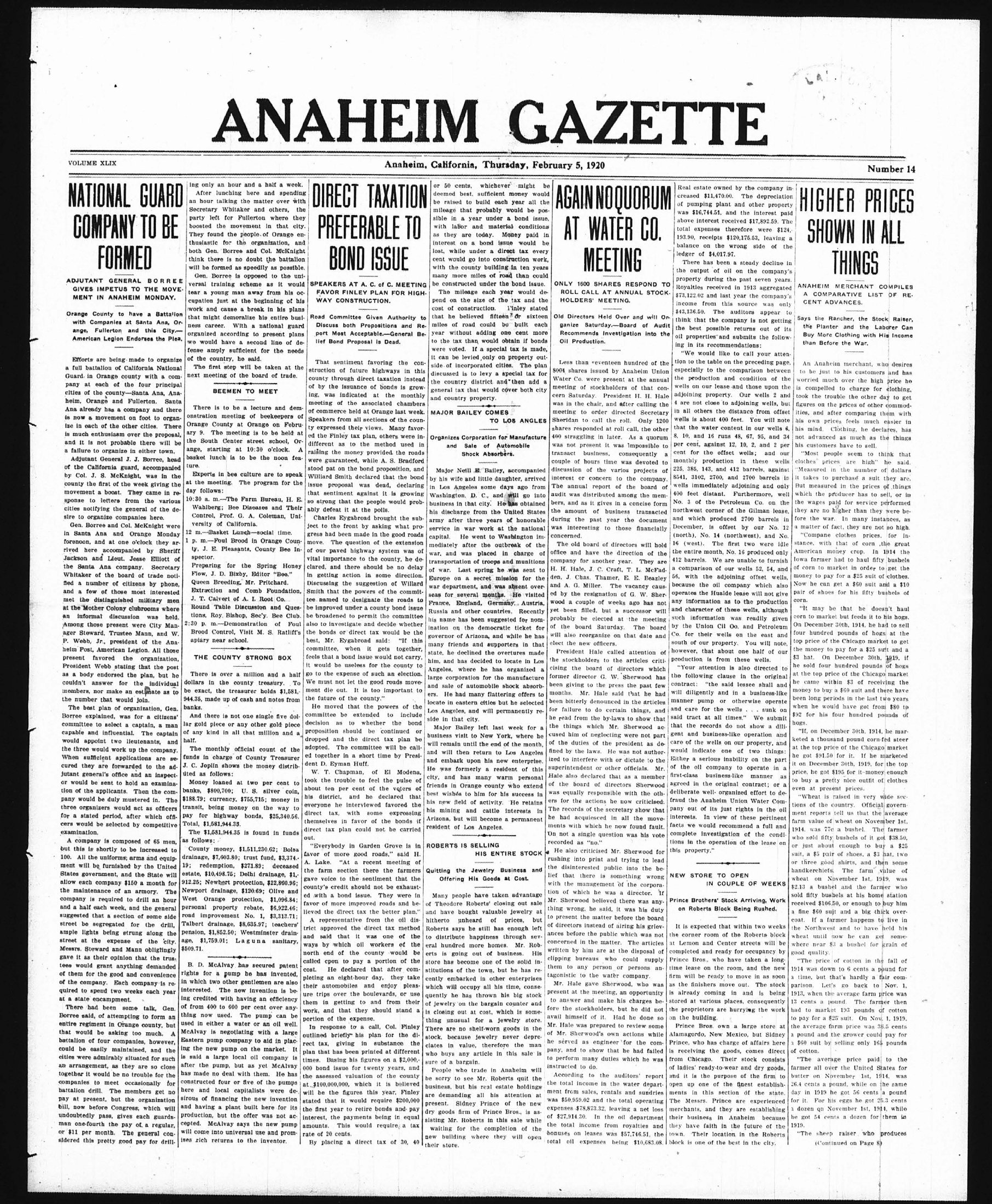
Searchable text
NATIONAL GUARD COMPANY TO BE FORMED
ADJUTANT GENERAL BORREE GIVES IMPETUS TO THE MOVEMENT IN ANAHEIM MONDAY.
Orange County to have a Battalion with Companies at Santa Ana, Orange, Fullerton and this City—American Legion Endorses the Plea.
Emorts are being made to organize a full battalion of California National Guard in Orange county with a company at each of the four principal cities of the county—Santa Ana, Anaheim, Orange and Fullerton. Santa Ana already has a company and there is now a movement on foot to organize in each of the other cities. There is much enthusiasm over the proposal, and it is not probable there will be ing only an hour and a half a week.
After lunching here and spending an hour talking the matter over with Secretary Whitaker and others, the party left for Fullerton where they boosted the movement in that city. They found the people of Orange enthusiastic for the organization, and both Gen. Borree and Col. McKnight think there is no doubt the battalion will be formed as speedily as possible.
Gen. Borree is opposed to the universal training scheme as it would tear a young man away from his occupation just at the beginning of his work and cause a break in his plans that might demoralize his entire business career. With a national guard organized according to present plans we would have a second line of defense amply sufficient for the needs of the country, he said.
The first step will be taken at the next meeting of the board of trade.
BEEMEN TO MEET
There is to be a lecture and demonstration meeting of beekeepers of Orange County at Orange on February 9. The meeting is to be held at the South Center street school, Orange starting at 10:30 o'clock.
Efforts are being made to organize a full battalion of California National Guard in Orange county with a company at each of the four principal cities of the county—Santa Ana, Anaheim, Orange and Fullerton. Santa Ana already has a company and there is now a movement on foot to organize in each of the other cities. There is much enthusiasm over the proposal, and it is not probable there will be a failure to organize in either town.
Adjutant General J. J. Borree, head of the California guard, accompanied by Col. J. S. McKnight, was in the county the first of the week giving the movement a boost. They came in response to letters from the various cities notifying the general of the desire to organize companies here.
Gen. Borree and Col. McKnight were in Santa Ana and Orange Monday forenoon, and at one o'clock they arrived here accompanied by Sheriff Jackson and Lieut. Jesse Elliott of the Santa Ana company. Secretary Whitaker of the board of trade notified a number of citizens by phone, and a few of those most interested met the distinguished military men at the Mother Colony clubrooms where an informal discussion was held. Among those present were City Manager Steward, Trustee Mann, and W. P. Webb, Jr., president of the Anaheim Post, American Legion. All those present favored the organization, President Webb stating that the post as a body endorsed the plan, but he couldn't answer for the individual members, nor make an estimate as to the number that would join.
The best plan of organization, Gen. Borree explained, was for a citizens' committee to select a captain, a man capable and influential. The captain would appoint two lieutenants, and the three would work up the company. When sufficient applications are secured they are forwarded to the adjutant general's office and an inspector would be sent to hold an examination of the applicants. Then the company would be duly mustered in. The three organizers would act as officers for a stated period, after which officers would be selected by competitive examination.
A company is composed of 65 men, but this is shortly to be increased to of the country, he said.
The first step will be taken at the next meeting of the board of trade.
BEEMEN TO MEET
There is to be a lecture and demonstration meeting of beekeepers of Orange County at Orange on February 9. The meeting is to be held at the South Center street school, Orange, starting at 10:30 o'clock. A basket lunch is to be the noon feature.
Experts in bee culture are to speak at the meeting. The program for the day follows:
10:30 a.m.-The Farm Bureau, H. E. Wahlberg; Bee Diseases and Their Control, Prof. G. A. Coleman, University of California.
12 m.-Basket Lunch-social time.
1 p.m.-Foul Brood in Orange County, J. E. Pleasants, County Bee Inspector.
Preparing for the Spring Honey Flow, J. D. Bixby, Editor "Bee."
Queen Breeding, Mr. Pritchard.
Extraction and Comb Foundation, J. T. Calvert of A. I. Root Co.
Round Table Discussion and Questions, Roy Bishop, Sec'y. Bee Club.
2:30 p.m.-Demonstration of Foul Brood Control, Visit M. S. Ratliff's apiary near school.
THE COUNTY STRONG BOX
There is over a million and a half dollars in the county treasury. To be exact, the treasurer holds $1,581,944.35, made up of cash and notes from banks.
And there is not one single five dollar gold piece or any other gold piece of any kind in all that million and a half.
The monthly official count of the funds in charge of County Treasurer J. C. Joplin shows the money distributed as follows:
Money loaned at two per cent to banks, $800,700; U. S. silver coin, $188.79; currency, $755,715; money in transit, being money on the way to pay for highway bonds, $25,340.56.
Total, $1,581,944.33.
The $1,581,944.35 is found in funds as follows:
County money, $1,511,230.62; Bolsa That sentiment for construction of future county through directing of by the issuance of meeting of the assessee of commerce held at Speakers from all seceded their visited the Finley tax plan different as to their raising the money paid were guaranteed, while stood pat on the bond Williard Smith declared issue proposal was that sentiment against so strong that the penalty defeat it at the Charles Eygabroad project to the front by progress had been made move. The question of our paved highway vital importance to the clared, and there should in getting action imDiscussing the suggestSmith that the powertee named to designbe improved under a be broadened to permitalso to investigate amthe bonds or directthe best, Mr. Eygabroadcommittee, when it feels that a bond issuedit would be useless fogo to the expense ofWe must not let the ment die out. It isthe future of the counHe moved that theremember decision as to whoproposition should b dropped and the diried adopted. The committed together in a short dent D. Eyman Huff.
W. T. Chapman, took the trouble to fathabout ten per cent off his district, and heeveryone he interviewdirect tax, with s themselves in favordirect tax plan could out.
"Everybody in Gar
When sufficient applications are secured they are forwarded to the adjutant general's office and an inspector would be sent to hold an examination of the applicants. Then the company would be duly mustered in. The three organizers would act as officers for a stated period, after which officers would be selected by competitive examination.
A company is composed of 65 men, but this is shortly to be increased to 100. All the uniforms, arms and equipment will be furnished by the United States government, and the State will allow each company $150 a month for the maintenance of an armory. The company is required to drill an hour and a half each week, and the general suggested that a section of some side street be segregated for the drill, ample lights being strung along the street at the expense of the city. Messrs. Steward and Mann obligingly gave it as their opinion that the trustees would grant anything demanded of them for the good and convenience of the company. Each company is required to spend two weeks each year at a state encampment.
There had been some talk, Gen. Borree said, of attempting to form an entire regiment in Orange county, but that would be asking too much. A battalion of four companies, however, could be easily maintained, and the cities were admirably situated for such an arrangement, as they are so close together it would be no trouble for the companies to meet occasionally for battalion drill. The members get no pay at present, but the organization bill, now before Congress, which will undoubtedly pass, gives each guardman one-fourth the pay of a regular, or $11 per month. The general considered this pretty good pay for drill-
B. D. McAlvay has secured patent rights for a pump he has invented, in which two other gentlemen are also interested. The new invention is being credited with having an efficiency of from 400 to 600 per cent over anything now used. The pump can be used in either a water or an oil well. McAlvay is negotiating with a large Eastern pump company to aid in placing the new pump on the market. It is said a large local oil company is after the pump, but as yet McAlvay has made no deal with them. He has constructed four or five of the pumps here and local capitalists were desirous of financing the new invention and having a plant built here for its production, but the offer was not accepted. McAlvay says the new pump will come into universal use and promises rich returns to the inventor.
Money loaned at two per cent to banks, $800,700; U. S. silver coin, $188.79; currency, $755,715; money in transit, being money on the way to pay for highway bonds, $25,340.56. Total, $1,581,944.35.
The $1,581,944.35 is found in funds as follows:
County money, $1,511,230.62; Bolsa drainage, $7,603.80; trust fund, $3,374.19; redemption, $271.89; deceased estate, $10,498.75; Delhi drainage, $1,912.25; Newhert protection, $22,860.96; Newport drainage, $120.69; Olive and West Orange protection, $1,096.84; personal property rebate, $6,922.46; road improvement No. 1, $3,313.71; Talbert drainage, $8,635.97; teachers' pension, $1,852.50; Westminster drainage, $1,759.01; Laguna sanitary, $509.71.
In response to a court outlined briefly his perfect tax, giving in plan that has been pristine times. Basing his figure 000 bond issue for two the assessed valuation at $100,000,000, which will be the figures stated that it would be the first year to retire interest, the payments amounts. This would rate of 20 cents.
By placing a direct
AHEIM GAZETY
Anaheim, California, Thursday, February 5, 1920
DIRECT TAXATION PREFERABLE TO BOND ISSUE
SPEAKERS AT A. C. OF C. MEETING FAVOR FINLEY PLAN FOR HIGHWAY CONSTRUCTION.
Road Committee Given Authority to Discuss both Propositions and Report Most Acceptable.—General Belief Bond Proposal is Dead.
That sentiment favoring the construction of future highways in this county through direct taxation instead of by the issuance of bonds is growing, was indicated at the monthly meeting of the associated chambers of commerce held at Orange last week. Speakers from all sections of the county expressed their views. Many favored the Finley tax plan, others were indifferent as to the method used in or 50 cents, whichever might be deemed best, sufficient money would be raised to build each year all the mileage that probably would be possible in a year under a bond issue, with labor and material conditions as they are today. Money paid in interest on a bond issue would be lost, while under a direct tax every cent would go into construction work, with the county building in ten years many more miles of road than could be constructed under the bond issue.
The mileage each year would depend on the size of the tax and the cost of construction. Unley stated that he believed fifteen or sixteen miles of road could be built each year without adding one cent more to the tax than would obtain if bonds were voted. If a special tax is made, it can be levied only on property outside of incorporated cities. The plan discussed is to levy a special tax for the country district and then add a general tax that would cover both city and country property.
MAJOR BAILEY COMES TO LOS ANGLES
Organizes Corporation for Manufacture and Sale of Automobile
AGAIN NOQUORUM AT WATER CO. MEETING
ONLY 1600 SHARES RESPOND TO ROLL CALL AT ANNUAL STOCK-HOLDERS' MEETING.
Old Directors Held Over and will Organize Saturday.—Board of Audit Recommends Investigation into the Oil Production.
Less than seventeen hundred of the 8004 shares issued by Anaheim Union Water Co. were present at the annual meeting of stockholders of that concern Saturday. President H. H. Hale was in the chair, and after calling the meeting to order directed Secretary Sheridan to call the roll. Only 1200 shares responded at roll call, the other 400 straggling in later. As a quorum was not present it was impossible to
That sentiment favoring the construction of future highways in this county through direct taxation instead of by the issuance of bonds is growing, was indicated at the monthly meeting of the associated chambers of commerce held at Orange last week. Speakers from all sections of the county expressed their views. Many favored the Finley tax plan, others were different as to the method used in raising the money provided the roads were guaranteed, while A. S. Bradford stood pat on the bond proposition, and Willard Smith declared that the bond issue proposal was dead, declaring that sentiment against it is growing so strong that the people would probably defeat it at the polls.
Charles Eygabroad brought the subject to the front by asking what progress had been made in the good roads move. The question of the extension of our paved highway system was of vital importance to the county, he declared, and there should be no delay in getting action in some direction. Discussing the suggestion of Willard Smith that the powers of the committee named to designate the roads to be improved under a county bond issue be broadened to permit the committee also to investigate and decide whether the bonds or direct tax would be the best, Mr. Eygabroad said: "If this committee, when it gets together, feels that a bond issue would not carry, it would be useless for the county to go to the expense of such an election. We must not let the good roads movement die out. It is too important to the future of the county."
He moved that the powers of the committee be extended to include decision as to whether the bond proposition should be continued or dropped and the direct tax plan be adopted. The committee will be called together in a short time by President D. Eyman Huff.
W. T. Chapman, of El Modena, took the trouble to feel the pulse of about ten per cent of the voters of his district, and he declared that everyone he interviewed favored the direct tax, with some expressing themselves in favor of the bonds if direct tax plan could not be carried out.
"Everybody in Garden Grove is in
MAJOR BAILEY COMES TO LOS ANGLES
Organizes Corporation for Manufacture and Sale of Automobile Shock Absorbers.
Major Neill E. Bailey, accompanied by his wife and little daughter, arrived in Los Angeles some days ago from Washington, D. C., and will go into business in that city. He has obtained his discharge from the United States army after three years of honorable service in war work at the national capital. He went to Washington immediately after the outbreak of the war, and was placed in charge of transportation of troops and munitions of war. Last spring he was sent to Europe on a secret mission for the war department, and was absent overseas for several months. He visited France, England, Germany, Austria, Russia and other countries. Recently his name has been suggested for nomination on the democratic ticket for governor of Arizona, and while he has many friends and supporters in that state, he declined the overtures made him, and has decided to locate in Los Angeles, where he has organized a large corporation for the manufacture and sale of automobile shock absorbers. He had many flattering offers to locate in eastern cities but he selected Los Angeles, and will permanently reside in that city.
Major Bailey left last week for a business visit to New York, where he will remain until the end of the month, and will then return to Los Angeles and embark upon his new enterprise. He was formerly a resident of this city, and has many warm personal friends in Orange county who extend best wishes to him for his success in his new field of activity. He retains his mining and cattle interests in Arizona, but will become a permanent resident of Los Angeles.
ROBERTS IS SELLING
Less than seventeen hundred of the 8004 shares issued by Anaheim Union Water Co. were present at the annual meeting of stockholders of that concern Saturday. President H. H. Hale was in the chair, and after calling the meeting to order directed Secretary Sheridan to call the roll. Only 1200 shares responded at roll call, the other 400 straggling in later. As a quorum was not present it was impossible to transact business, consequently a couple of hours time was devoted to discussion of the various projects of interest or concern to the company. The annual report of the board of audit was distributed among the members, and as it gives in a concise form the amount of business transacted during the past year the document was interesting to those financially concerned.
The old board of directors will hold office and have the direction of the company for another year. They are H. H. Hale, J. C. Craft, T. L. McFadden, J. Chas. Thamer, E. E. Beazley and A. G. Miller. The vacancy caused by the resignation of G. W. Sherwood a couple of weeks ago has not yet been filled, but a successor will probably be elected at the meeting of the board Saturday. The board will also reorganize on that date and elect the new officers.
President Hale called attention of the stockholders to the articles criticising the board of directors which former director G. W. Sherwood has been giving to the press the past few months. Mr. Hale said that he had been bitterly denounced in the articles for failure to do certain things, and he read from the by-laws to show that the things which Mr. Sherwood accused him of neglecting were not part of the duties of the president as defined by the laws. He was not authorized to interfere with or dictate to the superintendent or other officials. Mr. Hale also declared that as a member of the board of directors Sherwood was equally responsible with the others for the actions he now criticised. The records of the secretary show that he had acquiesced in all the movements with which he now found fault. On not a single question was his vote recorded as "no."
He also criticized Mr. Sherwood for especially the prodigious wells on adjoining 4 are not in all other wells is at that they 8, 10, and per cent; cent for monthly 225, 385, 8541, 310 wells imprint 400 feet No. 3 of northwest and which December (north). No 16 (west)the entire 412 barrels a comparison 56.with because ther operates th any informa and charac such info by the U.S.Co.for t south of o however.production.
"Your sage,the follow contract:will diligent manner payand caresaided tractethatthe n gentand th careof th would indl Either a s.ofthe olf first-class agreed in deliberate fraudthe pany outinterests.facts we w complete tions in thi prophecy."
W. T. Chapman, of El Modena, took the trouble to feel the pulse of about ten per cent of the voters of his district, and he declared that everyone he interviewed favored the direct tax, with some expressing themselves in favor of the bonds if direct tax plan could not be carried out.
"Everybody in Garden Grove is in favor of more good roads," said H. A. Lake. "At a recent meeting of the farm section there the farmers gave voice to the sentiment that the county's credit should not be exhausted with a bond issue. They were in favor of more improved roads and believed the direct tax the better plan."
A representative from the oil district approved the direct tax method and said that it was one of the ways by which oil workers of the north end of the county would be called upon to pay a portion of the cost. He declared that after completing an eight-hour day, they take their automobiles and enjoy pleasure trips over the boulevards, or use them in getting to and from their work, and that they should stand a portion of the expense.
In response to a call, Col. Finley outlined briefly his plan for the direct tax, giving in substance the plan that has been printed at different times. Basing his figures on a $2,000,000 bond issue for twenty years, and the assessed valuation of the county at $100,000,000, which it is believed will be the figures this year, Finley stated that it would require $200,000 the first year to retire bonds and pay interest, the payments being in equal amounts. This would require a tax rate of 20 cents.
By placing a direct tax of 30,40 and embark upon his new enterprise. He was formerly a resident of this city, and has many warm personal friends in Orange county who extend best wishes to him for his success in his new field of activity. He retains his mining and cattle interests in Arizona, but will become a permanent resident of Los Angeles.
ROBERTS IS SELLING
HIS ENTIRE STOCK
Quitting the Jewelry Business and Offering His Goods at Cost.
Many people have taken advantage of Theodore Roberts' closing out sale and have bought valuable jewelry at hitherto unheard of prices, but Roberts says he still has enough left to distribute happiness through several hundred more homes. Mr. Roberts is going out of business. His store has become one of the solid institutions of the town, but he has recently embarked in other enterprises which will occupy all his time, consequently he has thrown his big stock of jewelry on the bargain counter and is closing out at cost, which is something unusual for a jewelry store. There are no shelf-worn goods in the stock, because jewelry never depreciates in value, therefore the man who buys any article in this sale is sure of a bargain.
People who trade in Anaheim will be sorry to see Mr. Roberts quit the business, but his real estate holdings are demanding all his attention at present. Sidney Prince of the new dry goods firm of Prince Bros., is assisting Mr. Roberts in this sale while waiting for the completion of the new building where they will open their store.
He also criticised Mr. Sherwood for rushing into print and trying to lead the disinterested public into the belief that there is something wrong with the management of the corporation of which he was a director. If Mr. Sherwood believed there was anything wrong, he said, it was his duty to present the matter before the board of directors instead of airing his grievances before the public which was not concerned in the matter. The articles written by him are at the disposal of clipping bureaus who could supply them to any person or persons antagonistic to the water company.
Mr. Hale gave Sherwood, who was present at the meeting, an opportunity to answer and make his charges before the stockholders, but he did not avail himself of it. Had he done so Mr. Hale was prepared to review some of Mr. Sherwood's own actions while he served as engineer for the company, and to show that he had failed to perform many duties which he was instructed to do.
According to the auditors' report the total income in the water department from sales, rentals and sundries was $50,959.02 and the total operating expenses $78,873.32, leaving a net loss of $27,914.30. In the oil department the total income from royalties and bonuses on leases was $57,746.51, the total oil expenses being $10,683.08.
Either a survey of the oil first-class agreement in deliberate fraud or a pany out of interests facts we would complete tions in this proper...
RESPOND TO ANNUAL STOCKING.
Over and will On Board of Auditigation into the hundred of the Anaheim Union at the annual call of that content H. H. Hale after calling the selected Secretary roll. Only 1200 call, the other As a quorum is impossible to
Real estate owned by the company increased $11,470.00. The depreciation of pumping plant and other property was $16,744.51, and the interest paid above interest received $17,892.59. The total expenses therefore were $124,193.90, receipts $120,175.53, leaving a balance on the wrong side of the ledger of $4,017.97.
There has been a steady decline in the output of oil on the company's property during the past seven years. Royalties received in 1913 aggregated $73,122.02 and last year the company's income from this source was only $43,136.50. The auditors appear to think that the company is not getting the best possible returns out of its oil properties and submits the following in its recommendations:
"We would like to call your attention to the table on the preceding page, especially to the comparison between the production and condition of the wells on our lease and those upon the adjoining property. Our wells 2 and 4 are not close to adjoining wells, but in all others the distance from offset wells is about 400 feet. You will note that the water content in our wells 6,8,10, and 16 runs 48,67,95, and 34 per cent, against 12,10,2, and 2 per
HIGHER PRICES SHOWN IN ALL THINGS
ANAHEIM MERCHANT COMPILES A COMPARATIVE LIST OF RECENT ADVANCES.
Says the Rancher, the Stock Raiser, the Planter and the Laborer Can Buy More Clothing with His Income than Before the War.
An Anaheim merchant, who desires to be just to his customers and has worried much over the high price he is compelled to charge for clothing, took the trouble the other day to get figures on the prices of other commodities, and after comparing them with his own prices feels much easier in his mind. Clothing, he declares, has not advanced as much as the things his customers have to sell.
A hundred of the Anaheim Union plant at the annual hours of that convent H. H. Hale after calling the selected Secretary toll. Only 1200 call, the other As a quorum is impossible to consequently a was devoted to jobs projects of the company. On the board of among the members a concise form transacted in the document whose financially directors will hold direction of the year. They are T. L. McFadie E. E. Beazley vacancy cause of G. W. Sherwood ago has not successor will meet the meeting by The board that date and attention of the articles critic-directors which Sherwood has is the past few days that he had in the articles things, and is to show that Sherwood action were not part president as dewas not author-dictate to the officials. Mr. as a member officers Sherwood with the oth-now criticised.etary show that all the move-found fault. was his vote
We would like to call your attention to the table on the preceding page, especially to the comparison between the production and condition of the wells on our lease-and those upon the adjoining property. Our wells 2 and 4 are not close to adjoining wells, but in all others the distance from offset wells is about 400 feet. You will note that the water content in our wells 6, 8, 10, and 16 runs 48, 67, 95, and 34 per cent, against 12, 10, 2, and 2 per cent for the offset wells; and our monthly production in these wells 225, 385, 143, and 412 barrels, against 8541, 3102, 2700, and 2700 barrels in wells immediately adjoining and only 400 feet distant. Furthermore, well No. 3 of the Petroleum Co. on the northwest corner of the Gilman lease, and which produced 2700 barrels in December, is offset by our No. 12 (north), No. 14 (northwest), and No. 16 (west). The first two were idle the entire month, No. 16 produced only 412 barrels. We are unable to furnish a comparison of our wells 52, 54, and 56, with the adjoining offset wells, because the oil company which also operates the Hualde lease will not give any information as to the production and character of these wells, although such information was readily given by the Union Cil Oo. and Petroleum Co. for their wells on the east and south of our property. You will note, however, that about one half of our production is from these wells.
Your attention is also directed to the following clause in the original contract: "the said lessee shall and will diligently and in a business-like manner pump or otherwise operate and care for the wells . . . sunk on said tract at all times." We submit that the records do not show a diligent and business-like operation and care of the wells on our property, and would indicate one of two things: Either a serious inability on the part of the oil company to operate in a first-class business-like manner as agreed in the original contract; or a deliberate well-organized effort to defraud the Anaheim Union Water Company out of its just rights in the oil interests. In view of these pertinent facts we would recommend a full and complete investigation of the conditions in the operation of the lease on this property."
An Anaheim merchant, who desires to be just to his customers and has worried much over the high price he is compelled to charge for clothing, took the trouble the other day to get figures on the prices of other commodities, and after comparing them with his own prices feels much easier in his mind. Clothing, he declares, has not advanced as much as the things his customers have to sell.
"Most people seem to think that clothes prices are high" he said. "Measured in the number of dollars it takes to purchase a suit they are. But measured in the prices of things which the producer has to sell, or in the wages paid for service performed they are no higher than they were before the war. In many instances, as a matter of fact, they are not so high.
"Compane clothes prices, for instance, with that of corn ,the great American money crop. In 1914 the Iowa farmer had to haul fifty bushels of corn to market in order to get the money to pay for a $25 suit of clothes. Now he can get a $60 suit and a $10 pair of shoes for his fifty bushels of corn.
"It may be that he doesn't haul corn to market but feeds it to his hogs. On December 30th, 1914, he had to sell four hundred pounds of hogs at the top price of the Chicago market to get the money to pay for a $25 suit and a $3 hat. On December 30th, 1919, if he sold four hundred pounds of hogs at the top price of the Chicago market he came within $3 of receiving the money to buy a $50 suit and there have been long periods in the last two years when he would have got from $80 to $92 for his four hundred pounds of hogs.
"If, on December 30th, 1914, he marketed a thousand pound corn-fed steer at the top price of the Chicago market he got $91.50 for it. If he marketed it on December 30th, 1919, for the top price, he got $195 for it-money enough to buy a pretty nice outfit of clothes even at present prices.
"Wheat is raised in very wide sections of the country. Official government reports tell us that the average farm value of wheat on November 1st, 1914, was 77c a bushel. The farmer who sold fifty bushels of it got $38.50, or just about enough to buy a $25
NEW STORE TO OPEN
IN COUPLE OF WEEKS
Prince Brothers' Stock Arriving, Work on Roberts Block Being Rushed.
It is expected that within two weeks the corner room of the Roberts block at Lemon and Center streets will be completed and ready for occupancy by Prince Bros., who have taken a long-time lease on the room, and the new firm will be ready to move in as soon as the finishers move out. The stock is already coming in and is being stored at various places, consequently the proprietors are hurrying the work on the building.
Prince Bros. own a large store at Alamagordo, New Mexico, but Sidney Prince, who has charge of affairs here is receiving the goods, comes direct from Chicago. Their stock consists of ladies' ready-to-wear and dry goods, and it is the purpose of the firm to open up one of the finest establishments in this section of the state. The Messrs. Prince are experienced merchants, and they are establishing their business in Anaheim because they have faith in the future of the town. Their location in the Roberts block is one of the best in the city.
Wheat is raised in very wide sections of the country. Official government reports tell us that the average farm value of wheat on November 1st, 1914, was 77c a bushel. The farmer who sold fifty bushels of it got $38.50, or just about enough to buy a $25 suit, a $5 pair of shoes, a $3 hat, two or three good shirts, and then some handkerchiefs. The farm value of wheat on November 1st, 1919, was $2.13 a bushel and the farmer who sold fifty bushels at his home station received $106.50, or enough to buy him a fine $60 suit and a big thick overcoat. If a farmer happens to live in the Northwest and to have held his wheat until now he can get somewhere near $3 a bushel for grain of good quality.
The price of cotton in the fall of 1914 was down to 6 cents a pound for a time, but that's hardly a fair comparison. Let's go back to Nov. 1, 1913, when the average farm price was 13 cents a pound. The farmer then had to market 193 pounds of cotton to pay for a $25 suit. On Nov. 1, 1919, the average farm price was 35.5 cents a pound and the grower could pay for a $60 suit by selling only 165 pounds of cotton.
The average price paid to the farmer all over the United States for butter on November 1st, 1914, was 26.4 cents a pound, while on the same day in 1919 he got 56 cents a pound for it. For his eggs he got 25.3 cents a dozen qn November 1st, 1914, while he got 54 cents a dozen for them in 1919.
"The sheep raiser who produces (Continued on Page 8)