anaheim-gazette 1920-01-29
Scanned page
Searchable text
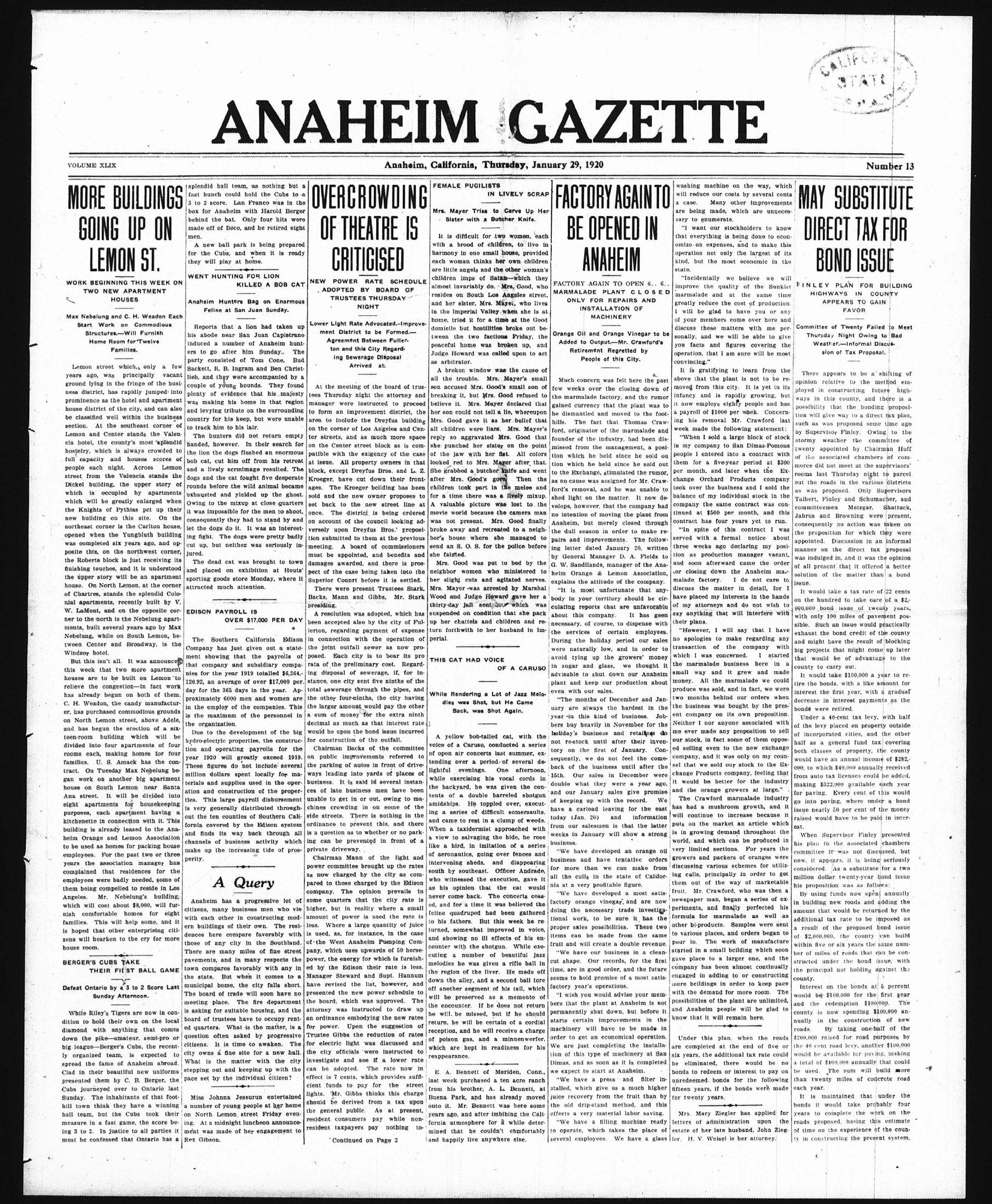
MORE BUILDINGS GOING UP ON LEMON ST.
WORK BEGINNING THIS WEEK ON TWO NEW APARTMENT HOUSES
Max Nebelung and C. H. Weadon Each Start Work on Commodious Structures.—Will Furnish Home Room for Twelve Families.
Lemon street which, only a few years ago, was principally vacant ground lying in the fringe of the business district, has rapidly jumped into prominence as the hotel and apartment house district of the city, and can also be classified well within the business section. At the southeast corner of Lemon and Center stands the Valencia hotel, the county's most splendid splendid ball team, as nothing but a fast bunch could hold the Cubs to a 3 to 2 score. Lan Franco was in the box for Anaheim with Harold Berger behind the bat. Only four hits were made off of Beco, and he retired eight men.
A new ball park is being prepared for the Cubs, and when it is ready they will play at home.
WENT HUNTING FOR LION KILLED A BOB CAT
Anaheim Hunters Bag on Enormous Feline at San Juan Sunday.
Reports that a lion had taken up his abode near San Juan Capistrano induced a number of Anaheim hunters to go after him Sunday.. The party consisted of Tom Cone, Bud Sackett, R. B. Ingram and Ben Christlieb, and they were accompanied by a couple of young hounds. They found plenty of evidence that his majesty was making his home in that region and levying tribute on the surrounding country for his keep, but were unable to track him to his lair.
The hunters did not return empty handed, however. In their search for
OVERCROSS OF THEATERS CRITICI
NEW POWER RAIL ADOPTED BY TRUSTEES NIGHT
Lower Light Rate Amendment District to Agreement Betton and this ing Sewerage Arrived
At the meeting oftees Thursday night manager were instruct to form an improved area to include them on the corner of Loster streets, and as on the Center street
Lemon street which, only a few years ago, was principally vacant ground lying in the fringe of the business district, has rapidly jumped into prominence as the hotel and apartment house district of the city, and can also be classified well within the business section. At the southeast corner of Lemon and Center stands the Valencia hotel, the county's most splendid hostelry, which is always crowded to full capacity and houses scores of people each night. Across Lemon street from the Valencia stands the Dickel building, the upper story of which is occupied by apartments which will be greatly enlarged when the Knights of Pythias pct up their new building on this site. On the northeast corner is the Carlton house, opened when the Yungbluth building was completed six years ago, and opposite this, on the northwest corner, the Roberts block is just receiving its finishing touches, and it is understood the upper story will be an apartment house. On North Lemon, at the corner of Chartres, stands the splendid Colonial apartments, recently built by V. W. LaMont, and on the opposite corner to the north is the Nebelung apartments, built several years ago by Max Nebelung, while on South Lemon, between Center and Broadway, is the Windsor hotel.
But this isn't all. It was announced this week that two more apartment houses are to be built on Lemon to relieve the congestion—in fact work has already begun on both of them. C. H. Weadon, the candy manufacturer, has purchased commodious grounds on North Lemon street, above Adele, and has begun the erection of a sixteen-room building which will be divided into four apartments of four rooms each, making homes for four families. U. S. Amack has the contract. On Tuesday Max Nebelung began work on another big apartment house on South Lemon near Santa Ana street. It will be divided into eight apartments for housekeeping purposes, each apartment having a kitchenette in connection with it. This building is already leased to the Anaheim Orange and Lemon Association to be used as homes for packing house party consisted of Tom Cone, Bud Sackett, R. B. Ingram and Ben Christlieb, and they were accompanied by a couple of young hounds. They found plenty of evidence that his majesty was making his home in that region and levying tribute on the surrounding country for his keep, but were unable to track him to his lair.
The hunters did not return empty handed, however. In their search for the lion the dogs flushed an enormous bob cat, cut him off from his retreat and a lively scrimage resulted. The dogs and the cat fought five desperate rounds before the wild animal became exhausted and yielded up the ghost. Owing to the mixup at close quarters it was impossible for the men to shoot, consequently they had to stand by and let the dogs do it. It was an interesting fight. The dogs were pretty badly cut up, but neither was seriously injured.
The dead cat was brought to town and placed on exhibition at Houts' sporting goods store Monday, where it attracted much attention.
EDISON PAYROLL IS OVER $17,000 PER DAY
The Southern California Edison Company has just given out a statement showing that the payrolls of that company and subsidiary companies for the year 1919 totalled $6,264,-120.92, an average of over $17,000 per day for the 365 days in the year. Approximately 6000 men and women are in the employ of the companies. This is the maximum of the personnel in the organization.
Due to the development of the big hydro-electric properties, the construction and operating payrolls for the year 1920 will greatly exceed 1919. These figures do not include several million dollars spent locally for materials and supplies used in the operation and construction of the properties. This large payroll disbursement is very generally distributed throughout the ten counties of Southern California covered by the Edison system and finds its way back through all channels of business activity which make up the increasing tide of prosocial sewerage.
At the meeting oftees Thursday night manager were instructed to form an improvement area to include them on the corner of Loster streets, and as on the Center street patible with the exit at issue. All proper block, except Dreyfur Kroeger, have cut ages. The Kroeger sold and the new one set back to the next once. The district on account of the conversion upon Dreyfur submitted to the meeting. A board must be appointed, damages awarded, a spect of the case being Superior Court before there were present Backs, Mann and Presiding.
A resolution was also been accepted also by lerton, regarding payment in connection with the joint outfall seized. Each city is rata of the preliminary disposal of sewance, one city sent total sewerage through the other four-ninths; the larger amount would a sum of money for decimal as much as would be upon the book for construction of chairs.
Chairman Backs on public improvementthe parking of autos ways leading into your business. It is said ces of late businesses unable to get in or chines crowding in side streets. There ordinance to prevent is a question as to whether can be prevented private driveway.
BERGER'S CUBS TAKE
THEIR FIRST BALL GAME
Defeat Ontario by a 3 to 2 Score Last Sunday Afternoon.
While Riley's Tigers are now in condition to hold their own on the local diamond with anything that comes down the pike—amateur, semi-pro or big league—Berger's Cubs, the recently organized team, is expected to spread the fame of Anaheim abroad. Clad in their beautiful new uniforms presented them by C. B. Berger, the Cubs journeyed over to Ontario last Sunday. The inhabitants of that foothill town think they have a winning ball team, but the Cubs took their measure in a fast game, the score being 3 to 2. In justice to all parties it must be confessed that Ontario has a
A Query
Anaheim has a progressive lot of citizens, many business men who vie with each other in constructing modern buildings of their own. The residences here compare favorably with those of any city in the Southland. There are many miles of fine street pavements, and in many respects the town compares favorably with any in the state. But when it comes to a municipal home, the city falls short. The board of trade will soon have no meeting place. The fire department is asking for suitable housing, and the board of trustees have to occupy rented quarters. What is the matter, is a question often asked by progressive citizens. It is time to awaken. The city owns a fine site for a new hall. What is the matter with the city stepping out and keeping up with the pace set by the individual citizen?
Miss Johnna Jessurun entertained a number of young people at her home on North Lemon street Friday evening. At a midnight luncheon announcement was made of her engagement to Rex Gibson.
Chairman Mann of power committee brood as now charged by his pared to those charging company. The opinion some quarters that higher, but in reality amount of power is less. Where a large is used, as, for instance of the West Anaheim company, which uses up power, the energy formed by the Edison the Manager Steward and have revised the list presented the new paper the board, which was attorney was instructed an ordinance embody for power. Upon the Trustee Gibbs the refor electric light was the city officials we investigate and see can be adopted. The effect is 7 cents, which client funds to pay lights. Mr. Gibbs that should be derived from the general public resident consumers resident taxpayers pro
AHEIM GAZETY
Anaheim, California, Thursday, January 29, 1920
OVERCROWDING OF THEATRE IS CRITICISED
NEW POWER RATE SCHEDULE ADOPTED BY BOARD OF TRUSTEES THURSDAY NIGHT
Lower Light Rate Advocated.—Improvement District to be Formed.—Agreement Between Fullerton and this City Regarding Sewerage Disposal Arrived at.
At the meeting of the board of trustees Thursday night the attorney and manager were instructed to proceed to form an improvement district, the area to include the Dreyfus building on the corner of Los Angeles and Center streets, and as much more space on the Center street block as is com-
FEMALE PUGILISTS IN LIVELY SCRAP
Mrs. Mayer Tries to Carve Up Her Sister with a Butcher Knife.
It is difficult for two women, each with a brood of children, to live in harmony in one small house, provided each woman thinks her own children are little angels and the other woman's children imps of Satan—which they almost invariably do. Mrs. Good, who resides on South Los Angeles street, and her sister, Mrs. Mayer, who lives in the Imperial Valley when she is at home, tried it for a time at the Good domicile but hostilities broke out between the two factions Friday, the peaceful home was broken up, and Judge Howard was called upon to act as arbitrator.
A broken window was the cause of all the trouble. Mrs. Mayer's small son accused Mrs. Good's small son of breaking it, but Mrs. Good refused to believe it. Mrs. Mayer declared that her son could not tell a lie, whereupon Mrs. Good gave it as her belief that all children were liars. Mrs. Mayer's reply so aggravated Mrs. Good that she punched her sister on the point
FACTORY AGAIN TO BE OPENED IN ANAHEIM
FACTORY AGAIN TO OPEN 6.. 6.. MARMALADE PLANT CLOSED ONLY FOR REPAIRS AND INSTALLATION OF MACHINERY
Orange Oil and Orange Vinegar to be Added to Output.—Mr. Crawford's Retirement Regretted by People of this City.
Much concern was felt here the past few weeks over the closing down of the marmalade factory, and the rumor gained currency that the plant was to be dismantled and moved to the foothills. The fact that Thomas Crawford, originator of the marmalade and founder of the industry, had been dismissed from the management, a posi-
At the meeting of the board of trustees Thursday night the attorney and manager were instructed to proceed to form an improvement district, the area to include the Dreyfus building on the corner of Los Angeles and Center streets, and as much more space on the Center street block as is compatible with the exigency of the case at issue. All property owners in that block, except Dreyfus Bros. and L. Z. Kroeger, have cut down their frontages. The Kroeger building has been sold and the new owner proposes to set back to the new street line at once. The district is being ordered on account of the council looking adversely upon Dreyfus Bros.' proposition submitted to them at the previous meeting. A board of commissioners must be appointed, and benefits and damages awarded, and there is prospect of the case being taken into the Superior Court before it is settled.
There were present Trustees Stark, Backs, Mann and Gibbs, Mr. Stark presiding.
A resolution was adopted, which has been accepted also by the city of Fullerton, regarding payment of expense in connection with the operation of the joint outfall sewer as now proposed. Each city is to bear its pro rata of the preliminary cost. Regarding disposal of sewerage, if, for instance, one city sent five ninths of the total sewerage through the pipes, and the other four-ninths, the city having the larger amount would pay the other a sum of money for the extra ninth decimal as much as that interest rate would be upon the bond issue incurred for construction of the outfall.
Chairman Backs of the committee on public improvements referred to the parking of autos in front of driveways leading into yards of places of business. It is said in several instances of late business men have been unable to get in or out, owing to machines crowding in on some of the side streets. There is nothing in the ordinance to prevent this, and there is a question as to whether or no parking can be prevented in front of a private driveway.
A broken window was the cause of all the trouble. Mrs. Mayer's small son accused Mrs. Good's small son of breaking it, but Mrs. Good refused to believe it. Mrs. Mayer declared that her son could not tell a lie, whereupon Mrs. Good gave it as her belief that all children were liars. Mrs. Mayer's reply so aggravated Mrs. Good that she punched her sister on the point of the jaw with her fist. All colors looked red to Mrs. Mayer after that. She grabbed a butcher knife and went after Mrs. Good's gore. Then the children took part in the melee and for a time there was a lively mixup. A valuable picture was lost to the movie world because the camera man was not present. Mrs. Good finally broke away and retreated to a neighbor's house where she managed to send an S. O. S. for the police before she fainted.
Mrs. Good was put to bed by the neighbor women who ministered to her slight cuts and agitated nerves. Mrs. Mayer was arrested by Marshal Wood and Judge Howard gave her a thirty-day jail sentence which was suspended on condition that she pack up her chattels and children and return forthwith to her husband in Imperial.
THIS CAT HAD VOICE OF A CARUSO
While Rendering a Lot of Jazz Melodies was Shot, but He Came Back, was Shot Again.
A yellow bob-tailed cat, with the voice of a Caruso, conducted a series of open air concerts last summer, extending over a period of several delightful evenings. One afternoon, while exercising his vocal cords in the backyard, he was given the contents of a double barreled shotgun amidships. He toppled over, executing a series of difficult somersaults, and came to rest in a clump of weeds. When a taxidermist approached with a view to salvaging the hide, he rose like a bird, in imitation of a series Judge Howard was called upon to act as arbitrator.
A broken window was the cause of all the trouble. Mrs. Mayer's small son accused Mrs. Good's small son of breaking it, but Mrs. Good refused to believe it. Mrs. Mayer declared that her son could not tell a lie, whereupon Mrs. Good gave it as her belief that all children were liars. Mrs. Mayer's reply so aggravated Mrs. Good that she punched her sister on the point of the jaw with her fist. All colors looked red to Mrs. Mayer after that. She grabbed a butcher knife and went after Mrs. Good's gore. Then the children took part in the melee and for a time there was a lively mixup. A valuable picture was lost to the movie world because the camera man was not present. Mrs. Good finally broke away and retreated to a neighbor's house where she managed to send an S. O. S. for the police before she fainted.
Mrs. Good was put to bed by the neighbor women who ministered to her slight cuts and agitated nerves. Mrs. Mayer was arrested by Marshal Wood and Judge Howard gave her a thirty-day jail sentence which was suspended on condition that she pack up her chattels and children and return forthwith to her husband in Imperial.
Much concern was felt here the past few weeks over the closing down of the marmalade factory, and the rumor gained currency that the plant was to be dismantled and moved to the foothills. The fact that Thomas Crawford, originator of the marmalade and founder of the industry, had been dismissed from the management, a position which he held since he sold out to the Exchange, stimulated the rumor, as no cause was assigned for Mr. Crawford's removal, and he was unable to shed light on the matter. It now develops, however, that the company had no intention of moving the plant from Anaheim, but merely closed through the dull season in order to make repairs and improvements. The following letter dated January 20, written by General Manager D. A. Fields to G.W.Sandilands, manager of the Anaheim Orange & Lemon Association, explains the attitude of the company.
"It is most unfortunate that anybody in your territory should be circulating reports that are unfavorable about this company. It has geen necessary, of course, to dispense with the services of certain employees. During the holiday period our sales were naturally low, and in order to avoid tying up the growers' money in sugar and glass, we thought it advisable to shut down our Anaheim plant and keep our production about even with our sales."
"The months of December and January are always the hardest in the year-in this kind of business. Jobbers buy heavily in November for the holiday's business and retailers do not re-stock until after their inventory on the first of January. Consequently, we do not feel the comeback of the business until after the 15th. Our sales in December were double what they were a year ago, and our January sales give promise of keeping up with the record. We have a carload leaving for the east today (Jan. 20) and information from our salesmen is that the latter weeks in January will show a strong business."
on public improvements referred to the parking of autos in front of driveways leading into yards of places of business. It is said in several instances of late business men have been unable to get in or out, owing to machines crowding in on some of the side streets. There is nothing in the ordinance to prevent this, and there is a question as to whether or no parking can be prevented in front of a private driveway.
Chairman Mann of the light and power committee brought up the rates as now charged by the city as compared to those charged by the Edison company. The opinion prevails in some quarters that the city rate is higher, but in reality where a small amount of power is used the rate is less. Where a large quantity of juice is used, as, for instance, in the case of the West Anaheim Pumping Company, which uses upwards of 50 horsepower, the energy for which is furnished by the Edison their rate is less. Manager Steward and Supt. Hannum have revised the list, however, and presented the new power schedule to the board, which was approved. The attorney was instructed to draw up an ordinance embodying the new rates for power. Upon the suggestion of Trustee Gibbs the reduction of rates for electric light was discussed and the city officials were instructed to investigate and see if a lower rate can be adopted. The rate now in effect is 7 cents, which provides sufficient funds to pay for the street lights. Mr. Gibbs thinks this charge should be derived from a tax upon the general public. As at present, resident consumers pay while non-resident taxpayers pay nothing to
E. A. Bennett of Meriden, Conn., last week purchased a ten acre ranch from his brother, A. L. Bennett, at Buena Park, and has already moved onto it. Mr. Bennett was here some years ago, and after imbibing the California atmosphere for a while determined that he couldn't comfortably and happily live anywhere else.
sequently, we do not feel the comeback of the business until after the 15th. Our sales in December were double what they were a year ago, and our January sales give promise of keeping up with the record. We have a carload leaving for the east today (Jan. 20) and information from our salesmen is that the latter weeks in January will show a strong business.
"We have developed an orange oil business and have tentative orders for more than we can make from all the culls in the state of California at a very profitable figure.
"We have developed a most satisfactory orange vinegar, and are now doing the necessary trade investigational work, to be sure it has the proper sales possibilities. These two items can be made from the same fruit and will create a double revenue.
"We have our business in a clean-cut shape. Our records, for the first time, are in good order, and the future seems to hold promise of a most satisfactory year's operations.
"I wish you would advise your members that the plant at Anaheim is not permanently shut down, but before it starts certain improvements in the machinery will have to be made in order to get an economical operation. We are just completing the installation of this type of machinery at San Dimas, and as soon as it is completed we expect to start at Anaheim.
"We have a press and filter installed, which give us a much higher juice recovery from the fruit than by the old drip-stand method, and this effects a very material labor saving.
"We have a filling machine ready to operate, which takes the place of several employees. We have a glass company," said that we change Printer it would do and the t
The Crane has had no control puts on it in grown world, and very limited growers are discussing culls, them out fruit. Mr. newspaper periments formula for other bi-purpose pour in. Started in gave place company engaged in more bollings with the possibility and Anahi know that...
GAIN TO CLOSED AIRS AND MONO OF VINEgar to be Mr. Crawford's settled by City.
It here the past closing down of and the rumor the plant was to moved to the foot-Thomas Crawford marmalade and had been disgement, a posi-washing machine on the way, which will reduce our costs by several cents a case. Many other improvements are being made, which are unnecessary to enumerate.
"I want our stockholders to know that everything is being done to economize on expenses, and to make this operation not only the largest of its kind, but the most economic in the state.
"Incidentally we believe we will improve the quality of the Sunkist marmalade and at the same time greatly reduce the cost of production. I will be glad to have you or any of your members come over here and discuss these matters with me personally, and we will be able to give you facts and figures covering the operation, that I am sure will be most convincing."
It is gratifying to learn from the above that the plant is not to be removed from this city. It is yet in its infancy and is rapidly growing, but it now employs eighty people and has a payroll of $1000 per week. Concerning his removal Mr. Crawford last week made the following statement:
"When I sold a large block of stock in my company to San Dimas-Pomona
MAY SUBSTITUTE DIRECT TAX FOR BOND ISSUE
FINLEY PLAN FOR BUILDING HIGHWAYS IN COUNTY APPEARS TO GAIN FAVOR
Committee of Twenty Failed to Meet Thursday Night Owing to Bad Weather.—Informal Discussion of Tax Proposal.
There appears to be a shifting of opinion relative to the method employed in constructing future highways in this county, and there is a possibility that the bonding proposition will give way to a direct tax plan, such as was proposed some time ago by Supervisor Finley. Owing to the stormy weather the committee of twenty appointed by Chairman Huff."
It here the past closing down of the plant and the rumor the plant was to be moved to the foot- Thomas Crawford marmalade and it had been disagreement, a position he sold out placed the rumor, and for Mr. Crawford it was unable to agree. It now de- dence company had the plant from closed through order to make re- sults. The follow- tuary 20, written by A. Fields to manager of the Anaheim Association, of the company. Animate that any- should be cir- care unfavorable. It has geen no dispense with in employees. Period our sales and in order to growers' money we thought it on our Anaheim production aboutember and Jan- hardest in the business. Job- November for the old retailers do over their inven- January. Confeel the com- until after the December were late a year ago, we give promise the record. We beg for the east information that the latter show a strong operation, that I am sure will be most convincing."
It is gratifying to learn from the above that the plant is not to be removed from this city. It is yet in its infancy and is rapidly growing, but it now employs eighty people and has a payroll of $1000 per week. Concerning his removal Mr. Crawford last week made the following statement:
"When I sold a large block of stock in my company to San Dimas-Pomona people I entered into a contract with them for a five-year period at $300 per month, and later when the Exchange Orchard Products company took over the business and I sold the balance of my individual stock in the company the same contract was continued at $500 per month, and this contract has four years yet to run.
"In spite of this contract I was served with a formal notice about three weeks ago declaring my position as production manager vacant, and soon afterward came the order or closing down the Anaheim marmalade factory. I do not care to discuss the matter in detail, for I have placed my interests in the hands of my attorneys and do not wish to say anything that will interfere with their plans.
"However, I will say that I have no apologies to make regarding any transaction of the company with which I was concerned. I started the marmalade business here in a small way and it grew and made money. All the marmalade we could produce was sold, and in fact, we were two months behind our orders when the business was bought by the present company on its own proposition. Neither I nor anyone associated with me ever made any proposition to sell our stock, in fact some of them opposed selling even to the new exchange company, and it was only on my counsel that we sold our stock to the Exchange Products company, feeling that it would be better for the industry and the orange growers at large."
The Crawford marmalade industry has had a mushroom growth, and it will continue to increase because it puts on the market an article which is in growing demand throughout the world, and which can be produced in very limited sections. For years there appears to be a shifting of opinion relative to the method employed in constructing future highways in this county, and there is a possibility that the bonding proposition will give way to a direct tax plan, such as was proposed some time ago by Supervisor Finley. Owing to the stormy weather the committee of twenty appointed by Chairman Huff of the associated chambers of commerce did not meet at the supervisors' rooms last Thursday night to parcel out the roads in the various districts as was proposed. Only Supervisors Talbert, Finley and Schumacher, and committeemen Metzgar, Shattuck, Jahrus and Browning were present, consequently no action was taken on the proposition for which they were appointed. Discussion in an informal manner on the direct tax proposal was indulged in, and it was the opinion of all present that it offered a better solution of the matter than a bond issue.
It would take a tax rate of 22 cents on the hundred to take care of a $2,000,000 bond issue of twenty years, with only 100 miles of pavement possible. Such an issue would practically exhaust the bond credit of the county and might have the result of blocking big projects that might come up later that would be of advantage to the county to carry out.
It would take $100,000 a year to retire the bonds, with a like amount for interest the first year, with a gradual decrease in interest payments as the bonds were retired.
Under a 40-cent tax levy, with half of the levy placed on property outside of incorporated cities, and the other half as a general fund tax covering both classes of property, the county would have an annual income of $282,000, to which $40,000 annually received from auto tax licenses could be added, making $322,000 available each year for paving. Every cent of this would go into paving, where under a bond issue nearly 50 per cent of the money raised would have to be paid in interest.
When Supervisor Finley presented his plan to the associated chambers committee it got disgusted but
feel the come-
until after the
December were
have a year ago,
give promise
the record. We
ing for the east
information
that the latter
show a strong
an orange oil
intensive orders
can make from
state of Califorfigure.
In a most satisfied and are now
grade investigation it has the
less. These two
from the same
double revenue.
press in a cleaness, for the first
and the future
of a most satissious.
wise your memAnaheim is not,
but before it
elements in the
to be made in
physical operation.
gig the installamachinery at San
it is completed
anaheim.
and filter ina much higher
fruit than by
method, and this
labor saving.
machine ready
is the place of
we have a glass
Under this plan, when the roads
are completed at the end of five or six years, the additional tax rate could be eliminated, there would be no bonds to redeem or interest to pay on unredeemed bonds for the following fifteen years, if the bonds were made for twenty years.
Mrs. Mary Ziegler has applied for letters of administration upon the estate of her late husband, John Ziegler. H. V. Weisel is her attorney.
would have an annual income of $282,000, to which $40,000 annually received from auto tax licenses could be added, making $322,000 available each year for paving. Every cent of this would go into paving, where under a bond issue nearly 50 per cent of the money raised would have to be paid in interest.
When Supervisor Finley presented his plan to the associated chambers committee it was not discussed, but now, it appears, it is being seriously considered. As a substitute for a two million dollar twenty-year bond issue his proposition was as follows:
By using funds now spent annually in building new roads and adding the amount that would be returned by the additional tax rate to be imposed as a result of the proposed bond issue of $2,000,000, the county can build within five or six years the same number of miles of roads that can be constructed under the bond issue, with the principal not holding against the county.
Interest on the bonds at 5 percent would be $100,000 for the first year and the redemption $100,000. The county is now spending $100,000 annually in the construction of new roads. By taking one-half of the $200,000 raised for road purposes by the 40 cent road levy, another $100,000 would be available for paving, making a total of $400,000 annually that could be used. The sum will build more than twenty miles of concrete road each year.
It is maintained that under the bonds it would take probably four years to complete the work on the roads proposed, basing this estimate of time on the experience of the county in constructing the present system.