anaheim-gazette 1920-01-22
Scanned page
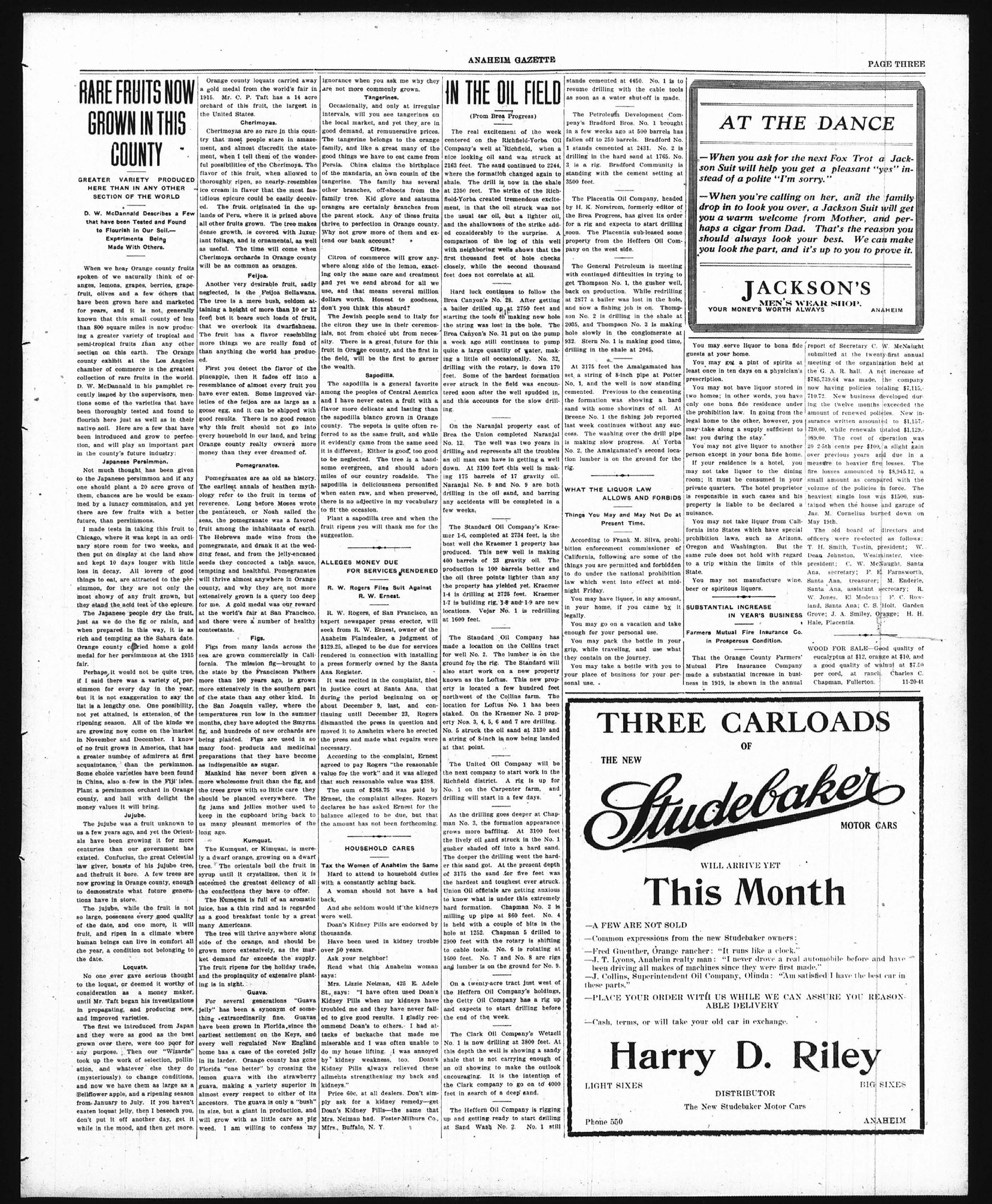
Searchable text
RARE FRUITS NOW GROWN IN THIS COUNTY
GREATER VARIETY PRODUCED HERE THAN IN ANY OTHER SECTION OF THE WORLD
D. W. McDannald Describes a Few that have been Tested and Found to Flourish in Our Soil.—Experiments Being Made With Others.
When we hear Orange county fruits spoken of we naturally think of oranges, lemons, grapes, berries, grapefruit, olives and a few others that have been grown here and marketed for years, and it is not generally known that this small county of less than 800 square miles is now producing a greater variety of tropical and semi-tropical fruits than any other section on this earth. The Orange county exhibit at the Los Angeles chamber of commerce is the greatest collection of rare fruits in the world. D. W. McDannald in his pamphlet recently issued by the supervisors, mentions some of the varieties that have been thoroughly tested and found to flourish here just as well as in their native soil. Here are a few that have been introduced and grow to perfection, and will play an important part Orange county loquats carried away a gold medal from the world's fair in 1915. Mr. C. P. Taft has a 14 acre orchard of this fruit, the largest in the United States.
Cherimoyas.
Cherimoyas are so rare in this country that most people stare in amazement, and almost discredit the statement, when I tell them of the wonderful possibilities of the Cherimoya. The flavor of this fruit, when allowed to thoroughly ripen, so nearly resembles ice cream in flavor that the most fastidious epicure could be easily deceived. The fruit originated in the uplands of Peru, where it is prized above all other fruits grown. The tree makes dense growth, is covered with luxuriant foliage, and is ornamental, as well as useful. The time will come when Cherimoya orchards in Orange county will be as common as oranges.
Feijoa.
Another very desirable fruit, sadly neglected, is the Feijoa Sellawana. The tree is a mere bush, seldom attaining a height of more than 10 or 12 feet but it bears such loads of fruit, that we overlook its dwarfishness. The fruit has a flavor resembling more things we are really fond of than anything the world has produced.
First you detect the flavor of the pineapple, then it fades off into a resemblance of almost every fruit you have ever eaten. Some improved varieties of the feijoa are as large as a goose egg, and it can be shipped with good results. There is no good reason why this fruit should not go into every household in our land, and bring Orange county realty owners more ignorance when we are not more cozy.
Occasionally, intervals, will yield the local market good demand, and The tangerine family, and like good things we love Persia. China of the mandarin tangerine. The other branches, family tree. K oranges are cedar the parent stock thrive to perfect Why not grow tend our bank.
Citron of comwhere along siding only the same and yet we seem use, and that no dollars worth don't you think.
The Jewish pethe citron they clals, not from cosity. There is a fruit in Orange county the field, will bthe wealth.
Sapodilla among the people and I have never flavor more delithe sapodilla blacounty. The sepferred to as the it evidently cam
Japanese Persimmon.
Not much thought has been given to the Japanese persimmon and if any one should plant a 20 acre grove of them, chances are he would be examined by a lunacy commission, and yet there are few fruits with a better future, than persimmons.
I made tests in taking this fruit to Chicago, where it was kept in an ordinary store room for two weeks, and then put on display at the land show and kept 10 days longer with little loss in decay. All lovers of good things to eat, are attracted to the persimmon, for they are not only the most showy of any fruit grown, but they stand the acid test of the epicure.
The Japanese people dry the fruit, just as we do the fig or raisin, and when prepared in this way, it is as rich and tempting as the Sahara date. Orange county carried home a gold medal for her persimmons at the 1915 fair.
Perhaps it would not be quite true, if I said there was a variety of persimmon for every day in the year, but it is not exaggeration to say the list is a lengthy one. One possibility, not yet attained, is extension of the ripening season. All of the kinds we are growing now come on the market in November and December. I know of no fruit grown in America, that has a greater number of admirers at first acquaintance, than the persimmon. Some choice varieties have been found in China, also a few in the Fiji islands. Plant a persimmon orchard in Orange county, and hail with delight the money values it will bring.
Jujube.
The jujube was a fruit unknown to us a few years ago, and yet the Orientals have been growing it for more centuries than our government has
First you detect the flavor of the pineapple, then it fades off into a resemblance of almost every fruit you have ever eaten. Some improved varieties of the feijoa are as large as a goose egg, and it can be shipped with good results. There is no good reason why this fruit should not go into every household in our land, and bring Orange county realty owners more money than they ever dreamed of.
Pomegranates.
Pomegranates are as old as history. The earliest annals of heathen mythology refer to the fruit in terms of reverence. Long before Moses wrote the pentateuch, or Noah sailed the seas, the pomegranate was a favored fruit among the inhabitants of earth. The Hebrews made wine from the pomegranate, and drank it at the wedding feast, and from the jelly-encased seeds they concocted a table sauce, tempting and healthful. Pomegranates will thrive almost anywhere in Orange county, and why they are not more extensively grown is a query too deep for me. A gold medal was our reward at the world's fair at San Francisco, and there were a number of healthy contestants.
Figs.
Figs from many lands across the sea are grown commercially in California. The mission fig—brought to the state by the Franciscan Fathers more than 100 years ago, is grown more extensively in the southern part of the state than any other kind. In the San Joaquin valley, where the temperatures run low in the summer months, they have adopted the Smyrna fig, and hundreds of new orchards are being planted. Figs are used in so many food products and medicinal preparations that they have become as indispensable as sugar.
Mankind has never been given a more wholesome fruit than the fig, and the trees grow with so little care they should be planted everywhere. The fig jams and jellies mother used to keep in the cupboard bring back to us many pleasant memories of the long ago.
Kumquat.
The Kumquat, or Kimquat, is mere-ed.
The sapodilla among the people and I have never flavor more delicately the sapodilla big county. The seedferred to as she it evidently came it is different. Eto be neglected some evergreen miles of our co-sapodilla is del when eaten raw there is no adjec to fit the occasion. Plant a sapodilla fruit ripens you suggest.
ALLEGES MONTH FOR SEEN
R. W. Rogers
R. W.
R. W. Rogers, expert newspaper seek from R. W. Anaheim Plaindale $129.25, alleged rendered in connection with a press formerly Ana Register.
It was recited in justice court during the period about December tinuing until I dismantled the moved it to Analyze the press and make necessary.
According to agreed to pay R value for the work that such reasons
The sum of $ Ernest, the company declares he has balance alleged in the amount has
a greater number of admirers at first acquaintance, than the persimmon. Some choice varieties have been found in China, also a few in the Fiji isles. Plant a persimmon orchard in Orange county, and hail with delight the money values it will bring.
Jujube.
The jujube was a fruit unknown to us a few years ago, and yet the Orientals have been growing it for more centuries than our government has existed. Confucius, the great Celestial law giver, boasts of his jujube tree, and the fruit it bore. A few trees are now growing in Orange county, enough to demonstrate what future generations have in store.
The jujube, while the fruit is not so large, possesses every good quality of the date, and one more, it will fruit, and ripen in a climate where human beings can live in comfort all the year, a condition not belonging to the date.
Loquats.
No one ever gave serious thought to the loquat, or deemed it worthy of consideration as a money maker, until Mr. Taft began his investigations in propagating, and producing new, and improved varieties.
The first we introduced from Japan and they were as good as the best grown over there, were too poor for any purpose. Then our "Wizards" took up the work of selection, pollination, and whatever else they do (mysteriously) to change conditions, and now we have them as large as a Bellflower apple, and a ripening season from January to July. If you haven't eaten loquat jelly, then I beseech you, don't put it off another day, get it while in the mood, and then get more.
Mankind has never been given a more wholesome fruit than the fig, and the trees grow with so little care they should be planted everywhere. The fig jams and jellies mother used to keep in the cupboard bring back to us many pleasant memories of the long ago.
Kumquat.
The Kumquat, or Kimquat, is merely a dwarf orange, growing on a dwarf tree. The orientals boil the fruit in syrup until it crystalizes, then it is esteemed the greatest delicacy of all the confections they have to offer.
The Kumquat is full of an aromatic juice, has a thin rind and is regarded as a good breakfast tonic by a great many Americans.
The tree will thrive anywhere along side of the orange, and should be grown more extensively, as the market demand far exceeds the supply. The fruit ripens for the holiday trade, and the propinquity of extensive planting is in sight.
Guava.
For several generations "Guava jelly" has been a synonym of something extraordinarily fine. Guavas have been grown in Florida since the earliest settlement on the Keys, and every well regulated New England home has a case of the coveted jelly in its larder. Orange county has gone Florida "one better" by crossing the lemon guava with the strawberry guava, making a variety superior in almost every respect to either of its ancestors. The guava is only a "bush" in size, but a giant in production, and will grow with as little care as pig weed. I am willing to confess my
According to agreement to pay R value for the world that such reason
The sum of $Ernest, the company declares he has balance alleged in the amount has
HOUSEHOLD
Tax the Women
Hard to attend with a constant A woman she back,
And she seldom were well.
Doan's Kidney thousands.
Have been used over 50 years.
Ask your neighbor Read what they say:
Mrs. Lizzie N St., says: "I had Kidney Pills when troubled me and ed to give good commend Doan's tacks of back miserable and I do my house life by kidney wee Kidney Pills alliments strengthen kidneys."
Price 60c, at ply ask for a Doan's Kidney Mrs. Nelman has Mfrs., Buffalo,
ANAHEIM GAZETTE
IGNORANCE WHEN YOU ASK ME WHY THEY ARE NOT MORE COMMONLY GROWN.
Tangerines.
Occasionally, and only at irregular intervals, will you see tangerines on the local market, and yet they are in good demand, at remunerative prices. The tangerine belongs to the orange family, and like a great many of the good things we have to eat came from Persia. China claims the birthplace of the mandarin, an own cousin of the tangerine. The family has several other branches, off-shoots from the family tree. Kid glove and satsuma oranges are certainly branches from the parent stock. Any of these fruits thrive to perfection in Orange county. Why not grow more of them and extend our bank account?
Citron.
Citron of commerce will grow anywhere along side of the lemon, exacting only the same care and treatment and yet we send abroad for all we use, and that means several million dollars worth. Honest to goodness, don't you think this absurd?
The Jewish people send to Italy for the citron they use in their ceremonials, not from choice but from necessity. There is a great future for this fruit in Orange county, and the first in the field, will be the first to garner the wealth.
Sapodilla.
The sapodilla is a general favorite among the peoples of Central Aemrica and I have never eaten a fruit with a flavor more delicate and lasting than the sapodilla blanco grown in Orange county. The sepota is quite often referred to as the same fruit, and while it evidently came from the same seed stands cemented at 4450. No. 1 is to resume drilling with the cable tools as soon as a water shut-off is made.
The Petroleum Development Company's Bradford Bros. No. 1 brought in a few weeks ago at 500 barrels has fallen off to 250 barrels. Bradford No. 1 stands cemented at 2431. No. 2 is drilling in the hard sand at 1765. No. 3 is a rig. Bradford Community is standing with the cement setting at 3500 feet.
The Placentia Oil Company, headed by H. K. Norstrom, formerly editor of the Brea Progress, has given its order for a rig and expects to start drilling soon. The Placentia sub-leased some property from the Heffern Oil Company on the west side.
The General Petroleum is meeting with continued difficulties in trying to get Thompson No. 1, the gusher well, back on production. While redrilling at 2877 a bailer was lost in the hole, and now a fishing job is on. Thompson No. 2 is drilling in the shale at 2035, and Thompson No. 3 is making hole slowly in the conglomerate at 932. Stern No. 1 is making good time, drilling in the shale at 2045.
At 3175 feet the Amalgamated has set a string of 8-inch pipe at Potter No. 1, and the well is now standing cemented. Previous to the cementing the formation was showing a hard sand with some showings of oil. At Breene No. 1 the fishing job reported last week continues without any success. The washing over the drill pipe is making slow progress. At Yorba No. 9 the cementing process has been completed.
IN THE OIL FIELD
(From Brea Progress)
The real excitement of the week centered on the Richfield-Yorba Oil Company's well at Richfield, when a nice looking oil sand was struck at 2163 feet. The sand continued to 2244, where the formation changed again to shale. The drill is now in the shale at 2350 feet. The strike of the Richfield-Yorba created tremendous excitement, in that the oil struck was not the usual tar oil, but a lighter oil, and the shallowness of the strike added considerably to the surprise. A comparison of the log of this well with neighboring wells shows that the first thousand feet of hole checks closely, while the second thousand feet does not correlate at all.
Hard luck continues to follow the Brea Canyon's No. 28. After getting a bailer drilled up at 2750 feet and starting the tools to make new hole the string was lost in the hole. The Brea Canyon's No. 31 put on the pump a week ago still continues to pump quite a large quantity of water, making a little oil occasionally. No. 32, drilling with the rotary, is down 170 feet. Some of the hardest formation ever struck in the field was encountered soon after the well spudded in, and this accounts for the slow drilling.
On the Naranjal property east of Brea the Union completed Naranjal No. 12. The well was two years in standees cemented at 4450. No. 1 is to resume drilling with the cable tools as soon as a water shut-off is made.
The Petroleum Development Company's Bradford Bros. No. 1 brought in a few weeks ago at 500 barrels has fallen off to 250 barrels. Bradford No. 1 stands cemented at 2431. No. 2 is drilling in the hard sand at 1765. No. 3 is a rig. Bradford Community is standing with the cement setting at 3500 feet.
The Placentia Oil Company, headed by H. K. Norstrom, formerly editor of the Brea Progress, has given its order for a rig and expects to start drilling soon. The Placentia sub-leased some property from the Heffern Oil Company on the west side.
The General Petroleum is meeting with continued difficulties in trying to get Thompson No. 1, the gusher well, back on production. While redrilling at 2877 a bailer was lost in the hole, and now a fishing job is on. Thompson No. 2 is drilling in the shale at 2035, and Thompson No. 3 is making hole slowly in the conglomerate at 932. Stern No. 1 is making good time, drilling in the shale at 2045.
At 3175 feet the Amalgamated has set a string of 8-inch pipe at Potter No. 1, and the well is now standing cemented. Previous to the cementing the formation was showing a hard sand with some showings of oil. At Breene No. 1 the fishing job reported last week continues without any success. The washing over the drill pipe is making slow progress. At Yorba No.
the field, will be the first to garner the wealth.
Sapodilla.
The sapodilla is a general favorite among the peoples of Central Aemrica and I have never eaten a fruit with a flavor more delicate and lasting than the sapodilla blanco grown in Orange county. The sepota is quite often referred to as the same fruit, and while it evidently came from the same seed it is different. Either is good, too good to be neglected. The tree is a handsome evergreen, and should adorn miles of our country roadside. The sapodilla is deliciousness personified when eaten raw, and when preserved, there is no adjective in my vocabulary to fit the occasion.
Plant a sapodilla tree and when the fruit ripens you will thank me for the suggestion.
ALLEGES MONEY DUE FOR SERVICES RENDERED
R. W. Rogers Files Suit Against R. W. Ernest.
R. W. Rogers, of San Francisco, an expert newspaper press erector, will seek from R. W. Ernest, owner of the Anaheim Plaindealer, a judgment of $129.25, alleged to be due for services rendered in connection with installing a press formerly owned by the Santa Ana Register.
It was recited in the complaint, filed in justice court at Santa Ana, that during the period beginning on or about December 9, last, and continuing until December 23, Rogers dismantled the press in question and moved it to Anaheim where he erected the press and made what repairs were necessary.
According to the complaint, Ernest agreed to pay Rogers "the reasonable value for the work" and it was alleged that such reasonable value was $398.
The sum of $268.75 was paid by Ernest, the complaint alleges. Rogers declares he has asked Ernest for the balance alleged to be due, but that the amount has not been forthcoming.
HOUSEHOLD CARES
At 3175 feet the Amalgamated has set a string of 8-inch pipe at Potter No. 1, and the well is now standing cemented. Previous to the cementing the formation was showing a hard sand with some showings of oil. At Breene No. 1 the fishing job reported last week continues without any success. The washing over the drill pipe is making slow progress. At Yorba No. 2, the Amalgamated's second location lumber is on the ground for the rig.
The Standard Oil Company's Kraemer 1-6, completed at 2734 feet, is the best well the Kraemer 1 property has produced. This new well is making 400 barrels of 23 gravity oil. The production is 100 barrels better and the oil three points lighter than any property has yielded yet. Kraemer 1-4 is drilling at 2725 feet. Kraemer 1-7 is building rig, 1-8 and 1-9 are new locations. Vejar No. 1 is redrilling at 1600 feet.
The Standard Oil Company has made a location on the Collins tract for well No. 2. The lumber is on the ground for the rig. The Standard will also start work on a new property known as the Loftus. This new property is located a few hundred feet northwest of the Collins farm. The location for Loftus No. 1 has been staked. On the Kraemer No. 2 property Nos. 3, 4, 5, 6 and 7 are drilling. No. 5 struck the oil sand at 3130 and a string of 8-inch is now being landed at that point.
The United Oil Company will be the next company to start work in the Richfield district. A rig is up for No. 1 on the Carpenter farm, and drilling will start in a few days.
As the drilling goes deeper at Chapman No. 3, the formation appearance grows more baffling. At 3100 feet the lively oil sand struck in the No. 1 gusher shaded off into a hard sand.
According to the complaint, Ernest agreed to pay Rogers "the reasonable value for the work" and it was alleged that such reasonable value was $398.
The sum of $268.75 was paid by Ernest, the complaint alleges. Rogers declares he has asked Ernest for the balance alleged to be due, but that the amount has not been forthcoming.
HOUSEHOLD CARES
Tax the Women of Anaheim the Same
Hard to attend to household duties with a constantly aching back.
A woman should not have a bad back,
And she seldom would if the kidneys were well.
Doan's Kidney Pills are endorsed by thousands.
Have been used in kidney trouble over 50 years.
Ask your neighbor!
Read what this Anaheim woman says:
Mrs. Lizzie Neiman, 425 E. Adele St., says: "I have often used Doan's Kidney Pills when my kidneys have troubled me and they have never failed to give good results. I gladly recommend Doan's to others. I had attacks of backache that made me miserable and I was often unable to do my house lifting. I was annoyed by kidney weakness, too. Doan's Kidney Pills always relieved these ailments strengthening my back and kidneys."
Price 60c, at all dealers. Don't simply ask for a kidney remedy—get Doan's Kidney Pills—the same that Mrs. Neiman had. Foster-Milburn Co., Mfrs., Buffalo, N.Y.
The United Oil Company will be the next company to start work in the Richfield district. A rig is up for No. 1 on the Carpenter farm, and drilling will start in a few days.
As the drilling goes deeper at Chapman No. 3, the formation appearance grows more baffling. At 3100 feet the lively oil sand struck in the No. 1 gusher shaded off into a hard sand. The deeper the drilling went the harder this sand got. At the present depth of 3175 the sand for five feet was the hardest and toughest ever struck. Union Oil officials are getting anxious to know what is under this extremely hard formation. Chapman No. 2 is milling up pipe at 860 feet. No. 4 is held with a couple of bits in the hole at 1252. Chapman 5 drilled to 2900 feet with the rotary is shifting to cable tools. No. 6 is rotating at 1600 feet. No. 7 and No. 8 are rigs and lumber is on the ground for No. 9.
On a twenty-acre tract just west of the Heffern Oil Company's holdings, the Getty Oil Company has a rig up and expects to start drilling before the end of the week.
The Clark Oil Company's Wetzell No. 1 is now drilling at 3800 feet. At this depth the well is showing a sandy shale that is not carrying enough of an oil showing to make the outlook encouraging. It is the intention of the Clark company to go on to 4000 feet in search of a deep sand.
The Heffern Oil Company is rigging up and getting ready to start drilling at Sand Wash No. 2. No. 1 still
AT THE DANCE
—When you ask for the next Fox Trot a Jackson Suit will help you get a pleasant “yes” instead of a polite “I’m sorry.”
—When you’re calling on her, and the family drop in to look you over, a Jackson Suit will get you a warm welcome from Mother, and perhaps a cigar from Dad. That’s the reason you should always look your best. We can make you look the part, and it’s up to you to prove it.
JACKSON'S
MEN’S WEAR SHOP.
YOUR MONEY’S WORTH ALWAYS
ANAHEIM
You may serve liquor to bona fide guests at your home.
You may get a pint of spirits at least once in ten days on a physician’s prescription.
You may not have liquor stored in two homes; in other words, you have only one bona fide residence under the prohibition law. In going from the legal home to the other, however, you may take along a supply sufficient to last you during the stay.
You may not give liquor to another report of Secretary C. W. McNaught submitted at the twenty-first annual meeting of the organization held at the G. A. R. hall. A net increase of $785,739.64 was made, the company now having policies totaling $7,115.710.72. New business developed during the twelve months exceeded the amount of renewed policies. New insurance written amounted to $1,157.730.00, while renewals totaled $1,129.089.00. The cost of operation was 20-25 cents per $100, a slight gain
Amalgamated has
branch pipe at Potter
ell is now standing
us to the cementing
showings of oil. At
fishing job reported
without any sucover the drill pipe
progress. At Yorba
animated's second locathe ground for the
You may get a pint of spirits at least once in ten days on a physician's prescription.
You may not have liquor stored in two homes; in other words, you have only one bona fide residence under the prohibition law. In going from the legal home to the other, however, you may take along a supply sufficient to last you during the stay.
You may not give liquor to another person except in your bona fide home.
If your residence is a hotel, you may not take liquor to the dining room; it must be consumed in your private quarters. The hotel proprietor is responsible in such cases and his property is liable to be declared a nuisance.
You may not take liquor from California into States which have special prohibition laws, such as Arizona, Oregon and Washington. But the same rule does not hold with regard to a trip within the limits of this State.
You may not manufacture wine, beer or spiritous liquors.
SUBSTANTIAL INCREASE IN YEAR'S BUSINESS
Farmers Mutual Fire Insurance Co. in Prosperous Condition.
That the Orange County Farmers' Mutual Fire Insurance Company made a substantial increase in business in 1919, is shown in the annual submitted at the twenty-first annual meeting of the organization held at the G. A. R. hall. A net increase of $785,739.64 was made, the company now having policies totaling $7,115.710.72. New business developed during the twelve months exceeded the amount of renewed policies. New insurance written amounted to $1,157.730.00, while renewals totaled $1,129.089.00. The cost of operation was 20 2-5th cents per $100, a slight gain over previous years and due in a measure to heavier fire losses. The fire losses amounted to $8,945.12, a small amount as compared with the volume of the policies in force. The heaviest single loss was $1500, sustained when the house and garage of Jas. M. Cornellius burned down on May 19th.
The old board of directors and officers were re-elected as follows: T. H. Smith, Tustin, president; W. Dean Johnston, Westminster, vice-president; C. W. McNaught, Santa Ana, secretary; F. E. Farnsworth, Santa Ana, treasurer; M. Enderle, Santa Ana, assistant secretary; R. W. Jones, El Modena; F. C. Rowland, Santa Ana; C. S. Holt, Garden Grove; J. A. Smiley, Orange; H. H. Hale, Placentia.
WOOD FOR SALE—Good quality of eucalyptus at $12, orange at $10, and a good quality of walnut at $7.50 per cord, at ranch. Charles C. Chapman, Fullerton.
HREE CARLOADS OF NEW Studebaker MOTOR CARS
NEW
Studebaker
MOTOR CARS
WILL ARRIVE YET
This Month
ARE NOT SOLD
In expressions from the new Studebaker owners:
Quenther, Orange rancher: "It runs like a clock."
Oons, Anaheim realty man: "I never drove a real automobile before and haveaving all makes of machines since they were first made."
Uss, Superintendent Oil Company, Olinda: "Am satisfied I have the best car inus."
YOUR ORDER WITH US WHILE WE CAN ASSURE YOU REASONABLE DELIVERY
Harry D. Riley
DISTRIBUTOR
The New Studebaker Motor Cars
ANAHEIM