anaheim-gazette 1920-01-22
Scanned page
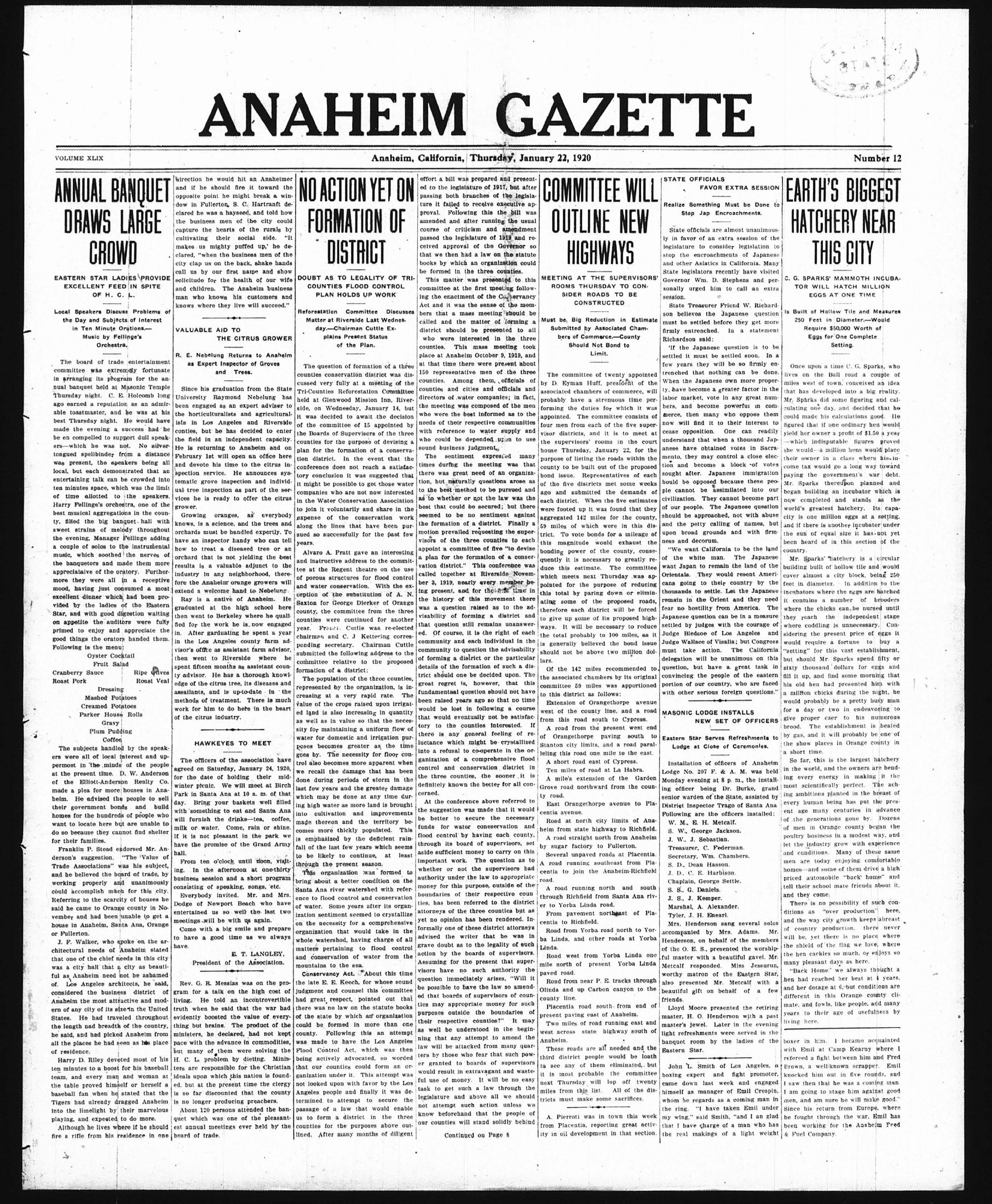
Searchable text
VOLUME XLIX
ANNUAL BANQUET DRAWS LARGE CROWD
EASTERN STAR LADIES PROVIDE EXCELLENT FEED IN SPITE OF H. C. L.
Local Speakers Discuss Problems of the Day and Subjects of Interest in Ten Minute Orations.—Music by Feilinge's Orchestra.
The board of trade entertainment committee was extremely fortunate in arranging its program for the annual banquet held at Masonic Temple Thursday night. C. E. Holcomb long ago earned a reputation as an admirable toastmaster, and he was at his best Thursday night. He would have made the evening a success had he be en compelled to support dull speakers—which he was not. No silver direction he would hit an Anaheim and if he should fire it toward the opposite point he might break a window in Fullerton, S. C. Hartranft declared he was a hayseed, and told how the business men of the city could capture the hearts of the rurals by cultivating their social side. "It makes us mighty puffed up," he declared, "when the business men of the city clap us on the back, shake hands call us by our first name and show solicitude for the health of our wife and children. The Anaheim business man who knows his customers and knows where they live will succeed."
VALUABLE AID TO THE CITRUS GROWER
R. E. Nebelung Returns to Anaheim as Expert Inspector of Groves and Trees.
Since his graduation from the State University Raymond Nebelung has been engaged as an expert adviser to the horticulturalists and agriculturalists in Los Angeles and Riverside counties, but he has decided to enter the field in an independent capacity. He is returning to Anaheim and on
NO ACTION FOR FORMATION DISTRICT
DOUBT AS TO LEGAL COUNTIES FLOOD PLAN HOLDS UP
Reforestation Committee Matter at Riverside Day.—Chairman Plains Present of the Plan.
The question of formal counties conservation discussed very fully at a Tri-Counties Reforestation held at Glenwood Mission side, on Wednesday, Jan. It was decided to await of the committee of 15 the Boards of Supervisor counties for the purpose
The board of trade entertainment committee was extremely fortunate in arranging its program for the annual banquet held at Masonic Temple Thursday night. C. E. Holcomb long ago earned a reputation as an admirable toastmaster, and he was at his best Thursday night. He would have made the evening a success had he be en compelled to support dull speakers—which he was not. No silver-tongued spellbinder from a distance was present, the speakers being all local, but each demonstrated that an entertaining talk can be crowded into ten minutes space, which was the limit of time allotted to the speakers. Harry Fellinge's orchestra, one of the best musical aggregations in the county, filled the big banquet hall with sweet strains of melody throughout the evening. Manager Fellinge adding a couple of solos to the instrumental music, which soothed the nerves of the banquetors and made them more appreciative of the oratory. Furthermore they were all in a receptive mood, having just consumed a most excellent dinner which had been provided by the ladies of the Eastern Star, and with good digestion waiting on appetite the auditors were fully primed to enjoy and appreciate the good things the orators handed them. Following is the menu:
Oyster Cocktail
Fruit Salad
Cranberry Sauce Ripe Graves
Roast Pork Roast Veal
Dressing
Mashed Potatoes
Creamed Potatoes
Parker House Rolls
Gravy
Plum Pudding
Coffee
The subjects handled by the speakers were all of local interest and uppermost in the minds of the people at the present time. D. W. Anderson of the Elliott-Anderson Realty Co. made a plea for more houses in Anaheim. He advised the people to sell their government bonds and build homes for the hundreds of people who want to locate here but are unable to do so because they cannot find shelter for their families.
Franklin P. Stead endorsed Mr. AnR. E. Nebelung Returns to Anaheim as Expert Inspector of Groves and Trees.
Since his graduation from the State University Raymond Nebelung has been engaged as an expert adviser to the horticulturalists and agriculturalists in Los Angeles and Riverside conties, but he has decided to enter the field in an independent capacity. He is returning to Anaheim and on February 1st will open an office here and devote his time to the citrus inspection service. He announces systematic grove inspection and individual tree inspection as part of the services he is ready to offer the citrus grower.
Growing oranges, as everybody knows, is a science, and the trees and orchards must be handled expertly. To have an inspector handy who can tell how to treat a diseased tree or an orchard that is not yielding the best results is a valuable adjunct to the industry in any neighborhood, therefore the Anaheim orange growers will extend a welcome hand to Nebelung.
Ray is a native of Anaheim. He graduated at the high school here then went to Berkeley where he qualified for the work he is now engaged in. After graduating he spent a year in the Los Angeles county farm advisor's office as assistant farm advisor, then went to Riverside where he spent fifteen months as assistant county advisor. He has a thorough knowledge of the citrus tree, its diseases and assailants, and is up-to-date in the methods of treatment. There is much work for him to do here in the heart of the citrus industry.
HAWKEYES TO MEET
The officers of the association have agreed on Saturday, January 24, 1920, for the date of holding their midwinter picnic. We will meet at Birch Park in Santa Ana at 10 a.m. of that day. Bring your baskets well filled with something to eat and Santa Ana will furnish the drinks—tea, coffee, milk or water. Come, rain or shine. If it is not pleasant in the park we have the promise of the Grand Army
The question of formal counties conservation discussed very fully at a Tri-Counties Reforestation held at Glenwood Mission side, on Wednesday, Jan. It was decided to await of the committee of 15the Boards of Supervision counties for the purpose plan for the formation district. In the conference does not reality conclusion it was said it might be possible to give companies who are not in in the Water Conservation to join it voluntarily and expense of the conserve along the lines that has sued so successfully for years.
Alvaro A. Pratt gave and instructive address at the Regent theatre of porous structures for water conservation.
ception of the substitute Saxton for George Dierkow county, the committee for counties were continued year. French: Cuttie w chairman and C. J Keen ponding secretary. China submitted the following committee relative to information of a district.
The population of the represented by the organization at a very rapid value of the crops raised land is also increasing as well as in value so that city for maintaining a uwater for domestic and poses becomes greater goes by. The necessity also becomes more severe we recall the damage done during periods of last few years and the great which may be done at eing high water as more land into cultivation and made thereon and the comes more thickly pops is emphasized by the fall of the last few years.
ers were all of local interest and uppermost in the minds of the people at the present time. D. W. Anderson of the Elliott-Anderson Realty Co. made a plea for more houses in Anaheim. He advised the people to sell their government bonds and build homes for the hundreds of people who want to locate here but are unable to do so because they cannot find shelter for their families.
Franklin P. Stead endorsed Mr. Anderson's suggestion. "The Value of Trade Associations" was his subject, and he believed the board of trade, by working properly and unanimously could accomplish much for this city. Referring to the scarcity of houses he said he came to Orange county in November and had been unable to get a house in Anaheim, Santa Ana, Orange or Fullerton.
J. F. Walker, who spoke on the architectural needs of Anaheim stated that one of the chief needs in this city was a city hall that a city as beautiful as Anaheim need not be ashamed of. Los Angeles architects, he said, considered the business district of Anaheim the most attractive and modern of any city of its size in the United States. He had traveled throughout the length nad breadth of the country, he said, and had picked Anaheim from all the places he had seen as his place of residence.
Harry D. Riley devoted most of his ten minutes to a boost for his baseball team, and every man and woman at the table proved himself or herself a baseball fan when he stated that the Tigers had already dragged Anaheim into the limelight by their marvelous playing, and expected to do more.
Although he lives where if he should fire a rifle from his residence in one
The officers of the association have agreed on Saturday, January 24, 1920, for the date of holding their mid-winter picnic. We will meet at Birch Park in Santa Ana at 10 a.m. of that day. Bring your baskets well filled with something to eat and Santa Ana will furnish the drinks—tea, coffee, milk or water. Come, rain or shine. If it is not pleasant in the park we have the promise of the Grand Army hall.
From ten o'clock until noon, visiting. In the afternoon at one-thirty business session and a short program consisting of speaking, songs, etc.
Everybody invited. Mr. and Mrs. Dodge of Newport Beach who have entertained us so well the last two meetings will be with us again.
Come with a big smile and prepare to have a good time as we always have.
E. T. LANGLEY,
President of the Association.
Rev. G. R. Messias was on the program for a talk on the high cost of living. He told an incontrovertible truth when he said that the war had evidently boosted the value of everything but brains. The product of the ministers, he declared, had not kept pace with the advance in commodities, but many of them were solving the H. C. L. problem by dieting. Ministers are responsible for the Christian ideals upon which this nation is founded, but at the present time the clergy is so far discounted that the county is no longer producing preachers.
About 120 persons attended the banquet which was one of the pleasantest annual meetings ever held by the board of trade.
This organization was bring about a better connection to flood control and water. Some years ago sentiment seemed on the necessity for a new organization that would whole watershed, having matters pertaining to conservation of water mountains to the sea.
Conservancy Act. All the late E. E. Keech, for judgment and counsel that had great respect, pointed there was no law on the state by which an could be formed in my county. Following this was made to have the Flood Control Act, while being actively advocated that our counties could organize under it. This not looked upon with fawl Angeles people and finally terminated to attempt to passage of a law that us to form a district counties for the purposes lined. After many months
AHEIM GAZETT
Anaheim, California, Thursday, January 22, 1920
NO ACTION YET ON FORMATION OF DISTRICT
DOUBT AS TO LEGALITY OF TRI-COUNTIES FLOOD CONTROL PLAN HOLDS UP WORK
Reforestation Committee Discusses Matter at Riverside Last Wednesday.—Chairman Cuttle Explains Present Status of the Plan.
The question of formation of a three counties conservation district was discussed very fully at a meeting of the Tri-Counties Reforestation Committee held at Glenwood Mission Inn, Riverside, on Wednesday, January 14, but it was decided to await the decision of the committee of 15 appointed by the Boards of Supervisors of the three counties for the purpose of devising a plan for the formation of a county conservation district.
effort a bill was prepared and presented to the legislature of 1917, but after passing both branches of the legislature it failed to receive executive approval. Following this the bill was amended and after running the usual course of criticism and amendment passed the legislature of 1919 and received approval of the Governor so that we then had a law on the statute books by which an organization could be formed in the three counties.
This matter was presented to this committee at the first meeting following the enactment of the Conservancy Act and it was the sense of the members that a mass meeting should be called and the matter of forming a district should be presented to all who were interested in the three counties. This mass meeting took place at Anaheim October 9, 1919, and at that time there were present about 150 representative men of the three counties. Among them, officials of counties and cities and officials and directors of water companies; in fact, the meeting was composed of the men who were the best informed as to the needs of their respective communities with reference to water supply and who could be depended upon to use sound business judgment.
COMMITTEE WILL OUTLINE NEW HIGHWAYS
MEETING AT THE SUPERVISORS' ROOMS THURSDAY TO CONSIDER ROADS TO BE CONSTRUCTED
Must be Big Reduction in Estimate Submitted by Associated Chambers of Commerce. County Should Not Bond to Limit.
The committee of twenty appointed by D. Eyman Huff, president of the associated chambers of commerce, will probably have a strenuous time performing the duties for which it was appointed. The committee consists of four men from each of the five supervisor districts, and it is to meet at the supervisors' rooms in the court room. Thursday January 23 for the STATE OFFICE.
Realize Some Stop
State officially in favor of legislature to stop the end and other As State legislature Governor will personally urge session.
State Treasurer believes must be settled firmly entrusted Richardson said: 'If the Japan settled it much few years theretrained that When the Justice have become labor market bers, and be mercy, then now will fine cease oppose understand the anse have...
The question of formation of a three counties conservation district was discussed very fully at a meeting of the Tri-Counties Reforestation Committee held at Glenwood Mission Inn, Riverside, on Wednesday, January 14, but it was decided to await the decision of the committee of 15 appointed by the Boards of Supervisors of the three counties for the purpose of devising a plan for the formation of a conservation district. In the event that the conference does not reach a satisfactory conclusion it was suggested that it might be possible to get those water companies who are not now interested in the Water Conservation Association to join it voluntarily and share in the expense of the conservation work along the lines that have been pursued so successfully for the past few years.
Alvaro A. Pratt gave an interesting and instructive address to the committee at the Regent theatre on the use of porous structures for flood control and water conservation. With the exception of the substitution of A. N. Saxton for George Dierker of Orange county, the committee from the three counties were continued for another year. Francis Cuttie was re-elected chairman and C. J. Kettering corresponding secretary. Chairman Cuttle submitted the following address to the committee relative to the proposed formation of a district:
The population of the three counties, represented by the organization, is increasing at a very rapid rate. The value of the crops raised upon irrigated land is also increasing in quantity as well as in value so that the necessity for maintaining a uniform flow of water for domestic and irrigation purposes becomes greater as the time goes by. The necessity for floor control also becomes more apparent when we recall the damage that has been done during periods of storm in the last few years and the greater damage which may be done at any time during high water as more land is brought into cultivation and improvements made thereon and the territory becomes more thickly populated. This is emphasized by the deficient rainfall of the last few years which seems
At the conference above referred to the suggestion was made that it would be better to secure the necessary funds for water conservation and flood control by having each county, through its board of supervisors, set aside sufficient money to cover this place at Anaheim October 9, 1919, and at that time there were present about 150 representative men of the three counties. Among them, officials of counties and cities and officials and directors of water companies; in fact, the meeting was composed of the men who were the best informed as to the needs of their respective communities with reference to water supply and who could be depended upon to use sound business judgment.
The sentiment expressed many times during the meeting was that there was great need of an organization, but naturally questions arose as to the best method to be pursued and as to whether or not the law was the best that could be secured; but there seemed to be no sentiment against the formation of a district. Finally a motion prevailed requesting the supervisors of the three counties to each appoint a committee of five "to devise a plan for the formation of a conservation district." This conference was called together at Riverside November 3, 1919, nearly every member being present, and for the first time in the history of this movement there was a question raised as to the advisability of forming a district and that question still remains unanswered. Of course, it is the right of each community and each individual in the community to question the advisability of forming a district or the particular details of the formation of such a district should one be decided upon. The great regret is, however, that this fundamental question should not have been raised years ago so that no time would be lost in following a course that would eventually not be satisfactory to the counties interested. If there is any general feeling of reluctance which might be crystallized into a refusal to co-operate in the organization of a comprehensive flood control and conservation district in the three counties, the sooner it is definitely known the better for all concerned.
At the conference above referred to the suggestion was made that it would be better to secure the necessary funds for water conservation and flood control by having each county, through its board of supervisors, set aside sufficient money to cover this place at Anaheim October 9, 1919, and at that time there were present about 150 representative men of the three counties. Among them, officials of counties and cities and officials and directors of water companies; in fact, the meeting was composed of the men who were the best informed as to the needs of their respective communities with reference to water supply and who could be depended upon to use sound business judgment.
The committee of twenty appointed by D. Eyman Huff, president of the associated chambers of commerce, will probably have a strenuous time performing the duties for which it was appointed. The committee consists of four men from each of the five supervisor districts, and it is to meet at the supervisors' rooms in the court house Thursday, January 22, for the purpose of listing the roads within the county to be built out of the proposed bond issue. Representatives of each of the five districts met some weeks ago and submitted the demands of each district. When the five estimates were footed up it was found that they aggregated 142 miles for the county, 59 miles of which were in this district. To vote bonds for a mileage of this magnitude would exhaust the bonding power of the county, consequently it is necessary to greatly reduce this estimate. The committee which meets next Thursday was appointed for the purpose of reducing this total by paring down or eliminating some of the proposed roads, therefore each district will be forced to give up some of its proposed highways. It will be necessary to reduce the total probably to 100 miles, as it is generally believed the bond issue should not be above two million dollars.
Of the 142 miles recommended to the associated chambers by its original committee 59 miles was apportioned to this district as follows:
Extension of Orangethorpe avenue west of the county line, and a road from this road south to Cypress.
A road from the present west end of Orangethorpe paving south to Stanton city limits, and a road parallelling this road one mile to the east.
A short road east of Cypress.
Ten miles of road at La Habra.
A mile's extension of the Garden Grove road northward from the county road.
East Orangethorpe avenue to Placentia avenue.
Road at north city limits of Anaheim from state highway to Richfield.
A road straight north from Anaheim by sugar factory to Fullerton.
settled it must few years thereto when The Jamaica has become labor market bers, and because then now will fine cease opposing understand them anese have mento they tion and best sought after; should he ope ple cannot civilization. Of our people should be appeared and pet upon broadness and decoration.
"We want it of white want Japan to Orientals. They can going thousands to remain in fear no hostage Japanese queen settled by judge Bledsoe Judge Wallace must take delegation ww question, but convincing ther portion oou with other se
MASONIC LOOKS
EASTERN STAR
Lodge at
Installation
Lodge No. 2
Monday evening
ing officer in senior warder
District Inspector Following ar
W. M., E.
S. W., Geo
J. W., J. S.
Treasurer,
The necessity for floor control also becomes more apparent when we recall the damage that has been done during periods of storm in the last few years and the greater damage which may be done at any time during high water as more land is brought into cultivation and improvements made thereon and the territory becomes more thickly populated. This is emphasized by the deficient rainfall of the last few years which seems to be likely to continue, at least through the present season.
This organization was formed to bring about a better condition on the Santa Ana river watershed with reference to flood control and conservation of water. Some years after its organization sentiment seemed to crystallize on the necessity for a comprehensive organization that would take in the whole watershed, having charge of all matters pertaining to flood control and conservation of water from the mountains to the sea.
Conservancy Act. About this time the late E. E. Keech, for whose sound judgment and counsel this committee had great respect, pointed out that there was no law on the statute books of the state by which art organization could be formed in more than one county. Following this an attempt was made to have the Los Angeles Flood Control Act, which was then being actively advocated, so worded that our counties could form an organization under it. This attempt was not looked upon with favor by the Los Angeles people and finally it was determined to attempt to secure the passage of a law that would enable us to form a district in the three counties for the purposes above outlined. After many months of diligent organization of a comprehensive flood control and conservation district in the three counties, the sooner it is definitely known the better for all concerned.
At the conference above referred to the suggestion was made that it would be better to secure the necessary funds for water conservation and flood control by having each county, through its board of supervisors, set aside sufficient money to carry on this important work. The question as to whether or not the supervisors had authority under the law to appropriate money for this purpose, outside of the boundaries of their respective counties, has been referred to the district attorneys of the three counties but as yet no opinion has been rendered. Informally one of these district attorneys advised the writer that he was in grave doubt as to the legality of such action by the boards of supervisors. Assuming for the present that supervisors have no such authority the question immediately arises, "Will it be possible to have the law so amended that boards of supervisors of counties may appropriate money for such purposes outside the boundaries of their respective counties?" It may as well be understood in the beginning that any attempt to amend the law will be attacked from many quarters by those who fear that such power granted to boards of supervisors would result in extravagant and wasteful use of money. It will be no easy task to get such a law through the legislature and above all we should not attempt such action unless we know beforehand that the people of our counties will stand solidly behind
Continued on Page 8
A short road east of Cypress.
Ten miles of road at La Habra.
A mile's extension of the Garden Grove road northward from the county road.
East Orangethorpe avenue to Placentia avenue.
Road at north city limits of Anaheim from state highway to Richfield.
A road straight north from Anaheim by sugar factory to Fullerton.
Several unpaved roads at Placentia. A road running southeast from Placentia to join the Anaheim-Richfield road.
A road running north and south through Richfield from Santa Ana river to Yorba Linda road.
From pavement northeast of Placentia to Richfield.
Road from Yorba road north to Yorba Linda, and other roads at Yorba Linda.
Road west from Yorba Linda one mile north of present Yorba Linda paved road.
Road from near P.E. tracks through Olinda and up Carbon canyon to the county line.
Placentia road south-from end of present paving east of Anaheim.
Two miles of road running east and west across state highway south of Anaheim.
These roads are all needed and the third district people would be loath to see any of them eliminated., but it is most probable the committee next Thursday will lop off twenty miles from this list. All of the districts must make some sacrifices.
A. Pierroti was in town this week from Placentia, reporting great activity in oil development in that section.
Installation Lodge No. 20 Monday evening ing officer senior warden District Inspector Following arrears W.M.E.S.W.George J.W.J.S Treasurer Secretary S.D.Dearen J.D.C.E Chaplain O.S.S.G.D J.S.J.K Marshal A Tyler, J.H Mrs. Henderson accompanied Henderson, one of the O.E.S. ful master with Metcalf respond worthy matr also present beautiful gift friends.
Lloyd Moor master, H.O master's jewel light refreshment banquet room Eastern Star
John L. S. boxing expert came down himself as m whom he regs ring. "I my wing," said that I have othe real ma-
WILL NEW YRS
SERVISORS' TO CON- BE
on Estimate and ChamCounty to
STATE OFFICIALS
FAVOR EXTRA SESSION
Realize Something Must be Done to Stop Jap Encroachments.
State officials are almost unanimously in favor of an extra session of the legislature to consider legislation to stop the encroachments of Japanese and other Asiatics in California. Many State legislators recently have visited Governor Wm. D. Stephens and personally urged him to call an extra session.
State Treasurer Friend W. Richardson believes the Japanese question must be settled before they get more firmly entrenched. In a statement Richardson said:
"If the Japanese question is to be settled it must be settled soon. In a few years they will be so firmly entrenched that nothing can be done. When the Japanese own more property, have become a greater factor in the labor market, vote in any great numbers, and become powerful in commerce, then many who oppose them now will find it to their interest to cease opposition. One can readily understand that when a thousand Japanese have obtained votes in Sacra-
EARTH'S BIGGEST HATCHERY NEAR THIS CITY
C. G. SPARKS' MAMMOTH INCUBA-TOR WILL HATCH MILLION EGGS AT ONE TIME
Is Built of Hollow Tile and Measures 250 Feet in Diameter.—Would Require $50,000 Worth of Eggs for One Complete Setting.
Once upon a time C. G. Sparks, who lives on the Ball road a couple of miles west of town, conceived an idea that has developed into a big reality. Mr. Sparks did some figuring and calculating one day, and decided that he could make his calculations good. He figured that if one ordinary hen would yield her owner a profit of $1.50 a year—which indisputable figures proved
only appointed resident of the commerce, will miss time per which it was consists of five super- to meet at the court 22, for the laws within the proposed laws of each some weeks demands of more estimates and that they in the county, in this dis- mileage of exhaust the county, conse- greatly re- committee day was ap- of reducing or elimi-posed roads, will be forced opposed high-ly to reduce miles, as it bond issue million dollar-mented to its original apportioned pe avenue and a road Cypress. At west end south to road paral- to the east. Press. Habra. The Garden on the coun- nue to Pla- nits of Ana- mo Richfield. from Anaheimerton.
MASONIC LODGE INSTALLS NEW SET OF OFFICERS
Eastern Star Serves Refreshments to Lodge at Close of Ceremonies.
Installation of officers of Anaheim Lodge No. 207 F. & A. M. was held Monday evening at 8 p.m., the install- ing officer being Dr. Burke, grand senior warden of the State, assisted by District Inspector Trago of Santa Ana Following are the officers installed:
W. M., E. H. Metcalf.
S. W., George Jackson.
J. W., J. Sebastian.
Treasurer, C. Federman.
Once upon a time C. G. Sparks, who lives on the Ball road a couple of miles west of town, conceived an idea that has developed into a big reality. Mr. Sparks did some figuring and calculating one day, and decided that he could make his calculations good. He figured that if one ordinary hen would yield her owner a profit of $1.50 a year—which indisputable figures proved she would—a million hens would place their owner in a class where his income tax would go a long way toward paying the government's war debt. Mr. Sparks thereupon planned and began building an incubator which is now completed and stands as the world's greatest hatchery. Its capacity is one million eggs at a setting, and if there is another incubator under the sun of equal size it has not yet been heard of in this section of the country.
Mr. Sparks' hatchery is a circular building built of hollow tile and would cover almost a city block, being 250 feet in diameter. In addition to the incubators where the eggs are hatched it contains a number of brooders where the chicks can be nursed until they reach the independent stage where coddling is unnecessary. Considering the present price of eggs it would require a fortune to buy a "setting" for this vast establishment, but should Mr. Sparks spend fifty or sixty thousand dollars for eggs and fill it up, and find some morning that his old hen had presented him with a million chicks during the night, he would probably be a pretty busy man for a day or two in endeavoring to give proper caer to his numerous brood. The establishment is heated by gas, and it will probably be one of the show places in Orange county in a short time.
So far, this is the largest hatchery in the world, and the owners are bending every energy in making it the most scientifically perfect. The aching ambitions planted in the breast of every human being has put the present age many centuries in advance of the generations gone by. Dozens of men in Orange county began the poultry business in a modest way, and let the industry grow with experience
Installation of officers of Anaheim Lodge No. 207 F. & A. M. was held Monday evening at 8 p.m., the installing officer being Dr. Burke, grand senior warden of the State, assisted by District Inspector Trago of Santa Ana. Following are the officers installed:
W. M., E. H. Metcalf.
S. W., George Jackson.
J. W., J. Sebastian.
Treasurer, C. Federman.
Secretary, Wm. Chambers.
S. D., Dean Hasson.
J. D., C. E. Harbison.
Chaplain, George Settle.
S. S., G. Daniels.
J. S., J. Kemper.
Marshal, A. Alexander.
Tyler, J. H. Enearl.
Mrs. Henderson sang several solos accompanied by Mrs. Adams. Mr. Henderson, on behalf of the members of the O. E. S., presented the worshipful master with a beautiful gavel. Mr. Metcalf responded. Miss Jessurun, worthy matron of the Eastern Star, also presented Mr. Metcalf with a beautiful gift on behalf of a few friends.
Lloyd Moore presented the retiring master, H. O. Henderson with a past master's jewel. Later in the evening light refreshments were served in the banquet room by the ladies of the Eastern Star.
John L. Smith of Los Angeles, a boxing expert and fight promoter, came down last week and engaged himself as manager of Emil Crespin, whom he regards as a coming man in the ring. "I have taken Emil under my wing," said Smith, "and I am glad that I have charge of a man who has the real makings of a light weight
So far, this is the largest hatchery in the world, and the owners are bending every energy in making it the most scientifically perfect. The aching ambitions planted in the breast of every human being has put the present age many centuries in advance of the generations gone by. Dozens of men in Orange county began the poultry business in a modest way, and let the industry grow with experience and conditions. Many of these same men are today enjoying comfortable homes—and some of them drive a high priced automobile "back home" and tell their school mate friends about it, and they come.
There is no possibility of such conditions as "over production" here, and the way city growth keeps abreast of country production, there never will be, yet there is no place where the shield of the flag we love, where the hen cackles so much, or enjoys so many pleasant days as here.
"Back Home" we always thought a hen had reached her best at 4 years, and her dotage at 6—but conditions are different in this Orange county climate, and fowls, like people, add many years to their age of usefulness by living here.
boxer in him. I became acquainted with Emil at Camp Kearny where I refereed a fight between him and Fred Brown, a well-known scrapper. Emil knocked him out in five rounds, and I saw then that he was a coming man. I am going to stage him against good men, and am sure he will make good." Since his return from Europe, where he fought through the war, Emil has been working for the Anaheim Feed & Fuel Company.