anaheim-gazette 1920-01-15
Scanned page
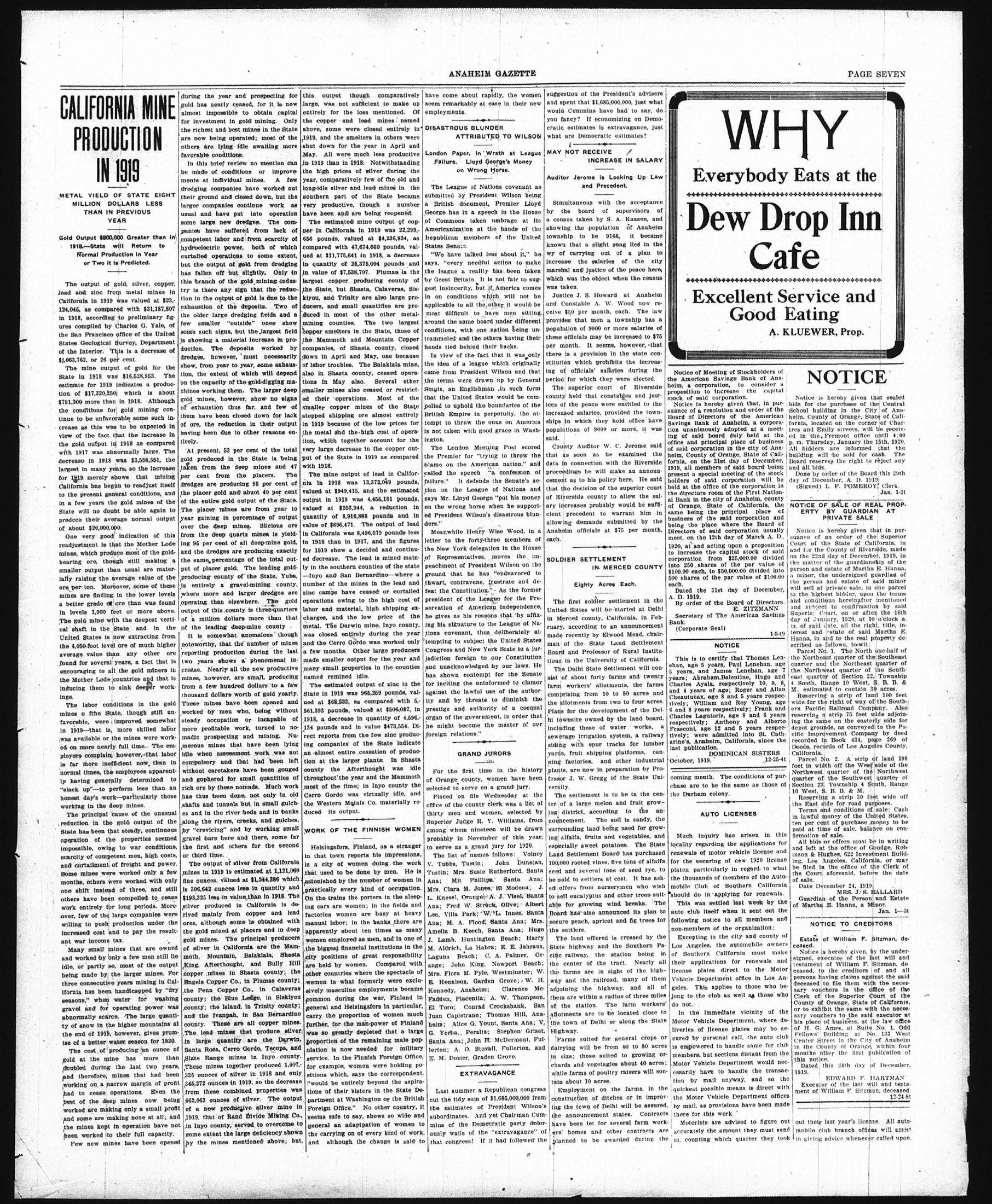
Searchable text
CALIFORNIA MINE PRODUCTION IN 1919
METAL YIELD OF STATE EIGHT MILLION DOLLARS LESS THAN IN PREVIOUS YEAR
Gold Output $800,000 Greater than in 1918—State will Return to Normal Production in Year or Two it is Predicted.
The output of gold, silver, copper, lead and zinc from metal mines in California in 1919 was valued at $23,124,045, as compared with $31,187,807 in 1918, according to preliminary figures compiled by Charles G. Yale, of the San Francisco office of the United States Geological Survey, Department of the Interior. This is a decrease of $1,063,762, or 26 per cent.
The mine output of gold for the State in 1918 was $16,528,953. The estimate for 1919 indicates a production of $17,320,250, which is about $791,300 more than in 1918. Although the conditions for gold mining continue to be unfavorable some such increase as this was to be expected in view of the fact that the increase in the gold output in 1918 as compared during the year and prospecting for gold has nearly ceased, for it is now almost impossible to obtain capital for investment in gold mining. Only the richest and best mines in the State are now being operated; most of the others are lying idle awaiting more favorable conditions.
In this brief review no mention can be made of conditions or improvements at individual mines. A few dredging companies have worked out their ground and closed down, but the larger companies continue work as usual and have put into operation some large new dredges. The companies have suffered from lack of competent labor and from scarcity of hydroelectric power, both of which curtailed operations to some extent, but the output of gold from dredging has fallen off but slightly. Only in this branch of the gold mining industry is there any sign that the reduction in the output of gold is due to the exhaustion of the deposits. Two of the older large dredging fields and a few smaller "outside" ones show some such signs, but the largest field is showing a material increase in production. The deposits worked by dredges, however, must necessarily show, from year to year, some exhaustion, the extent of which will depend on the capacity of the gold-digging machines working them. The larger deep gold mines, however, show no signs of exhaustion thus far, and few of them have been closed down for lack of ore, the reduction in their output having been due to other reasons entirely.
this output though large, was not sufficient entirely for the loss of the copper and lead above, some were close 1919, and the smelters shut down for the year May. All were much in 1919 than in 1918. The high prices of steel year, comparatively few long-idle silver and less southern part of the very productive, though have been and are being.
The estimated mine per in California in 1918 is 656 pounds, valued at compared with 47,674, used at $11,775,641 in quantity of 25,375, in value of $7,538,707. The largest copper producer in the State, but Shasta, klyou, and Trinity areducers, and small quantities produced in most of the mining counties. The copper smelters in the Mammoth and Mine companies, of Shasta, down in April and May of labor troubles. They also in Shasta county tions in May also. Smaller mines also ceased their operations. Smaller copper mines stopped shipping ore in 1919 because of the metal and the high tion, which together
The mine output of gold for the State in 1918 was $16,528,953. The estimate for 1919 indicates a production of $17,320,250, which is about $791,300 more than in 1918. Although the conditions for gold mining continue to be unfavorable some such increase as this was to be expected in view of the fact that the increase in the gold output in 1918 as compared with 1917 was abnormally large. The decrease in 1918 was $3,558,551, the largest in many years, so the increase for 1919 merely shows that mining California has begun to readjust itself to the present general conditions, and in a few years the gold mines of the State will no doubt be able again to produce their average normal output of about $20,000,000.
One very good indication of this readjustment is that the Mother Lode mines, which produce most of the gold-bearing ore, though still making a smaller output than usual are materially raising the average value of the ore per ton. Moreover, some of these mines are finding in the lower levels a better grade of ore than was found in levels 1,000 feet or more above. The gold mine with the deepest vertical shaft in the State and in the United States is now extracting from the 4,050-foot level ore of much higher average value than any other ore found for several years, a fact that is encouraging to all the gold miners in the Mother Lode countries and that is inducing them to sink deeper workings.
The labor conditions in the gold mines o f the State, though still unfavorable, were improved somewhat in 1919—that is, more skilled labor was available or the mines were worked on more nearly full time. The employers complain, however, that labor is far more inefficient now than in normal times, the employees apparently having generally determined to "slack up"—to perform less than an honest day's work—particularly those working in the deep mines.
The principal cause of the unusual reduction in the gold output of the State has been that steady, continuous operation of the properties seemed impossible, owing to war conditions, dredges, however, must necessarily show, from year to year, some exhaustion, the extent of which will depend on the capacity of the gold-digging machines working them. The larger deep gold mines, however, show no signs of exhaustion thus far, and few of them have been closed down for lack of ore, the reduction in their output having been due to other reasons entirely.
At present, 53 per cent of the total gold produced in the State is being taken from the deep mines and 47 per cent from the placers. The dredges are producing 95 per cent of the placer gold and abutot 40 per cent of the entire gold output of the State. The placer mines are from year to year gaining in percentage of output over the deep mines. Slicious ore from the deep quartz mines is yielding 95 per cent of all deep-mine gold, and the dredges are producing exactly the same percentage of the total output of placer gold. The leading gold-producing county of the State, Yuba, is entirely a gravel-mining county, where more and larger dredges are operating than elsewhere. The gold output of this county is three-quarters of a million dollars more than that of the leading deep-mine county.
It is somewhat anomalous though noteworthy, that the number of mines reporting production during the last two years shows a phenomenal increase. Nearly all the new productive mines, however, are small, producing from a few hundred dollars to a few thousand dollars worth of gold yearly. These mines have been opened and worked by men who, being without steady occupation or incapable of more profitable work, turned to nomadic prospecting and mining. Numerous mines that have been lying idle when assessment work was not compulsory and that had been left without caretakers have been gouged and gophered for small quantities of rich ore by these nomads. Much work has thus been done, not only in old shafts and tunnels but in small gulches and in the river beds and in banks along the rivers, creeks, and gulches, by "crevicing" and by working small gravel bars here and there, some far the first and others for the second
The mine output of California in 1918 was 13, valued at $949,415, and output in 1919 was 4 valued at $253,944; quantity of 8,916,888 value of $695,471. The in California was 8,496 in 1918 than in 1917; for 1919 show a decided decrease. The leadily in the southern country—Inyo and San Bernardo number of the mines zinc camps have ceased operations owing to labor and material charges, and the low metal. The Darwin mine was closed entirely o and the Cerro Gordo ve a few months. Other made smaller output in many small properties named remined idle.
The estimated output State in 1919 was 965 used at $68,533, as coated 561,393 pounds; valued 1918, a decrease in quantity 134 pounds and in direct reports from the ing companies of tha an almost entire cessation at the larger placer county the Afterthought throughout'the year and most of the time; in Cerro Gordo was visited by Western Metals Co. induced its output.
is far more inefficient now than in normal times, the employees apparently having generally determined to "slack up"—to perform less than an honest day's work—particularly those working in the deep mines.
The principal cause of the unusual reduction in the gold output of the State has been that steady, continuous operation of the properties seemed impossible, owing to war conditions, scarcity of competent men, high costs, and curtailment of freight and power. Some mines were worked only a few months, others were worked with only one shift instead of three, and still others have been compelled to cease work entirely for long periods. Moreover, few of the large companies were willing to push production under the increased cost and to pay the resultant war income tax.
Many small mines that are owned and worked by only a few men still lie idle, or partly so, most of the output being made by the larger mines. For three consecutive years mining in California has been handicapped by "dry seasons," when water for washing gravel and for operating power was abnormally scarce. The large quantity of snow in the higher mountains at the end of 1919, however, gives promise of a better water season for 1920.
The cost of producing an ounce of gold at the mine has more than doubled during the last two years, and therefore, mines that had been working on a narrow margin of profit had to cease operations. Even the best of the deep mines now being worked are making only a small profit and some are making none at all; and the mines kept in operation have not been worked to their full capacity.
Few new mines have been opened
compulsory and that had been left without caretakers have been gouged and gophered for small quantities of rich ore by these nomads. Much work has thus been done, not only in old shafts and tunnels but in small gulches and in the river beds and in banks along the riyers, creeks, and gulches, by "crevicing" and by working small gravel bars here and there, some far the first and others for the second or third time.
The output of silver from California mines in 1919 is estimated at 1,121,069 fine ounces, valued at $1,244,386 which is 306,642 ounces less in quantity and $193,325 less in value than in 1918. The silver produced in California is derived mainly from copper and lead ores, although some is obtained with the gold mined at placers and in deep gold mines. The principal producers of silver in California are the Mammoth, Mountain, Balaklala, Shasta King, Afterthought, and Bully Hill copper mines in Shasta county; the Engels Copper Co., in Plumas county; the Penn Copper Co., in Calaveras county; the Blue Ledge, in Siskiyou county; the Island, in Trinity county; and the Ivanpah, in San Bernardino county. These are all copper mines. The lead mines that produce silver in large quantity are the Darwin, Santa Rosa, Cerro Gordo, Tecopa, and Slate Range mines in Inyo county. These mines together produced 1,007,335 ounces of silver in 1918 and only 345,272 ounces in 1919, so the decrease from these combined properties was 662,063 ounces of silver. The output of a new productive silver mine in 1919, that of Rand Divide Mining Co., in Inyo county, served to overcome to some extent the large deficiency shown by the mines mentioned above; but,
Helsingsfors, Finland
in that town reports it is a city of women that used to be done astonished by the number practically every kind On the trains the poring cars are women; factories women are manual labor; in the apparently about ten women employed as many the biggest financial city positions of great are held by women. Other countries where wemon in what form sively masculine emp common during the general and Helsings carry the proportion further, for the man was so greatly deplei proportion of the remulation is now need service. In the Finnish for example, women sitions which, says t "would be entirely bitions of their sisters' partment at Washing Foreign Office." No seems safe to say, si general an adaptathe carrying on of eva and although the
ANAHEIM GAZETTE
this output though comparatively large, was not sufficient to make up entirely for the loss mentioned. Of the copper and lead mines named above, some were closed entirely in 1919, and the smelters in others were shut down for the year in April and May. All were much less productive in 1919 than in 1918. Notwithstanding the high prices of silver during the year, comparatively few of the old and long-idle silver and lead mines in the southern part of the State became very productive, though a number have been and are being reopened.
The estimated mine output of copper in California in 1919 was 22,299.656 pounds, valued at $4,236,934, as compared with 47,674,660 pounds, valued at $11,775,641 in 1918, a decrease in quantity of 25,375,004 pounds and in value of $7,538,707. Plumas is the largest copper producing county of the State, but Shasta, Calaveras, Siskiyou, and Trinity are also large producers, and small quantities are produced in most of the other metal-mining counties. The two largest copper smelters in the State, those of the Mammoth and Mountain Copper companies, of Shasta county, closed down in April and May, one because of labor troubles. The Balaklala mine, also in Shasta county, ceased operations in May also. Several other smaller mines also ceased or restricted their operations. Most of the smaller copper mines of the State stopped shipping ore almost entirely in 1919 because of the low prices for the metal and the high cost of operation, which together account for the very large decrease in the copper output.
have come about rapidly, the women seem remarkably at ease in their new employments.
DISASTROUS BLUNDER ATTRIBUTED TO WILSON
London Paper, in Wrath at League Failure. Lloyd George's Money on Wrong Horse.
The League of Nations covenant as submitted by President Wilson being a British document, Premier Lloyd George has in a speech in the House of Commons taken umbrage at its Americanization at the hands of the Republican members of the United States Senate.
"We have talked less about it," he says, "every needful action to make the league a reality has been taken by Great Britain. It is not fair to suggest insincerity, but if America comes in on conditions which will not be applicable to all the other it would be most difficult to have men sitting around the same board under different conditions, with one nation being untrammeled and the others having their hands tied behind their backs.
In view of the fact that it was only the idea of a league which originally came from President Wilson and that the terms were drawn up by General Smuts, an Englishman, in such form that the United States would be compelled to uphold the boundaries of the British Empire in perpetuity, the attempt to throw the onus on America is not taken with good grace in Washington.
The London Morning Post scored suggestion of the President's advisers and spent that $1,685,000,000 just what would Cummins have had to say, do you fancy? If economizing on Democratic estimates is extravagance, just what are Democratic estimates?
MAY NOT RECEIVE INCREASE IN SALARY
Auditor Jerome is Looking Up Law and Precedent.
Simultaneous with the acceptance by the board of supervisors of a census taken by S. A. Kaasen, and showing the population of Anaheim township to be 9168, it became known that a slight snag lies in the way of carrying out of a plan to increase the salaries of the city marshal and justice of the peace here, which was the object when the census was taken.
Justice J. S. Howard at Anaheim and Constable A. W. Wood now receive $50 per month, each. The law provides that men a township has a population of 9000 or more salaries of these officials may be increased to $75 per month. It seems, however,-that there is a provision in the state constitution which prohibits the increasing of officials' salaries during the period for which they were elected.
The superior court of Riverside county held that constables and justices of the peace were entitled to the increased salaries provided the townships in which they hold office have populations of 9000 or more, it was said.
County Auditor W. C. Jerome said
down in April and May, one because of labor troubles. The Balaklala mine, also in Shasta county, ceased operations in May also. Several other smaller mines also ceased or restricted their operations. Most of the smaller copper mines of the State stopped shipping ore almost entirely in 1919 because of the low prices for the metal and the high cost of operation, which together account for the very large decrease in the copper output of the State in 1919 as compared with 1918.
The mine output of lead in California in 1918 was 13,372,049 pounds, valued at $949,415, and the estimated output in 1919 was 4,455,161 pounds, valued at $253,944, a reduction in quantity of 8,916,888 pounds and in value of $696,471. The output of lead in California was 8,496,579 pounds less in 1918 than in 1917, and the figures for 1919 show a decided and continued decrease. The lead is mined mainly in the southern counties of the state—Inyo and San Bernardino—where a number of the mines in the lead and zinc camps have ceased or curtailed operations owing to the high cost of labor and material, high shipping charges, and the low price of the metal. The Darwin mine, Inyo county, was closed entirely during the year and the Cerro Gordo was worked only a few months. Other large producers made smaller output for the year and many small properties in the counties named remined idle.
The estimated output of zinc in the State in 1919 was 965,259 pounds, valued at $68,533, as compared with 5,561,393 pounds, valued at $506,087, in 1918, a decrease in quantity of 4,596,134 pounds and in value $473,554. Direct reports from the few zinc producing companies of the State indicate an almost entire cessation of production at the larger plants. In Shasta county the Afterthought was idle throughout the year and the Mammoth most of the time; in Inyo county the Cerro Gordo was virtually idle, and the Western Metals Co. materially reduced its output.
WORK OF THE FINNISH WOMEN
Helsingsfors, Finland, as a stranger
In view of the fact that it was only the idea of a league which originally came from President Wilson and that the terms were drawn up by General Smuts, an Englishman, in such form that the United States would be compelled to uphold the boundaries of the British Empire in perpetuity, the attempt to throw the onus on America is not taken with good grace in Washington.
The London Morning Post scored the Premier for "trying to throw the blame on the American nation," and called the speech "a confession of failure." It defends the Senate's action on the League of Nations and says Mr. Lloyd George "put his money on the wrong horse when he supported President Wilson's disastrous blunders."
Meanwhile Henry Wise Wood, in a letter to the forty-three members of the New York delegation in the House of Representatives, moves the impeachment of President Wilson on the ground that he has "endeavored to thwart, contravene, frustrate and defeat the Constitution." As the former president of the League for the Preservation of American Independence, he gives as his reasons that "by affixing his signature to the League of Nations covenant, thus deliberately attempting to subject the United States Congress and New York State to a jurisdiction foreign to our Constitution and unacknowledged by our laws. He has shown contempt for the Senate for inciting the uninformed to clamor against the lawful use of the authority and by threats to diminish the prestige and authority of a coequal organ of the government, in order that he might become the master of our foreign relations."
GRAND JURORS
For the first time in the history of Orange county, women have been selected to serve on a grand jury.
Placed on file Wednesday at the office of the county clerk was a list of thirty men and women, selected by Superior Judge R. Y. Williams, from among whom nineteen will be drawn probably in November of this year, to serve as a grand jury for 1920.
SOLDIER SETTLEMENT
IN MERCED COUNTY
Eighty Acres Each.
The first soldier settlement in the United Sittes will be started at Delhi in Merced county, California, in February, according to an announcement made recently by Elwood Mead, chairman of the State Land Settlement Board and Professor of Rural Institutions in the University of California.
The Delhi State Settlement will consist of about forty farms and twenty farm workers' allotments, the farms comprising from 10 to 80 acres and the allotments from two to four acres. Plans for the development of the Delhi townsite owned by the land board, including those of water works, a sewerage irrigation system, a railway siding with spur tracks for lumber yards, fruit shipping platforms, canning factories, and other industrial plants, are now in preparation by Professor J. W. Gregg of the State University.
The settlement is to be in the center of a large melon and fruit growing district, according to the announcement. The soil is sandy, the surrounding land being used for growing alfalfa, fruits and vegetables, and especially sweet potatoes. The State there is a provision in the state constitution which prohibits the increasing of officials' salaries during the period for which they were elected.
The superior court of Riverside county held that constables and justices of the peace were entitled to the increased salaries provided townships in which they hold office have populations of 9000 or more, it was said.
County Auditor W. C. Jerome said that as soon as he examined the data in connection with the Riverside proceedings he will make an announcement as to his policy here. He said that the decision of the superior court of Riverside county to allow the salary increases probably would be sufficient precedent to warrant him in allowing demands submitted by the Anaheim officials at $75 per month each.
NOTICE OF THE AMERICAN HEIM,
a co-operative stock of sea
Notice is issued by
Board of D Savings Bank
unanimously
of sale office and
of said corp.
heim,
County forma,
on
1919,
all me present a s
holders of a s
held at ther
director
Bank in
of Orange,
same being
business o
being ther
Directors o
meet on ther
1920,
at an
to increase
corporation
into 250 s.
$100.00 each
500 shares e
each.
Dated th.
A. D. 1919.
By order
Secretary Bank.
(Corporate)
This is te
ehan, age
5 years, a
years; Abi
Charles A.
and 4 years;
Cheautueantively; Wilh6 and 8 years;
Charles Lea.
respectivelFrasconi,
tively; we
arine's Anlast public
October,
coming m
chase are
the DurhaMuch i
locality re
WORK OF THE FINNISH WOMEN
Helsingsfors, Finland, as a stranger in that town reports his impressions, is a city of women doing the work that used to be done by men. He is astonished by the number of women in practically every kind of occupation. On the trains the porters in the sleeping cars are women; in the fields and factories women are busy at heavy manual labor; in the banks there are apparently about ten times as many women employed as men, and in one of the biggest financial institutions in the city positions of great responsibility are held by women. Compared with other countries where the spectacle of womens in what formerly were exclusively masculine employments became common during the war, Finland in general and Helsingsfors in particular, carry the proportion of women much further, for the man-power of Finland was so greatly depleted that a large proportion of the remaining male population is now needed for military service. In the Finnish Foreign Office, for example, women were holding positions which, says the correspondent, "would be entirely beyond the aspirations of their sisters in the State Department at Washington or the British Foreign Office." No other country, it seems safe to say, shows so wide and general an adaptation of women to the carrying on of every kind of work, and although the change is said to
For the first time in the history of Orange county, women have been selected to serve on a grand jury.
Placed on file Wednesday at the office of the county clerk was a list of thirty men and women, selected by Superior Judge R. Y. Williams, from among whom nineteen will be drawn probably in November of this year, to serve as a grand jury for 1920.
The list of names follows: Volney V. Tubbs, Tustin; John Dunstan, Tustin; Mrs. Susie Rutherford, Santa Ana; Mit Phillips, Santa Ana; Mrs. Clara M. Jones, El Modena; J. L. Knesel, Orange; A. J. Visel, Santa Ana; Fred W. Struck, Olive; Albert Lee, Villa Park; W. L. Innes, Santa Ana; M. A. Flood, Santa Ana; Mrs. Amelia B. Keech, Santa Ana; Hugo J. Lamb, Huntington Beach; Harry M. Aldrich, La Habra; E. E. Jahraus, Laguna Beach; C. A. Palmer, Orange; John King, Newport Beach; Mrs. Flora M. Pyle, Westminster; W. E. Hennison, Garden Grove; W. H. Kennedy, Anaheim; Clarence McFadden, Placentia; A. W. Thompson, El Toro; Conrad Crookshank, San Juan Capistrano; Thomas Hill, Anaheim; Alice G. Yount, Santa Ana; V. G. Yorba., Peralta; Stephen Griset, Santa Ana; John H. McDermont, Fullerton; A. O. Stovall, Fullerton, and E. M. Dozier, Graden Grove.
EXTRAVAGANCE
Last summer a Republican congress cut the tidy sum of $1,685,000,000 from the estimates of President Wilson's subordinates. And yet Chairman Cummins of the Democratic party dolorously wails of the "extravagance" of that congress! If it had followed the ning factories, and other industrial plants, are now in preparation by Professor J. W. Gregg of the State University.
The settlement is to be in the center of a large melon and fruit growing district, according to the announcement. The soil is sandy, the surrounding land being used for growing alfalfa, fruits and vegetables, and especially sweet potatoes. The State Land Settlement Board has purchased 100,000 rooted vines, five tons of alfalfa seed and several tons of seed rye, to be sold to settlers at cost. It has asked offers from nurserymen who wish to sell eucalyptus and other trees suitable for growing wind breaks. The Board has also announced its plan to secure peach, apricot and fig trees for the settlers.
The land offered is crossed by the State highway and the Southern Pacific railway, the station being in the center of the tract. Nearly all the farms are in sight of the highway and the railroad, many of them adjoining the highway, and all of them are within a radius of three miles of the station. The farm workers' allotments are to be located close to the town of Delhi or along the State Highway.
Farms suited for general crops or dairying will be from 40 to 80 acres in size; those suited to growing orchards and vegetages about 40 acres; while farms of poultry raisers will contain about 10 acres.
Employment on the farms, in the construction of ditches or in improving the town of Delhi will be assured, the announcement states. Contracts have been let for several farm workers' homes and other contracts are planned to be awarded during the October 19th coming month.
Much is locality renewals for the seas plates, part the thousand mobile Clios should do.
This was auto club following non-member Excepting Los Angeles of South their app license p Vehicle Delges. The Jong to thou do not.
In the Motor Vei liveries o cured by is empower members Motor Vei essarily l tion by quickest t he Motor by mail, there for Motor vei accurately i n count-
WHY Everybody Eats at the Dew Drop Inn Cafe
Excellent Service and Good Eating
A. KLUEWER, Prop.
Notice of Meeting of Stockholders of the American Savings Bank of Anaheim, a corporation, to consider a proposition to increase the capital stock of said corporation.
Notice is hereby given that, in pursuance of a resolution and order of the Board of Directors of the American Savings Bank of Anaheim, a corporation unanimously adopted at a meeting of said board duly held at the office and principal place of business of said corporation in the city of Ana-
NOTICE
Notice is hereby given that sealed bids for the purchase of the Central School building in the City of Anaheim, County of Orange, State of California, located on the corner of Char-tres and Emily streets, will be received in the, Fremont office until 4:00 p.m. Thursday, January the 15th, 1920.
All bidders are informed that the
Notice of Meeting of Stockholders of the American Savings Bank of Anaheim, a corporation, to consider a proposition to increase the capital stock of said corporation.
Notice is hereby given that, in pursuance of a resolution and order of the Board of Directors of the American Savings Bank of Anaheim, a corporation unanimously adopted at a meeting of said board duly held at the office and principal place of business of said corporation in the city of Anaheim, County of Orange, State of California, on the 31st day of December, 1919, all members of said board being present a special meeting of the stock holders of said corporation will be held at the office of the corporation in the directors room of the First National Bank in the city of Anaheim, county of Orange, State of California, the same being the principal place of business of the said corporation and being the place where the Board of Directors of said corporation usually meet, on the 12th day of March A. D., 1920, at and acting upon a proposition to increase the capital stock of said corporation from $25,000.00 divided into 250 shares of the par value of $100.00 each, to $50,000.00 divided into 500 shares of the par value of $100.00 each.
Dated the 31st day of December, A. D. 1919.
By order of the Board of Directors.
E. Zitzmann
Secretary of The American Savings Bank.
(Corporate Seal)
NOTICE
This is to certify that Thomas Lenehan, age 5 years, Paul Lenehan, age 5 years, and James Lenehan, age 7 years, Abraham Balentine, Hugo and Charles Ayala, respectively 10, 9, 8, and 4 years of age; Roger and Allan Cheautueax, age 8 and 5 years respectively; William and Roy Young, age 6 and 8 years respectively; Frank and Charles Lagutoris, age 8 and 6 years respectively; Anthony and Alberto Frasconi, age 12 and 5 years respectively; were admitted into St. Catharine's, Anaheim, California, since the last publication.
DOMINICAN SISTERS
October, 1919.
coming month. The conditions of purchase are to be the same as those of the Durham colony.
AUTO LICENSES
Much inquiry has arisen in this locality regarding the applications for auto license.
NOTICE
Notice is hereby given that sealed bids for the purchase of the Central School building in the City of Anaheim, County of Orange, State of California, located on the corner of Charries and Emily streets, will be received in the Fremont office until 4:00 p.m. Thursday, January the 15th, 1920. All bidders are informed that the building will be sold for cash. The Board reserves the right to reject any and all bids.
Done by order of the Board this 29th day of December, A. D. 1919.
(Signed) L. F. POMEROY Clerk.
Jan. 1-3t
NOTICE OF SALE OF REAL PROPERTY BY GUARDIAN AT PRIVATE SALE
Notice is hereby given that in pursuance of an order of the Superior Court of the State of California, in and for the County of Riverside, made on the 22nd day of December, 1919, in the matter of the guardianship of the person and estate of Martha E. Hanna, a minor, the undersigned guardian of the person and estate of said minor will sell at private sale, in one parcel to the highest bidder, upon the terms and conditions hereinafter mentioned and subject to confirmation by said Superior Court, on or after the 16th day of January, 1920, at 10 o'clock a.m. of said date, all the right title, interest and estate of said Martha E. Hanna, in and to the real property described as follows, to-wit:
Parcel No. 1. The North one-half of the Northeast quarter of the Southeast quarter and the Northeast quarter of the Northwest quarter of the Southeast quarter of Section 22, Township 4 South Range 10 West, S. B. B. & M., estimated to contain 36 acres.
Reserving a strip of land 100 feet wide for the right of way of the Southern Pacific Railroad Company. Also reserving a strip 75 feet wide adjoining the same on the easterly side for depot grounds, as conveyed to the Pacific Improvement Company by deed recorded in Book 434, page 269 of Deeds, records of Los Angeles County, California.
Parcel No. 2. A strip of land 198 feet in width off the West side of the Northwest quarter of the Northwest quarter of Section 23, Township 4 South Range 10 West, S. B. B. & M.
Reserving a strip 30 feet wide off the East side for road purposes.
Terms and conditions of sale: Cash in lawful money of the United States, ten per cent of purchase money to be paid at time of sale, balance on confirmation of sale.
All bids or offers must be in writing and left at the office of Goudge, Rob-
AUTO LICENSES
Much inquiry has arisen in this locality regarding the applications for renewals of motor vehicle license and for the securing of new 1920 license plates, particularly in regard to what the thousands of members of the Automobile Club of Southern California should do in applying for renewals.
This was settled last week by the auto club itself when it sent out the following notice to all members and non-members of the organization:
Excepting in the city and county of Los Angeles, the automobile owners of Southern California must make their applications for renewals and license plates direct to the Motor Vehicle Department office in Los Angeles. This applies to those who belong to the club as well as those who do not.
In the immediate vicinity of the Motor Vehicle Department, where deliveries of license plates may be secured by personal call, the auto club is empowered to handle same for club members, but sections distant from the Motor Vehicle Department would necessarily have to handle the transaction by mail anyway, and so the quickest possible means is direct with the Motor Vehicle Department offices by mail, as provisions have been made there for this work.
Motorists are advised to figure out accurately the amount they must send in, counting which quarter they took Parcel No. 2. A strip of land 198 feet in width off the West side of the Northwest quarter of the Northwest quarter of the Southwest quarter of Section 23, Township 4 South, Range 10 West, S. B. B. & M.
Reserving a strip 30 feet wide off the East side for road purposes.
Terms and conditions of sale: Cash in lawful money of the United States, ten per cent of purchase money to be paid at time of sale, balance on confirmation of sale.
All bids or offers must be in writing and left at the office of Goudge, Robinson & Hughes, 622 Investment Building, Los Angeles, California, or may be filed in the office of the Clerk of the Court aforesaid, before the date of sale.
Date December 24, 1919
MRS. J. S. EALLARD
Guardian of the Person and Estate of Marthe E. Hanna, a Minor.
Jan. 1—3t
NOTICE TO CREDITORS
Estate of William F. Sitzman, deceased.
Notice is hereby given, by the undersigned, executor of the last will and testament of William F. Sitzman, deceased, to the creditors of and all persons having claims against the said deceased to file them with the necessary vouchers in the office of the Clerk of the Superior Court of the County of Orange, State of California, or to exhibit the same with the necessary vouchers to the said executor at his place of business, at the law office of H. G. Ames, at Suite No. 1, Odd Fellows' Building at No. 133 West Center Street in the City of Anaheim in the County of Orange, within four months after the first publication of this notice.
Dated this 24th day of December, 1919.
EDWARD F. HARTMAN
Executor of the last will and testament of William F. Sitzman, deceased.
12-24-5t
out their last year's license. All automobile club branch offices will assist in giving advice whenever called upon.