anaheim-gazette 1920-01-08
Scanned page
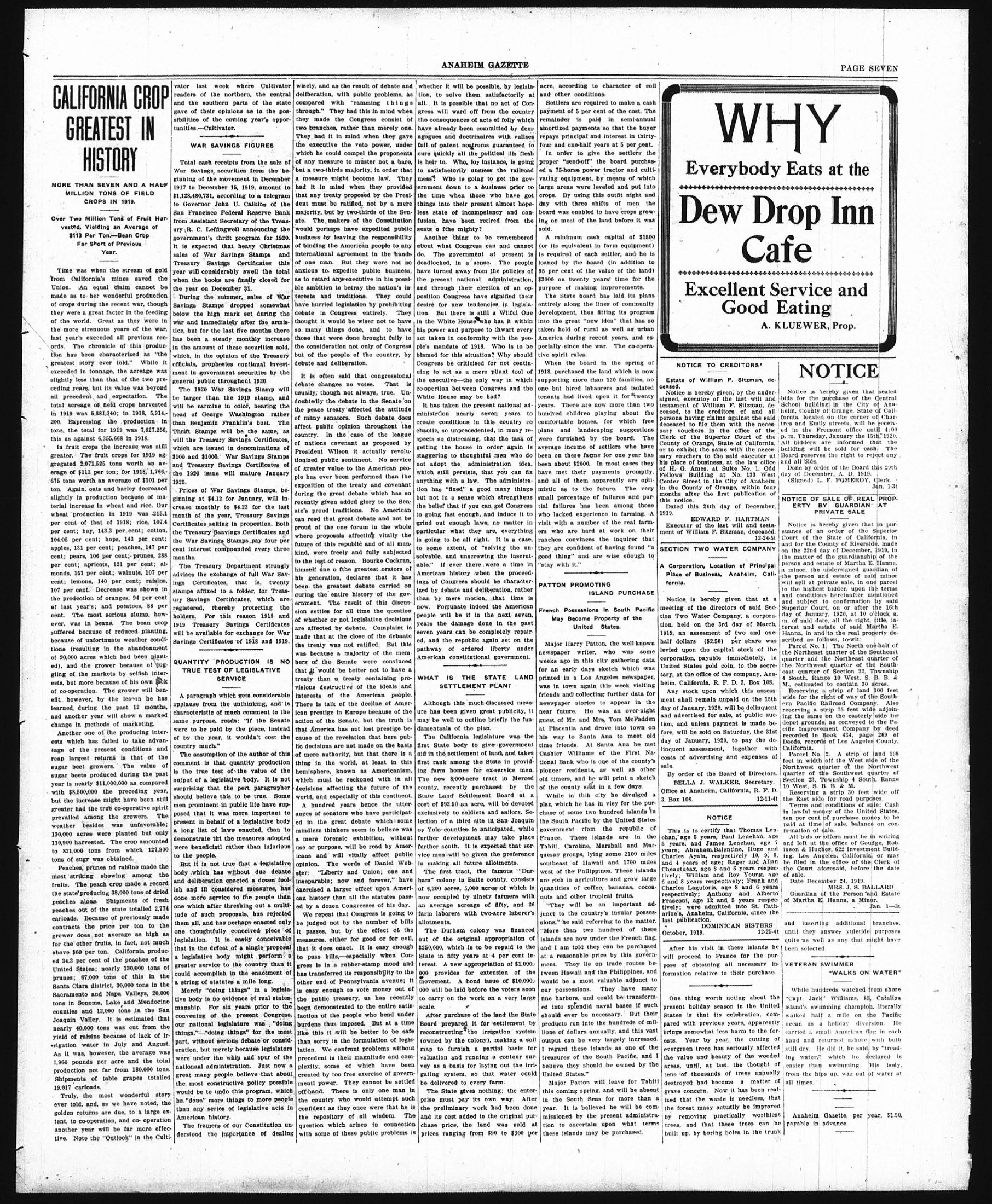
Searchable text
CALIFORNIA CROP GREATEST IN HISTORY
MORE THAN SEVEN AND A HALF MILLION TONS OF FIELD CROPS IN 1919.
Over Two Million Tons of Fruit Harvested, Yielding an Average of $113 Per Ton.—Bean Crop Far Short of Previous Year.
Time was when the stream of gold from California's mines saved the Union. An equal claim cannot be made as to her wonderful production of crops during the recent war, though they were a great factor in the feeding of the world. Great as they were in the more strenuous years of the war, last year's exceeded all previous records. The chronicle of this production has been characterized as "the greatest story ever told." While it exceeded in tonnage, the acreage was slightly less than that of the two preceding years, but its value was beyond all precedent and expectation. The total acreage of field crops harvested in 1919 was 5,881,340; in 1918, 5,914,200. Expressing the production in tons, the total for 1919 was 7,627,256, this as against 6,355,668 in 1918.
In fruit crops the increase was still伏ator last week where Cultivator readers of the northern, the central and the southern parts of the state gave of their opinions as to the possibilities of the coming year's opportunities.—Cultivator.
WAR SAVINGS FIGURES
Total cash receipts from the sale of War Savings, securities from the beginning of the movement in December 1917 to December 15, 1919, amount to $1,128,480,731, according to a telegram to Governor John U. Calkins of the San Francisco Federal Reserve Bank from Assistant Secretary of the Treasury R. C. Leffingwell announcing the government's thrift program for 1920. It is expected that heavy Christmas sales of War Savings Stamps and Treasury Savings Certificates this year will considerably swell the total when the books are finally closed for the year on December $1.
During the summer, sales of War Savings Stamps dropped somewhat below the high mark set during the war and immediately after the armistice, but for the last five months there has been a steady monthly increase in the amount of these securities sold, which, in the opinion of the Treasury officials, prophesies continual investment in government securities by the general public throughout 1920.
The 1920 War Savings Stamp will be larger than the 1919 stamp, and will be carmine in color, bearing the head of George Washington rather than Benjamin Franklin's bust. The Thrift Stamps will be the same, as will the Treasury Savings Certificates, which are issued in denominations of wisely, and as the result deliberation, with public compared with "ramm through." They had this they made the Congress two branches, rather than They had it in mind while the executive the veto which he could compel to any measure to muster but a two-thirds majority; a measure might become had it in mind when that any treaty proposed dent must be ratified, no majority, but by two-thirds date. The makers of the would perhaps have expired business by leaving the binding American international agreement of one man. But they anxious to expedite put as to retard any executive ambition to betray their interests and traditions. have hurried legislation to debate in Congress enought thought it would be wise so many things done, a those that were done before the consideration not only but of the people of the debate and deliberation.
It is often said that debate changes no votes usually, though not always doubtedly the debate in t he peace treaty affected of many senators. Such affect public opinion th e country. In the case o f nations covenant as
In fruit crops the increase was still greater. The fruit crops for 1919 aggregated 2,071,525 tons worth an average of $113 per ton; for 1918, 1,766,675 tons worth an average of $101 per ton. Again, oats and barley decreased slightly in production because of material increase in wheat and rice. Our wheat production in 1919 was 215.1 per cent of that of 1918; rice, 107.4 per cent; hay, 143.3 per cent; cotton, 104.05 per cent; hops, 143 per cent; apples, 131 per cent; peaches, 147 per cent; pears, 106 per cent; prunes, 288 per cent; apricots, 121 per cent; almonds, 151 per cent; walnuts, 107 per cent; lemons, 140 per cent; raisins, 107 per cent. Decrease was shown in the production of oranges, 94 per cent of last year's; and potatoes, 88 per cent. The most serious slump, however, was in beans. The bean crop suffered because of reduced planting, because of unfortunate weather conditions (resulting in the abandonment of 20,000 acres which had been planted), and the grower because of juggling of the markets by selfish interests, but more because of his own lack of co-operation. The grower will benefit, however, by the lesson he has learned during the past 12 months, and another year will show a marked change in methods of marketing.
Another one of the producing interests which has failed to take advantage of the present conditions and reap largest returns is that of the sugar beet growers. The value of sugar beets produced during the past year is nearly $11,000,000 as compared with $8,500,000 the preceding year, but the increase might have been still greater had the true co-operative spirit prevailed among the growers. The weather besides was unfavorable; 130,000 acres were planted but only 110,900 harvested. The crop amounted to 821,000 tons from which 127,900 which, in the opinion of the Treasury officials, prophesies continual investment in government securities by the general public throughout 1920.
The 1920 War Savings Stamp will be larger than the 1919 stamp, and will be carmine in color, bearing the head of George Washington rather than Benjamin Franklin's bust. The Thrift Stamps will be the same, as will the Treasury Savings Certificates, which are issued in denominations of $100 and $1000. War Savings Stamps and Treasury Savings Certificates of the 1920 issue will mature January 1925.
Prices of War Savings Stamps, beginning at $4.12 for January, will increase monthly to $4.23 for the last month of the year. Treasury Savings Certificates selling in proportion. Both the Treasury Saavings Certificates and the War Savings Stamps pay four per cent interest compounded every three months.
The Treasury Department strongly advises the exchange of full War Savings Certificates, that is, twenty stamps affixed to a folder, for Treasury Savings Certificates, which are registered, thereby protecting the holders. For this reason 1918 and 1919 Treasury Savings Certificates will be available for exchange for War Savings Certificates of 1918 and 1919.
QUANTITY PRODUCTION IS NO TRUE TEST OF LEGISLATIVE SERVICE
A paragraph which gets considerable applause from the unthinking, and is characteristic of much comment to the same purpose, reads: "If the Senate were to be paid by the piece, instead of by the year, it wouldn't cost the country much."
The assumption of the author of this comment is that quantity production is the true test of the value of the output of a legislative body. It is not surprising that the pert paragraph should believe this to be true. Some men prominent in public life have supposed that it was more important to present in behalf of a legislative body a long list of laws enacted, than to demonstrate that the measures adopted were beneficiatl rather than injurious.
It is often said that debate changes no vote usually, though not always doubtedly the debate in the peace treaty affected many senators. Such affect public opinion there country. In the case of nations covenant as President Wilson it actionized public sentiment of greater value to the people has ever been performed exposition of the treaty during the great debate recently given added gloryate's proud traditions. can read that great debate proud of the one forum where proposals affecting future of this republic and kind were freely and futile to the test of reason. Body himself one o fthe greatest his generation, declares been the greatest debate during the entire history ernment. The result of vision settlers for all time whether or not legislature are affected by debate made that at the close of the treaty was not ratified was because a majority bers of the Senate we that it would be better treaty than a treaty co visions destructive of th interests of the America There is talk of the deeican prestige in Europe by action of the Senate, but that America has not lost cause of the revelation tlic decisions are not made of mere authority, but th thing in the world, at hemisphere, known as which must be reckoned decisions affecting th world, and especially of A hundred years henceances of senators who hared in the great debate mindless thinkers seem ta mere forseic exhibit use or purpose, will be n
reap largest returns is that of the sugar beet growers. The value of sugar beets produced during the past year is nearly $11,000,000 as compared with $8,500,000 the preceding year, but the increase might have been still greater had the true co-operative spirit prevailed among the growers. The weather besides was unfavorable; 130,000 acres were planted but only 110,900 harvested. The crop amounted to 821,000 tons from which 127,900 tons of sugr was obtained.
Peaches, prunes and raisins made the most striking showing among the fruits. The peach crop made a record the state producing 38,000 tons of dried peaches alone. Shipments of fresh peaches out of the state totalled 2,774 carloads. Because of previously made contracts the price per ton to the grower does not average as high as for the other fruits, in fact, not much above $60 per ton. California produced 34.3 per cent of the peaches of the United States; nearly 130,000 tons of prunes; 67,000 tons of this in the Santa Clara district, 30,000 tons in the Sacramento and Napa Valleys, 20,000 tons in Sonoma, Lake and Mendocino counties and 12,000 tons in the San Joaquin Valley. It is estimated that nearly 40,000 tons was cut from the yield of raisins because of lack of irrigation water in July and August. As it was, however, the average was 1,960 pounds per acre and the total production not far from 180,000 tons. Shipments of table grapes totalled 19,017 carloads.
Truly, the most wonderful story ever told, and, as we have noted, the golden returns are due to a large extent, to co-operation, and co-operation another year will be far more effective. Note the "Outlook" in the Culti-
The assumption of the author of this comment is that quantity production is the true test of the value of the output of a legislative body. It is not surprising that the pert paragrapher should believe this to be true. Some men prominent in public life have supposed that it was more important to present in behalf of a legislative body a long list of laws enacted, than to demonstrate that the measures adopted were beneficiatl rather than injurious to the people.
But it is not true that a legislative body which has without due debate and deliberation enacted a dozen foolish and ill considered measures, has done more service to the people than one which after threshing out a multitude of such proposals, has rejected them all, and has perhaps enacted only one thoughtfully conceived piece of legislation. It is easily conceivable that in the defeat of a single proposal a legislative body might perform a greater service to the country than it could accomplish in the enactment of a string of statutes a mile long.
Merely "doing things" in a legislative body is no evidence of real statesmanship. For six years prior to the convening of the present Congress, our national legislature was "doing things,"—"doing things" for the most part, without serious debate or consideration, but merely because legislators were under the whip and spur of the national administration. Just now a great many people believe that about the most constructive policy possible would be to undo this program, which has "done" more things to more people than any series of legislative acts in American history.
The framers of our Constitution understood the importance of dealing with some of these public things in the world, at homeisphere, known as which must be reckoned decisions affecting the world, and especially of the thing in the world, at homeisphere, known as which must be reckoned decisions affecting the world, and especially of the thing in the world, at homeisphere, known as which must be reckoned decisions affecting the world, and especially of the thing in the world, at homeisphere, known as which must be reckoned decisions affecting the world, and especially of the thing in the world, at homeisphere, known as which must be reckoned decisions affecting the world, and especially of the thing in the world, at homeisphere, known as which must be reckoned decisions affecting the world, and especially of the thing in the world, at homeisphere, known as which must be reckoned decisions affecting the world, and especially of the thing in the world, at homeisphere, known as which must be reckoned decisions affecting the world, and especially of the thing in the world, at homeisphere, known as which must be reckoned decisions affecting the world, and especially of the thing in the world, at homeisphere, known as which must be reckoned decisions affecting the world, and especially of the thing in the world, at homeisphere, known as which must be reckoned decisions affecting the world, and especially of the thing in the world, at homeisphere, known as which must be reckoned decisions affecting the world, and especially of the thing in the world, at homeisphere, known as which must be reckoned decisions affecting the world, and especially of the thing in the world, at homeisphere, known as which must be reckoned decisions affecting the world, and especially of the thing in the world, at homeisphere, known as which must be reckoned decisions affecting the world, and especially of the thing in the world, at homeisphere, known as which must be reckoned decisions affecting the world, and especially of the thing in the world, at homeisphere, known as which must be reckoned decisions affecting the world, and especially of the thing in the world, at homeisphere,known as which must be reckoned decisions affectingtheworld,andespeciallyofthethingintheworld.athomeisphere,knownasthemismsphere,knownasthehemisphere,knownasthehemisphere,knownasthehemisphere,knownasthehemisphere,knownasthehemisphere,knownasthehemisphere,knownasthehemisphere,knownasthehemisphere,knownasthehemisphere,knownasthehemisphere,knownasthehemisphere,knownasthehemisphere,knownasthehemisphere,knownasthehemisphere,knownasthehemisphere,knownasthehemisphere,knownasthehemisphere,knownasthehemisphere,knownasthehemisphere,knownasthehemisphere,knownasthehemisphere,knownasthehemisphere,knownasthehemisphere,knownasthehemisphere,knownasthehemisphere,knownasthehemisphere,knownasthehemisphere,knownasthehemisphere,knownasthehemisphere,knownasthehemisphere,knownasthehemisphere,knownasthehemisphere,knownasthehemisphere,knownasthehemisphere,kknownascertainble,themostconstructivepolicypossiblewouldbetoundthisprogramwhichhasmorethingstomorepeoplethananyseriesoflegislativeactsinAmericanhistory.
A hundred years henceances of senators who hailed in the great debates mindless thinkers seem to a mere forensic exhibition use or purpose will be newicans and will vitally opinion. The words of stater: "Liberty and Uninseparable; now and for exercise a larger effect can history than all they led by a dozen Congressmen."
We repeat that Congress be judged not by the number it passes but by its measures either for good that it does enact. It is to pass bills—especiallygress is in a rubber-stamp has transferred its responsibility end of Pennsylvania is easy enough to vote on public treasury; as been demonstrated to this faction ofthepeoplewhurdensthusimposed.likethisitwillbetethorsemorrowsof sorryintheformulation.Wew confrontprocedentin their magnificity,someofwhichcreatedbytoofreeexertementpower.Theycanoff-hand.Thereisononlythecountrywhowouldconfidentastheyoncewiththerepositoryofallquestionwhichariseswithsomeofthesepublc
wisely, and as the result of debate and deliberation, with public problems, as compared with "ramming things through." They had this in mind when they made the Congress consist of two branches, rather than merely one. They had it in mind when they gave the executive the veto power, under which he could compel the proponents of any measure to muster not a bare, but a two-thirds majority, in order that a measure might become law. They had it in mind when they provided that any treaty proposed by the President must be ratified, not by a mere majority, but by two-thirds of the Senate. The makers of the Constitution would perhaps have expedited public business by leaving the responsibility of binding the American people to any international agreement in the hands of one man. But they were not so anxious to expedite public business, as to retard any executive in his possible ambition to betray the nation's interests and traditions. They could have hurried legislation by prohibiting debate in Congress entirely. They thought it would be wiser not to have so many things done, and to have those that were done brought fully to the consideration not only of Congress but of the people of the country, by debate and deliberation.
It is often said that congressional debate changes no votes. That is usually, though not always, true. Undoubtedly the debate in the Senate on the peace treaty affected the attitude of many senators. Such debate does affect public opinion throughout the country. In the case of the league of nations covenant as proposed by
whether it will be possible, by legislation, to solve them satisfactorily at all. It is possible that no act of Congress will ward off from the country the consequences of acts of folly which have already been committed by demagogues and doctrinales with valises full of patent non-trums guaranteed to cure quickly all the political illus flesh is heir to. Who, for instance, is going to satisfactorily unmess the railroad mess? Who is going to get the government down to a business prior to the time when those who have got things into their present almost hopeless state of incompetency and confusion, have been retired from the seats ofthe mighty?
Another thing to be remembered about what Congress can and cannot do. The government at present is deadlocked, in a sense. The people have turned away from the policies of the present national administration, and through their election of an opposition Congress have signified their desire for new tendencies in legislation. But there is still a Wilful One in the White House who has it within his power and purpose to thwart every act taken in conformity with the people's mandate of 1918. Who is to be blamed for this situation? Why should Congress be criticised for not continuing to act as a mere pliant tool of the executive—the only way in which co-operation between Congress and the White House may be had?
It has taken the present national administration nearly seven years to create conditions in this country so chaotic, so unprecedented, in many respects so distressing, that the task of getting the house in order again is acre, according to character of soil and other conditions.
Settlers are required to make a cash payment of 5 per cent of the cost. The remainder is paid in semi-annual amortized payments so that the buyer repays principal and interest in thirty-four and one-half years at 5 per cent.
In order to give the settlers the proper "send-off" the board purchased a 75-horse power tractor and cultivating equipment, by means of which large areas were leveled and put into crops. By using this outfit night and day with three shifts of men the board was enabled to have crops growing on most of the land before it was sold.
A minimum cash capital of $1500 (or its equivalent in farm equipment) is required of each settler, and he is loaned by the board (in addition to 95 per cent of the value of the land) $3000 on twenty years' time for the purpose of making improvements.
The State board has laid its plans entirely along the lines of community development, thus fitting its program into the great "new idea" that has so taken hold of rural as well as urban America during recent years, and especially since the war. The co-operative spirit rules.
When the board in the spring of 1918, purchased the land which is now supporting more than 120 families, no one hired labaorers and isolated tenants had lived upon it for twenty years. There are now more than two hundred children playing about the comfortable homes, for which free plans and landscaping suggestions were furnished by the board. The average income of settlers who have
It is often said that congressional debate changes no votes. That is usually, though not always, true. Undoubtedly the debate in the Senate on the peace treaty affected the attitude of many senators. Such debate does affect public opinion throughout the country. In the case of the league of nations covenant as proposed by President Wilson it actually revolutionized public sentiment. No service of greater value to the American people has ever been performed than the exposition of the treaty and covenant during the great debate which has so recently given added glory to the Senate's proud traditions. No American can read that great debate and not be proud of the one forum in the whole where proposals affecting vitally the future of this republic and of all mankind, were freely and fully subjected to the test of reason. Bourke Cockran, himself one o f the greatest orators of his generation, declares that it has been the greatest debate carried on during the entire history of the government. The result of this discussion settles for all time the question of whether or not legislative decisions are affected by debate. Complaint is made that at the close of the debaate the treaty was not ratified. But this was because a majority of the members of the Senate were convinced that it would be better not to have a treaty than a treaty containing provisions destructive of the ideals and interests of the American people. There is talk of the decline of American prestige in Europe because of the action of the Senate, but the truth is that America has not lost prestige because of the revelation that here public decisions are not made on the basis of mere authority, but that there is a thing in the world, at least in this hemisphere, known as Americanism, which must be reckoned with in all decisions affecting the future of the world, and especially of this continent.
A hundred years hence the utterances of senators who have participated in the great debate which some mindless thinkers seem to believe was a mere forensic exhibition, without use or purpose, will be read by Amer-
It has taken the present national administration nearly seven years to create conditions in this country so chaotic, so unprecedented, in many respects so distressing, that the task of getting the house in order again is staggering to thoughtful men who do not adopt the administration idea, which still persists, that you can fix anything with a law. The administration has "fixed" a good many things but not in a sense which strengthens the belief that if you can get Congress to going fast enough, and induce it to grind out enough laws, no matter in particular what they are, everything is going to be all right. It is a case, to some extent, of "solving the unsolvable, and unscrewing the inscrutable." If ever there were a time in American history when the proceedings of Congress should be characterized by debate and deliberation, rather than by mere motion, that time is now. Fortunate indeed the American people will be if in the next seven years the damage done in the past seven years can be completely repaired, and the republic again set on the pathway of ordered liberty under American constitutional government.
WHAT IS THE STATE LAND SETTLEMENT PLAN?
Although this much-discussed measure has been given great publicity, it may be well to outline briefly the fundamentals of the plan.
The California legislature was the first State body to give government aid in the settlement of land, and takes first rank among the Stats in providing farm homes for ex-service men. The new 8,000-acre tract in Merced county, recently purchased by the State Land Settlement Board at a cost of $92.50 an acre, will be devoted exclusively to soldiers and sailors. Selection of a third site in San Joaquin or Yolo counties is anticipated, while further development may take place further south. It is expected that service spirit rules.
When the board in the spring of 1918, purchased the land which is now supporting more than 120 families, no one but hired labaorers and isolated tenants had lived upon it for twenty years. There are now more than two hundred children playing about the comfortable homes, for which free plans and landscaping suggestions were furnished by the board. The average income of settlers who have been on these farms for one year has been about $2000. In most cases they have met their payments promptly, and all of them apparently are optimistic as to the future. The very small percentage of failures and partial failures has been among those who lacked experience in farming. A visit with a number of the real farmers who are hard at work on their ranches convinces the inquirer that they are confident of having found "a good thing" and are wise enough to "stay with it."
PATTON PROMOTING ISLAND PURCHASE
French Possessions in South Pacific May Become Property of the United States.
Major Harry Patton, the well-known newspaper writer, who was some weeks ago in this city gathering data for an early days sketch which was printed in a Los Angeles newspaper, was in town again this week visiting friends and collecting further data for newspaper stories to appear in the near future. He was an over-night guest of Mr. and Mrs. Tom McFadden at Placentia and drove into town on his way to Santa Ana to meet old time friends. At Santa Ana he met Cashier Williams of the First National Bank who is one of the county's pioneer residents, as well as other old timers, and he will print a sketch of the county seat in a few days.
While in thih city he divulged a plan which he has in vey for the purchase of some two hundred islands in the South Pacific by the United States government from the republic of France. These islands are in the Tahiti, Caroline, Marshall and Maritime spirit rules.
When the board in the spring of 1918, purchased the land which is now supporting more than 120 families, no one but hired labaorers and isolated tenants had lived upon it for twenty years. There are now more than two hundred children playing about the comfortable homes, for which free plans and landscaping suggestions were furnished by the board. The average income of settlers who have been on these farms for one year has been about $2000. In most cases they have met their payments promptly, and all of them apparently are optimistic as to the future. The very small percentage of failures and partial failures has been among those who lacked experience in farming. A visit with a number of the real farmers who are hard at work on their ranches convinces the inquirer that they are confident of having found "a good thing" and are wise enough to "stay with it."
PATTON PROMOTING ISLAND PURCHASE
French Possessions in South Pacific May Become Property of the United States.
Major Harry Patton, the well-known newspaper writer, who was some weeks ago in this city gathering data for an early days sketch which was printed in a Los Angeles newspaper, was in town again this week visiting friends and collecting further data for newspaper stories to appear in the near future. He was an over-night guest of Mr. and Mrs. Tom McFadden at Placentia and drove into town on his way to Santa Ana to meet old time friends. At Santa Ana he met Cashier Williams of the First National Bank who is one of the county's pioneer residents, as well as other old timers, and he will print a sketch of the county seat in a few days.
While in thih city he divulged a plan which he has in vey for the purchase of some two hundred islands in the South Pacific by the United States government from the republic of France. These islands are in the Tahiti, Caroline, Marshall and Maritime spirit rules.
When the board in the spring of 1918, purchased the land which is now supporting more than 120 families, no one but hired labaorers and isolated tenants had lived upon it for twenty years. There are now more than two hundred children playing about the comfortable homes, for which free plans and landscaping suggestions were furnished by the board. The average income of settlers who have been on these farms for one year has been about $2000. In most cases they have met their payments promptly, and all of them apparently are optimistic as to the future. The very small percentage of failures and partial failures has been among those who lacked experience in farming. A visit with a number of the real farmers who are hard at work on their ranches convinces the inquirer that they are confident of having found "a good thing" and are wise enough to "stay with it."
PATTON PROMOTING ISLAND PURCHASE
French Possessions in South Pacific May Become Property of the United States.
Major Harry Patton, the well-known newspaper writer, who was some weeks ago in this city gathering data for an early days sketch which was printed in a Los Angeles newspaper, was in town again this week visiting friends and collecting further data for newspaper stories to appear in the near future. He was an over-night guest of Mr. and Mrs. Tom McFadden at Placentia and drove into town on his way to Santa Ana to meet old time friends. At Santa Ana he met Cashier Williams of the First National Bank who is one of the county's pioneer residents, as well as other old timers, and he will print a sketch of the county seat in a few days.
While in thih city he divulged a plan which he has in vey for the purchase of some two hundred islands in the South Pacific by the United States government from the republic of France. These islands are in the Tahiti, Caroline, Marshall and Maritime spirit rules.
When the board in the spring of 1918, purchased the land which is now supporting more than 120 families, no one but hired labaorers and isolated tenants had lived upon it for twenty years. There are now more than two hundred children playing about the comfortable homes, for which free plans and landscaping suggestions were furnished by the board. The average income of settlers who have been on these farms for one year has been about $2000. In most cases they have met their payments promptly, and all of them apparently are optimistic as to the future. The very small percentage of failures and partial failures has been among those who lacked experience in farming. A visit with a number of the real farmers who are hard at work on their ranches convinces the inquirer that they are confident of having found "a good thing" and are wise enough to "stay with it."
PATTON PROMOTING ISLAND PURCHASE
French Possessions in South Pacific May Become Property of the United States.
Major Harry Patton, the well-known newspaper writer, who was some weeks ago in this city gathering data for an early days sketch which was printed in a Los Angeles newspaper, was in town again this week visiting friends and collecting further data for newspaper stories to appear in the near future. He was an over-night guest of Mr. and Mrs. Tom McFadden at Placentia and drove into town on his way to Santa Ana to meet old time friends. At Santa Ana he met Cashier Williams of the First National Bank who is one of the county's pioneer residents, as well as other old timers, and he will print a sketch of the county seat in a few days.
While in thih city he divulged a plan which he has in vey for the purchase of some two hundred islands in the South Pacific by the United States government from the republic of France. These islands are in the Tahiti, Caroline, Marshall and Maritime spirit rules.
When the board in the spring of 1918, purchasedthe landwhichisnowsupportingmorethan120familiesnoonebuthiredlabaorersandisolatedtenantshadliveduponitfortwentyyearsTherearenowmothenowthantwohundredchildrenplayingaboutthecomfortablehomes,forgivethenecessarypromptlyandallofthehemapparentlyareoptimisticastothefuture.Theverysmallpercentageoffailuresandpartialfailureshasbeenamongthosewho lackedexperienceinfarming.Avisitwithanumberoftherealfarmerswhohardatworkontheirranchesconvinencestheinquirerthattheyareconfidentofhavingfound"agoodthing"andarewiseenoughtostaywithit."
A hundred years hence the utterances of senators who have participated in the great debate which some mindless thinkers seem to believe was a mere forensic exhibition, without use or purpose, will be read by Americans and will vitally affect public opinion. The words of Daniel Webster: "Liberty and Union; one and inseparable; now and forever," have exercised a larger effect upon American history than all the statutes passed by a dozen Congresses of his day.
We repeat that Congress is going to be judged not by the number of bills it passes, but by the effect of the measures, either for good or for evil, that it does enact. It is easy enough to pass bills—especially when Congress is in a rubber-stamp mood and has transferred its responsibility to the other end of Pennsylvania avenue; it is easy enough to vote money out of the public treasury, as has recently been demonstrated to the entire satisfaction of the people who bend under burdens thus imposed. But at a time like this it will be better to be safe than sorry in the formulation of legislation. We confront problems without precedent in their magnitude and complexity, some of which have been created by too free exercise of governmental power. They cannot be settled off-hand. There is only one man in the country who would attempt such confident as they once were that he is the repository of all wisdom. The question which arises in connection with some of these public problems is
first rank among the Stats in providing farm homes for ex-service men. The new 8,000-acre tract in Merced county, recently purchased by the State Land Settlement Board at a cost of $92.50 an acre, will be devoted exclusively to soldiers and sailors. Selection of a third site in San Joaquin or Yolo counties is anticipated, while further development may take place further south. It is expected that service men will be given the preference in making all future allotments.
The first tract, the famous "Durham" colony in Butte county, consists of 6,200 acres, 5,000 acres of which is now occupied by ninety farmers with an average acreage of fifty, and 26 farm laborers with two-acre laborer's allotments.
The Durham colony was financed out of the original appropriation of $250,000, which is to be repaid to the State in fifty years at 4 per cent interest. A new appropriation of $1,000.00 provides for extension of the movement. A bond issue of $10,000.00 will be laid before the voters soon to carry on the work on a very large scale.
After purchase of the land the State Board prepared it for settlement by reconstructing the irrigation system (owned by the colony), making a soil map to furnish a partial basis for valuation and running a contour survey as a basis for laying out the irrigating system, so that water could be delivered to every farm.
The State gives nothing; the enterprise must pay its own way. After the preliminary work had been done and its cost added to the original purchase price, the land was sold at prices ranging from $90 to $300 per
national Bank who is one of the county's pioneer residents, as well as other old timers, and he will print a sketch of the county seat in a few days.
While in thih city he divulged a plan which he has in viey for the purchase of some two hundred islands in the South Pacific by the United States government rfrom the republic of France. These islands are in the Tahiti, Caroline, Marshall and Marquesas groups, lying some 2100 miles southeast of Hawaii and 1700 miles west of the Philippines. These islands are rich in agriculture and grow large quantities of coffee, bananas, cocoa nuts and other tropical fruits.
"They will be an important adjunct to the country's insular possessions," he said referring to the matter. "More than two hundred of these islands are now under the French flag, and I am told they can be purchased at a reasonable price by this government. They lie on trade routes between Hawaii and the Philippines, and would be a most valuable adjunct to our possessions. They have many fine harbors, and could be transformed into splendid naval bases if such should ever be necessary. But their products run into the hundreds of millions of dollars annually, and this vast output can be very largely increased. I regard these islands as one of the treasures of the South Pacific, and I believe they should be owned by the United States."
Major Patton will leave for Tahiti this coming spring, and will be absent in the South Seas for more than a year. It is believed he will be commissioned by the present administration to ascertain upon what terms these islands may be purchased.
WHY
Everybody Eats at the
Dew Drop Inn Cafe
Excellent Service and Good Eating
A. KLUEWER, Prop.
NOTICE TO CREDITORS*
Estate of William F. Sitzman, deceased.
Notice is hereby given, by the undersigned, executor of the last will and testament of William F. Sitzman, deceased, to the creditors of and all persons having claims against the said deceased to file them with the necessary vouchers in the office of the Clerk of the Superior Court of the County of Orange, State of California, or to exhibit the same with the neces
NOTICE
Notice is hereby given that sealed bids for the purchase of the Central School building in the City of Anaheim, County of Orange, State of California, located on the corner of Char-tres and Emily streets, will be receiv-ed in the Fremont office until 4:00 p.m. Thursday, January the 15th, 1920. All bidders are informed that the building will be sold for cash. The
NOTICE TO CREDITORS*
Estate of William F. Sitzman, deceased.
Notice is hereby given, by the undersigned, executor of the last will and testament of William F. Sitzman, deceased, to the creditors of and all persons having claims against the said deceased to file them with the necessary vouchers in the office of the Clerk of the Superior Court of the County of Orange, State of California, or to exhibit the same with the necessary vouchers to the said executor at his place of business, at the law office of H. G. Ames, at Suite No. 1, Odd Fellows' Building at No. 133 West Center Street in the City of Anaheim in the County of Orange, within four months after the first publication of this notice.
Dated this 24th day of December, 1919.
EDWARD F. HARTMAN
Executor of the last will and testament of William F. Sitzman, deceased.
SECTION TWO WATER COMPANY
A Corporation, Location of Principal Place of Business, Anaheim, California.
Notice is hereby given that at a meeting of the directors of said Section Two Water Company, a corporation, held on the 3rd day of March, 1919, an assessment of two and one-half dollars ($2.50) per share was levied upon the capital stock of the corporation, payable immediately, in United States gold coin, to the secretary, at the office of the company, Anaheim, California, R. F. D. 3, Box 108.
Any stock upon which this assessment shall remain unpaid on the 15th day of January, 1920, will be delinquent and advertised for sale, at public auction, and unless payment is made before, will be sold on Saturday, the 31st day of January, 1920, to pay the delinquent assessment, together with costs of advertising and expenses of sale.
By order of the Board of Directors.
BELLA J. WALKER, Secretary.
Office at Anaheim, California, R. F. D. 3, Box 108.
12-11-4t
NOTICE
This is to certify that Thomas Lenchan, age 5 years, Paul Lenehan, age 5 years, and James Lenehan, age 7 years; Abraham Balentine, Hugo and
NOTICE
Notice is hereby given that sealed bids for the purchase of the Central School building in the City of Anaheim, County of Orange, State of California, located on the corner of Charles and Emily streets, will be received in the Fremont office until 4:00 p.m. Thursday, January the 15th, 1920. All bidders are informed that the building will be sold for cash. The Board reserves the right to reject any and all bids.
Done by order of the Board thus 29th day of December, A. D. 1919.
(Signed) L. F. POMEROY, Clerk.
Jan. 1-3t
NOTICE OF SALE OF REAL PROPERTY BY GUARDIAN AT PRIVATE SALE
Notice is hereby given that in pursuance of an order of the Superior Court of the State of California, in and for the County of Riverside, made on the 22nd day of December, 1919, in the matter of the guardianship of the person and estate of Martha E. Hanna, a minor, the undersigned guardian of the person and estate of said minor will sell at private sale, in one parcel to the highest bidder, upon the terms and conditions hereinafter mentioned and subject to confirmation by said Superior Court, on or after the 16th day of January, 1920, at 10 o'clock a.m. of said date, all the right, title, interest and estate of said Martha E. Hanna, in and to the real property described as follows, to-wit:
Parcel No. 1. The North one-half of the Northeast quarter of the Southeast quarter and the Northeast quarter of the Northwest quarter of the Southeast quarter of Section 22, Township 4 South, Range 10 West, S. B. B. & M., estimated to contain 30 acres.
Reserving a strip of land 100 feet wide for the right of way of the Southern Pacific Railroad Company. Also reserving a strip 75 feet wide adjoining the same on the easterly side for depot grounds; as conveyed to the Pacific Improvement Company by deed recorded in Book 434, page 269 of Deeds, records of Los Angeles County, California.
Parcel No. 2. A strip of land 198 feet in width off the West side of the Northwest quarter of the Northwest quarter of Section 23, Township 4 South, Range 10 West, S. B. B. & M.
Reserving a strip 30 feet wide off the East side for road purposes.
Terms and conditions of sale: Cash in lawful money of the United States, ten per cent of purchase money to be paid at time of sale, balance on confirmation of sale.
All bids or offers must be in writing and left at the office of Gouldge, Robinson & Hughes, 622 Investment Build-
NOTICE
This is to certify that Thomas Lenchan, age 5 years, Paul Lenehan, age 5 years, and James Lenehan, age 7 years; Abraham Balentine, Hugo and Charles Ayala, respectively 10, 9, 8, and 4 years of age; Roger and Allan Cheautueax, age 8 and 5 years respectively; William and Roy Young, age 6 and 8 years respectively; Frank and Charles Lagutoris, age 8 and 6 years respectively; Anthony and Alberto Frasconi, age 12 and 5 years respectively; were admitted into St. Catharine's, Anaheim, California, since the last publication.
DOMINICAN SISTERS
October, 1919.
12-25-4t
After his visit in these islands he will proceed to France for the purpose of obtaining all necessary information relative to their purchase.
One thing worth noting about the present holiday season in the United States is that its celebration, compared with previous years, apparently brings somewhat less harm to the forests. Year by year, the cutting of evergreen trees has seriously affected the value and beauty of the wooded areas, until, at last, the thought of tens of thousands of trees annually destroyed had become a matter of grave concern. Now it has been realized that the waste is needless, that the forest may actually be improved by removing practically worthless trees, and that these trees can be built up by boring holes in the trunk.
MRS. J. S. BALLARD
Guardian of the Person and Estate of Martha E. Hanna, a Minor.
Jan. 1—3t
and inserting additional branches, until they answer yuletide purposes quite as well as any that might have been selected.
VETERAN SWIMMER
"WALKS ON WATER"
While hundreds watched from shore "Capt. Jack" Williams, 85, Catalina island's swimming champion, literally walked half a mile on the Pacific ocean as a holiday diversion. He carried a small American flag in each hand and returned ashore with both still dry. He did it, he said, by "treading water," which he declared is easier than swimming. His body, from the hips up, was out of water at all times.
Anaheim Gazette, per year, $1.50, payable in advance.