anaheim-gazette 1920-01-01
Scanned page
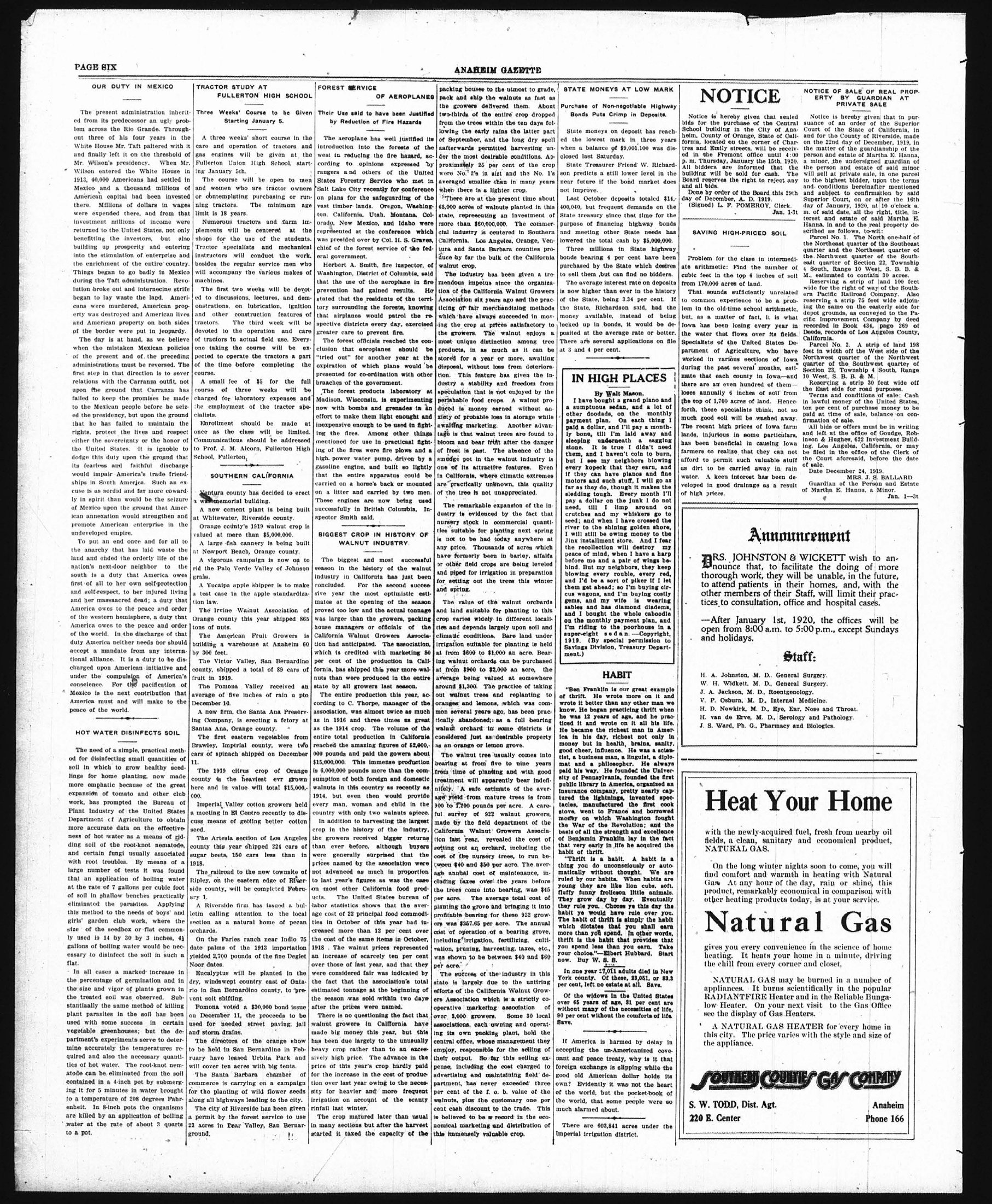
Searchable text
OUR DUTY IN MEXICO
The present administration inherited from its predecessor an ugly problem across the Rio Grande. Throughout three of his four years in the White House Mr. Taft paltered with it and finally left it on the threshold of Mr. Wilson's presidency. When Mr. Wilson entered the White House in 1913, 40,000 Americans had settled in Mexico and a thousand millions of American capital had been invested there. Millions of dollars in wages were expended there, and from that investment millions of income were returned to the United States, not only benefitting the investors, but also building up prosperity and entering into the stimulation of enterprise and the enrichment of the entire country. Things began to go badly in Mexico during the Taft administration. Revolution broke out and internecine strife began to lay waste the land. Americans were murdered, American property was destroyed and American lives and American property on both sides of the border were put in jeopardy.
The day is at hand, as we believe when the mistaken Mexican policies of the present and of the preceding administrations must be reversed. The first step in that direction is to sever relations with the Carranza outfit, not upon the ground that Carranza has failed to keep the promises he made to the Mexican people before he seized the presidency, but upon the ground that he has failed to maintain the rights, protect the lives and respect either the sovereignty or the honor of the United States. It is ironic to
TRACTOR STUDY AT FULLERTON HIGH SCHOOL
Three Weeks' Course to be Given Starting January 5.
A three weeks' short course in the care and operation of tractors and gas engines will be given at the Fullerton Union High School, starting January 5th.
The course will be open to men and women who are tractor owners or contemplating purchasing or running tractors. The minimum age limit is 18 years.
Numerous tractors and farm implements will be centered at the shops for the use of the students. Tractor specialists and mechanical instructors will conduct the work, besides the regular service men who will accompany the various makes of machines.
The first two weeks will be devoted to discussions, lectures, and demonstrations, on lubrication, ignition and other construction features of tractors. The third week will be devoted to the operation and care of tractors in actual field use. Everyone taking the course will be expected to operate the tractors a part of the time before completing the course.
A small fee of $5 for the full course of three weeks will be charged for laboratory expenses and the employment of the tractor specialists.
Enrollment should be made at once as the class will be limited. Communications should be addressed to Prof. J. M. Alcorn, Fullerton High Forest Service.
The aeroplane introduction into west in reducing cording to opining rangers and other States Forestry by Reduction.
The aeroplane introduction into west in reducing cording to opining rangers and other States Forestry by Reduction.
Herbert A. Smith Washington, District that the use of the prevention had given stated that the recovery surrounding that airplanes wouldpective districts greater care to provide forest officialclusion that aeroplane "tried out" for some expiration of which presented for co-braaches of the geography.
The forest program Madison, Wisconsin now with bombs effort to make their inexpensive enough using the fires. A mentionned for use of
of the present and of the preceding administrations must be reversed. The first step in that direction is to sever relations with the Carranza outfit, not upon the ground that Carranza has failed to keep the promises he made to the Mexican people before he seized the presidency, but upon the ground that he has failed to maintain the rights, protect the lives and respect either the sovereignty or the honor of the United States. It is ignoble to dodge this duty upon the ground that its fearless and faithful discharge would impair America's trade friendships in South America. Such an excuse is as sordid and far more cowardly in spirit than would be the seizure of Mexico upon the ground that American annexation would strengthen and promote American enterprise in the undeveloped empire.
To put an end once and for all to the anarchy that has laid waste the land and ended the orderly life of the nation's next-door neighbor to the south is a duty that America owes first of all to her own self-protection and self-respect, to her injured living and her massacred dead; a duty that America owes to the peace and order of the western hemisphere, a duty that America owes to the peace and order of the world. In the discharge of that duty America neither needs nor should accept a mandate from any international alliance. It is a duty to be discharged upon American initiative and under the compulsion of America's conscience. For the pacification of Mexico is the next contribution that America must and will make to the peace of the world.
HOT WATER DISINFECTS SOIL
The need of a simple, practical method for disinfecting small quantities of soil in which to grow healthy seedlings for home planting, now made more emphatic because of the great expansion of tomato and other club work, has prompted the Bureau of Plant Industry of the United States Department of Agriculture to obtain more accurate data on the effectiveness of hot water as a means of ridding soil of the root-knot nematode,
A small fee of $5 for the full course of three weeks will be charged for laboratory expenses and the employment of the tractor specialists.
Enrollment should be made at once as the class will be limited. Communications should be addressed to Prof. J. M. Alcorn, Fullerton High School, Fullerton.
SOUTHERN CALIFORNIA
Ventura county has decided to erect a war memorial building.
A new cement plant is being built at Whitewater, Riverside county.
Orange county's 1919 walnut crop is valued at more than $5,000,000.
A large fish cannery is being built at Newport Beach, Orange county.
A vigorous campaign is now on to rid the Palo Verde Valley of Johnson grass.
A Yucalpa apple shipper is to make a test case in the apple standardization law.
The Irvine Wainut Association of Orange county this year shipped 865 tons of nuts.
The American Fruit Growers is building a warehouse at Anaheim 60 by 300 feet.
The Victor Valley, San Bernardino county, shipped a total of 89 cars of fruit in 1919.
The Pomona Valley received an average of five inches of rain u pto December 10.
A new firm, the Santa Ana Preserving Company, is erecting a factory at Santaa Ana, Orange county.
The first eastern vegetables from Drawley, Imptrial county, were two cars of spinach shipped on December 11.
The 1919 citrus crop of Orange county is the heaviest evr grown here and in value will total $15,000,-000.
Imperial Valley cotton growers held a meeting in El Centro recently to discuss means of getting better cotton seed.
The Artesia section of Los Angeles county this year shipped 224 cars of expected to operate the tractors a part of the time before completing the course.
The forest producer Madison, Wisconsin now with bombs and effort to make their inexpensive enough fires. A mentioned for use in inging of the fires with high power water gasoline engine, so that the entire carried on a horse on a litter and crayon. These engines are successfully in Brush spector Smith said.
BIGGEST CROP WALNUT
The biggest annual season in the big industry in California concluded. For five years the maizes at the open proved too low and was larger than the house managers of California Walnut cultivation had anticipated which is credited per cent of the California, has shipped nuts than were produced state by all growers.
The entire product cording to C. Thornton association, was also in 1916 and thus as the 1914 crop. Entire total products reached the amazing 000 pounds and pallet $15,000,000. This is 6,000,000 pounds sumption of both for walnuts in this country 1914, but even then every man, woman country with only one crop in history. The growers receive than ever before.
od for disinfecting small quantities of soil in which to grow healthy seedlings for home planting, now made more emphatic because of the great expansion of tomato and other club work, has prompted the Bureau of Plant Industry of the United States Department of Agriculture to obtain more accurate data on the effectiveness of hot water as a means of ridding soil of the root-knot nematode, and certain fungi usually associated with root troubles. By means of a large number of tests it was found that an application of boiling water at the rate of 7 gallons per cubic foot of soil in shallow benches practically eliminated the parasites. Applying this method to the needs of boys' and girls' garden club work, where the size of the seedbox or flat commonly used is 14 by 30 by 3 inches, 4½ gallons of boiling water would be necessary to disinfect the soil in such a flat.
In all cases a marked increase in the percentage of germination and in the size and vigor of plants grown in the treated soil was observed. Substantially the same method of killing plant parasites in the soil has been used with some success in certain vegetable greenhouses; but the department's experiments serve to determine accurately the temperatures required and also the necessary quantities of hot water. The root-knot nematode can be eliminated from the soil contained in a 4-inch pot by submerging it for 5 minutes in water brought to a temperature of 208 degrees Fahrenheit. In 8-inch pots the organisms are killed by an application of boiling water at the rate of about 3 quarts to a pot.
The 1919 citrus crop of Orange county is the heaviest evr grown here and in value will total $15,000,000.
Imperial Valley cotton growers held a meeting in El Centro recently to discuss means of getting better cotton seed.
The Artesia section of Los Angeles county this year shipped 224 cars of sugar beets, 150 cars less than in 1918.
The railroad to the new townsite of Ripley, on the eastern edge of River-side county, will be completed February 1.
A Riverside firm has issued a bulletin calling attention to the local section as a natural home of pecan orchards.
On the Faries ranch near Indio 75 date palms of the 1913 importation yielded 2,700 pounds of the fine Deglet Noor dates.
Eucalyptus will be planted in the dry, windswept country east of Ontario in San Bernardino county, to prevent soil shifting.
Pomona voted a $30,000 bond issue on December 11, the proceeds to be used for needed street paving, jail and storm drains.
The directors of the orange show to be held in San Bernardino in February have leased Urbita Park and will cover ten acres with big tents.
The Santa Barbara chamber of commerce is carrying on a campaign for the planting of wild flower seeds along all highways leading to the city.
The city of Riverside has been given a permit by the forest service to use 23 acres in Pear Valley, San Bernarground.
There is no question walnut growers in made big money that has been due largely heavy crop rather severely high price. The price of this year's for the increase in production over last year is city for heavier irrigation on account rainfall last winter.
The crop matured in many sections but started it taxed th
ANAHEIM GAZETTE
FOREST SERVICE OF AEROPLANES
Their Use said to have been Justified by Reduction of Fire Hazards
The aeroplane has well justified its introduction into the forests of the west in reducing the fire hazard, according to opinions expressed by rangers and others of the United States Forestry Service who met in Salt Lake City recently for conference on plans for the safeguarding of the vast timber lands. Oregon, Washington, California, Utah, Montana, Colorado, New Mexico, and Idaho were represented at the conference which was presided over by Col. H. S. Graves, chief of the forest service of the federal government.
Herbert A. Smith, fire inspector, of Washington, District of Columbia, said that the use of the aeroplane in fire prevention had gained results. He stated that the residents of the territory surrounding the forests, knowing that airplanes would patrol the respective districts every day, exercised greater care to prevent fire.
The forest officials reached the conclusion that aeroplanes should be "tried out" for another year at the expiration of which plans would be presented for co-ordination with other braaches of the government.
The forest products laboratory at Madison, Wisconsin, is experimenting now with bombs and grenades in an effort to make them light enough and inexpensive enough to be used in fighting the fires. Among other things mentioned for use in practical fighting of the fires of the forests to the utmost to grade, pack and ship the walnuts as fast as the growers delivered them. About two-thirds of the entire crop dropped from the trees within the ten days following the early rains the latter part of September, and the long dry spell afterwards permitted harvesting under the most desirable conditions. Approximately 25 per cent of the crop were No. 2's in silt and the No. 1's averaged smaller than in many years when there is a lighter crop.
There are at present time about 65,000 acres of walnut planted in this state, representing an investment of more than $60,000,000. The commercial industry is centered in Southern California. Los Angeles, Orange, Ventura and Santa Barbara counties produce by far the bulk of the California walnut crop.
The industry has been given a tremendous impetus since the organization of the California Walnut Growers Association six years ago and the practicing of fair merchandizing methods which have always succeeded in moving the crop at prices satisfactory to the growers. The walnut enjoys a most unique distinction among tree products, in as much as it can be stored for a year or more, awaiting disposal, without loss from deterioration. This feature has given the industry a stability and freedom from speculation that is not enjoyed by the perishable food crops. A walnut produced is money earned without anxiety of probable loss in storage while awaiting marketing. Another advantage is that walnut trees are found to bloom and bear fruit after the danger.
STATE MONEYS AT LOW MARK
Purchase of Non-negotiable Highway Bonds Puts Crimp in Deposits.
State moneys on deposit has reached the lowest mark in three years when a balance of $9,001,100 was disclosed last Saturday.
State Treasurer Friend W. Richardson predicts a still lower level in the near future if the bond market does not improve.
Last October deposits totaled $14,400,040, but frequent demands on the State treasury since that time for the purpose of financing highway bonds and meeting other State needs has lowered the total cash by $5,000,000.
Three millions in State highway bonds bearing 4 per cent have been purchased by the State which desires to sell them but can find no bidders.
The average interest rate on deposits is now higher than ever in the history of the State, being 3.34 per cent. If the State, Richardson said, had the money available, instead of being locked up in bonds, it would be deposited at the average rate or better. There are several applications on file at 3 and 4 per cent.
IN HIGH PLACES
By Walt Mason.
I have bought a grand plano and a sumptuous sedan, and a lot of other doodads, on the monthly payment plan. On each thing I paid a dollar, and I'll pay a monthly bone, till I'm laid away and sleeping underneath a sagging stone. It is true I didn't need
"tried out" for another year at the expiration of which plans would be presented for co-ordination with other braaches of the government.
The forest products laboratory at Madison, Wisconsin, is experimenting now with bombs and grenades in an effort to make them light enough and inexpensive enough to be used in fighting the fires. Among other things mentioned for use in practical fighting of the fires were fire plows and a high power water pump, driven by a gasoline engine, and built so lightly that the entire apparatus could be carried on a horse's back or mounted on a litter and carried by two men. These engines are now being used successfully in British Columbia, Inspector Smith said.
BIGGEST CROP IN HISTORY OF WALNUT INDUSTRY
The biggest and most successful season in the history of the walnut industry in California has just been concluded. For the second successive year the most optimistic estimates at the opening of the season proved too low and the actual tonnage was larger than the growers, packing house managers or officials of the California Walnut Growers Association had anticipated. The association, which is credited with marketing 80 per cent of the production in California, has shipped this year more walnuts than were produced in the entire state by all growers last season.
The entire production this year, according to C. Thorpe, manager of the association, was almost twice as much as in 1916 and three times as great as the 1914 crop. The volume of the entire total production in California reached the amazing figures of 52,000,000 pounds and paid the gowers about $15,000,000. This immense production is 6,000,000 pounds more than the consumption of both foreign and domestic walnuts in this country as recently as 1914, but even then would provide every man, woman and child in the country with only two walnuts apiece.
In addition to harvesting the largest crop in the history of the industry, the growers received bigger returns than ever before, although buyers stored for a year or more, awaiting disposal, without loss from deterioration. This feature has given the industry a stability and freedom from speculation that is not enjoyed by the perishable food crops. A walnut produced is money earned without anxiety of probable loss in storage while awaiting marketing. Another advantage is that walnut trees are found to bloom and bear fruit after the danger of frost is past. The absence of the smudge pot in the walnut industry is one of its attractive features. Even in California, where climatic extremes are practically unknown, this quality of the tree is not unappreciated.
The remarkable expansion of the industry is evidenced by the fact that nursery stock in commercial quantities suitable for planting next spring is not to be had today anywhere at any price. Thousands of acres which have formerly been in barley, alfalfa or other field crops are being leveled and piped for irrigation in preparation for setting out the trees this winter and spring.
The value of the walnut orchards and land suitable for planting to this crop varies widely in different localities and depends largely upon soil and climatic conditions. Bare land under irrigation suitable for planting is held at from $600 to $1,000 an acre. Bear ing walnut orchards can be purchased at from $900 to $2,000 an acre, the average being valued at somewhere around $1,300. The practice of taking out walnut trees and replanting to oranges and lemons, which was common several years ago, has been practically abandoned; as a full bearing walnut orchard in some districts is considered just as desirable property as an orange or lemon grove.
The walnut tree usually comes into bearing at from five to nine years from time of planting and with good treatment will apparently bear indefinitely. A safe estimate of the average yield from mature trees is from 900 to 1,200 pounds per acre. A careful survey of 922 walnut growers, made by the field department of the California Walnut Growers Association fast year, revealed the cost of setting out an orchard, including the
IN HIGH PLACES
By Walt Mason.
I have bought a grand plano and a sumptuous sedan, and a lot of other doodads, on the monthly payment plan. On each thing I paid a dollar, and I'll pay a monthly bone, till I'm laid away and sleeping underneath a sagging stone. It is true I didn't need them, and I haven't coin to burn, but I see my neighbors blowing every kopeck that they earn, and if they can have planes and fine motors and such stuff, I will go as far as they do, though it makes the sledding tough. Every month I'll pay a dollar on the junk I do not need, till I limp around on crutches and my whiskers go to seed; and when I have crossed the river to the shining golden shore, I will still be owing money to the Jinx installment store. And I fear the recollection will destroy my peace of mind, when I have a harp before me and a pair of wings behind. But my neighbors, they keep blowing every rouble, every red, and I'd be a sort of piker if I let them get ahead; so I'm buying circus wagons, and I'm buying costly gems, and my wife is wearing sables and has diamond diadems, and I bought the whole caboodle on the monthly payment plan, and I'm riding to the poorhouse in a super-eight sedan.—Copyright, 1919. (By special permission to Savings Division, Treasury Department.)
HABIT
"Ben Franklin is our great example of thrift. He wrote more on it and wrote it better than any other man we know. He began practicing thrift when he was 12 years of age, and he practiced it and wrote on it all his life. He became the richest man in America in his day, richest not only in money but in health, brainy, sanity, good cheer, influence. He was a scientist, a business man, a linguist, a diplomat and a philosopher. He always paid his way. He founded the University of Pennsylvania, founded the first public library in America, organized an insurance company, pretty nearly captured the lightnings, invented spectacles, manufactured the first cook stove, went to France and borrowed money on which Washington fought the War of the Revolution; and the basis of all the strength and excellence of Benjamin Franklin lay in the fact that very early in life he acquired the
This immense production is 6,000,000 pounds more than the consumption of both foreign and domestic walnuts in this country as recently as 1914, but even then would provide every man, woman and child in the country with only two walnuts apiece.
In addition to harvesting the largest crop in the history of the industry, the growers received bigger returns than ever before, although buyers were generally surprised that the prices named by the association were not advanced as much in proportion to last year's figures as was the case on most other California food products.
The United States bureau of labor statistics shows that the average cost of 22 principal food commodities in October of this year had increased more than 12 per cent over the cost of the same items in October, 1918. The walnut prices represented an increase of scarcely ten per cent over those of last year, and that they were considered fair was indicated by the fact that the association's total estimated tonnage at the beginning of the season was sold within two days after the prices were named.
There is no questioning the fact that walnut growers in California have made big money this year, but this has been due largely to the unusually heavy crop rather than to an excessively high price. The advance in the price of this year's crop hardly paid for the increase in the cost of production over last year owing to the necessity for heavier and more frequent irrigation on account of the scanty rainfall last winter.
The crop matured later than usual in many sections but after the harvest started it taxed the capacity of the walnut tree usually comes into bearing at from five to nine years from time of planting and with good treatment will apparently bear indefinitely. A safe estimate of the average yield from mature trees is from 900 to 1,200 pounds per acre. A careful survey of 922 walnut growers, made by the field department of the California Walnut Growers Association last year, revealed the cost of setting out an orchard, including the cost of the nursery trees, to run between $40 and $50 per acre. The average annual cost of maintenance, including taxes over the years before the trees come into bearing, was $45 per acre. The average total cost of planting the grove and bringing it into profitable bearing for these 922 growers was $257.65 per acre. The annual cost of operation of a bearing grove, including irrigation, fertilizing, cultivation, pruning, harvesting, taxes, etc., was shown to be between $40 and $60 per acre.
The success of the industry in this state is largely due to the untiring efforts of the California Walnut Growers Association which is a strictly cooperative marketing association of over 3,000 growers. Some 30 local associations, each owning and operating its own packing plant, hold the central office, whose management they employ, responsible for the selling of their output. So far this selling expense, including the cost charged to advertising and maintaining field department, has never exceeded three per cent of the f. o. b. value of the walnuts, plus the customary one per cent cash discount to the trade. This is believed to be a record in the economical marketing and distribution of this immensely valuable crop.
If America is harmed by delay in accepting the un-Americanized covenant and peace treaty, why is it that foreign exchange is slipping while the good old American dollar holds its own? Evidently it was not the heart of the world, but the pocket-book of the world, that some people were so much alarmed about.
There are 603,841 acres under the Imperial irrigation district.
NOTICE
Notice is hereby given that sealed bids for the purchase of the Central School building in the City of Anaheim, County of Orange, State of California, located on the corner of Charles and Emily streets, will be received in the Fremont office until 4:00 p.m. Thursday, January the 15th, 1920. All bidders are informed that the building will be sold for cash. The Board reserves the right to reject any and all bids.
Done by order of the Board this 29th day of December, A. D. 1919.
(Signed) L. F. POMEROY, Clerk.
Jan. 1-3t
SAVING HIGH-PRICED SOIL
Problem for the class in intermediate arithmetic: Find the number of cubic feet in the top 6 inches of soil from 170,000 acres of land.
That sounds sufficiently unrelated to common experience to be a problem in the old-time school arithmetic, but, as a matter of fact, it is what Iowa has been losing every year in the water that flows over its fields. Specialists of the United States Department of Agriculture, who have worked in various sections of Iowa during the past several months, estimate that each county in Iowa—and there are an even hundred of them—loses annually 6 inches of soil from the top of 1,700 acres of land. Henceforth, these specialists think, not so much good soil will be washed away. The recent high prices of Iowa farm lands, injurious in some particulars, has been beneficial in causing Iowa
NOTICE OF SALE OF REAL PROPERTY BY GUARDIAN AT PRIVATE SALE
Notice is hereby given that in pursuance of an order of the Superior Court of the State of California, in and for the County of Riverside, made on the 22nd day of December, 1919, in the matter of the guardianship of the person and estate of Martha E. Hanna, a minor, the undersigned guardian of the person and estate of said minor will sell at private sale, in one parcel to the highest bidder, upon the terms and conditions hereinafter mentioned and subject to confirmation by said Superior Court, on or after the 16th day of January, 1920, at 10 o'clock a.m. of said date, all the right, title, interest and estate of said Martha E. Hanna, in and to the real property described as follows, to-wit:
Parcel No. 1. The North one-half of the Northeast quarter of the Southeast quarter and the Northeast quarter of the Northwest quarter of the Southeast quarter of Section 22, Township 4 South, Range 10 West, S. B. B. & M., estimated to contain 30 acres.
Reserving a strip of land 100 feet wide for the right of way of the Southern Pacific Railroad Company. Also reserving a strip 75 feet wide adjoining the same on the easterly side for depot grounds, as conveyed to the Pacific Improvement Company by deed recorded in Book 434, page 269 of Deeds, records of Los Angeles County, California.
Parcel No. 2. A strip of land 198 feet in width off the West side of the Northwest quarter of the Northwest quarter of the Southwest quarter of Section 23, Township 4 South, Range 10 West, S. B. B. & M.
Reserving a strip 30 feet wide off the East side for road purposes.
Terms and conditions of sale: Cash in lawful money of the United States, ten per cent of purchase money to be paid at time of sale, balance on confirmation of sale.
All bids or offers must be in writing and left at the office of Goudge, Robinson & Hughes, 622 Investment Building, Los Angeles, California, or may
worked in various sections of Iowa during the past several months, estimate that each county in Iowa—and there are an even hundred of them—loses annually 6 inches of soil from the top of 1,700 acres of land. Henceforth, these specialists think, not so much good soil will be washed away. The recent high prices of Iowa farm lands, injurious in some particulars, has been beneficial in causing Iowa farmers to realize that they can not afford to permit such valuable stuff as dirt to be carried away in rain water. A keen interest has been developed in good drainage as a result of high prices.
Northwest quarter of the Northwest quarter of the Southwest quarter of Section 23, Township 4 South, Range 10 West, S. B. B. & M.
Reserving a strip 30 feet wide off the East side for road purposes.
Terms and conditions of sale: Cash in lawful money of the United States, ten per cent of purchase money to be paid at time of sale, balance on confirmation of sale.
All bids or offers must be in writing and left at the office of Goudge, Robinson & Hughes, 622 Investment Building, Los Angeles, California, or may be filed in the office of the Clerk of the Court aforesaid, before the date of sale.
Date December 24, 1919.
MRS. J. S. BALLARD
Guardian of the Person and Estate of Martha E. Hanna, a Minor.
Jan. 1—3t
Announcement
DRS. JOHNSTON & WICKETT wish to announce that, to facilitate the doing of more thorough work, they will be unable, in the future, to attend patients in their homes, and, with the other members of their Staff, will limit their practices to consultation, office and hospital cases.
After January 1st, 1920, the offices will be open from 8:00 a.m. to 5:00 p.m., except Sundays and holidays.
Staff:
H. A. Johnston, M. D., General Surgery.
W. H. Widkett, M. D., General Surgery.
J. A. Jackson, M. D., Roentgenology.
V. P. Osburn, M. D., Internal Medicine.
H. D. Newkirk, M. D., Eye, Ear, Nose and Throat.
H. van de Erve, M. D., Serology and Pathology.
J. S. Ward, Ph. G., Pharmacy and Biologics.
Heat Your Home
with the newly-acquired fuel, fresh from nearby oil fields, a clean, sanitary and economical product,
NATURAL GAS.
Heat Your Home
with the newly-acquired fuel, fresh from nearby oil fields, a clean, sanitary and economical product,
NATURAL GAS.
On the long winter nights soon to come, you will find comfort and warmth in heating with Natural Gas. At any hour of the day, rain or shine, this product, remarkably economical in comparison with other heating products today, is at your service.
Natural Gas
gives you every convenience in the science of home heating. It heats your home in a minute, driving the chill from every corner and closet.
NATURAL GAS may be burned in a number of appliances. It burns scientifically in the popular RADIANTFIRE Heater and in the Reliable Bungalow Heater. On your next visit to the Gas Office see the display of Gas Heaters.
A NATURAL GAS HEATER for every home in this city. The price varies with the style and size of the appliance.
SOUTHERN COUNTIES GAS COMPANY
S. W. TODD, Dist. Agt.
220 E. Center
Anaheim
Phone 166