anaheim-gazette 1919-11-13
Scanned page
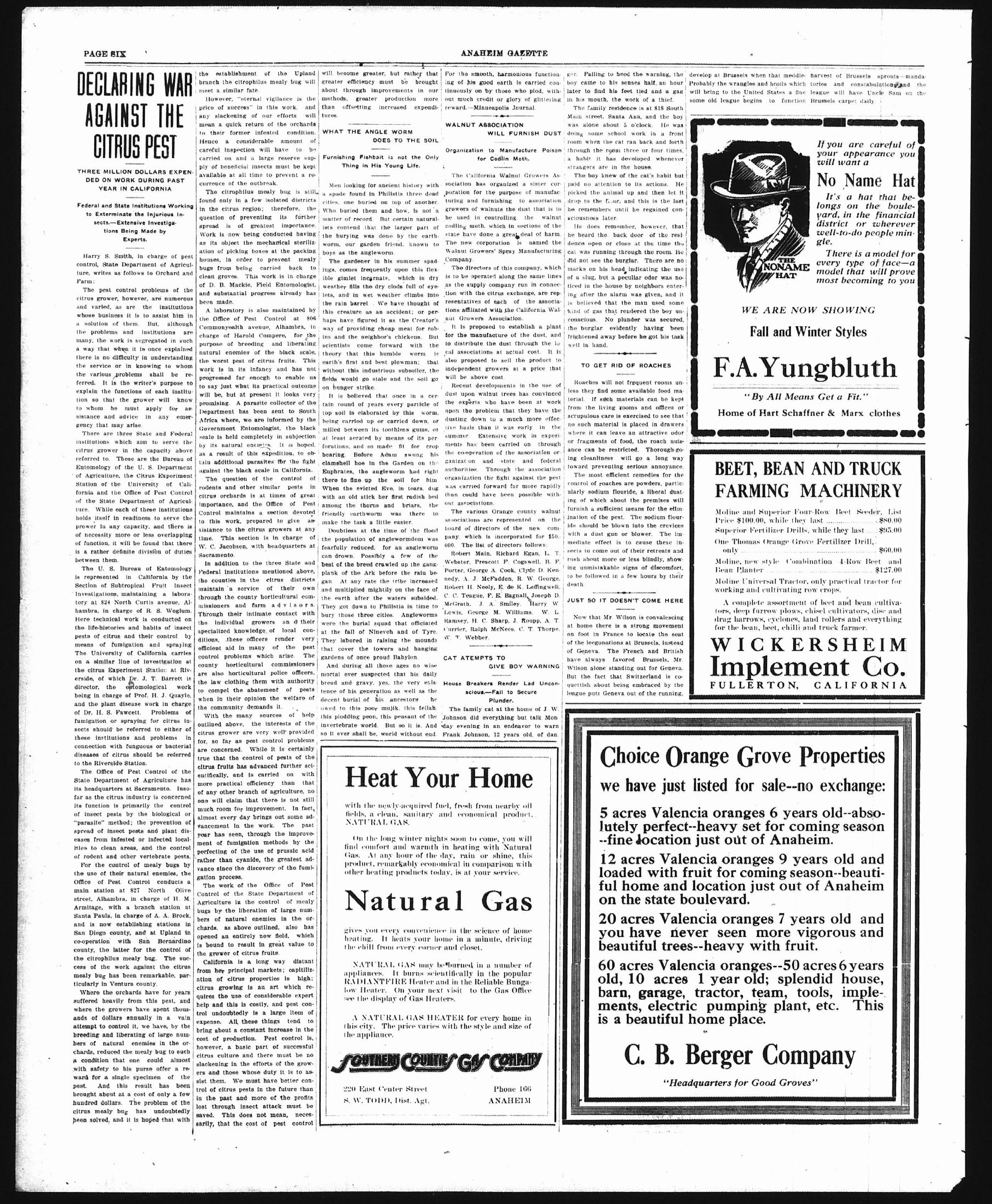
Searchable text
DECLARING WAR AGAINST THE CITRUS PEST
THREE MILLION DOLLARS EXPENDED ON WORK DURING PAST YEAR IN CALIFORNIA
Federal and State Institutions Working to Exterminate the Injurious Insects.—Extensive Investigations Being Made by Experts.
Harry S. Smith, in charge of pest control, State Department of Agriculture, writes as follows to Orchard and Farm:
The pest control problems of the citrus grower, however, are numerous and varied, as are the institutions whose business it is to assist him in a solution of them. But, although the problems and institutions are many, the work is segregated in such a way that when it is once explained there is no difficulty in understanding the service or in knowing to whom the various problems shall be referred. It is the writer's purpose to explain the functions of each institution so that the grower will know to whom he must apply for assistance and advice in any emergency that may arise.
There are three State and Federal institutions which aim to serve the establishment of the Upland branch the citrophilus mealy bug will meet a similar fate.
However, "eternal vigilance is the price of success" in this work, and any slackening of our efforts will mean a quick return of the orchards to their former infested condition. Hence a considerable amount of careful inspection will have to be carried on and a large reserve supply of beneficial insects must be kept available at all time to prevent a recurrence of the outbreak.
The citrophilus mealy bug is still found only in a few isolated districts in the citrus region; therefore, the question of preventing its further spread is of greatest importance. Work is now being conducted having as its object the mechanical sterilization of picking boxes at the packing houses, in order to prevent mealy bugs from being carried back to clean groves. This work is in charge of D. B. Mackie, Field Entomologist, and substantial progress already has been made.
A laboratory is also maintained by the Office of Pest Control at 806 Commonwealth avenue, Alhambra, in charge of Harold Compere, for the purpose of breeding and liberating natural enemies of the black scale, the worst pest of citrus fruits. This work is in its infancy and has not progressed far enoogh to enable us to say just what its practical outcome will be, but at present it looks very promising. A parasite collector of the Department has been sent to South Africa where, we are informed by the Government Entomologist, the black scale is held completely in subjection by its natural enemies. It is hoped,
will become greater efficiency about through methods, greater than offsetting tures.
WHAT THE A
Furnishing Fish Thing in
Men looking for a spade found in cities, one buried Who buried the matter of recordists contend that the burying was worm, our garage boys as the angel.
The gardenerings, comes free gimlet incipient fills the lets, and in wet rain barrel. This creature ass haps have figure way of providing ins and the new scientists come theory that this earth's first and without this indies fields would go on hunger strike.
It is believed tain round of y top soil is elab being carried u milled between at least aerated forations, and s
there is no difficulty in understanding the service or in knowing to whom the various problems shall be referred. It is the writer's purpose to explain the functions of each institution so that the grower will know to whom he must apply for assistance and advice in any emergency that may arise.
There are three State and Federal institutions which aim to serve the citrus grower in the capacity above referred to. These are the Bureau of Entomology of the U. S. Department of Agriculture, the Citrus Experiment Station of the University of California and the Office of Pest Control of the State Department of Agriculture. While each of these institutions holds itself in readiness to serve the prower in any capacity, and there is of necessity more or less overlapping of function, it will be found that there is a rather definite division of duties between them.
The U. S. Bureau of Entomology is represented in California by the Section of Subtropical Fruit Insect Investigations, maintaining a laboratory at 824 North Curtis avenue, Alhambra, in charge of R. S. Woglum. Here technical work is conducted on the life-histories and habits of insect pests of citrus and their control by means of fumigation and spraying The University of California carries on a similar line of investigation at the citrus Experiment Station at Riverside, of which Dr. J. T. Barrrett is director, the entomological work being in charge of Prof. H. J. Quayle, and the plant disease work in charge of Dr. H. S. Fawcett. Problems of fumigation or spraying for citrus insects should be referred to either of these institutions and problems in connection with fungous or bacterial diseases of citrus should be referred to the Riverside Station.
The Office of Pest Control of the State Department of Agriculture has its headquarters at Sacramento. Insofar as the citrus industry is concerned its function is primarily the control of insect pests by the biological or "parasite" method; the prevention of spread of insect pests and plant diseases from infested or infected localities to clean areas, and the control of the worst pest of citrus fruits. This work is in its infancy and has not progressed far enocgh to enable us to say just what its practical outcome will be, but at present it looks very promising. A parasite collector of the Department has been sent to South Africa where, we are informed by the Government Entomologist, the black scale is held completely in subjection by its natural enemies. It is hoped, as a result of this expedition, to obtain additional parasites for the fight against the black scale in California.
The question of the control of rodents and other similar pests in citrus orchards is at times of great importance, and the Office of Pest Control maintains a section devoted to this work, prepared to give assistance to the citrus growers at any time. This section is in charge of W. C. Jacobsen, with headquarters at Sacramento.
In addition to the three State and Federal institutions mentioned above, the counties in the citrus districts maintain a service of their own through the county horticultural commissioners and farm advisors. Through their intimate contact with the individual growers an d their specialized knowledge, of local conditions, these officers render very efficient aid in many of the pest control problems which arise. The county horticultural commissioners are also horticultural police officers, the law clothing them with authority to compel the abatement of pests when in their opinion the welfare of the community demands it.
With the many sources of help outlined above, the interests of the citrus grower are very well provided for, so far as pest control problems are concerned. While it is certainly true that the control of pests of the citrus fruits has advanced further scientifically, and is carried on with more practical efficiency than that of any other branch of agriculture, no one will claim that there is not still much room for improvement. In fact, almost every day brings out some advancement in the work. The past year has seen, through the improvement of fumigation methods by the perfecting of the use of prussic acid
The Office of Pest Control of the State Department of Agriculture has its headquarters at Sacramento. Insofar as the citrus industry is concerned its function is primarily the control of insect pests by the biological or "parasite" method; the prevention of spread of insect pests and plant diseases from infested or infected localities to clean areas, and the control of rodent and other vertebrate pests.
For the control of mealy bugs by the use of their natural enemies, the Office of Pest Control conducts a main station at 827 North Olive street, Alhambra, in charge of H. M. Armitage, with a branch station at Santa Paula, in charge of A. A. Brock, and is now establishing stations in San Diego county, and at Upland in co-operation with San Bernardino county, the latter for the control of the citrophilus mealy bug. The success of the work against the citrus mealy bug has been remarkable, particularly in Ventura county.
Where the orchards have for years suffered heavily from this pest, and where the growers have spent thousands of dollars annually in a vain attempt to control it, we have, by the breeding and liberating of large numbers of natural enemies in the orchards, reduced the mealy bug to such a condition that one could almost with safety to his purse offer a reward for a single specimen of the pest. And this result has been brought about at a cost of only a few hundred dollars. The problem of the citrus mealy bug has undoubtedly been solved, and it is hoped that with true that the control of pests of the citrus fruits has advanced further scientifically, and is carried on with more practical efficiency than that of any other branch of agriculture, no one will claim that there is not still much room for improvement. In fact, almost every day brings out some advancement in the work. The past year has seen, through the improvement of fumigation methods by the perfecting of the use of prussic acid rather than cyanide, the greatest advance since the discovery of the fumigation process.
The work of the Office of Pest Control of the State Department of Agriculture is the control of mealy bugs by the liberation of large numbers of natural enemies in the orchards, as above outlined, also has opened an entirely new field, which is bound to result in great value to the grower of citrus fruits.
California is a long way distant from her principal markets; capitillization of citrus properties is high; citrus growing is an art which requires the use of considerable expert help and this is costly, and pest control undoubtedly is a large item of expense. All these things tend to bring about a constant increase in the cost of production. Pest control is, however, a basic part of successful citrus culture and there must be no slackening in the efforts of the growers and those whose duty it is to assist them. We must have better control of citrus pests in the future than in the past and more of the profits lost through insect attack must be saved. This does not mean, necessarily, that the cost of pest control
ANAHEIM GAZETTE
WHAT THE ANGLE WORM DOES TO THE SOIL
Furnishing Fishbait is not the Only Thing in His Young Life.
Men looking for ancient history with a spade found in Philistia three dead cities, one buried on top of another. Who buried them and how, is not a matter of record. But certain naturalists contend that the larger part of the burying was done by the earthworm, our garden friend, known to boys as the angleworm.
The gardener in his summer spadings, comes frequently upon this flexible glimlet incarnate, which in dry weather fills the dry clods full of eyelets, and in wet weather climbs into the rain barrel. We have thought of this creature as an accident; or perhaps have figured it as the Creator's way of providing cheap meat for robins and the neighbor's chickens. But scientists come forward with the theory that this humble worm is earth's first and best plowman; that without this industrious subsolver, the fields would go stale and the soil go on hunger strike.
It is believed that once in a certain round of years every particle of top soil is elaborated by this worm, being carried up or carried down, or milled between its toothless gums, or at least aerated by means of its perforations, and so made fit for crop will become greater, but rather that greater efficiency must be brought about through improvements in our methods, greater production more than offsetting increased expenditures.
For the smooth, harmonious functioning of his good earth is carried continuously on by those who plod, without much credit or glory of glittering reward.—Minneapolis Journal.
WALNUT ASSOCIATION WILL FURNISH DUST
Organization to Manufacture Poison for Codlin Moth.
The California Walnut Growers Association has organized a sister corporation for the purpose of manufacturing and furnishing to association growers of walnuts the dust that is to be used in controlling the walnut codling moth, which in sections of the state have done a great deal of harm. The new corporation is named the Walnut Growers' Spray Manufacturing Company.
The directors of this company, which is to be operated along the same lines as the supply company run in connection with the citrus exchange, are representatives of each of the associations affiliated with the California Walnut Growers Association.
It is proposed to establish a plant for the manufacture of the dust, and to distribute the dust through the local associations at actual cost. It is also proposed to sell the product to independent growers at a price that will be above cost.
Recent developments in the use of dust upon walnut trees has convinced the experts who have been at work upon the problem that they have the dusting down to a much more effective basis than it was early in the summer. Extensive work in experiments has been carried on through ger. Falling to heed the warning, the boy came to his senses half an hour later to find his feet tied and a gag in his mouth, the work of a thief.
The family residence is at 818 South Main street. Santa Ana, and the boy was alone about 5 o'clock. He was doing some school work in a front room when the cat ran back and forth through the room three or four times, a habit it has developed whenever strangers are in the house.
The boy knew of the cat's habit but paid no attention to its actions. He picked the animal up and then let it drop to the floor, and this is the last he remembers until he regained consciousness later.
He does remember, however, that he heard the back door of the residence open or close at the time the cat was running through the room. He did not see the burglar. There are no marks on his head indicating the use of a slug, but a peculiar odor was noticed in the house by neighbors entering after the alarm was given, and it is believed that the man used some kind of gas that rendered the boy unconscious. No plunder was secured, the burglar evidently having been frightened away before he got his task well in hand.
TO GET RID OF ROACHES
Roaches will not frequent rooms unless they find some available food material. If such materials can be kept from the living rooms and offices or scrupulous care is exercised to see that no such material is placed in drawers where it can leave an attractive odor or fragments of food, the roach nuisance can be restricted. Through go-
Heat Your Home
with the newly-acquired fuel, fresh from nearby oil fields, a clean, sanitary and economical product.
On the long winter nights soon to come, you will find comfort and warmth in heating with Natural
Heat Your Home
with the newly-acquired fuel, fresh from nearby oil fields, a clean, sanitary and economical product, NATURAL GAS.
On the long winter nights soon to come, you will find comfort and warmth in heating with Natural Gas. At any hour of the day, rain or shine, this product, remarkably economical in comparison with other heating products today, is at your service.
Natural Gas
gives you every convenience in the science of home heating. It heats your home in a minute, driving the chill from every corner and closet.
NATURAL GAS may be burned in a number of appliances. It burns scientifically in the popular RADIANTFIRE Heater and in the Reliable Bungalow Heater. On your next visit to the Gas Office see the display of Gas Heaters.
A NATURAL GAS HEATER for every home in this city. The price varies with the style and size of the appliance.
SOUTHERN COUNTIES GAS COMPANY
220 East Center Street
S. W. TODD, Dist. Agt.
ANAHEIM
develop at Brussels when that middle-earvest of Brussels sprouts—mandaProbably the wrangles and broils which tories and constabulation, and the
will bring to the United States a fine league will have Uncle Sam on the
some old league begins to function Brussels carpet daily.
If you are careful of your appearance you will want a
No Name Hat
It's a hat that belongs on the boulevard, in the financial district or wherever well-to-do people mingle.
There is a model for every type of face—a model that will prove most becoming to you
WE ARE NOW SHOWING
Fall and Winter Styles
F.A.Yungbluth
"By All Means Get a Fit."
Home of Hart Schaffner & Marx clothes
F.A.Yungbluth
"By All Means Get a Fit."
Home of Hart Schaffner & Marx clothes
BEET, BEAN AND TRUCK FARMING MACHINERY
Moline and Superior Four-Row Beet Seeder, List Price $100.00, while they last ... $80.00
Superior Fertilizer Drills, while they last ... $95.00
One Thomas Orange Grove Fertilizer Drill, only ... $60.00
Moline, new style Combination 4-Row Beet and Bean Planter ... $127.00
Moline Universal Tractor, only practical tractor for working and cultivating row crops.
A complete assortment of beet and bean cultivators, deep furrow plows, chisel cultivators, disc and drag harrows, cyclones, land rollers and everything for the bean, beet, chilli and truck farmer.
WICKERSHEIM Implement Co.
FULLERTON, CALIFORNIA
Noice Orange Grove Properties
have just listed for sale--no exchange:
Macres Valencia oranges 6 years old--absolutely perfect--heavy set for coming season
the location just out of Anaheim.
have just listed for sale--no exchange:
acres Valencia oranges 6 years old--absolutely perfect--heavy set for coming season
the location just out of Anaheim.
acres Valencia oranges 9 years old and
added with fruit for coming season--beautihome and location just out of Anaheim
the state boulevard.
acres Valencia oranges 7 years old and
you have never seen more vigorous and
beautiful trees--heavy with fruit.
acres Valencia oranges--50 acres 6 years
10 acres 1 year old; splendid house,
garage, tractor, team, tools, implents, electric pumping plant, etc. This
beautiful home place.
C. B. Berger Company
"Headquarters for Good Groves"