anaheim-gazette 1919-10-09
Scanned page
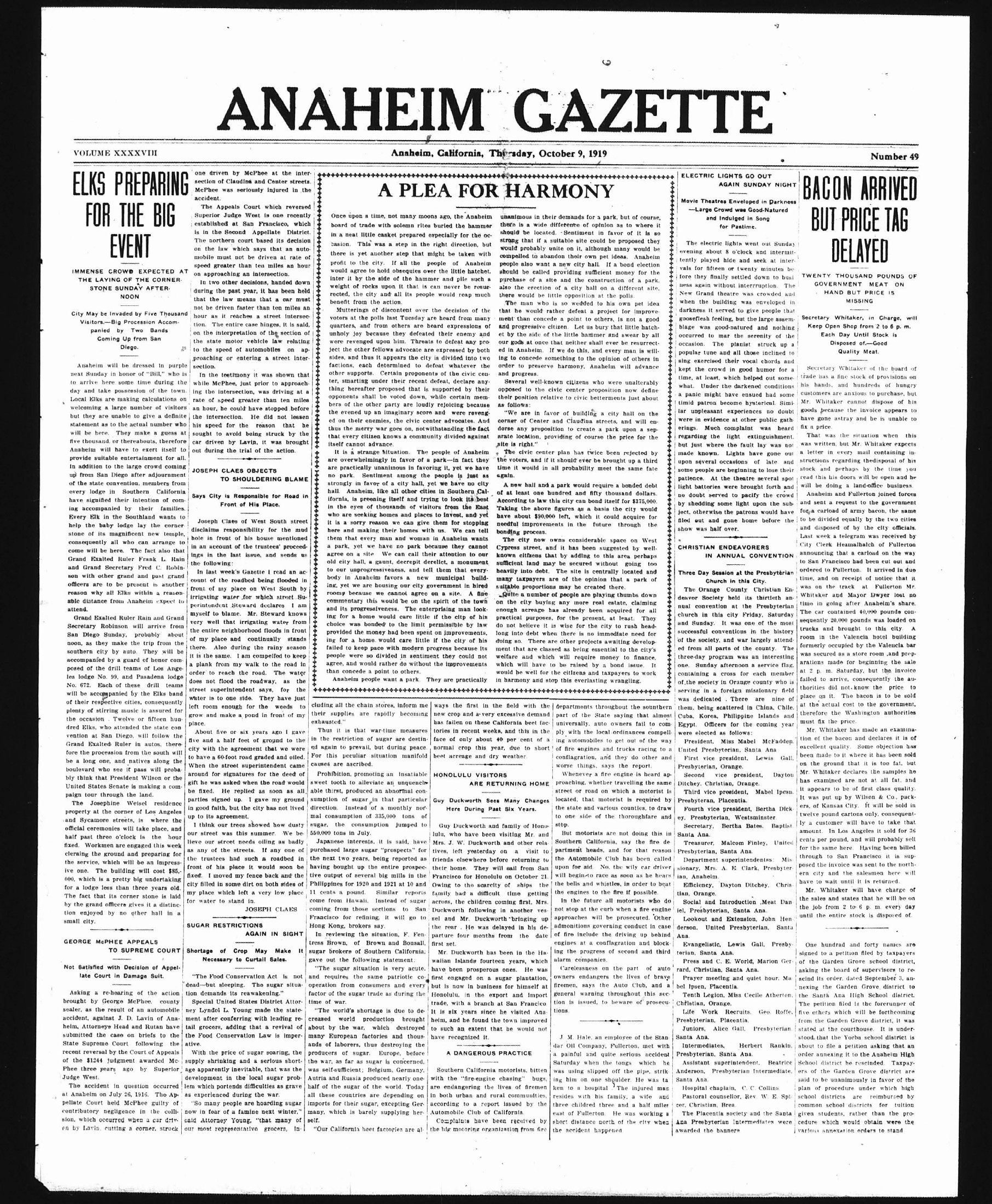
Searchable text
VOLUME XXXXVIII
ELKS PREPARING FOR THE BIG EVENT
IMMENSE CROWD EXPECTED AT THE LAYING OF THE CORNER-STONE SUNDAY AFTERNOON
City May be Invaded by Five Thousand Visitors.—Big Procession Accompanied by Two Bands Coming Up from San Diego.
Anaheim will be dressed in purple next Sunday in honor of “Bill,” who is to arrive here some time during the day and take possession of the town. Local Elks are making calculations on welcoming a large number of visitors but they are unable to give a definite statement as to the actual number who will be here. They make a guess at five thousand, or thereabouts, therefore one driven by McPhee at the intersection of Claudina and Center streets. McPhee was seriously injured in the accident.
The Appeals Court which reversed Superior Judge West is one recently established at San Francisco, which is in the Second Appellate District. The northern court based its decision on the law which says that an automobile must not be driven at rate of speed greater than ten miles an hour on approaching an intersection.
In two other decisions, handed down during the past year, it has been held that the law means that a car must not be driven faster than ten miles an hour as it reaches a street intersection. The entire case hinges, it is said, on the interpretation of the section of the state motor vehicle law relating to the speed of automobiles on approaching or entering a street intersection.
In the testimony it was shown that while McPhee, just prior to approaching the intersection, was driving at a rate of speed greater than ten miles an hour, he could have stopped before the intersection. He did not lessen his speed for the reason that he sought to avoid being struck by the car driven by Lavin, it was brought once upon a board of trade in a neat little casion. This there is yet profit to the would agree to inter it by the weight of roc rected, the c benefit from Mutterings voters at the quarters, and unholy joy be were revenged ject the other sides, and thu factions, each other support ter, smarting thing hereafter opponents sha bers of the ot the evened up ed on their en thus the merry that every clit itself cannot a
Anaheim will be dressed in purple next Sunday in honor of "Bill," who is to arrive here some time during the day and take possession of the town. Local Elks are making calculations on welcoming a large number of visitors but they are unable to give a definite statement as to the actual number who will be here. They make a guess at five thousand, or thereabouts, therefore Anaheim will have to exert itself to provide suitable entertainment for all. In addition to the large crowd coming up from San Diego after adjournment of the state convention, members from every lodge in Southern California have signified their intention of coming accompanied by their families. Every Elk in the Southland wants to help the baby lodge lay the cornerstone of its magnificent new temple, consequently all who can arrange to come will be here. The fact also that Grand Exalted Ruler Frank L. Rain and Grand Secretary Fred C. Robinson with other grand and past grand officers are to be present is another reason why all Elks within a reasonable distance from Anaheim expect to attend.
Grand Exalted Ruler Rain and Grand Secretary Robinson will arrive from San Diego Sunday, probably about noon, as they make the trip from the southern city by auto. They will be accompanied by a guard of honor composed of the drill teams of Los Angeles lodge No. 99, and Pasadena lodge No. 672. Each of these drill teams will be accompanied by the Elks band of their respective cities, consequently plenty of stirring music is assured for the occasion. Twelve or fifteen hundred Elks, who attended the state convention at San Diego, will follow the Grand Exalted Ruler in autos, therefore the procession from the south will be a long one, and natives along the boulevard who see if pass will probably think that President Wilson or the United States Senate is making a campaign tour through the land.
The Josephine Weisel residence property at the corner of Los Angeles and Sycamore streets, is where the official ceremonies will take place, and half past three o'clock is the hour fixed. Workmen are engaged this week proaching or entering a street intersection.
In the testimony it was shown that while McPhee, just prior to approaching the intersection, was driving at a rate of speed greater than ten miles an hour, he could have stopped before the intersection. He did not lessen his speed for the reason that he sought to avoid being struck by the car driven by Lavin, it was brought out during the trial of the action.
JOSEPH CLAES OBJECTS TO SHOULDERING BLAME
Says City is Responsible for Road in Front of His Place.
Joseph Claes of West South street disclaims responsibility for the mud hole in front of his house mentioned in an account of the trustees' proceedings in the last issue, and sends us the following:
In last week's Gazette I read an account of the roadbed being flooded in front of my place on West South by irrigating water for which street Superintendent Steward declares I am myself to blame. Mr. Steward knows very well that irrigating water from the entire neighborhood floods in front of my place and continually stands there. Also during the rainy season it is the same. I am compelled to keep a plank from my walk to the road in order to reach the road. The water does not flood the roadway, as the street superintendent says, for the water is to one side. They have just left room enough for the weeds to grow and make a pond in front of my place.
About five or six years ago I gave five and a half feet of ground to the city with the agreement that we were to have a 60-foot road graded and oiled. When the street superintendent came around for signatures for the deed of gift he was asked when the road would be fixed. He replied as soon as all parties signed up. I gave my ground in good faith, but the city has not lived up to its agreement.
I think our trees showed how dusty our street was this summer. We believe our street needs oiling as badly as any of the streets. If any one of
be a long one, and natives along the boulevard who see if pass will probably think that President Wilson or the United States Senate is making a campaign tour through the land.
The Josephine Weisel residence property at the corner of Los Angeles and Sycamore streets, is where the official ceremonies will take place, and half past three o'clock is the hour fixed. Workmen are engaged this week cleraining the ground and preparing for the service, which will be an impressive one. The building will cost $85,000, which is a pretty big undertaking for a lodge less than three years old. The fact that its corner stone is laid by the grand officers gives it a distinction enjoyed by no other hall in a small city.
GEORGE McPHEE APPEALS TO SUPREME COURT
Not Satisfied with Decision of Appellate Court in Damage Suit.
Asking a re-hearing of the action brought by George McPhee, county sealer, as the result of an automobile accident, against J. D. Lavin of Anaheim, Attorneys Head and Rutan have submitted the case on briefs to the State Supreme Court following the recent reversal by the Court of Appeals of the $1244 judgment awarded McPhee three years ago by Superior Judge West.
The accident in question occurred at Anaheim on July 26, 1916. The Appellate Court held McPhee guilty of contributory negligence in the collision, which occurred when a car driven by Lavin, cutting a corner, struck to have a 60-foot road graded and oiled. When the street superintendent came around for signatures for the deed of gift he was asked when the road would be fixed. He replied as soon as all parties signed up. I gave my ground in good faith, but the city has not lived up to its agreement.
I think our trees showed how dusty our street was this summer. We believe our street needs oiling as badly as any of the streets. If any one of the trustees had such a roadbed in front of his place it would soon be fixed. I moved my fence back and the city filled in some dirt on both sides of my place which left a very low place for water to stand in.
JOSEPH CLAES
SUGAR RESTRICTIONS AGAIN IN SIGHT
Shortage of Crop May Make It Necessary to Curtail Sales.
"The Food Conservation Act is not dead—but sleeping. The sugar situation demands its reawakening."
Special United States District Attorney Lyndol L. Young made the statement after conferring with leading retail grocers, adding that a revival of the Food Conservation Law is imperative.
With the price of sugar soaring, the supply shrinking and a serious shortage apparently inevitable, that was the development in the local sugar problem which portends difficulties as grave as experienced during the war.
"So many people are hoarding sugar now in fear of a famine next winter," said Attorney Young, "that many of our most representative grocers, In-
Prohibition, promote sweet tooth to allow able thirst, produced sumption of sugar direction. Instead mal consumption of sugar, the consumer 550,000 tons in July.
Japanese interest purchased large sugars the next two years, having bought up theive output of several Philippines for 1920 to 11 cents a pound. come from Hawaii coming from those Francisco for refining Hong Kong, brokers.
In reviewing the stress Brown, of B sugar brokers of So gave out the follow:
"The sugar situation and requires the operation from cons factor of the sugar time of war.
"The world's short creased world pre- about by the war, many European fac-ands of laborers, tha producers of sugar. the war, as far as su- was self-sufficient; B Autria and Russia pre- half of the sugar of all these countries imports for their sug- many, which is bare- self."
A PLEA FOR HARMONY
Once upon a time, not many moons ago, the Anaheim board of trade with solemn rites buried the hammer in a neat little casket prepared especially for the occasion. This was a step in the right direction, but there is yet another step that might be taken with profit to the city. If all the people of Anaheim would agree to hold obsequies over the little hatchet, inter it by the side of the hammer and pile such a weight of rocks upon it that is can never be resurrected, the city and all its people would reap much benefit from the action.
Mutterings of discontent over the decision of the voters at the polls last Tuesday are heard from many quarters, and from others are heard expressions of unholy joy because they defeated their enemy and were revenged upon him. Threats to defeat any project the other fellows advocate are expressed by both sides, and thus it appears the city is divided into two factions, each determined to defeat whatever the other supports. Certain proponents of the civic center, smarting under their recent defeat, declare anything hereafter proposed that is supported by their opponents shall be voted down, while certain members of the other party are loudly rejoicing because the evened up an imaginary score and were revenged on their enemies, the civic center advocates. And thus the merry war goes on, notwithstanding the fact that every citizen knows a community divided against itself cannot advance.
unanimous in their demands for a park, but of course, there is a wide difference of opinion as to where it should be located. Sentiment in favor of it is so strong that if a suitable site could be proposed they would probably unite on it, although many would be compelled to abandon their own pet ideas. Anaheim people also want a new city hall. If a bond election should be called providing sufficient money for the purchase of a site and the construction of a park, also the erection of a city hall on a different site, there would be little opposition at the polls.
The man who is so wedded to his own pet idea that he would rather defeat a project for improvement than concede a point to others, is not a good and progressive citizen. Let us bury that little hatchet by the side of the little hammer and swear by all our gods at once that neither shall ever be resurrected in Anaheim. If we do this, and every man is willing to concede something to the opinion of others in order to preserve harmony, Anaheim will advance and progress.
Several well-known citizens who were unalterably opposed to the civic center proposition now define their position relative to civic betterments just about as follows:
"We are in favor of building a city hall on the corner of Center and Claudina streets, and will endorse any proposition to create a park upon a separate location, providing of course the price for the site is right."
It is a strange situation. The people of Anaheim are overwhelmingly in favor of a park—in fact they are practically unanimous in favoring it, yet we have no park. Sentiment among the people is just as strongly in favor of a city hall, yet we have no city hall. Anaheim, like all other cities in Southern California, is preening itself and trying to look its best in the eyes of thousands of visitors from the East who are seeking homes and places to invest, and yet it is a sorry reason we can give them for stopping here and making their homes with us. We can tell them that every man and woman in Anaheim wants a park, yet we have no park because they cannot agree on a site. We can call their attention to our old city hall, a gaunt, decrepit derelict, a monument to our unprogressiveness, and tell them that everybody in Anaheim favors a new municipal building, yet we are housing our city government in hired roomy because we cannot agree on a site. A fine commentary this would be on the spirit of the town and its progressiveness. The enterprising man looking for a home would care little if the citp of his choice was bonded to the limit permissible by law provided the money had been spent on improvements, ing for a home would care little if the city of his failed to keep pace with modern progress because its people were so divided in sentiment they could not agree, and would rather do without the improvements than concede a point to others.
Anaheim people want a park. They are practically including all the chain stores, inform me their supplies are rapidly becoming exhausted."
Thus it is that war-time measures in the restriction of sugar are destined again to prevail, but during peace. For this peculiar situation manifold causes are ascribed.
Prohibition, promoting an insatiable sweet tooth to alleviate an unquenchable thirst, produced an abnormal consumption of sugar in that particular direction. Instead of a monthly normal consumption of 335,000 tons of sugar, the consumption jumped to 550,000 tons in July.
Japanese interests, it is said, have purchased large sugar "prospects" for sides, and thus it appears the city is divided into two factions, each determined to defeat whatever the other supports. Certain proponents of the civic center, smarting under their recent defeat, declare anything hereafter proposed that is supported by their opponents shall be voted down, while certain members of the other party are loudly rejoicing because the evened up an imaginary score and were revenged on their enemies, the civic center advocates. And thus the merry war goes on, notwithstanding the fact that every citizen knows a community divided against itself cannot advance.
The civic center plan has twice been rejected by the voters, and if it should ever be brought up a third time it would in all probability meet the same fate again.
A new hall and a park would require a bonded debt of at least one hundred and fifty thousand dollars. According to law this city can bond itself for $375,000. Taking the above figures as a basis the city would have about $90,000 left, which it could acquire for needful improvements in the future through the bonding process.
The city now owns considerable space on West Cypress street, and it has been suggested by well-known citizens that by adding to this area perhaps sufficient land may be secured without going too heavily into debt. The site is centrally located and many taxpayers are of the opinion that a park of suitable proportions may be created there.
Quite a number of people are playing thumbs down on the city buying any more real estate, claiming enough acreage has already been acquired for all practical purposes, for the present, at least. They do not believe it is wise for the city to rush headlong into debt when there is no immediate need for doing so. There are other projects awaiting development that are classed as being essential to the city's welfare and which will require money to finance, which will have to be raised by a bond issue. It would be well for the citizens and taxpayers to work in harmony and stop this everlasting wrangling.
HONOLULU VISITORS ARE RETURNING HOME
Guy Duckworth Sees Many Changes Here During Past Six Years.
Guy Duckworth and family of Honolulu, who have been visiting Mr. and Mrs. J. W. Duckworth and other relatives left yesterday on a visit to departments throughout the southern part of the State saying that almost universally, auto owners fail to comply with the local ordinances compelling automobiles to get out of the way of fire engines and trucks racing to a conflagration, and they do other and worse things, says the report.
Whenever a fire engine is heard approaching, whether travelling the same street or road on which a motorist is located, that motorist is required by the state and various counties, to draw to one side of the thoroughfare and stop.
But motorists are not doing this in Southern California, say the fire department heads, and for that reason
For this peculiar situation manifold causes are ascribed.
Prohibition, promoting an insatiable sweet tooth to alleviate an unquenchable thirst, produced an abnormal consumption of sugar in that particular direction. Instead of a monthly normal consumption of 335,000 tons of sugar, the consumption jumped to 550,000 tons in July.
Japanese interests, it is said, have purchased large sugar "prospects" for the next two years, being reported as having bought up the entire prospective output of several big mills in the Philippines for 1920 and 1921 at 10 and 11 cents a pound. Similar reports come from Hawaii. Instead of sugar coming from those sections to San Francisco for refining, it will go to Hong Kong, brokers say.
In reviewing the situation, F. Fentress Brown, of Brown and Bonsall, sugar brokers of Southern California, gave out the following statement:
"The sugar situation is very acute, and requires the same patriotic cooperation from consumers and every factor of the sugar trade as during the time of war.
"The world's shortage is due to decreased world production brought about by the war, which destroyed many European factories and thousands of laborers, thus destroying the producers of sugar. Europe, before the war, as far as sugar is concerned, was self-sufficient; Belgium, Germany, Autria and Russia produced nearly one-half of the sugar of the world. Today all these countries are depending on imports for their sugar, excepting Germany, which is barely supplying herself.
"Our California beet factories are al-
HONOLULU VISITORS ARE RETURNING HOME
Guy Duckworth Sees Many Changes Here During Past Six Years.
Guy Duckworth and family of Honolulu, who have been visiting Mr. and Mrs. J. W. Duckworth and other relatives, left yesterday on a visit to friends elsewhere before returning to their home. They will sail from San Francisco for Honolulu on October 21. Owing to the scarcity of ships the family had a difficult time getting across, the children coming first. Mrs. Duckworth following in another vessel and Mr. Duckworth bringing up the rear. He was delayed in his departure four months from the date first set.
Mr. Duckworth has been in Hawaiian Islands fourteen years, which have been prosperous ones. He was first engaged on a sugar plantation, but is now in business for himself at Honolulu, in the export and import trade, with a branch at San Francisco. It is six years since he visited Anaheim, and he found the town improved to such an extent that he would not have recognized it.
A DANGEROUS PRACTICE
Southern California motorists, bitten with the "fire-engine chasing" bugs, are endangering the lives of firemen in both urban and rural communities, according to a report issued by the Automobile Club of California.
Complaints have been received by the big motoring organization from fire
Whenever a fire engine is heard approaching, whether travelling the same street or road on which a motorist is located, that motorist is required by the state and various counties, to draw to one side of the thoroughfare and stbp.
But motorists are not doing this in Southern California, say the fire department heads, and for that reason the Automobile Club has been called upon for aid. No, the wily car driver will begin to race as soon as he hears the bells and whistles, in order to beat the engines to the fire if possible.
In the future all motorists who do not stop at the curb when a fire engine approaches will be prosecuted. Other admonitions governing conduct in case of fire include the driving up behind engines at a conflagration and blocking the progress of second and third alarm companies.
Carelessness on the part of auto owners endangers the lives of brave firemen, says the Auto Club, and a general warning throughout this section is issued, to beware of prosecutions.
J. M. Hale, an employee of the Standard Oil Company, Fullerton, met with a painful and quite serious accident Saturday when the tongs which he was using slipped off the pipe, striking him on one shoulder. He was taken to a hospital. The injured man resides with his family, a wife and three childred three and a half miller east of Fullerton. He was working a short distance north of the city when the accident happened.
ELECTRIC LIGHTS GO OUT
AGAIN SUNDAY NIGHT
Movie Theatres Enveloped in Darkness
—Large Crowd was Good-Natured and Indulged in Song for Pastime.
The electric lights went out Sunday evening about 8 o'clock and intermittently played hide and seek at intervals for fifteen or twenty minutes before they finally settled down to business again without interruption. The New Grand theatre was crowded and when the building was enveloped in darkness it served to give people that gooseflesh feeling, but the large assemblage was good-natured and nothing occurred to mar the serenity of the occasion. The pianist struck up a popular tune and all those inclined to sing exercised their vocal chords and kept the crowd in good humor for a time, at least, which helped out somewhat. Under the darkened conditions a panic might have ensued had some timid patron become hysterical. Similar unpleasant experiences no doubt were in evidence at other public gatherings. Much complaint was heard regarding the light extinguishment, but just where the fault lay was not.
BACON ARRIVED BUT PRICE TAG DELAYED
TWENTY THOUSAND POUNDS OF GOVERNMENT MEAT ON HAND BUT PRICE IS MISSING
Secretary Whitaker, in Charge, will Keep Open Shop from 2 to 6 p.m. Each Day Until Stock is Disposed of.—Good Quality Meat.
Secretary Whitaker of the board of trade has a fine stock of provisions on his hands, and hundreds of hungry customers are anxious to purchase, but Mr. Whitaker cannot dispose of his goods because the invoice appears to have gone astray and he is unable to fix a price.
That was the situation when this was written, but Mr. Whitaker expects
CHRISTIAN ENDEAVORERS
IN ANNUAL CONVENTION
Three Day Session at the Presbyterian Church in this City.
The Orange County Christian Endeavor Society held its thirtieth annual convention at the Presbyterian church in this city Friday, Saturday and Sunday. It was one of the most successful conventions in the history of the society, and war largely attended from all parts of the county. The three-day program was an interesting one. Sunday afternoon a service flag, containing a cross for each member of the society in Orange county who is serving in a foreign missionary field was dedicated. There are nine of them, being scattered in China, Chile, Cuba, Korea, Philippine Islands and Egypt. Officers for the coming year were elected as follows:
President, Miss Mabel McFadden.
United Presbyterian, Santa Ana
First vice president, Lewis Gall,
Presbyterian, Orange.
Second vice president, Dayton Ditchey, Christian, Orange.
Third vice president, Mabel Ipenn.
Presbyterian, Placentia.
Fourth vice president, Bertha Dickey.
Presbyterian, Westminster.
Secretary, Bertha Bates.
Baptist Santa Ana.
Treasurer, Malcom Finley, United Presbyterian, Santa Ana.
Secretary Whitaker of the board of trade has a fine stock of provisions on his hands, and hundreds of hungry customers are anxious to purchase, but Mr. Whitaker cannot dispose of his goods because the invoice appears to have gone astray and he is unable to fix a price.
That was the situation when this was written, but Mr. Whitaker expects a letter in every mail containing instructions regarding the disposal of his stock and perhaps by the time you read this his doors will be open and he will be doing a land-office business.
Anaheim and Fullerton joined forces and sent a request to the government for a carload of army bacon, the same to be divided equally by the two cities and disposed of by the city officials. Last week a telegram was received by City Clerk Hexmalhalch of Fullerton announcing that a carload on the way to San Francisco had been cut out and ordered to Fullerton. It arrived in due time, and on receipt of notice that it was on the track at Fullerton Mr. Whitaker and Mayor Dwyer lost no time in going after Anaheim's share. The car contained 40,000 pounds consequently 20,000 pounds was loaded on trucks and brought to this city. A room in the Valencia hotel building formerly occupied by the Valencia bar was secured as a store room and preparations made for beginning the sale at 2 p.m. Saturday, but the invoice failed to arrive, consequently the authorities did not know the price to place on it. The bacon is to be sold at the actual cost to the government, therefore the Washington authorities must fix the price.
Mr. Whitaker has made an examination of the bacon and declares it is of excellent quality. Some objection has been made to it where it has been sold on the ground that it is too fat, but Mr. Whitaker declares the samples he has examined are not at all fat, and it appears to be of first class quality. It was put up by Wilson & Co., packers, of Kansas City. It will be sold in twelve pound cartons only, consequently a customer will have to take that amount. In Los Angeles it sold for 36 cents per pound, and will probably sell for the same here. Having been billed
First vice president, Lewis Gall, Presbyterian, Orange.
Second vice president, Dayton Ditchey, Christian, Orange.
Third vice president, Mabel Ipsen, Presbyterian, Placentia.
Fourth vice president, Bertha Dickey, Presbyterian, Westminster.
Secretary, Bertha Bates, Baptist Santa Ana.
Treasurer, Malcom Finley, United Presbyterian, Santa Ana.
Department superintendentss: Missionary, Mrs. A. E. Clark, Presbyterian, Anaheim.
Efficiency, Dayton Ditchey, Christian, Orange.
Social and Introduction Meat Daniel, Presbyterian, Santa Ana.
Lookout and Extension John Henderson, United Presbyterian, Santa Ana.
Evangelistic, Lewis Gall, Presbyterian, Santa Ana.
Press and C. E. World, Marion Gerrard, Christian, Santa Ana.
Prayer meeting and quiet hour, Mabel Ipsen, Placentia.
Tenth Legion, Miss Cecile Atherton, Christian, Orange.
Life Work Recruits, Geo. Roffe, Presbyterian, Placentia.
Juniors, Alice Gall, Presbyterian, Santa Ana.
Intermediates, Herbert Rankin, Presbyterian, Santa Ana.
Assistant superintendent, Beatrice Anderson, Presbyterian Intermediate, Santa Ana.
Hospital chaplain, C. C. Collins.
Pastoral counsellor, Rev. W. E. Splcer, Christian, Brea.
The Placentia society and the Santa Ana Presbyterian Intermediates were awarded the banners.
One hundred and forty names are signed to a petition filed by taxpayers of the Garden Grove school district, asking the board of supervisors to rescind its order, dated September 3, annexing the Garden Grove district to the Santa Ana High School district. The petition filed is the forerunner of five others which will be forthcoming from the Garden Grove district, it was stated at the courthouse. It is understood that the Yorba school district is about to file a petition asking that an order annexing it to the Anaheim High School district be rescinded. Taxpayers of the Garden Grove district are said to be unanimously in favor of the plan of procedure under which high school districts are reimbursed by common school districts for tuition given students, rather than the procedure which would obtain were the various annexation orders to stand.