anaheim-gazette 1919-09-25
Scanned page
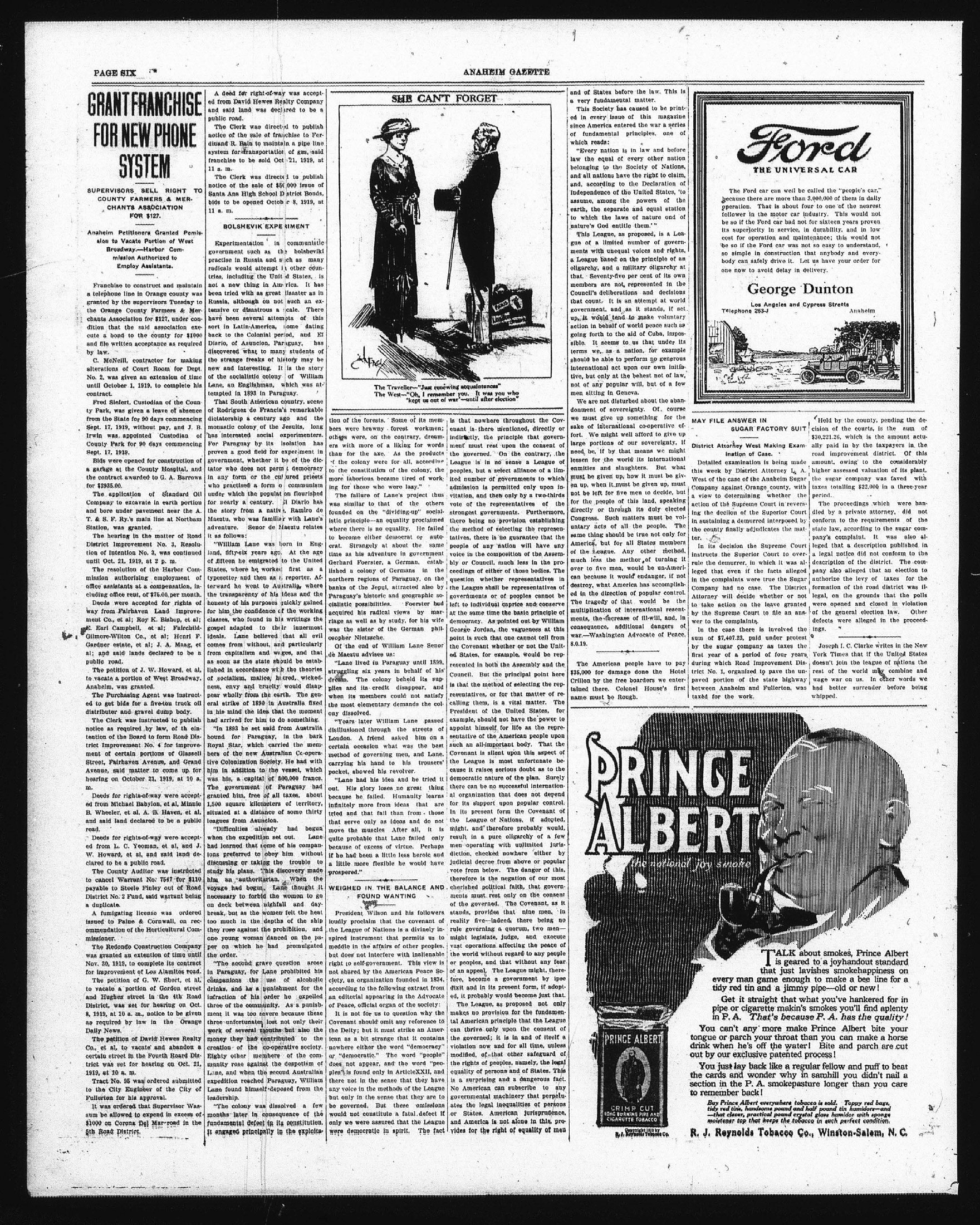
Searchable text
GRANT FRANCHISE FOR NEW PHONE SYSTEM
SUPERVISORS SELL RIGHT TO COUNTY FARMERS & MERCHANTS ASSOCIATION FOR $127.
Anaheim Petitioners Granted Permission to Vacate Portion of West Broadway—Harbor Commission Authorized to Employ Assistants.
Franchise to construct and maintain a telephone line in Orange county was granted by the supervisors Tuesday to the Orange County Farmers & Merchants Association for $127, under condition that the said association execute a bond to the county for $1000 and file written acceptance as required by law.
C. McNeill, contractor for making alterations of Court Room for Dept. No. 2, was given an extension of time until October 1, 1919, to complete his contract.
Fred Siefert, Custodian of the County Park, was given a leave of absence from the State for 90 days commencing Sept. 17, 1919, without pay, and J. B. Irwin was appointed Custodian of County Park for 90 days commencing Sept. 17, 1919.
A deed for right-of-way was accepted from David Hewes Realty Company and said land was declared to be a public road.
The Clerk was directed to publish notice of the sale of franchise to Ferdinand R. Bain to maintain a pipe line system for transportation of gas, said franchise to be sold Oct. 21, 1919, at 11 a.m.
The Clerk was directed to publish notice of the sale of $50,000 issue of Santa Ana High School District Bonds, bids to be opened October 8, 1919, at 11 a.m.
BOLSHEVIK EXPERIMENT
Experimentation in communistic government such as the bolshevik practise in Russia and such as many radicals would attempt in other countries, including the United States, is not a new thing in America. It has been tried with as great disaster as in Russia, although on not such an extensive or disastrous scale. There have been several attempts of this sort in Latin-America, some dating back to the Colonial period, and El Diario, of Asuncion, Paraguay, has discovered what to many students of the strange freaks of history may be new and interesting. It is the story of the socialistic colony of William Lane, an Englishman, which was attempted in 1893 in Paraguay.
That South American country, scene of Rodriguez de Francia's remarkable dictatorship a century ago and the monastic colony of the Jesuits, long has interested social experimenters. For Paraguay by its isolation has proven a good field for experiment in
C. McNeill, contractor for making alterations of Court Room for Dept.
No. 2, was given an extension of time until October 1, 1919, to complete his contract.
Fred Siefert, Custodian of the County Park, was given a leave of absence from the State for 90 days commencing Sept. 17, 1919, without pay, and J. B. Irwin was appointed Custodian of County Park for 90 days commencing Sept. 17, 1919.
Bids were opened for construction of a garage at the County Hospital, and the contract awarded to G. A. Barrows for $2935.00.
The application of Standard Oil Company to excavate in earth portion and bore under pavement near the A. T. & S. F. Ry.'s main line at Northam Station, was granted.
The hearing in the matter of Road District Improvement No. 3, Resolution of Intention No. 3, was continued until Oct. 21, 1919, at 2 p.m.
The resolution of the Harbor Commission authorizing employment of office assistants at a compensation, including office rent, of $75.00 per month.
Deeds were accepted for rights of way from Fairhaven Land Improvement Co., et al; Roy K. Bishop, et al; E. Earl Campbell, et al; Fairchild-Gilmore-Wilton Co., et al; Henri F. Gardner estate, et al; J. A. Maag, et al; and said lands declared to be a public road.
The petition of J. W. Howard, et al, to vacate a portion of West Broadway, Anaheim, was granted.
The Purchasing Agent was instructed to get bids for a five-ton truck oil distributer and gravel dump body.
The Clerk was instructed to publish notice as required by law, of the intention of the Board to form Road District Improvement No. 4 for improvement of certain portions of Glassell Street, Fairhaven Avenue, and Grand Avenue, said matter to come up for hearing on October 21, 1919, at 10 a.m.
Deeds for rights-of-way were accepted from Michael Babylon, et al, Minnie B. Wheeler, et al, A. B. Haven, et al, and said land declared to be a public road.
Deeds for rights-of-way were accepted from L. C. Yeoman, et al, and J. W. Howard, et al, and said land declared to be a public road.
That South American country, scene of Rodriguez de Francia's remarkable dictatorship a century ago and the monastic colony of the Jesuits, long has interested social experimenters. For Paraguay by its isolation has proven a good field for experiment in government, whether it be of the dictator who does not permit democracy in any form or the cultured priests who practised a form of communism under which the population flourished for nearly a century.
El Diario has the story from a native, Ramiro de Maeztu, who was familiar with Lane's adventure. Senor de Maeztu relates it as follows:
"William Lane was born in England, fifty-six years ago. At the age of fifteen he emigrated to the United States, where he worked first as a typesetter and then as a reporter. Afterward he went to Australia, where the transparency of his ideas and the honesty of his purposes quickly gained for him the confidence of the working classes, who found in his writings the gospel adapted to their innermost ideals. Lane believed that all evil comes from without, and particularly from capitalism and wages, and that as soon as the state should be established in accordance with the theories of socialism, malice, hatred, wickedness, envy and cruelty would disappear wholly from the earth. The general strike of 1890 in Australia fixed in his mind the idea that the moment had arrived for him to do something.
In 1893 he set said from Australia bound for Paraguay, in the bark Royal Star, which carried the members of the new Australian Co-operative Colonization Society. He had with him in addition to the vessel, which was his, a capital of 500,000 francs. The government of Paraguay had granted him free of all taxes, about 1,500 square kilometers of territory, situated at a distance of some thirty leagues from Asunción.
Difficulties already had begun when the expedition set out. Lane had learned that some of his companions preferred to obey him without discussing or taking the trouble to move the mute quite probably because of if he had been a little more..."
Avenue, said matter to come up for hearing on October 21, 1919, at 10 a.m.
Deeds for rights-of-way were accepted from Michael Babylon, et al, Minnie B. Wheeler, et al, A. B. Haven, et al, and said land declared to be a public road.
Deeds for rights-of-way were accepted from L. C. Yeoman, et al, and J. W. Howard, et al, and said land declared to be a public road.
The County Auditor was instructed to cancel Warrant No: 7547 for $110 payable to Steele Finley out of Road District No: 2 Fund, said warrant being a duplicate.
A fumigating license was ordered issued to Paine & Cornwall, on recommendation of the Horticultural Commissioner.
The Redondo Construction Company was granted an extension of time until Nov. 30, 1919, to complete its contract for improvement of Los Alamitos road.
The petition of G. W. Short, et al, to vacate a portion of Gordon street and Hughes street in the 4th Road District, was set for hearing on Oct. 8, 1919, at 10 a.m., notice to be given as required by law in the Orange Daily News.
The petition of David Hewes Realty Co., et al, to vacate and abandon a certain street in the Fourth Board District was set for hearing on Oct. 21, 1919, at 10 a.m.
Tract No. 95 was ordered submitted to the City Engineer of the City of Fullerton for his approval.
It was ordered that Supervisor Wassum be allowed to expend in excess of $1000 on Corona Del Mar-road in the 6th Road District.
"Difficulties already had begun when the expedition set out. Lane had learned that some of his companions preferred to obey him without discussing or taking the trouble to study his plans. This discovery made him an authoritarian. When the voyage had begun, Lane thought it necessary to forbid the women to go on deck between nightfall and daybreak, but as the women felt the heat too much in the depths of the ship they rose against the prohibition, and one young woman danced on the paper on which he had promulgated the order.
"The second grave question arose in Paraguay, for Lane prohibited his companions the use of alcoholic drinks, and as a punishment for the infraction of his order he expelled three of the community. As a punishment it was too severe because these unfortunate lost not only their work of several months but also the money they had contributed to the creation of the co-operative society. Eighty other members of the community rose against the despotism of Lane, and when the second Australian expedition reached Paraguay, William Lane found himself-deposed from the leadership.
"The colony was dissolved a few months later in consequence of the fundamental defect in its constitution. It engaged principally in the exploitation of him in addition to the vessel, which was his, a capital of 500,000 francs. The government of Paraguay had granted him, free of all taxee, about 1,500 square kilometers of territory, situated at a distance of some thirty leagues from Asunción."
President President loudly proclaimed the League of Spired Instrucmeddle in this but does not right to self-not shared by clety, an org according to an editorial of Peace, office.
It is not for Covenant she Deity; butican as a big nowhere elitior or "democracy does not apply" is found there not in any voice in but only in it be governed would not c only we were democra
SHE CAN'T FORGET
The Traveller—"Just renewing acquaintances"
The West—"Oh, I remember you. It was you who kept us out of war—until after election"
tion of the forests. Some of its members were brawny forest workmen; others were, on the contrary, dreamers with more of a liking for words than for the axe. As the products is that nowhere throughout the Covenant is there mentioned, directly or indirectly, the principle that government must rest upon the consent of the governed. On the contrary, the and of States before the law. This is a very fundamental matter.
This Society has caused to be printed in every issue of this magazine since America entered the war a series of fundamental principles, one of which reads:
"Every nation is in law and before law the equal of every other nation belonging to the Society of Nations, and all nations have the right to claim, and, according to the Declaration of Independence of the United States, 'to assume, among the powers of the earth, the separate and equal station to which the laws of nature end of nature's God entitle them.'"
This League, as proposed, is a League of a limited number of governments with unequal voices and rights, a League based on the principle of an oligarchy, and a military oligarchy at that. Seventy-five per cent of its own members are not represented in the Council's deliberations and decisions that count. It is an attempt at world government, and as it stands, if set up, it would tend to make voluntary action in behalf of world peace such as going forth to the aid of Cuba, impossible. It seems to us that under its terms we, as a nation, for example should be able to perform no generous international act upon our own initiative, but only at the behest not of law, not of any popular will, but of a few men sitting in Geneva.
We are not disturbed about the abandonment of sovereignty. Of course we must give up something for the sake of international co-operative effort. We might well afford to give up large portions of our sovereignty, if need be, if by that means we might
The Traveller—"Just renewing acquaintances"
The West—"Oh, I remember you. It was you who kept us out of war—until after election"
tion of the forests. Some of its members were brawny forest workmen; others were, on the contrary, dreamers with more of a liking for words than for the axe. As the products of the colony were for all, according to the constitution of the colony, the more laborious became tired of working for those who were lazy."
The failure of Lane's project thus was similar to that of the others founded on the "dividing-up" socialistic principle—an equality proclaimed where there is no equality. He failed to become either democrat or autocrat. Strangely at about the same time as his adventure in government Gerhard Foerster, a German, established a colony of Germans in the northern regions of Paraguay, on the banks of the Jepui, attracted also by Paraguay's historic and geographic socialistic possibilities. Foerster had acquired his radical views by marriage as well as by study, for his wife was the sister of the German philosopher Nietzsche.
Of the end of William Lane Senor de Maeztu advises us:
"Lane lived in Paraguay until 1899, struggling six years in behalf of his dream. The colony beheld its supplies and its credit disappear, and when its members could not satisfy the most elementary demands the colony dissolved.
"Years later William Lane passed disillusioned through the streets of London. A friend asked him on a certain occasion what was the best method of governing men, and Lane, carrying his hand to his trousers' pocket, showed his revolver.
"Lane had his idea and he tried it out. His glory loses no great thing because he failed. Humanity learns infinitely more from ideas that are tried and that fail than from those that serve only as ideas and do not move the muscles. After all, it is quite probable that Lane failed only because of excess of virtue. Perhaps if he had been a little less heroic and a little more flexible he would have is that nowhere throughout the Covenant is there mentioned, directly or indirectly, the principle that government must rest upon the consent of the governed. On the contrary, the League is in no sense a League of peoples, but a select alliance of a limited number of governments to which admission is permitted only upon invitation, and then only by a two-thirds vote of the representatives of the strongest governments. Furthermore, there being no provision establishing the method of selecting the representatives, there is no guarantee that the people of any nation will have any voice in the composition of the Assembly or Council, much less in the proceedings of either of those bodies. The question whether representatives in the League shall be representatives of governments or of peoples cannot be left to individual caprice and conserve at the same time the basic principle of democracy. As pointed out by William George Jordan, the vagueness at this point is such that one cannot tell from the Covenant whether or not the United States, for example, would be represented in both the Assembly and the Council. But the principal point here is that the method of selecting the representatives, or for that matter of recalling them, is a vital matter. The President of the United States, for example, should not have the power to appoint himself for life as the representative of the American people upon such an all-important body. That the Covenant is silent upon this aspect of the League is most unfortunate because it raises serious doubt as to the democratic nature of the plan. Surely there can be no successful international organization that does not depend for its support upon popular control. In its present form the Covenant of the League of Nations, if adopted, might, and therefore probably would, result in a pure oligarchy of a few men operating with unlimited jurisdiction, checked nowhere either by judicial decree from above or popular
The American people have to pay $35,000 for damage done the Hotel Crillon by the free boarders we entertained there. Colonel House's first name must be Rough.
"Lane had his idea and he tried it out. His glory loses no great thing because he failed. Humanity learns infinitely more from ideas that are tried and that fall than from those that serve only as ideas and do not move the muscles After all, it is quite probable that Lane failed only because of excess of virtue. Perhaps if he had been a little less heroic and a little more flexible he would have prospered."
WEIGHED IN THE BALANCE AND FOUND WANTING
President Wilson and his followers loudly proclaim that the covenant of the League of Nations is a divinely inspired instrument that permits us to meddle in the affairs of other peoples, but does not interfere with inalienable right to self-government. This view is not shared by the American Peace Society, an organization founded in 1834, according to the following extract from an editorial appearing in the Advocate of Peace, official organ of the society:
It is not for us to question why the Covenant should omit any reference to the Deity; but it must strike an American as a bit strange that it contains nowhere either the word "democracy" or "democratic." The word "people" does not appear, and the word "peoples" is found only in Article XXII, and there not in the sense that they have any voice in the methods of the League but only in the sense that they are to be governed. But these omissions would not constitute a fatal defect if only we were assured that the League were democratic in spirit. The fact cause it raises serious doubt as to the democratic nature of the plan. Surely there can be no successful international organization that does not depend for its support upon popular control. In its present form the Covenant of the League of Nations, if adopted, might, and therefore probably would, result in a pure oligarchy of a few men operating with unlimited jurisdiction, checked nowhere either by judicial decree from above or popular vote from below. The danger of this, therefore is the negation of our most cherished political faith, that governments must rest only on the consent of the governed. The Covenant, as it stands, provides that nine men, in reality five—indeed, there being no rule governing a quorum, two men—might legislate, judge, and execute vast operations affecting the peace of the world without regard to any people or peoples, and that without any fear of an appeal. The League might, therefore, become a government by ipse dixit and in its present form, if adopted, it probably would become just that.
The League, as proposed not only makes no provision for the fundamental American principle that the League can thrive only upon the consent of the governed; it is in and of itself a violation now and for all time, unless modified, of that other safeguard of the rights of peoples, namely, the legal equality of persons and of States. This is a surprising and a dangerous fact. No American can subscribe to any governmental machinery that perpetuates the legal inequalities of persons or States. American jurisprudence, and America is not alone in this, provides for the right of equality of men
Ford
THE UNIVERSAL CAR
The Ford car can well be called the "people's car," because there are more than 3,000,000 of them in daily operation. That is about four to one of the nearest follower in the motor car industry. This would not be so if the Ford car had not for sixteen years proven its superiority in service, in durability, and in low cost for operation and maintenance; this would not be so if the Ford car was not so easy to understand, so simple in construction that anybody and everybody can safely drive it. Let us have your order for one now to avoid delay in delivery.
George Dunton
Los Angeles and Cypress Streets
Telephone 263-J Anaheim
MAY FILE ANSWER IN
SUGAR FACTORY SUIT
District Attorney West Making Examination of Case.
Held by the county, pending the decision of the courts, is the sum of $30,221.26, which is the amount actually paid in by the taxpayers in the road improvement district. Of this
MAY FILE ANSWER IN
SUGAR FACTORY SUIT
District Attorney West Making Examination of Case.
Detailed examination is being made this week by District Attorney L. A. West of the case of the Anaheim Sugar Company against Orange county, with a view to determining whether the action of the Supreme Court in reversing the decision of the Superior Court in sustaining a demurred interposed by the county finally adjudicates the matter.
In its decision the Supreme Court instructs the Superior Court to overrule the demurrer, in which it was alleged that even if the facts alleged in the complaints were true the Sugar Company had no case. The District Attorney will decide whether or not to take action on the leave granted by the Supreme Court to file an answer to the complaints.
In the case there is involved the sum of $7,407.23, paid under protest by the sugar company as taxes the first year of a period of four years, during which Road Improvement District No. 1, organized to pave the unpaved portion of the state highway between Anaheim and Fullerton, was taxed for the work.
Held by the county, pending the decision of the courts, is the sum of $30,221.26, which is the amount actually paid in by the taxpayers in the road improvement district. Of this amount, owing to the considerably higher assessed valuation of its plant, the sugar company was faved with taxes totalling $22,000 in a three-year period.
The proceedings which were handled by a private attorney, did not conform to the requirements of the state law, according to the sugar company's complaint. It was also alleged that a description published in a legal notice did not conform to the description of the district. The company also alleged that an election to authorize the levy of taxes for the formation of the road district was illegal, on the grounds that the polls were opened and closed in violation of the general election law. Other defects were alleged in the proceedings.
Joseph I. C. Clarke writes in the New York Times that if the United States doesn't join the league of nations the rest of the world may combine and wage war on us. In other words we had better surrender before being whipped.
TALK about smokes, Prince Albert is geared to a joyhandout standard that just lavishes smokehappiness on every man game enough to make a bee line for a tidy red tin and a jimmy pipe—old or new!
Get it straight that what you've hankered for in pipe or cigarette makin's smokes you'll find aplenty in P.A. That's because P.A. has the quality!
You can't any more make Prince Albert bite your tongue or parch your throat than you can make a horse drink when he's off the water! Bite and parch are cut out by our exclusive patented process!
You just lay back like a regular fellow and puff to beat the cards and wonder why in samhill you didn't nail a section in the P.A. smokepasture longer than you care to remember back!
Buy Prince Albert everywhere tobacco is sold. Toppy red bags, tidy red tine, handsome pound and half pound tin humidors—and that clever, practical pound crystal glass humidor with sponge moistener top that keeps the tobacco in such perfect condition.
R. J. Reynolds Tobacco Co., Winston-Salem, N.C.