anaheim-gazette 1919-09-18
Scanned page
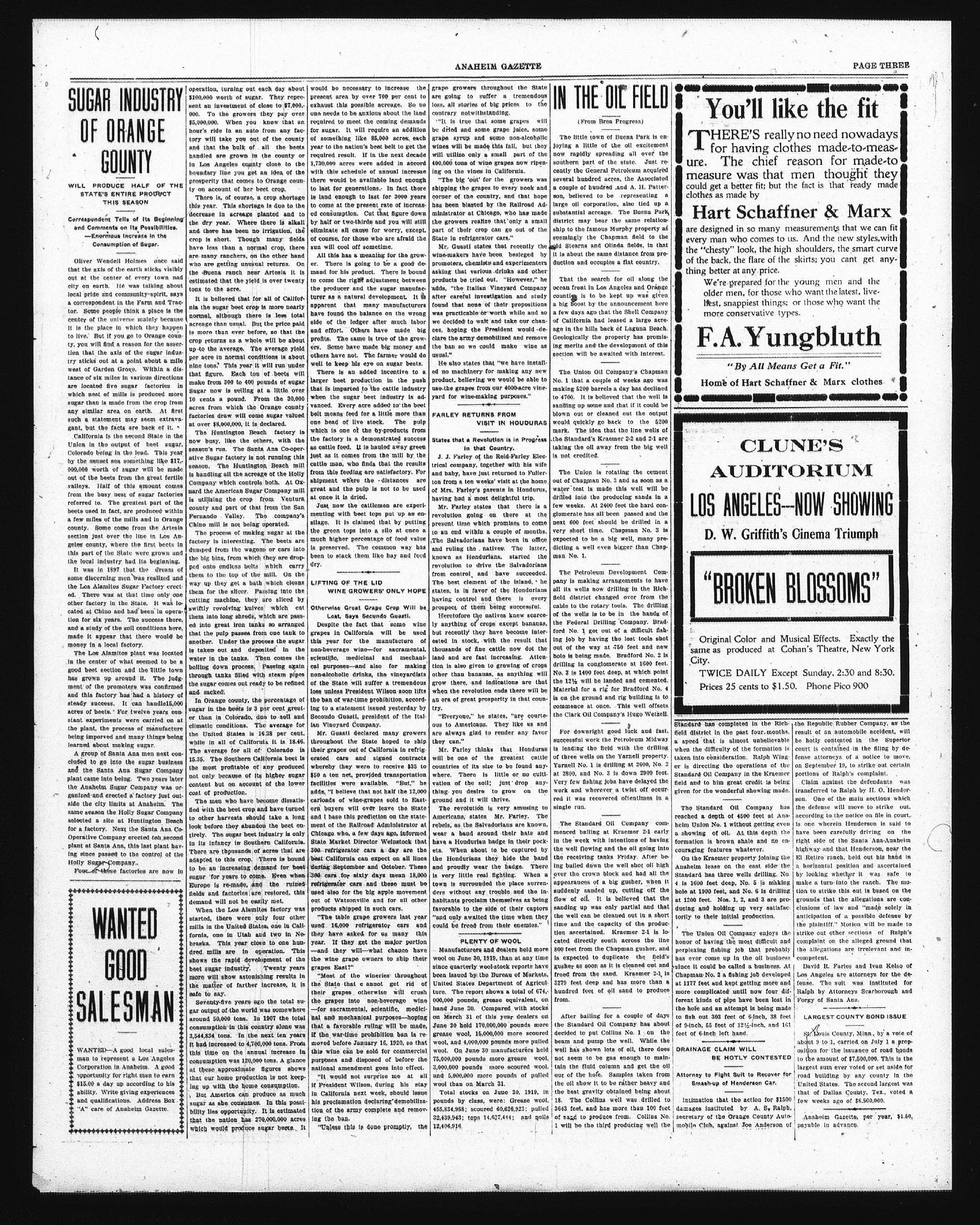
Searchable text
SUGAR INDUSTRY OF ORANGE GOUNTY
WILL PRODUCE HALF OF THE STATE'S ENTIRE PRODUCT THIS SEASON
Correspondent Tells of Its Beginning and Comments on Its Possibilities.
—Enormous Increase in the Consumption of Sugar.
Oliver Wendell Holmes once said that the axis of the earth sticks visibly out at the center of every town nad city on earth. He was talking about local pride and community spirit, says a correspondent in the Farm and Tractor. Some people think a place is the center of the universe mainly because it is the place in which they happen to live. But if you go to Orange county, you will find a reason for the assertion that the axis of the sugar industry sticks out at a point about a mile west of Garden Grove. Within a distance of six miles in various directions are located five sugar factories in which nest of mills is produced more sugar than is made from the crop from any similar area on earth. At first such a statement may seem extravagant, but the facts are back of it.
California is the second State in the Union in the output of beet sugar, Colorado being in the lead. This year operation, turning out each day about $100,000 worth of sugar. They represent an investment of close to $7,000,000. To the growers they pay over $5,000,000. When you know that an hour's ride in an auto from any factory will take you out of the county and that the bulk of all the beets handled are grown in the county or in Los Angeles county close to the boundary line you get an idea of the prosperity that comes to Orange county on account of her beet crop.
There is, of course, a crop shortage this year. This shortage is due to the decrease in acreage planted and to the dry year. Where there is alkali and there has been no irrigation, the crop is short. Though many fields have less than a normal crop, there are many ranchers, on the other hand who are getting unusual returns. On the Buena ranch near Artesia it is estimated that the yield is over twenty tons to the acre.
It is believed that for all of California the sugar beet crop is more nearly normal, although there is less total acreage than usual. But the price paid is more than ever before, so that the crop returns as a whole will be about up to the average. The average yield per acre in normal conditions is about nine tons. This year it will run under that figure. Each ton of beets will make from 300 to 400 pounds of sugar. Sugar now is selling at a little over 10 cents a pound. From the 30,000 acres from which the Orange county factories draw will come sugar valued at over $8,000,000, it is declared.
The Huntington Beach factory is now busy, like the others, with the season's run. The Santa Ana Co-operative Sugar factory is not running would be necessary present area by one exhaust this possibility one needs to be and required to meet them for sugar. It will of something like year to the nation's required result. If 1,730,000 acres were with this schedule there would be avail to last for generation is land enough to come at the predefined consumption. Or by half or two-thirds eliminate all cause of course, for those sun will cool off s.
All this has a mer. There is going mand for his product to come the right producer and turer as a natural apparent that we have found the base side of the ledger and effort. Other profits. The same ers. Some have no others have not. The well to keep his e.
There is an added larger beet product that is imparted to when the sugar bevanced. Every acre belt means feed for one head of live which is one of the factory is a deas cattle feed. It is just as it comes f
California is the second State in the Union in the output of beet sugar, Colorado being in the lead. This year by the sunset sea something like $17,000,000 worth of sugar will be made out of the beets from the great fertile valleys. Half of this amount comes from the busy nest of sugar factories referred to. The greatest part of the beets used in fact, are produced within a few miles of the mills and in Orange county. Some come from the Artesia section just over the line in Los Angeles county, where the first beets in this part of the State were grown and the local industry had its beginning.
It was in 1897 that the dream of some discerning men was realized and the Los Alamitos Sugar Factory erected. There was at that time only one other factory in the State. It was located at Chino and had been in operation for six years. The success there, and a study of the soil conditions here, made it appear that there would be money in a local factory.
The Los Alamitos plant was located in the center of what seemed to be a good beet section and the little town has grown up around it. The judgment of the promoters was confirmed and this factory has had a history of steady success. It can handle 15,000 acres of beets. For twelve years constant experiments were carried on at the plant, the process of manufacture being imporved and many things being learned about making sugar.
A group of Santa Ana men next concluded to go into the sugar business and the Santa Ana Sugar Company plant came into being. Two years later the Anaheim Sugar Company was organized and erected a factory just outside the city limits at Anaheim. The same season the Holly Sugar Company selected a site at Huntington Beach for a factory. Next the Santa Ana Co-Operative Company erected teh second plant at Santa Ana, this last plant having since passed to the control of the Holly Sugar Company...
This year it will run under that figure. Each ton of beets will make from 300 to 400 pounds of sugar. Sugar now is selling at a little over 10 cents a pound. From the 30,000 acres from which the Orange county factories draw will come sugar valued at over $8,000,000, it is declared.
The Huntington Beach factory is now busy, like the others, with the season's run. The Santa Ana Co-operative Sugar factory is not running this season. The Huntington Beach mill is handling all the acreage of the Holly Company which controls both. At Oxnard the American Sugar Company mill is utilizing the crop from Ventura county and part of that from the San Fernando Valley. The company's Chino mill is not being operated.
The process of making sugar at the factory is interesting. The beets are dumped from the wagons or cars into the big bins, from which they are dropped onto endless belts which carry them to the top of the mill. On the way up they get a bath which cleans them for the slicer. Passing into the cutting machine, they are sliced by swiftly revolving knives which cut them into long shreds, which are passed into great iron tanks so arranged that the pulp passes from one tank to another. Under the process the sugar is taken out and deposited in the water in the tanks. Then comes the boiling down process. Passing again through tanks filled with steam pipes the sugar comes out ready to be refined and sacked.
In Orange county, the percentage of sugar in the beets is 3 per cent greater than in Colorado, due to soil and climatic conditions. The average for the United States is 16.38 per cent, while in all of California it is 18.46. The average for all of Colorado is 15.35. The Southern California beet is the most profitable of any produced not only because of its higher sugar content but on account of the lower cost of production.
The men who have become dissatisfied with the beet crop and have turned to other harvests should take a long look before they abandon the beet entirely. The sugar beet industry is only in its infancy in Southern California. There are thousands of acres that are adapted to this crop. There is bound nine tons.* This year it will run under that figure. Each ton of beets will make from 300 to 400 pounds of sugar Sugar now is selling at a little over 10 cents a pound. From the 30,000 acres from which the Orange county factories draw will come sugar valued at over $8,000,000, it is declared.
The Huntington Beach factory is now busy, like the others, with the season's run. The Santa Ana Co-operative Sugar factory is not running this season. The Huntington Beach mill is handling all the acreage of the Holly Company which controls both. At Oxnard the American Sugar Company mill is utilizing the crop from Ventura county and part of that from the San Fernando Valley. The company's Chino mill is not being operated.
The process of making sugar at the factory is interesting. The beets are dumped from the wagons or cars into the big bins, from which they are dropped onto endless belts which carry them to the top of the mill. On the way up they get a bath which cleans them for the slicer. Passing into the cutting machine, they are sliced by swiftly revolving knives which cut them into long shreds, which are passed into great iron tanks so arranged that the pulp passes from one tank to another. Under the process the sugar is taken out and deposited in the water in the tanks. Then comes the boiling down process. Passing again through tanks filled with steam pipes the sugar comes out ready to be refined and sacked.
In Orange county, the percentage of sugar in the beets is 3 per cent greater than in Colorado, due to soil and climatic conditions. The average for the United States is 16.38 per cent, while in all of California it is 18.46. The average for all of Colorado is 15.35. The Southern California beet is the most profitable of any produced not only because of its higher sugar content but on account of the lower cost of production.
The men who have become dissatisfied with the beet crop and have turned to other harvests should take a long look before they abandon the beet entirely. The sugar beet industry is only in its infancy in Southern California. There are thousands of acres that are adapted to this crop. There is bound nine tons.* This year it will run under that figure. Each ton of beets will make from 300 to 400 pounds of sugar Sugar now is selling at a little over 10 cents a pound. From the 30,000 acres from which the Orange county factories draw will come sugar valued at over $8,000,000, it is declared.
The Huntington Beach factory is now busy, like the others, with the season's run. The Santa Ana Co-operative Sugar factory is not running this season. The Huntington Beach mill is handling all the acreage of the Holly Company which controls both. At Oxnard the American Sugar Company mill is utilizing the crop from Ventura county and part of that from the San Fernando Valley. The company's Chino mill is not being operated.
The process of making sugar at the factory is interesting. The beets are dumped from the wagons or cars into the big bins, from which they are dropped onto endless belts which carry them to the top of the mill. On the way up they get a bath which cleans them for the slicer. Passing into the cutting machine, they are sliced by swiftly revolving knives which cut them into long shreds, which are passed into great iron tanks so arranged that the pulp passes from one tank to another. Under the process the sugar is taken out and deposited in the water in the tanks. Then comes the boiling down process. Passing again through tanks filled with steam pipes the sugar comes out ready to be refined and sacked.
In Orange county, the percentage of sugar in the beets is 3 per cent greater than in Colorado, due to soil and climatic conditions. The average for the United States is 16.38 per cent, while in all of California it is 18.46. The average for all of Colorado is 15.35. The Southern California beet is the most profitable of any produced not only because of its higher sugar content but on account of the lower cost of production.
The men who have become dissatisfied with the beet crop and have turned to other harvests should take a long look before they abandon the beet entirely. The sugar beet industry is only in its infancy in Southern California. There are thousands of acres that are adapted to this crop. There is bound nine tons.* This year it will run under that figure. Each ton of beets will make from 300 to 400 pounds of sugar Sugar now is selling at a little over 10 cents a pound. From the 30,000 acres from which the Orange county factories draw will come sugar valued at over $8,000,000, it is declared.
The Huntington Beach factory is now busy, like the others, with the season's run. The Santa Ana Co-operative Sugar factory is not running this season. The Huntington Beach mill is handling all the acreage of the Holly Company which controls both. At Oxnard the American Sugar Company mill is utilizing the crop from Ventura county and part of that from the San Fernando Valley. The company's Chino mill is not being operated.
The process of making sugar at the factory is interesting. The beets are dumped from the wagons or cars into the big bins, from which they are dropped onto endless belts which carry them to the top of the mill. On the way up they get a bath which cleans them for the slicer. Passing into the cutting machine, they are sliced by swiftly revolving knives which cut them into long shreds, which are passed into great iron tanks so arranged that the pulp passes from one tank to another. Under the processthe sugar is taken out and deposited inthe water inthe tanks.$\textcircled{1}$ Then comesthe boiling downprocess.Passing againthroughtanksfilledwithsteampipesthesugarcomeutoadreadytobewiredandsacked.$\textcircled{2}$
In Orange county,the percentageofsugarinthebeetscropis3percentgreaterthaninColorado,due.tosoilandclimaticconditions.TheaverageforallofCaliforniaitis18:46.TheaverageforallofColoradois15:35.TheSouthernCaliforniabeetisthemostprofitableofanyproducednotonlybecauseofitshighersugarcontentbutonaccountofthelowercostofproduction.$\textcircled{3}$Therearethousandsofacresthataredappliedtothesicldressoftowearthiscarloadsfowerginegernyearswillocamlestacarfeed.$\textcircled{4}$Ijustasitcomesfromcattlemanwhofindromthisfeedingtshipmentwherethegreatandthepullatonceitisdried.$\textcircled{5}$Justnowthecarmentingwithbeetsilage.itisclaimingthegreentopsintmuchhigherpercentispreserved.Thebeentostackthereddry.$\textcircled{6}$LIFTINGOFTHEWINEGROWN
OtherwiseGreatCo-Lost,SaysSDespitethefactgrapesinCaliforniathisyearforthenon-beveragewinnescientificmedicalpurposes—andnon-alcoholicdrinkofftheStatewilllosssuccess unlessPresidentthebanofwar-timeingtoastatementSecondoGuastli,pianVineyardCompMr.Guastidecl throughouttheS theirgrapesoutoferatedcarsandwherebytheywere$50atonnet.profacilitieswereavadd,"Ibelieve thereloadsofwine-gernybuyerswillocamlestacarfeed.itisjustasitcomesfromcattlemanwhofindromthisfeedingtshipmentwherethegreatandthepullatonceitisdried."LIFTINGOFTHEWINEGROWN
OtherwiseGreatCo-Lost,SaysSDespitethefactgrapesinCaliforniathisyearforthenon-beveragewinnescientificmedicalpurposes—andnon-alcoholicdrinkofftheStatewilllosssuccess unlessPresidentthebanofwar-timeingtoa statementSecondoGuastli,pianVineyardCompMr.Guastidecl throughouttheS theirgrapesoutoferatedcarsandwherebytheywere$50atonnet.profacilitieswereavadd,"Ibelieve thereloadsofwine-gernybuyerswillocamlestacarfeed.itisjustasitcomesfromcattlemanwhofindromthisfeedingtshipmentwherethegreatandthepullatonceitisdried."LIFTINGOFTHEWINEGROWN
and the Santa Ana Sugar Company plant came into being. Two years later the Anaheim Sugar Company was organized and erected a factory just outside the city limits at Anaheim. The same season the Holly Sugar Company selected a site at Huntington Beach for a factory. Next the Santa Ana Co-Operative Company erected teh second plant at Santa Ana, this last plant having since passed to the control of the Holly Sugar Company.
Four of these factories are now in
WANTED
GOOD
SALESMAN
WANTED—A good local salesman to represent a Los Angeles Corporation in Anaheim. A good opportunity for right man to earn $15.00 a day up according to his ability. Write giving experiences and qualifications. Address Box "A" care of Anaheim Gazette.
Seventy-five years ago the total sugar output of the world was somewhere around 50,000 tons. In 1907 the total consumption in this country alone was 3,544,834 tons. In the next ten years it had increased to 4,700,000 tons. From this time on the annual increase in consumption was 120,000 tons. A glance at these approximate figures shows that our home production is not keeping up with the home consumption.
But America can produce as much sugar as she consumes. In this possibility lies opportunity. It is estimated that the nation has 270,000,000 acres which would produce sugar beets. It
The men who have become dissatisfied with the beet crop and have turned to other harvests should take a long look before they abandon the beet entirely. The sugar beet industry is only in its infancy in Southern California. There are thousands of acres that are adapted to this crop. There is bound to be an increasing demand for beet sugar for years to come. Even when Europe is re-made, and the ruined fields and factories are restored, this demand will not be easily met.
When the Los Alamitos factory was started, there were only four other mills in the United States, one in California, one in Utah and two in Nebraska. This year close to one hundred mills are in operation. This shows the rapid development of the beet sugar industry. Twenty years more will show astonishing results in the matter of farther increase, it is safe to say.
"The table grape used 16,000 refrere they have asked for year. If they get—and they will—the wine grape or grapes East?"
"Most of the State that c their grapes other that a favorable if the war-time pr moved before January this wine can be purposes and disp national amendments."
"It would not s if President Wilson in California next his proclamation o tion of the army o ing the ban."
ANAHEIM GAZETTE
IN THE OIL FIELD
(From Brea Progress)
The little town of Buena Park is enjoying a little of the oil excitement now rapidly spreading all over the southern part of the state. Just recently the General Petroleum acquired several hundred acres, the Associated couple of hundred and A. H. Patterson, believed to be representing a large oil corporation, also tied up a substantial acreage. The Buena Park district may bear the same relationship to the famous Murphy property as seemingly the Chapman field to the old Stearns and Olinda fields, in that it is about the same distance from production and occupies a flat country.
That the search for oil along the ocean front in Los Angeles and Orange counties is to be kept up was given a big boost by the announcement here a few days ago that the Shell Company of California had leased a large acreage in the hills back of Laguna Beach. Geologically the property has promising merits and the development of this section will be awaited with interest.
The Union Oil Company's Chapman No. 1 that a couple of weeks ago was making 5200 barrels a day has declined to 4700. It is believed that the well is sanding up some and that if it could be blown out or cleaned out the output would quickly go back to the 5200 mark. The idea that the line wells of the Standard's Kraemer 2-2 and 2-1 are taking the oil away from the big well is not credited.
Mr. Guasti states that recently the wine-makers have been besieged by promoters, chemists and experimenters asking that various drinks and other products be tried out. "However," he adds, "the Italian Vineyard Company after careful investigation and study found that none of their propositions was practicable or worth while and so we decided to wait and take our chances, hoping the President would declare the army demobilized and remove the ban so we could make wine as usual."
He also states that "we have installed no machinery for making any new product, believing we would be able to use the grapes from our 4000-acre vineyard for wine-making purposes."
FARLEY RETURNS FROM VISIT IN HOUDURAS
States that a Revolution is in Progress in that Country.
J. J. Farley of the Reid-Farley Elec-
There is an added incentive to a larger beet production in the push that is imparted to the cattle industry when the sugar beet industry is advanced. Every acre added to the beet belt means feed for a little more than one head of live stock. The pulp which is one of the by-products from the factory is a demonstrated success as cattle feed. It is hauled away green just as it comes from the mill by the cattle man, who finds that the results from this feeding are satisfactory. For shipment where the distances are great and the pulp is not to be used at once it is dried.
Just now the cattlemen are experimenting with beet tops put up as enclosure. It is claimed that by putting the green tops into a silo at once a much higher percentage of food value is preserved. The common way has been to stack them like hay and feed dry.
LIFTING OF THE LID WINE GROWERS' ONLY HOPE
Otherwise Great Grape Crop Will be Lost, Says Secundo Guasti.
Despite the fact that some wine grapes in California will be used this year for the manufacture of non-beverage wine—for sacramental, scientific, medicinal and mechanical purposes—and also for making non-alcoholic drinks, the vineyardists of the State will suffer a tremendous loss unless President Wilson soon lifts the ban of war-time prohibition, according to a statement issued yesterday by Secondo Guasti, president of the Italian Vineyard Company.
Mr. Guasti declared many growers throughout the State hoped to ship their grapes out of California in refrigerated cars and signed contracts whereby they were to receive $35 to $50 a ton net, provided transportation facilities were available. "But," he adds, "I believe that not half the 12,000 carloads of wine-grapes sold to Eastern buyers will ever leave the State and I base this prediction on the statement of the Railroad Administrator at Chicago who, a few days ago, informed State Market Director Weinstock that 300 refrigerator cars a day are the best California can expect on all lines well to keep his eye on sugar beets.
He also states that "we have installed no machinery for making any new product, believing we would be able to use the grapes from our 4000-acre vineyard for wine-making purposes."
FARLEY RETURNS FROM VISIT IN HOUDURAS
States that a Revolution is in Progress in that Country.
J. J. Farley of the Reid-Farley Electrical company, together with his wife and baby, have just returned to Fullerton from a ten weeks' visit at the home of Mrs. Farley's parents in Hondurus, having had a most delightful trip.
Mr. Farley states that there is a revolution going on there at the present time which promises to come to an end within a couple of months. The Salvadorians have been in office and ruling the natives. The latter, known as Hondurians, started the revolution to drive the Salvadorians from control and have succeeded. The best element of the island, he states, is in favor of the Hondurians having control and there is every prospect of them being successful.
Heretofore the natives knew scarce anything of crops except bananas, but recently they have become interested in stock, with the result that thousands of fine cattle now dot the land and are fast increasing. Attention is also given to growing of crops other than bananas, as anything will grow there, and indications are that when the revolution ends there will be an era of great prosperity in that country.
"Everyone," he states, "are courteous to Americans. They like us and are always glad to render any favor they can."
Mr. Farley thinks that Honduras will be one of the greatest cattle countries of its size to be found anywhere. There is little or no cultivation of the soil; just drop anything you desire to grow on the ground and it will thrive.
The revolution is very amusing to Americans, states Mr. Farley. The rebels, as the Salvadorians are known, wear a band around their hats and have a Honduran badge in their pockets. When about to be captured by the Hondurians they hide the band.
The Union Oil Company's Chapman No. 1 that a couple of weeks ago was making 5200 barrels a day has declined to 4700. It is believed that the well is sanding up some and that if it could be blown out or cleaned out the output would quickly go back to the 5200 mark. The idea that the line wells of the Standard's Kraemer 2-2 and 2-1 are taking the oil away from the big well is not credited.
The Union is rotating the cement out of Chapman No. 3 and as soon as a water test is made this well will be drilled into the producing sands in a few weeks. At 2400 feet the hard conglomerate has all been passed and the next 600 feet should be drilled in a very short time. Chapman No. 3 is expected to be a big well, many predicting a well even bigger than Chapman No. 1.
The Petroleum Development Company is making arrangements to have all its wells now drilling in the Richfield district changed over from the cable to the rotary tools. The drilling of the wells is to be in the hands of the Federal Drilling Company. Bradford No. 1 got out of a difficult fishing job by having lost tools shot out of the way at 750 feet and new hole is being made. Bradford No. 2 is drilling in conglomerate at 1600 feet. No. 3 is 1400 feet deep, at which point the 12½ will be landed and cemented. Material for a rig for Bradford No. 4 is on the ground and rig building is to commence at once. This well offsets the Clark Oil Company's Hugo Wetzell.
For downright good luck and fast, successful work the Petroleum Midway is leading the field with the drilling of three wells on the Yarnell property. Yarnell No. 1 is drilling at 2600, No. 2 at 2800, and No. 3 is down 2900 feet. Very few fishing jobs have delayed the work and wherever a twist off occurred it was recovered oftentimes in a single run.
The Standard Oil Company commenced balling at Kraemer 2-1 early in the week with intentions of having the well flowing and the oil going into the receiving tanks Friday. After being hailed down the well shot oil high
$50 a ton net, provided transportation facilities were available. "But," he adds, "I believe that not half the 12,000 carloads of wine-grapes sold to Eastern buyers will ever leave the State and I base this prediction on the statement of the Railroad Administrator at Chicago who, a few days ago, informed State Market Director Welnstock that 300 refrigerator cars a day are the best California can expect on all lines during September and October. These 300 cars for sixty days mean 18,000 refrigerator cars and these must be used also for the big apple movement out of Watsonville and for all other products shipped in such cars.
"The table grape growers last year used 16,000 refrigerator cars and they have asked for as many this year. If they get the major portion—and they will—what chance have the wine grape owners to ship their grapes East?"
"Most of the wineries throughout the State that cannot get rid of their grapes otherwise will crush the grapes into non-beverage wine—for sacramental, scientific, medicinal and mechanical purposes—hoping that a favorable ruling will be made, if the war-time prohibition ban is removed before January 16, 1920, so that this wine can be sold for commercial purposes and disposed of before the national amendment goes into effect.
"It would not surprise me at all if President Wilson, during his stay in California next week, should issue his proclamation declaring demobilization of the army complete and removing the ban."
"Unless this is done promptly, the where. There is little or no cultivation of the soil; just drop anything you desire to grow on the ground and it will thrive.
The revolution is very amusing to Americans, states Mr. Farley. The rebels, as the Salvadorians are known, wear a band around their hats and have a Hondurian badge in their pockets. When about to be captured by the Hondurians they hide the band and proudly wear the badge. There is very little real fighting. When a town is surrounded the place surrenders without any trouble and the inhabitants proclaim themselves as being favorable to the side of their captors "and only awaited the time when they could be freed from their enemies."
PLENTY OF WOOL
Manufacturers and dealers held more wool on June 30, 1919, than at any time since quarterly wool-stock reports have been issued by the Bureau of Markets, United States Department of Agriculture. The report shows a total of 674,000,000 pounds, grease equivalent, on hand June 30. Compared with stocks on March 31 of this year dealers on June 30 held 170,000,000 pounds more grease wool, 15,000,000 more scoured wool, and 4,000,000 pounds more pulled wool. On June 30 manufacturers held 75,000,000 pounds more grease wool, 3,000,000 pounds more scoured wool, and 5,000,000 more pounds of pulled wool than on March 31.
Total stocks on June 30, 1919, in pounds by class, were: Grease wool, 455,834,958; scoured 60,626,923; pulled 32,439,943; tops 14,627,444; and polls 12,406,916.
The Standard Oil Company commenced bailing at Kraemer 2-1 early in the week with intentions of having the well flowing and the oil going into the receiving tanks Friday. After being bailed down the well shot oil high over the crown block and had all the appearances of a big gusher, when it suddenly sanded up, cutting off the flow of oil. It is believed that the sanding up was only partial and that the well can be cleaned out in a short time and the capacity of the production ascertained. Kraemer 2-1 is located directly south across the line 800 feet from the Chapman gusher, and is expected to duplicate the field's gusher as soon as it is cleaned out and freed from the sand. Kraemer 2-1 is 3279 feet deep and has more than a hundred feet of oil sand to produce from.
After bailing for a couple of days the Standard Oil Company has about decided to put Collins No. 1 on the beam and pump the well. While the well has shown lots of oil, there does not seem to be gas enough to maintain the fluid column and get the oil out of the hole. Samples taken from the oil show it to be rather heavy and the best gravity obtained being about 18. The Collins well was drilled to 3643 feet, and has more than 100 feet of sand to produce from. Collins No. 1 will be the third producing well the
You’ll like the fit
THERE’S really no need nowadays
for having clothes made-to-measure. The chief reason for made-to
measure was that men thought they could get a better fit; but the fact is that ready made
clothes as made by
Hart Schaffner & Marx
are designed in so many measurements that we can fit
every man who comes to us. And the new styles, with
the “chesty” look, the high shoulders, the smart curve
of the back, the flare of the skirts; you cant get anything better at any price.
We’re prepared for the young men and the
older men, for those who want the latest, livetest, snappiest things; or those who want the
more conservative types.
F.A. Yungbluth
“By All Means Get a Fit.”
Home of Hart Schaffner & Marx clothes
CLUNE'S
"By All Means Get a Fit."
Home of Hart Schaffner & Marx clothes
CLUNE'S AUDITORIUM
LOS ANGELES--NOW SHOWING
D. W. Griffith's Cinema Triumph
"BROKEN BLOSSOMS"
Original Color and Musical Effects. Exactly the same as produced at Cohan’s Theatre, New York City.
TWICE DAILY Except Sunday, 2:30 and 8:30.
Prices 25 cents to $1.50. Phone Pico 900
Standard has completed in the Richfield district in the past four months, a speed that is almost unbelievable when the difficulty of the formation is taken into consideration. Ralph Winger is directing the operations of the Standard Oil Company in the Kraemer field and to him great credit is being given for the wonderful showing made.
The Standard Oil Company has reached a depth of 4500 feet at Anaheim Union No. 1 without getting even a showing of oil. At this depth the formation is brown shale and no encouraging features whatever.
On the Kraemer property joining the Anaheim lease on the east side the Republic Rubber Company, as the result of an automobile accident, will be hotly contested in the Superior court is contained in the filing by defense attorneys of a notice to move, on September 19, to strike out certain portions of Ralph’s complaint.
Claim against the defendants was transferred to Ralph by H. O. Henderson. One of the main sections which the defense will move to strike out, according to the notice on file in court, is one wherein Henderson is said to have been carefully driving on the right side of the Santa Ana-Anaheim highway and that Henderson, near the El Retiro ranch, held out his hand in a horizontal position and ascertained
Standard Oil Company in the Kraemer field and to him great credit is being given for the wonderful showing made.
The Standard Oil Company has reached a depth of 4500 feet at Anaheim Union No. 1 without getting even a showing of oil. At this depth the formation is brown shale and no encouraging features whatever.
On the Kraemer property joining the Anaheim lease on the east side the Standard has three wells drilling. No. 4 is 1600 feet deep, No. 5 is making hole at 1900 feet, and No. 6 is drilling at 1200 feet. Nos. 1, 2, and 3 are producing and holding up very satisfactorily to their initial production.
The Union Oil Company enjoys the honor of having the most difficult and perplexing fishing job that probably has ever come up in the oil business since it could be called a business. At Chapman-No. 2 a fishing job developed at 1177 feet and kept getting more and more complicated until now four different kinds of pipe have been lost in the hole and an attempt is being made to fish out 303 feet of 6-inch, 38 feet of 9-inch, 55 feet of 12½-inch, and 161 feet of 6-inch left hand.
DRAINAGE CLAIM WILL BE HOTLY CONTESTED
Attorney to Fight Suit to Recover for Smash-up of Henderson Car.
Intimation that the action for $1500 damages instituted by A. S. Ralph, secretary of the Orange County Automobile Club, against Joe Anderson of portions of Ralph's complaint.
Claim against the defendants was transferred to Ralph by H. O. Henderson. One of the main sections which the defense will move to strike out, according to the notice on file in court, is one wherein Henderson is said to have been carefully driving on the right side of the Santa Ana-Anaheim highway and that Henderson, near the El Retiro ranch, held out his hand in a horizontal position and ascertained by looking whether it was safe to make a turn into the ranch. The motion to strike this out is based on the grounds that the allegations are conclusions of law and "made solely in anticipation of a possible defense by the plaintiff." Motion will be made to strike out other sections of Ralph's complaint on the alleged ground that the allegations are irrelevant and incompetent.
David R. Farles and Ivan Kelso of Los Angeles are attorneys for the defense. The suit was instituted for Ralph by Attorneys Scarborough and Forgy of Santa Ana.
LARGEST COUNTY BOND ISSUE
St. Louis County, Minn., by a vote of about 9 to 1, carried on July 1 a proposition for the issuance of road bonds to the amount of $7,500,000. This is the largest sum ever voted or set aside for road building by any county in the United States. The second largest was that of Dallas County, Tex., voted a few weeks ago of $6,500,000.
Anaheim Gazette, per year, $1.50, payable in advance.