anaheim-gazette 1919-09-04
Scanned page
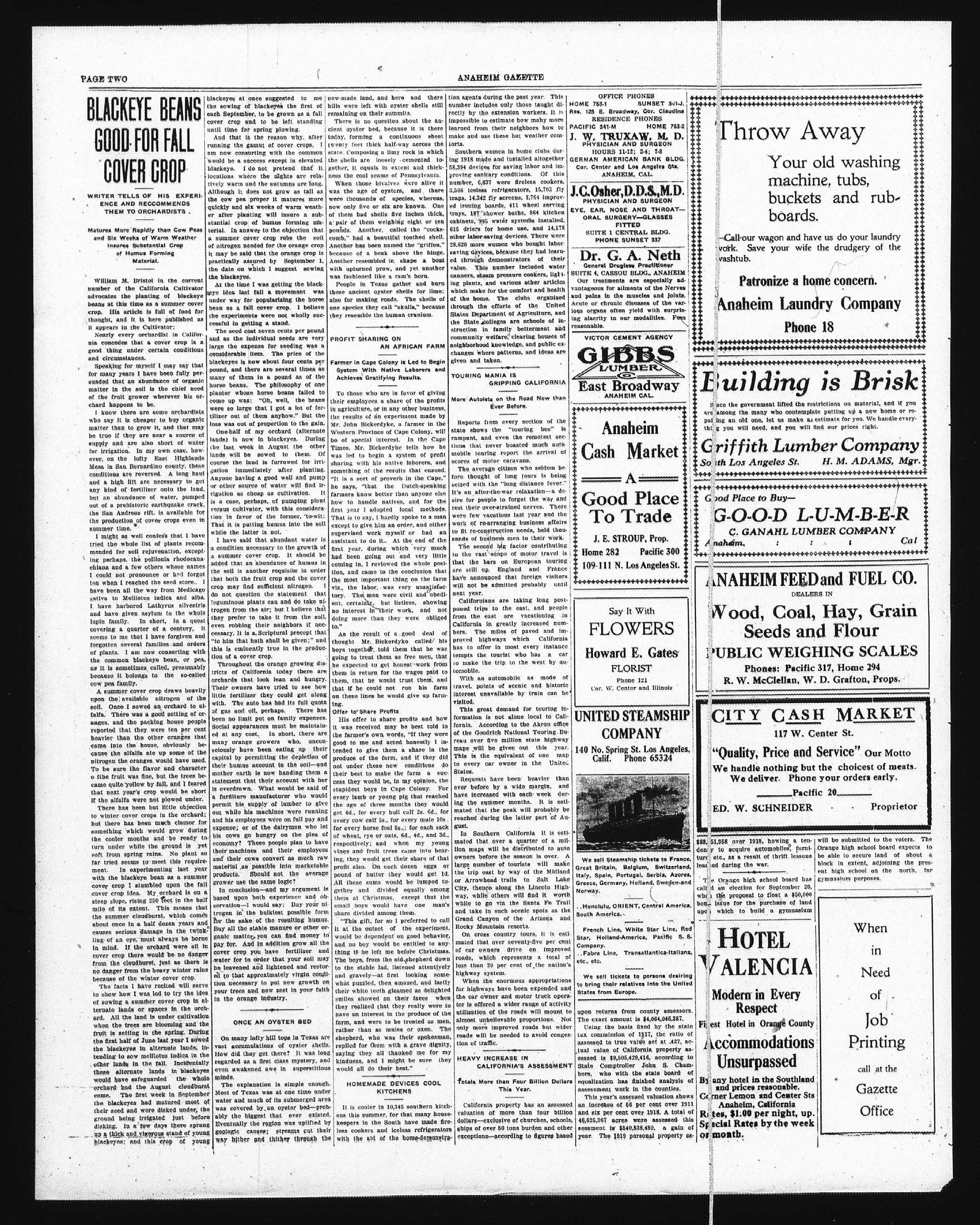
Searchable text
BLACKEYE BEANS
GOOD FOR FALL COVER GROP
WRITER TELLS OF HIS EXPERIENCE AND RECOMMENDS THEM TO ORCHARDISTS.
Matures More Rapidly than Cow Peas and Six Weeks of Warm Weather Insures Substantial Crop of Humus Forming Material.
William M. Bristol in the current number of the California Cultivator advocates the planting of blackeye beans at this time as a summer cover crop. His article is full of food for thought, and it is here published as it appears in the Cultivator:
Nearly every orchardist in California concedes that a cover crop is a good thing under certain conditions and circumstances.
Speaking for myself I may say that for many years I have been fully persuaded that an abundance of organic matter in the soil is the chief need of the fruit grower wherever his orchard happens to be.
I know there are some orchardists who say it is cheaper to buy organic matter than to grow it, and that may be true if they are near a source of supply and are also short of water for irrigation. In my own case, how blackeyes at once suggested to me the sowing of blackeyes the first of each September, to be grown as a fall cover crop and to be left standing until time for spring plowing.
And that is the reason why, after running the gamut of cover crops, I am now consorting with the common would be a success except in elevated blackeye. I do not pretend that it locations where the nights are relatively warm and the autumns are long. Although it does not grow as tall as the cow pea proper it matures more quickly and six weeks of warm weather after planting will insure a substantial crop of humus forming material. In answer to the objection that a summer cover crop robs the soil of nitrogen needed for the orange crop it may be said that the orange crop is practically assured by September 1, the date on which I suggest sowing the blackeyes.
At the time I was getting the blackeye idea last fall a movement was under way for popularizing the horse bean as a fall cover crop. I believe the experiments were not wholly successful in getting a stand.
The seed cost seven cents per pound and as the individual seeds are very large the expense for seeding was a considerable item. The price of the blackeyes is now about four cents per pound, and there are several times as many of them in a pound as of the horse beans. The philosophy of one planter whose horse beans failed to come up was: "Oh, well, the beans were so large that I got a lot of fertilizer out of them anyhow." But the loss was out of proportion to the gain.
One-half of my orchard (alternate lands) is now in blackeyes. During the last week in August the other lands will be sowed to them. Of new-made land hills were leased remaining ones.
There is no client oyster today, forming twenty feet state. Composing the shells are gether, it equips the coast.
When those was the age were thousand now only five of them had a pair of the pounds. An comb," had Another has because of Another reseer with upturn was fashioned.
People in these ancients also for make one species they resemble.
PROFIT SHOP
Farmer in C System W Achieves
To those their employ in agriculture the results Mr. John B Western Pro be of specif Times, Mr. was led to
Speaking for myself I may say that for many years I have been fully persuaded that an abundance of organic matter in the soil is the chief need of the fruit grower wherever his orchard happens to be.
I know there are some orchardists who say it is cheaper to buy organic matter than to grow it, and that may be true if they are near a source of supply and are also short of water for irrigation. In my own case, however, on the lofty East Highlands Mesa in San Bernardino county, these conditions are reversed. A long haul and a high lift are necessary to get any kind of fertilizer onto the land, but an abundance of water, pumped out of a prehistoric earthquake crack, the San Andreas rift, is available for the production of cover crops even in summer time.
I might as well confess that I have tried the whole list of plants recommended for soil rejuvenation, excepting perhaps, the pellionia rhodocana-chiana and a few others whose names I could not pronounce or had forgot ten when I reached the seed store. I have been all the way from Medicago sativa to Melilotus indica and alba. I have harbored Lathyrus silvestris and have given asylum to the whole lupin family. In short, in a quest covering a quarter of a century, it seems to me that I have forgiven and forgotten several families and orders of plants. I am now consorting with the common blackeye bean, or pea, as it is sometimes called, presumably because it belongs to the so-called cow pea family.
A summer cover crop draws heavily upon the available nitrogen of the soil. Once I sowed an orchard to alfalfa. There was a good setting of oranges, and the packing house people reported that they were ten per cent heavier than the other oranges that came into the house, obviously because the alfalfa ate up some of the nitrogen the oranges would have used. To be sure the flavor and character of the fruit was fine, but the trees became quite yellow by fall, and I feared that next year's crop would be short if the alfalfa were not plowed under.
There has been but little objection to winter cover crops in the orchard; but there has been much clamor for something which would grow during the cooler months and be ready to turn under while the ground is yet soft from spring rains. No plant so far tried seems to meet this requirement.
blackeyes is now about four cents per pound, and there are several times as many of them in a pound as of the horse beans. The philosophy of one planter whose horse beans failed to come up was: "Oh, well, the beans were so large that I got a lot of fertilizer out of them anyhow." But the loss was out of proportion to the gain.
One-half of my orchard (alternate lands) is now in blackeyes. During the last week in August the other lands will be sowed to them. Of course the land is furrowed for irrigation immediately after planting. Anyone having a good well and pump or other source of water will find irrigation as cheap as cultivation. It is a case, perhaps, of pumping plant versus cultivator, with this consideration in favor of the former, "to-wit: That it is putting humus into the soil while the latter is not.
I have said that abundant water is a condition necessary to the growth of a summer cover crop. It should be added that an abundance of humus in the soil is another requisite in order that both the fruit crop and the cover crop may find sufficient nitrogen. I do not question the statement that leguminous plants can and do take nitrogen from the air; but I believe that they prefer to take it from the soil, even robbing their neighbors if necessary. It is a Scriptural precept that "to him that hath shall be given;" and this is eminently true in the production of a cover crop.
Throughout the orange growing districts of California today there are orchards that look lean and hungry. Their owners have tried to see how little fertilizer they could get along with. The auto has had its full quota of gas and oil, perhaps. There has been no limit put on family expenses. Social appearances must be maintained at any cost. In short, there are many orange growers who, unconsciously have been eating up their capital by permitting the depletion of their humus account in the soil—and mother earth is now handing them a statement that their account with her is overdrawn. What would be said of a furniture manufacturer who would permit his supply of lumber to give out while his machines were running and his employees were on full pay and expense; or of the dairyman who let his cows go hungry on the plea of economy? These people plan to have their machines and their employees and their cows convert as much raw material as possible into marketable products.
To those whose employments in agriculture the results of Mr. John Bent Western Province be of special Times, Mr. Bent was led to sharing with something o'r "It is a sorrow he says," "the farmers know how to handle first year I." That is to say except to give supervised assistance to first year, had been coming in, tion, and care the most imminent viz., the laboratory. The ent, certain no interest doing more to."
As the righthought Mr. boys together going to treat he expected them in retelling them, that if he on these lines.
Offer to Shall His offer it was received the farmer's good to me tended to produce of not under their bestcess they we stupidest b every lambage age of get 6d., for every cow for every he of wheat, r respectively vines and ing, they w
To be sure the flavor and character of the fruit was fine, but the trees became quite yellow by fall, and I feared that next year's crop would be short if the alfalfa were not plowed under.
There has been but little objection to winter cover crops in the orchard; but there has been much clamor for something which would grow during the cooler months and be ready to turn under while the ground is yet soft from spring rains. No plant so far tried seems to meet this requirement. In experimenting last year with the blackeye bean as a summer cover crop I stumbled upon the fall cover crop idea. My orchard is on a steep slope, rising 250 feet in the half mile of its extent. This means that the summer cloudburst, which comes about once in a half dozen years and causes serious damage in the twinkling of an eye, must always be borne in mind. If the orchard were all in cover crop there would be no danger from the cloudburst, just as there is no danger from the heavy winter rains because of the winter cover crop.
The facts I have recited will serve to show how I was led to try the idea of sowing a summer cover crop in alternate lands or spaces in the orchard. All the land is under cultivation when the trees are blooming and the fruit is setting in the spring. During the first half of June last year I sowed the blackeyes in alternate lands, intending to sow mellilotus indica in the other lands in the fall. Incidentally these alternate lands in blackeyes would have safeguarded the whole orchard had the August cloudburst come. The first week in September the blackeyes had matured most of their seed and were disked under, the ground being irrigated just before disking. In a few days there sprang up a thick and vigorous stand of young blackeyes; and this crop of young mother earth is now handing them a statement that their account with her is overdrawn. What would be said of a furniture manufacturer who would permit his supply of lumber to give out while his machines were running and his employees were on full pay and expense; or of the dairyman who let his cows go hungry on the plea of economy? These people plan to have their machines and their employees and their cows convert as much raw material as possible into marketable products. Should not the average grower use the same logic?
In conclusion—and my argument is based upon both experience and observation—I would say: Buy your nitrogen in the bulkiest possible form for the sake of the resulting humus. Buy all the stable manure or other organic matter you can find money to pay for. And in addition grow all the cover crop you have fertilizer and water for in order that your soil may be leavened and lightened and restored to that approximately virgin condition necessary to put new growth on your trees and new zest in your faith in the orange industry.
ONCE AN OYSTER BED
On many lofty hill tops in Texas are vast accumulations of oyster shells. How did they get there? It was long regarded as a first class mystery, and even awakened awe in superstitious minds.
The explanation is simple enough. Most of Texas was at one time under water and much of its submerged area was covered by an oyster bed—probably the biggest that ever existed. Eventually the region was uplifted by geologic causes; streams cut their way hither and thither through the
ANAHEIM GAZETTE
new-made land, and here and there hills were left with oyster shells still remaining on their summits.
There is no question about the ancient oyster bed, because it is there today, forming a continuous sheet twenty feet thick half-way across the state. Composing a limy rock in which the shells are loosely cemented together, it equals in extent and thickness the coal seams of Pennsylvania.
When those bivalves were alive it was the age of oysters, and there were thousands of species, whereas now only five or six are known. One of them had shells five inches thick, a pair of them weighing eight or ten pounds. Another, called the "cockscomb," had a beautiful toothed shell. Another has been named the "griffen," because of a beak above the hinge. Another resembled in shape a boat with upturned prow, and yet another was fashioned like a ram's horn.
People in Texas gather and burn these ancient oyster shells for lime; also for making roads. The shells of one species they call "skulls," because they resemble the human cranium.
PROFIT SHARING ON AN AFRICAN FARM
Farmer in Cape Colony is Led to Begin System With Native Laborers and Achieves Gratifying Results.
To those who are in favor of giving their employees a share of the profits in agriculture, or in any other business, the results of an experiment made by Mr. John Bickerdyke, a farmer in the Western Province of Cape Colony, will be of special interest. In the Cape Times, Mr. Bickerdyke tells how he was led to begin a system of profit-taking agents during the past year. This number includes only those taught directly by the extension workers. It is impossible to estimate how mahy more learned from their neighbors how to make and use these hot weather comforts.
Southern women in home clubs during 1918 made and installed altogether 58,394 devices for saving labor and improving sanitary conditions. Of this number, 6,837 were fireless cookers, 3,508 iceless refrigerators, 15,703 fly traps, 14,342 fly screens, 1,764 improved ironing boards, 411 wheel serving trays, 187 shower baths, 864 kitchen cabinets, 985 water systems installed, 615 driers for home use, and 14,178 other labor-saving devices. There were 28,620 more women who bought labor-saving devices, because they had learned through demonstrators of their value. This number included water canners, skim pressure cookers, lighting plants, and various other articles which make for the comfort and health of the home. The clubs organized through the efforts of the United States Department of Agriculture, and the State colleges are schools of instruction in family betterment and community welfare, clearing houses of neighborhood knowledge, and public exchanges where patterns, and ideas are given and taken.
TOURING MANIA IS GRIPPING CALIFORNIA
More Autoists on the Road Now than Ever Before.
Reports from every section of the state shows the "touring bee" is rampant, and even the remotest sections that never boasted much automobile touring report the arrival of...
Farmer in Cape Colony is Led to Begin System With Native Laborers and Achieves Gratifying Results.
To those who are in favor of giving their employees a share of the profits in agriculture, or in any other business, the results of an experiment made by Mr. John Bickerdyke, a farmer in the Western Province of Cape Colony, will be of special interest. In the Cape Times, Mr. Bickerdyke tells how he was led to begin a system of profit sharing with his native laborers, and something of the results that ensued. "It is a sort of proverb in the Cape," he says, "that the Dutch-speaking farmers know better than anyone else how to handle natives, and for the first year I adopted local methods. That is to say, I hardly spoke to a man except to give him an order, and either supervised work myself or had an assistant to do it... At the end of the first year, during which very much had been going out and very little coming in, I reviewed the whole position, and came to the conclusion that the most important thing on the farm viz., the labor, was very unsatisfactory. The men were civil and obedient, certainly, but listless, showing no interest in their work, and not doing more than they were obliged to."
As the result of a good deal of thought Mr. Bickerdyke called/his boys together, told them that he was going to treat them as free men, that he expected to get honest work from them in return for the wages paid to them, that he would trust them, and that if he could not run his farm on these lines he would give up farming.
Offer to Share Profits
His offer to share profits and how it was received may be best told in the farmer's own words, "If they were good to me and acted honestly I intended to give them a share in the produce of the farm, and if they did not under these new conditions do their best to make the farm a success they would be, in my opinion, the stupidest boys in Cape Colony. For every lamb or young pig that reached the age of three months they would get 6d., for every bull calf 2s. 6d., for every cow calf 5s., for every mule 10s. for every horse foal 5s.; for each sack of wheat, rye or oats, 6d., 4d., and 3d., respectively; and when my young vines and fruit trees came into bearing, they would get their share of that profit also. On each dozen eggs or given and taken.
TOURING MANIA IS GRIPPING CALIFORNIA
More Autoists on the Road Now than Ever Before.
Reports from every section of the state shows the "touring bee" is rampant, and even the remotest sections that never boasted much automobile touring report the arrival of scores of motor caravans.
The average citizen who seldom before thought of long tours is being seized with the "long distance fever." It's an after-the-war relaxation—a desire for people to forget the war and rest their over-strained nerves. There were few vacations last year and the work of re-arranging business affairs to fit re-construction needs, held thousands of business men to their work.
The second big factor contributing to the vast scope of motor travel is that the bars on European touring are still up. England and France have announced that foreign visitors will not be admitted probably until next year.
Californians are taking long postponed trips to the east, and people from the east are vacationing in California in greatly increased numbers. The miles of paved and improved highways which California has to offer in most every instance tempts the tourist who has a car to make the trip to the west by automobile.
With an automobile as mode of travel, points of scenic and historic interest unavailable by train can be visited.
This great demand for touring information is not alone local to California. According to the Akron office of the Goodrich National Touring Bureau over five million state highway maps will be given out this year. This is the equivalent of one map to every car owner in the United States.
Requests have been heavier than ever before by a wide margin, and have increased with each week during the summer months. It is estimated that the peak will probably be reached during the latter part of August.
In Southern California it is estimated that over a quarter of a million maps will be distributed to auto owners before the season is over. A large number of tourists will make
and them a count with her would be said of her who would number to give were running on full pay and man who let the plea of plan to have their employees much raw to marketable the average sale?
The argument isience and objection Buy your ni impossible formulating humus. Give or other ordinance money to grow all the fertilizer and your soil may need and restore virgin condition new growth on in your faith.
This gift, for so I preferred to call it at the outset of the experiment, would be dependent on good behavior, and no boy would be entitled to anything if he left me before Christmas. The boys, from the old shepherd down to the stable lad, listened attentively and gravely—at first looking somewhat puzzled, then amazed, and lastly their white teeth gleamed as delighted smiles showed on their faces when they realized that they really were to have an interest in the produce of the farm, and were to be treated as men, rather than as mules or oxen. The shepherd, who was their spokesman, replied for them with a grave dignity, saying they all thanked me for my kindness, and I might be sure they would all do their best."
HOMEMADE DEVICES COOL KITCHENS
It is cooler in 10,345 southern kitchens this summer, for that many housekeepers in the South have made fireless cookers and iceless refrigerators with the aid of the home-demonstration.
HEAVY INCREASE IN CALIFORNIA'S ASSESSMENT
Totals More than Four Billion Dollars This Year.
California property has an assessed valuation of more than four billion dollars—exclusive of churches, schools, ships of over 50 tons burden and other exceptions—according to figures based
We sell Steamship ticket to France, Great Britain, Belgium, Switzerland, Italy, Spain, Portugal, Serbia, Azores, Greece, Germany, Holland, Sweden and Norway.
.. Honolulu, ORIENT, Central America, South America.
French Line, White Star Line, Red Star, Holland-America, Pacific S. S. Company.
.. Fabre Line, Transatlantica-Italliana, etc., etc.
We sell tickets to persons desiring to bring their relatives into the United States from Europe.
upon returns from county assessors. The exact amount is $4,064,046,387.
Using the basis fixed by the state tax commission of 1917, the ratio of assessed to true value set at A27, actual value of California property assessed is $9,505,429,416, according to State Comptroller John S. Chambers, who with the state board of equalization has finished analysis of assessment work in the counties.
This year's assessed valuation shows an increase of 56 per cent over 1911 and six per cent over 1918. A total of 46,625,367 acres were assessed this session is $540,838,480, a gain of year. The 1919 personal property as
Throw Away
Your old washing machine, tubs,
buckets and rubboards.
Call our wagon and have us do your laundry
work. Save your wife the drudgery of the
washtub.
Patronize a home concern.
Anaheim Laundry Company
Phone 18
Building is Brisk
Since the government lifted the restrictions on material, and if you
are among the many who contemplate putting up a new home or repairing an old one, let us make an estimate for you. We handle everything you will need, and you will find our prices right.
Griffith Lumber Company
Building is Brisk
Since the government lifted the restrictions on material, and if you are among the many who contemplate putting up a new home or repairing an old one, let us make an estimate for you. We handle everything you will need, and you will find our prices right.
Griffith Lumber Company
South Los Angeles St. H. M. ADAMS, Mgr.
Good Place to Buy—
G-O-O-D L-U-M-B-E-R
C. GANAHL LUMBER COMPANY
Anaheim Cal
ANAHEIM FEED and FUEL CO.
DEALERS IN
Wood, Coal, Hay, Grain Seeds and Flour
PUBLIC WEIGHING SCALES
Phones: Pacific 317, Home 294
R. W. McClellan, W. D. Grafton, Props.
CITY CASH MARKET
117 W. Center St.
“Quality, Price and Service” Our Motto
We handle nothing but the choicest of meats.
We deliver. Phone your orders early.
Pacific 20
ED. W. SCHNEIDER Proprietor
$88,51,958 over 1918, howing a tendency to acquire automobiles, furniture etc., as a result of thrift lessons learned during the war.
will be submitted to the voters. The Orange high school board expects to be able to secure land of about a block in extent, adjoining the pres-
HOTEL VALENCIA
Modern in Every Respect
Finest Hotel in Orange County
Accommodations Unsurpassed
By any hotel in the Southland and prices reasonable.
Corner Lemon and Center Sts Anaheim, California
Rates, $1.00 per night, up.
Special Rates by the week or month.
When in Need of Job Printing
call at the Gazette Office