anaheim-gazette 1919-08-07
Scanned page
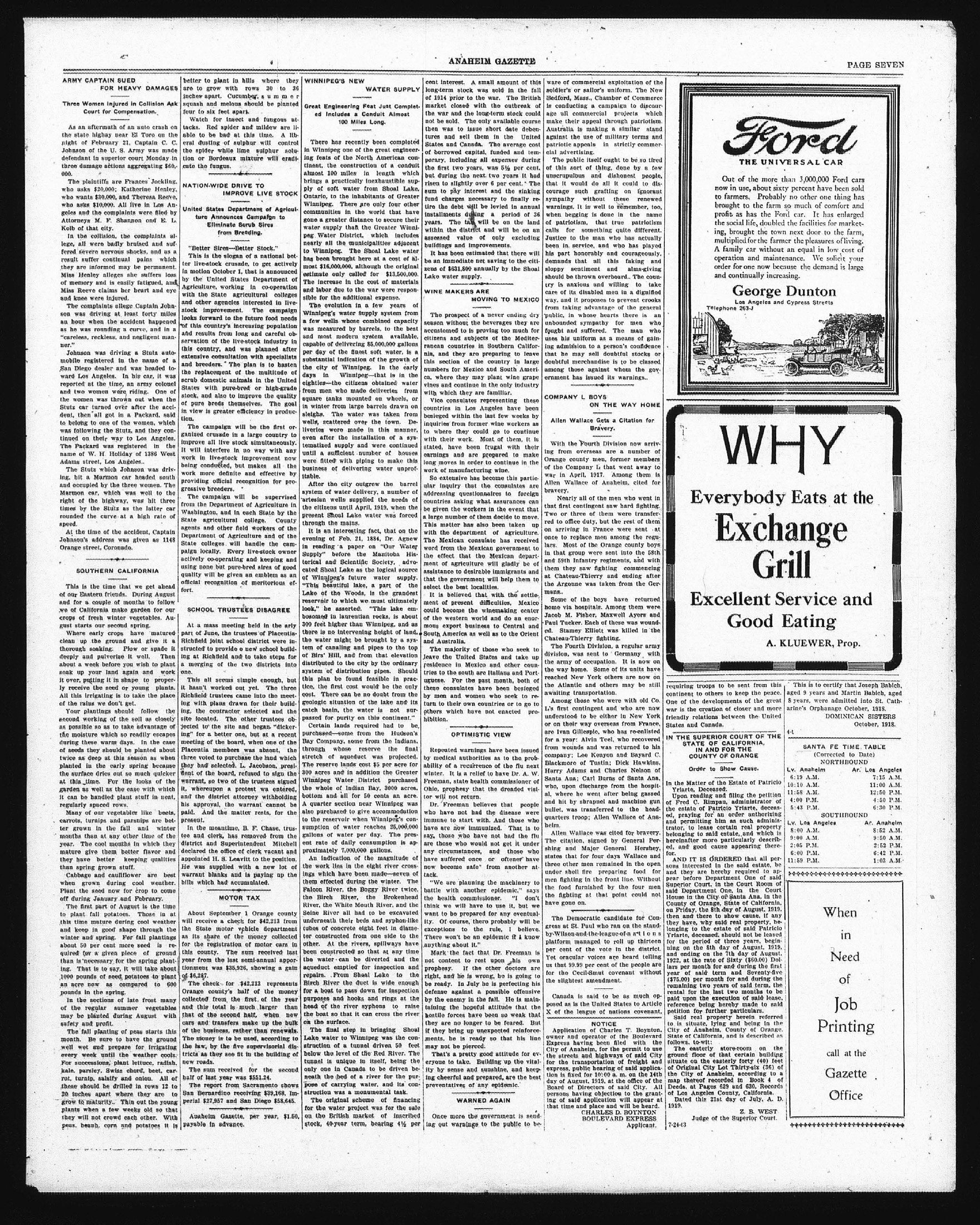
Searchable text
ARMY CAPTAIN SUED
FOR HEAVY DAMAGES
Three Women Injured in Collision Ask Court for Compensation.
As an aftermath of an auto crash on the state highway near El Toro on the night of February 21, Captain C. C. Johnson of the U. S. Army was made defendant in superior court Monday in three damage actions aggregating $60,000.
The plaintiffs are Frances Jockling, who asks $20,000; Katherine Henley, who wants $30,000, and Theresa Reeve, who asks $10,000. All live in Los Angeles and the complaints were filed by Attorneys M. F. Shannon and E. L. Kolb of that city.
In the collision, the complaints allege all were badly bruised and suffered severe nervous shocks, and as a result suffer continual pains which they are informed may be permanent. Miss Henley alleges she suffers loss of memory and is easily fatigued, and Miss Reeve claims her heart and eye and knee were injured.
The complaints allege Captain Johnson was driving at least forty miles an hour when the accident happened as he was rounding a curve, and in a "careless, reckless, and negligent manner."
Johnson was driving a Stutz automobile registered in the name of a San Diego dealer and was headed toward Los Angeles. In his car, it was reported at the time, an army colonel and two women were riding. One of the women was thrown out when the Stutz car turned over after the accident, then all got in a Packard, said to belong to one of the women, which was following the Stutz, and they continued on their way to Los Angeles. The Packard was registered in the name of W. H. Holiday of 1386 West
better to plant in hills where they are to grow with rows 30 to 36 inches apart. Cucumber, squash and melons should be planted four to six feet apart.
Watch for insect and fungous attacks. Red spider and mildew are liable to be bad at this time. A liberal dusting of sulphur will control the spider while lime sulphur solution or Bordeaux mixture will eradicate the fungus.
NATION-WIDE DRIVE TO IMPROVE LIVE STOCK
United States Department of Agriculture Announces Campaign to Eliminate Scrub Sires from Breeding.
"Better Sires—Better Stock."
This is the slogan of a national better live-stock crusade, to get actively in motion October 1, that is announced by the United States Department of Agriculture, working in co-operation with the State agricultural colleges and other agencies interested in livestock improvement. The campaign looks forward to the future food needs of this country's increasing population and results from long and careful observation of the live-stock industry in this country, and was planned after extensive consultation with specialists and breeders. The plan is to hasten the replacement of the multitude of scrub domestic animals in the United States with pure-bred or high-grade stock, and also to improve the quality of pure breds themselves. The goal in view is greater efficiency in production.
The campaign will be the first organized crusade in a large country to improve all live stock simultaneously. It will interfere in no way with any work in livestock improvement.
WINNIPEG'S NEW
Great Engineering Filed Includes a C
100 Miles
There has recently been Winnipeg one of the leading feats of the Northtinent, the construct almost 100 miles brings a practically empty soft water from Ontario, to the Inhaled Winnipeg. There are communities in the gone a greater distance water supply than the peg. Water District, nearly all the municipality to Winnipeg. The S has been brought here most $16,000,000, although estimate only called. The increase in the land labor due to thesible for the addition.
The evolution in Winnipeg's water supply a few wells whose cows was measured by hand and most modern capable of delivering per day of the finest substantial indication the city of Winnipeg days in Winnipeg eighties—the citizens from men who made square tanks mounted in winter from large sleighs. The water wells, scattered over liveries were made even after the installation tematized supply and until a sufficient num
SOUTHERN CALIFORNIA
This is the time that we get ahead of our Eastern friends. During August and for a couple of months to follow we of California make garden for our crops of fresh winter vegetables. August starts our second spring.
Where early crops have matured clean up the ground and give it a thorough soaking. Plow or spade it deeply and pulverize it well. Then about a week before you wish to plant soak up your land again and work it over, putting it in shape to properly receive the seed or young plants. All this irrigating is to take the place of the rains we don't get.
Your plantings should follow the second working of the soil as closely as possible so as to take advantage of the moisture which so readily escapes during these warm days. In the case of seeds they should be planted about twice as deep at this season as when planted in the early spring because the surface dries out so much quicker at this time. For the looks of the garden as well as the ease with which it can be handled plant stuff in neat, regularly spaced rows.
Many of our vegetables like beets, carrots, turnips and parsnips are better grown in the fall and winter months than at any other time of the year. The cool months in which they mature give them better flavor and they have better keeping qualities and breeders. The plan is to hasten the replacement of the multitude of scrub domestic animals in the United States with pure-bred or high-grade stock, and also to improve the quality of pure breds themselves. The goal in view is greater efficiency in production.
The campaign will be the first organized crusade in a large country to improve all live stock simultaneously. It will interfere in no way with any work in live-stock improvement now being conducted, but makes all the work more definite and effective by providing official recognition for progressive breeders.
The campaign will be supervised from the Department of Agriculture in Washington, and in each State by the State agricultural college. County agents and other field workers of the Department of Agriculture and of the State colleges will handle the campaign locally. Every live-stock owner actively co-operating and keeping and using none but pure-bred sires of good quality will be given an emblem as an official recognition of meritorious effort.
SCHOOL TRUSTEES DISAGREE
At a mass meeting held in the arly part of June, the trustees of Placentia-Richfield joint school district were instructed to provide a new school building at Richfield and to take steps for a merging of the two districts into one.
This all seems simple enough, but it hasn't worked out yet. The three Richfield trustees came into the meeting with plans drawn for their building, the contractor selected and the site located. The other trustees objected to the site and began "dickering" for a better one, but at a recent meeting of the board, when one of the Placentia members was absent, the three voted to purchase the land which they had selected. L. Jacobson, president of the board, refused to sign the warrant, so two of the trustees signed it, whereupon a protest wa entered, and the district attorney withholding his approval, the warrant cannot be paid. And the matter rests, for the present.
In the meantime, B. F. Chase, trustee and clerk, has removed from the district and Superintendent Mitchell declared the office of clerk vacant and appointed H. S. Leavitt to the position.
Certain lands required—some from Bay Company, some through whose resettle of aqueduct The reserve lands cost 300 acres and in addition Winnipeg Water Discharge the whole of Indian bottom and all for 5 A quarter section near also purchased to give to the reservoir where sumption of water rises gallons of water per cent rate of daily commuting approximately 7,000,000.
An indication of t
the surface dries out so much quicker at this time. For the looks of the garden as well as the ease with which it can be handled plant stuff in neat, regularly spaced rows.
Many of our vegetables like beets, carrots, turnips and parsnips are better grown in the fall and winter months than at any other time of the year. The cool months in which they mature give them better flavor and they have better keeping qualities than spring grown stuff.
Cabbage and cauliflower are best when grown during cool weather. Plant the seed now for crop to come off during January and February.
The first part of August is the time to plant fall potatoes. Those in at this time mature during cool weather and keep in good shape through the winter and spring. For fall plantings about 50 per cent more seed is required for a given piece of ground than is necessary for the spring planting. That is to say, it will take about 1000 pounds of seed potatoes to plant an acre now as compared to 600 pounds in the spring.
In the sections of late frost many of the regular summer vegetables may be planted during August with safety and profit.
The fall planting of peas starts this month. Be sure to have the ground well wet and prepare for irrigating every week until the weather cools. For successions, plant lettuce, radish, kale, parsley, Swiss chord, beet, carrot, turnip, salsify and onion. All of these should be drilled in rows 12 to 20 inches apart where they are to grow to maturity. Thin out the young plants when a few weeks old so that they will not crowd each other. With peas, beanh, corn and potatoes it is
MOTOR TAX
About September 1 Orange county will receive a check for $42,213 from the State motor vehicle department as its share of the money collected for the registration of motor cars in this county. The sum received last year from the last semi-annual apportionment was $35,926, showing a gain of $6,287.
The check for $42,213 represents Orange county's half of the money collected from the first of the year and this total is much larger than that of the second half, when new cars and transfers make up the bulk of the business, rather than renewals. The money is to be used, according to the law, by the five supervisorial districts as they see fit in the building of new roads.
The sum received for the second half of last year was $551.24.
The report from Sacramento shows San Bernardino receiving $39,168, Imperial $27,957 and San Diego $58,645.
Anaheim Gazette, per year, $1.50, payable in advance.
300 acres and in addition Winnipeg Water District the whole of Indian bottom and all for 5 A quarter section need also purchased to give to the reservoir where sumption of water regallons of water per cent rate of daily cost approximately 7,000,000.
An indication of the work lies in the things which have been effected during Falcon River, the Boat the Birch River, River, the White Mount Seine River all had underneath their beds tubes of concrete eighter constructed from other. At the river been constructed so that the water can be aqueduct emptied for repairs. From Shore Birch River the duck for a boat to pass do purposes and hooks head of the river sy the boat so that it can on the surface.
The final step in Lake water to Winnipeg struction of a tunnel below the level of the tunnel is unique in only one in Canada, neath the bed of a pose of carrying water struction was a mon.
The original schedule for the water project on the British market stock, 40-year term.
WINNIPEG'S NEW
WATER SUPPLY
Great Engineering Feat Just Completed Includes a Conduit Almost 100 Miles Long.
There has recently been completed in Winnipeg one of the great engineering feats of the North American continent, the construction of a conduit almost 100 miles in length which brings a practically inexhaustible supply of soft water from Shoal Lake, Ontario, to the inhabitants of Greater Winnipeg. There are only four other communities in the world that have gone a greater distance to secure their water supply than the Greater Winnipeg Water District, which includes nearly all the municipalities adjacent to Winnipeg. The Shoal Lake water has been brought here at a cost of almost $16,000,000, although the original estimate only called for $13,500,000. The increase in the cost of materials and labor due to the war were responsible for the additional expense.
The evolution in a few years of Winnipeg's water supply system from a few wells whose combined capacity was measured by barrels, to the best and most modern system available, capable of delivering 85,000,000 gallons per day of the finest soft water, is a substantial indication of the growth of the city of Winnipeg. In the early days in Winnipeg—that is in the eighties—the citizens obtained water from men who made deliveries from square tanks mounted on wheels, or in winter from large barrels drawn on sleighs. The water was taken from wells, scattered over the town. Deliveries were made in this manner, even after the installation of a systematic supply and were continued until a sufficient number of houses cent interest. A small amount of this long-term stock was sold in the fall of 1914 prior to the war. The British market closed with the outbreak of the war and the long-term stock could not be sold. The only available course then was to issue short date debentures and sell them in the United States and Canada. The average cost of borrowed capital, funded and temporary, including all expenses during the first two years, was 5½ per cent, but during the next two years it had risen to slightly over 6 per cent. The sum to pay interest and the sinking fund charges necessary to finally retire the debt will be levied in annual installments during a period of 36 years. The tax will be on the land within the district and will be on an assessed value of only excluding buildings and improvements.
It has been estimated that there will be an immediate net saving to the citizens of $631,800 annually by the Shoal Lake water supply.
WINE MAKERS ARE
MOVING TO MEXICO
The prospect of a never ending dry season without the beverages they are accustomed to is proving too much for citizens and subjects of the Mediterranean countries in Southern California, and they are preparing to leave this section of the country in large numbers for Mexico and South America, where they may plant wine grape vines and continue in the only industry with which they are familiar.
Vice consulates representing these countries in Los Angeles have been besieged within the last few weeks by inquiries from former wine workers as to where they could go to continue with their work. Most of them, it is stated, have been frugal with their earnings and are prepared to make ware of commercial exploitation of the soldier's or sailor's uniform. The New Bedford, Mass., Chamber of Commerce is conducting a campaign to discourage all commercial projects which make their appeal through patriotism. Australia is making a similar stand against the use of military terms and patriotic appeals in strictly commercial advertising.
The public itself ought to be so tired of this sort of thing, done by a few unscrupulous and dishonest people, that it would do all it could to discourage such grafting on ignorant sympathy without these renewed warnings. It is well to remember, too, when begging is done in the name of patriotism, that true patriotism calls for something quite different. Justice to the man who has actually been in service, and who has played his part honorably and courageously, demands that all this faking and sloppy sentiment and alms-giving should be thrown overboard.. The country is anxious and willing to take care of its disabled men in a dignified way, and it proposes to prevent crooks from taking advantage of the general public, in whose hearts there is an unbounded sympathy for men who fought and suffered. The man who uses his uniform as a means of gaining admission to a person's confidence that he may sell doubtful stocks or doubtful merchandise is to be classed among those against whom the government has issued its warnings...
COMPANY L BOYS
ON THE WAY HOME
Allen Wallace Gets a Citation for Bravery.
With the Fourth Division now arriving from overseas are a number of
After the city outgrew the barrel system of water delivery, a number of artesian wells supplied the needs of the citizens until April, 1919, when the present Shoal Lake water was forced through the mains.
It is an interesting fact, that on the evening of Feb. 21, 1884, Dr. Agnew in reading a paper on "Our Water Supply" before the Manitoba Historical and Scientific Society, advocated Shoal Lake as the logical source of Winnipeg's future water supply. "This beautiful lake, a part of the Lake of the Woods, is the grandest reservoir to which we must ultimately look," he asserted. "This lake embosomed in laurentian rocks, is about 300 feet higher than Winnipeg, and as there is no intervening height of land, the water might be brought by a system of canaling and pipes to the top of Birs' Hill, and from that elevation distributed to the city by the ordinary system of distribution pipes. Should this plan be found feasible in practice, the first cost would be the only cost. There can be no doubt from the geologic situation of the lake and its catch basin, the water is not surpassed for purity on this continent."
Certain lands required had to be purchased—some from the Hudson's Bay Company, some from the Indians, through whose reserve the final stretch of aqueduct was projected. The reserve lands cost $5 per acre for 300 acres and in addition the Greater Winnipeg Water District purchased the whole of Indian Bay, 3000 acres, bottom and all for 50 cents an acre. A quarter section near Winnipeg was also purchased to give accommodation to the reservoir when Winnipeg's consumption of water reaches 25,000,000 gallons of water per day. The present rate of daily consumption is approximately 7,000,000 gallons.
An indication of the magnitude of substantial indication of the growth of the city of Winnipeg. In the early days in Winnipeg—that is in the eighties—the citizens obtained water from men who made deliveries from square tanks mounted on wheels, or in winter from large barrels drawn on sleighs. The water was taken from wells, scattered over the town. Deliveries were made in this manner, even after the installation of a systematic supply and were continued until a sufficient number of houses were fitted with piping to make this business of delivering water unprofitable.
After the city outgrew the barrel system of water delivery, a number of artesian wells supplied the needs of the citizens until April, 1919, when the present Shoal Lake water was forced through the mains.
It is an interesting fact, that on the evening of Feb. 21, 1884, Dr. Agnew in reading a paper on "Our Water Supply" before the Manitoba Historical and Scientific Society, advocated Shoal Lake as the logical source of Winnipeg's future water supply. "This beautiful lake, a part of the Lake of the Woods, is the grandest reservoir to which we must ultimately look," he asserted. "This lake embosomed in laurentian rocks, is about 300 feet higher than Winnipeg, and as there is no intervening height of land, the water might be brought by a system of canaling and pipes to the top of Birs' Hill, and from that elevation distributed to the city by the ordinary system of distribution pipes. Should this plan be found feasible in practice, the first cost would be the only cost. There can be no doubt from the geologic situation of the lake and its catch basin, the water is not surpassed for purity on this continent."
Certain lands required had to be purchased—some from the Hudson's Bay Company, some from the Indians, through whose reserve the final stretch of aqueduct was projected. The reserve lands cost $5 per acre for 300 acres and in addition the Greater Winnipeg Water District purchased the whole of Indian Bay, 3000 acres, bottom and all for 50 cents an acre. A quarter section near Winnipeg was also purchased to give accommodation to the reservoir when Winnipeg's consumption of water reaches 25,000,000 gallons of water per day. The present rate of daily consumption is approximately 7,000,000 gallons.
An indication of the magnitude of substantial indication of the growth of the city of Winnipeg. In the early days in Winnipeg—that is in the eighties—the citizens obtained water from men who made deliveries from square tanks mounted on wheels, or in winter from large barrels drawn on sleighs. The water was taken from wells, scattered over the town. Deliveries were made in this manner, even after the installation of a systematic supply and were continued until a sufficient number of houses were fitted with piping to make this business of delivering water unprofitable.
After the city outgrew the barrel system of water delivery, a number of artesian wells supplied the needs of the citizens until April, 1919, when the present Shoal Lake water was forced through the mains.
It is an interesting fact, that on the evening of Feb. 21, 1884, Dr. Agnew in reading a paper on "Our Water Supply" before the Manitoba Historical and Scientific Society, advocated Shoal Lake as the logical source of Winnipeg's future water supply. "This beautiful lake, a part of the Lake of the Woods, is the grandest reservoir to which we must ultimately look," he asserted. "This lake embosomed in laurentian rocks, is about 300 feet higher than Winnipeg, and as there is no intervening height of land, the water might be brought by a system of canaling and pipes to the top of Birs' Hill, and from that elevation distributed to the city by the ordinary system of distribution pipes. Should this plan be found feasible in practice, the first cost would be the only cost. There can be no doubt from the geologic situation of the lake and its catch basin, the water is not surpassed for purity on this continent."
Certain lands required had to be purchased—some from the Hudson's Bay Company, some from the Indians, through whose reserve the final stretch of aqueduct was projected. The reserve lands cost $5 per acre for 300 acres and in addition the Greater Winnipeg Water District purchased the whole of Indian Bay, 3000 acres, bottom and all for 50 cents an acre. A quarter section near Winnipeg was also purchased to give accommodation to the reservoir when Winnipeg's consumption of water reaches 25,000,000 gallons of water per day. The present rate of daily consumption is approximately 7,000,000 gallons.
An indication of the magnitude of substantial indication of the growth of the city of Winnipeg. In the early days in Winnipeg—that is in the eighties—the citizens obtained water from men who made deliveries from square tanks mounted on wheels, or in winter from large barrels drawn on sleighs. The water was taken from wells, scattered over the town. Deliveries were made in this manner, even after the installation of a systematic supply and were continued until a sufficient number of houses were fitted with piping to make this business of delivering water unprofitable.
After the city outgrew the barrel system of water delivery, a number of artesian wells supplied the needs of the citizens until April, 1919, when the present Shoal Lake water was forced through the mains.
It is an interesting fact, that on the evening of Feb. 21, 1884, Dr. Agnew in reading a paper on "Our Water Supply" before the Manitoba Historical and Scientific Society, advocated Shoal Lake as the logical source of Winnipeg's future water supply. "This beautiful lake, a part of the Lake of the Woods, is the grandest reservoir to which we must ultimately look," he asserted. "This lake embosomed in laurentian rocks, is about 300 feet higher than Winnipeg, and as there is no intervening height of land, the water might be brought by a system of canaling and pipes to the top of Birs' Hill, and from that elevation distributed to the city by the ordinary system of distribution pipes. Should this plan be found feasible in practice, the first cost would be the only cost. There can be no doubt from the geologic situation of the lake and its catch basin, the water is not surpassed for purity on this continent."
Certain lands required had to be purchased—some from the Hudson's Bay Company, some from the Indians, through whose reserve the final stretch of aqueduct was projected. The reserve lands cost $5 per acre for 300 acres and in addition the Greater Winnipeg Water District purchased the whole of Indian Bay, 3000 acres, bottom and all for 50 cents an acre. A quarter section near Winnipeg was also purchased to give accommodation to the reservoir when Winnipeg's consumption of water reaches 25,000,000 gallons of water per day. The present rate of daily consumption is approximately 7,000,000 gallons.
An indication of the magnitude of substantial indication of the growth of the city of Winnipeg. In the early days in Winnipeg—that is in the eighties—the citizens obtained water from men who made deliveries from square tanks mounted on wheels, or in winter from large barrels drawn on sleighs. The water was taken from wells, scattered over the town. Deliveries were made in this manner, even after the installation of a systematic supply and were continued until a sufficient number of houses were fitted with piping to make this business of delivering water unprofitable.
After the city outgrew the barrel system of water delivery, a number of artesian wells supplied the needs of the citizens until April, 1919, when the present Shoal Lake water was forced through the mains.
It is an interesting fact, that onthe eveningof Feb.21,1884,Dr.Agnew在阅读a纸on“OurWaterSupply”beforetheManitoba历史和科学 society, advocatedShoal Lake作为逻辑来源to foreign countries askingwhat assurances canbe given到 workers在event thata largenumber them decide to move。这 matter has also been taken upwiththe departmentof agriculture.The Mexican consulatehas receivedwordfromtheMexicangovernmentto effect thatthe Mexicandepartmentofagriculturewill gladlybe off assistanceto desirableimmigrantsandthatthe政府will helpthemto selectthebestlocalities.
Itis believed thatwiththesettlementofpresentdifficulties,Mexico could becomethewinemakingcenterofthewesternworldanddoanenormousexportbusinesstoCentralandSouthAmericaaswellastotheOrientandAustralia.
ThemajorityofthosewhoseektoleavetheUnitedStatesandtakeupresidenceinMexicoandothercountriestothe southareItaliansandPortuguese.对于 past month,bothof theseconsulateshavebeens脏bymenandwomenwhosehavenotenactprohibition.
Dr.Freeman believes thatpeoplewhohavenothadthe diseasewereimmunetostartwith.AndthosewhohavearenowimmunizedThatisto say,theywohavenothadthefluarethosewhowouldnotgetitunderanycircumstances,andthosewhohave sufferedonceoroffenerhavebewheretoofferhavenowherefrownerhavebewheretoofferhavenowherefrownerhavebewheretoofferhavenowherefrownerhavebewheretooffer havenowherefrownerhavebewheretooffer havenowherefrownerhave bewheretooffer havenowherefrowner havebewheretooffer havenowherefrowner havebewheretooffer havenowherefrowner havebewheretooffer havenowherefrowner havebewheretooffer havenowherefrowner havebewheretooffer havenowherefrowner havebewheretooffer havenowherefrowner havebewheretooffer havenowherefrowner havebewheretooffer havenowherefrowner havebewheretooffer havenowherefrowner havebewheretooffer havenowherefrowner havebewheretooffer havenowherefrowner havebewheretooffer havenowherefrowner havebewheretooffer havenowherefrowner havebewheretooffer havenowherefrowner havebewheretooffer havenowherefrowner havebewheretooffer havenowherefrowner havebewheretooffer havenowherefrowner havebewheretooffer havenowherefrowner havebewheretooffer havenowherefrowner havebewheretooffer havenowherefrowner have bewheretooffer havenowherefrowner have bewheretooffer havenowherefrowner have bewheretooffer havenowherefrowner have bewheretooffer havenowherefrowner have bewheretooffer havenowherefrowner have bewheretooffer havenowherefrowner have bewheretooffer havenowherefrowner have bewheretooffer havenowherefrowner have bewheretooffer havenowherefrowner have bewheretooffer havenowherefrowner have bewheretooffer havenowherefrowner have bewheretooffer Have nowhere frowner Have nowhere frowner Have nowhere frowner Have nowhere frowner Have nowhere frowner Have nowhere frowner Have nowhere frownier Have nowhere frownier Have nowhere frownier Have nowhere frownier Have nowhere frownier Have nowhere frownier Have nowhere frownier Have nowhere frownier Have nowhere frownier Have nowhere frownier Have nowhere frownier Have nowhere frownier Have nowhere frownier Have nowhere frownier Have nowhere frownier Have nowhere frownier Have nowHERE fawnier Have nowHERE fawnier Have nowHERE fawnier Have nowHERE fawnier Have nowHERE fawnier Have nowHERE fawnier Have nowHERE fawnier Have nowHERE fawnier Have nowHERE fawnier Have nowHERE fawnier Have nowHERE fawnier Have nowHERE fawnier Have nowHERE fawnier Have nowHERE fawnier Have nowHERE fawnier Have nowHERE fawnier Have nowHERE fawnierHave nowHERE fawnierHave nowHERE fawnierHave nowHERE fawnierHave nowHERE fawnierHave nowHERE fawnierHave nowHERE fawnierHave nowHERE fawnierHave nowHERE fawnierHave nowHERE fawnierHave nowHERE fawnierHave nowHERE fawnierHave nowHERE fawnierHave nowHERE fawnierHave nowHERE fawnierHave nowHERE fawnierHave nowHERE fawnierHave nowHERE fawnierHave nowHERE fawnierHaveNow HERE fawnierHave Now HERE fawnierHave Now HERE fawnierHave Now HERE fawnierHave Now HERE fawnierHave Now HERE fawnierHave Now HERE fawnierHave Now HERE fawnierHave Now HERE fawnierHave Now HERE fawnierHave Now HERE fawnierHave Now HERE fawnierHave Now HERE fawnierHave Now HERE fawnierHave Now HERE fawnierHave Now HERE fawnierHave Now HERE FawniersHave Now HERE FawniersHave Now HERE FawniersHave Now HERE FawniersHave Now HERE FawniersHave Now HERE FawniersHave Now HERE FawniersHave Now HERE FawniersHave Now HERE FawniersHave Now HERE FawniersHave Now HERE FawniersHave Now HERE FawniersHave Now HERE FawniersHave Now HERE FawniersHave Now HERE FawniersHave Now HERE FawniersHave Now HERE FawniersHasNowHereFawniersHasNowHereFawniersHasNowHereFawniersHasNowHereFawniersHasNowHereF笼iersHasNowHereF笼iersHasNowHereF笼iersHasNowHereF笼iersHasNowHereF笼iersHasNowHereF笼iersHasNowHereF笼iersHasNowHereF笼iersHasNowHereF笼iersHasNowHereF笼iersHasNowHereF笼iersHasNowHereF笼iersHasNowHereF笼iersHasNowHereF笼iersHasNowHereF笼iersHasNowHereF笼iersHasNowHereF笼iersHasNoHereF笼iersHasNoHereF笼iersHasNo HereF笼iersHasNo HereF笼iersHasNo HereF笼iers HasNo HereF笼iers HasNo HereF笼iers HasNo HereF笼iers HasNo HereF笼ieri HasNo HereF笼ieri HasNo HereF笼ieri HasNo HereF笼ieri HasNo HereF笼ieri HasNo HereF笼ieri HasNo HereF笼ieri HasNo HereF笼ieri HasNo HereF笼ieri HasNo HereF笼ieri HasNo HereF笼ieri HasNo HereF笼ieri HasNo HereF笼ieri HasNo HereF笼ieri HasNo HereF笼ieri HasNo HereF笼ieri HasNo HereF笼ieriHasNo HereF笼ieriHasNo HereF笼ieriHasNo HereF笼ieriHasNo HereF笼ieriHasNo HereF笼ieriHasNo HereF笼ieriHasNo HereF笼ieriHasNo HereF笼ieriHasNo HereF笼ieriHasNo HereF笼ieriHasNo HereF笼ieriHasNo HereF笼ieriHasNo HereF笼ieriHasNo HereF笼ieriHasNo HereF笼ieriHasNo HereF笼ieri.HasNo HereF笼ieri.HasNo HereF笼ieri.HasNo HereF笼ieri.HasNo HereF笼�i.HasNo HereF笼�i.HasNo HereF笼�i.HasNo HereF笼�i.HasNo HereF笼�i.HasNo HereF笼�i.HasNo HereF笼�i.HasNo HereF笼�i.HasNo HereF笼�i.HasNo HereF笼;i.HasNo HereF笼;i.HasNo hereFi.Has No hereFi.Has No hereFi.Has No hereFi.Has No hereFi.Has No hereFi.Has No hereFi.Has No hereFi.Has No hereFi.Has No hereFi.Has No hereFi.Has No hereFi.Has No hereFi.Has No hereFi.Has No hereFi.Has No hereFi.Has No hereFi.Has No hereFi.Has No hereFi.Has No hereFi.Has No hereFi.Has No hereFi.Has No hereFi.Has No hereFi.Has No hereFi.Has No hereFi.Has No hereFi.Has No hereFi.Has No hereFi.Has No hereFi.Has No hereFi.Has No hereFi.Has No hereFi.Has No hereFi.Has No hereFi.Has No hereFi.Has No hereFi.Has No hereFi.Has No hereFi.Has No hereFi.Has No hereFi.Has No hereFi.Has No hereFi.Has No hereFi.Has No hereFI.Has No hereFI.Has No hereFI.Has No hereFI.Has No hereFi.Has No hereFi.Has No hereFi.Has No hereFi.Has No hereFi.Has No hereFi.Has No hereFi.Has No hereFi.Has No hereFi.Has No hereFi.Has No hereFi.Has No here Fi.Has No hereFi.Has No hereFi.Has No hereFi.Has NO hereFI.Has NO hereFI.Has NO hereFI.Has NO hereFI.Has NO hereFI.Has NO hereFI.Has NO hereFI.Has NO hereFI.Has NO hereFI.Has NO hereFI.Has NO hereFI.Has NO hereFI.Has NO hereFI.Has NO hereFI.Has NO hereFI.Has NO hereFI.Has NO hereFI.Has NO hereFI.Has NO hereFI.Has NO homeFI.Has NO homeFI.Has NO homeFI.Has NO homeFI.Has NO homeFI.Has NO homeFI.Has NO homeFI.Has NO homeFI.Has NO homeFI.Has NO homeFI.Нас.No homeFI.Нас.No homeFI.Нас.No homeFI.Нас.No homeFI.Нас.No homeFI.Нас.No homeFI.Нас.No homeFI.Нас.No homeFI.Нас.No homeFI.Нас.No homeFI.Нас.No homeFI.Нас.No homeFI.Нас.No homeFI.Нас.No homeFI.Нас.No homeFI.Нас.No homeFI.Нас.No homeFI.Нас.No homeFI.Нас.No homeFI.Нас.No homefi.Нас.No homefi.Нас.No homefi.Нас.No homefi.Нас.No homefi.Нас.No homefi.Ис.No homefi.Ис.Nohomefi.Ис.Nohomefi.Ис.Nohomefi.Ис.Nohomefi.Ис.Nohomefi.Ис.Nohomefi.Ис.Nohomefi.Ис.Nohomefi.Ис.Nohomefi.Ис.Nohomefi.Ис.Nohomefi.Ис.Nohomefi.Ис.Nohomefi.Ис.Nohomefi.Ис.Nohomefi.Ис.Nohomefi.Ис.Nohomefi.Ис.Nohomefi.Ис.ПОМЕНИЙ.ПОМЕНИЙ.ПОМЕНИЙ.ПОМЕНИЙ.ПОМЕНИЙ.ПОМЕНИЙ.ПОМЕНИЙ.ПОМЕНИЙ.ПОМЕНИЙ.ПОМЕНИЙ.ПОМЕНИЙ.ПОМЕНИЙ.ПОМЕНИЙ.ПОМЕНИЙ.ПОМЕНИЙ.ПОМЕНИЙ.ПОМЕНИЙ.ПОМЕНИЙ.ПОМЕНИЙ.ПОМЕНИЙ.ПОмЕНИЙ.ПОмЕНИЙ.ПОмЕНИЙ.ПОмЕНИЙ.ПОмЕНИЙ.ПОмЕНИЙ.ПОмЕНИЙ.ПОмЕНИЙ.ПОмЕНИЙ.ПОмЕНИЙ.ПОмЕНИЙ.ПОмЕНИЙ.ПОмЕНИЙ.ПОмЕНИЙ.ПОмЕНИЙ.ПОмЕНИЙ.ПОмЕНИЙ.ПОмЕНИЙ.ПОмЕНИЙ.ПОмЕНИЙ.ПОмЕНИЙ.ПОмЕНИЙ.ПОмений.Помений.Помений.Помений.Помений.Помений.Pомений.Pомений.Pомений.Pомений.Pомений.Pомений.Pомений.Pомений.Pомений.Pомений.Pомениий.Pомений.Pомений.Pомений.Помений.Помений.Помений.Помений.Помений.Помений.Помений.Помений.Помений.Помений.Помений.Поменией.Поменией.Поменией.Поменией.Поменией.Поменией.Поменией.Поменией.Помениий.Мемедии.Мемедии.Мемедии.Мемедии.Мемедии.Мемедии.Мемедии.Мемедии.Мемедии.Мемедии.Мемедии.Мемедии.Мемедии.Мемедии.Мемедии.Мемедии.Мемедии.Мемедии.Мемедии.Мемедии.Мемедии.Мемедии.Мемедии.Мемедии.Мемедии.Мемедии.Мемедии.Мемедии.Мемедии.Мемедии.Мемедии.Мемедии.Мемедии.Мемедии.Мемедии.Мемедии.Мемедии.Мемедии.Мемедии.Мемедии.Мемедии.Мемедии.Мемедии.Мемедии.Мемедии.Мемедии.Мемедии.Мемmedи.Mемmedи.Mемmedи.Mемmedи.Mемmedи.Mемmedи.Mемmedи.Mемmedи.Mемmedи.Mемmedи.Memnedi.Memnedi.Memnedi.Memnedi.Memnedi.Memnedi.Memnedi.Memnedi.Memnedi.Memnedi.Memnedi.Memnedi.Mmnendi.Mmnendi.Mmnendi.Mmnendi.Mmnendi.Mmnendi.Mmnendi.Mmnendi.Mmnendi.Mmnendi.Mmnendi.Mmnendi.Mmnendi.Mmnendi.Mmnendi.Mmnendi.Mmnendi.Mmnendi.Mmnendi.Mmnendi.Mmnendi.Mmnendi.Mmnendi.Mmnendi.Mmnendi.Mmnendi.Mmnendi.Mmnendi.Mmnendi.Mmnendi.Mmnendi.Mmnendi.Mnnendi.Mnnendi.Mnnendi.Mnnendi.Mnnendi.Mnnendi.Mnnendi.Mnnendi.Mnnendi.Mnnendi.Mnnidi.Mnnidi.Mnnidi.Mnnidi.Mnnidi.Mnnidi.Mnnidi.Mnnidi.Mnnidi.Mnnidi.Mnnidi.Mnnidi.Mnnidi.Mnnidi.Mnnidi.Mnnidi.Mnnidi.Mnnidi.Mnnidi.Mnnidi.Mnnidi.Mnnidi.Mnnidi.Mnnidi.Mnnidi.Mnnidi.Mnnidi.Mnnidi.Mnnidi.Mnnidi.Мnnidi.Мnnidi.Мnnidi.Мnnidi.Мnnidi.Мnnidi.Мnnidi.Мnnidi.Мnnidi.Мnnidi.Мnnidi.Мnnidi.Мnnidi.Мnnidi.Мnnidi.Мnnidi.Мnnidi.Мnnidi.Мnnidi.Мnnidi.Мnndi Мнди Мнди Мнди Мнди Мнди Мнди Мнди Мнди Мнди Мнди Мнди Мнди Мнди Мнди Мнди Мнди Мнди Мнди Мнди Мнди Мнди Мнди Мнди Мнди Мнди Мнди Мнди Мнди Мнди Мнди Мнди Мнди Мнди Мнди Мнди Мнди Мнди Мнди Мнди Мнди Мнди Мнди Мнди Мнди Мнди Мнди Мнди Мнди МыМыМыМыМыМыМыМыМыМыМыМыМыМыМыМыМыМыМыМыМыМыМы Мы Мы Мы Мы Мы Мы Мы Мы Мы Мы Мы Мы Мы Мы Мы Мы Мы Мы Мы Мы Мы Мы Мы Мы Мы Мы Мы Мы Мы Мы Мы Мы Мы Мы Мы Мы Мы Мы Мы Мы Мы Мы мы мы мы мы мы мы мы мы мы мы мы мы мы мы мы мы мы мы мы мы мы мы мы мы мы мы мы мы мы мы мы мы ты ты ты ты ты ты ты ты ты ты ты ты ты ты ты ты ты ты ты ты ты ты ты ты ты ты ты ты ты ты ты ты ты ты ты ты ты ты ты ты ты ты ты ты ты ты ты ты ты ты ть ть ть ть ть ть ть ть ть ть ть ть ть ть ть ть ть ть ть ть ть ть ть ть ть ть ть ть ть ть ть ть ть ть ть ть ть ть ть ть ть ть ть ть ть ть ть ть ть ть ть ть ть ть ть ть ть ть ть ть ть ть ть ть ть ть ть тъ坯坯坯坯坯坯坯坯坯坯坯坯坯坯坯坯坯坯坯坯坯坯坯坯坯坯坯坯坯坯坯坯坯坯坯坯坯坯坯坯坯坯坯坯坯坯坯坯坯
300 acres and in addition the Greater Winnipeg Water District purchased the whole of Indian Bay, 3000 acres, bottom and all for 50 cents an acre. A quarter section near Winnipeg was also purchased to give accommodation to the reservoir when Winnipeg's consumption of water reaches 25,000,000 gallons of water per day. The present rate of daily consumption is approximately 7,000,000 gallons.
An indication of the magnitude of the work lies in the eight river crossings which have been made—seven of them effected during the winter. The Falcon River, the Boggy River twice, the Birch River, the Brokenhead River, the White Mouth River, and the Selne River all had to be excavated underneath their beds and syphon-like tubes of concrete eight feet in diameter constructed from one side to the other. At the rivers, spillways have been constructed so that at any time the water can be diverted and the aqueduct emptied for inspection and repairs. From Sheal Lake to the Birch River the duct is wide enough for a boat to pass down for inspection purposes and hooks and rings at the head of the river syphons to raise the boat so that it can cross the river on the surface.
The final step in bringing Shoal Lake water to Winnipeg was the construction of a tunnel driven 50 feet below the level of the Red River. The tunnel is unique in itself, being the only one in Canada to be driven beneath the bed of a river for the purpose of carrying water, and its construction was a monumental task.
The original scheme of financing for the water project was for the sale on the British market of inscribed stock, 40-year term, bearing 4½ per winter. It is a relief to have Dr. A. W. Freeman, state health commissioner of Ohio, prophesy that the dreaded visitor will not return.
Dr. Freeman believes that people who have not had the disease were immune to start with. And those who have are now immunized. That is to say, those who have not had the flu are those who would not get it under any circumstances, and those who have suffered once or oftener have now become safe from another attack.
"We are planning the machinery to battle with another epidemic," says the health commissioner. "I don't think we will have to use it, but we want to be prepared for any eventuality. Of course, there probably will be exceptions to the rule, I believe. There won't be an epidemic if I know anything about it."
Mark the fact that Dr. Freeman is not content to rest upon his own prophesy. If the other doctors are right, and he is wrong, he is going to be ready. In July he is perfecting his defense against a possible offensive by the enemy in the fall. He is maintaining the hopeful attitude that the hostile forces have been so weak that they are no longer to be feared. But if they bring up unexpected reinforcements, he is ready so that his line may not be pierced.
That's a pretty good attitude for everyone to take. Building up the vitality by sense and sunshine, and keeping cheerful and prepared, are the best preventatives of any epidemic.
WARNED AGAIN
Once more the government is sending out warnings to the public to be
Harry Adams and Charles Nelson of Santa Ana; Carl Burns of Santa Ana, who, upon discharge from the hospital, where he went after being gassed and hit by shrapnel and machine gun bullet, was transferred to the headquarters troop; Allen Wallace of Anaheim.
Allen Wallace was cited for bravery. The citation, signed by General Pershing and Major General Hershey, states that for four days Wallace and three other men remained in the open under shell fire preparing food for men fighting in the front line. Without the food furnished by the four men the fighting at that point could not have gone on.
The Democratic candidate for Congress at St. Paul who ran on the stand-by-Wilson-and-the-league-of-n actions platform managed to roll up thirteen per cent of the vote in the district. Yet oracular voices are heard telling us that 99.99 per cent of the people are for the Cecil-Smut covenant without the slightest amendment.
Canada is said to be as much opposed as is the United States to Article X of the league of nations covenant,
NOTICE
Application of Charles T. Boynton, owner and operator of the Boulevard Express having been filed with the City of Anaheim, for the permit to use the streets and highways of said City for the transportation of freight and express, public hearing of said application is fixed for 10:00 a.m. on the 14th day of August, 1919, at the office of the Board of Directors of said City. All persons having objection to the granting of said application will appear at that time and place and will be heard.
CHARLES D. BOYNTON
BOULEVARD EXPRESS
Applicant.
Ford
THE UNIVERSAL CAR
Out of the more than 3,000,000 Ford cars now in use, about sixty percent have been sold to farmers. Probably no other thing has brought to the farm so much of comfort and profit as has the Ford car. It has enlarged the social life, doubled the facilities for marketing, brought the town next door to the farm, multiplied for the farmer the pleasures of living. A family car without an equal in low cost of operation and maintenance. We solicit your order for one now because the demand is large and continually increasing.
George Dunton
Los Angeles and Cypress Streets
Telephone 263-J
WHY
Everybody Eats at the Exchange Grill
Excellent Service and Good Eating
A. KLUEWER, Prop.
IN THE SUPERIOR COURT OF THE STATE OF CALIFORNIA, IN AND FOR THE COUNTY OF ORANGE
Order to Show Cause.
In the Matter of the Estate of Patricio Yrlarte, Deceased.
Upon reading and filing the petition of Fred C. Rimpau, administrator of the estate of Patricio Yrlarte, deceased, praying for an order authorizing and permitting him as such administrator, to lease certain real property belonging to said estate, and which is hereinafter more particularly described, and good cause appearing therefor.
AND IT IS ORDERED that all persons interested in the said estate be requiring troops to be sent from this continent to others to keep the peace. One of the developments of the great war is the creation of closer and more friendly relations between the United States and Canada.
This is to certify that Joseph Babich, aged 9 years and Martin Babich, aged 8 years, were admitted into St. Catharine's Orphanage October, 1918.
DOMINICAN SISTERS
October, 1918.
4-t
SANTA FE TIME TABLE
(Corrected to Date)
NORTHBOUND
Lv. Anaheim Ar. Los Angeles
6:19 A.M. 7:15 A.M.
10:10 A.M. 11:00 A.M.
11:58 A.M. 12:50 P.M.
4:00 P.M. 4:50 P.M.
5:43 P.M. 6:30 P.M.
SOUTHBOUND
Lv. Los Angeles Ar. Anaheim
8:00 A.M. 8:52 A.M.
9:00 A.M. 9:50 A.M.
2:05 P.M. 2:52 P.M.
6:00 P.M. 6:42 P.M.
11:59 P.M. 1:03 A.M.
In the Matter of the Estate of Patricio Yriarte, Deceased.
Upon reading and filing the petition of Fred C. Rimpau, administrator of the estate of Patricio Yriarte, deceased, praying for an order authorizing and permitting him as such administrator, to lease certain real property belonging to said estate, and which is hereinafter more particularly described, and good cause appearing therefor.
AND IT IS ORDERED that all persons interested in the said estate, be and they are hereby required to appear before Department One of said Superior Court, in the Court Room of said Department One, in the Court House in the City of Santa Ana, in the County of Orange, State of California, on Friday, the 8th day of August, 1919, then and there to show cause, if any they have, why said real property, belonging to the estate of said Patricio Yriarte, deceased, should not be leased for the period of three years, beginning on the 8th day of August, 1919, and ending on the 7th day of August, 1922, at the rate of Sixty ($60.00) Dollars per month for and during the first year of said term and Seventy-five ($75.00) per month for and during the remaining two years of said term, the rental for the last two months to be paid upon the execution of said lease, reference being hereby made to said petition for further particulars.
Said real property herein referred to is situate, lying and being in the City of Anaheim, County of Orange, State of California, and is described as follows, to-wit:
The easterly store-room on the ground floor of that certain building situate on the easterly forty (40) feet of Original City Lot Thirty-six (36) of the City of Anaheim, according to a map thereof recorded in Book 4 of Deeds, at Pages 629 and 630, Records of Los Angeles County, California.
Dated this 21st day of July, A. D. 1919.
Z. B. WEST
Judge of the Superior Court.
7-24-13