anaheim-gazette 1919-08-07
Scanned page
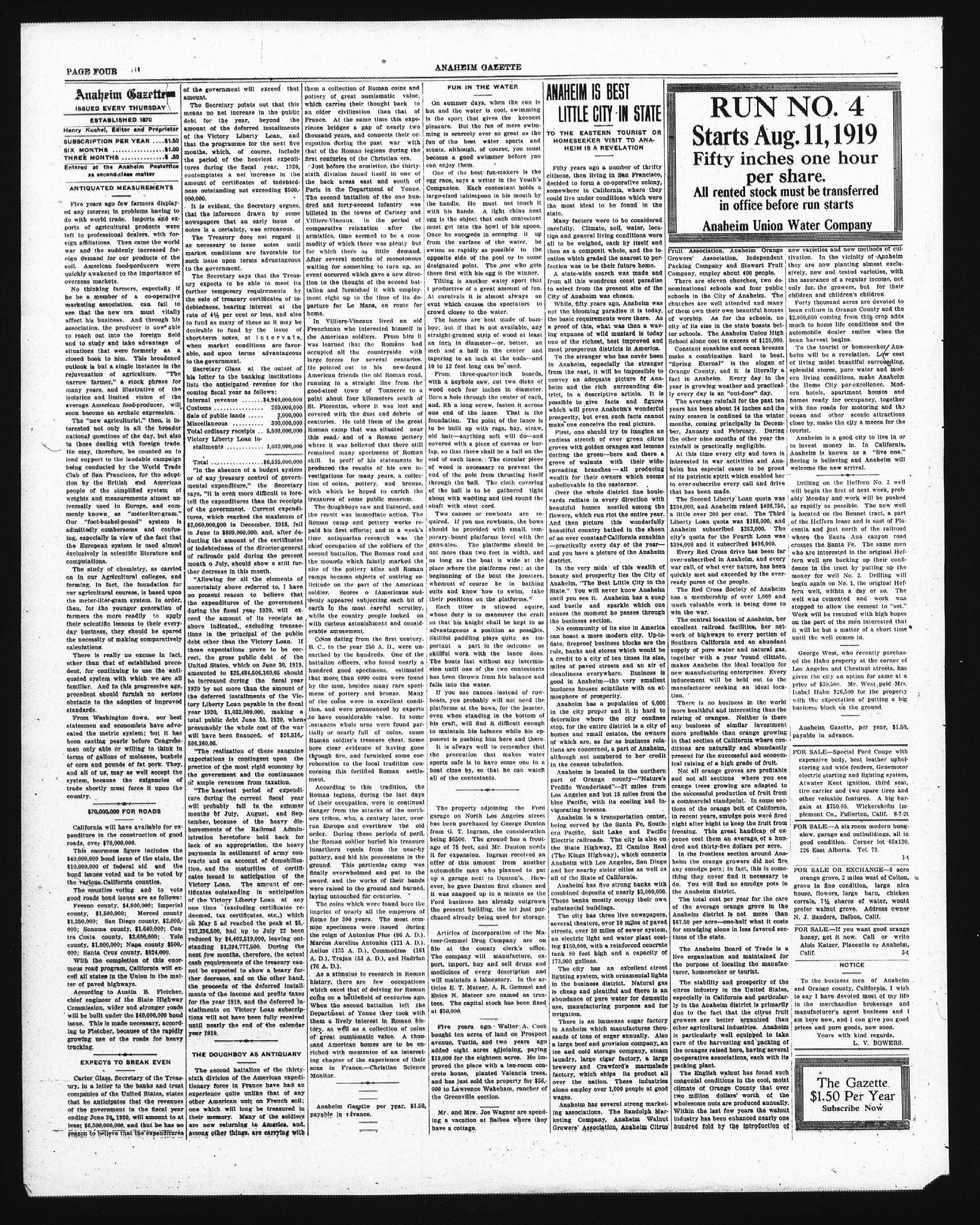
Searchable text
Anaheim Gazette
ISSUED EVERY THURSDAY
ESTABLISHED 1870
Henry Kuehel, Editor and Proprietor
SUBSCRIPTION PER YEAR ...$1.50
SIX MONTHS ...$1.00
THREE MONTHS ...$ .50
Entered at the Anaheim Postoffice as second-class matter
ANTIQUATED MEASUREMENTS
Five years ago few farmers displayed any interest in problems having to do with world trade. Imports and exports of agricultural products were left to professional dealers, with foreign affiliations. Then came the world war and the suddenly increased foreign demand for our products of the soil. American food-porducers were quickly awakened to the importance of overseas markets.
No thinking farmers, especially if he be a member of a co-operative marketing association, can fail to see that the new era must vitally affect his business. And through his association, the producer is now able to reach out into the foreign field and to study and take advantage of situations that were formerly as a closed book to him. This broadened outlook is but a single instance in the rejuvenation of agriculture. "The narrow farmer," a stock phrase for many years, and illustrative of the isolation and limited vision of the average American food-producer, will soon become an archaic expression.
The "new agriculturist," then, is interested not only in all the broader national questions of the day, but also in those dealing with foreign trade. He may, therefore, be counted on to of the government will exceed that amount.
The Secretary points out that this means no net increase in the public debt for the year, beyond the amount of the deferred installments of the Victory Liberty Loan, and that the programme for the next five months, which, of course, include the period of the heaviest expenditures during the fiscal year, 1920, contemplates a net increase in the amount of certificates of indebtedness outstanding not exceeding $500,000,000.
It is evident, the Secretary argues, that the inference drawn by some newspapers that an early issue of notes is a certainty, was erroneous.
The Treasury does not regard it as necessary to issue notes until market conditions are favorable for such issue upon terms advantageous to the government.
The Secretary says that the Treasury expects to be able to meet its further temporary requirements by the sale of treasury certificates of indebtedness, bearing interest at the rate of 4½ per cent or less, and also to fund as many of these as it may be desirable to fund by the issue of short-term notes, at intervals when market conditions are favorable, and upon terms advantageous to the government.
Secretary Glass at the outset of his letter to the banking institutions lists the anticipated revenue for the coming fiscal year as follows:
Internal revenue .....$4,940,000,000
Customs .....260,000,000
Sale of public lands .....3,000,000
Miscellaneous .....300,000,000
Total ordinary receipts .....5,503,000,000
Victory Liberty Loan installments .....1,032,000,000
them a collection of pottery of great nuance which carries their own older civilization France. At the same time bridges a gap thousand years, and provides durability for them that of the Roman first centuries of the past before the arrival sixth division found the back areas east Paris in the Department. The second battalion dredged and forty-second billeted in the town Villiers-Vineaux. It comparative relaxes armistice, time seen modality of which they for which there are After several months waiting for something event occurred which tion to the thought of talion and furnished right up to the parture for Le Ma home.
In Villiers-Vineaux Frenchman who entered the American soldier was learned that occupied all the large forces for He pointed out to American friends that running in a straight good-sized town point about four km St. Florentin, where covered with the dark centuries. He told Roman camp that this road; and of where it was believed remained many sparsely
outlook is but a single instance in the rejuvenation of agriculture. "The narrow farmer," a stock phrase for many years, and illustrative of the isolation and limited vision of the average American food-producer, will soon become an archaic expression.
The "new agriculturist," then, is interested not only in all the broader national questions of the day, but also in those dealing with foreign trade. He may, therefore, be counted on to lend support to the laudable campaign being conducted by the World Trade Club of San Francisco, for the adoption by the British and American people of the simplified system of weights and measurements almost universally used in Europe, and commonly known as "meter-liter-gram." Our "foot-bushel-pound" system is admittedly cumbersome and confusing, especially in view of the fact that the European system is used almost exclusively in scientific literature and computations.
The study of chemistry, as carried on in our Agricultural colleges, and forming, in fact, the foundation for our agricultural courses, is based upon the meter-liter-gram system. In order, then, for the younger generation of farmers the more readily to apply their scientific lessons to their everyday business, they should be spared the necessity of making comparatively calculations.
There is really no excuse in fact, other than that of established precedent, for continuing to use the antiquated system with which we are all familiar. And in this progressive age, precedent should furnish no serious obstacle to the adoption of improved standards.
From Washington down, our best statesmen and economists have advocated the metric system; but it has been casting pearls before Congressmen only able or willing to think in terms of gallons of molasses, bushels of corn and pounds of fat pork. They, and all of us, may as well accept the system, because the exigencies of trade shortly must force it upon the country.
$70,000,000 FOR ROADS
California will have available for expenditure in the construction of good roads, over $70,000,000.
This enormous figure includes the $40,000,000 bond issue of the state, the $10,000,000 federal aid and the Secretary Glass at the outset of his letter to the banking institutions lists the anticipated revenue for the coming fiscal year as follows:
Internal revenue ..... $4,940,000,000
Customs ..... 260,000,000
Sale of public lands ..... 3,000,000
Miscellaneous ..... 300,000,000
Total ordinary receipts ..... 5,503,000,000
Victory Liberty Loan installments ..... 1,032,000,000
Total ..... $6,535,000,000
"In the absence of a budget system or any treasury control of governmental expenditure," the Secretary says, "it is even more difficult to foretell the expenditures than the receipts of the government. Current expenditures, which reached the maximum of $2,060,000,000 in December, 1918, fell in June to $809,000,000, and after deducting the amount of the certificates of indebtedness of the director-general of railroads paid during the present month o July, should show a still further decrease in this month.
"Allowing for all the elements of uncertainty above referred to, I have no present reason to believe that the expenditures of the government during the fiscal year 1920 will exceed the amount of its receipts as above indicated., excluding transactions in the principal of the public debt other than the Victory Loan. If these expectations prove to be correct, the gross public debt of the United States, which on June 30, 1919, amounted to $25,484,506,160.05 should be increased during the fiscal year 1920 by not more than the amount of the deferred installments of the Victory Liberty Loan payable in the fiscal year 1920, $1,032,000,000, making a total public debt June 30, 1920. when presumably the whole cost of the war will have been financed, of $26,516,506,160.05.
"The realization of these sanguine expectations is contingent upon the practice of the most rigid economy by the government and the continuance of ample revenues from taxation.
"The heaviest period of expenditure during the current fiscal year will probably fall in the summer months of July, August, and September, because of the heavy disbursements of the Railroad Administration heretofore held back for lack of an appropriation, the heavy payments in settlement of army contracts and on account of demobiliza-tion."
He pointed out to American friends that running in a straight good-sized town point about four knots St. Florentin, where covered with dark centuries. He told Roman camp that this road; and if where it was believed remained many spare skill. In profof of produced the result vestigations for many coinage with which he hoisted treasures of some kind.
The doughboys saw the result was immensely Roman camp and paid his first effort time antiquarian chief occupation of second battalion. Then he mounds which site of the pottery camps became objectively on the parish soldier. Scores or denly appeared suburban earth to the most while the country with curious astonishing amusement.
COINS dating from B. C., to the year 1847 earched by the hunter battalion officers; with hundred good speeches that more than 400 by the men; besides mens of pottery and of the coins were written and were promised to have considerable instances whole urtimately or nearly fully Roman soldier's troop bore clear evidence through fire; and for roboration to the viceroy this fortification.
According to the Roman legions, due to their occupation danger from at least three tribes who a ran Europe and on order. During these Roman soldiers ineartern vessels pottery; and hid his ground. This paper
$70,000,000 FOR ROADS
California will have available for expenditure in the construction of good roads, over $70,000,000.
This enormous figure includes the $40,000,000 bond issue of the state, the $10,000,000 of federal aid and the bond issues voted and to be voted by the various California counties.
The counties voting and to vote good roads bond issues are as follows:
Fresno county, $4,800,000; Imperial county, $1,500,000; Merced county $1,250,000; San Diego county, $2,000,000; Sonoma county, $1,640,000; Contra Costa county, $2,600,000; Yolo county, $1,000,000; Napa county $500,000; Santa Cruz county, $924,000.
With the completion of this enormous road program, California will excel all states in the Union in the matter of paved highways.
According to Austin B. Fletcher, chief engineer of the State Highway Commission, wider and stronger roads will be built under the $40,000,000 bond issue. This is made necessary, according to Fletcher, because of the rapidly growing use of the roads for heavy trucking.
EXPECTS TO BREAK EVEN
Carter Glass, Secretary of the Treasury, in a letter to the banks and trust companies of the United States, states that he anticipates that the revenues of the government in the fiscal year ending June 30, 1920, will amount to at least $6,500,000,000, and that he has no reason to believe that the expenditures
THE DOUGHBOY AS ANTIQUARY
The second battalion of the thirty-sixth division of the American expeditionary force in France have had an experience quite unlike that of any other American unit on French soil; one which will long be treasured in their memory. Many of the soldiers are now returning to America, and among other things are carrying with
ANAHEIM GAZETTE
that this public the events and five include genli1920, the quoted 500,
the rues, home of us,
and it until for these
also may be of a is, flavor-geous
most of institutions in the
300,000
300,000
300,000
300,000
them a collection of Roman coins and pottery of great numismatic value, which carries their thought back to an older civilization than that of France. At the same time this experience bridges a gap of nearly two thousand years, and connects their occupation during the past war with that of the Roman legions during the first centuries of the Christian era.
Just before the armistice, the thirty-sixth division found itself in one of the back areas east and south of Paris in the Department of Yonne. The second battalion of the one hundred and forty-second infantry was billeted in the towns of Carisey and Villiers-Vineaux. In the period of comparative relaxation after the armistice, time seemed to be a commodity of which there was plenty but for which there as little demand. After several months of monotonous waiting for something to turn up, an event occurred which gave a new direction to the thought of the second battalion and furnished it with employment right up to the time of its departure for Le Mans, en route for home.
In Villiers-Vineaux lived an old Frenchman who interested himself in the American soldiers. From him it was learned that the Romans had occupied all the countryside with large forces for several centuries. He pointed out to his new-found American friends the old Roman road, running in a straight line from the good-sized town of Tonnerre to a point about four kilometers south of St. Florentin, where it was lost and covered with the dust and debris of centuries. He told them of the great Roman camp that was situated near this road, and of a Roman pottery where it was believed that there still remained many specimens of Roman
FUN IN THE WATER
On summer days, when the sun is hot and the water is cool, swimming is the sport that gives the keenest pleasure. But the fun of mere swimming is scarcely ever so great as the fun of the best water sports and stunts, although, of course, you must become a good swimmer before you can enjoy them.
One of the best fun-makers is the egg race, says a writer in the Youth's Companion. Each contestant holds a large-sized tablespoon in his mouth by the handle. He must not touch it with his hands. A light china nest egg is the object that each contestant must get into the bowl of his spoon. Once he succeeds in scooping it up from the surface of the water, he swims as rapidly as possible to the opposite side of the pool or to some designated point. The one who gets there first with his egg is the winner.
Tilting is another water sport that is productive of a great amount of fun. At carnivals it is almost always an event which causes the spectators to crowd closer to the water.
The lances are best made of bamboo; but if that is not available, any straight-grained strip of wood at least an inch in diameter—or better, an inch and a half in the center and tapering to an inch at the ends—and 10 to 12 feet long can be used.
From three-quarter-inch boards, with a keyhole saw, cut two disks of wood each four inches in diameter. Eore a hole through the center of each, and, ith a long screw, fasten it across one end of the lance. That is the foundation. The point of the lance is to be built up with rags, hay, straw, old hair—anything soft will do—and covered with a piece of canvas or bur-lap, so that there shall be a ball on the
ANAHEIM IS BEST LITTLE CITY·IN STATE
TO THE EASTERN TOURIST OR HOMESEEKER VISIT TO ANAHEIM IS A REVELATION
Fifty years ago a number of thrifty citizens, then living in San Francisco, decided to form a co-operative colony somewhere in California, where they could live under conditions which were the most ideal to be found in the state.
Many factors were to be considered carefully. Climate, soil, water, location and general living conditions were all to be weighed, each by itself and then as a composit whole, and the location which graded the nearest to perfection was to be their future home.
A state-wide search was made and from all this wondrous coast paradise to select from the present site of the City of Anaheim was chosen.
While, fifty years ago, Anaheim was not the blooming paradise it is today, the basic requirements were there. As a proof of this, what was then a waving expanse of wild mustard is today one of the richest, best improved and most prosperous districts in America.
To the stranger who has never been in Anaheim, especially the stranger from the east, it will be impossible to convey an adequate picture of Anaheim and the rich surrounding district, in a descriptive article. It is possible to give facts and figures which will prove Anaheim's wonderful prosperity, but even such facts cannot make one conceive the real picture.
First, one should try to imagine an endless stretch of ever green citrus groves with golden oranges and lemons dotting the green—here and there a
Fruit A Grower's Packing Company
There are nominations schools for churches of them or worst city of larger school School area
Constitute make a "Spring Orange" fact in year 1874 every day.
The last years have rainy season months, ber, Janet the other rainfall fall at this
large forces for several centuries.
He pointed out to his new-found American friends the old Roman road, running in a straight line from the good-sized town of Tonnerre to a point about four kilometers south of St. Florentin, where it was lost and covered with the dust and debris of centuries. He told them of the great Roman camp that was situated near this road, and of a Roman pottery where it was believed that there still remained many specimens of Roman skill. In proof of his statements he produced the results of his own investigations for many years, a collection of coins, pottery, and bronze, with which he hoped to enrich the treasures of some public museum.
The doughboys saw and listened, and the result was immediate action. The Roman camp and pottery works repaid his first efforts; and in a week's time antiquarian research was the chief occupation of the soldiers of the second battalion. The Roman road and the mounds which faintly marked the site of the pottery kilns and Roman camps became objects of untiring solicitude on the part of the American soldier. Scores o f Americans suddenly appeared subjecting each bit of earth to the most careful scrutiny, while the country people looked on with curious astonishment and considerable amusement.
COns dating from the first century. B. C., to the year 250 A. D., were unearthed by the hundreds. One of the battalion officers, who found nearly a hundred good specimens, estimated that more than 4000 coins were found by the men, besides many rare specimens of pottery and bronze. Many of the coins were in excellent condition, and were pronounced by experts to have considerable value. In some instances whole urns were found partially or nearly full of coins, some Roman soldier's treasure chest. Some bore clear evidence of having gone through fire, and furnished some corroboration to the local tradition concerning this fortified Roman settlement.
According to this tradition, the Roman legions, during the last days of their occupation, were in continual danger from the attacks of the northern tribes, who, a century later, overran Europe and overthrew the old order. During these periods of peril, the Roman soldier buried his treasure inearthern vessels from the near-by pottery, and hid his possessions in the ground. This particular camp was from three-quarter-inch boards, with a keyhole saw, cut two disks of wood each four inches in diameter. Eorea a hole through the center of each, and, lith a long screw, fasten it across one end of the lance. That is the foundation. The point of the lance is to be built up with rags, hay, straw, old hair—anything soft will do—and covered with a piece of canvas or burlap, so that there shall be a ball on the end of each lance. The circular piece of wood is necessary to prevent the end of the pole from thrusting itself through the ball. The cloth covering of the ball is to be gathered tight about with wadding and tied round the shaft with stout cord.
Two canoes or rowboats are required. If you use rowboats, the bows should be provided with small, temporary-board platforms level with the gunwales. The platforms should not more than two feet in width, and as long as the boat is wide at the place where the platforms rest; at the beginning of the bout the jousters, whom must of course be in bathing suits and know how to swim, take their positions on the platforms.
Each tilter is allowed squire, whose duty is to maneuver the craft so that his knight shall be kept in as advantageous a position as possible. Skillful paddling plays quite as important a part in the outcome as skillful work with the lance does. The bouts last without any intermission until one of the two contestants has been thrown from his balance and falls into the water.
If you use canoes instead of rowboats, you probably will not need the platforms at the bows, for the jouster, even when standing in the bottom of his craft, will find it difficult enough to maintain his balance while his opponent is pushing him here and there.
It is always well to remember that the precaution that makes water sports safe is to have some one in a boat close by, so that he can watch all of the contestants.
The property adjoining the Ford garage on North Los Angeles street has been purchased by George Dunton from G. T. Ingram, the consideration being $6500. The ground has a frontage of 75 feet, and Mr. Dunton needs it for expansion. Ingram received an offer of this amount from another in Anaheim, especially the stranger from the east, it will be impossible to convey an adequate picture of Anaheim and the rich surrounding district, in a descriptive article. It is possible to give facts and figures which will prove Anaheim's wonderful prosperity, but even such facts cannot make one conceive the real picture.
First, one should try to imagine an endless stretch of ever green citrus groves with golden oranges and lemons dotting the green—here and there a grove of walnuts with their widespread branches—all producing wealth for their owners which seems unbelievable to the easterner.
Over the whole district fine boulevards radiate in every direction with beautiful homes nestled among the flowers, which run riot the entire year. And then picture this wonderfully beautiful country bathed in the sheen of an ever constant California sunshine—practically every day of the year—and you have a picture of the Anaheim district.
In the very mids of this wealth of beauty and prosperity lies the City of Anaheim, "The Best Little City in the State." You will never know Anaheim until you see it. Anaheim has a snap and bustle and sparkle which one senses the moment he passes through the business section.
No community of its size in America can boast a more modern city. Up-to-date, fireproof business blocks are the rule, banks and stores which would be a credit to a city of ten times its size, miles of paved streets and an air of cleanliness everywhere. Business is good in Anaheim—the very smallest business houses scintillate with an atmosphere of prosperity.
Anaheim has a population of 6,000 in the city proper and it is hard to determine where the city confines stop, for the entire district is a city of homes and small estates, the owners of which are, as far as business relations are concerned, a part of Anaheim, although not numbered to her credit in the census tabulation.
Anaheim is located in the northern part of Orange county—"Nature's Prolific Wonderland"—27 miles from Los Angeles and but 15 miles from the blue Pacific, with its cooling and invigorating breezes.
Anaheim is a transportation center, being served by the Santa Fe, Southern Pacific, Salt Lake and Pacific Electric railroads. The city is also on the State Highway, El Camino Real (The Kings Highway), which connects Anaheim with Los Angeles, San Diego
"Spring," Orange fact in January every year.
The last years had rainy season months, ber, Jamaica other rainfall.
At this interesting holm harbor of its path over that has passed.
The S $204,000 a little Liberty Anaheim city's price $394,000
Every over-subsidy war called quickly by ready people.
The L has a much win this season.
The C excellent work on Southern supply makes new material in new dictionions presentical rails.
Not sank and now orange due to such a commotion in recent night freezing sense o dred and dredged.
In this helm th
According to this tradition, the Roman legions, during the last days of their occupation, were in continual danger from the attacks of the northern tribes, who, a century later, overran Europe and overthrew the old order. During these periods of peril, the Roman soldier buried his treasure inearthern vessels from the near-by pottery, and hid his possessions in the ground. This particular camp was finally overwhelmed and put to the sword, and the works of their hands were raised to the ground and burned, laying untouched for centuries.
The coins which were found bore the imprint of nearly all the emperors of Rome for 300 years. The most common specimens were issued during the reign of Antonius Plus (86 A.D.), Marcus Aurelius Antonius (121 A.D.), Aelius (135 A.D.), Commodius (161 A.D.), Trajan (53 A.D.), and Hadrian (76 A.D.).
As a stimulus to research in Roman history, there are few occupations which excel that of deliving for Roman coffins on a battlefield of centuries ago. When the second battalion left the Department of Yonne they took with them a lively interest in Roman history, as well as a collection of coins of great numismatic value. A thousand American homes are to be enriched with mementos of an interesting chapter of the experience of their sons in France.—Christian Science Monitor.
Anaheim glazette per year, $1.50, payable in advance.
The property adjoining the Ford garage on North Los Angeles street has been purchased by George Dunton from G. T. Ingram, the consideration being $6500. The ground has a frontage of 75 feet, and Mr. Dunton needs it for expansion. Ingram received an offer of this amount from another automobile man who planned to put up a garage next to Dunton's. However, he gave Dunton first chance and it was snapped up in a minute as the Ford business has already outgrown the present building, the lot just purchased already being used for storage.
Articles of incorporation of the Mateer-Gemmel Drug Company are on file at the county clerk's office. The company will manufacture, export, import, buy and sell drugs and medicines of every description and will maintain a laboratory. In the articles E. T. Mateer, A. R. Gemmel and Enice N. Mateer are named as trustees. The capital stock has been fixed at $50,000.
Five years ago Walter A. Cook bought ten acres of land on Prospect avenue, Tustin, and two years ago added eight acres adjoining, paying $19,000 for the eighteen acres. He improved the place with a ten-room concrete house, planted Valencia trees, and has just sold the property for $56,000 to Lawrence Wakeham, rancher of the Greenville section.
Mr. and Mrs. Joe Wagner are spending a vacation at Balboa where they have a cottage.
Anaheim is located in the northern part of Orange county—"Nature's Prolific Wonderland"—27 miles from Los Angeles and but 15 miles from the blue Pacific, with its cooling and invigorating breezes.
Anaheim is a transportation center, being served by the Santa Fe, Southern Pacific, Salt Lake and Pacific Electric railroads. The city is also on the State Highway, El Camino Real (The Kings Highway), which connects Anaheim with Los Angeles, San Diego and her nearby sister cities as well as all of the State of California.
Anaheim has five strong banks with combined deposits of nearly $3,000,000. These banks mostly occupy their own substantial buildings.
The city has three live newspapers, several theaters, over 10 miles of paved streets, over 20 miles of sewer system, an electric light and water plant costing $150,000, with a reinforced concrete tank 90 feet high and a capacity of 173,000 gallons.
The city has an excellent street lighting system, with ornamental lights in the business district. Natural gas is cheap and plentiful and there is an abundance of pure water for domestic use, manufacturing purposes and for irrigation.
There is an immense sugar factory in Anaheim which manufactures thousands of tons of sugar annually. Also a large beef and provision company, an ice and cold storage company, steam laundry, large cigar factory, a large brewery and Crawford's marmalade factory, which ships its product all over the nation. These industries alone employ over 1,000 people at good wages.
Anaheim has several strong marketing associations. The Randolph Marketing Company, Anaheim Walnut Growers' Association, Anaheim Citrus
RUN NO. 4
Starts Aug. 11, 1919
Fifty inches one hour per share.
All rented stock must be transferred in office before run starts
Anaheim Union Water Company
Fruit Association, Anaheim Orange Growers' Association, Independent Packing Company and Stewart Fruit Company, employ about 400 people.
There are eleven churches, two denominational schools and four public schools in the City of Anaheim. The churches are well attended and many of them own their own beautiful houses of worship. As for the schools, no city of its size in the state boasts better schools. The Anaheim Union High School alone cost in excess of $125,000.
Constant sunshine and ocean breezes make a combination hard to beat. "Spring Eternal" is the slogan of Orange County, and it is literally a fact in Anaheim. Every day in the year is growing weather and practically every day is an "out-door" day.
The average rainfall for the past ten years has been about 14 inches and the rainy season is confined to the winter months, coming principally in December, January and February. During the other nine months of the year the rainfall is practically negligible.
At this time every city and town is new varieties and new methods of cultivation. In the vicinity of Anaheim they are now planting almost exclusively, new and tested varieties, with the assurance of a regular income, not only for the growers, but for their children and children's children.
Forty thousand acres are devoted to bean culture in Orange County and the $2,000,000 coming from this crop adds much to home life conditions and the automobile dealer smiles when the bean harvest begins.
To the tourist or homeseeker/Anaheim will be a revelation. Low cost of living midst beautiful surrounding, splendid stores, pure water and modern living conditions, make Anaheim the Home City par-excellence. Modern hotels, apartment houses and homes ready for occupancy, together with fine roads for motoring and the ocean and other scenic attractions close by, make the city a mecca for the tourist.
Anaheim is a good city to live in or to invest money in. In California, Anaheim is known as a "live one."
Only the stranger be impossible to picture of Anaheim surroundings dislike article. It is facts and figures Anaheim's wonderful much facts cannot real picture.
Try to imagine an ever green citrusanges and lemons there and there all producing fruits which seems sterner.
District fine boulevard direction with ostled among the at the entire year, this wonderfully named in the sheen California sunshine day of the year—one of the Anaheim of this wealth of lies the City of Little City in the far know Anaheim Anaheim has a snap sparkle which one passes through its size in America modern city. Up-to-date blocks are the ones which would be taken times its size, lots and an air of mere. Business is the very smallest affiliate with an attitude.
Population of 6,000 and it is hard to see city confines district is a city of states, the owners of business related part of Anaheim need to her credit on. In the northern county—"Nature's—27 miles from 15 miles from the cooling and in transportation center, Santa Fe, South Lake and Pacific the city is also on El Camino Real), which connects Angeles, San Diego
"Spring Eternal" is the slogan of Orange County, and it is literally a fact in Anaheim. Every day in the year is growing weather and practically every day is an "out-door" day.
The average rainfall for the past ten years has been about 14 inches and the rainy season is confined to the winter months, coming principally in December, January and February. During the other nine months of the year the rainfall is practically negligible.
At this time every city and town is interested in war activities and Anaheim has especial cause to be proud of its patriotic spirit which enabled her to over-subscribe every call and drive that has been made.
The Second Liberty Loan quota was $204,000, and Anaheim raised $408,750, a little over 200 per cent. The Third Liberty Loan quota was $188,000, and Anaheim subscribed $252,000. The city's quota for the Fourth Loan was $394,000 and it subscribed $496,000.
Every Red Cross drive has been far over-subscribed in Anaheim, and every war call, of what ever nature, has been quickly met and exceeded by the ever-ready purse of the people.
The Red Cross Society of Anaheim has a membership of over 1,000 and much valuable work is being done to win the war.
The central location of Anaheim, her excellent railroad facilities, her network of highways to every portion of Southern California and an abundant supply of pure water and natural gas, together with a year 'round climate, makes Anaheim the ideal location for new manufacturing enterprises. Every inducement will be held out to the manufacturer seeking an ideal location.
There is no business in the world more healthful and interesting than the raising of oranges. Neither is there any business of similar investment more profitable than orange growing in that section of California where conditions are naturally and abundantly present for the successful and economical raising of a high grade of fruit.
Not all orange groves are profitable and not all sections where you see orange trees growing are adapted to the successful production of fruit from a commercial standpoint. In some sections of the orange belt of California, in recent years, smudge pots were fired night after hight to keep the fruit from freezing. This great handicap of expense cost them an average, of a hundred and thirty-five dollars per acre.
In the frostless section around Anaheim the orange growers did not fire of living midst beautiful surrounding, splendid stores, pure water and modern living conditions, make Anaheim the Home City par-excellence. Modern hotels, apartment houses and homes ready for occupancy, together with fine roads for motoring and the ocean and other scenic attractions close by, make the city a mecca for the tourist.
Anaheim is a good city to live in or to invest money in. In California, Anaheim is known as a "live one." Seeing is believing and Anaheim will welcome the new arrival.
Drilling on the Heffern No. 2 well will begin the first of next week, probably Monday and work will be pushed as rapidly as possible. The new well is located on the Bennet tract, a part of the Heffern lease and is east of Placentia and just north of the railroad where the Santa Ana canyon road crosses the Santa Fe. The same men who are interested in the original Heffern well are backing up their confidence in the tract by putting up the money for well No. 2. Drilling will begin again on No. 1, the original Heffern well, within a day or so. The well was cemented and work was stopped to allow the cement to "set." Work will be resumed with high hopes on the part of the men interested that it will be but a matter of a short time until the well comes in.
George West, who recently purchased the Hahn property at the corner of Los Angeles and Chestnut streets, has given the city an option for same at a price of $30,500. Mr. West paid Mrs. Isabel Hahn $26,500 for the property with the expectation of putting a big business block on the ground.
Anaheim Gazette, per year, $1.50, payable in advance.
FOR SALE—Special Ford Coupe with expensive body, best leather upholstering and wide fenders, Genemotor electric starting and lighting system, Atwater Kent ignition, third seat, tire carrier and two spare tires and other valuable features. A big bargain at $750.00. Wickersheim Implement Co., Fullerton, Calif. 8-7-2t
FOR SALE—A six-room modern bungalow, garage and outbuildings, all in good condition. Corner lot 65x130. 226 East Alberta. Tel. 79.
Not all orange groves are profitable and not all sections where you see orange trees growing are adapted to the successful production of fruit from a commercial standpoint. In some sections of the orange belt of California, in recent years, smudge pots were fired night after night to keep the fruit from freezing. This great handicap of expense cost them an average, of a hundred and thirty-five dollars per acre.
In the frostless section around Anaheim the orange growers did not fire any smudge pots; in fact, this is something they never find it necessary to do. You will find no smudge pots in the Anaheim district.
The total cost per year for the care of the average orange grove in the Anaheim district is not more than $67.50 per acre—one-half what it costs for smudging alone in less favored sections of the state.
The Anaheim Board of Trade is a live organization and maintained for the purpose of locating the manufacturer, homeseeker or tourist.
The stability and prosperity of the citrus industry in the United States, especially in California and particularly in the Anaheim district is primarily due to the fact that the citrus fruit growers are better organized than other agricultural industries. Anaheim is particularly well equipped to take care of the harvesting and packing of the oranges raised here, having several co-operative associations, each with its packing plant.
The English walnut has found such congenial conditions in the cool, moist climate of Orange County that over two million dollars' worth of the wholesome nuts are produced annually. Within the last few years the walnut industry has been enhanced nearly one hundred fold by the introduction of
FOR SALE.—A six-room modern bungalow, garage and outbuildings, all in good condition. Corner lot 65x130. 226 East Alberta. Tel. 79.
FOR SALE OR EXCHANGE—8 acre orange grove, 2 miles west of Colton, grove in fine condition, large nice house, flowers, large barn, chicken corrals, 7½ shares of water, would prefer walnut grove. Address owner N. J. Sanders, Balboa, Calif.
NOTICE
To the business men of Anaheim and Orange county, California, I wish to say I have devoted most of my life in the merchandise brokerage and manufacturer's agent business and I am here now, and I can give you good prices and pure goods, now soon.
Yours with kind regards,
L. V. BOWERS.