anaheim-gazette 1919-07-17
Scanned page
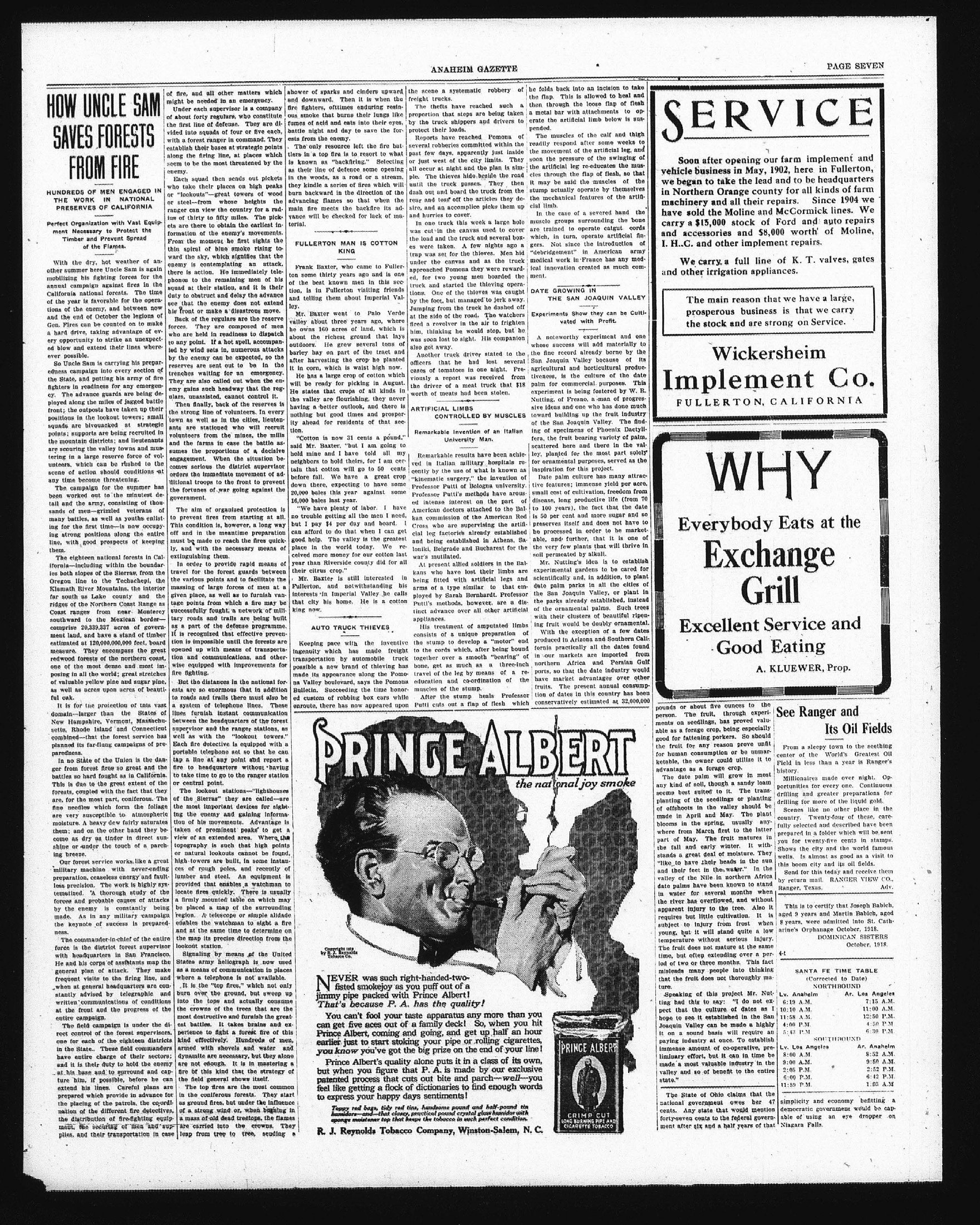
Searchable text
HOW UNCLE SAM SAVES FORESTS FROM FIRE
HUNDREDS OF MEN ENGAGED IN THE WORK IN NATIONAL PRESERVES OF CALIFORNIA
Perfect Organization with Vast Equipment Necessary to Protect the Timber and Prevent Spread of the Flames.
With the dry, hot weather of another summer here Uncle Sam is again mobilizing his fighting forces for the annual campaign against fires in the California national forests. The time of the year is favorable for the operations of the enemy, and between now and the end of October the legions of Gen. Fires can be counted on to make a hard drive, taking advantage of every opportunity to strike an unexpected blow and extend their lines wherever possible.
So Uncle Sam is carrying his preparedness campaign into every section of the State, and putting his army of fire fighters in readiness for any emergency. The advance guards are being deployed along the miles of jagged battle front; the outposts have taken up their positions in the lookout towers; small squads are blivouacked at strategic points; supports are being recruited in the mountain districts; and lieutenants are scouring the valley towns and mustering in a large reserve force of volcanic fire, and all other matters which might be needed in an emergency.
Under each supervisor is a company of about forty regulars, who constitute the first line of defense. They are divided into squads of four or five each, with a forest ranger in command. They establish their bases at strategic points along the firing line, at places which seem to be the most threatened by the enemy.
Each squad then sends out pickets who take their places on high peaks or "lookouts"—great towers of wood or steel—from whose heights the ranger can view the country for a radius of thirty to fifty miles. The pickets are there to obtain the earliest information of the enemy's movements. From the moment he first sights the thin spiral of blue smoke rising toward the sky, which signifies that the enemy is contemplating an attack, there is action. He immediately telephones to the remaining men of his squad at their station, and it is their duty to obstruct and delay the advance see that the enemy does not extend his front or make a disastrous move.
Back of the regulars are the reserve forces. They are composed of men who are held in readiness to dispatch to any point. If a hot spell, accompanied by wind sets in, numerous attacks by the enemy can be expected, so the reserves are sent out to be in the trenches waiting for an emergency. They are also called out when the enemy gains such headway that the regulars, unassisted, cannot control it.
Then finally, back of the reserves is the strong line of volunteers. In every town as well as in the cities, lieutenants are stationed who will recruit volunteers from the mines, the mills and the farms in case the battle assumes the proportions of a decisive shower of sparks and cinematic downward. Then it fire fighters, oftimes enduring smoke that burns their fumes of acid and eats into battle night and day to seize from the enemy.
The only resource left tillers in a top fire is to reel them in the woods, as a road they kindle a series of fires burn backward in the dire advancing flames so that main fire meets the backrance will be checked for material.
FULLERTON MAN IS KING
Frank Baxter, who cannon some thirty years ago of the best known men in tion, is in Fullerton visitation and telling them about Leley.
Mr. Baxter went to valley about three years after he owns 160 acres of land about the richest ground outdoors. He grew seven barley hay on part of it after harvesting the crop it in corn, which is wails.
He has a large crop of will be ready for picking. He states that crops of the valley are flourishing having a better outlook, nothing but good times ahead for residents tion.
"Cotton is now 31 cents said Mr. Baxter," but I hold mine and I have
So Uncle Sam is carrying his preparedness campaign into every section of the State, and putting his army of fire fighters in readiness for any emergency. The advance guards are being deployed along the miles of jagged battle front; the outposts have taken up their positions in the lookout towers; small squads are bivouacked at strategic points; supports are being recruited in the mountain districts; and lieutenants are scouring the valley towns and mustering in a large reserve force of volunteers, which can be rushed to the scene of action should conditions at any time become threatening.
The campaign for the summer has been worked out to the minutest detail and the army, consisting of thousands of men—grizzled veterans of many battles, as well as youths enlisting for the first time—is now occupying strong positions along the entire line, with good prospects of keeping them.
The eighteen national forests in California—including within the boundaries both slopes of the Sierras, from the Oregon line to the Techachepli, the Klamath River Mountains, the interior far south as Lake county and the ridges of the Northern Coast Range as Coast ranges from near Monterey southward to the Mexican border—comprise 20,339,337 acres of government land, and have a stand of timber estimated at 120,000,000,000 feet, board measure. They encompass the great redwood forests of the northern coast, one of the most dense and most imposing in all the world; great stretches of valuable yellow pine and sugar pine, as well as acres upon acres of beautiful oak.
It is for the protection of this vast domain—larger than the States of New Hampshire, Vermont, Massachusetts, Rhode Island and Connecticut combined—that the forest service has planned its far-flung campaigns of preparedness.
In no State of the Union is the danger from forest fires so great and the battles so hard fought as in California. This is due to the great extent of the forests, coupled with the fact that they are, for the most part, coniferous. The fine needles which form the foliage are very susceptible to atmospheric moisture. A heavy dew fairly saturates them; and on the other hand they become as dry as tinder in direct sunshine or under the touch of a parching breeze.
Our forest service works, like a great reserves are sent out to be in the trenches waiting for an emergency. They are also called out when the enemy gains such headway that the regulars, unassisted, cannot control it.
Then finally, back of the reserves is the strong line of volunteers. In every town as well as in the cities, lieutenants are stationed who will recruit volunteers from the mines, the mills and the farms in case the battle assumes the proportions of a decisive engagement. When the situation becomes serious the district supervisor orders the immediate movement of additional troops to the front to prevent the fortunes of war going against the government.
The aim of organized protection is to prevent fires from starting at all. This condition is, however, a long way off and in the meantime preparation must be made to reach the fires quickly, and with the necessary means of extinguishing them.
In order to provide rapid means of travel for the forest guards between the various points and to facilitate the massing of large forces of men at a given place, as well as to furnish vantage points from which a fire may be successfully fought, a network of military roads and trails are being built as a part of the defense programme. It is recognized that effective prevention is impossible until the forests are opened up with means of transportation and communications, and otherwise equipped with improvements for fire fighting.
But the distances in the national forests are so enormous that in addition to roads and trails there must also be a system of telephone lines. These lines furnish instant communication between the headquarters of the forest supervisor and the ranger stations, as well as with the "lookout towers." Each fire detective is equipped with a portable telephone set so that he can tap a line at any point and report a fire to headquarters without having to take time to go to the ranger station or central point.
The lookout stations—"lighthouses of the Sierras" they are called—the most important devices for sighting the enemy and gaining information of his movements. Advantage is taken of prominent peaks to get a view of an extended area. Where topography is such that high points or natural lookouts cannot be found, high-towers are built, in some instan-
Our forest service works, like a great military machine with never-ending preparation, ceaseless energy and faultless precision. The work is highly systematized. A thorough study of the forces and probable causes of attacks by the enemy is constantly being made. As in any military campaign the keynote of success is preparedness.
The commander-in-chief of the entire force is the district forest supervisor with headquarters in San Francisco. He and his corps of assistants map the general plan of attack. They make frequent visits to the firing line, and when at general headquarters are constantly advised by telegraphic and written communications of conditions at the front and the progress of the entire campaign.
The field campaign is under the direct control of the forest supervisors, one for each of the eighteen districts in the State. These field commanders have entire charge of their sectors; and it is their duty to hold the enemy at his base and to surround and capture him, if possible, before he can extend his lines. Careful plans are prepared which provide in advance for the placing of the patrols, the coordination of the different fire detectives, the distribution of fire-fighting equipment, the securing of men and supplies, and their transportation in case
The lookout stations—"lighthouses of the Sierras" they are called—the most important devices for sighting the enemy and gaining information of his movements. Advantage is taken of prominent peaks to get a view of an extended area. Where the topography is such that high points or natural lookouts cannot be found, high-towers are built, in some instances of rough poles, and recently of lumber and steel. An equipment is provided that enables a watchman to locate fires quickly. There is usually a firmly mounted table on which may be placed a map of the surrounding region. A telescope or simple alidade enables the watchman to sight a fire and at the same time to determine on the map its precise direction from the lookout station.
Signaling by means of the United States army hellograph is now used as a means of communication in places where a telephone is not available.
It is the "top fires," which not only burn over the ground, but sweep up into the tops and actually consume the crowns of the trees that are the most destructive and furnish the greatest battles. It takes brains and experience to fight a forest fire of this kind effectively. Hundreds of men, armed with shovels and water and dynamite are necessary, but they alone are not enough. It is in mastering a fire of this kind that the strategy of the field general shows itself.
The top fires are the most common in the coniferous forests. They start as ground fires, but under the influence of a strong wind or, when burning in a mass of old dead treetops, the flames are carried into the crowns. They leap from tree to tree, sending a
shower of sparks and cinders upward and downward. Then it is when the fire fighters, oftimes enduring resinous smoke that burns their lungs like fumes of acid and eats into their eyes, battle night and day to save the forests from the enemy.
The only resource left the fire battlers in a top fire is to resort to what is known as "backfiring." Selecting as their line of defence some opening in the woods, as a road or a stream, they kindle a series of fires which will burn backward in the direction of the advancing flames so that when the main fire meets the backfire its advance will be checked for lack of material.
FULLERTON MAN IS COTTON KING
Frank Baxter, who came to Fullerton some thirty years ago and is one of the best known men in this section, is in Fullerton visiting friends and telling them about Imperial Valley.
Mr. Baxter went to Palo Verde valley about three years ago, where he owns 160 acres of land, which is about the richest ground that lays outdoors. He grew several tons of barley hay on part of the tract and after harvesting the crop he planted it in corn, which is waist high now.
He has a large crop of cotton which will be ready for picking in August. He states that crops of all kinds in the valley are flourishing, they never having a better outlook, and there is nothing but good times and prosperity ahead for residents of that section.
"Cotton is now 31 cents a pound," said Mr. Baxter, "but I am going to hold mine and I have told all my the scene a systematic robbery of freight trucks.
The thefts have reached such a proportion that steps are being taken by the truck shippers and drivers to protect their loads.
Reports have reached Pomona of several robberies committed within the past few days, apparently just inside or just west of the city limits. They all occur at night and the plan is simple. The thieves hide beside the road until the truck passes. They then dash out and board the truck from the rear and toss off the articles they desire, and an accomplice picks them up and hurries to cover.
In one truck this week a large hole was cut in the canvas used to cover the load and the truck and several boxes were taken. A few nights ago a trap was set for the thieves. Men hid under the canvas and as the truck approached Pomona they were rewarded, for two young men boarded the truck and started the thieving operations. One of the thieves was caught by the foot, but managed to jerk away. Jumping from the truck he dashed off at the side of the road. The watchers fired a revolver in the air to frighten him, thinking he would stop, but he was soon lost to sight. His companion also got away.
Another truck driver stated to the officers that he had lost several cases of tomatoes in one night. Previously a report was received from the driver of a meat truck that $18 worth of meats had been stolen.
ARTIFICIAL LIMBS CONTROLLED BY MUSCLES
Remarkable Invention of an Italian University Man.
Remarkable results have been achieved by the folds back into an incision to take the flap. This is allowed to heal and then through the loose flap of flesh a metal bar with attachments to operate the artificial limb below is suspended.
The muscles of the calf and thigh readily respond after some weeks to the movement of the artificial leg, and soon the pressure of the swinging of the artificial leg re-educates the muscles through the flap of flesh, so that it may be said the muscles of the stump actually operate by themselves the mechanical features of the artificial limb.
In the case of a severed hand the muscle groups surrounding the bone are trained to operate catgut cords which, in turn, operate artificial fingers. Not since the introduction of "debridement" in American army medical work in France has any medical innovation created as much comment.
DATE GROWING IN THE SAN JOAQUIN VALLEY
Experiments Show they can be Cultivated with Profit.
A noteworthy experiment and one whose success will add materially to the fine record already borne by the San Joaquin Valley because of its agricultural and horticultural productivity, is the culture of the date palm for commercial purposes. This experiment is being fostered by W. R. Nutting, of Fresno, a man of progressive ideas and one who has done much toward building up the fruit industry of the San Joaquin Valley. The finding of specimens of Phoenix Dactylifera, the fruit bearing variety of palm, scattered here and there in the valley, planted for the most part solely
after harvesting the crop he planted it in corn, which is waist high now.
He has a large crop of cotton which will be ready for picking in August. He states that crops of all kinds in the valley are flourishing, they never having a better outlook, and there is nothing but good times and prosperity ahead for residents of that section.
"Cotton is now 31 cents a pound," said Mr. Baxter, "but I am going to hold mine and I have told all my neighbors to hold theirs, for I am certain that cotton will go to 50 cents before fall. We have a great crop down there, expecting to have some 20,000 bales this year against some 16,000 bales last year."
"We have plenty of labor. I have no trouble getting all the men I need, but I pay $4 per day and board. I can afford to do that when I can get good help. The valley is the greatest place in the world today. We received more money for our cotton last year than Riverside county did for all their citrus crop."
Mr. Baxter is still interested in Fullerton, and notwithstanding his interests in Imperial Valley he calls that city his home. He is a cotton king now.
AUTO TRUCK THIEVES
Keeping pace with the inventive ingenuity which has made freight transportation by automobile truck possible a new brand of thieving has made its appearance along the Pomona Valley boulevard, says the Pomona Bulletin. Succeeding the time honored custom of robbing box cars while enroute, there has now appeared upon officers that he had lost several cases of tomatoes in one night. Previously a report was received from the driver of a meat truck that $18 worth of meats had been stolen.
ARTIFICIAL LIMBS CONTROLLED BY MUSCLES
Remarkable Invention of an Italian University Man.
Remarkable results have been achieved in Italian military hospitals recently by the use of what is known as "kinematic surgery," the invention of Professor Putti of Bologna university. Professor Putti's methods have aroused intense interest on the part of American doctors attached to the Balkan commission of the American Red Cross who are supervising the artificial leg factories already established and being established in Athens, Saloniki, Belgrade and Bucharest for the war's mutilated.
At present allied soldiers in the Balkans who have lost their limbs are being fitted with artificial legs and arms of a type similar to that employed by Sarah Bernhardt. Professor Putti's methods, however, are a distinct advance over all other artificial appliances.
His treatment of amputated limbs consists of a unique preparation of the stump to develop a "motor" end to the cords which, after being bound together over a smooth "bearing" of bone, get as much as a three-inch travel of the leg by means of a reeducation and co-ordination of the muscles of the stump.
After the stump heals Professor Putti cuts out a flap of flesh which San Joaquin Valley because of its agricultural and horticultural productivity, is the culture of the date palm for commercial purposes. This experiment is being fostered by W. R. Nutting, of Fresno, a man of progressive ideas and one who has done much toward building up the fruit industry of the San Joaquin Valley. The finding of specimens of Phoenix Dactylifera, the fruit bearing variety of palm, scattered here and there in the valley, planted for the most part solely for ornamental purposes, served as the inspiration for this project.
Date palm culture has many attractive features; immense yield per acre, small cost of cultivation, freedom from disease, long productive life (from 70 to 100 years), the fact that the date is 50 per cent and more sugar and so preserves itself and does not have to be processed in order to be marketable, and further, that it is one of the very few plants that will thrive in soil permeated by alkali.
Mr. Nutting's idea is to establish experimental gardens to be cared for scientifically and, in addition, to plant date palm parks in all the cities of the San Joaquin Valley, or plant in the parks already established, instead of the ornamental palms. Such trees with their clusters of beautiful ripening fruit would be doubly ornamental.
With the exception of a few dates produced in Arizona and Southern California practically all the dates found in our markets are imported from northern Africa and Persian Gulf ports, so that the date industry would have market advantages over other fruits. The present annual consumption of dates in this country has been conservatively estimated at 32,000,000 pounds or a person. Thements on seable as a for good for fatfthe fruit for human cketable,the advantage a
The date any kind of seems best planting offshoots made in April blooms in t where from part of Ma fall and stands a gre like_to haw
NEVER was such right-handed-two-fisted smokejoy as you puff out of a jimmy pipe packed with Prince Albert!
That's because P. A. has the quality!
You can't fool your taste apparatus any more than you can get five aces out of a family deck! So, when you hit Prince Albert, coming and going, and get up half an hour earlier just to start stoking your pipe or rolling cigarettes, you know you've got the big prize on the end of your line!
Prince Albert's quality alone puts it in a class of its own, but when you figure that P. A. is made by our exclusive patented process that cuts out bite and parch—well—you feel like getting a flock of dictionaries to find enough words to express your happy days sentiments!
Toppy red bags, tidy red tins, handsome pound and half-pound tin humidors—and that classy, practical pound crystal glass humidor with sponge moistener top that keeps the tobacco in such perfect condition.
R. J. Reynolds Tobacco Company, Winston-Salem, N. C.
SERVICE
Soon after opening our farm implement and vehicle business in May, 1902, here in Fullerton, we began to take the lead and to be headquarters in Northern Orange county for all kinds of farm machinery and all their repairs. Since 1904 we have sold the Moline and McCormick lines. We carry a $15,000 stock of Ford and auto repairs and accessories and $8,000 worth of Moline, I. H..G. and other implement repairs.
We carry a full line of K. T. valves, gates and other irrigation appliances.
The main reason that we have a large, prosperous business is that we carry the stock and are strong on Service.
Wickersheim
Implement Co.
FULLERTON, CALIFORNIA
Implement Co.
FULLERTON, CALIFORNIA
WHY
Everybody Eats at the Exchange Grill
Excellent Service and Good Eating
A. KLUEWER, Prop.
pounds or about five ounces to the person. The fruit, through experiments on seedlings, has proved valuable as a forage crop, being especially good for fattening porkers. So should the fruit for any reason prove unfit for human consumption or be unmarketable, the owner could utilize it to advantage as a forage crop.
The date palm will grow in most any kind of soil, though a sandy loam seems best suited to it. The transplanting of the seedlings or planting of offshoots in the valley should be made in April and May. The plant blooms in the spring, usually anywhere from March first to the latter part of May. The fruit matures in the fall and early winter. It withstands a great deal of moisture. They "like" to have their heads in the sun
See Ranger and Its Oil Fields
From a sleepy town to the seething center of the World's Greatest Oil Field in less than a year is Ranger's history.
Millionaires made over night. Opportunities for every one. Continuous drilling and greater preparations for drilling for more of the liquid gold.
Scenes like no other place in the country. Twenty-four of these, carefully selected and described have been prepared in a folder which will be sent you for twenty-five cents in stamps. Shows the city and the world famous wells. Is almost as good as a visit to this boom city and its oil fields.
The date palm will grow in most any kind of soil, though a sandy loam seems best suited to it. The transplanting of the seedlings or planting of offshoots in the valley should be made in April and May. The plant blooms in the spring, usually anywhere from March first to the latter part of May. The fruit matures in the fall and early winter. It withstands a great deal of moisture. They "like to have their heads in the sun and their feet in the water." In the valley of the Nile in northern Africa date palms have been known to stand in water for several months when the river has overflowed, and without apparent injury to the tree. Also it requires but little cultivation. It is subject to injury from frost when young, but it will stand quite a low temperature without serious injury. The fruit does not mature at the same time, but often extending over a period of two or three months. This fact misleads many people into thinking that the fruit does not thoroughly mature.
Speaking of this project Mr. Nutting had this to say: "I do not expect that the culture of dates as I hope to see it established in the San Joaquin Valley can be made a highly it on a sound basis will require an paying industry at once. To establish immense amount of co-operative, preliminary effort, but it can in time be made a most valuable industry in the valley and so of benefit to the entire state."
The State of Ohio claims that the national government owes her 47 cents. Any state that would mention forty-seven cents to the federal government after six and a half years of that
Millionaires made over night. Opportunities for every one. Continuous drilling and greater preparations for drilling for more of the liquid gold.
Scenes like no other place in the country. Twenty-four of these, carefully selected and described have been prepared in a folder which will be sent you for twenty-five cents in stamps. Shows the city and the world famous wells. Is almost as good as a visit to this boom city and its oil fields.
Send for this today and receive them by return mail. RANGER VIEW CO., Ranger, Texas.
This is to certify that Joseph Babich, aged 9 years and Martin Babich, aged 8 years, were admitted into St. Catharine's Orphanage October, 1918.
DOMINICAN SISTERS
October, 1918.
SANTA FE TIME TABLE
(Corrected to Date)
NORTHBOUND
Lv. Anaheim Ar. Los Angeles
6:19 A.M. 7:15 A.M.
10:10 A.M. 11:00 A.M.
11:58 A.M. 12:50 P.M.
4:00 P.M. 4:50 P.M.
5:43 P.M. 6:30 P.M.
SOUTHBOUND
Lv. Los Angeles Ar. Anaheim
8:00 A.M. 8:52 A.M.
9:00 A.M. 9:50 A.M.
2:05 P.M. 2:52 P.M.
6:00 P.M. 6:42 P.M.
11:59 P.M. 1:03 A.M.
simplicity and economy befitting a democratic government would be capable of using an eye dropper on Niagara Falls.