anaheim-gazette 1919-06-12
Scanned page
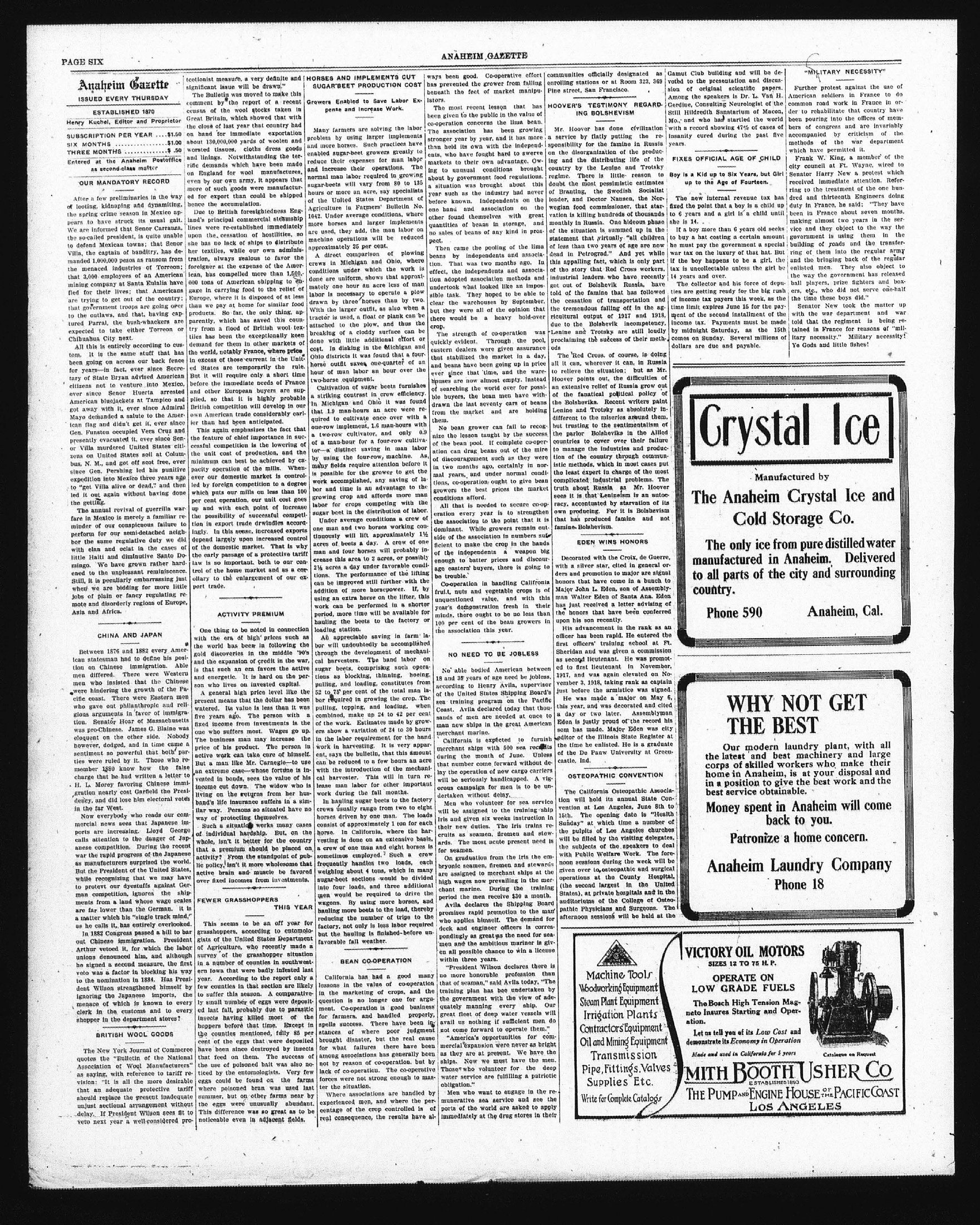
Searchable text
Anaheim Gazette
ISSUED EVERY THURSDAY
ESTABLISHED 1870
Henry Kuchel, Editor and Proprietor
SUBSCRIPTION PER YEAR ... $1.50
SIX MONTHS ... $1.00
THREE MONTHS ... $ .50
Entered at the Anaheim Postoffice as second-class matter
OUR MANDATORY RECORD
After a few preliminaries in the way of looting, kidnapping and dynamiting, the spring crime season in Mexico appears to have struck its usual gait. We are informed that Senor Carranza, the so-called president, is quite unable to defend Mexican towns; that Senor Villa, the captain of banditry, has demanded 1,000,000 pesos as ransom from the menaced industries of Torreon; that 3,000 employees of an American mining company at Santa Eulalia have fled for their lives; that Americans are trying to get out of the country; that government troops are going over to the outlaws, and that, having captured Parral, the bush-whackers are expected to take either Torreon or Chihuahua City next.
All this is entirely according to custom. It is the same stuff that has been going on across our back fence for years—in fact, ever since Secretary of State Bryan advised American citizens not to venture into Mexico, ever since Senor Huerta arrested American bluejackets at Tampico and got away with it, ever since Admiral Mayo demanded a salute to the American flag and didn't get it, ever since Gen. Funston occupied Vera Cruz and presently evacuated it, ever since Senor Villa murdered United States citizens on United States soil at Columbo.
The Bulletin was moved to make this comment by the report of a recent census of the wool stocks taken in Great Britain, which showed that with the close of last year that country had on hand for immediate exportation about 130,000,000 yards of woolen and worsted tissues, cloths dress goods and linings. Notwithstanding the terrific demands which have been made on England for wool manufactures, even by our own army, it appears that more of such goods were manufactured for export than could be shipped hence the accumulation.
Due to British foresightedness England's principal commercial steamship lines were re-established immediately upon the cessation of hostilities, so she has no lack of ships to distribute her textiles, while our own administration, always zealous to favor the foreigner at the expense of the American, has compelled more than 1,500,000 tons of American shipping to engage in carrying food to the relief of Europe, where it is disposed of at less than we pay at home for similar food products. So far, the only thing apparently, which has saved this country from a flood of British wool-textiles has been the exceptionally keen demand for them in other markets of the world, notably France, where price in excess of those current in the United States are temporarily the rule. But it will require only a short time before the immediate needs of France and other European buyers are supplied, so that it is highly probable British competition will develop in our own American trade considerably earlier than had been anticipated.
This again emphasizes the fact that the feature of chief importance in successful competition is the lowering of the unit cost of production, and the horse-specified sugar-beet prices.
Many farmers are problem by using and more horses. They enabled sugar-beet to reduce their expenses and increase their normal man labor rate; sugar-beets will vary hours or more an hour of the United States Agriculture in Fargo 1042. Under average more horses and they add machine operations approximately 25 per cent.
A direct comparison crews in Michigan conditions under done are uniform, mately one hour a labor is necessary drawn by three horses. With the larger our tractor is used, a flock attached to the prairie breaking of a clock done with little cost. In disking Ohio districts it was horse outfit saves hour of man labor two-horse equipment.
Cultivation of sucker a striking contrast. In Michigan and that 1.9 man-hour required to cultivate one-row cultivator a two-row cultivator—a distinct saver by using the four
been going on across our back fence for years—in fact, ever since Secretary of State Bryan advised American citizens not to venture into Mexico, ever since Senor Huerta arrested American bluejackets at Tampico and got away with it, ever since Admiral Mayo demanded a salute to the American flag and didn't get it, ever since Gen. Funston occupied Vera Cruz and presently evacuated it, ever since Senator Villa murdered United States citizens on United States soil at Columbus, N. M., and got off scot free, ever since Gen. Pershing led his punitive expedition into Mexico three years ago to "get Villa alive or dead," and then led it out again without having done the getting.
The annual revival of guerrilla warfare in Mexico is merely a familiar reminder of our conspicuous failure to perform for our semi-detached neighbor the same legislative duty we did with elan and eclat in the cases of little Haiti and diminutive Santo Domingo. We have grown rather hardened to the unpleasant reminiscence. Still, it is peculiarly embarrassing just when we are bidding for more little jobs of plain or fancy regulating remote and disorderly regions of Europe, Asia and Africa.
CHINA AND JAPAN
Between 1876 and 1882 every American statesman had to define his position on Chinese immigration. Able men differed. There were Western men who insisted that the Chinese were hindering the growth of the Pacific coast. There were Eastern men who gave out philanthropic and religious arguments in favor of immigration. Senator Hoar of Massachusetts was pro-Chinese. James G. Blaine was eloquent on the other side. Nobody however, dodged, and in time came a sentiment so powerful that both parties were ruled by it. Those who remember 1880 know how the false charge that he had written a letter to H. L. Morey favoring Chinese immigration nearly cost Garfield the Presidency, and did lose him electoral votes in the far West.
Now everybody who reads our commercial news sees that Japanese imports are increasing. Lloyd George calls attention to the danger of Japanese competition. During the recent war the rapid progress of the Japanese as manufacturers surprised the world.
ACTIVITY PREMIUM
One thing to be noted in connection with the era of high prices such as the world has been in following the gold discoveries in the middle '90's and the expansion of credit in the war, is that such an era favors the active and energetic. It is hard on the person who lives on invested capital.
A general high price level like the present means that the dollar has been watered. Its value is less than it was five years ago. The person with a fixed income from investments is the one who suffers most. Wages go up. The business man may increase the price of his product. The person in active work can take care of himself. But a man like Mr. Carnegie—to use an extreme case—whose fortune is invested in bonds, sees the value of his income cut down. The widow who is living on the returns from her husband's life insurance suffers in a similar way. Persons so situated have no way of protecting themselves.
Such a situation works many cases of individual hardship. But, on the whole, isn't it better for the country that a premium should be placed on activity? From the standpoint of public policy, isn't it more wholesome that horse outfit saves hour of man labor two-horse equipment?
Cultivation of sugar striking contrasts in Michigan and that 1.9 man-hour required to cultivate one-row cultivator a two-row cultivator of a man-hour former—a distinct saver by using the four many fields require is possible for the work accomplished bor and time is a growing crop and labor for crops sugar beet in the area under average one man and two continuously will lift acres of beets a man and four hours crease this area to 2½ acres a day units. The performance can be improved addition of more using an extra hour work can be per period, more time hauling the beet loading station.
An appreciable bor will undoubtedly through the developmental harvesters. sugar beets, conditions as blocking, pulling, and load 52 to 75 per cent bor required in gull pulling, topping, combined, make of the work. Esters show a variation in the labor requirement in harvestent, says the bull can be reduced to with the introduction harvester. Lease man labor work during the harvesting usually rays horses driven by consist of approx horse. In Californiesting is done by a crew of one man sometimes employ frequently hand-
Now everybody who reads our commercial news sees that Japanese imports are increasing. Lloyd George calls attention to the danger of Japanese competition. During the recent war the rapid progress of the Japanese as manufacturers surprised the world. But the President of the United States, while recognizing that we may have to protect our dyestuffs against German competition, ignores the shipments from a land whose wage scales are far lower than the German. It is a matter which his "single track mind," as he calls it, has entirely overlooked.
In 1882 Congress passed a bill to bar out Chinese immigration. President Arthur vetoed it, for which the labor unions denounced him, and although he signed a second measure, the first veto was a factor in blocking his way to the nomination in 1884. Has President Wilson strengthened himself by ignoring the Japanese imports, the menace of which is known to every clerk in the customs and to every shopper in the department stores?
BRITISH WOOL GOODS
The New York Journal of Commerce quotes the "Bulletin of the National Association of Wool Manufacturers" as saying, with reference to tariff revision: "It is all the more desirable that an adequate protective tariff should replace the present inadequate unjust sectional arrangement without delay. If President Wilson sees fit to veto next year a well-considered pro-
FEWER GRASSHOPPERS
THIS YEAR
This seems to be an off year for grasshoppers, according to entomologists of the United States Department of Agriculture, who recently made a survey of the grasshopper situation in a number of counties in southwestern Iowa that were badly infested last year. According to the report only a few counties in that section are likely to suffer this season. A comparatively small number of eggs were deposited last fall, probably due to parasitic insects having killed most of the hoppers before that time. Except in the counties mentioned, fully 85 percent of the eggs that were deposited have been since destroyed by insects that feed on them. The success of the use of poisoned bait was also noticed by the entomologists. Very few eggs could be found on the farms where poisoned bran was used last summer, but on other farms near by the eggs were unusually abundant. This difference was so great as to be noticeable even in adjacent fields.
BEAN C
California has lessons in the market question is no mention. Co-operate for farmers, and spells success. Stances of what brought disaster for what failure among associates not by reason or lack of co-operative forces were not ter the situation.
Where associates experienced more percentage of the real consequence...
HORSES AND IMPLEMENTS CUT SUGAR BEET PRODUCTION COST
Growers Enabled to Save Labor Expense and Increase Work.
Many farmers are solving the labor problem by using larger implements and more horses. Such practices have enabled sugar-beet growers greatly to reduce their expenses for man labor and increase their operations. The normal man labor required in growing sugar-beets will vary from 80 to 135 hours or more an acre, say specialists of the United States Department of Agriculture in Farmers' Bulletin No. 1042. Under average conditions, where more horses and larger implements are used, they add, the man labor on machine operations will be reduced approximately 25 per cent.
A direct comparison of plowing crews in Michigan and Ohio, where conditions under which the work is done are uniform, shows that approximately one hour an acre less of man labor is necessary to operate a plow drawn by three horses than by two. With the larger outfit, as also when a tractor is used, a float or plank can be attached to the plow, and thus the breaking of a cloddy surface can be done with little additional effort or cost. In disking in the Michigan and Ohio districts it was found that a four-horse outfit saves one-quarter of an hour of man labor an hour over the two-hour equipment.
Cultivation of sugar beets furnishes a striking contrast in crew efficiency. In Michigan and Ohio it was found that 1.9 man-hours an acre were required to cultivate once over with a one-row implement, 1.6 man-hours with a two-row cultivator, and only 0.9 of a man-hour for a four-row cultivator—a distinct saving in man labor by using the four-row machine. As ways been good. Co-operative effort has prevented the grower from falling beneath the feet of market manipulators.
The most recent lesson that has been given to the public in the value of co-operation concerns the lima bean. The association has been growing stronger year by year, and it has more than held its own with the independents, who have fought hard to swerve markets to their own advantage. Owing to unusual conditions brought about by government food regulations, a situation was brought about this year such as the industry had never before known. Independents on the one hand and association on the other found themselves with great quantities of beans in storage, and no sales of beans of any kind in prospect.
Then came the pooling of the lima beans by independents and association. That was two months ago. In effect, the independents and association adopted association methods and undertook what looked like an impossible task. They hoped to be able to clear the warehouses by September, but they were all of the opinion that there would be a heavy hold-over crop.
The strength of co-operation was quickly evident. Through the pool, eastern dealers were given assurance that stabilized the market in a day, and beans have been going up in price ever since that time, and the warehouses are now almost empty. Instead of searching the world over for possible buyers, the bean men have withdrawn the last seventy cars of beans from the market and are holding them.
No bean grower can fail to recognize the lesson taught by the success of the bean pool. If complete co-operation can drag beans out of the mire communities officially designated as enrolling stations or at Room 323, 369 Pine street, San Francisco.
HOOVER'S TESTIMONY REGARDING BOLSHEVISM
Mr. Hoover has done civilization a service by flatly putting the responsibility for the famine in Russia on the disorganization of the producing and the distributing life of the country by the Lenine and Trotsky regime. There is little reason to doubt the most pessimistic estimates of Branting, the Swedish Socialist leader, and Doctor Nansen, the Norwegian food commissioner, that starvation is killing hundreds of thousands monthly in Russia. One hideous phase of the situation is summed up in the statement that virtually "all children of less than two years of age are now dead in Petrograd." And yet while this appalling fact, which is only part of the story that Red Cross workers, industrial leaders who have recently got out of Bolshevik Russia, have told of the famine that has followed the cessation of transportation and the tremendous falling off in the agricultural output of 1917 and 1918, due to the Bolshevik incompetency, Lenine and Trotsky are still loudly proclaiming the success of their methods.
The Red Cross. of course, is doing all it can, wherever it can, in Russia to relieve the situation; but as Mr. Hoover points out, the difficulties of an extensive relief of Russia grow out of the fanatical political policy of the Bolsheviks. Recent writers paint Lenine and Trotsky as absolutely indifferent to the miseries around them, but trusting to the sentimentalism of the parlor Bolsheviks in the Allied countries to cover over their failure to manage the industries and production of the country through communi-
Cultivation of sugar beets furnishes a striking contrast in crew efficiency. In Michigan and Ohio it was found that 1.9 man-hours an acre were required to cultivate once over with a one-row implement, 1.6 man-hours with a two-row cultivator, and only 0.9 of a man-hour for a four-row cultivator—a distinct saving in man labor by using the four-row machine. As many fields require attention before it is possible for the grower to get the work accomplished, any saving of labor and time is an advantage to the growing crop and affords more man labor for crops competing with the sugar beet in the distribution of labor.
Under average conditions a crew of one man and two horses working continuously will lift approximately 1½ acres of beets a day. A crew of one man and four horses will probably increase this area to 2 acres, or possibly 2½ acres a day under favorable conditions. The performance of the lifting can be improved still further with the addition of more horsepower. If, by using an extra horse on the lifter, this work can be performed in a shorter period, more time will be available for hauling the beets to the factory or loading station.
An appreciable saving in farm labor will undoubtedly be accomplished through the development of mechanical harvesters. The hand labor on sugar beets, comprising such operations as blocking, thinning, hoeing, pulling, and loading, constitutes from 52 to 75' per cent of the total man labor required in growing the crop. The pulling, tapping, and loading, when combined, make up 24 to 42 per cent of the work. Estimates made by growers show a variation of 24 to 30 hours in the labor requirement for the hand work in harvesting. It is very apparent, says the bulletin, that this amount can be reduced to a few hours an acre with the introduction of the mechanical harvester. This will in turn release man labor for other important work during the fall months.
In hauling sugar beets to the factory crews usually range from two to eight horses driven by one man. The loads consist of approximately 1 ton for each horse. In California, where the harvesting is done on an extensive basis, a crew of one man and eight horses is sometimes employed. Such a crew frequently handles two loads, each and beans have been going up in price ever since that time, and the warehouses are now almost empty. Instead of searching the world over for possible buyers, the bean men have withdrawn the last seventy cars of beans from the market and are holding them.
No bean grower can fail to recognize the lesson taught by the success of the bean pool. If complete co-operation can drag beans out of the mire of discouragement such as they were in two months ago, certainly in normal years, and under normal conditions, co-operation ought to give bean growers the best prices the market conditions afford.
All that is needed to secure co-operation every year is to strengthen the association to the point that it is dominant. While growers remain outside of the association in numbers sufficient to make the crop in the hands of the independents a weapon big enough to batter prices and discourage eastern buyers, there is going to be trouble.
Co-operation in handling Califronia frui.t, nuts and vegetable crops is of unquestioned value, and with this year's demonstration fresh in their minds, there ought to be no less than 100 per cent of the bean growers in the association this year.
NO NEED TO BE JOBLESS
No able bodied American between 18 and 36 years of age need be jobless, according to Henry Avila, supervisor of the United States Shipping Board's sea training program on the Pacific Coast. Avila declared today that thousands of men are needed at once to man new ships in the great American merchant marine.
California is expected to furnish merchant ships with 500 sea recruits during the month of June. Unless that number come forward without delay the operation of new cargo carriers will be seriously handicapped. A vigorous campaign for men is to be undertaken without delay.
Men who volunteer for sea service will be assigned to the training ship Iris and given six weeks instruction in their new duties. The Iris trains recruits as seamen, firemen and stewards. The most acute present need is for seamen.
On graduation from the Iris the embryonic seamen firemen and stewards all it can, wherever it can, in Russia to relieve the situation; but as Mr. Hoover points out, the difficulties of an extensive relief of Russia grow out of the fanatical political policy of the Bolsheviks. Recent writers paint Lenine and Trotsky as absolutely different to the miseries around them, but trusting to the sentimentalism of the parlor Bolsheviks in the Allied countries to cover over their failure to manage the industries and production of the country through communistic methods, which in most cases put the least expert in charge of the most complicated industrial problems. The truth about Russia as Mr. Hoover sees it is that Lenineism is an autocracy, accentuated by starvation of its own producing. For it is Bolshevism that has produced famine and not famine. Bolshevism.
EDEN WINS HONORS
Decorated with the Croix, de Guerre, with a silver star, cited in general orders and promotion to major are signal honors that have come in a bunch to Major John L. Eden, son of Assemblyman Walter Eden of Santa Ana. Eden has just received a letter advising of the honors that have been conferred upon his son recently.
His advancement in the rank as an officer has been rapid. He entered the first officers' training school at Ft. Sheridan and was given a commission as second lieutenant. He was promoted to first lieutenant in November, 1917, and was again elevated on November 3, 1918, taking rank as captain just before the armistice was signed.
He was made a major on May 6, this year, and was decorated and cited a day or two later. Assemblyman Eden is justly proud of the record his som has made. Major Eden was city editor of the Illinois State Register at the time he enlisted. He is a graduate of the De Pauw University at Greencastle, Ind.
OSTEOPATHIC CONVENTION
The California Osteopathic Association will hold its annual State Convention at Los Angeles, June 8th to 15th. The opening date is "Health Sunday" at which time a number of the pulpits of Los Angeles churches will be filled by the visiting delegates, the subjects of the speakers to deal with Public Welfare Work. The fore-noon sessions during the week will be
with the introduction of the mechanical harvester. This will in turn release man labor for other important work during the fall months.
In hauling sugar beets to the factory crews usually range from two to eight horses driven by one man. The loads consist of approximately 1 ton for each horse. In California, where the harvesting is done on an extensive basis, a crew of one man and eight horses is sometimes employed. Such a crew frequently handles two loads, each weighing about 4 tons, which in many sugar-beet sections would be divided into four loads, and three additional men would be required to drive the wagons. By using more horses, and hauling more beets to the load, thereby reducing the number of trips to the factory, not only is less labor required but the hauling is finished-before unfavorable fall weather.
BEAN CO-OPERATION
California has had a good many lessons in the value of co-operation in the marketing of crops, and the question is no longer one for argument. Co-operation is good business for farmers, and handled properly, spells success. There have been instances of where poor judgment brought disaster, but the real cause for what failures there have been among associations has generally been not by reason of co-operation, but by lack of co-operation. The co-operative forces were not strong enough to master the situation.
Where associations are handled by experienced men, and where the percentage of the crop controlled is of real consequence, the results have al-
lay the operation of new cargo carriers will be seriously handicapped. A vigorous campaign for men is to be undertaken without delay.
Men who volunteer for sea service will be assigned to the training-ship Iris and given six weeks instruction in their new duties. The Iris trains recruits as seamen, firemen and stewards. The most acute present need is for seamen.
On graduation from the Iris the embryonic seamen, firemen and stewards are assigned to merchant ships at the high wages now prevailing in the merchant marine. During the training period the men receive $30 a month.
Avilla declares the Shipping Board promises rapid promotion to the man who applies himself. The demand for deck and engineer officers is correspondingly as great as the need for seamen and the ambitious mariner is given all possible chance to win a license within three years.
"President Wilson declares there is no more honorable profession than that of seaman," said Avilla today. "The training plan has bee undertaken by the government with the view of adequately manning every ship. Our great fleet of deep water vessels will avail us nothing if sufficient men do not come forward to operate them."
"America's opportunities for commercial expansion were never as bright as they are at present. We have the ships. Now we must have the men. Those who volunteer for the deep water service are fulfilling a patriotic obligation."
Men who want to engage in the remunerative sea service and see the ports of the world are asked to apply immediately at the drug stores in their
Gamut Club building and will be devoted to the presentation and discussion of original scientific papers. Among the speakers is Dr. L. Van H. Gordine, Consulting Neurologist of the Still Hildredth Sanatarium of Macon, Mo., and who has startled the world with a record showing 47% of cases of insanity cured during the past five years.
FIXES OFFICIAL AGE OF CHILD
Boy is a Kid up to Six Years, but Girl up to the Age of Fourteen.
The new internal revenue tax has fixed the point that a boy is a child up to 6 years and a girl is a child until she is 14.
If a boy more than 6 years old seeks to buy a hat costing a certain amount he must pay the government a special war tax on the luxury of that hat. But if the boy happens to be a girl, the tax is uncollectable unless the girl be 14 years and over.
The collector and his force of deputies are getting ready for the big rush of income tax payers this week, as the time limit expires June 15 for the payment of the second installment of the income tax. Payments must be made by midnight Saturday, as the 15th comes on Sunday. Several millions of dollars are due and payable.
"MILITARY NECESSITY"
Further protest against the use of American soldiers in France to do common road work in France in order to rehabilitate that country have been pouring into the offices of members of congress and are invariably accompanied by criticism of the methods of the war department which have permitted it.
Frank W. King, a member of the city council at Ft. Wayne, wired to Senator Harry New a protest which received immediate attention. Referring to the treatment of the one hundred and thirteenth Engineers doing duty in France, he said: "They have been in France about seven months, making almost two years in the service and they object to the way the government is using them in the building of roads and the transferring of them into the regular army and the bringing back of the regular enlisted men. They also object to the way the government has released ball players, prize fighters and boxers, etc., who did not serve one-half the time these boys did."
Senator New took the matter up with the war department and told that the regiment is being retained in France for reasons of "military necessity." Military necessity! Ye Gods and little fishes!
Crystal Ice
Manufactured by
The Anaheim Crystal Ice and
Cold Storage Co.
The only ice from pure distilled water manufactured in Anaheim. Delivered to all parts of the city and surrounding country.
Phone 590 Anaheim, Cal.
WHY NOT GET THE BEST
Our modern laundry plant, with all the latest and best machinery and large corps of skilled workers who make their home in Anaheim, is at your disposal and in a position to give the best work and the best service obtainable.
Money spent in Anaheim will come back to you.
Patronize a home concern.
Anaheim Laundry Company
home in Anaheim, is at your disposal and in a position to give the best work and the best service obtainable.
Money spent in Anaheim will come back to you.
Patronize a home concern.
Anaheim Laundry Company
Phone 18
VICTORY OIL MOTORS
SIZES 12 TO 75 H.P.
OPERATE ON
LOW GRADE FUELS
The Bosch High Tension Magneto Insures Starting and Operation.
Let us tell you of its Low Cost and demonstrate its Economy in Operation
Made and used in California for 5 years
MITH BOOTH USHER CO
ESTABLISHED 1893
THE PUMP AND ENGINE HOUSE OF THE PACIFIC COAST
LOS ANGELES