anaheim-gazette 1919-06-05
Scanned page
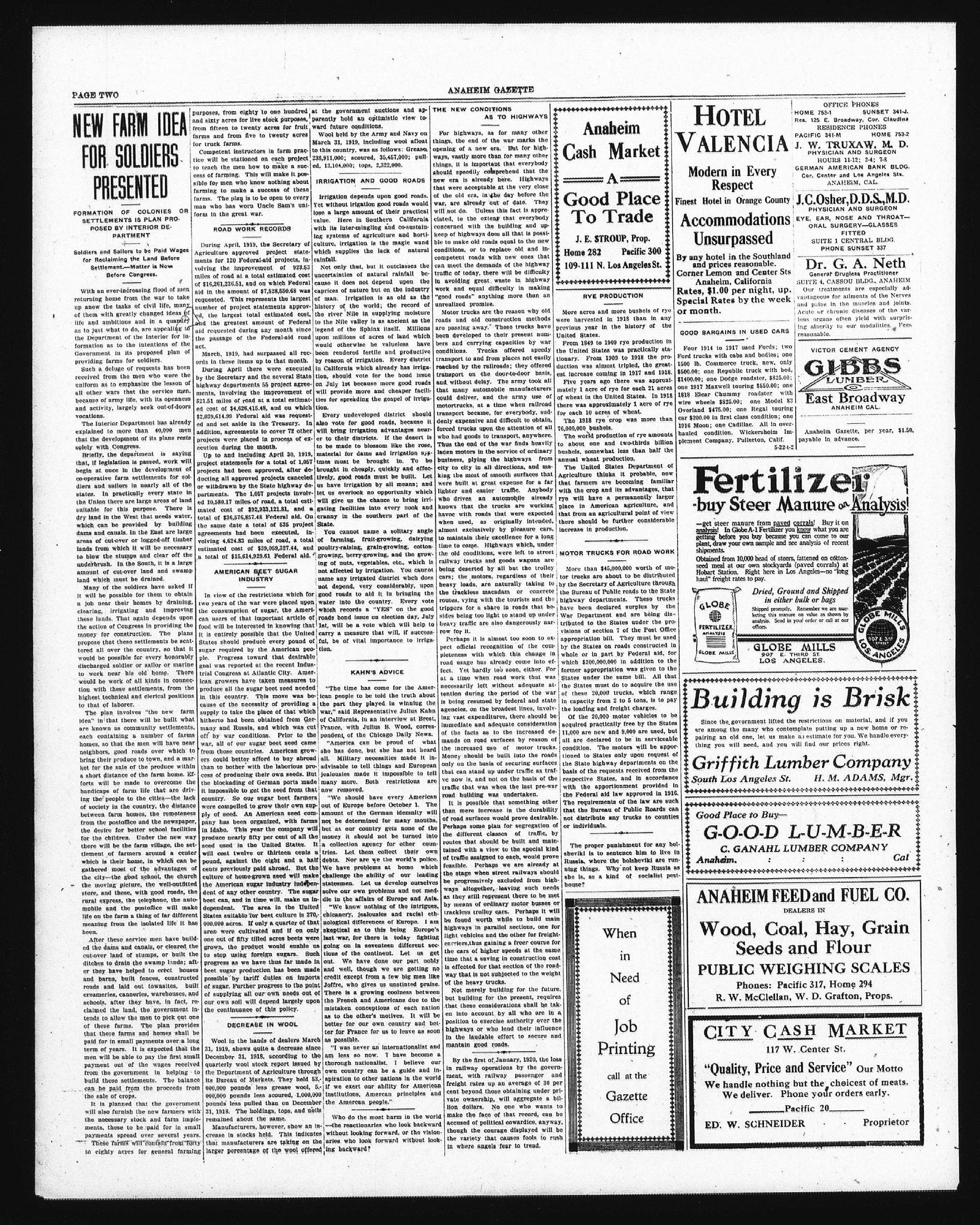
Searchable text
NEW FARM IDEA FOR SOLDIERS PRESENTED
FORMATION OF COLONIES OR SETTLEMENTS IS PLAN PROPOSED BY INTERIOR DEPARTMENT
Soldiers and Sailors to be Paid Wages for Reclaiming the Land Before Settlement.—Matter is Now Before Congress.
With an ever-increasing flood of men returning home from the war to take up anew the tasks of civil life, many of them with greatly changed ideas of life and ambitions and in a quandry as to just what to do, are appealing to the Department of the Interior for information as to the intentions of the Government in its proposed plan of providing farms for soldiers.
Such a deluge of requests has been received from the men who wore the uniform as to emphasize the lesson of all other wars that the service men, because of army life, with its openness and activity, largely seek out-of-doors vocations.
The Interior Department has already explained to more than 40,000 men that the development of its plans rests solely with Congress.
Briefly, the department is saying purposes, from eighty to one hundred and sixty acres for live stock purposes, from fifteen to twenty acres for fruit farms and from five to twenty acres for truck farms.
Competent instructors in farm practice will be stationed on each project to teach the men how to make a success of farming. This will make it possible for men who know nothing about farming to make a success of these farms. The plaq is to be open to every man who has worn Uncle Sam's uniform in the great war.
ROAD WORK RECORDS
During April, 1919, the Secretary of Agriculture approved project statements for 120 Federal-aid projects, involving the improvement of 923.53 miles of road at a total estimated cost of $16,261,236.51, and on which Federal aid in the amount of $7,528,550.68 was requested. This represents the largest number of project statements approved, the largest total estimated cost, and the greatest amount of Federal aid requested during any month since the passage of the Federal-aid road act.
March, 1919, had surpassed all records in these items up to that month.
During April there were executed by the Secretary and the several State highway departments 55 project agreements, involving the improvement of 521.51 miles of road at a total estimated cost of $4,626,415.48, and on which $2,039,614.99 Federal aid was requested and set aside in the Treasury. In addition, agreements to cover 72 other projects were placed in process of execution during the month.
Up to and including April 30, 1919, at the government parentally hold an ward future condition.
Wool held by the March 31, 1919, in this country, waived 238,911,000; scoured 13,104,000; top IRRIGATION AUCTION
Irrigation depends yet without irrigation lose a large amount value. Here in with its inter-mining systems of agriculture, irrigation which supplies the rainfall.
Not only that, uncertainties of cause it does not caprices of nature of man. Irrigation history of the river Nile in to the Nile valley legend of the Spir upon millions of would otherwise been rendered for by reason of irrigation in California whition, should vote on July 1st because will provide materials for spreading it.
Every undeveloped also vote for go will bring irrigation to their district to be made to be material for dam
Such a deluge of requests has been received from the men who wore the uniform as to emphasize the lesson of all other wars that the service men, because of army life, with its openness and activity, largely seek out-of-doors vocations.
The Interior Department has already explained to more than 40,000 men that the development of its plans rests solely with Congress.
Briefly, the department is saying that, if legislation is passed, work will begin at once in the development of co-operative farm settlements for soldiers and sailors in nearly all of the states. In practically every state in the Union there are large areas of land suitable for this purpose. There is dry land in the West that needs water, which can be provided by building dams and canals. In the East are large areas of cut-over or logged-off timber lands from which it will be necessary to blow the stumps and clear off the underbrush. In the South, it is a large amount of cut-over land and swamp land which must be drained.
Many of the soldiers have asked if it will be possible for them to obtain a job near their homes by draining, clearing, irrigating and improving these lands. That again depends upon the action of Congress in providing the money for construction. The plans propose that these settlements be scattered all over the country, so that it would be possible for every honorably discharged soldier or sailor or marine to work near his old home. There would be work of all kinds in connection with these settlements, from the highest technical and clerical positions to that of laborer.
The plan involves "the new farm idea" in that there will be built what are known as community settlements, each containing a number of farms homes, so that the men will have near neighbors, good roads over which to bring their produce to town, and a market for the sale of the produce within a short distance of the farm home. Efforts will be made to overcome the handicaps of farm life that are driving the people to the cities—the lack of society in the country, the distance between farm homes, the remoteness from the postoffice and the newspaper, the desire for better school facilities for the children. Under the new way there will be the farm village, the settlement of farmers around a center which is their home, in which can be
During April there were executed by the Secretary and the several State highway departments 55 project agreements, involving the improvement of 521.51 miles of road at a total estimated cost of $4,626,415.48, and on which $2,039,614.99 Federal aid was requested and set aside in the Treasury. In addition, agreements to cover 72 other projects were placed in process of execution during the month.
Up to and including April 30, 1919, project statements for a total of 1,057 projects had been approved, after deducting all approved projects canceled or withdrawn by the State highway departments. The 1,057 projects involved 10,580.17 miles of road, a total estimated cost of $92,933,121.81, and a total of $36,576,857.48 Federal aid. On the same date a total of 535 project agreements had been executed, involving 4,624.83 miles of road, a total estimated cost of $39,059,327.44, and a total of $15,614,929.61 Federal aid.
AMERICAN BEET SUGAR INDUSTRY
In view of the restrictions which for two years of the war were placed upon the consumption of sugar, the American users of that important article of food will be interested in knowing that it is entirely possible that the United States should produce every pound of sugar required by the American people. Progress toward that desirable goal was reported at the recent Industrial Congress at Atlantic City. American growers have taken measures to produce all the sugar beet seed needed in this country. This move was because of the necessity of providing a supply to take the place of that which hitherto had been obtained from Germany and Russia, and which was cut off by war conditions. Prior to the war, all of our sugar beet seed came from those countries. American growers could better afford to buy abroad than to bother with the laborious process of producing their own seeds. But the blockading of German ports made it impossible to get the seed from that country. So our sugar beet farmers were compelled to grow their own supply of seed. An American seed company has been organized, with farms in Idaho. This year the company will produce nearly fifty per cent of all the seed used in the United States. It will cost twelve or thirteen cents a pound against the eight and a half orders in these items up to that month.
By reason of irrigation in California which should vote on July 1st because will provide more ties for spreading it.
Every undeveloped also vote for go will bring irrigation to their district to be made to be material for daft times must be brought in cheaply, good roads us have irrigation let us overlook will give us these gating facilities as cranny in the State.
You cannot meet any farming, from poultry-raising, growing, berry-growing of nuts, veg not affected by your name any irrigation not depend, very good roads to water into the which records our roads bond issue 1st, will be a very carry a measure ful, be of vital tion.
KAHU
"The time has come for the part they want," said Reporter of California, in France, with J.P.pondent of the case.
"America can she has done, all. Military may advisable to teach jealousies made many more. I now removed."
"We should out of Europe an amount of them not be determined but as our cost money it should a collection and tries. Let that debts. Nor are
After these service men have built the dams and canals, or cleared the cut-over land of stumps, or built the ditches to drain the swamp lands; after they have helped to erect houses and barns, built fences, constructed roads and laid out townsites, built creameries, canneries, warehouses, and schools, after they have, in fact, reclaimed the land, the government intends to allow the men to pick out one of these farms. The plan provides that these farms and homes shall be paid for in small payments over a long term of years. It is expected that the men will be able to pay the first small payment out of the wages received from the government in helping to build these settlements. The balance can be paid from the proceeds from the sale of crops.
It is planned that the government will also furnish the new farmers with the necessary stock and farm implements, these to be paid for in small payments spread over several years. These farms will contain from forty to eighty acres for general farming
Wool in the hands of dealers March 31, 1919, shows quite a decrease since December 31, 1918, according to the quarterly wool stock report issued by the Department of Agriculture through its Bureau of Markets. They held 53,000,000 pounds less grease wool, 5,000,000 pounds less scoured, 1,000,000 pounds less pulled than on December 31, 1918. The holdings, tops, and noils remained about the same.
Manufacturers, however, show an increase in stocks held. This indicates that manufacturers are taking on the larger percentage of the wool offered
hundred purposes, for fruit acres
in prac-project a suce it posing about of these
to every unitary of state-sects, in923.53 cost Federal
largest approv-ced cost,
Federal since old road
all rec-month. Executed Real State set agreement of estimation which request-uary. In 1912 other asses of ex30,1919.
at the government auctions and apparently hold an optimistic view toward future conditions.
Wool held by the Army and Navy on March 31, 1919, including wool afloat to this country, was as follows: Grease, 238,911,000; scoured, 35,457,000; pulled, 13,104,000; tops, 2,322,000.
IRRIGATION AND GOOD ROADS
Irrigation depends upon good roads. Yet without irrigation good roads would lose a large amount of their practical value. Here in Southern California with its inter-mingling and co-sustaining systems of agriculture and horticulture, irrigation is the magic wand which supplies the lack of natural rainfall.
Not only that, but it outclasses the uncertainties of natural rainfall because it does not depend upon the caprices of nature but on the industry of man. Irrigation is as old as the history of the world; the record of the river Nile in supplying moisture to the Nile valley is as ancient as the legend of the Sphinx itself. Millions upon millions of acres of land which would otherwise be valueless have been rendered fertile and productive by reason of irrigation. Every district in California which already has irrigation, should vote for the bond issue on July 1st because more good roads will provide more and cheaper facilities for spreading the gospel of irrigation.
Every undeveloped district should also vote for good roads, because it will bring irrigation advantages nearer to their districts. If the desert is to be made to blossom like the rose, material for dams and irrigation sys-
THE NEW CONDITIONS AS TO HIGHWAYS
For highways, as for many other things, the end of the war marks the opening of a new era. But for highways, vastly more than for many other things, it is important that everybody should speedily comprehend that the new era is already here. Highways that were acceptable at the very close of the old era, in the day before the war, are already out of date. They will not do. Unless this fact is appreciated, to the extent that everybody concerned with the building and upkeep of highways does all that is possible to make old roads equal to the new conditions, or to replace old and incompetent roads with new ones that can meet the demands of the highway traffic of today, there will be difficulty in avoiding great waste in highway work and equal difficulty in making "good roads" anything more than an unrealized promise.
Motor trucks are the reason why old roads and old construction methods are passing away. These trucks have been developed to their present numbers and carrying capacities by war conditions. Trucks offered speedy transport to and from places not easily reached by the railroads; they offered transport on the door-to-door basis, and without delay. The army took all that many automobile manufacturers could deliver, and the army use of motortrucks, at a time when railroad transport became, for everybody, suddenly expensive and difficult to obtain, forced trucks upon the attention of all who had goods to transport, anywhere. Thus the end of the war finds heavily laden motors in the service of ordinary
Anaheim Cash Market
A Good Place To Trade
J. E. STROUP, Prop.
Home 282 Pacific 300
109-111 N. Los Angeles St.
RYE PRODUCTION
More acres and more bushels of rye were harvested in 1918 than in any previous year in the history of the United States.
From 1849 to 1909 rye production in the United States was practically stationary. From 1909 to 1918 the production was almost tripled, the greatest increase coming in 1917 and 1918.
Five years ago there was approximately 1 acre of rye for each 21 acres of wheat in the United States. In 1918 there was approximately 1 acre of rye for each 10 acres of wheat.
The 1918 rye crop was more than 76,000,000 bushels.
The world production of rye amounts to about one and two-thirds billion bushels, somewhat less than half the
which forced upon the Ameri-article ofwing that the United pound of can grow-ly abroad serious pro-ceeds. Butports made from that farmers own supeed com-mit with farms company will be of all the States. It has cents a and a half by reason of irrigation. Every district in California which already has irrigation, should vote for the bond issue on July 1st because more good roads will provide more and cheaper facilities for spreading the gospel of irrigation.
Every undeveloped district should also vote for good roads, because it will bring irrigation advantages nearer to their districts. If the desert is to be made to blossom like the rose, material for dams and irrigation sys-tmes must be brought in. To be brought in cheaply, quickly and effec-ively, good roads must be built. Let us have irrigation by all means; and let us overlook no opportunity which will give us the chance to bring irrigating facilities into every nook and cranny in the southern part of the State.
You cannot name a solitary angle of farming, fruit-growing, dairying poultry-raising, grain-growing, cotton-growing, berry-growing, and the growing of nuts, vegetables, etc., which is not affected by irrigation. You cannot name any irrigated district which does not depend, very considerably, upon good roads to aid it in bringing the water into the country. Every vote which records a "YES" on the good roads bond issue on election day, July 1st, will be a vote which will help to carry a measure that will, if successful, be of vital importance to irrigation.
KAHN'S ADVICE
"The time has come for the American people to be told the truth about the part they played in winning the war," said Representative Julius Kahn of California, in an interview at Brest, France, with Julius B. Wood, correspondent of the Chicago Daily News.
"America can be proud of what she has done, but she has not heard all. Military necessities made it advisable to tell things and European jealousies made it impossible to tell many more. Both restrictions are now removed.
"We should have every American out of Europe before October 1. The amount of the German idemnity will not be determined for many months, but as our country gets none of the money it should not be turned into a collection agency for other countries. Let them collect their own debts. Nor are we the world's police."
It is possible that something other than mere increase in the durability of road surfaces would prove desirable. Perhaps some plan for segregation of the different classes of traffic, by routes that should be built and maintained with a view to the special kind of traffic assigned to each, would prove feasible. Perhaps we are already at duction was almost tripled, the greatest increase coming in 1917 and 1918.
Five years ago there was approximately 1 acre of rye for each 21 acres of wheat in the United States. In 1918 there was approximately 1 acre of rye for each 10 acres of wheat.
The 1918 rye crop was more than 76,000,000 bushels.
The world production of rye amounts to about one and two-thirds billion bushels, somewhat less than half the annual wheat production.
The United States Department of Agriculture thinks it probable, now that farmers are becoming familiar with the crop and its advantages, that rye will have a permanently larger place in American agriculture, and that from an agricultural point of view there should be further considerable increase in production.
MOTOR TRUCKS FOR ROAD WORK
More than $45,000,000 worth of motor trucks are about to be distributed by the Secretary of Agriculture through the Bureau of Public roads to the State highway departments. These trucks have been declared surplus by the War Department and are being distributed to the States under the provisions of section 7 of the Post Office appropriation bill. They must be used by the States on roads constructed in whole or in part by Federal aid, for which $200,000,000 in addition to the former appropriation was given to the States under the same bill. All that the States must do to acquire the use of these 20,000 trucks, which range in capacity from 2 to 5 tons, is to pay the loading and freight charges.
Of the 20,000 motor vehicles to be acquired practically free by the States 11,000 are new and 9,000 are used, but all are declared to be in serviceable condition. The motors will be apportioned to States only upon request of the State highway departments on the basis of the requests received from the respective States, and in accordance with the apportionment provided in the Federal aid law approved in 1916. The requirements of the law are such that the Bureau of Public Roards can not distribute any trucks to counties or individuals.
The proper punishment for any bol-sheviki is to sentence him to live in Russia, where the bol-sheviki are run-
But farmers own up seeded corn with farms company will sell all the States. It cents a half and a half. But the will make my independence. The sugar make us in the United State is 270 percent of that self on only beets were enable us cars. Such war made in been made on imports to the point needs out of largely upon policy.
We should have every American out of Europe before October 1. The amount of the German idemnity will not be determined for many months, but as our country gets none of the money it should not be turned into a collection agency for other countries. Let them collect their own debts. Nor are we the world's police. We have problems at home which challenge the ability of our leading statesmen. Let us develop ourselves solve our own problems and not meddle in the affairs of Europe and Asia.
"We know nothing of the intrigues, chicanery, jealousies and racial ethnological differences of Europe. I am skeptical as to this being Europe's last war, for there is today fighting going on in seventeen different sections of the continent. Let us get out. We have done our part nobly and well, though we are getting no credit except from a few big men like Joffre, who gives us unstinted praise. There is a growing coolness between the French and Americans due to the mistaken conceptions of each nation as to the other's motives. It will be better for our own country and better for France for us to leave as soon as possible.
"I was never an internationalist and am less so now. I have become a thorough nationalist. I believe our own country can be a guide and inspiration to other nations in the world if we exert our ability for American institutions, American principles and the American people."
Who do the most harm in the world—the reactionaries who look backward without looking forward, or the visionaries who look forward without looking backward?
It is possible that something other than mere increase in the durability of road surfaces would prove desirable. Perhaps some plan for segregation of the different classes of traffic, by routes that should be built and maintained with a view to the special kind of traffic assigned to each, would prove feasible. Perhaps we are already at the stage when street railways should be progressively excluded from highways altogether, leaving such needs as they still represent there to be met by means of ordinary motor busses or trackless trolley cars. Perhaps it will be found worth while to build main highways in parallel sections, one for light vehicles and the other for freight-carriers, thus gaining a freer course for the cars of higher speeds at the same time that a saving in construction cost is effected for that section of the roadway that is not subjected to the weight of the heavy trucks.
Not merely building for the future, but building for the present, requires that these considerations shall be taken into account by all who are in a position to exercise authority over the highways or who lend their influence in the laudable effort to secure and maintain good roads.
By the first of January, 1920, the loss in railway operations by the government, with railway passenger and freight rates up an average of 30 per cent beyond those obtaining under private ownership, will aggregate a billion dollars. No one who wants to make the face of that record, can be accused of political cowardice, anyway, though the courage displayed will be the variety that causes fools to rush in where angels fear to tread.
HOTEL VALENCIA
Modern in Every Respect
Finest Hotel in Orange County
Accommodations Unsurpassed
By any hotel in the Southland and prices reasonable.
Corner Lemon and Center Sts Anaheim, California
Rates, $1.00 per night, up.
Special Rates by the week or month.
GOOD BARGAINS IN USED CARS
Four 1914 to 1917 used Fords; two Ford trucks with cabs and bodies; one 1500 lb. Commerce truck, new, only $500.00; one Republic truck with bed, $1400.00; one Dodge roadster, $825.00; one 1917 Maxwell touring $550.00; one 1818 Elcar Chummy roadster with wire wheels $825.00; one Model 83 Overland $475.00; one Regal touring car $200.00 in first class condition; one 1916 Moon; one Cadillac. All in over-hauled condition. Wickersheim Implement Company, Fullerton, Calif.
OFFICE PHONES
HOME 753-1 SUNSET 341-J.
Res. 125 E. Broadway, Cor. Claudina
RESIDENCE PHONES
PACIFIC 341-M HOME 753-2
J. W. TRUXAW, M.D.
PHYSICIAN AND SURGEON
HOURS 11-12; 2-4; 7-8
GERMAN AMERICAN BANK BLDG.
Cor. Center and Los Angeles Sts.
ANAHEIM, CAL.
J.C.Osher, D.D.S., M.D.
PHYSICIAN AND SURGEON
EYE, EAR, NOSE AND THROAT—ORAL SURGERY—GLASSES FITTED
SUITE 1 CENTRAL BLDG.
PHONE SUNSET 337
Dr. G. A. Neth
General Drugless Practitioner
SUITE 4, CASSOU BLDG., ANAHEIM
Our treatments are especially advantageous for ailments of the Nerves and pains in the muscles and joints.
Acute or chronic diseases of the various organs often yield with surprising alarency to our modalities. Fees reasonable.
VICTOR CEMENT AGENCY
GIBBS LUMBER
East Broadway
ANAHEIM CAL.
Anaheim Gazette, per year, $1.50, payable in advance.
Fertilizer
-buy Steer Manure on Analysis!
—get steer manure from paved corrals! Buy it on analysis! In Globe A-1 Fertilizer you know what you are getting before you buy because you can come to our plant, draw your own sample and see analysis of recent shipments.
Obtained from 10,000 head of steers, fattened on cotton-seed meal at our own stockyards (paved corrals) at Hobart Station. Right here in Los Angeles—no "long haul" freight rates to pay.
Dried, Ground and Shipped in either bulk or bags
Shipped promptly. Remember we are marketing this manure on value as shown by analysis. Send in your order or call at our offices.
GLOBE MILLS
907 E. THIRD ST.
LOS ANGELES.
Building is Brisk
Since the government lifted the restrictions on material, and if you are among the many who contemplate putting up a new home or repairing an old one, let us make an estimate for you. We handle everything you will need, and you will find our prices right.
Griffith Lumber Company
South Los Angeles St. H. M. ADAMS, Mgr.
Good Place to Buy—
G-O-O-D L-U-M-B-E-R
C. GANAHL LUMBER COMPANY
Anaheim. Cal
Good Place to Buy—
G-O-O-D L-U-M-B-E-R
C. GANAHL LUMBER COMPANY
Anaheim. : : : Cal
ANAHEIM FEED and FUEL CO.
DEALERS IN
Wood, Coal, Hay, Grain
Seeds and Flour
PUBLIC WEIGHING SCALES
Phones: Pacific 317, Home 294
R. W. McClellan, W. D. Grafton, Props.
CITY CASH MARKET
117 W. Center St.
“Quality, Price and Service” Our Motto
We handle nothing but the choicest of meats.
We deliver. Phone your orders early.
Pacific 20
ED. W. SCHNEIDER Proprietor