anaheim-gazette 1919-05-22
Scanned page
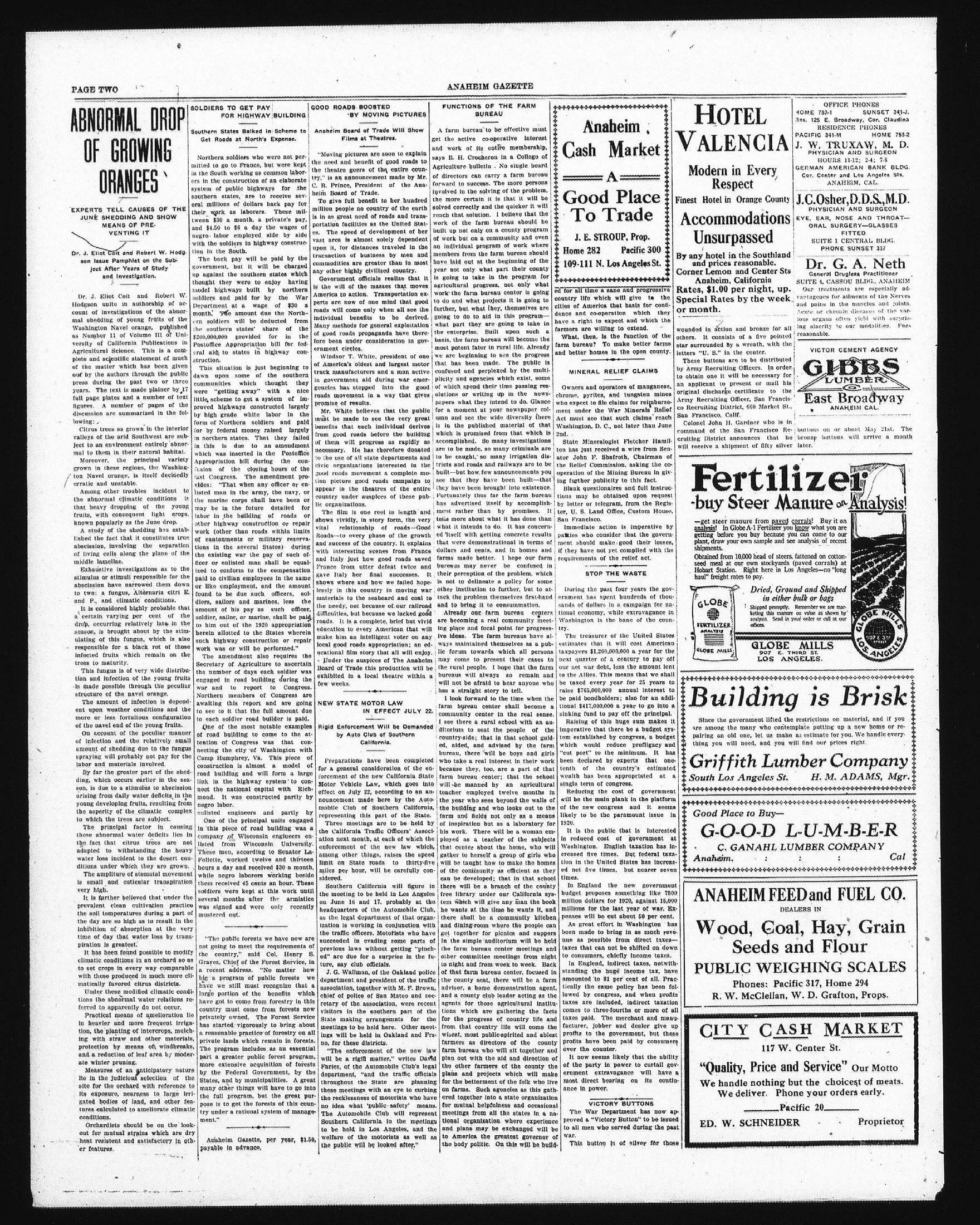
Searchable text
ABNORMAL DROP OF GROWING ORANGES
EXPERTS TELL CAUSES OF THE JUNE SHEDDING AND SHOW MEANS OF PREVENTING IT
Dr. J. Eliot Coit and Robert W. Hodgson issue Pamphlet on the Subject After Years of Study and Investigation.
Dr. J. Eliot Coit and Robert W. Hodgson unite in authorship of account of investigations of the abnormal shedding of young fruits of the Washington Navel orange, published as Number 11 of Volume III of University of California Publications in Agricultural Science. This is a complete and scientific statement of much of the matter which has been given out by the authors through the public press during the past two or three years. The text is made plainer by 17 full page plates and a number of text figures. A number of pages of the discussion are summarized in the following:
Citrus trees as grown in the interior valleys of the arid Southwest are subject to an environment entirely abnormal to them in their natural habitat.
SOLDIERS TO GET PAY FOR HIGHWAY BUILDING
Southern States Balked in Scheme to Get Roads at North's Expense.
Northern soldiers who were not permitted to go to France, but were kept in the South working as common laborers in the construction of an elaborate system of public highways for the southern states, are to receive several millions of dollars back pay for their work as laborers. These mil-tween $30 a month, a private's pay, and $4.50 to $6 a day the wages of negro-labor employed side by side with the soldiers in highway construction in the South.
The back pay will be paid by the government, but it will be charged up against the southern states which thought they were to enjoy having model highways built by northern soldiers and paid for by the War Department at a wage of $30 a month. The amount due the Northern soldiers will be deducted from the southern states' share of the $200,000,000 provided for in the Postoffice Appropriation bill for federal aid to states in highway construction.
This situation is just beginning to dawn upon some of the southern communities which thought they were "getting away" with a nice little scheme to get a system of improved highways constructed largely by high grade white labor in the form of Northern soldiers and paid for by federal money raised largely in northern states. That they failed in this is due to an amendment which was inserted in the Postoffice
GOOD ROADS BOY BY MANAHEIM BOARD OF FILMS AT
"Moving pictures: the need and benefit the theatre goes to try." is an announcement C. R. Prince, Presseheim Board of Trust To give full benefit million people no is in as great need portation facilities es. The speed of vast area is almost upon it, for distant transaction of bus commodities are any other highly o Government office is the will of the America to action perts are now of roads will come o individual benefi Many methods for good roads pre-fore been under gernment circles.
Windsor T. Whof America's older truck manufactur ing in government agencies has steep roads movement promise of result Mr. White bell must be made to benefits that each from good roads of them will pro necessary. He h
Citrus trees as grown in the interior valleys of the arid Southwest are subject to an environment entirely abnormal to them in their natural habitat.
Moreover, the principal variety grown in these regions, the Washington Navel orange, is itself decidedly erratic and unstable.
Among other troubles incident to the abnormal climatic conditions is that heavy dropping of the young fruits, with consequent light crops, known popularly as the June drop.
A study of the shedding has established the fact that it constitutes true abscission, involving the separation of living cells along the plane of the middle lamellae.
Exhaustive investigations as to the stimulus or stimuli responsible for the abscission have narrowed them down to two: a fungus, Alternaria citri E. and P., and climatic conditions.
It is considered highly probable that a certain varying per cent of the drop, occurring relatively late in the season, is brought about by the stimulating of this fungus, which is also responsible for a black rot of those infected fruits which remain on the trees to maturity.
This fungus is of very wide distribution and infection of the young fruits is made possible through the peculiar structure of the navel orange.
The amount of infection is dependent upon weather conditions and the more or less fortuitous configuration of the navel end of the young fruits.
On account of the peculiar manner of infection and the relatively small amount of shedding due to the fungus spraying will probably not pay for the labor and materials involved.
By far the greater part of the shedding, which occurs earlier in the season, is due to a stimulus to abscission arising from daily water deficits in the young developing fruits, resulting from the asperity of the climatic complex to which the trees are subject.
The principal factor in causing these abnormal water deficits lies in the fact that citrus trees are not adapted to withstanding the heavy water loss incident to the desert conditions under which they are grown.
This situation is just beginning to dawn upon some of the southern communities which thought they were "getting away" with a nice little scheme to get a system of improved highways constructed largely by high grade white labor in the form of Northern soldiers and paid for by federal money raised largely in northern states. That they failed in this is due to an amendment which was inserted in the Postoffice Appropriation bill during the conclusion of the closing hours of the last Congress. The amendment provides: "That when any officer or enlisted man in the army, or the marine corps shall have been or may be in the future detailed for labor in the building of roads or other highway construction or repair work (other than roads within limits of cantonments or military reservations in the several States) during the existing war the pay of such officer or enlisted man shall be equalized to conform to the compensation paid to civilian employees in the same or like employment, and the amount found to be due such officers, soldiers, sailors and marines, less the amount of his pay as such officer, soldier, sailor, or marine, shall be paid to him out of the 1920 appropriation herein allotted to the States wherein such highway construction or repair work was or will be performed."
The amendment also requires the Secretary of Agriculture to ascertain the number of days each soldier was engaged in road building during the war and to report to Congress. Northern members of Congress are awaiting this report and are going to see to it that the full amount due to each soldier road builder is paid.
One of the most notable examples of road building to come to the attention of Congress was that connecting the city of Washington with Camp Humphrey, Va. This piece of construction is almost a model of road building and will form a large link in the highway system to connect the national capital with Richmond. It was constructed partly by negro labor.
Enlisted engineers and partly by one of the principal units engaged in this piece of road building was a company of Wisconsin engineers enlisted from Wisconsin University. These men, according to Senator La-Follette, worked twelve and thirteen of America's older truck manufacturers in government agencies has stepped roads movement promise of results.
Mr. White belts must be made to benefits that each from good roads of them will provide necessary. He has to use all civil organization good roads movement picture good appear in the country under aid lie organizations.
The film is only shows vividly, its vital relationship Roads—to every and success of them with interesting and Italy just his France from utter gave Italy her shows where and lessly in this co-materials to them needy, not be difficulties, but be roads. It is a co-education to ever make him an in local good roads educational film story Under the ausse Board of Trade exhibited in a few weeks.
NEW STATE MEMBER
Rigid Enforcement by Auto Clerk
Preparations for a general enforcement of the Motor Vehicle effect on July 24 nouncement made mobile Club of representing three meeting California station next month enforcement of among other limit on State
By far the greater part of the shedding, which occurs earlier in the season, is due to a stimulus to abscission arising from daily water deficits in the young developing fruits, resulting from the asperity of the climatic complex to which the trees are subject.
The principal factor in causing these abnormal water deficits lies in the fact that citrus trees are not adapted to withstanding the heavy water loss incident to the desert conditions under which they are grown.
The amplitude of stomatal movement is small and cuticular transpiration very high.
It is further believed that under the prevalent clean cultivation practice the soil temperatures during a part of the day are so high as to result in the inhibition of absorption at the very time of day that water loss by transpiration is greatest.
It has been found possible to modify climatic conditions in an orchard so as to set crops in every way comparable with those produced in much more climatically favored citrus districts.
Under these modified climatic conditions the abnormal water relations referred to apparently do not occur.
Practical means of amelioration lie in heavier and more frequent irrigation, the planting of intercrops, mulching with straw and other materials, protection by means of windbreaks, and a reduction of leaf area by moderate winter pruning.
Measures of an anticipatory nature lie in the judicious selection of the site for the orchard with reference to its exposure, nearness to large irrigated bodies of land, and other features calculated to ameliorate climatic conditions.
Orchardists should be on the lookout for mutual strains which are dry heat resistant and satisfactory in other features.
"The public forests we have now are not going to meet the requirements of the country," said Col. Henry S. Graves, Chief of the Forest Service, in a recent address. "No matter how big a program of public forests we have we still must recognize that a large portion of the benefits which have got to come from forestry in this country must come from forests now privately owned. The Forest Service has started vigorously to bring about a reasonable practice of forestry on all private lands which remain in forests. The program includes as an essential part a greater public forest program, more extensive acquisition of forests by the Federal Government, by the States, and by municipalities. A great many other things will have to go into the full program, but the great purpose is to get the forests of this country under a rational system of management."
Anaheim Gazette, per year, $1.50, payable in advance.
GOOD ROADS BOOSTED BY MOVING PICTURES
Anaheim Board of Trade Will Show Films at Theatres.
"Moving pictures are soon to explain the need and benefit of good roads to the theatre goers of the entire country," is an announcement made by Mr. C. R. Prince, President of the Anaheim Board of Trade.
To give full benefit to her hundred million people no country of the earth is in as great need of roads and transportation facilities as the United States. The speed of development of her vast area is almost solely dependent upon it, for distances traveled in the transaction of business by men and commodities are greater than in most any other highly civilized country.
Government officials realize that it is the will of the masses that moves America to action. Transportation experts are now of one mind that good roads will come only when all see the individual benefits to be derived. Many methods for general exploitation of good roads propaganda have therefore been under consideration in government circles.
Windsor T. White, president of one of America's oldest and largest motor truck manufacturers and a man active in government aid during war emergencies has stepped into the good roads movement in a way that gives promise of results.
Mr. White believes that the public must be made to see the very great benefits that each individual derives from good roads before the building of them will progress as rapidly as necessary. He has therefore donated to the use of all state departments and
FUNCTIONS OF THE FARM BUREAU
A farm bureau to be effective must get the active co-operative interest and work of its entire membership, says B. H. Crocheron in a College of Agriculture bulletin. No single board of directors can carry a farm bureau forward to success. The more persons involved in the solving of the problem, the more certain it is that it will be solved correctly and the quicker it will reach that solution. I believe that the work of the farm bureau should be built up not only on a county program of work but on a community and even an individual program of work where members from the farm bureau should have laid out at the beginning of the year not only what part their county is going to take in the program for agricultural progress, not only what work the farm bureau center is going to do and what projects it is going to further, but what they, themselves are going to do to aid in this program—what part they are going to take in the enterprise. Built upon such a basis, the farm bureau will become the most potent fator in rural life. Already we are beginning to see the progress that has been made. The public is confused and perplexed by the multiplicity and agencies which exist, some of which spend their time passing resolutions or writing up in the newspapers what they intend to do. Glance for a moment at your newspaper column and see the wide diversity there is in the published material of that which is promised from that which is accomplished. So many investigations are to be made, so many criminals are to be caught, so many irrigation discharges for all time a sane and progressive country life which will give to the cities of America that basis for confidence and co-operation which they have a right to expect and which the farmers are willing to extend.
What, then, is the function of the farm bureau? To make better farms and better homes in the open county.
MINERAL RELIEF CLAIMS
Owners and operators of manganese, chrome, pyrites, and tungsten mines who expect to file claims for reimbursement under the War Minerals Relief Act must see that such claims reach Washington, D. C., not later than June 2nd.
State Mineralogist Fletcher Hamilton has just received a wire from Senator John E. Shafroth Chairman of
of America's oldest and largest motor truck manufacturers and a man active in government aid during war emergencies has stepped into the good roads movement in a way that gives promise of results.
Mr. White believes that the public must be made to see the very great benefits that each individual derives from good roads before the building of them will progress as rapidly as necessary. He has therefore donated to the use of all state departments and civic organizations interested in the good roads movement a complete motion picture good roads campaign to appear in the theatres of the entire country under auspices of these public organizations.
The film is one reel in length and shows vividly, in story form, the very vital relationship of roads—Good Roads—to every phase of the growth and success of the country. It explains with interesting scenes from France and Italy just how good roads saved France from utter defeat twice and gave Italy her final successes. It shows where and how we failed hopefully in this country in moving war materials to the seaboard and coal to the needy, not because of our railroad difficulties, but because we lacked good roads. It is a complete, brief but vivid education to every American that will make him an intelligent voter on any local good roads appropriation; an educational film story that all will enjoy. Under the auspices of The Anaheim Board of Trade this production will be exhibited in a local theatre within a few weeks.
NEW STATE MOTOR LAW
IN EFFECT JULY 22.
Rigid Enforcement Will be Demanded by Auto Club of Southern California.
Preparations have been completed for a general consideration of the enforcement of the new California State Motor Vehicle Law, which goes into effect on July 22, according to an announcement made here by the Automobile Club of Southern California, representing this part of the State.
Three meetings are to be held by the California Traffic Officers' Association next month, at each of which the enforcement of the new law which, among other things, raises the speed limit on State roads to thirty-five miles of America's oldest and largest motor truck manufacturers and a man active in government aid during war emergencies has stepped into the good roads movement in a way that gives promise of results.
Mr. White believes that the public must be made to see the very great benefits that each individual derives from good roads before the building of them will progress as rapidly as necessary. He has therefore donated to the use of all state departments and civic organizations interested in the good roads movement a complete motion picture good roads campaign to appear in the theatres of the entire country under auspices of these public organizations.
The film is one reel in length and shows vividly, in story form, the very vital relationship of roads—Good Roads—to every phase of the growth and success of the country. It explains with interesting scenes from France and Italy just how good roads saved France from utter defeat twice and gave Italy her final successes. It shows where and how we failed hopefully in this country in moving war materials to the seaboard and coal to the needy, not because of our railroad difficulties, but because we lacked good roads. It is a complete, brief but vivid education to every American that will make him an intelligent voter on any local good roads appropriation; an educational film story that all will enjoy. Under the auspices of The Anaheim Board of Trade this production will be exhibited in a local theatre within a few weeks.
I look forward to the time when the farm bureau center shall become a community center in the real sense. I see there a rural school with an auditorium to seat the people of the country-side; that in that school guided, aided, and advised by the farm bureau, there will be boys and girls who take a real interest in their work because they, too, are a part of that farm bureau center; that the school will be manned by an agricultural teacher employed twelve months in the year who sees beyond the walls of the building and who looks out to the farm and fields not only as a means of inspiration but as a laboratory for his work. There will be a woman employed as a teacher of the subjects that center about the home, who will gather to herself a group of girls who will be taught how to make the homes that has been made. The public is confused and perplexed by the multiplicity and agencies which exist, some of which spend their time passing resolutions or writing up in the newspapers what they intend to do. Glance for a moment at your newspaper column and see the wide diversity there is in the published material of that which is promised from that which is accomplished. So many investigations are to be made, so many criminals are to be caught, so many irrigation districts and roads and railways are to be built—but how few announcements you see that they have been built—that they have been brought into existence. Fortunately thus far the farm bureau has advertised itself by accomplishment rather than by promises. It tells more about what it has done than what it intends to do. It has concerned itself with getting concrete results that were demonstrational in terms of dollars and cents, and in homes and farms made better. I hope our farm bureaus may never be confused in their perception of the problem, which is not to delineate a policy for some other institution to further, but to attack the problem themselves first-hand and to bring it to consummation.
Already our farm bureau centers are becoming a real community meeting place and focal point for progressive ideas. The farm bureaus have always maintained themselves as a public forum towards which all persons may come to present their cases to the rural people. I hope that the farm bureaus will always so remain and will not be afraid to hear anyone who has a straight story to tell.
During the past four years the government has spent hundreds of thousands of dollars in a campaign for national economy, while extravagance in Washington is the bane of the country.
The treasurer of the United States estimates that it will cost American taxpayers $1,200,000,000 a year for the next quarter of a century to pay off our net war debt, less the amount lent to the Allies. This means that we shall be taxed every year for 25 years to raise $765,000,000 annual interest to be paid bondholders; also for an additional $417,000,000 a year to go into a sinking fund to pay off the principal.
Raising of this huge sum makes it imperative that there be a budget system established by congress, a budget which would reduce profligacy and "cut port" to the minimum. It has been declared by experts that one-tenth of the country's estimated wealth has been appropriated at a single term of congress.
Reducing the cost of government will be the main plank in the platform of the new congress and it seems likely to be the paramount issue in 1920.
It is the public that is interested in reduced cost of government at Washington. English taxation has increased five times. But federal taxation in the United States has increas-
for a general consideration of the enforcement of the new California State Motor Vehicle Law, which goes into effect on July 22, according to an announcement made here by the Automobile Club of Southern California, representing this part of the State.
Three meetings are to be held by the California Traffic Officers' Association next month, at each of which the enforcement of the new law which, among other things, raises the speed limit on State roads to thirty-five miles per hour, will be carefully considered.
Southern California will figure in the meeting to be held in Los Angeles on June 16 and 17, probably at the headquarters of the Automobile Club, as the legal department of that organization is working in conjunction with the traffic officers. Motorists who have succeeded in evading some parts of previous laws without getting "pinched" are due for a surprise in the future, say club officials.
J. G. Wallman, of the Oakland police department and president of the traffic association, together with M. F. Brown, chief of police of San Mateo and secretary of the association, were recent visitors in the southern part of the State making arrangements for the meetings to be held here. Other meetings will be held in Oakland and Frisco, for these districts.
"The enforcement of the new law will be a rigid matter," writes David Faries, of the Automobile Club's legal department, "and the traffic officials throughout the State are planning these meetings with an eye to curbing the recklessness of motorists who have no idea what 'public-safety' means. The Automobile Club will represent Southern California in the meetings to be held in Los Angeles, and the welfare of the motorists as well as the public will be looked after."
HOTEL VALENCIA
Modern in Every Respect
Finest Hotel in Orange County
Accommodations Unsurpassed
By any hotel in the Southland and prices reasonable.
Corner Lemon and Center Sts Anaheim, California
Rates, $1.00 per night, up. Special Rates by the week or month.
wounded in action and bronze for all others. It consists of a five pointed star surrounded by a wreath, with the letters "U. S." in the center.
These buttons are to be distributed by Army Recruiting Officers. In order to obtain one it will be necessary for an applicant to present or mail his original discharge certificate to the Army Recruiting Officer, San Francisco Recruiting District, 660 Market St., San Francisco, Calif.
Colonel John H. Gardner who is in command of the San Francisco Recruiting District announces that he will receive a shipment of fifty silver buttons on or about May 21st. The bronze buttons will arrive a month later.
Fertilizer
-buy Steer Manure on Analysis!
-get steer manure from paved corrals! Buy it on analysis! In Globe A-1 Fertilizer you know what you are getting before you buy because you can come to our plant, draw your own sample and see analysis of recent shipments.
Obtained from 10,000 head of steers, fattened on cotton-seed meal at our own stockyards (paved corrals) at Hobart Station. Right here in Los Angeles—no "long haul" freight rates to pay.
Dried, Ground and Shipped
in either bulk or bags
Shipped promptly. Remember we are marketing this manure on value as shown by analysis. Send in your order or call at our offices.
GLOBE MILLS
907 E. THIRD ST.
LOS ANGELES.
Building is Brisk
Since the government lifted the restrictions on material, and if you are among the many who contemplate putting up a new home or repairing an old one, let us make an estimate for you. We handle everything you will need, and you will find our prices right.
Griffith Lumber Company
South Los Angeles St. H. M. ADAMS, Mgr.
Good Place to Buy—
G-O-O-D L-U-M-B-E-R
C. GANAHL LUMBER COMPANY
Anaheim. Cal
South Los Angeles St. H. M. ADAMS, Mgr.
Good Place to Buy—
G-O-O-D L-U-M-B-E-R
C. GANAHL LUMBER COMPANY
Anaheim, Cal
ANAHEIM FEED and FUEL CO.
DEALERS IN
Wood, Goal, Hay, Grain
Seeds and Flour
PUBLIC WEIGHING SCALES
Phones: Pacific 317, Home 294
R. W. McClellan, W. D. Grafton, Props.
CITY CASH MARKET
117 W. Center St.
"Quality, Price and Service"
Our Motto
We handle nothing but the choice of meats.
We deliver. Phone your orders early.
Pacific 20
ED. W. SCHNEIDER Proprietor