anaheim-gazette 1919-05-08
Scanned page
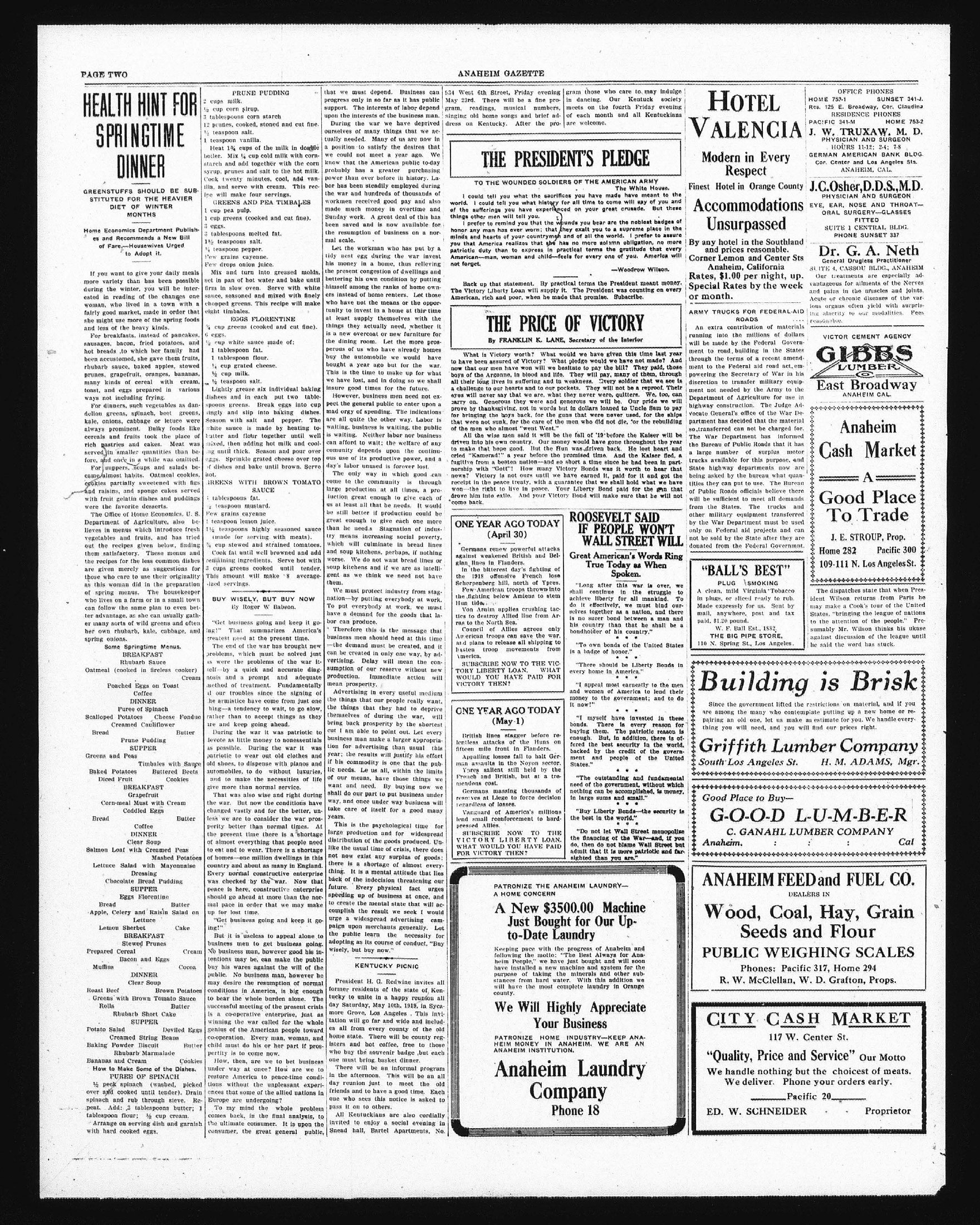
Searchable text
HEALTH HINT FOR SPRINGTIME DINNER
GREENSTUFFS SHOULD BE SUBSTITUTED FOR THE HEAVIER DIET OF WINTER MONTHS
Home Economics Department Publishers and Recommends a New Bill of Fare—Housewives Urged to Adopt it.
If you want to give your daily meals more variety than has been possible during the winter, you will be interested in reading of the changes one woman, who lived in a town with a fairly good market, made in order that she might use more of the spring foods and less of the heavy kinds.
For breakfasts, instead of pancakes, sausages, bacon, fried potatoes, and hot breads to which her family had been accustomed, she gave them fruits, rhubarb sauce, baked apples, stewed prunes, grapefruit, oranges, bananas, many kinds of cereal with cream, toast, and eggs prepared in various ways not including frying.
For dinners, such vegetables as dandelion greens, spinach, beet greens, kale, onions, cabbage or lettuce were always prominent. Bulky foods like cereals and fruits took the place of rich pastries and cakes. Meat was served in smaller quantities than be-
PRUNE PUDDING
2 cups milk.
½ cup corn syrup.
3 tablespoons corn starch
12 prunes, cooked, stoned and cut fine.
¼ teaspoon salt.
1 teaspoon vanilla.
Heat 1¾ cups of the milk in double boiler. Mix ¼ cup cold milk with cornstarch and add together with the corn syrup. Prunes and salt to the hot milk. Cook twenty minutes, cool, add vanilla, and serve with cream. This recipe will make four servings.
GREENS AND PEA TIMBALES
1 cup pea pulp.
1 cup greens (cooked and cut fine).
3 eggs.
3 tablespoons melted fat.
1½ teaspoons salt.
¼ teaspoon pepper.
Few grains cayenne.
Few drops onion juice.
Mix and turn into greased molds, set in pan of hot water and bake until firm in slow oven. Serve with white sauce, seasoned and mixed with finely chopped greens. This recipe will make eight timbales.
EGGS FLORENTINE
¼ cup greens (cooked and cut fine).
6 eggs.
½ cup white sauce made of:
1 tablespoon fat.
1 tablespoon flour.
¼ cup grated cheese.
½ cup milk.
½ teaspoon salt.
Lightly grease six individual baking dishees and in each put two tablespoons greens. Break eggs into cup singly and slip into baking dishes. Season with salt and pepper. The white sauce is made by heating butter and flour together until well mixed, then adding hot milk and cooling until thick. Season and pour over that we must progress only support. The upon the interest.
During the ourselves of naturally needed. a position to we could not know that the probably has power than ever bor has been at the war and his workmen received much Sunday work. been saved at the resumption mal scale.
Let the work tidy nest egg his money in the present co bettering his himself among ers instead of who have not tunity to invest at least supply things they are a new overview the dining room perous of us buy the auto bought a year. This is the time we have lost, insure good t
However, bepect the gener al mad orgy of s are all quite waiting. business is waiting. N can afford to community de
For dinners, such vegetables as dandelion greens, spinach, beet greens, kale, onions, cabbage or lettuce were always prominent. Bulky foods like cereals and fruits took the place of rich pastries and cakes. Meat was served in smaller quantities than before, and once in a while was omitted.
For suppers, soups and salads became almost habits. Oatmeal cookies, cookies partially sweetened with figs and raisins, and sponge cakes served with fruit gelatin dishes and puddings were the favorite desserts.
The Office of Home Economics, U.S. Department of Agriculture, also believes in menus which introduce fresh vegetables and fruits, and has tried out the recipes given below, finding them satisfactory. These menus and the recipes for the less common dishes are given merely as suggestions for those who care to use their originality as this woman did in the preparation of spring menus. The housekeeper who lives on a farm or in a small town can follow the same plan to even better advantage, as she can usually gather many sorts of wild greens and often her own rhubarb, kale, cabbage, and spring onions.
Some Springtime Menus.
BREAKFAST
Rhubarb Sauce
Oatmeal (cooked in fireless cooker)
Cream
Poached Eggs on Toast
Coffee
DINNER
Puree of Spinach
Scalloped Potatoes Cheese Fondue
Creamed Cauliflower
Bread Butter
Prune Pudding
SUPPER
Greens and Peas
Timbales with Sauce
Baked Potatoes Buttered Beets
Diced Fruit Cookies
BREAKFAST
Grapefruit
Corn-meal Must with Cream
Coddled Eggs
Bread Butter
Coffee
DINNER
Clear Soup
Salmon Loaf with Creamed Peas
Mashed Potatoes
1/4 cup grated cheese.
1/2 cup milk.
1/2 teaspoon salt.
Lightly grease six individual baking dishees and in each put two tablespoons greens. Break eggs into cups singly and slip into baking dishes. Season with salt and pepper. The white sauce is made by heating butter and flour together until well mixed, then adding hot milk and cooling until thick. Season and pour over eggs. Sprinkle grated cheese over top of dishes and bake until brown. Serve hot.
GREENS WITH BROWN TOMATO SAUCE
1 tablespoons fat.
1 teaspoon mustard.
Few grains cayenne
1 teaspoon lemon juice.
1/2 teaspoons highly seasoned sauce (made for serving with meats).
3/4 cup stewed and strained tomatoes.
Cook fat until well browned and add remaining ingredients. Serve hot with 3 cups greens cooked until tender. This amount will make 8 average-sized servings.
BUY WISELY, BUT BUY NOW
By Roger W Babson.
"Get business going and keep it going!" That summarizes America's greatest need at the present time.
The end of the war has brought new problems, which must be solved just as were the problems of the war itself—by a quick and accurate diagnosis and a prompt and adequate method of treatment. Fundamentally all our troubles since the signing of the armistice have come from just one thing—a tendency to wait, to go slow, rather than to accept things as they are and keep going ahead.
During the war it was patriotic to devote as little money to nonessentials as possible. During the war it was patriotic to wear out old clothes and old shoes, to dispense with pianos and automobiles, to do without luxuries, and to make the necessities of life give more than normal service.
That was also wise and right during the war. But now the conditions have changed vastly and for the better, unless we are to consider the war prosperity better than normal times. At the present time there is a shortage of almost everything that people need to eat and to wear. There is a shortage of homes—one million dwellings in this country—and about as many in England bought a year.
However, because the general mad orgy of satiety are all quite waiting, business is waiting. We can afford to community dependent use of its day's labor unpaid.
We must p nation—by pu To put every have a demand bor can produce Therefore business meme—the demand can be created vertising. D sumption of production mean prosperity.
Advertising the things that the things that themselves o bring back pu cut I am able business managemen for adv ear; the res est if his commo lic needs. Le of our means want and na shall do our pu way, and once take care of years.
This is the large produc t distribution o like the usual not now exist there is a
Baked Potatoes Buttered Beets
Diced Fruit Cookies
BREAKFAST
Grapefruit
Corn-meal Must with Cream
Coddled Eggs
Bread Butter
Coffee
DINNER
Clear Soup
Salmon Loaf with Creamed Peas
Mashed Potatoes
Lettuce Salad with Mayonnaise
Dressing
Chocolate Bread Pudding
SUPPER
Eggs Florentine
Bread Butter
Apple, Celery and Raisin Salad on Lettuce
Lemon Sherbet Cake
BREAKFAST
Stewed Prunes
Prepared Cereal Cream
Bacon and Eggs
Muffins Cocoa
DINNER
Clear Soup
Roast Beef Brown Potatoes
Greens with Brown Tomato Sauce
Rolls Butter
Rhubarb Short Cake
SUPPER
Potato Salad Deviled Eggs
Creamed String Beans
Baking Powder Biscuit Butter
Rhubarb Marmalade
Bananas and Cream Cookies
How to Make Some of the Dishes.
PUREE OF SPINACH
½ peck spinach (washed, picked over and cooked until tender). Drain spinach and rub through sieve. Repeat. Add: 3 tablespoons butter; 1 tablespoon flour; ½ cup cream.
Arrange on serving dish and garnish with hard cooked eggs.
That was also wise and right during the war. But now the conditions have changed vastly and for the better, unless we are to consider the war prosperity better than normal times. At the present time there is a shortage of almost everything that people need to eat and to wear. There is a shortage of homes—one million dwellings in this country and about as many in England. Every normal constructive enterprise was checked by the war. Now that peace is here, constructive enterprise should go ahead at more than the normal pace in order that we may make up for lost time.
"Get business going and keep it going!"
But it is useless to appeal alone to business men to get business going. No business man, however good his intentions may be, can make the public buy his wares against the will of the public. No business man, however he may desire the resumption of normal conditions in America, is big enough to bear the whole burden alone. The successful meeting of the present crisis is a co-operative enterprise, just as winning the war called for the whole genius of the American people toward co-operation. Every man, woman, and child must do his or her part if prosperity is to come now.
How, then, are we to bet business under way at once? How are we to restore America to peace-time conditions without the unpleasant experiences that some of the allied nations in Europe are undergoing?
To my mind the whole problem comes back, in the final analysis, to the ultimate consumer. It is upon the consumer, the great general public,
President of former resident tucky to unite day Saturday more Grove, tation will give es all from home state. isters and who buy them one must br
There will in the afternoon day reunion friends and one who see pass it on to All Kentu invited to e Snead hall,
ANAHEIM GAZETTE
that we must depend. Business can progress only in so far as it has public support. The interests of labor depend upon the interests of the business man.
During the war we have deprived ourselves of many things that we actually needed. Many of us are now in a position to satisfy the desires that we could not meet a year ago. We know that the American public to-day probably has a greater purchasing power than ever before in history. Labor has been steadily employed during the war and hundreds of thousands of workmen received good pay and also made much money in overtime and Sunday work. A great deal of this has been saved and is now available for the resumption of business on a normal scale.
Let the workman who has put by a tidy nest egg during the war invest his money in a home, thus relieving the present congestion of dwellings and bettering his own condition by putting himself among the ranks of home owners instead of home renters. Let those who have not the means or the opportunity to invest in a home at this time at least supply themselves with the things they actually need, whether it is a new overcoat or new furniture for the dining room. Let the more prosperous of us who have already homes buy the automobile we would have bought a year ago but for the war. This is the time to make up for what we have lost, and in doing so we shall insure good times for the future.
However, business men need not expect the general public to enter upon a mad orgy of spending. The indications are all quite the other way. Labor is waiting, business is waiting, the public is waiting. Neither labor nor business can afford to wait; the welfare of any community depends upon the continuity.
934 West 6th Street, Friday evening May 23rd. There will be a fine program, readings, musical numbers, singing old home songs and brief address on Kentucky. After the program those who care to may indulge in dancing. Our Kentuck society meets on the fourth Friday evening of each month and all Kentuckians are welcome.
THE PRESIDENT'S PLEDGE
TO THE WOUNDED SOLDIERS OF THE AMERICAN ARMY
The White House.
I could tell you what the sacrifices you have made have meant to the world. I could tell you what history for all time to come will say of you and of the sufferings you have experienced on your great crusade. But these things other men will tell you.
I prefer to remind you that the wounds you bear are the noblest badges of honor any man has ever worn; that they exalt you to a supreme place in the minds and hearts of your countrymen and of all the world. I prefer to assure you that America realizes that she has no more solitary obligation, no more patriotic duty than to express in practical terms the gratitude that every American—man, woman and child—feels for every one of you. America will not forget.
—Woodrow Wilson.
Back up that statement. By practical terms the President meant money. The Victory Liberty Loan will supply it. The President was counting on every American, rich and poor, when he made that promise. Subscribe.
THE PRICE OF VICTORY
By FRANKLIN K. LANE, Secretary of the Interior
What is Victory worth? What would we have given this time last year to have been assured of Victory? What pledge would we have not made? And now that our men have won will we hesitate to pay the bill? They paid, those boys of the Argonne, in blood and life. They will pay, many of them, through all their long lives in suffering and in weakness. Every soldier that we see is a champion to our hearts and to our pockets. They will not be a reproof. Their eyes will never say that we are, what they never were, quitters. We, too, can carry on. Generous they were and generous we will be. Our pride we will prove by thanksgiving, not in words but in dollars loaned to Uncle Sam to pay for bringing the boys back, for the guns that were never used, for the ships that were not sunk, for the care of the men who did not die, for the rebuilding of the men who almost "went West."
All the wise men said it will be the fall of '19 before the Kaiser will be driven into his own country. Our money would have gone throughout the year to make that hope good. But the Hun was driven back. He lost heart and cried "Kamerad!" a year before the promised time. And the Kaiser fled, a
dual baking two tables into cup dishes. Upper. The heating to until well and cooll pour over ease over top down. Serve
TOMATO
bought a year ago but for the war. This is the time to make up for what we have lost, and in doing so we shall insure good times for the future.
However, business men need not expect the general public to enter upon a mad orgy of spending. The indications are all quite the other way. Labor is waiting, business is waiting, the public is waiting. Neither labor nor business can afford to wait; the welfare of any community depends upon the continuous use of its productive power, and a day's labor unused is forever lost.
The only way in which good can come to the community is through large production at all times, a production great enough to give each of us at least all that he needs. It would be still better if production could be great enough to give each one more than he needs. Stagnation of industry means increasing social poverty, which will culminate in bread lines and soup kitchens, perhaps, if nothing worse. We do not want bread lines or soup kitchens and if we are as intelligent as we think we need not have them.
We must protect industry from stagnation—by putting everybody at work. To put everybody at work, we must have a demand for the goods that labor can produce.
Therefore this is the message that business men should heed at this time—the demand must be created, and it can be created in only one way, by advertising. Delay will mean the consumption of our reserve without new production. Immediate action will mean prosperity.
Advertising in every useful medium the things that our people really want, the things that they had to deprive themselves of during the war, will bring back prosperity by the shortest cut I am able to point out. Let every business man make a larger appropriation for advertising than usual this year; the results will justify his effort if his commodity is one that the public needs. Le us all, within the limits of our means, have those things we want and need. By buying now we shall do our part to put business under way, and once under way business will take care of itself for a good many years.
This is the psychological time for large production and for widespread distribution of the goods produced. Unlike the usual time of crisis, there does not now exist any surplus of goods; there is a shortage of almost every
ONE YEAR AGO TODAY (April 30)
Germans renew powerful attacks against weakened British and Belgian lines in Flanders.
In the bitterest day's fighting of the 1918 offensive French lose Scherpenberg hill, north of Ypres.
Few American troops thrown into the fighting below Amiens to stem Hun tide.
Von Arulm applies crushing tactics to destroy Allied line from Arras to the North Sea.
Council of Allies agrees only American troops can save the war, and plans to release all shipping to hasten troop movements from America.
SUBSCRIBE NOW TO THE VICTORY LIBERTY LOAN. WHAT WOULD YOU HAVE PAID FOR VICTORY THEN?
ROOSEVELT SAID IF PEOPLE WON'T WALL STREET WILL
Great American's Words Ring True Today as When Spoken.
"Long after this war is over, we shall continue in the struggle to achieve liberty for all mankind. To do it effectively, we must blind ourselves together as a nation, and there is no surer bond between a man and his country than that he shall be a bondholder of his country."
"To own bonds of the United States is a badge of honor."
"There should be Liberty Bonds in every home in America."
"I appeal most earnestly to the men and women of America to lend their money to the government; and to do it now!"
"I myself have invested in these bonds. There is every reason for buying them. The patriotic reason is enough. But, in addition, there is offered the best security in the world, backed by the credit of the government and people of the United States."
"The outstanding and fundamental need of the government, without which nothing can be accomplished, is money, in large sums and small."
"Buy Liberty Bonds—the security is the best in the world."
"Do not let Wall Street monopolize the financing of the War—and, if you do, then do not blame Wall Street but admit that it is more patriotic and far-sighted than you are."
PATRONIZE THE ANAHEIM LAUNDRY—
A HOME CONCERN
A New $3500.00 Machine Just Bought for Our Up-to-Date Laundry
Keeping pace with the progress of Anaheim and following the motto: "The Best Always for Anaheim People," we have just bought and will soon have installed a new machine and system for the purpose of taking the minerals and other substances from hard water. With this addition we will have the most complete laundry in Orange county.
We Will Highly Appreciate Your Business
PATRONIZE HOME INDUSTRY—KEEP ANAHEIM MONEY IN ANAHEIM. WE ARE AN ANAHEIM INSTITUTION.
Anaheim Laundry Company
Phone 18
HOTEL VALENCIA
Modern in Every Respect
Finest Hotel in Orange County
Accommodations Unsurpassed
By any hotel in the Southland and prices reasonable.
Corner Lemon and Center Sts
Anaheim, California
Rates, $1.00 per night, up.
Special Rates by the week or month.
ARMY TRUCKS FOR FEDERAL-AID ROADS
An extra contribution of materials running into the millions of dollars will be made by the Federal Government to road building in the States through the terms of a recent amendment to the Federal aid road act, empowering the Secretary of War in his discretion to transfer military equipment not needed by the Army to the Department of Agriculture for use in highway construction. The Judge Advocate General's office of the War Department has decided that the material so transferred can not be charged for. The War Department has informed the Bureau of Public Roads that it has a large number of surplus motor
OFFICE PHONES
HOME 753-1 SUNSET 341-J.
Res. 125 E. Broadway, Cor. Claudina
RESIDENCE PHONES
PACIFIC 341-M HOME 753-2
J. W. TRUXAW, M. D.
PHYSICIAN AND SURGEON
HOURS 11-12; 2-4; 7-8
GERMAN AMERICAN BANK BLDG.
Cor. Center and Los Angeles Sts.
ANAHEIM, CAL.
J.C.Osher,D.D.S.,M.D.
PHYSICIAN AND SURGEON
EYE, EAR, NOSE AND THROAT—ORAL SURGERY—GLASSES FITTED
SUITE 1 CENTRAL BLDG.
PHONE SUNSET 337
Dr. G. A. Neth
General Drugless Practitioner
SUITE 4, CASSOU BLDG., ANAHEIM
Our treatments are especially advantageous for alliments of the Nerves and pains in the muscles and joints.
Acute or chronic diseases of the various organs often yield with surprising adherence to our modalities. Fees reasonable.
VICTOR CEMENT AGENCY
GIBBS LUMBER
East Broadway
ANAHEIM CAL.
Anaheim Cash Market
ELT SAID
PLE WON'T
STREET WILL
American's Words Ring
Today as When Spoken.
this war is over, we in the struggle to for all mankind. To try, we must blind our nation, and there and between a man and man that he shall be a his country."
ads of the United States honor."
and be Liberty Bonds in America."
est earnestly to the men America to lend their government; and to do have invested in these is every reason for The patriotic reason is in addition, there is of security in the world, credit of the govern-people of the United
ding and fundamental government, without which accomplished, is money, and small."
Bonds—the security is world."
Wall Street monopolize of the War—and, if you blame Wall Street but more patriotic and far you are."
"BALL'S BEST"
PLUG SMOKING
A clean, mild Virginia Tobacco in plugs, or sliced ready to rub. Made expressly for us. Sent by mail, anywhere, post and tax paid, $1.20 pound.
W. F. Ball Est., 1882,
THE BIG PIPE STORE,
110 N. Spring St., Los Angeles.
The dispatches state that when President Wilson returns from Paris he may make a Cook's tour of the United States, "bringing the league of nations to the attention of the people." Presumably Mr. Wilson thinks his ukase against discussion of the league until he said the word has stuck.
Building is Brisk
Since the government lifted the restrictions on material, and if you are among the many who contemplate putting up a new home or repairing an old one, let us make an estimate for you. We handle everything you will need, and you will find our prices right.
Griffith Lumber Company
South Los Angeles St. H. M. ADAMS, Mgr.
Good Place to Buy—
G-O-O-D L-U-M-B-E-R
C. GANAHL LUMBER COMPANY
Anaheim. : : Cal
Good Place to Buy—
G-O-O-D L-U-M-B-E-R
C. GANAHL LUMBER COMPANY
Anaheim. : : Cal
ANAHEIM FEED and FUEL CO.
DEALERS IN
Wood, Coal, Hay, Grain
Seeds and Flour
PUBLIC WEIGHING SCALES
Phones: Pacific 317, Home 294
R. W. McClellan, W. D. Grafton, Props.
CITY CASH MARKET
117 W. Center St.
"Quality, Price and Service"
Our Motto
We handle nothing but the choicest of meats.
We deliver. Phone your orders early.
Pacific 20
ED. W. SCHNEIDER Proprietor