anaheim-gazette 1919-05-01
Scanned page
Searchable text
Anaheim Gazette
ISSUED EVERY THURSDAY
ESTABLISHED 1870
Henry Kuchel, Editor and Proprietor
SUBSCRIPTION PER YEAR ... $1.50
SIX MONTHS ... $1.00
THREE MONTHS ... $ .50
Entered at the Anaheim Postoffice as second-class matter
WHAT PROCRASTINATION HAS DONE
It will never be known in terms of dollars and cents the price America has paid for the prolonged dickering by the peace conferees at Paris. But that the insistence of the President for his league of nations through a period of four long months has brought a tremendous burden upon our industries is clearly evident. The recent report of the National Association of Manufacturers presents facts, obtained from a canvass of 4,400 representative establishments throughout the United States that are startling. No political taint whatever can attach to that report. The Association is merely interested in presenting conditions as they are found.
The industries questioned were divided into twenty-two principal groups, all but five of which reported business between 25 and 50 per cent of normal. Those making a more encouraging reports are manufacturers of luxuries, such as jewelry, musical instruments, automobiles and tobacco. The showing is admittedly pessimistic, and accentuates the failure of the last Democratic Congress to pass any sort of reconstruction legislation to facilitate the resumption of normal business from the American to the foreign producer in such a way as to at the same time stimulate domestic and foreign commerce.
Striking evidence of this is furnished by Senator Warren G. Harding, of Ohio. "Very recently," he said to your correspondent, "five thousand tons of English salt were delivered to an Atlantic port at $6.07 per ton. This seriously menaces the salt works in my State. The freight rates alone from Ohio to Atlantic Coast points, such as New York, Philadelphia, Baltimore and Boston, range from $5 to $7 per ton. The manufacturing cost in this country now averages about $7 per ton. Manifestly, if it costs $7 per ton to produce in Ohio and a minimum of $5 to deliver, we cannot hope to find sale for the American product at $12 when English salt is sold in this country at $6.07. The pity of the situation is that the foreign product does not reduce the cost to the American consumer, because the difference in price is immediately absorbed by the importer. Thus we have the maintained prices along with diminished American production and the inseparable diminution of American capacity to buy. Undoubtedly situations like this will be given the attention of the incoming Congress and find remedy in the new tariff bill.
"Very prominent manufactureres have written to me repeatedly that on the one hand the government is seeking to return American soldiers to their homes and find employment for them, and, on the other hand, is admitting foreign products which will displace American labor. Of course, these policies are utterly inconsistent. We cannot hope to have the higher American production unless we protect the American market for American interests. The time has arrived."
VICTORIA NOT IN SAY
"Capitalists, vestors may purchase Loan notes without that they will be to the issue Weeks, Victory eager for the T in calling attention peal the Victoryors strictly fro point. He concludes that it has, of course, disappointment vious Liberty issues have gone a discount of f market.
"While this loss to those who for investment, scribbers for Vid discount is pos present issue.
"A decline oi of only one pound would put thur of 5.03%. Even
The industries questioned were divided into twenty-two principal groups, all but five of which reported business between 25 and 50 per cent of normal. Those making a more encouraging reports are manufacturers of luxuries, such as jewelry, musical instruments, automobiles and tobacco. The showing is admittedly pessimistic, and accentuates the failure of the last Democratic Congress to pass any sort of reconstruction legislation to facilitate the resumption of normal business by firms engaged on war contracts. Not only are present conditions in the trades poor, but the future is far from bright. Many of the leading industries speak of their prospects as "from poor to fair," according to the report.
Eleven reasons are given by business men for the present stagnation. Delay in the signing of the peace treaty stands at the head ofthe list. That obstacle is named by thousands of industrial managers as the chief impediment to their speedy return to normal conditions. Among the other reasons ascribed are continued government operation of railroads and other utilities, sudden imposition of heavy war tax burdens, high prices of wheat due to government guarantee, unemployment and poor distribution of labor forces released from military and naval service, and delay in settlement by the Federal government of claims for payment under informal war contracts. Let the reader run over those items and see how directly they may be charged to the incapacity of a Democratic Congress to realize the vital needs of business.
The report of the National Association of Manufacturers emphasizes the fact that the condition of the iron and steel market is an unerring index to trade conditions as a whole. The replies received to the questionnaire speak of that industry as being in a "state of lethargy." Lack of buying on the part of the railroads is given as the reason. It might be added that agitation of government ownership of the rails, coupled with the refusal of Mr. Wilson to reconvene Congress to provide funds for their maintenance, is responsible for the "lethargy." 67 percent of the iron and steel manufacturers do not regard prospects for 1919 as bright.
An overwhelming percentage of those questioned were emphatically opposed to continued government ownership, 21 of the 22 principal industrial groups vigorously recording them.
"Very prominent manufactureres have written to me repeatedly that on the one hand the government is seeking to return American soldiers to their homes and find employment for them, and, on the other hand, is admitting foreign products which will displace American labor. Of course, these policies are utterly inconsistent. We cannot hope to have the higher American production unless we protect the American market for American interests. The time has arrived, in my opinion, to understand that it is possible for humanity to begin at home. The per capita annual governmental expenditures have increased from $6 to $84 in a short time, and it is becoming daily more important that protection be afforded through an adequate tariff for the benefit of the American producer and the American tax payers generally."
THE BOLSHEVIK STATE
A recent interview with Lenine, in Moscow, lets in the light on the character and morals of the bolshevik state.
The bolshevik chief declares the first aim of a political party must be to convince a majority that its program is right. He does not leave any doubt as to what he means by "convincing" them, for later in the course of the interview he asserts that second importance is the "conquest" of all political power and the "suppression of all resistance." He as frankly admits that the means to this end is a "dictatorship," which he explains means, in all languages, simply a "rule of terror." This rule of terror, he asserts, must be most pitiless in the face of any attempted resistance.
Lenine freely admits that hundreds of thousands of ruble notes are being issued by him daily with the deliberate intent of destroying the value, and so the use, of money as a medium of exchange. He declares that there is no place for money in the bolshevik state. He nevertheless employs it plentifully in his own behalf.
The bolshevik boss and dictator further declares that the bolshevik state cannot exist in a world of non-bolshevik states, hence they, too, must be infected with the virus of this sinister form of moral insanity which he calls "the social philosophy of Marx put into practice and worked out in actual government."
A most astounding thing is Lenine's
agitation of government ownership of the rails, coupled with the refusal of Mr. Wilson to reconvene Congress to provide funds for their maintenance, is responsible for the "lethargy." 67 percent of the iron and steel manufacturers do not regard prospects for 1919 as bright.
An overwhelming percentage of those questioned were emphatically opposed to continued government ownership, 21 of the 22 principal industrial groups vigorously recording themselves against it. Early return of the railroads to their private owners is advocated, and for other public utilities a "reasonable and limited form of government regulation" is suggested.
Since the signing of the armistice buying has been strictly limited to immediate needs. As a consequence stocks on hand are far below normal. Of course that situation is directly attributable to the procrastination at Paris, every day of delay there mean in a corresponding postponement of trade activity on this side of the water. It is a tremendous responsibility that Mr. Wilson has assumed in continuing such a state of affairs here while he urges his league over there, and one for which he will be held to a "strict accountability."
NEED OF HIGH TARIFF IS URGED BY HARDING
Gives Figures to Show That Producers Cannot Compete and Maintain Standards.
Further details are coming to the attention of members of the majority party in the House and Senate to impress upon them the necessity of Republican high protection which will shift much of the burden of taxation
The bolshevik boss and dictator further declares that the bolshevik state cannot exist in a world of non-bolshevik states, hence they, too, must be infected with the virus of this sinister form of moral insanity which he calls "the social philosophy of Marx put into practice and worked out in actual government."
A most astounding thing is Lenine's admission that for the transformation of what he terms the "capitalist" state into the "communistic" state he has been compelled to call into his service scientific and technical experts, every one of whom are of the bourgeois, at large salaries, contrary, of course, to the bolshevik profession of principles or lack of principles.
To sum up, the bolshevik state confessedly consists of a bloody and despotic dictatorship, supported by a rule of terror and drawing on bourgeois intelligence for the modicum of sanity it is forced to employ to avoid stewing to death in its own cruelty, infamy and incompetency. At least that is Lenine's own exposition of it, reduced to comprehensible terms.
Lloyd George complains that while the peace conference has been on, intruders have been hanging around the keyhole. What has a keyhole got to do with "open covenants openly arrived at."
We should hesitate to determine which policy toward the Bolshevists is the more obnoxious, that of the President or that of Mr. Hoover. The President, having appointed three American Bolshevists to hobnob with Lenine and his fellow criminals, wants
ANAHEIM GAZETTE
VICTORY NOTES
NOT TO LOWER IN PAR VALUE
New Issue Has Special Appeal to All Investors, Says Expert.
"Capitalists, as well as the small investor, may purchase the new Victory Loan notes with the fullest assurance that they will hold in the market close to the issue price," declared G. K. Weeks, Victory Loan campaign manager for the Twelfth District, today in calling attention to the strong appeal the Victory notes make to investors strictly from an investment standpoint. He continued:
"It has, of course, been a source of disappointment to subscribers for previous Liberty Loan issues that these issues have gone, even temporarily, to a discount of five or six points in the market."
"While this does not represent a real loss to those who have held their bonds for investment, it is reassuring to subscribers for Victory notes that no such discount is possible in the case of the present issue."
"Discount Impossible."
"A decline of the Victory Loan notes of only one point, to 99 for example, would put them on an interest return of 5.03%. Even during the war, with winter cover crop has not proven very satisfactory. During the last few years, however, the growing of the summer cover crop for the addition of organic matter has enjoyed a considerable extension and bids fair to become a regular practice in many seticles. For this purpose, in the past better crop has been found than the black-eye bean or cow pea, although buckwheat has been used to a limited extent. For green manure the qualities desired in a crop are of course ability to make a heavy tonnage with a minimum of water and in a relatively short time, and the cow pea apparently excels all other summer growing crops tried up to the present time in these particular qualities. The ordinary field cow pea has been used with considerable success, but more desirable varieties seem to be the Clay and Whippoorwill, both of which seem to make a faster growth and consequently more tonnage in a given time. Other cover crops which have been tried out in a small way and will be given larger trial this season include the soy bean and velvet bean.
For the best results these crops should be planted when the soil is warm, which means not earlier than the latter part of April or the first of May. If planted earlier, a poor stand and stunted growth is apt to be the result.
The usual manner of planting is 1 rows spaced about twenty-four inches apart and the usual amount of seed required varies from twenty to forty pounds per acre, depending largely upon the size of the trees. Some growers have rereferred to broadcast the seed, which requires considerable more to the acre, as high as sixty pounds frequently being necessary. There is a disadvantage in this method, how much cultivation is possible summer cover crop for the prevention of June drop are, first to plant it early, and second, to irrigate it often. Of course, such a cover crop at the same time serves to add organic matter to the soil and should be turned under when its function is over, which is in July or August.
REGISTER
If you want to vote for the Orange County Harbor Bonds on June 10th you must register before May 10th if you have not registered since Jan. 1st, 1918.
Register with Bertha Meyers at Meyers Bookstore or Hannah HorWitz at Judge Howard's office.
SIX MONTHS IN WHICH TO PAY
Secretary of the Treasury Carter Glass has announced that subscribers to the Victory Liberty Loan will be given six months in which to complete their payments.
The dates for payments on the notes are: 10% with application before May 10. 10% before July 15. 20% before August 12. 20% before September 9. 20% before October 7. 20% before November 11.
Payment in full can be made on May 20, ten per cent having been paid with the application before May 10 or payment can be completed on any installment date with accrued interest.
TIRED, WORN-OUT AND MISERABLE
Many Anaheim people in this condition.
There is little rest for many a kidney giverer.
The kidneys feel congested, sore and
Here Are the Terms—And They're Easy
10 Per Cent With Application
10 Per Cent ... July 15
20 Per Cent ... Aug. 12
20 Per Cent ... Sept. 9
20 Per Cent ... Oct. 7
20 Per Cent ... Nov. 11
VICTORY LOAN.
DA VECTRA LOAN
I use' for teenk dat anny man
Could be da gooda 'Merican,
No mattra where upon dees earth
Ees com' da landa for hees birth,
So long he speak, w'en he ees here,
Enough Inglace so he can cheer
And joosta wave hees hat an' say:
"Da redda, whita, blue, hooray!"
I use' for teenk est ees enough
Ef you could joosta maka bluff;
Pretand to love your fellow-man—
But also skeen heem all you can.
Eet mak' no odds how mooch you lle
So longa, w'en da flag go by.
You joosta leeft your hat an' say:
"Da redda, whita, blue, hooray!"
But dat was wrong. My head was bone!
For now w'en com's dees Vectra Loan
I see how mooch ete mean to me,
An' all men here an' ovra sea.
An' no one here, not anny man,
Can be da gooda 'Merican
Onless he mak' hees money say:
"Da redda, whita, blue, hooray!"
—T. A. DALY.
The usual manner of planting is 1 rows spaced about twenty-four inches apart and the usual amount of seed required varies from twenty to forty pounds per acre, depending largely upon the size of the trees. Some growers have referred to broadcast the seed, which requires considerable more to the acre, as high as sixty pounds frequently being necessary. There is a disadvantage in this method, however, in that no cultivation is possible after seeding, which in certain soil types is very undesirable and is also wasteful in the use of water. When grown for green manure purposes, however, the rows should be closer and the plants crowded closer in the row than when grown for the seed.
In the heavier, more retentive soils one extra run of water or at most two or three will usually suffice for the cover crop, but in the lighter soils as much as half again the usual amount may be required for success. In any case one must be equipped so that a sufficiency of water for both crop and trees may be supplied, else instead of being a benefit, the cover crop actually results in injury.
The cover crop should, of course, be turned under while still lush and green, which usually means some time in July or August, depending upon the time of planting and weather conditions.
The term summer cover crop proper, when applied to a crop planted early in order to cover the ground during the critical period and aid in the setting of the pruit is a misnomer. Such a crop should more properly be called a spring cover crop. Herein has lain much of the difficulty in citrus growers getting together on the subject of summer cover crops. The ends in view are different and the means to the end go under the same name.
For the prevention of "June drop" however, it is imperative that the summer rover crop be planted early enough so that it forms a good green carpet by the time the trees are in bloom in April and for six weeks to two months thereafter. This can hardly be accomplished by the use of any of the bean or cow pea family, except in seasons when for some reason or other, the normal blooming period is delayed. More satisfactory crops for this purpose seem to be buckwheat, which can be planted early in March and makes a satisfactory growth by the time the trees come into bloom...
But also skeen heem all you can.
Eet mak' no odds how mooch you lie
So longa, w'en da flag go by,
You joosta leeft your hat an' say:
"Da redda, whita, blue, hooray!"
But dat was wrong. My head was bone!
For now w'en com's dees Vectra Loan
I see how mooch ete mean to me,
An' all men here an' ovra sea.
An' no one here, not anny man,
Can be da gooda 'Merican
Onless he mak' hees money say:
"Da redda, whita, blue, hooray!"
—T. A. DALY.
War Savings Stamps are the best remedy for an over-worked bank account.
SUMMER COVER CROPS
The many inquiries coming to the writer's desk during the last few weeks have indicated that there is a wide-spread interest among citrus growers in the summer cover crop, says R. W. Hodgson. Some of these indicate a general lack of understanding of the summer cover crop problem and it is in the hope that some popular misconceptions may be cleared up that the present article is written.
Summer cover crops may be grown in citrus orchards for at least two distinct purposes, the first being to provide for the building up of the soil through the addition of readily decayable organic material, the second (and this is of especial interest to growers of navel oranges), to aid in the setting of satisfactory crosp of fruit.
Summer cover crops for the first purpose have of course been grown to a limited extent for a number of years, particularly in orchards where some winter intercrop has been grown which prevents the raising of a winter cover crop, or in localities where the enough so that it forms a good green carpet by the time the trees are in bloom in April and for six weeks to two months thereafter. This can hardly be accomplished by the use of any of the bean or cow pea family, except in seasons when for some reason or other, the normal blooming period is delayed. More satisfactory crops for this purpose seem to be buckwheat, which can be planted early in March and makes a satisfactory growth by the time the trees come into bloom, and Mellotus alba or alfalfa, which may be planted either in the preceding fall or in very early spring. The writer knows of no good reason why Mellotus indica planted in January or February should not prove satisfactory for an early summer cover crop.
It is obviously then too late at the present time to hope to do much in the way of June drop prevention through the use of the summer cover crop this season. The time is now past when it should have been planted. But for those who already have the crop in, a few words of caution may be in order.
With a cover crop grown for prevention of the June drop, especial emphasis should be laid upon the necessity of plenty of water. There must be no competition between the cover crop and trees. With buckwheat one may possibly do with as little as one-third to one-half additional water, but with the others mentioned considerable more may be needed. In some soils as much as three times the usual amount is necessary to insure success. Where water is expensive and scarce, the summer cover crop may be an impossibility, but where it is cheap, it should at least be given a trial. The important things then in planting a
Bill White, the Kansas editor, must be puffed up-fifth pride because of the men President Wilson has chosen him to associate with in conference with the Russian Bolshevik. One of them is Prof. George Herron, the renegade preacher, free lover, anarchist and enemy of law enforcement, and now Lincoln Steffens has been added to the commission. Steffens is the man who made the statement in a speech at San Diego recently that there are only two governments in the world that are not rotten—the Russian and Mexican governments.
Alleging that J. L. Adkins, now employed by the Model Laundry of Santa Ana, and former driver for the Anaheim Laundry, has been violating the terms of an injunction granted April 18, Theodore Brothers, proprietors of the Anaheim Laundry, today applied for a citation against Adkins, for contempt of court. In compliance with the application, an order was issued directing Adkins to appear in court to show whether or not he had violated the injunction. Accompanying the application was the affidavit of Nicholas Theodore, who has been keeping watch of Adkins' actions, and who claimed that Adkins persistently and continuously had been soliciting laundry trade from the Anaheim firm's customers in violation of the injunction. He alleges Adkins has been soliciting directly, by telephone, and through advertisements in the Anaheim Daily Herald, and had collected numerous bundles which he knew came to him as the result of such solicitation, which Theodore claims was in violation of the injunction. Theodore's affidavit names several Anaheim people, former customers of the Anaheim Laundry, whom he alleges Adkins has been soliciting and
SCHOOL TRUSTEES WILL CALL BOND ELECTION
Two New Buildings to be Erected Provided People Vote the Money.
There was no division of opinion at the school meeting Wednesday night, called for the purpose of discussing the question of more school room. By unanimous vote the trustees were authorized to call a bond election for the purpose of raising the money, the amount being left to the discretion of the board, the maximum, however, being placed at $150,000. A representative of Theodore Kistler, the San Diego architect, presented the plans prepared by Mr. Kistler, and these were adopted. The board will meet tonight for the purpose of taking action.
The plans call for two new buildings, one on the Central grounds, and one on Citron street near the Fremont school. The Central building will have eleven rooms, the Citron street building five. The site for the latter building will cost $13,000, but it adjoins the Fremont site, and will give that school much needed additional playground. Members of the board believe that a bond issue of $130,000 will cover the entire cost.
The traditional right of an American crowd to lick the umpire if they don't like his decisions is not a right recognized upon American soil by H. Toyoda, strong man and wrestler and Sunday referee at a Japanese wrestling match at the County Park When Toyoda's decisions were jeered, he turned in and licked the crowd. Since the Japs couldn't Jiu-Jitsu Toyoda into submission, they have re-
before May 10 or paypled on any installaccredited interest.
people in this conrest for many a kidnel congested, sore and
passages are often irpressing.
tired, worn-out and
special kidney remedy,
need quick help.
Pills have stood the
especially for kidney allheim reader doubt this
311 N. Emily street,
"Mornings I could
self, because of severe
night me in the small
had rheumatic pains
dy, felt worn-out and
in energy. I had headaspels, too. Two boxes
by Pills, procured from
Store, relieved the
me feel better in
all dealers. Don't
a kidney remedy—get
Pills—the same that
Foster-Milburn Co.,
N.Y. Adv.
The board of trade is figuring on a "trade at home" campaign. A resolution was adopted favoring the move Monday night, and an effort will probably be made to educate the people to the advantages of patronizing home institutions.
The New York Produce News says: Orange county is the battle ground for Valencias. Recent deals have shown as high as 5½ lb. paid for fruit on tree. Valencia contracts have been selling around $4.50 basis. This means that the low point is $4.25 and the high about $3.75. This is a remarkably high opening price, especially when one recalls that the fruit is still quite sour and the deal is opening fully six weeks early.
Mr. and Mrs. Frank Nemetz of Los Angeles visited with relatives and friends in town Sunday.
The traditional right of an American crowd to lick the umpire if they don't like his decisions is not a right recognized upon American soil by H. Toyoda, strong man and wrestler and Sunday referee at a Japanese wrestling match at the County Park When Toyoda's decisions were jeered, he turned in and licked the crowd. Since the Japs couldn't Jiu-Jitsu Toyoda into submission, they have resorted to the American courts. Toyoda is charged with battery. The bruised, angry Japs who told their tale of woe to Deputy District Attorney Menton this morning, said that Toyoda is a powerful man, a noted wrestler and rough in his methods. He is strong, and likes to use his strength upon his fellow countrymen. A feature of a wrestling match at the County Park. Sunday was a wrestling match, with the mighty Toyoda as referee. In the excitement of the contest some of the Japs said disrespectful things concerning the referee, and straightway the referee turned upon his tormentors. The complaining Japs said that he knocked down no less than ten of them, including Mrs. S. Nishizu.
Loren Whitaker is one of the Anaheim soldier boys who did his bit for his country and returned safely home. His brother, Gerald, is still in France.
Sergt. Oscar Heying has finished his career as a soldier and is once more a private citizen. He was discharged at Camp Kearny last week and reached his home Saturday.
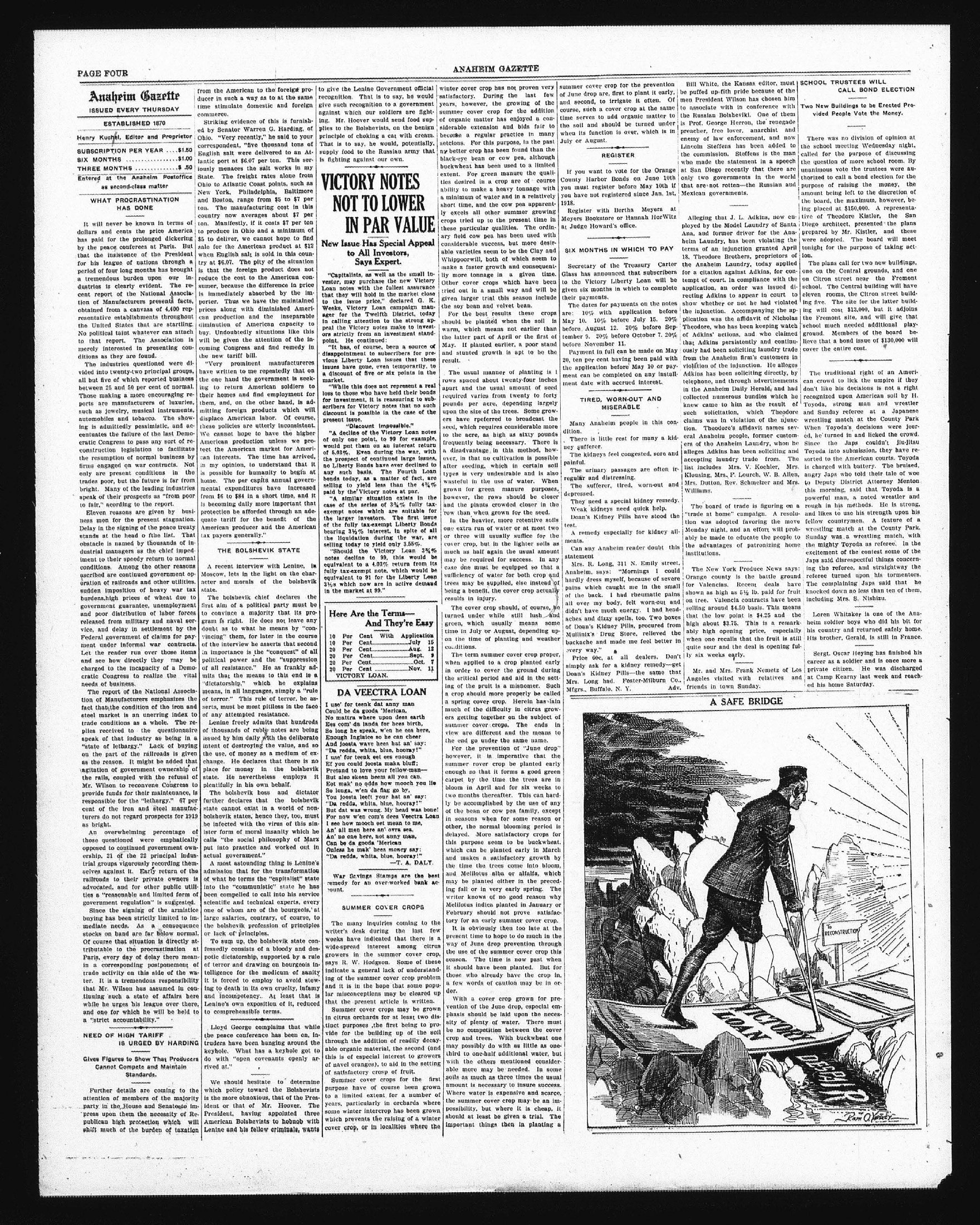
To
RECONSTRUCTION
VICTORY
LOAN
DECAIR R
Ram O'Keeley