anaheim-gazette 1919-04-24
Scanned page
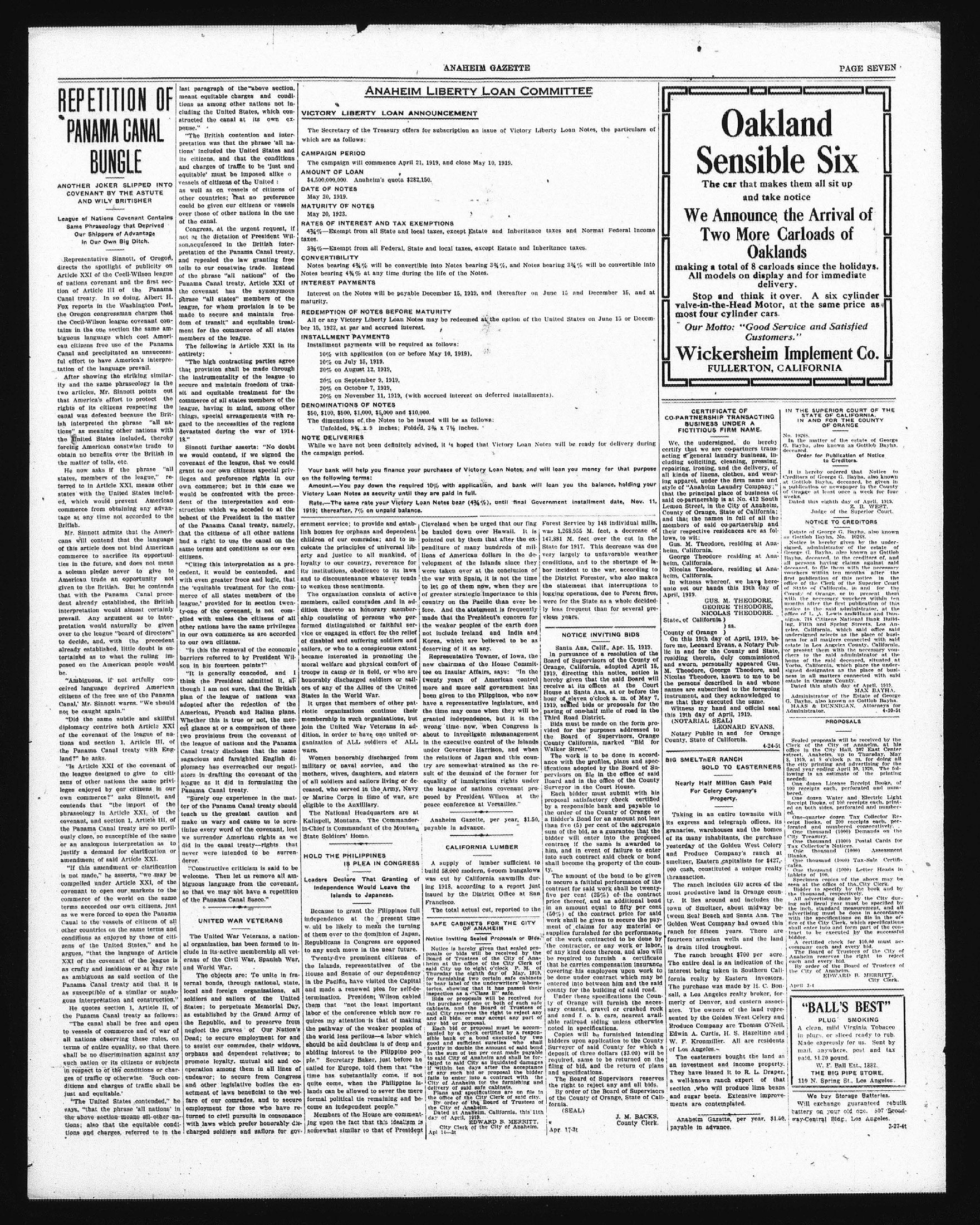
Searchable text
REPETITION OF
PANAMA CANAL
BUNGLE
ANOTHER JOKER SLIPPED INTO
COVENANT BY THE ASTUTE
AND WILY BRITISHER
League of Nations Covenant Contains
Same Phraseology that Deprived
Our Shippers of Advantage
in Our Own Big Ditch.
Representative Sinnott, of Oregon,
directs the spotlight of publicity on
Article XXI of the Cecil-Wilson league
of nations covenant and the first section
of Article III of the Panama Canal treaty. In so doing, Albert H. Fox reports in the Washington Post, the Oregon congressman charges that the Cecil-Wilson league covenant contains in the one section the same ambiguous language which cost American citizens free use of the Panama Canal and precipitated an unsuccessful effort to have America's interpretation of the language prevail.
After showing the striking similarity and the same phraseology in the two articles, Mr. Sinnott points out that America's effort to protect the rights of its citizens respecting the canal was defeated because the British interpreted the phrase "all nations" as meaning other nations with the United States included, thereby forcing American coastwise trade to obtain no benefits over the British in last paragraph of the above section, meant equitable charges and conditions as among other nations not including the United States, which constructed the canal at its own expense."
"The British contention and interpretation was that the phrase 'all nations' included the United States and its citizens, and that the conditions and charges of traffic to be 'just and equitable' must be imposed alike o vessels of citizens of the United :
as well as on vessels of citizens of other countries; that no preference could be given our citizens or vessels over those of other nations in the use of the canal.
Congress, at the urgent request, if not at the dictation of President Wilson, acquiesced in the British interpretation of the Panama Canal treaty, and repealed the law granting free tolls to our coastwise trade. Instead of the phrase "all nations" of the Panama Canal treaty, Article XXI of the covenant has the synonymous phrase "all states" members of the league, for whom provision is to be made to secure and maintain freedom of transit and equitable treatment for the commerce of all states members of the league.
The following is Article XXI in its entirety:
"The high contracting parties agree that provision shall be made through the instrumentality of the league to secure and maintain freedom of transit and equitable treatment for the commerce of all states members of the league, having in mind, among other things, special arrangements with regard to the necessities of the regions devastated during the war of 1914-18."
Sinnott further asserts: "No doubt we would contend, if we signed the VICTORY LIBERATION
The Secretary of th which are as follows:
CAMPAIGN PERIOD
The campaign will amOUNT OF LOAN $4,500,000,000. AnA
DATE OF NOTES May 20, 1919.
MATURITY OF NOTES May 20, 1923.
RATES OF INTEREST 4%—Exempt from taxes.
3%—Exempt from CONVERTIBILITY
Notes bearing 4% Notes bearing 4% a INTEREST PAYMENT
Interest on the Note maturity.
REDEMPTION OF NO All or any Victory November 15, 1922, at par a INSTALLMENT PAYMENT Installment payment 10% with application 10% on July 15 20% on August 20% on September 20% on October 20% on November 20%
DENOMINATIONS OF $50, $100, $500, $1,00 The dimensions of Unfolded, 9% x NOTE DELIVERIES While we have not the campaign period.
After showing the striking similarity and the same phraseology in the two articles, Mr. Sinnott points out that America's effort to protect the rights of its citizens respecting the canal was defeated because the British interpreted the phrase "all nations" as meaning other nations with the United States included, thereby forcing American coastwise trade to obtain no benefits over the British in the matter of tolls, etc.
He now asks if the phrase "all states, members of the league," referred to in Article XXI, means other states with the United States included, which would prevent American commerce from obtaining any advantage at any time not accorded to the British.
Mr. Sinnott admits that the Americans will contend that the language of this article does not bind American commerce to sacrifice its opportunities in the future, and does not mean a solemn pledge never to give to American trade an opportunity not given to the British. But he contends that with the Panama Canal precedent already established, the British interpretation would almost certainly prevail. Any argument as to interpretation would naturally be given over to the league "board of directors" to decide, and, with the precedent already established, little doubt is entertained as to what the ruling imposed on the American people would be.
"Ambiguous, if not artfully conceived language deprived American citizens of the free use of the Panama Canal," Mr. Sinnott warns. "We should not be caught again."
"Did the same subtle and skillful diplomacy contrive both Article XXI of the covenant of the league of nations and section 1, Article III, of the Panama Canal treaty with England?" he asks.
"Is Article XXI of the covenant of the league designed to give to citizens of other nations the same privileges enjoyed by our citizens in our own commerce?" asks Sinnott, and contends that "the import of the phraseology in Article XXI of the covenant, and section 1, Article III, of the Panama Canal treaty are so perilously close, so susceptible of the same or an analogous interpretation as to justify a demand for clarification or amendment of said Article XXI."
"The high contracting parties agree that provision shall be made through the instrumentality of the league to secure and maintain freedom of transit and equitable treatment for the commerce of all states members of the league, having in mind, among other things, special arrangements with regard to the necessities of the regions devastated during the war of 1914-18."
Sinnott further asserts: "No doubt we would contend, if we signed the covenant of the league, that we could grant to our own citizens special privileges and preference rights in our own commerce; but in this case we would be confronted with the precedent of the interpretation and construction which we acceded to at the behest of the President in the matter of the Panama Canal treaty, namely, that the citizens of all other nations had a right to use the canal on the same terms and conditions as our own citizens.
"Citing this interpretation as a precedent, it would be contended, and with even greater froce and logic, that the 'equitable treatment for the commerce of all states members of the league,' provided for in section twenty-one of the covenant, is not compiled with unless the citizens of all other nations have the same privileges in our own commerce as are accorded to our own citizens.
"Is this the removal of the economic barriers referred to by President Wilson in his fourteen points?"
"It is generally conceded, and I think the President admitted it, although I am not sure, that the British plan of the league of nations was adopted after the rejection of the American, French and Italian plans. Whether this is true or not, the merest glance at or a comparison of these two provisions from the covenant of the league of nations and the Panama Canal treaty discloses that the same sagacious and farsighted English diplomacy has overreached our negotiators in drafting the covenant of the league as it did in formulating the Panama Canal treaty.
"Surely our experience in the matter of the Panama Canal treaty should teach us the greatest caution and make us wary and cause us to scrutinize every word of the covenant, lest we surrender American rights as we did in the canal treaty—rights that never were intended to be surrenderer."
the league designed to give to citizens of other nations the same privileges enjoyed by our citizens in our own commerce?" asks Sinnott, and contends that "the import of the phraseology in Article XXI of the covenant, and section 1, Article III, of the Panama Canal treaty are so perilously close, so susceptible of the same or an analogous interpretation as to justify a demand for clarification or amendment of said Article XXI.
"If this amendment or clarification is not made," he asserts, "we may be compelled under Article XXI, of the covenant to open our markets to the commerce of the world on the same terms accorded our own citizens, just as we were forced to open the Panama Canal to the vessels of citizens of all other countries on the same terms and conditions as enjoyed by those of citizens of the United States," and he argues, "that the language of Article XXI of the covenant of the league is as crafty and insidious or at any rate as ambiguous as said section of the Panama Canal treaty and that it is as susceptible of a similar or analogous interpretation and construction."
He quotes section 1, Article II, of the Panama Canal treaty as follows:
"The canal shall be free and open to vessels of commerce and of war of all nations observing these rules, on terms of entire equality, so that there shall be no discrimination against any such nation or its citizens or subjects in respect to of the conditions or charges of traffic or otherwise. 'Such conditions and charges of traffic shall be just and equitable.'"
"The United States contended," he says, "that the phrase 'all nations' in the above section means all other nations; also that the equitable conditions and charges, referred to in the
UNITED WAR VETERANS
The United War Veterans, a national organization, has been formed to include in its active membership all veterans of the Civil War, Spanish War, and World War.
The objects are: To unite in fraternal bonds, through national, state, local and foreign organizations, all soldiers and sailors of the United States; to perpetuate Memorial Day, as established by the Grand Army of the Republic, and to preserve from neglect the graves of Our Nation's Dead; to secure employment for and to assist our comrades, their widows,orphans and dependent relatives; to promote loyalty, mutual aid and cooperation among them in all lines of endeavor; to secure from Congress and other legislative bodies the enactment of laws beneficial to the welfare of our comrades, and to secure employment for those who have returned to civil pursuits in consonance with laws which prefer honorably discharged soldiers and sailors for government and overseeing agents in drafting the covenant of the league as it did in formulating the Panama Canal treaty.
"Surely our experience in the matter of the Panama Canal treaty should teach us the greatest caution and make us wary and cause us to scrutinize every word of the covenant, lest we surrender American rights as we did in the canal treaty—rights that never were intended to be surrenderer.
"Constructive criticism is said to be welcome. Then let us remove all ambiguous language from the covenant, so that we may not have a repetition of the Panama Canal flasco."
ANAHEIM LIBERTY LOAN COMMITTEE
VICTORY LIBERTY LOAN ANNOUNCEMENT
The Secretary of the Treasury offers for subscription an issue of Victory Liberty Loan Notes, the particulars of which are as follows:
CAMPAIGN PERIOD
The campaign will commence April 21, 1919, and close May 10, 1919.
AMOUNT OF LOAN
$4,500,000,000. Anaheim's quota $282,150.
DATE OF NOTES
May 20, 1919.
MATURITY OF NOTES
May 20, 1923.
RATES OF INTEREST AND TAX EXEMPTIONS
4%—Exempt from all State and local taxes, except Estate and Inheritance taxes and Normal Federal Income taxes.
3%—Exempt from all Federal, State and local taxes, except Estate and Inheritance taxes.
CONVERTIBILITY
Notes bearing 4% will be convertible into Notes bearing 3%, and Notes bearing 3% will be convertible into Notes bearing 4% at any time during the life of the Notes.
INTEREST PAYMENTS
Interest on the Notes will be payable December 15, 1919, and thereafter on June 15 and December 15, and at maturity.
REDEMPTION OF NOTES BEFORE MATURITY
All or any Victory Liberty Loan Notes may be redeemed at the option of the United States on June 15 or December 15, 1922, at par and accrued interest.
INSTALLMENT PAYMENTS
Installment payments will be required as follows:
10% with application (on or before May 10, 1919).
10% on July 15, 1919.
20% on August 12, 1919.
20% on September 9, 1919.
20% on October 7, 1919.
20% on November 11, 1919, (with accrued interest on deferred installments).
DENOMINATIONS OF NOTES
$50, $100, $500, $1,000, $5,000 and $10,000.
The dimensions of the Notes to be issued will be as follows:
Unfolded, 9½ x 9 inches; Folded, 3½ x 7½ inches.
NOTE DELIVERIES
While we have not been definitely advised, it is hoped that Victory Loan Notes will be ready for delivery during the campaign period.
DENOMINATIONS OF NOTES
$50, $100, $500, $1,000, $5,000 and $10,000.
The dimensions of the Notes to be issued will be as follows:
Unfolded, 9½ x 9 inches; Folded, 3½ x 7½ inches.
NOTE DELIVERIES
While we have not been definitely advised, it is hoped that Victory Loan Notes will be ready for delivery during the campaign period.
Your bank will help you finance your purchases of Victory Loan Notes; and will loan you money for that purpose on the following terms:
Amount.—You pay down the required 10% with application, and bank will loan you the balance, holding your Victory Loan Notes as security until they are paid in full.
Rate.—The same rate your Victory Loan Notes bear (4¼%), until final Government installment date, Nov. 11, 1919; thereafter, 7% on unpaid balance.
ernment service; to provide and establish homes for orphans and dependent children of our comrades; and to incalcate the principles of universal liberty and justice to all mankind, of loyalty to our country, reverence for its institutions, obedience to its laws and to discountenance whatever tends to weaken these sentiments.
The organization consists of active members, called comrades, and in addition thereto an honorary membership consisting of persons who performed distinguished or faithful service or engaged in effort for the relief of disabled and suffering soldiers and sailors, or who to a conspicuous extent became interested in promoting the moral welfare and physical comfort of troops in camp or in field, or who are honorably discharged soldiers or sailors of any of the Allies of the United States in the World War.
It urges that members of other patriotic organizations continue their membership in such organizations, but join the United War Veterans in addition, in order to have one united organization of ALL soldiers of ALL wars.
Women honorably discharged from military or naval service, and the mothers, wives, daughters, and sisters of all soldiers and sailors living or deceased, who served in the Army, Navy or Marine Corps in time of war, are eligible to the Auxiliary.
The National Headquarters are at Kalispell, Montana. The Commander-in-Chief is Commandant of the Montana State Soldiers' Home.
HOLD THE PHILIPPINES IS PLEA IN CONGRESS
Cleveland when he urged that our flag be hauled down over Hawaii. It is pointed out by them that after the expenditure of many hundreds of millions of American dollars in the development of the Islands since they were taken over at the conclusion of the war with Spain, it is not the time to let go of them now, when they are of greater strategic importance to this country on the Pacific than ever before. And the statement is frequently made that the President's concern for the weaker peoples of the earth does not include Ireland and India and Korea, which are believed to be as deserving of it as any.
Representative Towner, of Iowa, the new chairman of the House Committee on Insular Affairs, says: "In the twenty years of American control more and more self government has been given to the Philippines, who now have a representative legislature, and the time may come when they will be granted independence, but it is the wrong time now, when Congress is about to investigate mismanagement in the executive control of the Islands under Governor Harrison, and when the relations of Japan and this country are somewhat strained as the result of the demand of the former for equality of immigration rights under the league of nations covenant proposed by President Wilson at the peace conference at Versailles."
Anaheim Gazette, per year, $1.50, payable in advance.
CALIFORNIA LUMBER
A supply of lumber sufficient to Forest Service by 148 individual mills, was 1,268,955 M. feet, a decrease of 147,881 M. feet over the cut in the State for 1917. This decrease was due very largely to unfavorable weather conditions, and to the shortage of labor incident to the war, according to the District Forester, who also makes the statement that interruptions to logging operations, due to Forest fires, were for the State as a whole decidedly less frequent than for several previous years.
NOTICE INVITING BIDS
Santa Ana, Calif., Apr. 15, 1919.
In pursuance of a resolution of the Board of Supervisors of the County of Orange, California, adopted April 15, 1919, directing this notice, notice is hereby given that the said Board will receive at its offices at the Court House at Santa Ana, at or before the hour of eleven o'clock a.m. of May 7, 1919, sealed bids or proposals for the paving of one-half mile of road in the Third Road District.
Bids must be made on the form provided for the purposes addressed to the Board of Supervisors, Orange County California, marked "Bid for Walker Street."
The work is to be done in accordance with the profiles, plans and specifications adopted by the Board of Supervisors on file in the office of said Board and in the office of the County Surveyor in the Court House.
Each bidder must submit with his proposal satisfactory check certified by a responsible bank and payable to the order of the County of Orange or a Bidder's Bond for an amount not less than five (5) per cent of the aggregate sum of the bid, as a guarantee that the bidder will enter into the proposed contract if the same is awarded to him, and in event of failure to enter into such contract said check or bond shall become the property of the county.
HOLD THE PHILIPPINES IS PLEA IN CONGRESS
Leaders Declare That Granting of Independence Would Leave the Islands to Japanese.
Because to grant the Philippines full independence at the present time would be likely to mean the turning of them over to the dominion of Japan, Republicans in Congress are opposed to any such move in the near future.
Twenty-five prominent citizens of the Islands, representatives of the House and Senate of our dependency in the Pacific, have visited the Capital and made a renewed plea for self-determination. President Wilson cabled them that "not the least important labor of the conference which now requires my attention is that of making the pathway of the weaker peoples of the world less perilous—a labor which should be and doubtless is of deep and abiding interest to the Philippino people." Secretary Baker, just before he sailed for Europe, told them that "the time has substantially come, if not quite come, when the Philippine Islands can be allowed to sever the mere formal political tie remaining and become an independent people."
Members of the House are commenting upon the fact that this idealism is somewhat similar to that of President Anaheim Gazette, per year, $1.50, payable in advance.
CALIFORNIA LUMBER
A supply of lumber sufficient to build 58,000 modern, 6-room bungalows was cut by California sawmills during 1918, according to a report just issued by the District Office at San Francisco.
The total actual cut, reported to the SAFE CABINETS FOR THE CITY OF ANAHEIM
Notice Inviting Sealed Proposals or Bids.
Notice is hereby given that sealed proposals or bids will be received by the Board of Trustees of the City of Anaheim at the office of the City Clerk of said City up to eight o'clock P.M. on Thursday the eighth day of May, 1919, for furnishing two certain safe cabinets to bear label of the underwriters' laboratories, showing that it has passed their inspection as a "Class B" safe.
Bids or proposals will be received for the purchase of one or both of such safe cabinets, and the Board of Trustees of said City reserves the right to reject any and all bids, or may accept any part of any bid or proposal.
Each bid or proposal must be accompanied by a check certified by a responsible bank or a bond executed by two good and sufficient sureties who shall justify in double the amount of said bond in the sum of ten per cent made payable to said City as liquidated damages if within ten days after the acceptance of any such bid or proposal the bidder fails to enter into a contract with the City of Anaheim for the furnishing and delivery of said safe cabinets.
Plans and specifications are on file in the office of the City Clerk of said city. By order of the Board of Trustees of the City of Anaheim.
Dated at Anaheim, California, this 11th day of April, 1819.
EDWARD B. MERRITT.
City Clerk of the City of Anaheim.
Apr. 17-3t
Each bidder must submit with his proposal satisfactory check certified by a responsible bank and payable to the order of the County of Orange or a Bidder's Bond for an amount not less than five (5) per cent of the aggregate sum of the bid, as a guarantee that the bidder will enter into the proposed contract if the same is awarded to him, and in event of failure to enter into such contract said check or bond shall become the property of the county.
The amount of the bond to be given to secure a faithful performance of the contract for said work shall be twenty-five per cent (25%) of the contract price thereof, and an additional bond in an amount equal to fifty per cent (50%) of the contract price for said work shall be given to secure the payment of claims for any material or supplies furnished for the performance of the work contracted to be done by the contractor, or any work or labor, of any kind done thereon, and also will be required to furnish a certificate that he carries compensation insurance covering his employees upon work to be done under contract which may be entered into between him and the said county for the building of said road.
Under these specifications the County of Orange will furnish the necessary cement, gravel or crushed rock and send f. o. b. cars, nearest available railroad siding unless otherwise noted in specifications.
Copies will be furnished intending bidders upon application to the County Surveyor of said County for which a deposit of three dollars ($3.00) will be required, same to be returned on the filing of bid, and the return of plans and specifications.
The Board of Supervisors reserves the right to reject any and all bids.
By order of the Board of Supervisors of the County of Orange, State of California.
(SEAL)
J. M. BACKS,
County Clerk.
Apr. 17-3t
Oakland
Sensible Six
The car that makes them all sit up
and take notice
We Announce the Arrival of
Two More Carloads of
Oaklands
making a total of 8 carloads since the holidays.
All models on display and for immediate delivery.
Stop and think it over. A six cylinder valve-in-the-Head Motor, at the same price as most four cylinder cars.
Our Motto: "Good Service and Satisfied Customers."
Wickersheim Implement Co.
FULLERTON, CALIFORNIA
CERTIFICATE OF
CO-PARTNERSHIP TRANSACTING
BUSINESS UNDER A
FICTITIOUS FIRM NAME.
We, the undersigned, do hereby certify that we are co-partners transacting general laundry business, in-
CERTIFICATE OF CO-PARTNERSHIP TRANSACTING BUSINESS UNDER A FICTITIOUS FIRM NAME.
We, the undersigned, do hereby certify that we are co-partners transacting general laundry business, including soliciting, cleaning, pressing, repairing, ironing, and the delivery of all kinds of linens, clothes, and wearing apparel, under the firm name and style of "Anaheim Laundry Company;" that the principal place of business of said co-partnership is at No. 412 South Lemon Street, in the City of Anaheim, County of Orange, State of California; and that the names in full of all the members of said co-partnership and their respective residences are as follows, to wit:
Gus. M. Theodore, residing at Anaheim, California.
George Theodore residing at Anaheim, California.
Nicolas Theodore, residing at Anaheim, California.
In witness whereof, we have hereunto set our hands this 19th day of April, 1919.
GUS. M. THEODORE,
GEORGE THEODORE,
NICOLAS THEODORE.
State of California)
) ss.
County of Orange )
On this 19th day of April, 1919, before me, Leonard Evans, a Notary Public in and for the County and State, residing therein, duly commissioned and sworn, personally appeared Gus. M. Theodore, George Theodore, and Nicolas Theodore, known to me to be the persons described in and whose names are subscribed to the foregoing instrument, and they acknowledged to me that they executed the same.
Witness my hand and official seal this 19th day of April, 1919.
(NOTARIAL SEAL)
LEONARD EVANS,
Notary Public in and for Orange County, State of California.
4-24-5t
BIG SMELTnER RANCH
SOLD TO EASTERNERS
Nearly Half Million Cash Paid For Celery Company's Property.
Taking in an entire townsite with its express and telegraph offices, its granaries, warehouses and the homes of its many inhabitants, the purchase yesterday of the Golden West Celery and Produce Company's ranch at smeltzer, Eastern capitalists for $427.
IN THE SUPERIOR COURT OF THE STATE OF CALIFORNIA,
IN AND FOR THE COUNTY OF ORANGE
No. 10268.
In the matter of the estate of George G. Bayha, also known as Gottlob Bayha, deceased.
Order for Publication of Notice to Creditors.
It is hereby ordered that Notice to Creditors of George G. Bayha, also known at Gottlob Bayha, deceased, be given in a publication or newspaper in the County of Orange at least once a week for four weeks.
Dated this eighth day of April, 1919.
Z. B. WEST.
Judge of the Superior Court.
NOTICE TO CREDITORS
Estate of George G. Bayha, also known as Gottlob Bayha, No. 10268.
Notice is hereby given by the undersigned, administrator of the estate of George G. Bayha, also known as Gottlob Bayha, deceased, to the creditors of, and all persons having claims against said deceased, to file them with the necessary vouchers within ten months after the first publication of this notice in the office of the Clerk of the Superior Court of State of California, in and for the County of Orange, or to present them with the necessary vouchers within ten months after the first publication of this notice to the said administrator, at the office of L. A. Lewis and Haas and Dunigan, 718 Citizens National Bank Building, Fifth and Spring Streets, Los Angeles, California, which said office said undersigned selects as the place of business for all matters connected with said estate in Los Angeles County, California, or present them with the necessary vouchers to the said administrator at the home of the said deceased, situated at Torba, California, which place the undersigned designates as the place of business in all matters connected with said estate in Orange County.
Dated this ninth day of April, 1919.
MAX BAYHA.
Administrator of the Estate of George G. Bayha, also known as Gottlob Bayha.
HAAS & DUNNIGAN. Attorneys for Administrator.
PROPOSALS
Sealed proposals will be received by the Clerk of the City of Annelm, at his office in the City Hall, 307 East Center street. Annelm, up to Thursday, May 8, 1919, at 8 o'clock p.m. for doing all the city printing and advertising for the fiscal year ending April 30, 1920. The following is an estimate of the printing needed:
One dozen License Receipt Books, of 100 receipts each, perforated and numbered.
One dozen Water and Electric Light Receipt Books, of 100 receipts each, perforated and numbered consecutively.
One thousand (1000) Demands on the City Treasury.
One thousand (1000) Postal Cards for Tax Collector's Notices.
One thousand (1000) Assessment Blanks.
One thousand (1000) Tax-Sale Certificates.
Nearly Half Million Cash Paid For Celery Company's Property.
Taking in an entire townsite with its express and telegraph offices, its granaries, warehouses and the homes of its many inhabitants, the purchase yesterday of the Golden West Celery and Produce Company's ranch at smeltzer, Eastern capitalists for $427,000 cash, constituted a unique realty transaction.
The ranch includes 610 acres of the most productive land in Orange county. It lies around and includes the town of Smeltzer, about midway between Seal Beach and Santa Ana. The Golden West Company had owned this ranch for fifteen years. There are fourteen artesian wells and the land is drain tiled throughout.
The ranch brought $700 per acre. The entire deal is an indication of the interest being taken in Southern California realty by Eastern investors. The purchase was made by H. C. Bonsall, a Los Angeles realty broker, formerly of Denver, and eastern associates. The owners of the land represented by the Golden West Celery and R produce Company are Thomas O'Neil, Edwin A. Curtis, H. S. Hazeltine and W. F. Kronmiller. All are residents of Los Angeles.
The easterners bought the land as an investment and income property. They have leased it to R. L. Draper, a well-known ranch expert of that section who will produce lima beans and sugar beets. Extensive improvements are contemplated.
Anaheim Gazette, per year, $1.50, payable in advance.
"BALL'S BEST"
PLUG SMOKING
A clean, mild Virginia Tobacco in plugs, or sliced ready to rub. Made expressly for us. Sent by mail, anywhere, post and tax paid. $1.20 pound.
W. F. Ball Est., 1832.
THE BIG PIPE STORE,
110 N. Spring St., Los Angeles.
We buy Storage Batteries.
Will exchange guaranteed rebuilt battery on your old one. 507 Broadway-Central Bldg., Los Angeles.
3-27-4t