anaheim-gazette 1919-04-10
Scanned page
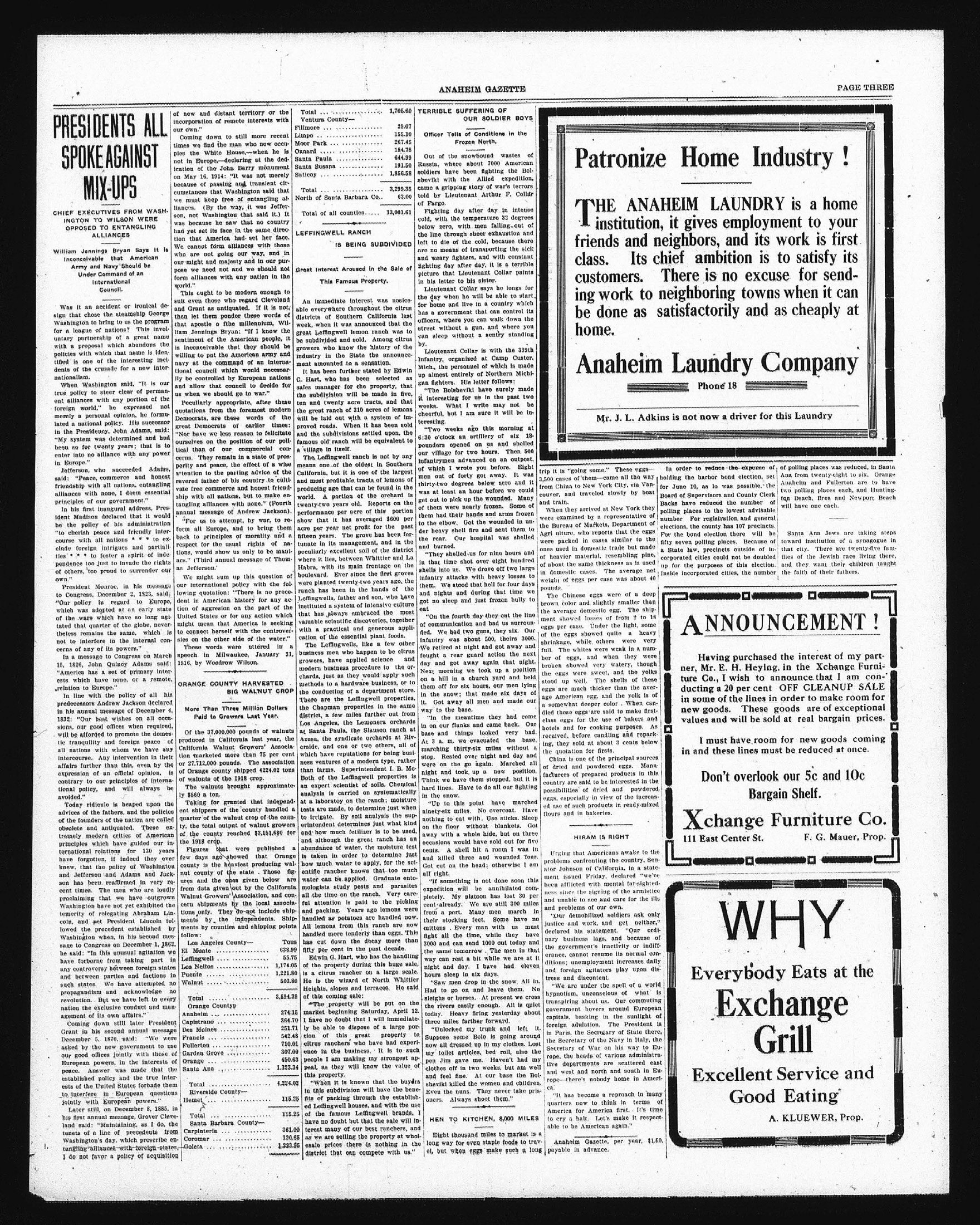
Searchable text
PRESIDENTS ALL SPOKE AGAINST MIX-UPS
CHIEF EXECUTIVES FROM WASHINGTON TO WILSON WERE OPPOSED TO ENTANGLING ALLIANCES
William Jennings Bryan Says It is Inconceivable that American Army and Navy Should be Under Command of an International Council.
Was it an accident or ironical design that chose the steamship George Washington to bring to us the program for a league of nations? This involuntary partnership of a great name with a proposal which abandons the policies with which that name is identified is one of the interesting incidents of the crusade for a new internationalism.
When Washington said, "It is our true policy to steer clear of permanent alliances with any portion of the foreign world," he expressed not merely a personal opinion, he formulated a national policy. His successor in the Presidency, John Adams, said: "My system was determined and had been so for twenty years; that is to enter into no alliance with any power of new and distant territory or the incorporation of remote interests with our own."
Coming down to still more recent times we find the man who now occupies the White House,—when he is not in Europe,—declaring at the dedication of the John Barry monument on May 16, 1914: "It was not merely because of passing and transient circumstances that Washington said that we must keep free of entangling alliances. (By the way, it was Jefferson, not Washington that said it.) It was because he saw that no country had yet set its face in the same direction that America had set her face. We cannot form alliances with those who are not going our way, and in our might and majesty and in our purpose we need not and we should not form alliances with any nation in the world."
This ought to be modern enough to suit even those who regard Cleveland and Grant as antiquated. If it is not, then let them ponder these words of that apostle o fthe millennium, William Jennings Bryan: "If I know the sentiment of the American people, it is inconceivable that they should be willing to put the American army and navy at the command of an international council which would necessarily be controlled by European nations and allow that council to decide for us when we should go to war."
Peculiarly appropriate, after these quotations from the foremost modern Democrats, are these words of the great Democrats of earlier times: "Nor have we less reason to felicitate ourselves on the position of our political than of our commercial concerns. They remain in a state of pro-
Total ... Ventura County—Fillmore ... Limpo ... Moor Park ... Oxnard ... Santa Paula ... Santa Susana ... Saticoy ... Total ... North of Santa Barbara ... Total of all counties.
LEFFINGWELL RANCH IS BEING
Great Interest Aroused
This Famous Pro
An immediate interestable everywhere through districts of Southern week, when it was announced great Leffingwell lemon be subdivided and sold. growers who know the industry in the State ment amounted to a se-
It has been further said G. Hart, who has been sales manager for them, the subdivision will be ten and twenty acre t the great ranch of 310 will be laid out with a proved roads. When it and the subdivisions see famous old ranch will be a village in itself.
When Washington said, "It is our true policy to steer clear of permanent alliances with any portion of the foreign world," he expressed not merely a personal opinion, he formulated a national policy. His successor in the Presidency, John Adams, said: "My system was determined and had been so for twenty years; that is to enter into no alliance with any power in Europe."
Jefferson, who succeeded Adams, said: "Peace, commerce and honest friendship with all nations, entangling alliances with none, I deem essential principles of our government."
In his first inaugural address, President Madison declared that it would be the policy of his administration "to cherish peace and friendly intercourse with all nations * * * to exclude foreign intrigues and partialities * * * to foster a spirit of independence too just to invade the rights of others, too proud to surrender our own."
President Monroe, in his message to Congress, December 2, 1823, said: "Our policy in regard to Europe, which was adopted at an early state of the wars which have so long agitated that quarter of the globe, nevertheless remains the same, which is not to interfere in the internal concerns of any of its powers."
In a message to Congress on March 15, 1826, John Quincy Adams said: "America has a set of primary interests which have none, or a remote relation to Europe."
In line with the policy of all his predecessors Andrew Jackson declared in his annual message of December 4, 1832: "Our best wishes on all occasions, our good offices when required, will be afforded to promote the domestic tranquility and foreign peace of all nations with whom we have any intercourse. Any intervention in their affairs further than this, even by the expression of an official opinion, is contrary to our principles of international policy, and will always be avoided."
Today ridicule is heaped upon the advices of the fathers, and the policies of the founders of the nation are called obsolete and antiquated. These extremely modern critics of American principles which have guided our international relations for 130 years have forgotten, if indeed they ever identified is one of the interesting incidents of the crusade for a new internationalism.
When Washington said, "It is our true policy to steer clear of permanent alliances with any portion of the foreign world," he expressed not merely a personal opinion, he formulated a national policy. His successor in the Presidency, John Adams, said: "My system was determined and had been so for twenty years; that is to enter into no alliance with any power in Europe."
Jefferson, who succeeded Adams, said: "Peace, commerce and honest friendship with all nations, entangling alliances with none, I deem essential principles of our government."
In his first inaugural address, President Madison declared that it would be the policy of his administration "to cherish peace and friendly intercourse with all nations * * * to exclude foreign intrigues and partialities * * * to foster a spirit of independence too just to invade the rights of others, too proud to surrender our own."
President Monroe, in his message to Congress, December 2, 1823, said: "Our policy in regard to Europe, which was adopted at an early state of the wars which have so long agitated that quarter of the globe, nevertheless remains the same, which is not to interfere in the internal concerns of any of its powers."
In a message to Congress on March 15, 1826, John Quincy Adams said: "America has a set of primary interests which have none, or a remote relation to Europe."
In line with the policy of all his predecessors Andrew Jackson declared in his annual message of December 4, 1832: "Our best wishes on all occasions, our good offices when required, will be afforded to promote the domestic tranquility and foreign peace of all nations with whom we have any intercourse. Any intervention in their affairs further than this, even by the expression of an official opinion, is contrary to our principles of international policy, and will always be avoided."
Today ridicule is heaped upon the advices of the fathers, and the policies of the founders of the nation are called obsolete and antiquated. These extremely modern critics of American principles which have guided our international relations for 130 years have forgotten, if indeed they ever identified is one of the interesting incidents of the crusade for a new internationalism.
When Washington said, "It is our true policy to steer clear of permanent alliances with any portion of the foreign world," he expressed not merely a personal opinion, he formulated a national policy. His successor in the Presidency, John Adams, said: "My system was determined and had been so for twenty years; that is to enter into no alliance with any power in Europe."
Jefferson, who succeeded Adams, said: "Peace, commerce and honest friendship with all nations, entangling alliances with none, I deem essential principles of our government."
In his first inaugural address, President Madison declared that it would be the policy of his administration "to cherish peace and friendly intercourse with all nations * * * to exclude foreign intrigues and partialities * * * to foster a spirit of independence too just to invade the rights of others, too proud to surrender our own."
President Monroe, in his message to Congress, December 2, 1823, said: "Our policy in regard to Europe, which was adopted at an early state of the wars which have so long agitated that quarter of the globe, nevertheless remains the same, which is not to interfere in the internal concerns of any of its powers."
In a message to Congress on March 15, 1826, John Quincy Adams said: "America has a set of primary interests which have none, or a remote relation to Europe."
In line with the policy of all his predecessors Andrew Jackson declared in his annual message of December 4, 1832: "Our best wishes on all occasions, our good offices when required, will be afforded to promote the domestic tranquility and foreign peace of all nations with whom we have any intercourse. Any intervention in their affairs further than this, even by the expression of an official opinion, is contrary to our principles of international policy, and will always be avoided."
Today ridicule is heaped upon the advices of the fathers, and the policies of the founders of the nation are called obsolete and antiquated. These extremely modern critics of American principles which have guided our international relations for 130 years have forgotten, if indeed they ever knew, that the policy of Washington and Jefferson and Adams and Jackson has been reaffirmed in very recent times. The men who are loudly proclaiming that we have outgrown Washington have not yet exhibited the temerity of relegating Abraham Lincoln, and set President Lincoln followed the precedent established by Washington when, in his second message to Congress on December 1, 1862, he said: "In this unusual agitation we have forborne from taking part in any controversy between foreign states and between parties and factions in such states. We have attempted no propagandism and acknowledge no revolution. But we have left to every nation the exclusive conduct and management of its own affairs."
Coming down still later President Grant in his second annual message December 5, 1870, said: "We were asked by the new government to use our good offices jointly with those of European powers, in the interests of peace. Answer was made that the established policy and the true interests of the United States forbade them to interfere in European questions jointly with European powers."
Later still, on December 8, 1885, in his first annual message, Grover Cleveland said: "Maintaining, as I do, the tenets of a line of precedents from Washington's day, which proscribe entangling alliances with foreign states, I do not favor a policy of acquisition of Orange county shipped 4224.02 tons of walnuts of the 1918 crop.
The walnuts brought approximately $560 a ton.
Taking for granted that independent shippers of the county handled a quarter of the walnut crop of the county, the total output of walnut growers of the county reached $3,151,680 for the 1918 crop.
Figures that were published a few days ago showed that Orange county is the heaviest producing walnut county of the state. Those figures and the ones given below are from data given out by the California Walnut Growers' Association, and concern shipments by the local associations only. They do not include shipments by the independents. Shipments by counties and shipping points follow:
Los Angeles County— Tons
El Monte ... 638.99
Leffingwell ... 55.75
Los Neltos ... 1,174.05
Puente ... 1,221.80
Walnut ... 503.80
Total ... 3,594.39
Orange Countyp
Anaheim ... 274.15
Capistrano ... 364.70
Des Moines ... 251.71
Francis ... 542.48
Fullerton ... 710.01
Garden Grove ... 307.00
Orange ... 450.63
Santa Ana ... 1,323.34
Total ... 4,224.02
Riverside County—
Hemet ... 115.25
Total ... 115.25
Santa Barbara County—
Carpinteria ... 361.00
Coromar ... 120.65
Goleta ... 1,223.95
Both of the Leffingwells an expert scientist of analysis is carried out at a laboratoy on the tests are made, to deter to irrigate. By soil erintendent determine and how much fertilize and although the great abundance of water, it is taken in order to how much water to an infiltrate rancher know water can be applied. Mologists study pests all the time on the raftful attention is paid and packing. Years handled as potatoes or All lemons from this handled more tenderly has cut down the fifty per cent in the Edwin G. Hart, who of the property during is a citrus rancher or He is the wizard of Heights, slopes and of this coming sale:
"The property will market beginning Sa... I have no doubt that... may be able to disposition of this great citrus ranchers who ence in the business people I am making peal, as they will know this property.
"When it is known in this subdivision we fits of packing through Leffingwell houses of the famous Leffing well have no doubt but therest many of our b... as we are selling these esale prices there district that can co..."
ANAHEIM GAZETTE
Total ... 1,705.60
Ventura County—
Fillmore ... 29.07
Limpo ... 155.10
Moor Park ... 267.45
Oxnard ... 154.75
Santa Paula ... 644.39
Santa Susana ... 191.50
Saticoy ... 1,856.58
Total ... 3,299.35
North of Santa Barbara Co... 63.00
Total of all counties ... 13,001.61
LEFFINGWELL RANCH
IS BEING SUBDIVIDED
Great Interest Aroused in the Sale of
This Famous Property.
An immediate interest was nosiceable everywhere throughout the citrus districts of Southern California last week, when it was announced that the great Leffingwell lemon ranch was to be subdivided and sold. Among citrus growers who know the history of the industry in the State the announcement amounted to a sensation.
It has been further stated by Edwin G. Hart, who has been selected as sales manager for the property, that the subdivision will be made in five, ten and twenty acre tracts, and that the great ranch of 310 acres of lemons will be laid out with a system of improved roads. When it has been sold and the subdivisions settled upon, the famous old ranch will be equivalent to a village in itself.
TERRIBLE SUFFERING OF
OUR SOLDIER BOYS
Officer Tells of Conditions in the Frozen North.
Out of the snowbound wastes of Russia, where about 7000 American soldiers have been fighting the Bolsheviks with the Allied expedition, came a gripping story of war's terrors told by Lieutenant Arthur F. Collard of Fargo.
Fighting day after day in intense cold, with the temperature 32 degrees below zero, with men falling out of the line through sheer exhaustion and left to die of the cold, because there are no means of transporting the sick and weary fighters, and with constant fighting day after day, it is a terrible picture that Lieutenant Collar paints in his letter to his sister.
Lieutenant Collar says he longs for the day when he will be able to start for home and live in a country which has a government that can control its officers, where you can walk down the street without a gun, and where you can sleep without a sentry standing by.
Lieutenant Collar is with the 339th Infantry, organized at Camp Custer. Mich., the personnel of which is made up almost entirely of Northern Michigan fighters. His letter follows:
"The Bolsheviks have surely made it interesting for us in the past two weeks. What I write may not be cheerful, but I am sure it will be interesting."
"Two weeks ago this morning at 6:30 o'clock an artillery of six 18-pounders opened on us and shelled our village for two hours. Then 500
It has been further stated by Edwin G. Hart, who has been selected as sales manager for the property, that the subdivision will be made in five, ten and twenty acre tracts, and that the great ranch of 310 acres of lemons will be laid out with a system of improved roads. When it has been sold and the subdivisions settled upon, the famous old ranch will be equivalent to a village in itself.
The Lefflingwell ranch is not by any means one of the oldest in Southern California, but it is one of the largest and most profitable tracts of lemons of producing age that can be found in the world. A portion of the orchard is twenty-two years old. Reports on the performance per acre of this portion show that it has averaged $600 per acre per year net profit for the past fifteen years. The grove has been fortunate in its management, and in the peculiarly excellent soil of the district where it lies, between Whittier and La Habra, with its main frontage on the boulevard. Ever since the first groves were planted twenty-two years ago, the ranch has been in the hands of the Lefflingwells, father and son, who have instituted a system of intensive culture that has always embraced the most valuable scientific discoveries, together with a practical and generous application of the essential plant foods.
The Lefflingwells, like a few other business men who happen to be citrus growers, have applied science and modern business procedure to the orchards, just as they would apply such methods to a hardware business, or to the conducting of a department store. There are the Lefflingwell properties, the Chapman properties in the same district, a few miles further out from Los Angeles, the Lemonera orchards at Santa Paula, the Slauson ranch at Azusa, the syndicate orchards at Riverside, and one or two others, all of which have reputations for being business ventures of a modern type, rather than farms. Superintendent I. B. McBoth of the Lefflingwell properties is an expert scientist of soils. Chemical analysis is carried on systematically at a laboratoy on the ranch; moisture tests are made, to determine just when to irrigate. By soil analysis the superintendent determines just what kind and how much fertilizer is to be used, and although the great ranch has an abundance of water, the moisture test is taken in order to determine just how much water to apply, for the sci-
trip it is "going some." These eggs—3,500 cases of them—came all the way from China to New York City, via Vancouver, and traveled slowly by boat and train.
When they arrived at New York they were examined by a representative of the Bureau of Markets, Department of Agriulture, who reports that the eggs were packed in cases similar to the ones used in domestic trade but made of heavier material, resembling pine, about the same thickness as is used in domestic cases. The average net weight of eggs per case was about 40 pounds.
The Chinese eggs were of a deep brown color and slightly smaller than the average domestic egg. The shipment showed losses of from 2 to 18 eggs per case. Under the light, some of the eggs showed quite a heavy shrinkage, while others were very full. The whites were weak in a number of eggs, and when they were broken showed very watery, though the eggs were sweet, and the yolks stood up well. The shells of these eggs are much thicker than the average American egg, and the yolk is of a somewhat deeper color. When candled these eggs are said to make first-class eggs for the use of bakers and hotels and for cooking purposes. As received, before candling and repacking, they sold at about 3 cents below the quotation for firsts.
China is one of the principal sources of dried and powdered eggs. Manufacturers of prepared products in this country are said to be interested in the possibilities of dried and powdered eggs, especially in view of the increased use of such products in ready-mixed flours and in bakeries.
HIRAM IS RIGHT
Urging that Americans awake to the problems confronting the country, Sen-
than farms. Superintendent I. B. McBoth of the Lefflingwell properties is an expert scientist of soils. Chemical analysis is carried on systematically at a laboratoy on the ranch; moisture tests are made, to determine just when to irrigate. By soil analysis the superintendent determines just what kind and how much fertilizer is to be used, and although the great ranch has an abundance of water, the moisture test is taken in order to determine just how much water to apply, for the scientific rancher knows that too much water can be applied. Graduate entomologists study pests and parasites all the time on the ranch. Very careful attention is paid to the picking and packing. Years ago lemons were handled as potatoes are handled now. All lemons from this ranch are now handled more tenderly than eggs. This has cut down the decay more than fifty per cent in the past decade.
Edwin G. Hart, who has the handling of the property during this huge sale, is a citrus rancher on a large scale. He is the wizard of North Whittier Heights, slopes and terraces. He said of this coming sale:
"The property will be put on the market beginning Saturday, April 12. I have no doubt that I will immediately be able to dispose of a large portion of this great property to citrus ranchers who have had experience in the business. It is to such people I am making my strongest appeal, as they will know the value of this property.
"When it is known that the buyers in this subdivision will have the benefits of packing through the established Lefflingwell houses, and with the use of the famous Lefflingwell brands, I have no doubt but that the sale will interest many of our best ranchers, and as we are selling the property at wholesale prices there is nothing in the district that can compete with us."
HIRAM IS RIGHT
Urging that Americans awake to the problems confronting the country, Senator Johnson of California, in a statement issued Friday, declared "we've been afflicted with mental far-sightedness since the signing of the armistice and unable to see and care for the ill and problems of our own.
"Our demobilized soldiers ask only justice and work, and get neither," declared his statement. "Our ordinary business lags, and because of the government's inactivity or indifference, cannot resume its normal conditions; unemployment increases daily and foreign agitators play upon distress and discontent.
"We are under the spell of a world hypnotism, unconscious of what is transpiring about us. Our commuting government hovers around European capitals, basking in the sunlight of foreign adulation. The President is in Paris, the Secretary of State there, the Secretary of the Navy in Italy, the Secretary of War on his way to Europe, the heads of various administrative departments are scattered east and west and north and south in Europe—there's nobody home in America.
"It has become a reproach in many quarters now to think in terms of America for America first. It's time to cry a halt. Let's make it respectable to be American again."
Anaheim Gazette, per year, $1.60, payable in advance.
PAGE THREE
Ronize Home Industry!
ANAHEIM LAUNDRY is a home institution, it gives employment to your sons and neighbors, and its work is first. Its chief ambition is to satisfy its owners. There is no excuse for send-work to neighboring towns when it can be as satisfactorily and as cheaply at Anaheim Laundry Company
Phone 18
J. L. Adkins is not now a driver for this Laundry
These eggs—
be all the way
City, via Vanlowly by boat
New York they
representative of
Department of
that the eggs
similar to the
made but made
embling pine,
less as is used
average net
was about 40
In order to reduce the expense of
holding the harbor bond election, set
for June 10, as lo was possible, the
Board of Supervisors and County Clerk
Backs have reduced the number of
polling places to the lowest advisable
number For registration and general
elections, the county has 107 precincts.
For the bond election there will be
fifty seven polling places. Because of
a State law, precincts outside of incorporated cities could not be doubled
up for the purposes of this election.
Inside incorporated cities, the number
of polling places was reduced, in Santa Ana from twenty-eight to six. Orange Anaheim and Fullerton are to have two polling places each, and Huntington Beach, Brea and Newport Beach will have one each.
Santa Ana Jews are taking steps toward institution of a synagogue in that city. There are twenty-five families of the Jewish race living there, and they want their children taught the faith of their fathers.
ANNOUNCEMENT!
Having purchased the interest of my partner, Mr. E. H. Heying, in the Xchange Furniture Co., I wish to announce that I am conducting a 20 per cent OFF CLEANUP SALE in some of the lines in order to make room for new goods. These goods are of exceptional values and will be sold at real bargain prices.
I must have room for new goods coming in and these lines must be reduced at once.
Don't overlook our 5c and 10c Bargain Shelf.
Xchange Furniture Co.
111 East Center St.
F. G. Mauer, Prop.
Don't overlook our 5c and 10c
Bargain Shelf.
Xchange Furniture Co.
111 East Center St. F. G. Mauer, Prop.
WHY
Everybody Eats at the
Exchange Grill
Excellent Service and
Good Eating
A. KLUEWER, Prop.