anaheim-gazette 1919-03-20
Scanned page
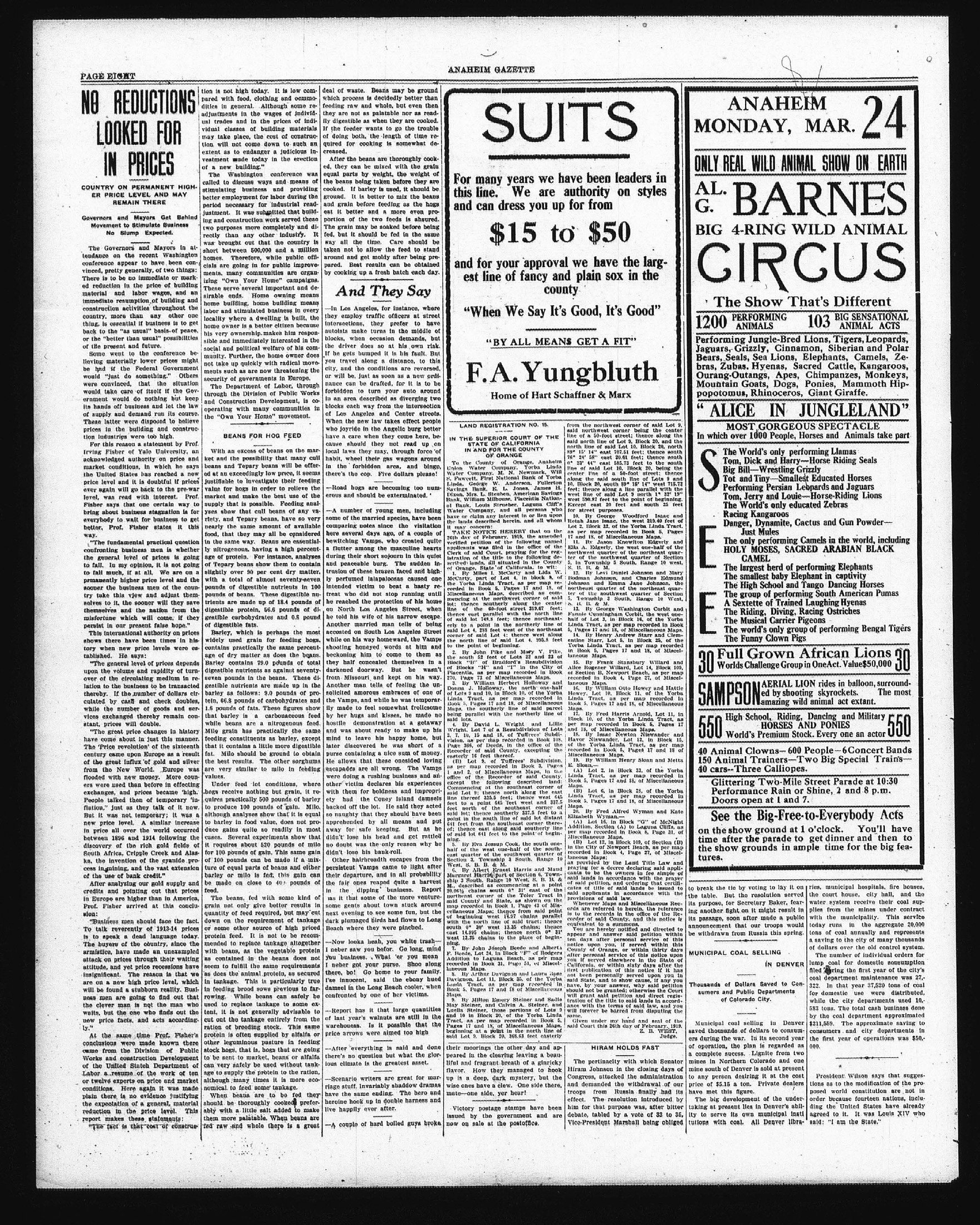
Searchable text
NO REDUCTIONS
LOOKED FOR
IN PRICES
COUNTRY ON PERMANENT HIGHER PRICE LEVEL AND MAY REMAIN THERE
Governors and Mayors Get Behind Movement to Stimulate Business No Slump Expected.
The Governors and Mayors in attendance on the recent Washington conference appear to have been convinced, pretty generally, of two things: There is to be no immediate or marked reduction in the price of building material and labor wages, and an immediate resumption of building and construction activities throughout the country, more than any other one thing, is essential if business is to get back to the "as usual" basis of peace, or the "better than usual" possibilities of the present and future.
Some went to the conference believing materially lower prices might be had if the Federal Government would "just do something." Others were convinced that the situation would take care of itself if the Government would do nothing but keep its hands off business and let the law of supply and demand run its course. These latter were disposed to believe prices in the building and construction industries were too high.
For this reason a statement by Prof. Irving Fisher of Yale University, an institution is not high today. It is low compared with food, clothing and ocmodities in general. Although some adjustments in the wages of individual trades and in the prices of individual classes of building materials may take place, the cost of construction will not come down to such an extent as to endanger a judicious investment made today in the erection of a new building."
The Washington conference was called to discuss ways and means of stimulating business and providing better employment for labor during the period necessary for industrial readjustment. It was submitted that building and construction work served these two purposes more completely and directly than any other industry. It was brought out that the country is short between 500,000 and a million homes. Therefore, while public officials are going in for public improvements, many communities are organizing "Own Your Home" campaigns. These serve several important and desirable ends. Home owning means home building, home building means labor and stimulated business in every locality where a dwelling is built, the home owner is a better citizen because his very ownership makes him responsible and immediately interested in the social and political welfare of his community. Further, the home owner does not take up quickly with radical movements such as are now threatening the security of governments in Europe.
The Department of Labor, through the Division of Public Works and Construction Development, is cooperating with many communities in the "Own Your Home" movement.
BEANS FOR HOG FEED
With an excess of beans on the market, which process feeding raw and they are not easily digestible if the feeder of doing both, quired for cocreased.
After the best ed, they can be equal parts by the beans being cooked. If bar ground. It is and grain before eat it better portion of the The grain may fed, but it she way all the taken not to around and get pared. Best by cooking up.
And
—In Los Angeles they employ intersections, autoists make blocks, when the driver does. If he gets busy you travel all city, and the or will be, just nance can be forbidden to in an area de blocks each week of Los Angeles. When the new who joyride l have a care w cause should local laws th
lieving materially lower prices might be had if the Federal Government would "just do something." Others were convinced, that the situation would take care of itself if the Government would do nothing but keep its hands off business and let the law of supply and demand run its course. These latter were disposed to believe prices in the building and construction industries were too high.
For this reason a statement by Prof. Irving Fisher of Yale University, an acknowledged authority on price and market conditions, in which he says the United States has reached a new price level and it is doubtful if prices ever again will go back to the pre-war level, was read with interest. Prof. Fisher says that one certain way to bring about business stagnation is for everybody to wait for business to get better, Prof. Fisher states it this way.
"The fundamental practical question confronting business men is whether the general level of prices is going to fall. In my opinion, it is not going to fall much, if at all. We are on a permanently higher price level and the sooner the business men of the country take this view and adjust themselves to it, the sooner will they save themselves and the nation from the misfortune which will come, if they persist in our present false hope."
This international authority on prices shows there have been times in history when new price levels were established. He says:
"The general level of prices depends upon the volume and rapidity of turnover of the circulating medium in relation to the business to be transacted thereby. If the number of dollars circulated by cash and check doubles, while the number of goods and services exchanged thereby remain constant, prices will double.
"The great price changes in history have come about in just this manner. The 'Price revolution' of the sixteenth century came upon Europe as a result of the great influx of gold and silver from the New World. Europe was flooded with new money. More counters were used than before in effecting exchanges, and prices became 'high. People talked then of temporary inflation," just as they talk of it now. But it was not temporary; it was a new price level. A similar increase in price all over the world occurred between 1896 and 1914 following the discovery of the rich gold fields of South Africa, Cripple Creek and Alaska, the invention of the cyanide pro-
With an excess of beans on the market and the possibility that many cull beans and Tepary beans will be offered at an exceedingly low price, it seems justifiable to investigate their feeding value for hogs in order to relieve the market and make the best use of the supply that is possible. Feeding analyses show that cull beans of any variety, and Tepary beans, have so very nearly the same amount of available food, that they may all be considered in the same way. Beans are essentially nitrogenous, having a high percentage of protein. For instance, analyses of Tepary beans show them to contain slightly over 90 per cent dry matter, with a total of almost seventy-seven pounds of digestible nutrients in 100 pounds of beans. These digestible nutrients are made up of 18.4 pounds of digestible protein, 56.6 pounds of digestible carbohydrates and 0.8 pound of digestible fats.
Barley, which is perhaps the most widely used grain for feeding hogs, contains practically the same percentage of dry matter as does the beans. Barley contains 79.0 pounds of total digestible nutrients as against seventy-seven pounds in the beans. These digestible nutrients are made up in the barley as follows: 9.0 pounds of protein, 66.8 pounds of carbohydrates and 1.6 pounds of fats. These figures show that barley is a carbonaceous feed while beans are a nitrogenous feed. Milo grain has practically the same feeding constituents as barley, except that it contains a little more digestible fat. Milo should be ground to obtain the best results. The other sorghums are very similar to milo in feeding values.
Under feed lot conditions, where hogs receive nothing but grain, it requires practically 500 pounds of barley to produce 100 pounds of gain. Milo, although analyses show that it is equal to barley in food value, does not produce gains quite so readily in most cases. Several experiments show that it requires about 520 pounds of milo for 100 pounds of gain. This same gain of 100 pounds can be made if a mix-
A number some of the most comparing no here several V bewitching V a flutter among during their s and peaceable trusion of them ly perfumed intended victor treat who did he reached th on North Lo he told his w Another mark accosted on S while on his w shooting home beckoning him they half con darkened door from Missouri Another man solicited among the Vamps, an lily made to t by her hugs hostile demand and was about mind to leave later discover purse contain He allows th escapades are were doing a other victim with them for et had th backed off th so naughty th apprehended away for sai didn't lose h no doubt was didn't lose h Other hairl
from the New World. Europe was flooded with new money. More counsers were used than before in effecting exchanges, and prices became 'high. People talked then of temporary 'inflation,' just as they talk of it now. But it was not temporary; it was a new price level. A similar increase in price all over the world occurred between 1896 and 1914 following the discovery of the rich gold fields of South Africa, Cripple Creek and Alaska, the invention of the cyanide process in mining, and the vast extension of the use of bank credit."
After analyzing our gold supply and credits and pointing out that prices in Europe are higher than in America, Prof. Fisher arrived at this conclusion:
"Business men should face the fact. To talk reverently of 1913-14 prices is to speak a dead language today. The buyers of the country, since the armistice, have made an unexamined attack on prices through their waiting attitude, and yet price recessions have insignificant. The reason is that we are on a new high price level, which will be found a stubborn reality. Business men are going to find out that the clever man is not the man who waits, but the one who finds out the new price facts, and acts accordingly."
At the same time Prof. Fisher's conclusions were made known there came from the Division of Public Works and construction Development of the United State Department of Labor a resume of the work of ten or twelve experts on price and market conditions. Here again it was made plain there is no evidence justifying the expectation of a general, material reduction in the price level. This report makes these statements:
"The fact is that cost of construc-
Under feed lot conditions, where hogs receive nothing but grain, it requires practically 500 pounds of barley to produce 100 pounds of gain. Milo, although analyses show that it is equal to barley in food value, does not produce gains quite so readily in most cases. Several experiments show that it requires about 520 pounds of milo for 100 pounds of gain. This same gain of 100 pounds can be made if a mixture of equal parts of beans and either barley or milo is fed; this gain can be made on close to 400 pounds of feed.
The beans, fed with some kind of grain not only give better results in quantity of feed required, but may cut down on the requirement of tankage or some other source of high priced protein feed. It is not to be recommended to replace tankage altogether with beans, as the vegetable protein as contained in the beans does not seem to fulfill the same requirements as does the animal protein, as secured in tankage. This is particularly true in feeding brood sows previous to farrowing. While beans can safely be used to replace tankage to some extent, it is not generally advisable to cut out the tankage entirely from the ration of breeding stock. This same protein is often supplied by alfalfa or other leguminous pasture in feeding stock hogs, that is, hogs that are going to be sent to market, beans or alfalfa can very safely be used without tankage to supply the protein to the ration, although many times it is more economical to feed some tankage.
When beans are to be fed they should be thoroughly cooked preferably with a little salt added to make them more palatable. When beans are fed raw and whole there is a great
ANAHEIM GAZETTE
SUITS
For many years we have been leaders in this line. We are authority on styles and can dress you up for from
$15 to $50
and for your approval we have the largest line of fancy and plain sox in the county
"When We Say It’s Good, It’s Good"
"BY ALL MEANS GET A FIT"
F.A.Yungbluth
Home of Hart Schaffner & Marx
LAND REGISTRATION NO. 15.
IN THE SUPERIOR COURT OF THE STATE OF CALIFORNIA IN AND FOR THE COUNTY OF ORANGE
F.A. Yungbluth
Home of Hart Schaffner & Marx
LAND REGISTRATION NO. 15.
IN THE SUPERIOR COURT OF THE STATE OF CALIFORNIA IN AND FOR THE COUNTY OF ORANGE
To the County of Orange, Anaheim Union Water Company, Yorba Linda Water Company, M. N. Newmark, Will S. Fawcett, First National Bank of Yorba Linda, George W. Anderson, Fullerton Savings Bank, E. L. Jones, James H. Dixon, Mrs. L. Steuben, American Savings Bank, William Milhouse, Placentia National Bank, Louis Strueber, Laguna Cliff Water Company, and all persons who have or claim any interest in or lien upon the lands described herein, and all whom it may concern:
TAKE NOTICE HEREBY that on the 26th day of February, 1919, the amended verification of the following named applicants was filed in the office of the Clerk of said Court, praying for the registration of the title to the following described lands, all situated in the County of Orange, State of California, to wit:
By Miles I. McCarty and Lida W. McCarty, part of Lot 4, in block 8, of the Yorba Linda Tract, as per map recorded in Book 5, Pages 17 and 18, of Miscellaneous Maps, described as commencing at the northwest corner of said lot; thence southerly along the center line of the 60-foot street 319.67 feet; thence east parallel with the north line of said lot 748.8 feet; thence northeastly to a point in the northerly line of said Lot 4, 258 feet west of the northeast corner of said Lot 4; thence west along the northline of said Lot 4, 995.8 feet to the point of beginning.
By John Pike and Mary V. Pike, the south 52 feet of Lots 22 and 23 of Block "B" of Bradford's Resubdivision of Blocks "H" and "I" in the City of Placentia, as per map recorded in Book 270, Page 73 of Miscellaneous Maps.
By William Herbert Holloway and Donna J. Holloway, the north one-half of Lots 9 and 10, in Block 10, of the Yorba Linda Tract, as per map recorded in Book 5, Pages 17 and 18, of Miscellaneous Maps, the southerly line of said parcel being parallel with the northerly line of said lots.
By David L. Wright and Lillie Wright, Lot 7 of a Resubdivision of Lots 2, 7, 10, 15 and 18, of Tuffrees' Subdivision, as per map recorded in Book 108, Page 366, of Deeds, in the office of the Recorder of said County, excepting the easterly 16 feet thereof.
(B) Lot 9, of Tuffrees' Subdivision, as per map recorded in Book 3, Pages 1 and 2, of Miscellaneous Maps, in the office of the Recorder of said County, except the following described land: Commencing at the southeastern corner of said Lot 9; thence north along the east line thereof 335.5 feet; thence west 645 feet to a point 645 feet west and 337.5 feet north of the southeastern corner of said lot; thence southerly 337.5 feet to a point in the south line of said lot distant 641 feet from the southeastern corner thereof; thence east along southerly line of said lot 641 feet to the point'of beginning.
By Eva Jessup Cook, the south half of the west one-half of the southeastern quarter of the southwest quarter of Section 3, Township 3 South, Range 10 West, S. B. & M.
from the northwest corner of said Lot 9, sald northwest corner being the center line of a 50-foot street; thence along the said north line of Lot 9, Block 20, and the north line of said Lot 10, Block 20, north 89°15'14'' east 707.51 feet; thence south 76°24'58'' east 20.61 feet; thence south 0°23'44'' east 585.73 feet to the south line of said Lot 10, Block 20, being the center line of a 50-foot street; thence along the said south line of Lots 9 and 10, Block 20, south 89°15'14'' west 715.72 feet; thence along a line parallel with the west line of said Lot 9 north 1°32'19'' west 590.87 feet to the point of beginning. Except east 20 feet and south 25 feet for street purposes.
10. By George Woodford Isaac and Retah Jane Isaac, the wright 218.40 feet of Lot 2, Block 32, of the Yorba Linda Tract, as per map recorded in Book 5, Pages 17 and 18, of Miscellaneous Maps.
11. By Jason Knowlton Edgerly and Ella A. Edgerly, the west one-half of the northwest quarter of the northeast quarter of the northwest quarter of Section 5, in Township 5 South, Range 10 west, S. B. R. & M.
12. By Levi Daniel Johnson and Mary Bodman Johnson,and Charles Edmund Johnson and Emma Jane Johnson,the northeast quarter of the northeast quarter of Section 5,Township 3 South,Range 10 west,S. B.R.&M.
13. By George Washington Corbit and Fannie Cunningham Corbit,the west one-half of Lot 3,Block 16,the Yorba Linda Tract.as per map recorded in Book 5,Pages 17 and 18 Of Miscellaneous Maps.
14. By Henry Andrew Starr and Clementine Starr,Lot 5,Block 25.ofthe Yorba Linda Tract.as per map recorded in Book5,Pages17and18OfMiscellaneous Maps.
15. By Frank Stansbury Willard and Alice Rogener Willard,Lot 14,Block109.ofSection B.Newport Beach.asper map recorded inBook4,Pages27.ofMiscellaneous Maps.
16. By William Otto Howey and Hattie Howey,Lot10.Block11.ofthe Yorba Linda Tract.asper map recorded inBook5,Pages17and18.ofMiscellaneous Maps.
17. By Fred Harris Arnold,Lot11.inBlock10.ofthe Yorba Linda Tract.asper map recorded inBook5,Pages17and18.ofMiscellaneous Maps.
18. By Isaac Newton Niswander and Havor Niswander,Lot12.InBlock15.ofthe Yorba Linda Tract.asper map recorded inBook5,Pages17and18.ofMiscellaneous Maps.
19. By William Henry Sloan and Metta E.Sloan.
(A) Lot2.inBlock33.ofthe Yorba Linda Tract.asper map recorded inBook5,Pages17and18.ofMiscellaneous Maps.
(B) Lot6.inBlock28.ofthe Yorba Linda Tract.asper map recorded inBook5,Pages17and18.ofMiscellaneous Maps.
20. By Fred Alfred Wyman and Kate Elizabeth Wyman.
(A) Lot16.inBlock"G"ofMcNight Addition.Section(A)to Laguna Cliffs.asper map recorded inBook8.Page31.ofMiscellaneous Maps.
(B) Lot12.inBlock109.ofSection(B)inTheCityofNewportBeach.aspermaprecordedinBook4.Page27.ofMiscellaneousMAPs;as providedbyTheLandTitleLawand
The Vamps were doing a rushing business and another victim declares his experiences with them for boldness and impropriety had the Coney Island damsels backed off the lot. He said they acted so naughty that they should have been apprehended by all means and put away for safe keeping. But as he didn't lose his head and get rattled no doubt was the only reason why he didn't lose his bank-roll.
Other hairbreadth escapes from the persistent Vamps came to light after their departure, and in all probability the fair ones reaped quite a harvest in the dipping business. Report has it that some of the more venture-some gents about town stuck around next evening to see some fun, but the dark plumaged birds had flown to Long Beach where they were pinched.
Now looka heah, you white trash—I neber saw you befor. Go long, mind you business. What 'er you mean I neber got your purse. Shoo along there, bo! Go home to your family. I've innocent, said the ebony hued damsel in the Long Beach cooler; when confronted by one of her victims.
Report has it that large quantities of last year's walnuts are still in the warehouess. Is it possible that the price arrows were aimed too high.
After everything is said and done there's no question but what the glorious climate is the greatest asset.
Scenario writers are great for marriage stuff. Invariably shaddow dramas have the same ending. The hero and heroine hook up in double harness and live happily ever after.
A couple of hard bolled guys broka
their moorings the other day and appeared in the clearing leaving a beautiful and fragrant breath of a ginricky flavor. How they managed to hook up is a deep, dark mystery, but the wise ones have a clew. One side there, mate—one side, yer hear!
Victory postage stamps have been issued by the government and are now on sale at the postoffice.
HIRAM HOLDS FAST
The pertinacity with which Senator Hiram Johnson in the closing days of Congress, attacked the administration and demanded the withdrawal of our troops from Russia finally had its effect. The resolution introduced by him for that purpose was, after bitter debate, tabled by a vote of 33 to 35, Vice-President Marshall being obliged
ANAHEIM
MONDAY, MAR. 24
ONLY REAL WILD ANIMAL SHOW ON EARTH
AL. G. BARNES
BIG 4-RING WILD ANIMAL CIRCUS
The Show That's Different
1200 PERFORMING ANIMALS 103 BIG SENSATIONAL ANIMAL ACTS
Performing Jungle-Bred Lions, Tigers, Leopards, Jaguars, Grizzly, Cinnamon, Siberian and Polar Bears, Seals, Sea Lions, Elephants, Camels, Zebras, Zubas, Hyenas, Sacred Cattle, Kangaroos, Ourang-Outangs, Apes, Chimpanzees, Monkeys, Mountain Goats, Dogs, Ponies, Mammoth Hippopotomus, Rhinoceros, Giant Giraffe.
"ALICE IN JUNGLELAND"
MOST GORGEOUS SPECTACLE
In which over 1000 People, Horses and Animals take part
The World's only performing Llamas
"ALICE IN JUNGLELAND"
MOST GORGEOUS SPECTACLE
In which over 1000 People, Horses and Animals take part
S The World's only performing Llamas
Tom, Dick and Harry—Horse Riding Seals
Big Bill—Wrestling Grizzly
Tot and Tiny—Smallest Educated Horses
Performing Persian Leopards and Jaguars
Tom, Jerry and Louie—Horse-Riding Lions
The World's only educated Zebras
Racing Kangaroos
Danger, Dynamite, Cactus and Gun Powder—Just Mules
The only performing Camels in the world, including
HOLY MOSES, SACRED ARABIAN BLACK CAMEL
The largest herd of performing Elephants
The smallest baby Elephant in captivity
The High School and Tango Dancing Horses
The group of performing South American Pumas
A Sextette of Trained Laughing Hyenas
The Riding, Diving, Racing Ostriches
The Musical Carrier Pigeons
The world's only group of performing Bengal Tigers
The Funny Clown Pigs
30 Full Grown African Lions
Worlds Challenge Group in OneAct. Value$50,000
SAMPSON AERIAL LION rides in balloon, surrounded by shooting skyrockets. The most amazing wild animal act extant.
550 High School, Riding, Dancing and Military HORSES AND PONIES
World's Premium Stock. Every one an actor
40 Animal Clowns—600 People—6 Concert Bands
150 Animal Trainers—Two Big Special Trains—40 cars--Three Calliopes.
Glittering Two-Mile Street Parade at 10:30
Performance Rain or Shine, 2 and 8 p.m.
Doors open at 1 and 7.
See the Big-Free-to-Everybody Acts on the show ground at 1 o'clock. You'll have time after the parade to get dinner and then to the show grounds in ample time for the big features.
to break the tie by voting to lay it on the table. But the resolution served its purpose, for Secretary Baker, fearing another fight, on it might result in its passage, soon after made a public announcement that our troops would be withdrawn from Russia this spring.
MUNICIPAL COAL SELLING
IN DENVER
Thousands of Dollars Saved to Consumers and Public Departments of Colorado City.
Municipal coal selling in Denver saved thousands of dollars to consumers during the war. In its second year of operation, the plan is regarded as a complete success. Lignite from two mines in Northern Colorado and one mine south of Denver is sold at present to any person desiring it at the cost price of $5.15 a ton. Private dealers have met this figure.
The big development of the undertaking at present lies in Denver's ability to serve its own municipal institutions with coal. All Denver libraries, municipal hospitals, fire houses, the court house, city hall, and the water system receive their coal supplies from the mines under contract with the municipality. This service today runs in the aggregate 20,000 tons of coal annually and represents a saving to the city of many thousands of dollars over the old control system.
The number of individual orders for lump coal for domestic consumption filed during the first year of the city's coal department maintenance was 27,322. In that year 37,520 tons of coal for domestic use were distributed, while the city departments used 10,583 tons. The total cash business done by the coal department approximated $211,559. The approximate saving to consumers and city departments in the first year of operations was $50,000.
President Wilson says that suggestions as to the modification of the proposed world constitution are not in order because fourteen nations, including the United States have already agreed to it. It was Louis XIV who said: "I am the State."