anaheim-gazette 1919-03-06
Scanned page
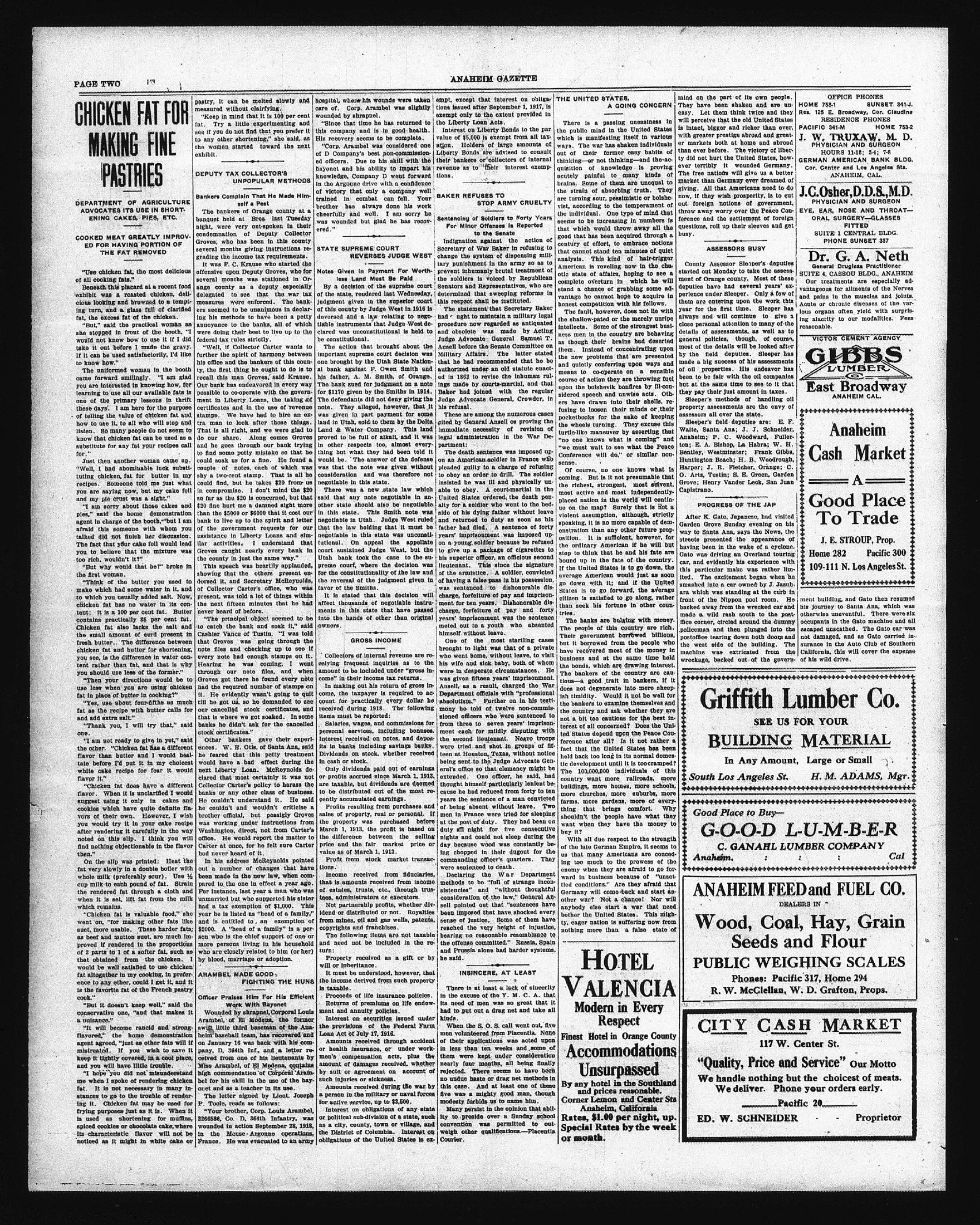
Searchable text
CHICKEN FAT FOR MAKING FINE PASTRIES
DEPARTMENT OF AGRICULTURE ADVOCATES ITS USE IN SHORT-ENING CAKES, PIES, ETC.
COOKED MEAT GREATLY IMPROVED FOR HAVING PORTION OF THE FAT REMOVED
"Use chicken fat, the most delicious of all cooking fats."
Beneath this placard at a recent food exhibit was a roasted chicken, delicious looking and browned to a tempting turn, and a glass full of clarified fat, the excess fat of the chicken.
"But," said the practical woman as she stopped in front of the booth, "I would not know how to use it if I did take it out before I made the gravy. If it can be used satisfactorily, I'd like to know how."
The uniformed woman in the booth came forward smilingly. "I am glad you are interested in knowing how, for learning to use all our available fats is one of the primary lessons in thrift these days." I am here for the purpose of telling the value of chicken fat and how to use it, to all who will stop and listen. So many people do not seem to know that chicken fat can be used as a substitute for any fat your recipes call for."
pastry, it can be melted slowly and measured without clairifying.
"Keep in mind that it is 100 per cent fat. Try a little experimenting and see if you do not find that you prefer it to any other shortening," she said, as the women started toward the next exhibit.
DEPUTY TAX COLLECTOR'S UNPOPULAR METHODS
Bankers Complain That He Made Himself a Pest
The bankers of Orange county at a banquet held at Brea last Tuesday night, were very out-spoken in their condemnation of Deputy Collector Groves; who has been in this county several months giving instructions regrading the income tax requirements.
It was F. C. Krause who started the offensive upon Deputy Groves, who for several months was stationed in Orange county as a deputy especially delegated to see that the war tax measures were enforced. The bankers seemed to be unanimous in declaring his methods to have been a petty annoyance to the banks, all of which were doing their beat to live up to the federal tax rules strictly.
"Well, if Collector Carter wants to further the spirit of harmony between his office and the bankers of this county, the first thing he ought to do is to recall this man Groves," said Krause. Our bank has endeavored in every way possible to co-operate with the government in Liberty Loans, the taking of certificates and in the use of revenue stamps. We have had to hire an extra man to look after those things. That is all right, and we were glad to do our share. Along comes Groves and he goes through our bank trying to find some petty mistake so that he hospital, where he care of. Corp., wounded by shrap.
"Since that time this company and His recovery seen."
"Corp. Aramber of D Company's ed officers. Due bayonet and his knowledge, Comp in the Argonne d of victory that trained in com brother has a cheerfully and was wounded bu ered."
STATE SUPREME REVEAL
Notes Given In less Land
By a decision of the state, reu judgment given of this county by deversed and a tiable instrument clared was unco be constitutional.
The action tha important supreme one brought by th al bank against his father, A. M. The bank sued f or $1170 given b The defendants o note. They all was given in pa land in Utah, sol Land & Water proved to be ful in other respect thing but what
The uniformed woman in the booth came forward smilingly. "I am glad you are interested in knowing how, for learning to use all our available fats is one of the primary lessons in thrift these days." I am here for the purpose of telling the value of chicken fat and how to use it, to all who will stop and listen. So many people do not seem to know that chicken fat can be used as a substitute for any fat your recipes call for."
Just then another woman came up. "Well, I had abominable luck substituting chicken fat for butter in my recipes. Someone told me just what you are saying now, but my cake fell and my pie crust was a sight."
"I am sorry about those cakes and pies," said the home demonstration agent in charge of the booth, "but I am afraid this someone with whom you talked did not finish her discussion. The fact that your cake fell would lead you to believe that the mixture was too rich, wouldn't it?"
"But why would that be?" broke in the first woman.
"Think of the butter you used to make which had some water in it, and to which you usually added salt. Now, chicken fat has no water in its content; it is a 100 per cent fat. Butter contains practically 85 per cent fat. Chicken fat also lacks the salt and the small amount of curd present in fresh butter... The difference between chicken fat and butter for shortening, you see, is the difference in water content rather than fat, and that is why you should use less of the former."
"Then your directions would be to use less when you are using chicken fat in place of butter in cooking?"
"Yes, use about four-fifths as much fat as the recipe with butter calls for and add extra salt."
"Thank you, I will try that," said one.
"I am not ready to give in yet," said the other. "Chicken fat has a different flavor than butter and I would hesitate before I'd put it in my choice white cake recipe for fear it would flavor it."
"Chicken fat does have a different flavor. When it is unclarified I would suggest using it only in cakes and cookies which have quite definite flavors of their own. However, I wish you would try it in your cake recipe after rendering it carefully in the way noted on this slip. I think you will find nothing objectionable in the flavor then."
On the slip was printed: Heat the office and the bankers of this county, the first thing he ought to do is to recall this man Groves, said Krause. Our bank has endeavored in every way possible to co-operate with the government in Liberty Loans, the taking of certificates and in the use of revenue stamps. We have had to hire an extra man to look after those things. That is all right, and we were glad to do our share. Along comes Groves and he goes through our bank trying to find some petty mistake so that he could soak us for a fine. He found a couple of notes, each of which was shy a two-cent stamp. That is all he could find, but he takes $20 from us in compromise. I don't mind the $20 so far as the $20 is concerned, but that $20 fine hurt me a damned sight more than the $5000 or $6000 that it cost our bank to live up to the spirit and letter of the government requests for our assistance in Liberty Loans and similar activities. I understand that Groves caught nearly every bank in the county in just the same way."
This speech was heartily applauded, showing that the others present endorsed it, and Secretary McReynolds, of Collector Carter's office, who was present, was told a lot of things within the next fifteen minutes that he had never heard of before.
"The principal object seemed to be to catch the bank and soak it," said Cashier Vance of Tustin. "I was told that Groves was going through the note files and checking up to see if every note had enough stamps on it. Hearing he was coming, I went through our note files, and when Groves got there he found every note had the required number of stamps on it. He evidently wasn't going to quit till he got us, so he demanded to see our cancelled stock certificates, and that is where we got soaked. In some banks he didn't ask for the cancelled stock certificates."
Other bankers gave their experiences. W. E. Otis, of Santa Ana, said he feared that this petty treatment would have a bad effect during the next Liberty Loan. McReynolds declared that most certainly it was not Collector Carter's policy to harass the banks or any other class of business. He couldn't understand it. He said he couldn't and wouldn't criticise a brother official, but possibly Groves was working under instructions from Washington, direct, not from Carter's office. He would report the matter to Carter at once, for he felt sure Carter had never heard of it.
In his address McReynolds pointed his office and the bankers of this county, the first thing he ought to do is to recall this man Groves, said Krause. Our bank has endeavored in every way possible to co-operate with the government in Liberty Loans, the taking of certificates and in the use of revenue stamps. We have had to hire an extra man to look after those things. That is all right, and we were glad to do our share. Along comes Groves and he goes through our bank trying to find some petty mistake so that he could soak us for a fine. He found a couple of notes, each of which was shy a two-cent stamp. That is all he could find, but he takes $20 from us in compromise. I don't mind the $20 so far as the $20 is concerned, but that $20 fine hurt me a damned sight more than the $5000 or $6000 that it cost our bank to live up to the spirit and letter of the government requests for our assistance in Liberty Loans and similar activities. I understand that Groves caught nearly every bank in the county in just the same way."
This speech was heartily applauded, showing that the others present endorsed it, and Secretary McReynolds, of Collector Carter's office, who was present, was told a lot of things within the next fifteen minutes that he had never heard of before.
"The principal object seemed to be to catch the bank and soak it," said Cashier Vance of Tustin. "I was told that Groves was going through the note files and checking up to see if every note had enough stamps on it. Hearing he was coming, I went through our note files, and when Groves got there he found every note had the required number of stamps on it. He evidently wasn't going to quit till he got us, so he demanded to see our cancelled stock certificates, and that is where we got soaked. In some banks he didn't ask for the cancelled stock certificates."
Other bankers gave their experiences. W. E. Otis, of Santa Ana, said he feared that this petty treatment would have a bad effect during the next Liberty Loan. McReynolds declared that most certainly it was not Collector Carter's policy to harass the banks or any other class of business. He couldn't understand it. He said he couldn't and wouldn't criticise a brother official, but possibly Groves was working under instructions from Washington, direct, not from Carter's office. He would report the matter to Carter at once, for he felt sure Carter had never heard of it.
In his address McReynolds pointed his office and the bankers of this county, the first thing he ought to do is to recall this man Groves, said Krause. Our bank has endeavored in every way possible to co-operate with the government in Liberty Loans, the taking of certificates and in the use of revenue stamps. We have had to hire an extra man to look after those things. That is all right, and we were glad to do our share. Along comes Groves and he goes through our bank trying to find some petty mistake so that he could soak us for a fine. He found a couple of notes, each of which was shy a two-cent stamp. That is all he could find, but he takes $20 from us in compromise. I don't mind the $20 so far as the $20 is concerned, but that $20 fine hurt me a damned sight more than the $5000 or $6000 that it cost our bank to live up to the spirit and letter of the government requests for our assistance in Liberty Loans and similar activities. I understand that Groves caught nearly every bank in the county in just the same way."
This speech was heartily applauded, showing that the others present endorsed it, and Secretary McReynolds, of Collector Carter's office, who was present, was told a lot of things within the next fifteen minutes that he had never heard of before.
"The principal object seemed to be to catch the bank and soak it," said Cashier Vance of Tustin. "I was told that Groves was going through the note files and checking up to see if every note had enough stamps on it. Hearing he was coming, I went through our note files, and when Groves got there he found every note had the required number of stamps on it. He evidently wasn't going to quit till he got us, so he demanded to see our cancelled stock certificates, and that is where we got soaked. In some banks he didn't ask for the cancelled stock certificates."
Other bankers gave their experiences. W. E. Otis, of Santa Ana, said he feared that this petty treatment would have a bad effect during the next Liberty Loan. McReynolds declared that most certainly it was not Collector Carter's policy to harass the banks or any other class of business. He couldn't understand it. He said he couldn't and wouldn't criticise a brother official, but possibly Groves was working under instructions from Washington, direct, not from Carter's office. He would report the matter to Carter at once, for he felt sure Carter had never heard of it.
In his address McReynolds pointed his office and the bankers of this county, the first thing he ought to do is to recall this man Groves, said Krause. Our bank has endeavored in every way possible to co-operate with the government in Liberty Loans, the taking of certificates and in the use of revenue stamps. We have had to hire an extra man to look after those things. That is all right, and we were glad to do our share. Along comes Groves and he goes through our bank trying to find some petty mistake so that he could soak us for a fine. He found a couple of notes, each of which was shy a two-cent stamp. That is all he could find, but he takes $20 from us in compromise. I don't mind the $20 so far as the $20 is concerned, but that $20 fine hurt me a damned sight more than the $5000 or $6000 that it cost our bank to live up to the spirit and letter of the government requests for our assistance in Liberty Loans and similar activities. I understand that Groves caught nearly every bank in the county in just the same way."
There was a sale that any new other state showed in this state.
Negotiable in Utah that the law holds negotiable in this tuteal.
On an court sustained in Utah bank took preme court, which for the constitution reversal of favor of the Smile.
It is stated that affect thousands actions in this state into hands owners.
GROSS
Collectors of iceying frequent amount to be insured come into issue.
In making out come,the taxpayer count for practice received during items must be re
Salaries wage personal service Interest received sales of propertythe property w March 1, 1913,the difference priceandthe valueasof Mar
Profit from
"Chicken fat does have a different flavor. When it is unclarified I would suggest using it only in cakes and cookies which have quite definite flavors of their own. However, I wish you would try it in your cake recipe after rendering it carefully in the way noted on this slip. I think you will find nothing objectionable in the flavor then."
On the slip was printed: Heat the fat very slowly in a double boiler with whole milk (preferably sour). Use ½ cup milk to each pound of fat. Strain the rendered fat through a cloth and when it is set, lift fat from the milk which remains.
"Chicken fat is valuable food," she went on, "for making other fats like suet, more usable. These harder fats; as beef and mutton suet, are much improved if rendered in the proportions of 2 parts to 1 of a softer fat, such as that obtained from the chicken. I would be well satisfied to use chicken fat altogether in my cooking, in preference to any other, could I get it, and it is the favorite fat of the French pastry cook."
"But it doesn't keep well," said the conservative one, "and that makes it a nuisance."
"It will become rancid and strong-flavored," the home demonstration agent agreed, "just as other fats will if mistreated. If you wish to save it keep it tightly covered, in a cool place, and you will have little trouble.
"I hope you did not misunderstand me when I spoke of rendering chicken fat. It is not necessary in many instances to go to the trouble of rendering it. Chicken fat may be used for frying purposes just as it is. When it is used as shortening for muffins, spiced cookies or chocolate cake, where its characteristic flavor will not be noticed as it might in white cake or next Liberty Loan. McReynolds declared that most certainly it was not Collector Carter's policy to harass the banks or any other class of business. He couldn't understand it. He said he couldn't and wouldn't criticise a brother official, but possibly Groves was working under instructions from Washington, direct, not from Carter's office. He would report the matter to Carter at once, for he felt sure Carter had never heard of it.
In his address McReynolds pointed out a number of changes that have been made in the new law, when compared to the one in effect a year ago. For instance, last year a man who was unmarried but who supported his sister had a tax exemption of $1,000. This year he is listed as "head of a family," and is entitled to an exemption of $2000. A "head of a family" is a person who is the chief support of one or more persons living in his household who are closely related to him (or her) by blood, marriage or adoption.
ARAMBEL MADE GOOD
FIGHTING THE HUNS
Officer Praises Him For His Efficient Work With Bayonet
Wounded by shrapnel, Corporal Louis Arambel, of El Modena, the former swift little third baseman of the Anaheim baseball team, has recovered and on January 16 was back with his company, D, 364th Inf., and a letter received from one of his lieutenants by Miss Arambel, of El Modena, contains high commendation of Corporal Arambel for his skill in the use of the bayonet and as a teacher in its use.
The letter signed by Lieut. Joseph P. Toole, reads as follows:
"Your brother, Corp. Louis Arambel, 2266586, Co. D, 364th Infantry, was wounded in action September 28, 1918, in the Meuse-Argonne operations, France. He was evacuated to an army"
Proceeds of his Returns of payment and annuity Interest on sale the provisions Loan Act of July Amounts received or health insurance men's compensation amount of damage by suit or agreement such injuries or Amounts received a person in the for active service Interest on oor political sub- as a city, counthe District of Obligations of th
ANAHEIM GAZETTE
early and super cent long and prefer it should, as the next
METHODS
de Himnty at a Tuesday in their Collector county actions rements. perted the who for in Orspecially war tax one bank of which up to the
wants to between calls coundo is to Krause. Every way governmaking of revenue be an ex-things.
glad to Groves trying that he
hospital, where his wounds were taken care of. Corp. Arambel was slightly wounded by shrapnel.
"Since that time he has returned to this company and is in good health. His recovery seems to be complete.
"Corp. Arambel was considered one of D Company's best non-commissioned officers. Due to his skill with the bayonet and his ability to impart his knowledge, Company D went forward in the Argonne drive with a confidence of victory that only a company well trained in combat can fell. Your brother has always done his work cheerfully and well. I am sorry he was wounded but glad he has recovered."
STATE SUPREME COURT
REVERSES JUDGE WEST
Notes Given in Payment For Worthless Land Must Be Paid
By a decision of the supreme court of the state, rendered last Wednesday, judgment given in the superior court of this county by Judge West in 1916 is deversed and a law relating to negotiable instruments that Judge West declared was unconstitutional is held to be constitutional.
The action that brought about the important supreme court decision was one brought by the Utah State National bank against F. Owen Smith and his father, A. M. Smith, of Orange. The bank sued for judgment on a note for $1170 given by the Smiths in 1914. The defendants did not deny giving the note. They alleged, however, that it was given in part payment for some land in Utah, sold to them by the Delta Land & Water Company. This land proved to be full of alkali, and it was in other respects too, almost everything but what they had been told itempt, except that interest on obligations issued after September 1, 1917, is exempt only to the extent provided in the Liberty Loan Acts.
Interest on Liberty Bonds to the par value of $5,000 is exempt from all taxation. Holders of large amounts of Liberty Bonds are advised to consult their bankers or collectors of internal revenue as to their interest exemptions.
BAKER REFUSES TO STOP ARMY CRUELTY
Sentencing of Soldiers to Forty Years For Minor Offenses is Reported to the Senate
Indignation against the action of Secretary of War Baker in refusing to change the system of dispensing military punishment in the army so as to prevent inhumanly brutal treatment of the soldiers is voiced by Republican Senators and Representatives, who are determined that sweeping reforms in this respect shall be instituted.
The statement that Secretary Baker had ought to maintain a military legal procedure now regarded as antiquated and obsolete was made by Acting Judge Advocate General Samuel T. Ansell before the Senate Committee on Military Affairs. The latter stated that he had recommended that he be authorized under an old statute enacted in 1862 to revise the inhuman rulings made by courts-martial, and that Baker had joined with the regular Judge Advocate General, Crowder, in his refusal.
These are among the numerous cases cited by General Ansell os proving the immediate necessity of revision of legal administration in the War Department:
The death sentence was imposed upon
THE UNITED STATES,
A GOING CONCERN
There is a passing uneasiness in the public mind in the United States which is manifesting itself in various ways. The war has shaken individuals out of their former easy habits of thinking—or not thinking—and the acquisition of knowledge is proving acutely painful to many kinds of brains. Some of them are unequal to the strain of absorbing truth. They are turning sour, pessimistic or bolshevist, according to the temperament of the individual. One type of mind that seems to be increasing in numbers is that which would throw away all the good that has been acquired through a century of effort, to embrace notions that cannot stand ten minutes of quiet analysis. This kind of hair-trigger American is reveling now in the chaotic state of affairs, hoping to see a complete overturn in which he will stand a chance of grabbing some advantage he cannot hope to acquire in honest competition with his fellows.
The fault, however, does not lie with the shallow-patted or the merely unripe intellects. Some of the strongest business men in the country are behaving as though their brains had deserted them. Instead of concentrating upon the new problems that are presented and quietly conferring upon ways and means to co-operate on a sensible course of action they are throwing fuel upon the bolshevik bonfires by ill-considered speech and unwise acts. Others have drawn into their shells, refusing to loosen their minds or their pocketbooks for the sake of keeping the wheels turning. They excuse this turtle-like maneuver by asserting that "no one knows what is coming" and "we must wait to see what the Peace Conference will do," or similar non-
Coast mentions depopular themes year after year close detail genres most by the made of oil been but at they Slide property assesses Slide Walter Anahaton; Bent
one brought by the Utah State National bank against F. Owen Smith and his father, A. M. Smith, of Orange. The bank sued for judgment on a note for $1170 given by the Smiths in 1914. The defendants did not deny giving the note. They alleged, however, that it was given in part payment for some land in Utah, sold to them by the Delta Land & Water Company. This land proved to be full of alkali, and it was in other respects too, almost everything but what they had been told it would be. The answer of the defense was that the note was given without consideration and was therefore not negotiable in this state.
There was a new state law which said that any note negotiable in another state should also be negotiable in this state. This Smith note was negotiable in Utah. Judge West ruled that the law holding that it must be negotiable in this state was unconstitutional. On appeal the appellate court sustained Judge West, but the Utah bank took the case to the supreme court, where the decision was for the constitutionality of the law and the reversal of the judgment given in favor of the Smiths.
It is stated that this decision will affect thousands of negotiable instruments in this state that have passed into the hands of other than original owners.
GROSS INCOME
Collectors of internal revenue are receiving frequent inquiries as to the amount to be included under "gross income" in their income tax returns.
In making out his return of gross income, the taxpayer is required to account for practically every dollar he received during 1918. The following items must be reported:
Salaries, wages, and commissions for personal services, including bonuses. Interest received on notes, and deposits in banks including savings banks. Dividends on stock, whether received in cash or stock.
Only dividends paid out of earnings or profits accrued since March 1, 1913, are taxable, but dividends are deemed to be distributed out of the most recently accumulated earnings.
Profit resulting from purchases and sales of property, real or personal. If the property was purchased before March 1, 1913, the profit is based on the difference between the selling price and the fair market price or value as of March 1, 1913.
Profit from stock market transactions
One of the most startling cases brought to light was that of a private who went home, without leave, to visit his wife and sick baby, both of whom were in desperate circumstances. He was given fifteen years' imprisonment. Ansell, as a result, charged the War Department officials with "professional absolutism." Further on in his testimony he told of twelve non-commissioned officers who were sentenced to from three to seven years' imprisonment each for mildly disputing with the second lieutenant. Negro troops were tried and shot in groups of fifteen at Houston, Texas, without notice being sent to the Judge Advocate General's office so that clemency might be extended. One officer, he said, had thought himself particularly lenient because he had reduced from forty to ten years the sentence of a man convicted of being absent without leave. Two men in France were tried for sleeping at the post of duty. They had been on duty all night for five consecutive nights and could not sleep during the day because wood was constantly being chopped in their dugout for the commanding officer's quarters. They had recommended that he be authorized under an old statute enacted in 1862 to revise the inhuman rulings made by courts-martial, and that Baker had joined with the regular Judge Advocate General, Crowder, in his refusal.
These are among the numerous cases cited by General Ansell os proving the immediate necessity of revision of legal administration in the War Department:
The death sentence was imposed upon an American soldier in France who pleaded guilty to a charge of refusing to obey an order to drill. The soldier insisted he was ill and physically unable to obey. A court-martial in the United States ordered, the death penalty for a soldier who went to the bedside of his dying father without leave and returned to duty as soon as his father had died. A sentence of forty years' imprisonment was imposed upon a young soldier because he refused to give up a package of cigarettes to his superior officer, an officious second lieutenant. This since the signature of the armistice. A soldier, convicted of having a false pass in his possession, was sentenced to dishonorable discharge, forfeiture of pay and imprisonment for ten years. Dishonorable discharge, forfeiture of pay and forty years' imprisonment was the sentence meted out to a youth who absented himself without leave.
Of course, no one knows what is coming. But is it not presumable that the richest, strongest, most slavent, most active and most independently placed nation in the world will continue on the map? Surely that is not a violent assumption, although, strictly speaking, it is no more capable of demonstration than any other future proposition. It is sufficient, however, for the ordinary American if he will but stop to think that he and his fate are bound up in the fate of the country. If the United States is to go down, the average American would just as soon go down with it; and if the United States is to go forward, the average citizen is satisfied to go along, rather than seek his fortune in other countries.
The banks are bulging with money. The people of this country are rich. Their government borrowed billions, but it borrowed from the people who have recovered most of the money in business and at the same time hold the bonds, which are drawing interest. The bankers of the country are cautious—a good trait in bankers, if it does not degenerate into mere sheepish timidity. Would it not be well for the bankers to examine themselves and the country and ask whether they are not a bit too cautious for the best interest of all concerned? Does the United States depend upon the Peace Conference after all? Is it not rather a fact that the United States has been held back too long in its normal domestic development until it is too cramped? The 100,000,000 individuals of this country want more railroads, more buildings, more homes, more schools, more churches, more suburbs, more farms, more gardens, more of everything that brings comfort. Why shouldn't the people have what they want when they have the money to buy it?
With all due respect to the strength of the late German Empire, it seems to us that many Americans are conceding too much to the prowess of the
Only dividends paid out of earnings or profits accrued since March 1, 1913, are taxable, but dividends are deemed to be distributed out of the most recently accumulated earnings.
Profit resulting from purchases and sales of property, real or personal. If the property was purchased before March 1, 1913, the profit is based on the difference between the selling price and the fair market price or value as of March 1, 1913.
Profit from stock market transactions.
Income received from fiduciaries that is amounts received from income of estates, trusts, etc., through trustees, administrators or executors.
Not partnership profits, whether dividend or distributed or not. Royalties from mines, oil and gas wells, patents, copyrights and franchises.
The following items are not taxable and need not be included in the return:
Property received as a gift or by will or inheritance.
It must be understood, however, that the income derived from such property is taxable.
Proceeds of life insurance policies.
Returns of premiums on life endowment and annuity policies.
Interest on securities issued under the provisions of the Federal Farm Loan Act of July 17, 1916.
Amounts received through accident or health insurance, or under workmen's compensation acts, plus the amount of damages received, whether by suit or agreement on account of such injuries or sickness.
Amounts received during the war by a person in the military or naval forces for active service, up to $3,500.
Interest on obligations of any state or political sub-division of a state, such as a city, county, town or village, and the District of Columbia. Interest on obligations of the United States is ex-
HOTEL VALENCIA Modern in Every Respect
Finest Hotel in Orange County Accommodations Unsurpassed
By any hotel in the Southland and prices reasonable.
Corner Lemon and Center Sts Anaheim, California
Rates, $1.00 per night, up.
Special Rates by the week or month.
STATES,
GOING CONCERN
Being uneasiness in the United States itself in various shaken individuals over easy habits of thinking—and the knowledge is proving to many kinds of them are unequal to barbing truth. They possessistic or bolshevist temperament of the type of mind that ushing in numbers is throw away all the acquired through a to embrace notions ten minutes of quiet and of hair-triggering now in the chats, hoping to see a in which he will grabbing some adhope to acquire in with his fellows. But does not lie with for the merely unripe of the strongest busi- country are behaving brains had deserted concentrating upon that are presented during upon ways and state on a sensible they are throwing fuel by bonfires by ill-con- unwise acts. Oth- into their shells, re- their minds or their sake of keeping. They excuse this error by asserting that what is coming" and see what the Peace so," or similar non- mind on the part of its own people. They have been shaken and are uneasy. Let them think twice and they will perceive that the old United States is intact, bigger and richer than ever, with greater prestige abroad and greater markets both at home and abroad than ever before. The victory of liberty did not hurt the United States, however terribly it wounded Germany. The free nations will give us a better market than Germany ever dreamed of giving. All that Americans need to do now, if they wish prosperity, is to cut out foreign notions of government, throw away worry over the Peace Conference and the settlement of foreign questions, roll up their sleeves and get busy.
ASSESSORS BUSY
County Assessor Sleeper's deputies started out Monday to take the assessment of Orange county. Most of these deputies have had several years' experience under Sleeper. Only a few of them are entering upon the work this year for the first time. Sleeper has always and will continue to give a close personal attention to many of the details of assessments, as well as to general policies, though, of course, most of the details will be looked after by the field deputies. Sleeper has made a big success of his assessments of oil properties. His endeavor has been to be fair with the oil companies but at the same time to see to it that they pay their just amount in taxes.
Sleeper's methods of handling oil property assessments are the envy of assessors all over the state.
Sleeper's field deputies are: E. F. Walte, Santa Ana; J. J. Schneider, Anaheim; P. C. Woodward, Fullerton; E. A. Bishop, La Habra; W. H. Bentley, Westminster; Frank Gibbs,
OFFICE PHONES
HOME 753-1 SUNSET 341-J.
Res. 125 E. Broadway, Cor. Claudina RESIDENCE PHONES
PACIFIC 341-M HOME 753-2
J. W. TRUXAW, M.D.
PHYSICIAN AND SURGEON
HOURS 11-12; 2-4; 7-8
GERMAN AMERICAN BANK BLDG.
Cor. Center and Los Angeles Sts.
ANAHEIM, CAL.
J.C.Osher,D.D.S.,M.D.
PHYSICIAN AND SURGEON
EYE, EAR, NOSE AND THROAT—ORAL SURGERY—GLASSES FITTED
SUITE 1 CENTRAL BLDG.
PHONE SUNSET 337
Dr. G. A. Neth
General Drugless Practitioner
SUITE 4, CASSOU BLDG., ANAHEIM
Our treatments are especially advantageous for alliments of the Nerves and pains in the muscles and joints. Acute or chronic diseases of the various organs often yield with surprising alacrity to our modalities. Fees reasonable.
VICTOR CEMENT AGENCY.
GIBBS LUMBER
East Broadway
ANAHEIM CAL.
Anaheim Cash Market
Anaheim Cash Market
A Good Place To Trade
J. E. STROUP, Prop.
Home 282 Pacific 300
109-111 N. Los Angeles St.
PROGRESS OF THE JAP
After K. Gato, Japanese, had visited Garden Grove Sunday evening on his way to Santa Ana, says the News, the streets presented the appearance of having been in the wake of a cyclone. Gato was driving an Overland touring car, and evidently his experience with this particular make was rather limited. The excitement began when he smashed into a car owned by J. Jasuhara which was standing at the curb in front of the Nippon pool room. He backed away from the wrecked car and made a wild rash south to the post office corner, circled around the dummy policeman and then plunged into the postoffice tearing down both doors and the west side of the building. The machine was extricated from the wreckage, backed out of the government building, and Gato then resumed his journey to Santa Ana, which was otherwise uneventful. There were six occupants in the Gato machine and all escaped unscathed. The Gato car was not damaged, and as Gato carried insurance in the Auto Club of Southern California, this will cover the expense of his wild drive.
Griffith Lumber Co.
SEE US FOR YOUR BUILDING MATERIAL
In Any Amount, Large or Small
South Los Angeles St. H. M. ADAMS, Mgr.
Good Place to Buy—
G-O-O-D L-U-M-B-E-R
C. GANAHL LUMBER COMPANY
Anaheim: : : : Cal
South Los Angeles St. H. M. ADAMS, Mgr.
Good Place to Buy—
G-O-O-D L-U-M-B-E-R
C. GANAHL LUMBER COMPANY
Anaheim, Cal
ANAHEIM FEED and FUEL CO.
DEALERS IN
Wood, Coal, Hay, Grain
Seeds and Flour
PUBLIC WEIGHING SCALES
Phones: Pacific 317, Home 294
R. W. McClellan, W. D. Grafton, Props.
CITY CASH MARKET
117 W. Center St.
“Quality, Price and Service” Our Motto
We handle nothing but the choicest of meats.
We deliver. Phone your orders early.
Pacific 20
ED. W. SCHNEIDER - Proprietor