anaheim-gazette 1919-02-20
Scanned page
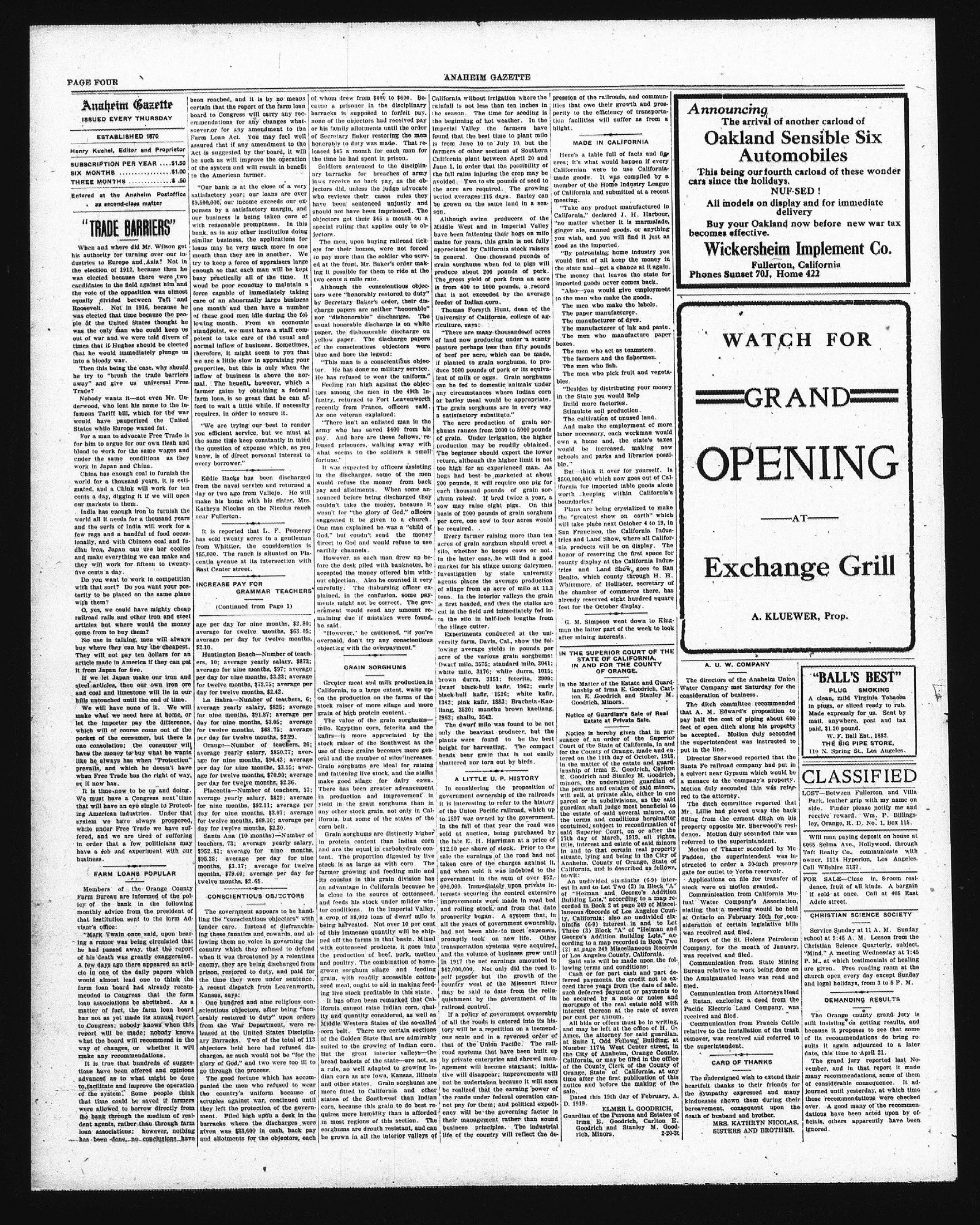
Searchable text
Anaheim Gazette
ISSUED EVERY THURSDAY
ESTABLISHED 1870
Henry Kuchel, Editor and Proprietor
SUBSCRIPTION PER YEAR ...$1.50
SIX MONTHS ...$1.00
THREE MONTHS ...$ .50
Entered at the Anaheim Postoffice as second-class matter
"TRADE BARRIERS"
When and where did Mr. Wilson get his authority for turning over our industries to Europe and Asia? Not in the election of 1912, because then he was elected because there were two candidates in the field against him and the vote of the opposition was almost equally divided between Taft and Roosevelt. Not in 1916, because he was elected that time because the people of the United States thought he was the only man who could keep us out of war and we were told divers of times that if Hughes should be elected that he would immediately plunge us into a bloody war.
Then this being the case, why should he try to "brush the trade barriers away" and give us universal Free Trade?
Nobody wants it—not even Mr. Underwood, who lent his name to the infamous Tariff bill, which for the war would have pauperized the United States while Europe waxed fat.
For a man to advocate Free Trade is for him to argue for our own flesh and blood to work for the same wages and conditions so they been reached, and it is by no means certain that the report of the farm loan board to Congress will carry any recommendations for any changes whatsoever, or for any amendment to the Farm Loan Act. You may feel well assured that if any amendment to the Act is suggested by the board, it will be such as will improve the operation of the system and will result in benefit to the American farmer.
"Our bank is at the close of a very satisfactory year; our loans are over $9,500,000, our income exceeds our expenses by a satisfactory margin, and our business is being taken care of with reasonable promptness. In this bank, as in any other institution doing similar business, the applications for loans may be very much more in one month than they are in another. We try to keep a force of appraisers large enough so that each man will be kept busy practically all of the time. It would be poor economy to maintain a force capable of immediately taking care of an abnormally large business one month and then have a number of these good men idle during the following month. From an economic standpoint, we must have a staff competent to take care of the usual and normal inflow of business. Sometimes, therefore, it might seem to you that we are a little slow in appraising your properties, but this is only when the inflow of business is above the normal. The benefit, however, which a farmer gains by obtaining a federal farm loan is so great that he can afford to wait a little while, if necessity requires, in order to secure it.
"We are trying our best to render you efficient service, but we must at the same time keep constantly in mind the question of expense which, as you know, is of direct personal interest to whom drew from cause a prisoner or barracks is supposed none of the objectors or his family allotment of Secretary Baker honorably to duty leased $45 a month the time he had spent.
Soldiers sentencedary barracks for laws receive no barjectors did, unless who reviews their have been sentenced should not have barjectors get their special ruling than barjectors.
The men, upon its for their home to pay more than ed at the front, M ing it possible for two cents a mile r.
Although the barjectors were "honored by Secretary Baker charge papers are nor "dishonorable usual honorable paper, the dishonorable yellow paper. To of the conscientious blue and bore them.
"This man is a tor. He has done He has refused t Feeling ran histors among the fantry, returned recently from Fr As one veteran t "There isn't any army who has paid. And here leased prisoners, what seems to
Then this being the case, why should he try to "brush the trade barriers away" and give us universal Free Trade?
Nobody wants it—not even Mr. Underwood, who lent his name to the infamous Tariff bill, which for the war would have pauperized the United States while Europe waxed fat.
For a man to advocate Free Trade is for him to argue for our own flesh and blood to work for the same wages and under the same conditions as they work in Japan and China.
China has enough coal to furnish the world for a thousand years, it is estimated, and a Chink will work for ten cents a day, digging it if we will open our markets to them.
India has enough iron to furnish the world all it needs for a thousand years and the serfs of India will work for a few rags and a handful of food occasionally, and with Chinese coal and Indian iron, Japan can use her coolies and make everything we can make and they will work for fifteen to twenty-five cents a day.
Do you want to work in competition with that sort? Do you want your posterity to be placed on the same plane with them?
O. yes, we could have mighty cheap railroad rails and other iron and steel articles but where would the money come from to buy them?
No use in talking, men will always buy where they can buy the cheapest. They will not pay ten dollars for an article made in America if they can get it from Japan for five.
If we let Japan make our iron and steel articles, then our own iron ore and coal and limestone will lie in our hills untouched until the end of time.
We will have none of it. We will make what we need here at home, or let the importer pay the difference, which will of course come out of the pocket of the consumer, but there is one consolation; the consumer will have the money to buy what he wants like he always has when "Protection" prevails, and which he doesn't have when Free Trade has the right of way, as it now has.
It is time now to be up and doing. We must have a Congress next time that will have an eye single to Protecting American industries. Under that system we have always prospered, while under Free Trade we have suffered, and we are tired of suffering in order that a few politicians may have a job and experiment with our business.
Eddie Backs has been discharged from the naval service and returned a day or two ago from Vallejo. He will make his home with his sister, Mrs. Kathryn Nicolas on the Nicolas ranch near Fullerton.
It is reported that L. F. Pomeroy has sold twenty acres to a gentleman from Whittier, the consideration is $55,000. The ranch is situated on Placentia avenue at its intersection with East Center street.
INCREASE PAY FOR GRAMMAR TEACHERS
(Continued from Page 1)
age per day for nine months, $2.80; average for twelve months, $63.05; average per day for twelve months, $2.10.
Huntington Beach—Number of teachers, 10; average yearly salary, $873; average for nine months, $97; average per day for nine months, $3.23; average for twelve months, $72.75; average per day for twelve months, $2.42.
La Habra—Number of teachers, 6; average yearly salary, $825; average for nine months, $91.87; average per day for nine months, $3.05; average for twelve months, $68.75; average per day for twelve months, $2.29.
Orange—Number of teachers, 26; average yearly salary, $850.77; average for nine months, $94.43; average per day for nine months, $3.15; average for twelve months, $70.90; average per day for twelve months, $2.36.
Placentia—Number of teachers, 13; average yearly salary, $829; average for nine months, $92.11; average per day for nine months, $3.07; average for twelve months, $69.10; average per day for twelve months, $2.30.
Santa Ana (10 months)—Number of teachers, 73; average yearly salary, $952.81; average for nine months, $95.28; average per day for nine months, $3.17; average for twelve weeks in appraising your properties, but this is only when the inflow of business is above the normal. The benefit, however, which a farmer gains by obtaining a federal farm loan is so great that he can afford to wait a little while, if necessity requires, in order to secure it.
"We are trying our best to render you efficient service, but we must at the same time keep constantly in mind the question of expense which, as you know, is of direct personal interest to every borrower."
There isn't any army who has paid. And here is leased prisoners, what seems to be fortune."
It was expected in the discharge would refuse the pay and allotment nounced before he couldn't take them wasn't for "the price suggested it be." One man explains God," but could direct to God and earthly channels.
However, as before the desk pilots accepted the move out objection. A carefully. The plained, in the events might not remain due if he said.
"However," he overpaid, don't objecting with the GRAIN.
Greater meat California, to a mile Egyptian kafirs—is more stock raiser of use of these gravel and the number Grain sorghums and fattening livestock make good silage. There has been in production yield in the grain any other stockifornia, but some corn belt.
Grain sorghum in protein content and are the equivalent stockstock is as lard.
FARM LOANS POPULAR
Members of the Orange County Farm Bureau are informed of the policy of the bank in the following monthly advice from the president of that institution sent to the larm Advisor's office:
"Mark Twain once said, upon hearing a rumor was being circulated that he had passed away, that the report of his death was greatly exaggerated. A few days ago there appeared an article in one of the daily papers which would almost lead one to think the farm loan board had already recommended to Congress that the farm loan associations be abolished. As a matter of fact, the farm loan board has not as yet made its annual report to Congress; nobody knows when this report will be made; nobody knows what the board will recommend in the way of changes, or whether it will make any recommendations.
It is true that hundreds of suggestions have been offered and opinions advanced as to what might be done to facilitate and improve the operation of the system. Some people think that time could be saved if farmers were allowed to borrow directly from the bank through the medium of resident agents, rather than through farm loan associations; however, nothing has been done, no conclusions have
Placentia—Number of teachers, 13; average yearly salary, $829; average for nine months, $92.11; average per day for nine months, $3.07; average for twelve months, $69.10; average per day for twelve months, $2.30.
Santa Ana (10 months)—Number of teachers, 73; average yearly salary, $952.81; average for nine months, $95.28; average per day for nine months, $3.17; average for twelve months, $79.40; average per day for twelve months, $2.65.
CONSCIENTIOUS OBJECTORS
The government appears to be handling the "conscientious objectors" with tender care. Instead of disfranchising these fanatics and cowards, and allowing them no voice in governing the country which they refused to defend when it was threatened by a relentless enemy, they are being discharged from prison, restored to duty, and paid for the time they were under sentence. A recent dispatch from Leavenworth, Kansas, says:
One hundred and nine religious conscientious objectors, after being "honorably restored to duty" upon orders from the War Department, were released at the United States Disciplinary Barracks. Two of the total of 113 objects held here had refused discharges, as such would not be "for the glory of God," and two were too ill to go through the process.
The good fortune which has accompanied the men who refused to wear the country's uniform because of scruples against war, continued until they left the protection of the government. Piled high upon a desk in the barracks where the discharges were given was $33,600 in cash, back pay and allotments for the objectors, each
It has often been lorem ipsum dolor sit amet, adipiscing elit. Donec ut leo euismod eget dolor sit amet, adipiscing elit. Donec ut leo euismod eget dolor sit amet, adipiscing elit. Donec ut leo euismod eget dolor sit amet, adipiscing elit. Donec ut leo euismod eget dolor sit amet, adipiscing elit. Donec ut leo euismod eget dolor sit amet, adipiscing elit. Donec ut leo euismod eget dolor sit amet, adipiscing elit. Donec ut leo euismod eget dolor sit amet, adipiscing elit. Donec ut leo euismod eget dolor sit amet, adipiscing elit. Donec ut leo euismod eget dolor sit amet, adipiscing elit. Donec ut leo euismod eget dolor sit amet, adipiscing elit. Donec ut leo euismod eget dolor sit amet, adipiscing elit. Donec ut leo euismod eget dolor sit amet, adipiscing elit. Donec ut leo euismod eget dolor sit amet, adipiscing elit. Donec ut leo euismod eget dolor sit amet, adipiscing elit. Donec ut leo euismod eget dolor sit amet, adipiscing elit. Donec ut leo euismod eget dolor sit amet, adipiscing elit. Donec ut leo euismod eget dolor sit amet, adipiscing elit. Donec ut leo euismod eget dolor sit amet, adipiscing elit. Donec ut leo euismod eget dolor sit amet, adipiscing elit. Donec ut leo euismod eget dolor sit amet, adipiscing elit. Donec ut leo euismod eget dolor sit amet, adipiscing elit. Donec ut leo euismod eget dolor sit amet, adipiscing elit. Donec ut leo euismod eget dolor sit amet, adipiscing elit. Donec ut leo euismod eget dolor sit amet, adipiscing elit. Donec ut leo euismod eget dolor sit amet, adipiscing elit. Donec ut leo euismod eget dolor sit amet, adipiscing elit. Donec ut leo euismod eget dolor sit amet, adipiscing elit. DonecUT leo euismod eget dolor sit amet, adipiscing elit. Donec UT leo euismod eget dolor sit amet, adipiscing elit. Donec UT leo euismod eget dolor sit amet, adipiscing elit. Donec UT leo euismod eget dolor sit amet, adipiscing elit. Donec UT leo euismod eget dolor sit amet, adipiscing elit. Donec UT leo euismod eget dolor sit amet, adipiscing elit. Donec UT leo euismod eget dolor sit amet, adipiscing elit. DONEC UT leo euismod eget dolor sit amet, adipiscing elit. DONEC UT leo euismod eget dolor sit amet, adipiscing elit. DONEC UT leo euismod eget dolor sit amet, adipiscing elit. DONEC UT leo euismod eget dolor sit amet, adipiscing elit. DONEC UT leo euismod eget dolor sit amet, adipiscing elit. DONEC UT leo euismod eget dolor sit amet, adipiscing elit.
Grain sorghum in protein content and are the equivalent stock is as large farmer growing its cousins in an advantageous climate conditions.
A crop of 88,000 being harvested of this immense ped off the farm with cottonseed; the production and poultry. The grown sorghum grain, with real seed meal, ought ing live stock ppt.
It has often been lorem ipsum dolor sit amet, adipiscing elit. DONEC UT leo euismod eget dolor sit amet, adipiscing elit. DONEC UT leo euismod eget dolor sit amet, adipiscing elit. DONEC UT leo euismod eget dolor sit amet, adipiscing elit. DONEC UT leo euismod eget dolor sit amet, adipiscing elit. DONEC UT leo euismod eget dolor sit amet, adipiscing elIT.
Of the Golden Sage suited to the grap But the great bread baskets on a rule so well dian corn as an and other states more fitted to states of the corn because it quires more hum in most regions sorghums are do be grown in al-
ANAHEIM GAZETTE
some means on loan they receive what to the well to the suit will liberation benefit
a very over your ex-ten, and care of this doing cons for in one. We large we kept me. It contain a taking business number the foliom economic affair and sometimes you that bring your men the nor which a federal can afford necessity
render must at in mind as you interest to
of whom drew from $400 to $600. Because a prisoner in the disciplinary barracks is supposed to forfeit pay, none of the objectors had received pay or his family allotments until the order of Secretary Baker restoring the men honorably to duty was made. That released $45 a month for each man for the time he had spent in prison.
Soldiers sentenced to the disciplinary barracks for breaches of army laws receive no back pay, as the objectors did, unless the judge advocate who reviews their cases rules they have been sentenced unjustly and should not have been imprisoned. The objectors get their $45 a month on a special ruling that applies only to objectors.
The men, upon buying railroad tickets for their homes, were not forced to pay more than the soldier who served at the front, Mr. Baker's order making it possible for them to ride at the two cents a mile rate.
Although the conscientious objectors were "honorably restored to duty" by Secretary Baker's order, their discharge papers are neither "honorable" nor "dishonorable" discharges. The usual honorable discharge is on white paper, the dishonorable discharge on yellow paper. The discharge papers of the conscientious objectors were blue and bore the legend:
"This man is a conscientious objector. He has done no military service. He has refused to wear the uniform."
Feeling ran high against the objectors among the men in the 49th Infantry, returned to Fort Leavenworth recently from France, officers said. As one veteran explained:
"There isn't an enlisted man in the army who has saved $400 from his pay. And here are these fellows, released prisoners, walking away with what seems to the soldiers a small California without irrigation where the rainfall is not less than ten inches in the season. The time for seeding is the beginning of hot weather. In the Imperial Valley the farmers have found that the best time to plant milo is from June 10 to July 10, but the farmers of other sections of Southern California plant between April 20 and June 1, in order that the possibility of the fall rains injuring the crop may be avoided. Two to six pounds of seed to the acre are required. The growing period averages 115 days. Barley can be grown on the same land in a season.
Although swine producers of the Middle West and in Imperial Valley have been fattening their hogs on milo maize for years, this grain is not fully appreciated by California stock raisers in general. One thousand puonds of grain sorghums when fed to pigs will produce about 200 pounds of pork. The gross yield of pork from an acre is from 400 to 1000 pounds, a record that is not exceeded by the average feeder of Indian corn.
Thomas Forsyth Hunt, dean of the University of California, college of agriculture, says:
"There are many thousands of acres of land now producing under a scanty pasture perhaps less than fifty pounds of beef per acre, which can be made, if planted to grain sorghums, to produce 1000 pounds of pork or its equivalent of milk or eggs. Grain sorghums can be fed to domestic animals under any circumstances where Indian corn or barley meal would be appropriate. The grain sorghums are in every way a satisfactory substitute."
The acre production of grain sorghums ranges from 2000 to 5000 pounds of grain. Under irrigation, the higher production may be readily obtained. The beginner should expert the lower pressure of the railroads, and communities that owe their growth and prosperity to the efficiency of transportation facilities will suffer as from a blight.
MADE IN CALIFORNIA
Here's a table full of facts and figures; it's what would happen if every Californian were to use California-made goods. It was compiled by a member of the Home Industry League of California and submitted at a recent meeting.
"Take any product manufactured in California," declared J. H. Harbour, "no matter whether it is marmalade, ginger ale, canned goods, or anything you wish, and you will find it just as good as the imported.
"By patronizing home industry you would first of all keep the money in the state and—get a chance at it again. The money that leaves the state for imported goods never comes back.
"Also—you would give employment to the men who make the goods.
The men who make the labels.
The paper manufacturer.
The manufacturer of dyes.
The manufacturer of ink and paste.
The men who manufacture paper boxes.
The men who act as teamsters.
The farmers and the fishermen.
The men who fish.
The men who pick fruit and vegetables.
"Besides by distributing your money in the State you would Help Build more factories.
Stimulate soil production.
The cultivation of unused land.
And make the employment of more labor necessary, each workman would own a home and, the state's taxes would be increased, making new schools and parks and libraries possi-
"This man is a conscientious objector. He has done no military service. He has refused to wear the uniform."
Feeling ran high against the objects among the men in the 49th Infantry, returned to Fort Leavenworth recently from France, officers said. As one veteran explained:
"There isn't an enlisted man in the army who has saved $400 from his pay. And here are these fellows, released prisoners, walking away with what seems to the soldiers a small fortune."
It was expected by officers assisting in the discharges, some of the men would refuse the money from back pay and allotments. When some announced before being discharged they couldn't take the money, because it wasn't for "the glory of God," officers suggested it be given to a church.
One man explained he was a "child of God," but couldn't send the money direct to God and would refuse to use earthly channels.
However, as each man drew up before the desk piled with banknotes, he accepted the money offered him without objection. Also he counted it very carefully. The disbursing officer explained, in the confusion, some payments might not be correct. The government would send any amount remaining due if mistakes were found, he said.
"However," he cautioned, "if you're overpaid, don't try any conscientious objecting with the overpayment."
GRAIN SORGHUMS
Greater meat and milk production in California, to a large extent, waits upon the production on the farms of the stock raiser of more silage and more grain of high protein content.
The value of the grain sorghums—milo, Egyptian corn, feterita and kafirs—is more appreciated by the stock raiser of the Southwest as the use of these grains becomes more general and the number of silos increases. Grain sorghums are ideal for raising and fattening live stock, and the stalks make good silage for dairy cows.
There has been greater advancement in production and improvement in yield in the grain sorghums than in any other stock grain, not only in California, but some of the states of the corn belt.
Grain sorghums are distinctly higher in protein content than Indian corn and are the equal in carbohydrate content. The proportion digested by live stock is as large as with corn. The if planted to grain sorghums, to produce 1000 pounds of pork or its equivalent of milk or eggs. Grain sorghums can be fed to domestic animals under any circumstances where Indian corn or barley meal would be appropriate. The grain sorghums are in every way a satisfactory substitute."
The acre production of grain sorghums ranges from 2000 to 5000 pounds of grain. Under irrigation, the higher production may be readily obtained. The beginner should expert the lower return, although the higher limit is not too high for an experienced man. As hogs had best be marketed at about 200 pounds, it will require one pig for each thousand pounds of grain sorghum raised. If bred twice a year, a sow may raise eight pigs. On this basis of 2000 pounds of grain sorghum per acre, one sow to four acres would be required.
Every farmer raising more than ten acres of grain sorghum should erect a silo, whether he keeps cows or not. In the latter case, he will find a good market for his silage among dairymen. Investigation by state university agents places the average production of silage from an acre of milo at 11.3 tons. In the interior valleys the grain is first headed, and then the stalks are cut in the field and immediately fed into the silo in half-inch lengths from the silage cutter.
Experiments conducted at the university farm, Davis, Cal., show the following average yields in pounds per acre of the various grain sorghums: Dwarf milo, 3575; standard milo, 3041; white milo, 3176; white durra, 1015; brown durra, 3151; feterita, 2909; dwarf black-hull kafar, 1962; early black-hull kafar, 1516; white kafar, 1342; pink kafar, 1883; Brachets-Kaollang, 2520; manchu brown kaollang, 2962; shallu, 3542.
The dwarf milo was found to be not only the heaviest producer, but the plants were found to be the best height for harvesting. The compact beads bear grain that is not easily shattered nor torn out by birds.
A LITTLE U. P. HISTORY
In considering the proposition of government ownership of the railroads it is interesting to refer to the history of the Union Pacific railroad, which up to 1897 was owned by the government. In the fall of that year the road was sold at auction, being purchased by the late E. H. Harriman at a price of $12.50 per share of stock. Prior to the sale the earnings of the road had not taken care of the charges against it.
The farmer who fish.
The men who pick fruit and vegetables.
"Besides by distributing your money in the State you would help Build more factories.
Stimulate soil production.
The cultivation of unused land.
And make the employment of more labor necessary, each workman would own a home and, the state's taxes would be increased, making new schools and parks and libraries possible."
But—think it over for yourself. Is $500,000,000 which now goes out of California for imported table goods alone worth keeping within California's boundaries?
Plans are being crystallized to make the "greatest show on earth" which will take place next October 4 to 19, in San Francisco, the California Industries and Land Show, where all California products will be on display. The honor of reserving the first space for county display at the California Industries and Land Show goes to San Benito, which county through H. H. Whittmore, of Hollister, secretary of the chamber of commerce there, has already reserved eight hundred square feet for the October display.
G. M. Simpson went down to Kingman the latter part of the week to look after mining interests.
IN THE SUPERIOR COURT OF THE STATE OF CALIFORNIA, IN AND FOR THE COUNTY OF ORANGE.
In the Matter of the Estate and Guardianship of Irma E. Goodrich, Carlton E. Goodrich and Stanley M. Goodrich, Minors.
Notice of Guardian's Sale of Real Estate at Private Sale.
Notice is hereby given that in pursuance of an order of the Superior Court of the State of California, in and for the County of Orange, made and entered on the 11th day of October, 1918, in the matter of the estate and guardianship of Irma E. Goodrich, Carlton E. Goodrich and Stanley M. Goodrich, Minors, the undersigned guardian of the persons and estates of said minors, will sell, at private sale, either in one parcel or in subdivisions, as the said guardian shall judge most beneficial to the estate of said several minors, on the terms and conditions hereinafter contained, subject to reconfirmation of said Superior Court, on or after the 17th day of March, 1919, all rights, title, interest and estate of said minors in and to that certain real property situate, lying and being in the City of Anaheim, County of Orange, State of
be handlers" with franchisors, and alarming the to defend inefficiently urged from the paid for presence. Evenworth,
conjunction of "honor orders were re-disciplined of 113 used disguise "for the too ill to us accommodate to wear because of closed until the governask in theages were back payctors, each
Grain sorghums are distinctly higher in protein content than Indian corn and are the equal in carbohydrate content. The proportion digested by live stock is as large as with corn. The farmer growing and feeding milo and its cousins in this grain division has an advantage in California because he is close to the source of cottonseed, and feeds his stock under mild winter conditions. In the Imperial Valley, a crop of 88,000 tons of dwarf milo is being harvested. Not over 10 per cent of this immense quantity will be shipped off the farms in that basin. Mixed with cottonseed products, it goes into the production of beef, pork, mutton and poultry. The combination of home-grown sorghum silage and feeding grain, with readily accessible cotton-seed meal, ought to aid in making feeding live stock profitable in this state.
It has often been remarked that California cannot raise Indian corn, quality and quantity considered, as well as Middle Western States of the so-called corn belt. There are certain sections of the Golden State that are admirably suited to the growing of Indian corn. But the great interior valleys—the bread baskets of the state—are not, as a rule, so well adapted to growing Indian corn as are Iowa, Kansas, Illinois and other states. Grain sorghums are more fitted to California and other states of the Southwest than Indian corn, because this grain to do best requires more humidity than is afforded in most regions of this section. The sorghums are drought resistant, and can be grown in all the interior valleys of
A LITTLE U. P. HISTORY
In considering the proposition of government ownership of the railroads it is interesting to refer to the history of the Union Pacific railroad, which up to 1897 was owned by the government. In the fall of that year the road was sold at auction, being purchased by the late E. H. Harriman at a price of $12.50 per share of stock. Prior to the sale the earnings of the road had not taken care of the charges against it, and when sold it was indebted to the government in the sum of over $52,000,000. Immediately upon private interests securing the control extensive improvements were made in road bed and rolling stock; and from that date prosperity began. A system that, in all the years of government ownership, had not been able to meet expenses, promptly took on new life. Other transportation systems were acquired, and the volume of business grew until in 1917 the net earnings amounted to $42,000,000. Not only did the road itself prosper but the growth of the country west of the Missouri River may be said to date from the relinquishment by the government of its railroad control.
If a policy of government ownership of all the roads is entered into its history will be a repetition on a tremendous scale and in a reversed order of that of the Union Pacific. The railroad systems that have been built up by private enterprise and shrewd management will become stagnant; initiative will disappear; improvements will not be undertaken because it will soon be realized that the earning power of the roads under federal operation cannot pay for them; and political expediency will be the governing factor in their management rather than sound business principles. The industrial life of the country will reflect the de-
An undivided six-ninths (6-9) interest in and to Lot Two (2) in Block "A" of "Helman and George's Addition Building Lots," according to a map recorded in Book 2 at page 249 of Miscellaneous Records of Los Angeles County, California; also an undivided six-ninths (6-9) interest in and to Lot Three (3) Block "A" of "Helman and George's Addition Building Lots," according to a map recorded in Book Two (2) at page 249 Miscellaneous Records of Los Angeles County, California.
Said sale will be made upon the following terms and conditions:
Cash or for part cash and part deferred payments, the credit not to exceed three years from the date of sale, such deferred payment or payments to be secured by a note or notes and mortgage of the real estate sold with interest thereon at the rate of seven per cent per annum.
All bids or offers must be in writing, and may be left at the office of H. G. Ames, the attorney for said guardian, at Suite I, Odd Felloww' Building, at Number 117½ West Center street, in the City of Anaheim, Orange County, California, or may be filed in the office of the County Clerk of the County of Orange, State of California, at any time after the first publication of this notice and before the making of the sale.
Dated this 19th day of February, A.D. 1919.
ELMER L. GOODRICH,
Guardian of the Persons and Estates of Irma E. Goodrich, Carlton E. Goodrich and Stanley M. Goodrich, Minors.
2-20-3t
Announcing
The arrival of another carload of
Oakland Sensible Six
Automobiles
This being our fourth carload of these wonder
cars since the holidays.
NUF-SED!
All models on display and for immediate
delivery
Buy your Oakland now before new war tax
becomes effective.
Wickersheim Implement Co.
Fullerton, California
Phones Sunset 70J, Home 422
WATCH FOR
GRAND
OPENING
GRAND OPENING AT Exchange Grill
A. KLUEWER, Prop.
A. U. W. COMPANY
The directors of the Anaheim Union Water Company met Saturday for the consideration of business.
The ditch committee recommended that A. M. Edward's proposition to pay half the cost of piping about 600 feet of open ditch along his property be accepted. Motion duly seconded the superintendent was instructed to put in the line.
Director Sherwood reported that the Santa Fe railroad company had put in a culvert near Gypsum which would be a menace to the company's property. Motion duly seconded this was referred to the attorney.
The ditch committee reported that Mr. Lillie had plowed away the back filling from the cement ditch on his property opposite Mr. Sherwood's residence. Motion duly seconded this was referred to the superintendent.
Motion of Thamer seconded by McFadden, the superintendent was instructed to order a 30-inch pressure
"BALL'S BEST"
PLUG SMOKING
A clean, mild Virginia Tobacco in plugs, or sliced ready to rub. Made expressly for us. Sent by mail, anywhere, post and tax paid, $1.20 pound.
W. F. Ball Est., 1882.
THE BIG PIPE STORE,
110 N. Spring St., Los Angeles.
CLASSIFIED
LOST—Between Fullerton and Villa Park, leather grip with my name on side. Finder please notify me and receive reward. Wm. P. Billingsley, Orange, R. D. No. 1, Box 115.
Will man paying deposit on house at 6065 Selma Ave., Hollywood, through Taft Realty Co., communicate with owner, 1124 Hyperion, Los Angeles.
STANLEY M. GOODRICH, CARLTON
Designated guardian of estates of said minors,
the sale, either in one division, as the said
most beneficial to several minors, on
conditions hereinafter
to reconfirmation of
court, on or after the
month, 1919, all rights,
estate of said minors
certain real property
being in the City of
Orange, State of
described as follows,
IX-ninths (6-9) interTwo (2) in Block "A"
George's Addition
According to a map reported page 249 of Misceldies of Los Angeles Countury, California.
A undivided sixrest in and to Lot
"A" of "Helman and
Building Lots," accorecorded in Book Two
of Miscellaneous Records
County, California.
We made upon the following conditions:
Part cash and part detax the credit not to exfrom the date of sale,
payment or payments to
note or notes and
real estate sold with
that the rate of seven
mm.
Mrs. must be in writing,
at the office of H. G.
Keyy for said guardian,
Fellow' Building, at
West Center street, in
Helim, Orange County,
may be filed in the office
work of the County of
California, at any
first publication of this
issue the making of the
day of February, A.
HER L. GOODRICH,
Persons and Estates of
Goodrich, Carlton E.
and Stanley M. Good2-20-3t
CLASSIFIED
LOST—Between Fullerton and Villa
Park, leather grip with my name on
side. Finder please notify me and
receive reward. Wm. P. Billingsley, Orange, R. D. No. 1, Box 115.
Will man paying deposit on house at
6065 Selma Ave., Hollywood, through
Taft Realty Co., communicate with
owner, 1124 Hyperion, Los Angeles.
Call Wilshire 3137.
FOR SALE—Close in, 8-room residence, fruit of all kinds. A bargain
if sold at once. Call at 405 East
Adele street.
CHRISTIAN SCIENCE SOCIETY
Service Sunday at 11 A.M. Sunday
school at 9:45 A.M. Lesson from the
Christian Science Quarterly, subject,
"Mind." A meeting Wednesday at 7:45
P.M., at which testimonials of healing
are given. Free reading room at the
church open every day except Sunday
and legal holidays, from 3 to 5 P.M.
DEMANDING RESULTS
The Orange county grand jury is still insisting on getting results, and because it proposes to see that some of its recommendations do bring results it again adjourned to a later date, this time to April 21.
The grand jury reported last November, and in that report it made many recommendations, some of them of considerable consequence. It ad-journed until yesterday, at which time those recommendations were checked over. A good many of the recommendations have been acted upon by officials, others apparently have been ignored.