anaheim-gazette 1919-02-20
Scanned page
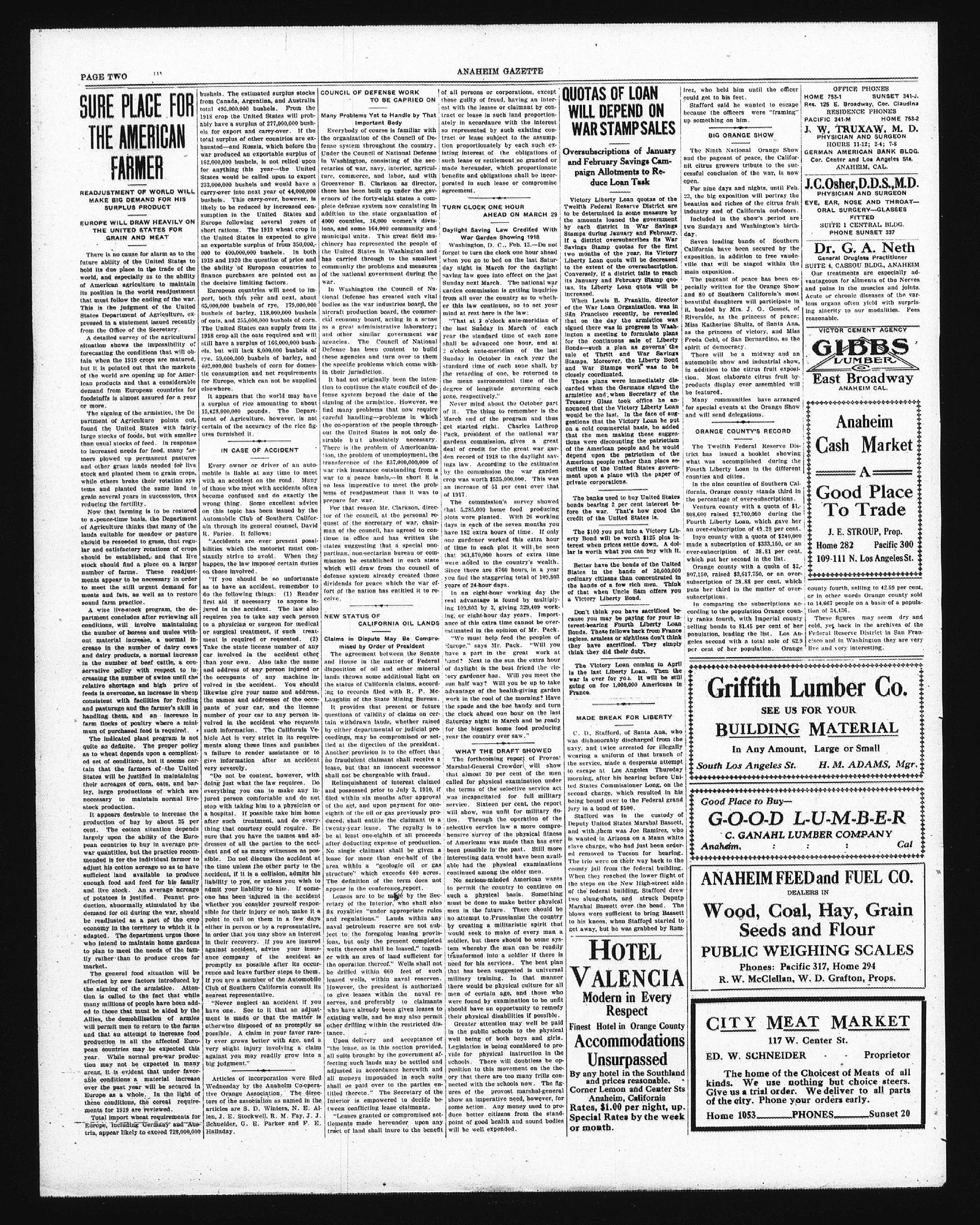
Searchable text
SURE PLACE FOR THE AMERICAN FARMER
READJUSTMENT OF WORLD WILL MAKE BIG DEMAND FOR HIS SURPLUS PRODUCT
EUROPE WILL DRAW HEAVILY ON THE UNITED STATES FOR GRAIN AND MEAT
There is no cause for alarm as to the future ability of the United States to hold its due place in the trade of the world, and especially as to the ability of American agriculture to maintain its position in the world readjustment that must follow the ending of the war. This is the judgment of the United States Department of Agriculture, expressed in a statement issued recently from the Office of the Secretary.
A detailed survey of the agricultural situation shows the impossibility of forecasting the conditions that will obtain when the 1919 crops are matured, but it is pointed out that the markets of the world are opening up for American products and that a considerable demand from European countries for foodstuffs is almost assured for a year or more.
The signing of the armistice, the Department of Agriculture points out, found the United States with fairly large stocks of foods, but with smaller than usual stocks of feed. In response to increased needs for food, many farmlands are permanent pastures bushels. The estimated surplus stocks from Canada, Argentina, and Australia total 495,000,000 bushels. From the 1918 crop the United States will probably have a surplus of 277,000,000 bushels for export and carry-over. If the total surplus of other countries are exhausted—and Russia, which before the war produced an exportable surplus of 162,000,000 bushels, is not relied upon for anything this year—the United States would be called upon to export 233,000,000 bushels and would have a carry-over into next year of 44,000,000 bushels. This carry-over, however, is likely to be reduced by increased consumption in the United States and Europe following several years of short rations. The 1919 wheat crop in the United States is expected to give an exportable surplus of from 350,000,000 to 400,000,000 bushels. In both 1919 and 1920 the question of price and the ability of European countries to finance purchases are pointed out as the decisive limiting factors.
European countries will need to import, both this year and next, about 65,000,000 bushels of rye, 179,000,000 bushels of barley, 118,000,000 bushels of oats, and 255,000,000 bushels of corn. The United States can supply from its 1918 crop all the oats required and will still have a surplus of 166,000,000 bushels, but will lack 8,000,000 bushels of rye, 59,000,000 bushels of barley, and 402,000,000 bushels of corn for domestic consumption and net requirements for Europe, which can not be supplied elsewhere.
It appears that the world may have a surplus of rice amounting to about 15,428,000,000 pounds. The Department of Agriculture, however, is not certain of the accuracy of the rice figures furnished it.
IN CASE OF ACCIDENT
COUNCIL OF EMPLOYMENT
Many Problems Impair Everybody on the organization fense system Under the Council in Washington retaries of war ture, commerce Groesvenor B. there has been few errors of the flete defense service addition to the 4000 counties, lions, and some municipal units chinery has received the United States has carried the community there of the national war.
In Washington national Defense bodies as the w aircraft produc cial economy b as a great ad hoc and other sin agencies. The Defense has th these agencies; the specific pro in their jurisdiction.
It had not on oition to continue fense system sign ing of the find many pro careful handling the co-operation out the United sirable but There is the p pro problem.
The signing of the armistice, the Department of Agriculture points out, found the United States with fairly large stocks of foods, but smaller than usual stocks of feed. In response to increased needs for food, many farmers plowed up permanent pastures and other grass lands needed for live stock and planted them to grain crops, while others broke their rotation systems and planted the same land to grain several years in succession, thus reducing the fertility.
Now that farming is to be restored to a peace-time basis, the Department of Agriculture thinks that many of the lands suitable for meadow or pasture should be reseeded to grass, that regular and satisfactory rotations of crops should be established, and that live stock should find a place on a larger number of farms. These readjustments appear to be necessary in order to meet the still urgent demand for meats and fats, as well as to restore sound farm practice.
A wise live-stock program, the department concludes after reviewing all conditions, will involve maintaining the number of horses and mules without material increase, a normal increase in the number of dairy cows and dairy products, a normal increase in the number of beef cattle, a conservative policy with respect to increasing the number of swine until the relative shortage and high price of feeds is overcome, an increase in sheep consistent with facilities for feeding and pasturage and the farmer's skill in handling them, and an increase in farm flocks of poultry where a minimum of purchased feed is required.
The indicated plant program is not quite so definite. The proper policy as to wheat depends upon a complicated set of conditions, but it seems certain that the farmers of the United States will be justified in maintaining their acreages of corn, oats, and barley, large productions of which are necessary to maintain normal livestock production.
It appears desirable to increase the production of hay by about 25 per cent. The cotton situation depends largely upon the ability of the European countries to buy in average pre-war quantities, but the practice recommended is for the individual farmer to bear when the 1919 crops are matured, but it is pointed out that the markets of the world are opening up for American products and that a considerable demand from European countries for foodstuffs is almost assured for a year or more.
The signing of the armistice, the Department of Agriculture points out, found the United States with fairly large stocks of foods, but smaller than usual stocks of feed. In response to increased needs for food, many farmers plowed up permanent pastures and other grass lands needed for live stock and planted them to grain crops, while others broke their rotation systems and planted the same land to grain several years in succession, thus reducing the fertility.
Now that farming is to be restored to a peace-time basis, the Department of Agriculture thinks that many of the lands suitable for meadow or pasture should be reseeded to grass, that regular and satisfactory rotations of crops should be established, and that live stock should find a place on a larger number of farms. These readjustments appear to be necessary in order to meet the still urgent demand for meats and fats, as well as to restore sound farm practice.
A wise live-stock program, the department concludes after reviewing all conditions, will involve maintaining the number of horses and mules without material increase, a normal increase in the number of beef cattle, a conservative policy with respect to increasing the number of swine until the relative shortage and high price of feeds is overcome, an increase in sheep consistent with facilities for feeding and pasturage and the farmer's skill in handling them, and an increase in farm flocks of poultry where a minimum of purchased feed is required.
The indicated plant program is not quite so definite. The proper policy as to wheat depends upon a complicated set of conditions, but it seems certain that the farmers of the United States will be justified in maintaining their acreages of corn, oats, and barley, large productions of which are necessary to maintain normal livestock production.
It appears desirable to increase the production of hay by about 25 per cent. The cotton situation depends largely upon the ability of the European countries to buy in average pre-war quantities, but the practice recommended is for the individual farmer to bear when the 1919 crops are matured, but it is pointed out that the markets of the world are opening up for American products and that a considerable demand from European countries for foodstuffs is almost assured for a year or more.
The signing of the armistice, the Department of Agriculture points out, found the United States with fairly large stocks of foods, but smaller than usual stocks of feed. In response to increased needs for food, many farmers plowed up permanent pastures and other grasslands needed for live stock and planted them to grain crops, while others broke their rotation systems and planted the same land to grain several years in succession, thus reducing the fertility.
Now that farming is to be restored to a peace-time basis, the Department of Agriculture thinks that many of the lands suitable for meadow or pasture should be reseeded to grass, that regular and satisfactory rotations of crops should be established, and that live stock should find a place on a larger number of farms. These readjustments appear to be necessary in order to meet the still urgent demand for meats and fats, as well as to restore sound farm practice.
A wise live-stock program, the department concludes after reviewing all conditions, will involve maintaining the number of horses and mules without material increase, a normal increase in the number of beef cattle, a conservative policy with respect to increasing the number of swine until the relative shortage and high price of feeds is overcome, an increase in sheep consistent with facilities for feeding and pasturage and the farmer's skill in handling them, and an increase in farm flocks of poultry where a minimum of purchased feed is required.
The indicated plant program is not quite so definite. The proper policy as to wheat depends upon a complicated set of conditions, but it seems certain that the farmers of the United States will be justified in maintaining their acreages of corn, oats, and barley, large productions of which are necessary to maintain normal livestock production.
It appears desirable to increase the production of hay by about 25 per cent. The cotton situation depends largely upon the ability of the European countries to buy in average pre-war quantities, but the practice recommended is for the individual farmer to bear when the 1919 crops are matured, but it is pointed out that the markets of the world are opening up for American products and that a considerable demand from European countries for foodstuffs is almost assured for a year or more.
The signing of the armistice, the Department of Agriculture thinks that many of the lands suitable for meadow or pasture should be reseeded to grass, that regular and satisfactory rotations of crops should be established, and that live stock should find a place on a larger number of farms. These readjustments appear to be necessary in order to meet the still urgent demand for meats and fats, as well as to restore sound farm practice.
A wise live-stock program, the department concludes after reviewing all conditions, will involve maintaining the number of horses and mules without material increase, a normal increase in the number of beef cattle, a conservative policy with respect to increasing the number of swine until the relative shortage and high price of feeds is overcome, an increase in sheep consistent with facilities for feeding and pasturage and the farmer's skill in handling them, and an increase in farm flocks of poultry where a minimum of purchased feed is required.
The indicated plant program is not quite so definite. The proper policy as to wheat depends upon a complicated set of conditions, but it seems certain that the farmers of the United States will be justified in maintaining their acreages of corn, oats, and barley, large productions of which are necessary to maintain normal livestock production.
It appears desirable to increase the production of hay by about 25 per cent. The cotton situation depends largely upon the ability of the European countries to buy in average pre-war quantities, but the practice recommended is for the individual farmer to bear when the 1919 crops are matured, but it is pointed out that the markets of the world are opening up for American products and that a considerable demand from European countries for foodstuffs is almost assured for a year or more.
The signing of the armistice, the Department of Agriculture thinks that many of the lands suitable for meadow or pasture should be reseeded to grass, that regular and satisfactory rotations of crops should be established, and that live stock should find a place on a larger number of farms. These readjustments appear to be necessary in order to meet the still urgent demand for meats and fats, as well as to restore sound farm practice.
A wise live-stock program, the department concludes after reviewing all conditions, will involve maintaining the number of horses and mules without material increase, a normal increase in the number of beef cattle, a conservative policy with respect to increasing the number of swine until the relative shortage and high price of feeds is overcome, an increase in sheep consistent with facilities for feeding and pasturage and the farmer's skill in handling them, and an increase in farm flocks of poultry where a minimum of purchased feed is required.
The indicated plant program is not quite so definite. The proper policy as to wheat depends upon a complicated set of conditions, but it seems certain that the farmers of the United States will be justified in maintaining their acreages of corn, oats, and barley, large productions of which are necessary to maintain normal livestock production.
It appears desirable to increase the production of hay by about 25 per cent. The cotton situation depends largely upon the ability of the European countries to buy in average pre-war quantities, but the practice recommended is for the individual farmer to bear when the 1919 crops are matured, but it is pointed out that the markets of the world are opening up for American products and that a considerable demand from European countries for foodstuffs is almost assured for a year or more.
The signing of the armistice, the Department of Agriculture thinks that many of the lands suitable for meadow or pasture should be reseeded to grass, that regular and satisfactory rotations of crops should be established, and that live stock should find a place on a larger number of farms. These readjustments appear to be necessary in order to meet the still urgent demand for meats and fats, as well as to restore sound farm practice.
A wise live-stock program, the department concludes after reviewing all conditions, will involve maintaining the number of horses and mules without material increase, a normal increase in the number of beef cattle, a conservative policy with respect to increasing the number of swine until the relative shortage and high price of feeds is overcome, an increase in sheep consistent with facilities for feeding and pasturage and the farmer's skill in handling them, and an increase in farm flocks of poultry where a minimum of purchased feed is required.
The indicated plant program is not quite so definite. The proper policy as to wheat depends upon a complicated set of conditions, but it seems certain that the farmers of the United States will be justified in maintaining their acreages of corn, oats, and barley, large productions of which are necessary to maintain normal livestock production.
It appears desirable to increase the production of hay by about 25 per cent. The cotton situation depends largely upon the ability of the European countries to buy in average pre-war quantities, but the practice recommended is for the individual farmer to bear when the 1919 crops are matured, but it is pointed out that the markets of the world are opening up for American products and that a considerable demand from European countries for foodstuffs is almost assured for a year or more.
The signing of the armistice, the Department of Agriculture thinks that many of the lands suitable for meadow or pasture should be reseeded to grass, that regular and satisfactory rotations of crops should be established, and that live stock should find a place on a larger number of farms. These readjustments appear to be necessary in order to meet the still urgent demand for meats and fats, as well as to restore defense system dividends for fortress or fortress area.
NEW STATUS
Claims in Disputed Mismed by House In disposition off lands throws at status Of Ging to record Laughlin o f th
It provides questions w vtain withdrawal by either depaeeceedings may tied at th displey Another provi no fraudulent lease but th shall not be clai Relinquishmentand possessed filed within si de at least o leafter deductin No single claim lease for mo area within
It appears desirable to increase the production of hay by about 25 per cent. The cotton situation depends largely upon the ability of the European countries to buy in average pre-war quantities, but the practice recommended is for the individual farmer to adjust his cotton acreage so as to have sufficient land available to produce enough food and feed for his family and live stock. An average acreage of potatoes is justified. Peanut production, abnormally stimulated by the demand for oil during the war, should be readjusted as a part of the crop economy in the territory to which it is adapted. The department urges those who intend to maintain home gardens to plan to meet the needs of the family rather than to produce crops for market.
The general food situation will be affected by new factors introduced by the signing of the armistice. Attention is called to the fact that while many millions of people have been added to those that must be aided by the Allies, the demobilization of armies will permit men to return to the farms and that an attempt to increase food production in all the affected European countries may be expected this year. While normal pre-war production may not be expected in many areas, it is evident that under favorable conditions a material increase over the past year will be secured in Europe as a whole. In the light of these conditions, the cereal requirements for 1919 are reviewed.
Total import wheat requirements for Europe, including Germany and Austria, appear likely to exceed 728,000,000
"Do not be content, however, with doing just what the law requires. Do everything you can to make any injured person comfortable and do not stop with taking him to a physician or a hospital. If possible take him home after such treatment, and do everything that courtesy could require. Be sure that you have the names and addresses of all the parties to the accident and of as many witnesses as possible. Do not discuss the accident at the time unless the other party to the accident, if it is a collision, admits his liability to you, or unless you wish to admit your liability to him. If someone has been injured in the accident whether you consider yourself responsible for their injury or not, make it a point to call on them in a few days either in person or by a representative, in order that you may show an interest in their recovery. If you are insured against accident, advise your insurance company of the accident as promptly as possible after its occurrence and leave further steps to them. If you are a member of the Automobile Club of Southern California consult its nearest representative.
Never neglect an accident if you have one. See to it that an adjustment is made or that the matter is otherwise disposed of as promptly as possible. A claim in your favor rarely ever grows better with age, and a very slight injury involving a claim against you may readily grow into a big judgment."
Articles of incorporation were filed Wednesday by the Anaheim Co-operative Orange Association. The directors of the association as named in the articles are S. D. Winters, N. E. Allen, J. E. Stockwell, R. M. Fay, J. J. Schneider, G. E. Parker and F. E. Halladay.
Relinquishment and possession filed within six of the act, and eighth of the act, shall be twenty-year long at least once after deducting No single claim for more area within the structure" where the definition appear in the Leases are secretary of the fix royalties and regulation naval petroleum object to the fions, but only wells thereon er with an alter operation be drilled wells; However, they to give lease serves, and p who have already existing wells other drilling tance.
Upon delivery "the lease, as all suits brought affecting such adjusted in all moneys shall oe paid titled thereto Interior is ex-tween conflict.
"Leases great elements made tract of land."
ANAHEIM GAZETTE
COUNCIL OF DEFENSE WORK TO BE CAPRIED ON
Many Problems Yet to Handle by That Important Body
Everybody of course is familiar with the organization of the Council of Defense system throughout the country. Under the Council of National Defense in Washington, consisting of the secretaries of war, navy, interior, agriculture, commerce, and labor, and with Groesvenor B. Clarkson as director, there has been built up under the governors of the forty-eight states a complete defense system now consisting in addition to the state organization of 400 counties, 16,000 women's divisions, and some 164,000 community and municipal units. This great field machinery has represented the people of the United States in Washington and has carried through to the smallest community the problems and measures of the national government during the war.
In Washington the Council of National Defense has created such vital bodies as the war industries board, the aircraft production board, the commercial economy board, acting in a sense as a great administrative laboratory; and other similar government war agencies. The Council of National Defense has been content to build these agencies and turn over to them the specific problems which come within their jurisdiction.
It had not originally been the intention to continue the state council of defense system beyond the date of the signing of the armistice. However, we find many problems that now require careful handling—problems in which the co-operation of the people throughout the United States is not only desirable but absolutely necessary. There is the problem of Americanization, the problem of unemployment, the need to imext, about 79,000,000 bush-shelves of corn, hay from its land and will be used and will be used to feed 350,000.
TURN CLOCK ONE HOUR AHEAD ON MARCH 29
Daylight Saving Law Credified With War Garden Showing 1918
Washington, D. C., Feb. 13.—Do not forget to turn the clock one hour ahead when you go to bed on the last Saturday night in March for the daylight saving law goes into effect on the last Sunday next March. The national war garden commission is getting inquiries from all over the country as to whether this law continues, so to set your mind at rest here is the law:
"That at 2 o'clock ante-meridian of the last Sunday in March of each year the standard time of each zone shall be advanced one hour, and at 2 o'clock ante-meridian of the last Sunday in October in each year the standard time of each zone shall, by the retarding of one, be returned to the mean astronomical time of the degree of longitude governing each zone, respectively."
Never mind about the October part of it. The thing to remember is the March end of the program and thus get started right. Charles Lathrop Pack, president of the national war gardens commission, gives a great deal of credit for the great war garden record of 1918 to the daylight saving agreement.
QUOTAS OF LOAN WILL DEPEND ON WAR STAMP SALES
Oversubscriptions of January and February Savings Campaign Allotments to Reduce Loan Task
Victory Liberty Loan quotas of the Twelfth Federal Reserve District are to be determined in some measure by the amounts loaned by each district in War Savings Stamps during January and February. If a district oversubscribes its War Savings Stamp quotas for the first two months of the year, its Victory Liberty Loan quota will be decreased to the extent of the oversubscription. Conversely, if a district falls to reach its January and February Stamp quotas, its Liberty Loan quota will be increased.
When Lewis B. Franklin, director of the War Loan Organization, was in San Francisco recently, he revealed that on the day the armistice was signed there was in progress in Washington a meeting to formulate plans for the continuous sale of Liberty Bonds—such a plan as governs' the sale of Thrift and War Savings Stamps. Moreover, the Liberty Bond and War Stamps work was to be closely coordinated.
These plans were immediately discarded when the Germans signed the armistice and when Secretary of the Treasury Glass took office he announced that the Victory Liberty Loan would be the last. In the face of suggestions that the Victory Loan be put on a cold commercial basis, he added that the men making these suggestions were discounting the patriotism of the American people and he would depend upon the patriotism of the
NEW STATUS OF CALIFORNIA OIL LANDS
Claims in Dispute May Be Compromised by Order of President
The agreement between the Senate and House in the matter of Federal disposition of oil and other mineral lands throws some additional light on the status of California claims, according to records filed with R. P. McLaughlin of the State Mining Bureau.
It provides that present or future questions of validity of claims on certain withdrawn lands, whether raised by either departmental or judicial proceedings, may be compromised or settled at the direction of the president. Another provision is to the effect that no fraudulent claimant shall receive a lease, but that an innocent successor shall not be chargeable with fraud.
Relinquishment of interest claimed and possessed prior to July 3, 1910, if filed within six months after approval of the act, and upon payment for one-eighth of the oil or gas previously produced, shall entitle the claimant to a twenty-year lease. The royalty is to be at least one-eighth of all proceeds after deducting expense of production. No single claimant shall be given a lease for more than one-half of the area within a "geologic oil" or gas standard time of each zone shall, by the retarding of one, be returned to the mean astronomical time of the degree of longitude governing each zone, respectively."
Never mind about the October part of it. The thing to remember is the March end of the program and thus get started right. Charles Lathrop Pack, president of the national war gardens commission, gives a great deal of credit for the great war garden record of 1918 to the daylight savings law. According to the estimates by the commission the war garden crop was worth $535,000,000. This was an increase of 51 per cent over that of 1917.
The commission's survey showed that 5,285,000 home food producing plots were planted. With 26 working days in each of the seven months you have 182 extra hours of time. If only one gardener worked this extra hour of time in each plot it will be seen that 961,870,000 hours of extra time were added to the country's wealth. Since there are 8760 hours, in a year you find the staggering total of 109,803 years of 24-hour days.
In an eight-hour working day the real advantage is found by multiplying 109,803 by 3, giving 329,409 working, or eight-hour day years. Importance of this extra time cannot be overestimated in the opinion of Mr. Pack.
"We must help feed the peoples of Europe," says Mr. Pack. "Will you have a part in the great work at hand? Next to the sun the extra hour of daylight is the best friend the victory gardener has. Will you meet the sun half way? Will you be up to take advantage of the health-giving garden work in the cool of the morning? Have the spade and the hoe handy and turn the clock ahead one hour on the last Saturday night in March and be ready for the biggest home food producing year the country ever saw."
WHAT THE DRAFT SHOWED
The forthcoming report of Provost Marshal-General Crowder will show that almost 30 per cent of the men called for physical examination under the terms of the selective service act was incapacitated for full military service. Sixteen per cent, the report will show, was unfit for military duties. Through the operation of the selective service law a more comprehensive survey of the physical fitness of Americans was made than has ever been possible in the past. Still more interesting data would have been available had the physical examinations
Stamps. Moreover, the Liberty Bond and War Stamps work was to be closely coordinated.
These plans were immediately discarded when the Germans signed the armistice and when Secretary of the Treasury Glass took office he announced that the Victory Liberty Loan would be the last. In the face of suggestions that the Victory Loan be put on a cold commercial basis, he added that the men making these suggestions were discounting the patriotism of the American people and he would depend upon the patriotism of the American people rather than place securities of the United States government upon a plane with the paper of private corporations.
The banks used to buy United States bonds bearing 2 per cent interest before the war. That's how good the credit of the United States is.
The $100 you put into a Victory Liberty Bond will be worth $125 plus interest when prices settle down. A dollar is worth what you can buy with it.
Better have the bonds of the United States in the hands of 30,000,000 ordinary citizens than concentrated in hands of a few rich men. Think of that when Uncle Sam offers you a Victory Liberty Bond.
Don't think you have sacrificed because you may be paying for your interest-bearing Fourth Liberty Loan Bonds. These fellows back from France legless, armless or sightless don't think they have sacrificed. They simply think they did their duty.
The Victory Loan coming in April is the last Liberty Loan. Then the war is over for you. It will be still going on for 1,000,000 Americans in France.
MADE BREAK FOR LIBERTY
C. D. Stafford, of Santa Ana, who was dishonorably discharged from the navy, and twice arrested for illegally wearing a uniform of that branch of the service, made a desperate attempt to escape at Los Angeles Thursday morning, after his hearing before United States Commissioner Long, on the second charge, which resulted in his being bound over to the Federal grand jury in a bond of $500.
Stafford was in the custody of Deputy United States Marshal Bassett, and with them was Joe Ramirez, who is wanted in Arizona on a Mann white slave charge, who had just been ordered removed to Tucson for hearing. The trio were on their way back to the
Relinquishment of interest claimed and possessed prior to July 3, 1910, if filed within six months after approval of the act, and upon payment for one-eighth of the oil or gas previously produced, shall entitle the claimant to a twenty-year lease. The royalty is to be at least one-eighth of all proceeds after deducting expense of production. No single claimant shall be given a lease for more than one-half of the area within a "geologic oil or gas structure" which exceeds 640 acres. The definition of the term does not appear in the conference report.
Leases are to be made by the Secretary of the Interior, who shall also fix royalties "under appropriate rules and regulations." Lands within any naval petroleum reserve are not subject to the foregoing leasing provisions, but only the present completed wells thereon shall be leased," together with an area of land sufficient for the operation thereof." Wells shall not be drilled within 660 feet of such leased wells, within naval reserves. However, the president is authorized to give leases within the naval reserves, and preferably to claimants who have already been given leases to existing wells, and he may also permit other drilling within the restricted distance.
Upon delivery and acceptance of "the lease, as in this section provided, all suits brought by the government affecting such lands may be settled and adjusted in accordance herewith and all moneys impounded in such suits shall oe paid over to the parties entitled thereto." The Secretary of the Interior is empowered to decide between conflicting lease claimants.
"Leases granted or compromised settlements made hereunder upon any tract of land shall inure to the benefit that almost 30 per cent of the men called for physical examination under the terms of the selective service act was incapacitated for full military service. Sixteen per cent, the report will show, was unfit for military duties. Through the operation of the selective service law a more comprehensive survey of the physical fitness of Americans was made than has ever been possible in the past. Still more interesting data would have been available had the physical examinations continued among the older men.
No serious-minded American wants to permit the country to continue on such a physical basis. Something must be done to make better physical men in the future. There should be no attempt to Prussianize the country by creating a militaristic spirit that would seek to make of every man a soldier, but there should be some system whereby the man can be readily transformed into a soldier if there is need for his services. The best plan that has been suggested is universal military training. In that manner there would be physical culture for all men of certain age, and those who were found by examination to be unfit should have an opportunity to remedy their physical disabilities if possible.
Greater attention may well be paid in the public schools to the physical well being of both boys and girls. Legislation is being considered to provide for physical instruction in the schools. There will doubtless be opposition to this movement on the theory that there are too many frills connected with the schools now. The figures of the provost marshal-general show an imperative need, however, for some action. Any money used to produce better citizens from the standpoint of good health and sound bodies will be well expended.
HOTEL VALENCIA Modern in Every Respect
Finest Hotel in Orange County Accommodations Unsurpassed
By any hotel in the Southland and prices reasonable.
Corner Lemon and Center Sts Anaheim, California
Rates, $1.00 per night, up.
Special Rates by the week or month.
OF LOAN
PEND ON
CAMP SALES
ions of January
by Savings Camtments to ReLoan Task
Loan quotas of the
Reserve District are
in some measure by
denied the government
at in War Savings
January and February.
Subscribes its War
quotas for the first
year, its Victory
quota will be decreased
the oversubscription.
District falls to reach
February Stamp quolaon quota will be
B. Franklin, director
Organization, was in
recently, he revealed
by the armistice was
in progress in Washing to formulate plans
ous sale of Liberty
quota as governs the
and War Savings
order, the Liberty Bond
works was to be
used.
Were immediately discerned Germans signed the
then Secretary of the
took office he anVictory Liberty Loan
t. In the face of sugVictory Loan be put
mercial basis, he added
making these suggesounting the patriotism
people and he would
patriotism of the
frez, who held him until the officer could get to his feet.
Stafford said he wanted to escape because the officers were "framing" up something on him.
BIG ORANGE SHOW
The Ninth National Orange Show and the pageant of peace, the Californiit citrus growers tribute to the successful conclusion of the war, is now open.
For nine days and nights, until Feb. 23, the big exposition will portray the beauties and riches of the citrus fruit industry and of California out-doors.
Included in the show's period are two Sundays and Washington's birthday.
Seven leading bands of Southern California have been secured by the exposition, in addition to free vaudeville that will be staged within the main exposition.
The pageant of peace has been especially written for the Orange Show and 80 of Southern California's most beautiful daughters will participate in it, headed by Mrs. J. O. Gosset, of Riverside, as the princess of peace; Miss Katherine Shultz, of Santa Ana, as the princess of victory, and Miss Freda Oehl, of San Bernardino, as the spirit of democracy.
There will be a midway and an automobile show and industrial show, in addition to the citrus fruit exposition. Most elaborate citrus fruit by-products display ever assembled will be featured.
Many communities have arranged for special events at the Orange Show and will send delegations.
ORANGE COUNTY'S RECORD
The Twelfth Federal Reserve District has issued a booklet showing
ORANGE COUNTY'S RECORD
The Twelfth Federal Reserve District has issued a booklet showing what was accomplished during the Fourth Liberty Loan in the different counties and cities.
In the nine counties of Southern California, Orange county stands third in the percentage of over-subscriptions.
Ventura county with a quota of $1,808,600 raised $2,700,050 during the Fourth Liberty Loan, which gave her an over-subscription of 49.29 per cent.
Inyo county with a quota of $240,000 made a subscription of $333,150, or an over-subscription of 38.81 per cent, which put her second in the list.
Orange county with a quota of $2,807,150, raised $3,617,750, or an over-subscription of 28.88 per cent, which puts her third in the matter of over-subscriptions.
In comparing the subscriptions according to the population Orange county ranks fourth, with Imperial county selling bonds to 81.45 per cent of her population, leading the list. Los Angeles second with a total sale of 62.9 per cent of her population. Orange county fourth, selling to 42.59 per cent, or in other words Orange county sold to 14,667 people on a basis-of a population of 34,436.
These figures may seem dry and cold, yet back in the archives of the Federal Reserve District in San Francisco and in Washington they are very live and very interesting.
Griffith Lumber Co.
SEE US FOR YOUR BUILDING MATERIAL
In Any Amount, Large or Small
South Los Angeles St. H. M. ADAMS, Mgr.
Good Place to Buy—
G-O-O-D L-U-M-B-E-R
C. GANAHL LUMBER COMPANY
Anaheim. : : : Cal
Good Place to Buy—
G-O-O-D L-U-M-B-E-R
C. GANAHL LUMBER COMPANY
Anaheim: Cal
ANAHEIM FEED and FUEL CO.
DEALERS IN
Wood, Coal, Hay, Grain
Seeds and Flour
PUBLIC WEIGHING SCALES
Phones: Pacific 317, Home 294
R. W. McClellan, W. D. Grafton, Props.
CITY MEAT MARKET
117 W. Center St.
ED. W. SCHNEIDER Proprietor
The home of the Choicest of Meats of all kinds. We use nothing but choice steers.
Give us a trial order. We deliver to all parts of the city. Phone your orders early.
Home 1053 PHONES Sunset 20