anaheim-gazette 1919-02-13
Scanned page
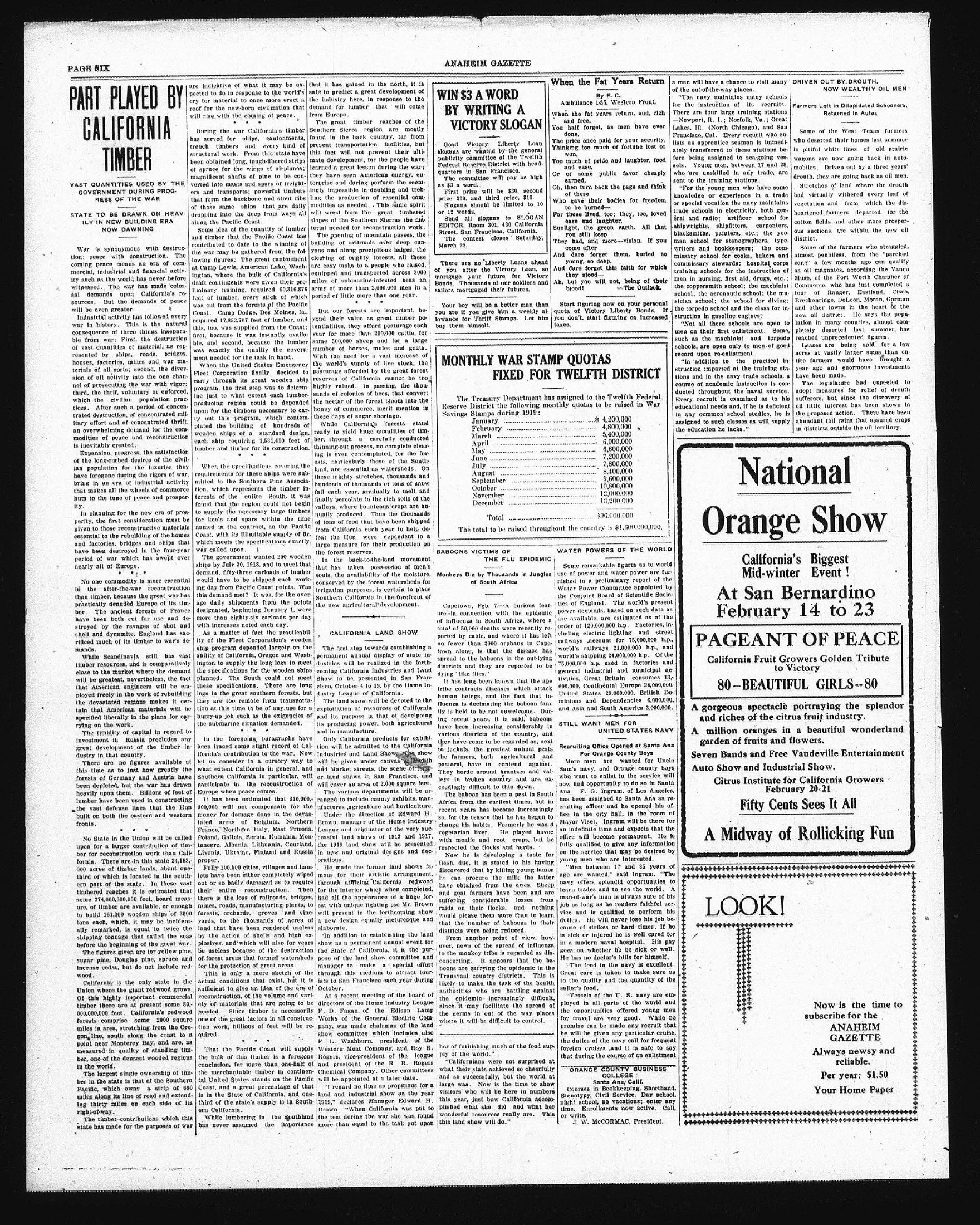
Searchable text
PART PLAYED BY CALIFORNIA TIMBER
VAST QUANTITIES USED BY THE GOVERNMENT DURING PROGRESS OF THE WAR
STATE TO BE DRAWN ON HEAVILY IN NEW BUILDING ERA NOW DAWNING
War is synonymous with destruction; peace with construction. The coming peace means an era of commercial, industrial and financial activity such as the world has never before witnessed. The war has made colossal demands upon California's resources. But the demands of peace will be even greater.
Industrial activity has followed every war in history. This is the natural consequence of three things inseparable from war: First, the destruction of vast quantities of material, as represented by ships, roads, bridges, houses, factories, mines and war materials of all sorts; second, the diversion of all activity into the one channel of prosecuting the war with vigor; third, the thrif, voluntary or enforced, which the civilian population practices. After such a period of concentrated destruction, of concentrated military effort and of concentrated thrift, an overwhelming demand for the commodities of peace and reconstruction is inevitably created.
Expansion, progress, the satisfaction are indicative of what it may be expected to do in response to the world's cry for material to once more erect a roof for the new-born civilization that will rise with the coming of peace.
During the war California's timber has served for ships, cantonments, trench timbers and every kind of structural work. From this state have been obtained long, tough-fibered strips of spruce for the wings of airplanes; magnificent shafts of pine to be converted into masts and spars of freighters and transports; powerful timbers that form the backbone and stout ribs of those same ships that are daily dropping into the deep from ways all along the Pacific Coast.
Some idea of the quantity of lumber and timber that the Pacific Coast has contributed to date to the winning of the war may be gathered from the following figures: The great cantonment at Camp Lewis, American Lake, Washington, where the bulk of California's draft contingents were given their preliminary training, required 60,316,876 feet of lumber, every stick of which was cut from the forests of the Pacific Coast. Camp Dodge, Des Moines, Ia., required 17,853,707 feet of lumber, and this, too, was supplied from the Coast; first, because it was instantly available, and second, because the lumber was exactly the quality the government needed for the task in hand.
When the United States Emergency Fleet Corporation finally decided to carry through its great wooden ship program, the first step was to determine just to what extent each lumber-producing region could be depended upon for the timbers necessary to carry out this program, which contemplated the building of hundreds of wooden ships of a standard design, each ship requiring 1,531,410 feet of lumber and timber for its construction.
That it has gained safe to predict a grief industry here, demand for lumber from Europe.
The great timber Southern Sierra ran found in the back present transportation; this fact will not mate development; learned a great lesson they have seen An enterprise and darling ingly impossible ling the production modities as needed will wrest from the slopes of the South terial needed for rails.
The opening of rail-building of arilroad yons and along pre-clearing of mighty are easy tasks to a equipped and trained miles of submarine army of more than period of little more.
But our forests yield their value inENTIALS, they are year for more than some 500,000 shee number of horses With the need for the world's supply pasturage afforded reserves of Califor highly valued. In sands of colonies on the nectar of the honey of commerce these days of sugar.
While California ready to yield humber through a thinning-out process is even contender
houses, factories, mines and war materials of all sorts; second, the diversion of all activity into the one channel of prosecuting the war with vigor; third, the thrif, voluntary or enforced, which the civilian population practices. After such a period of concentrated destruction, of concentrated military effort and of concentrated thrift, an overwhelming demand for the commodities of peace and reconstruction is inevitably created.
Expansion, progress, the satisfaction of the long-curbed desires of the civilian population for the luxuries they have foregone during the rigors of war, bring in an era of industrial activity that makes all the wheels of commerce hum to the tune of peace and prosperity.
In planning for the new era of prosperity, the first consideration must be given to those reconstructive materials essential to the rebuilding of the homes and factories, bridges and ships that have been destroyed in the four-year period of war which has swept over nearly all of Europe.
No one commodity is more essential in the after-the-war reconstruction than timber, because the great war has practically denuded Europe of its timber. The ancient forests of France have been both cut for use and destroyed by the ravages of shot and shell and dynamite, England has sacrificed much of its timber to war's demands.
While Scandinavia still has vast timber resources, and is comparatively close to the market where the demand will be greatest, nevertheless, the fact that American engineers will be employed freely in the work of rebuilding the devastated regions makes it certain that American materials will be specified liberally in the plans for carrying on the work.
The timidity of capital in regard to investment in Russia precludes any great development of the timber industry in that country.
There are no figures available at this time as to just how greatly the forests of Germany and Austria have been depleted, but the war has drawn heavily upon them. Billions of feet of lumber have been used in constructing the vast defense lines that the Hun built on both the eastern and western fronts.
No State in the Union will be called upon for a larger contribution of timber for reconstruction work than California. There are in this state 24,163 houses, factories, mines and war materials of all sorts; second, the diversion of all activity into the one channel of prosecuting the war with vigor; third, the thrif, voluntary or enforced, which the civilian population practices. After such a period of concentrated destruction, of concentrated military effort and of concentrated thrift, an overwhelming demand for the commodities of peace and reconstruction is inevitably created.
Expansion, progress, the satisfaction of the long-curbed desires of the civilian population for the luxuries they have foregone during the rigors of war, bring in an era of industrial activity that makes all the wheels of commerce hum to the tune of peace and prosperity.
In planning for the new era of prosperity, the first consideration must be given to those reconstructive materials essential to the rebuilding of the homes and factories, bridges and ships that have been destroyed in the four-year period of war which has swept over nearly all of Europe.
No one commodity is more essential in the after-the-war reconstruction than timber, because the great war has practically denuded Europe of its timber. The ancient forests of France have been both cut for use and destroyed by the ravages of shot and shell and dynamite, England has sacrificed much of its timber to war's demands.
While Scandinavia still has vast timber resources, and is comparatively close to the market where the demand will be greatest, nevertheless, the fact that American engineers will be employed freely in the work of rebuilding the devastated regions makes it certain that American materials will be specified liberally in the plans for carrying on the work.
The timidity of capital in regard to investment in Russia precludes any great development of the timber industry in that country.
There are no figures available at this time as to just how greatly the forests of Germany and Austria have been depleted, but the war has drawn heavily upon them. Billions of feet of lumber have been used in constructing the vast defense lines that the Hun built on both the eastern and western fronts.
No State in the Union will be called upon for a larger contribution of timber for reconstruction work than California. There are in this state 24,163 houses, factories, mines and war materials of all sorts; second, the diversion of all activity into the one channel of prosecuting the war with vigor; third, the thrif, voluntary or enforced, which the civilian population practices. After such a period of concentrated destruction, of concentrated military effort and of concentrated thrift, an overwhelming demand for the commodities of peace and reconstruction is inevitably created.
Expansion, progress, the satisfaction of the long-curbed desires of the civilian population for the luxuries they have foregone during the rigors of war, bring in an era of industrial activity that makes all the wheels of commerce hum to the tune of peace and prosperity.
In planning for the new era of prosperity, the first consideration must be given to those reconstructive materials essential to the rebuilding of the homes and factories, bridges and ships that have been destroyed in the four-year period of war which has swept over nearly all of Europe.
No one commodity is more essential in the after-the-war reconstruction than timber, because the great war has practically denuded Europe of its timber. The ancient forests of France have been both cut for use and destroyed by the ravages of shot and shell and dynamite, England has sacrificed much of its timber to war's demands.
While Scandinavia still has vast timber resources, and is comparatively close to the market where the demand will be greatest, nevertheless, the fact that American engineers will be employed freely in the work of rebuilding the devastated regions makes it certain that American materials will be specified liberally in the plans for carrying on the work.
The timidity of capital in regard to investment in Russia precludes any great development of the timber industry in that country.
There are no figures available at this time as to just how greatly the forests of Germany and Austria have been depleted, but the war has drawn heavily upon them. Billions of feet of lumber have been used in constructing the vast defense lines that the Hun built on both the eastern and western fronts.
No State in the Union will be called upon for a larger contribution of timber for reconstruction work than California. There are in this state 24,163 houses, factories, mines and war materials of all sorts; second, the diversion of all activity into the one channel of prosecuting the war with vigor; third, the thrif, voluntary or enforced, which the civilian population practices. After such a period of concentrated destruction, of concentrated military effort and of concentrated thrift, an overwhelming demand for the commodities of peace and reconstruction is inevitably created.
Expansion, progress, the satisfaction of the long-curbed desires of the civilian population for the luxuries they have foregone during the rigors of war, bring in an era of industrial activity that makes all the wheels of commerce hum to the tune of peace and prosperity.
In planning for the new era of prosperity, the first consideration must be given to those reconstructive materials essential to the rebuilding ofthe homes and factories, bridges and ships that have been destroyed in the four-year period of war which has swept over nearly all of Europe.
No one commodity is more essential in the after-the-war reconstruction than timber because the great war has practically denuded Europe of its timber. The ancient forests of France have been both cut for use and destroyed by the ravages of shot and shell and dynamite, England has sacrificed much of its timber to war's demands.
While Scandinavia still has vast timber resources, and is comparatively close to the market where the demand will be greatest, nevertheless, the fact that American engineers will be employed freely in the work of rebuildingthe devastated regions makes it certain that American materials will be specified liberally in the plans for carrying onthe work.
The timidity of capital in regard to investment in Russia precludes any great development ofthe timber industry in that country.
There are no figures available at this time as to just how greatlythe forests of Germany and Austria have been depleted,butthe war has drawn heavily upon them. Billionsof feetof lumberhavebeenusedinconstructingthevastdefenselinesthattheHunbuiltonboththeeasternandwesternfronts.
No State intheUnionwillbecalleduponforalargercontributionoftimberforreconstructionworkthanCalifornia.Thereareinthisstate24163houses,factories,minesandwarmaterialsofallsorts;second,thediversionofallactivityintotheonechannelofprosecutingthewarwithvigor;third,thethrifvoluntaryoreasoningisevencontentsthereparticularlylandareessentialthemightstreathundredsf thousandsfalleachyear,finallypercolatetvalleyswherebonnuannuallyproduced.oftonsoffoodtherefuhwlargemeasureforyforestreserve.Intheback-thathas taken souls,theavailablesconservedbytheirirrigationpurposeSouthernCaliforniathenewagriculture
CALIFORNIA
The first step to permanent annual dustries will be coming Californian ShowtobecreiscoOctober4dustryLeagueo
The land show exploitationofruralanditsproducingpoilandinmanufactureOnlyCalifornianwillbeadufacturesagricuUnderthedirBrownmanagerLeagueandorigcessfullandshootthe1919landshootinnowandorigentsions.
No State in the Union will be called upon for a larger contribution of timber for reconstruction work than California. There are in this state 24,163,000 acres of timber lands, about one-third of which is located in the southern part of the state. In these vast timbered reaches it is estimated that some 274,000,000,000 feet, board measure, of timber are available, or enough to build 161,000 wooden ships of 3500 tons each, which it may be incidentally remarked, is equal to twice the shipping tonnage that sailed the seas before the beginning of the great war.
The figures given are for yellow pine, sugar pine, Douglas pine, spruce and incense cedar, but do not include redwood.
California is the only state in the Union where the giant redwood grows. Of this highly important commercial timber there are at present some 80,000,000,000 feet. California's redwood forests comprise some 2000 square miles in area, stretching from the Oregon line, south along the coast to a point near Monterey Bay, and are, as measured in quality of standing timber, one of the densest wooded regions in the world.
The largest single ownership of timber in the state is that of the Southern Pacific, which owns a strip of 680 miles along its line of road and extending thirty miles on each side of its right-of-way.
The timber-contributions which this state has made for the purposes of war what extent California in general, and Southern California in particular, will participate in the reconstruction of Europe when peace comes.
It has been estimated that $10,000,000 will not compensate for the money for damage done in the devastated areas of Belgium, Northern France, Northern Italy, East Prussia, Poland, Galicia, Serbia, Rumania, Montenegro, Albania, Lithuania, Courland, Lvivia, Ukraine, Finland and Russia proper.
Fully 100,000 cities, villages and hamlets have been either completely wiped out or so badly damaged as to require their entire reconstruction. Then there is the loss of railroads, bridges, mines, roads, manufacturing plants, to forests, orchards, groves and vineyards, to the thousands of acres of land that have been rendered useless by the action of shells and high explosives, and which will also for years be useless because of the destruction of forest areas that formed watersheds for the protection of great areas.
This is only a mere sketch of the actual conditions that exist, but it is sufficient to give an idea of the era of reconstruction, of the volume and variety of materials that are going to be needed. Since timber is necessarily one of the great factors in all construction work, billions of feet will be required.
That the Pacific Coast will supply the bulk of this timber is a foregone conclusion, for more than one-half of the merchantable timber in continental United States stands on the Pacific Coast, and a great percentage of that is in the State of California, and one-third of the state's supply is in Southern California.
While lumbering in the Southland has never assumed the importance
ANAHEIM GAZETTE
that it has gained in the north, it is safe to predict a great development of the industry here, in response to the demand for lumber that will come from Europe.
The great timber reaches of the Southern Sierra region are mostly found in the back country, far from present transportation facilities, but this fact will not prevent their ultimate development, for the people have learned a great lesson during the war; they have seen American energy, enterprise and daring perform the seemingly impossible in doubling and trebling the production of essential commodities as needed. This same spirit will wrist from the great timbered slopes of the Southern Sierra the material needed for reconstruction work.
The opening of mountain passes, the building of arilroads over deep canyons and along precipitous ledges, the clearing of mighty forests, all these are easy tasks to a people who raised, equipped and transported across 3000 miles of submarine-infested seas an army of more than 2,000,000 men in a period of little more than one year.
But our forests are important, beyond their value as great timber potentialities, they afford pasturage each year for more than 200,000 cattle, for some 500,000 sheep and for a large number of horses, mules and goats. With the need for a vast increase of the world's supply of live stock, the pasturage afforded by the great forest reserves of California cannot be too highly valued. In passing, the thousands of colonies of bees, that convert the nectar of the forest bloom into the honey of commerce, merit mention in these days of sugar shortage.
While California's forests stand ready to yield huge quantities of timber, through a carefully conducted thinning-out process, no complete clearing is even contemplated, for the mankind has perfected a method that it has gained in the north, it is safe to predict a great development of the industry here, in response to the demand for lumber that will come from Europe.
The great timber reaches of the Southern Sierra region are mostly found in the back country, far from present transportation facilities, but this fact will not prevent their ultimate development, for the people have learned a great lesson during the war; they have seen American energy, enterprise and daring perform the seemingly impossible in doubling and trebling the production of essential commodities as needed. This same spirit will wrist from the great timbered slopes of the Southern Sierra the material needed for reconstruction work.
The opening of mountain passes, the building of arilroads over deep canyons and along precipitous ledges, the clearing of mighty forests, all these are easy tasks to a people who raised, equipped and transported across 3000 miles of submarine-infested seas an army of more than 2,000,000 men in a period of little more than one year.
But our forests are important, beyond their value as great timber potentialities, they afford pasturage each year for more than 200,000 cattle, for some 500,000 sheep and for a large number of horses, mules and goats. With the need for a vast increase of the world's supply of live stock, the pasturage afforded by the great forest reserves of California cannot be too highly valued. In passing, the thousands of colonies of bees, that convert the nectar of the forest bloom into the honey of commerce, merit mention in these days of sugar shortage.
While California's forests stand ready to yield huge quantities of timber, through a carefully conducted thinning-out process, no complete clearing is even contemplated, for the mankind has perfected a method that it has gained in the north, it is safe to predict a great development of the industry here, in response to the demand for lumber that will come from Europe.
The great timber reaches of the Southern Sierra region are mostly found in the back country, far from present transportation facilities, but this fact will not prevent their ultimate development, for the people have learned a great lesson during the war; they have seen American energy, enterprise and daring perform the seemingly impossible in doubling and trebling the production of essential commodities as needed. This same spirit will wrist from the great timbered slopes of the Southern Sierra the material needed for reconstruction work.
The opening of mountain passes, the building of arilroads over deep canyons and along precipitous ledges, the clearing of mighty forests, all these are easy tasks to a people who raised, equipped and transported across 3000 miles of submarine-infested seas an army of more than 2,000,000 men in a period of little more than one year.
But our forests are important, beyond their value as great timber potentialities, they afford pasturage each year for more than 200,000 cattle, for some 500,000 sheep and for a large number of horses, mules and goats. With the need for a vast increase of the world's supply of live stock, the pasturage afforded by the great forest reserves of California cannot be too highly valued. In passing, the thousands of colonies of bees, that convert the nectar of the forest bloom into the honey of commerce, merit mention in these days of sugar shortage.
While California's forests stand ready to yield huge quantities of timber through a carefully conducted thinning-out process, no complete clearing is even contemplated for the mankind has perfected a method that it has gained in the north, it is safe to predict a great development of the industry here, in response to the demand for lumber that will come from Europe.
The great timber reaches of the Southern Sierra region are mostly found in the back country, far from present transportation facilities, but this fact will not prevent their ultimate development, for the people have learned a great lesson during the war; they have seen American energy, enterprise and daring perform the seemingly impossible in doubling and trebling the production of essential commodities as needed. This same spirit will wrist from the great timbered slopes of the Southern Sierra the material needed for reconstruction work.
The opening of mountain passes, the building of arilroads over deep canyons and along precipitous ledges, the clearing of mighty forests, all these are easy tasks to a people who raised, equipped and transported across 3000 miles of submarine-infested seas an army of more than 2,000,000 men in a period of little more than one year.
But our forests are important, beyond their value as great timber potentialities, they afford pasturage each year for more than 200,000 cattle, for some 500,000 sheep and for a large number of horses, mules and goats. With the need for a vast increase of the world's supply of live stock, the pasturage afforded by the great forest reserves of California cannot be too highly valued. In passing, the thousands of colonies of bees that convert the nectar of the forest bloom into the honey of commerce merit mention in these days of sugar shortage.
While California's forests stand ready to yield huge quantities of timber through a carefully conducted thinning-out process, no complete clearing is even contemplated for the mankind has perfected a method that it has gained in the north, it is safe to predict a great development of the industry here, in response to the demand for lumber that will come from Europe.
The great timber reaches of the Southern Sierra region are mostly found in the back country, far from present transportation facilities, but this fact will not prevent their ultimate development, for the people have learned a great lesson during the war; they have seen American energy, enterprise and daring perform the seemingly impossible in doubling and trebling the production of essential commodities as needed. This same spirit will wrist from the great timbered slopes of the Southern Sierra the material needed for reconstruction work.
The opening of mountain passes, the building of arilroads over deep canyons and along precipitous ledges, the clearing of mighty forests, all these are easy tasks to a people who raised, equipped and transported across 3000 miles of submarine-infested seas an army of more than 2,000,000 men in a period of little more than one year.
But our forests are important beyond their value as great timber potentialities they afford pasturage each year for more than 200,000 cattle for some 500,000 sheep and for a large number of horses,mules and goats.With the need for a vast increase of the world's supply of live stock,the pasturage afforded by the great forest reserves of California cannot be too highly valued.In passing,the thousands of colonies of bees that convert the nectar of the forest bloom intothe honeyof commerce merit mentionin these daysof sugar shortage.
While California's forests stand ready to yield huge quantities of timber through a carefully conducted thinning-out process,nothing else can be done except to raise funds for military purposes. The Treasury Department has assigned to Twelfth Federal Reserve District following monthly quotas to be raised in War Savings Stamps during 1919:
January $4,200,000
February $4,800,000
March $5,400,000
April $6,000,000
May $6,600,000
There are no Liberty Loans ahead if you after The Victory Loan so mortgage your future for Victory Bonds. Thousands our soldiers and sailors mortgaged their futures.
Your boy will be a better man than you are if you give him a weekly allowance for Thrift Stamps. Let him buy them himself.
Start figuring now on your personal quota of Victory Liberty Bonds. If you don't start figuring on increased taxes.
MONTHLY WAR STAMP QUOTAS FIXED FOR TWELFTH DISTRICT
The Treasury Department has assigned to Twelfth Federal Reserve District following monthly quotas to be raised in War Savings Stamps during 1919:
January $4,200,000
February $4,800,000
March $5,400,000
April $6,600,000
May $6,6
MONTHLY WAR STAMP QUOTAS
FIXED FOR TWELFTH DISTRICT
The Treasury Department has assigned to the Twelfth Federal Reserve District the following monthly quotas to be raised in War Savings Stamps during 1919:
January ... $4,200,000
February ... 4,800,000
March ... 5,400,000
April ... 6,000,000
May ... 6,600,000
June ... 7,200,000
July ... 7,800,000
August ... 8,400,000
September ... 9,600,000
October ... 10,800,000
November ... 12,000,000
December ... 13,200,000
Total ... $96,000,000
The total to be raised throughout the country is $1,600,000,000.
BABOONS VICTIMS OF THE FLU EPIDEMIC
Monkeys Die by Thousands in Jungles of South Africa
Capetown, Feb. 7.—A curious feature in connection with the epidemic of influenza in South Africa, where a total of 50,000 deaths were recently reported by cable, and where it has left no fewer than 2000 orphans in Capetown alone, is that the disease has spread to the baboons in the outlying districts and they are reported to be dying "like flies."
It has long been known that the apes tribe contracts diseases which attack human beings, and the fact that influenza is decimating the baboon family is held to be not unwelcome. During recent years, it is said, baboons have been increasing considerably in various districts of the country, and they have come to be regarded as next to jackals, the greatest animal pests the farmers, both agricultural and pastoral, have to contend against. They horde around krantzes and valleys in broken country and are exceedingly difficult to thin down.
The baboon has been a pest in South Africa from the earliest times, but in recent years has become increasingly so, for the reason that he has begun to change his habits. Formerly he was a vegetarian liver. He played havoc with mealie and root crops, but he respected the flocks and herds.
Now he is developing a taste for flesh, due, it is stated to his having some remarkable figures as to world use of power and water power are furnished in a preliminary report of the Water Power Committee appointed by the Conjoint Board of Scientific Societies of England. The world's present power demands, based on such data as are available, are estimated as of the order of 120,000,000 h.p. Factories, including electric lighting and street railways account for 75,000,000 h.p., world's railways 21,000,000 h.p., and world's shipping 24,000,000 h.p. Of the 75,000,000 h.p. used in factories and general industrial and municipal activities, Great Britain consumes 13,000,000 Continental Europe 24,000,000 United States 29,999,999 British Dominions and Dependencies 6,999,999 and Asia and South America 3,999,999.
STILL WANT MEN FOR UNITED STATES NAVY
Recruiting Office Opened at Santa Ana For Orange County Boys
More men are wanted for Uncle Sam's navy, and Orange county boys who want to enlist in the service will now find opportunity to do so in Santa Ana. F. G. Ingram, of Los Angeles, has been assigned to Santa Ana as recruiting officer and he opened his office in the city hall, in the room of Mayor Visel. Ingram will be there for an indefinite time and expects that the office will become permanent. He is fully qualified to give any information on the service that may be desired by young men who are interested.
and Market streets, the scene of terer land shows in San Francisco, and will cover an area of 2,000 square feet.
The various departments will be arranged to include county exhibits, manufactures, agriculture and horticulture.
Under the direction of Edward H. Brown, manager of the Home Industry League and originator of the very successful land shows of 1913 and 1917, the 1919 land show will be presented in now and original designs and decorations.
He made the former land shows famous for their artistic arrangement, through utilizing California redwood for the interior which when completed, had all the appearance of a huge forest with unique lighting; so Mr. Brown will present in the forthcoming show a new design equally picturesque and elaborate.
In addition to establishing the land show as a permanent annual event for the State of California, it is the purpose of the land show committee and manager to make a special effort through this medium to attract tourists to San Francisco each year during October.
At a recent meeting of the board of directors of the Home Industry League F. D. Fagan, of the Edison Lamp Works of the General Electric Company, was made chairman of the land show committee which includes also F. L. Washburn, president of the Western Meat Company, and Roy R. Rogers, vice-president of the league and president of the R. R. Rogers Chemical Company. Other committees will be appointed at a later date.
"I regard no time as propitious for a land and industrial show as the year 1919," declares Manager Edward H. Brown. "When California was put to the test during the war she was found more than equal to the task put upon her of furnishing much of the food supply of the world."
"Californians were not surprised at what their state achieved so cheerfully and so successfully, but the world at large was. Now is the time to show visitors who will be here in numbers this year, just how California accomplished what she did and what her wonderful resources really are. This land show will do."
Years Return
Western Front.
return, and, rich
men have ever
for your security,
of fortune lost or
laughter, food
favor cheaply
page and think
freedom
they, too, loved
earth. All that
vision. If you
them, buried so
faith for which
not, being of their
The Outlook.
On your personal liberty Bonds. Ifiring on increased
DISTRICT
welfth Federal raised in War
a man will have a chance to visit many of the out-of-the-way places.
"The navy maintains many schools for the instruction of its recruits. There are four large training stations—Newport, R. I.; Norfolk, Va.; Great Lakes, Ill. (North Chicago), and San Francisco, Cal. Every recruit who enlists as apprentice seaman is immediately transferred to these stations before being assigned to sea-going vessels. Young men, between 17 and 25, who are unskilled in any trade, are sent to the training stations.
"For the young men who have some knowledge or experience in a trade or special vocation the navy maintains trade schools in electricity, both general and radio; artificer school for shipwrights, shipfitters, carpenters, blacksmiths, painters, etc.; the yeoman school for stenographers, typewriters and bookkeepers; the commissary school for cooks, bakers and commissary stewards; hospital corps training schools for the instruction of men in nursing, first aid, drugs, etc.; the coppersmith school; the machinist school; the aeronautic school; the musician school; the school for diving; the torpedo school and the class for instruction in gasoline engines;
"Not all these schools are open to men on their first enlistment. Some, such as the machinist and torpedo schools, are open only to men of good record upon re-enlistment.
In addition to the practical instruction imparted at the training stations and in the navy trade schools, a course of academic instruction is conducted throughout the naval service. Every recruit is examined as to his educational needs and, if he is deficient in any ocmmon school studies, he is assigned to such classes as will supply the education he lacks."
DRIVEN OUT BY DROUTH,
NOW WEALTHY OIL MEN
Farmers Left in Dilapidated Schooners,
Returned in Autos
Some of the West Texas farmers who deserted their homes last summer in pitiful white lines of old prairie wagons are now going back in automobiles. Driven out by a three years' drought, they are going back as oil men.
Stretches of land where the drouth had virtually withered every leaf of vegetation and from which the disheartened farmers departed for the cotton fields and other more prosperous sections, are within the new oil district.
Some of the farmers who straggled, almost penniless, from the "parched zone" a few months ago can qualify as oil magnates, according the Vance Muse, of the Fort Worth Chamber of Commerce, who has just completed a tour of Ranger, Eastland, Cisco, Breckenridge, DeLeon, Moran, Gorman and other towns in the heart of the new oil district. He says the population in many counties, almost completely deserted last summer, has reached unprecedented figures.
Leases are being sold for a few acres at vastly larger sums than entire farmers would have brought a year ago and enormous investments have been made.
The legislature had expected to adopt measures for relief of drouth sufferers, but since the discovery of oil little interest has been shown in the proposed action. There have been abundant fall rains that assured crops in districts outside the oil territory.
National
Orange Show
California’s Biggest
Mid-winter Event!
At San Bernardino
February 14 to 23
PAGEANT OF PEACE
California Fruit Growers Golden Tribute
to Victory
80--BEAUTIFUL GIRLS--80
A gorgeous spectacle portraying the splendor and riches of the citrus fruit industry.
A million oranges in a beautiful wonderland garden of fruits and flowers.
Seven Bands and Free Vaudeville Entertainment
Auto Show and Industrial Show.
Citrus Institute for California Growers
February 20-21
Fifty Cents Sees It All
A Midway of Rollicking Fun
Citrus Institute for California Growers
February 20-21
Fifty Cents Sees It All
A Midway of Rollicking Fun
LOOK!
Now is the time to subscribe for the
ANAHEIM
GAZETTE
Always newsy and reliable.
Per year: $1.50
Your Home Paper