anaheim-gazette 1919-02-06
Scanned page
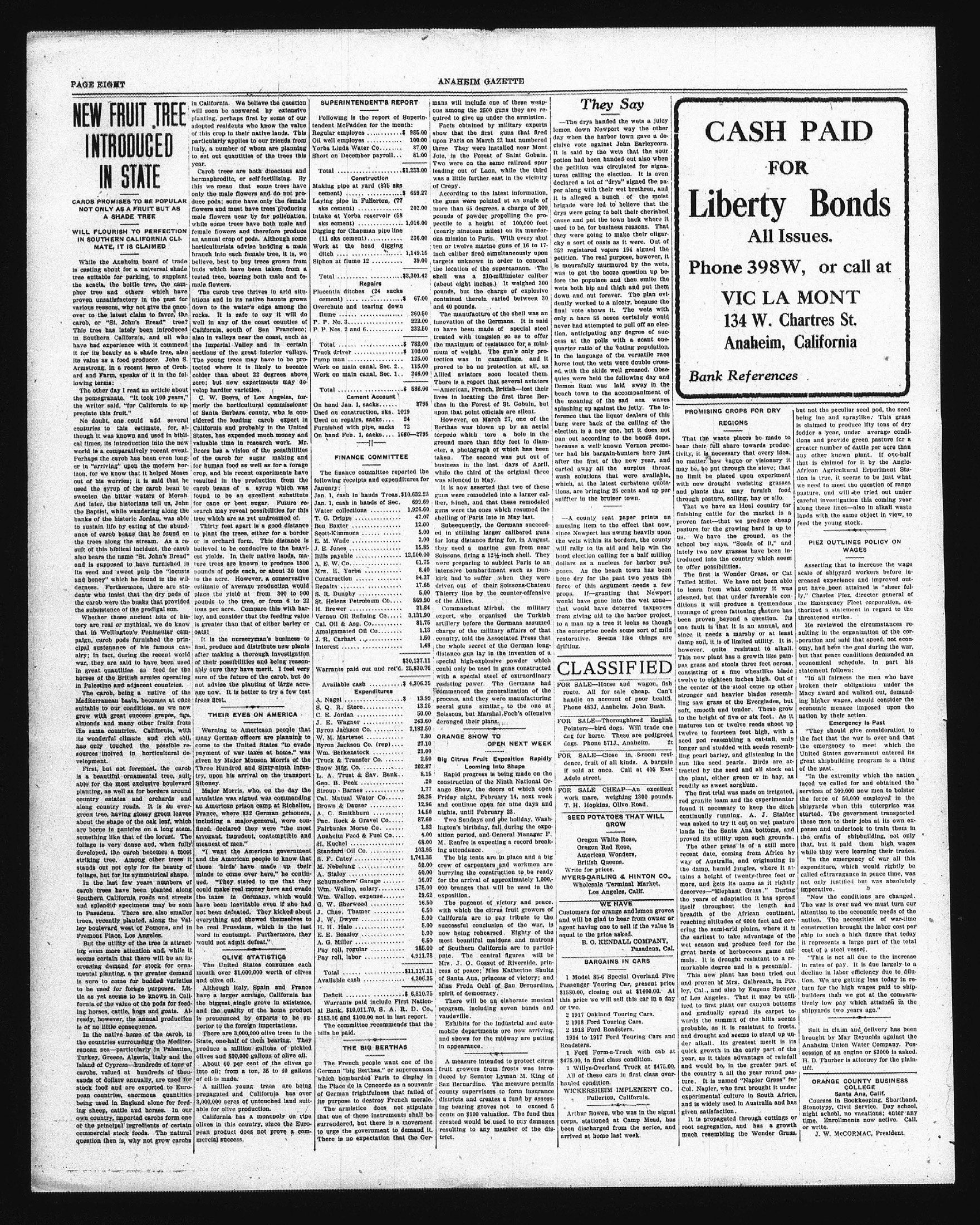
Searchable text
NEW FRUIT TREE INTRODUCED IN STATE
CAROB PROMISES TO BE POPULAR NOT ONLY AS A FRUIT BUT AS A SHADE TREE
WILL FLOURISH TO PERFECTION IN SOUTHERN CALIFORNIA CLIMATE, IT IS CLAIMED
While the Anaheim board of trade is casting about for a universal shade tree suitable for parking, to supplant the acacia, the bottle tree, the camphor tree and others which have proven unsatisfactory in the past for various reasons, why not give the once-over to the latest claim to favor, the carob, or "St. John's Bread" tree? This tree has lately been introduced in Southern California, and all who have had experience with it commend it for its beauty as a shade tree, also its value as a food producer. John S. Armstrong, in a recent issue of Orchard and Farm, speaks of it in the following terms:
The other day I read an article about the pomegranate. "It took 100 years," the writer said, "for California to appreciate this fruit."
No doubt, one could add several centuries to this estimate, for, although it was known and used in biblical times, its introduction into the new world is a comparatively recent event.
In California. We believe the question will soon be answered by extensive planting, perhaps first by some of our adopted residents who know the value of this crop in their native lands. This particularly applies to our friends from Italy, a number of whom are planning to set out quantities of the trees this year.
Carob trees are both dioecious and hermaphrodite, or self-fertilizing. By this we mean that some trees have only the male flowers and do not produce pods; some have only the female flowers and must have trees producing male flowers near by for pollination, while some trees have both male and female flowers and therefore produce an annual crop of pods. Although some horticulturists advise budding a male branch into each female tree, it is, we believe, best to buy trees grown from buds which have been taken from a tested tree, bearing both male and female flowers.
The carob tree thrives in arid situations and in its native haunts grows down to the water's edge among the rocks. It is safe to say it will do well in any of the coast counties of California, south of San Francisco; also in valleys near the coast, such as the Imperial Valley and in certain sections of the great interior valleys. The young trees may have to be protected where it is likely to become colder than about 22 degrees above zero; but new experiments may develop harder varieties.
C. W. Beers, of Los Angeles, formerly the horticultural commissioner of Santa Barbara county, who is considered the leading carob expert in California and probably in the United States, has expended much money and valuable time in research work. Mr. Beers has a vision of the possibilities of the carob for sugar making and SUPERINTENDENT
Following is the tendered McFadden Regular employees Oil well employes Yorba Linda Water Short on December
Total ... Const
Making pipe at ya cement) ... Laying pipe in FY sks cement) ... Intake at Yorba r sks ecment) ... Digging for Chapm (11 sks cement)
Work at the he ditch ... Siphon at flume 1
Total ... Re
Placentia ditches cement) ... Overchute and te flume ... P. P. No. 3... P. P. Nos. 2 and 6
Total ... Truck driver ... Pump man ... Work on main ca
Work on main ca
Total ... Cement
On hand Jan. 1, s Used on construc Used on repairs,
Furnished with pl On hand Feb. 1,
FINANCE
The other day I read an article about the pomegranate. "It took 100 years," the writer said, "for California to appreciate this fruit."
No doubt, one could add several centuries to this estimate, for, although it was known and used in biblical times, its introduction into the new world is a comparatively recent event. Perhaps the carob has been even longer in "arriving" upon the modern horizon, for we know that it helped Moses out of his worries; it is said that he used the syrup of the carob bean to sweeten the bitter waters of Morah. And later, the historians tell us, John the Baptist, while wandering along the banks of the historic Jordan, was able to sustain life by eating of the abundance of carob beans that he found on the trees along the stream. As a result of this biblical incident, the carob also bears the name "St. John's Bread" and is supposed to have furnished in its seed and sweet pulp the "locusts and honey" which he found in the wilderness. Furthermore, there are students who insist that the dry pods of the carob were the husks that provided the subsistence of the prodigal son.
Whether these ancient bits of history are real or mythical, we do know that in Wellington's Peninsular campaign, carob pods furnished the principal sustenance of his famous cavalry; in fact, during the recent world war, they are said to have been used in great quantities as feed for the horses of the British armies operating in Palestine and adjacent countries.
The carob, being a native of the Mediterranean basin, becomes at once suitable to our conditions, as we now grow with great success grapes, figs, almonds and many other fruits from the same countries. California, with its wonderful climate and rich soil, has only touched the possible resources involved in horticultural development.
First, but not foremost, the carob is a beautiful ornamental tree, suitable for the most exclusive boulevard planting, as well as for borders around country estates and orchards and along country roads. It is an evergreen tree, having glossy green leaves about the shape of the oak leaf, which are borne in panicles on a long stem, something like that of the locust. The foliage is very dense and, when fully developed, the carob becomes a most striking tree. Among other trees it
C. W. Beers, of Los Angeles, formerly the horticultural commissioner of Santa Barbara county, who is considered the leading carob expert in California and probably in the United States, has expended much money and valuable time in research work. Mr. Beers has a vision of the possibilities of the carob for sugar making and for human food as well as for a forage crop, and his recent experiments have resulted in the production from the carob beans of a syrup which was found to be an excellent substitute for cane or beet sugar. Future research may reveal possibilities for this tree which are as yet undreamed of.
Thirty feet apart is a good distance to plant the trees, either for a border or in orchard form. This distance is believed to be conducive to the heaviest yields. In their native lands, mature trees are known to produce 1500 pounds of pods each, or about 30 tons to the acre. However, a conservative estimate of average production would place the yield at from 300 to 900 pounds to the tree, or from 6 to 22 tons per acre. Compare this with barley, and consider that the feeding value is greater than that of either barley or oats!
It is the nurseryman's business to find, produce and distribute new plants after making a thorough investigation of their possibilities and being reasonably sure they have merit. I feel very sure of the future of the carob, but do not advise the planting of large acreage now. It is better to try a few test trees first.
THEIR EYES ON AMERICA
Warning to Americaan people that many German officers are planning to come to the United States "to evade payment of war taxes at home," was given by Major Monson Morris of the Three Hundred and Sixty-ninth Infantry, upon his arrival on the transport Siboney.
Major Morris, who, on the day the armistice was signed was commanding an American prison camp at Richelieu, France, where 832 German prisoners, including a major-general, were confined; declared they were "the most arrogant, impudent, contemptible and meanest of men."
"I want the American government and the American people to know that these three have made up their young trees may have to be protected where it is likely to become colder than about 22 degrees above zero; but new experiments may develop harder varieties.
C. W. Beers, of Los Angeles, formerly the horticultural commissioner of Santa Barbara county, who is considered the leading carob expert in California and probably in the United States, has expended much money and valuable time in research work. Mr. Beers has a vision of the possibilities of the carob for sugar making and for human food as well as for a forage crop, and his recent experiments have resulted in the production from the carob beans of a syrup which was found to be an excellent substitute for cane or beet sugar. Future research may reveal possibilities for this tree which are as yet undreamed of.
Thirty feet apart is a good distance to plant the trees, either for a border or in orchard form. This distance is believed to be conducive to the heaviest yields. In their native lands, mature trees are known to produce 1500 pounds of pods each, or about 30 tons to the acre. However, a conservative estimate of average production would place the yield at from 300 to 900 pounds to the tree, or from 6 to 22 tons per acre. Compare this with barley, and consider that the feeding value is greater than that of either barley or oats!
It is the nurseryman's business to find, produce and distribute new plants after making a thorough investigation of their possibilities and being reasonably sure they have merit. I feel very sure of the future of the carob, but do not advise the planting of large acreage now. It is better to try a few test trees first.
THEIR EYES ON AMERICA
Warning to Americaan people that many German officers are planning to come to the United States "to evade payment of war taxes at home," was given by Major Monson Morris of the Three Hundred and Sixty-ninth Infantry, upon his arrival on the transport Siboney.
Major Morris, who, on the day the armistice was signed was commanding an American prison camp at Richelieu, France, where 832 German prisoners, including a major-general, were confined; declared they were "the most arrogant, impudent, contemptible and meanest of men."
"I want the American government and the American people to know that these three have made up their young trees may have to be protected where it is likely to become colder than about 22 degrees above zero; but new experiments may develop harder varieties.
C. W. Beers, of Los Angeles, formerly the horticultural commissioner of Santa Barbara county, who is considered the leading carob expert in California and probably in the United States, has expended much money and valuable time in research work. Mr. Beers has a vision of the possibilities of the carob for sugar making and for human food as well as for a forage crop, and his recent experiments have resulted in the production from the carob beans of a syrup which was found to be an excellent substitute for cane or beet sugar. Future research may reveal possibilities for this tree which are as yet undreamed of.
Thirty feet apart is a good distance to plant the trees, either for a border or in orchard form. This distance is believed to be conducive to the heaviest yields. In their native lands, mature trees are known to produce 1500 pounds of pods each, or about 30 tons to the acre. However, a conservative estimate of average production would place the yield at from 300 to 900 pounds to the tree, or from 6 to 22 tons per acre. Compare this with barley, and consider that the feeding value is greater than that of either barley or oats!
It is the nurseryman's business to find, produce and distribute new plants after making a thorough investigation of their possibilities and being reasonably sure they have merit. I feel very sure of the future of the carob, but do not advise the planting of large acreage now. It is better to try a few test trees first.
THEIR EYES ON AMERICA
Warning to Americaan people that many German officers are planning to come to the United States "to evade payment of war taxes at home," was given by Major Monson Morris of the Three Hundred and Sixty-ninth Infantry, upon his arrival on the transport Siboney.
Major Morris, who, on the day the armistice was signed was commanding an American prison camp at Richelieu, France, where 832 German prisoners, including a major-general, were confined; declared they were "the most arrogant, impudent, contemptible and meanest of men."
"I want the American government and the American people to know that these three have made up their young trees may have to be protected where it is likely to become colder than about 22 degrees above zero; but new experiments may develop harder varieties.
C. W. Beers, of Los Angeles, formerly the horticultural commissioner of Santa Barbara county, who is considered the leading carob expert in California and probably in the United States, has expended much money and valuable time in research work. Mr. Beers has a vision of the possibilities of the carob for sugar making and for human food as well as for a forage crop, and his recent experiments have resulted in the production from the carob beans of a syrup which was found to be an excellent substitute for cane or beet sugar. Future research may reveal possibilities for this tree which are as yet undreamed of.
Thirty feet apart is a good distance to plant the trees, either for a border or in orchard form. This distance is believed to be conducive to the heaviest yields. In their native lands, mature trees are known to produce 1500 pounds of pods each, or about 30 tons to the acre. However, a conservative estimate of average production would place the yield at from 300 to 900 pounds to the tree, or from 6 to 22 tons per acre. Compare this with barley, and consider that the feeding value is greater than that of either barley or oats!
It is the nurseryman's business to find, produce and distribute new plants after making a thorough investigation of their possibilities and being reasonably sure they have merit. I feel very sure of the future of the carob, but do not advise the planting of large acreage now. It is better to try a few test trees first.
THEIR EYES ON AMERICA
Warning to Americaan people that many German officers are planning to come to the United States "to evade payment of war taxes at home," was given by Major Monson Morris of the Three Hundred and Sixty-ninth Infantry, upon his arrival on the transport Siboney.
Major Morris, who, on the day the armistice was signed was commanding an American prison camp at Richelieu, France, where 832 German prisoners,including a major-general, were confined; declared they were "the most arrogant,impudent,contemptible和meanestofmen."
"I wanttheAmericangovernmentandtheAmericanpeopletoknowthatthesethreehavemadeuptheiryoungtreesmayhavetheprotectedwhereitislikelytobecolderthanabout22degreesabovezero;butnewexperimentsmaydevelophardiervarieties."
First, but not foremost, the carob is a beautiful ornamental tree, suitable for the most exclusive boulevard planting, as well as for borders around country estates and orchards and along country roads. It is an evergreen tree, having glossy green leaves about the shape of the oak leaf, which are borne in panicles on a long stem, something like that of the locust. The foliage is very dense and, when fully developed, the carob becomes a most striking tree. Among other trees it stands out not only for its beauty of foliage, but for its symmetrical shape.
In the last few years numbers of carob trees have been planted along Southern California roads and streets and splendid specimens may be seen in Pasadena. There are also smaller trees, recently planted, along the Valley boulevard west of Pomona, and in Fremont Place, Los Angeles.
But the utility of the tree is attracting even more attention and, while it seems certain that there will be an increasing demand for stock for ornamental planting, a far greater demand is sure to come for budded varieties to be used for forage purposes. Little as yet seems to be known in California of the value of the pods for feeding horses, cattle, hogs and goats. Already, however, the annual production is of no little consequence.
In the native home of the carob, in the countries surrounding the Mediterranean sea—particularly in Palestine, Turkey, Greece, Algeria, Italy and the Island of Cypress—hundreds of tons of carobs, valued at hundreds of thousands of dollars annually, are used for stock food and are exported to European countries, enormous quantities being used in England alone for feeding sheep, cattle and horses. In our own country, imported carobs form one of the principal ingredients of certain commercial stock foods. The natural question then is, why not grow carobs
OLIVE STATISTICS
The United States consumes each month over $1,000,000 worth of olives and olive oil.
Although Italy, Spain and France have a larger acreage, California has the biggest single grove in existence, and the quality of the home product is pronounced by experts to be superior to the foreign importations.
There are 3,000,000 olive trees in the State, one-half of them bearing. They produce a million gallons of pickled olives and 800,000 gallons of olive oil.
About 60 per cent of the olives go into oil; from a ton, 35 to 40 gallons of oil is made.
A million young trees are being propagated and California has over 3,000,000 acres of untouched land suitable for olive production.
California has a monopoly on ripe olives in this country, since the European product does not prove a commercial success.
ANAHEIM GAZETTE
SUPERINTENDENT'S REPORT
Following is the report of Superintendent McFadden for the month:
Regular employees ... $ 985.00
Oil well employees ... 100.00
Yorba Linda Water Co... 87.00
Short on December payroll... 81.00
Total ... $1,233.00
Construction
Making pipe at yard (875 sks cement) ... $ 659.27
Laying pipe in Fullerton, (77 sks cement) ... 202.00
Intake at Yorba reservoir (58 sks ecmct) ... 1,016.00
Digging for Chapman pipe line (11 sks cement) ... 236.00
Work at the head digging ditch ... 1,149.15
Siphon at flume 12 ... 39.00
Total ... $3,301.42
Repairs
Placentia ditches (24 sacks cement) ... $ 67.00
Overchute and tearing down flume ... 260.50
P. P. No. 3 ... 222.00
P. P. Nos. 2 and 6 ... 232.50
Total ... $ 782.00
Truck driver ... $ 100.00
Pump man ... 125.00
Work on main canal, Sec. 2... 115.00
Work on main canal, Sec. 1... 246.00
Total ... $ 586.00
Cement Account
On hand Jan. 1, sacks ... 2795
Used on construction, sks. 1019
Used on repairs, sacks ... 24
Furnished with pipe, sacks ... 72
On hand Feb. 1, sacks ... 1680-2795
FINANCE COMMITTEE
mans will include one of these weapons among the 2500 guns they are required to give up under the armistice.
Facts obtained by military experts show that the first guns that fired upon Paris on March 23 last numbered three. They were installed near Mont Jolie, in the Forest of Saint Gobain. Two were on the same railroad spur leading out of Laon, while the third was a little farther east in the vicinity of Crepy.
According to the latest information, the guns were pointed at an angle of more than 65 degrees, a charge of 300 pounds of powder propelling the projectile to a height of 100,000 feet (nearly nineteen miles) on its murderous mission to Paris. With every shot ten or twelve marine guns of 16 to 17-inch caliber fired simultaneously upon targets unknown in order to conceal the location of the supercannon. The shell was a 210-millimeter caliber (about eight inches.) It weighed 300 pounds, but the charge of explosive contained therein varied between 30 and 40 pounds.
The manufacture of the shell was an innovation of the Germans. It is said to have been made of special steel treated with tungsten so as to offer the maximum of resistance for a minimum of weight. The gun's only protection was in camouflage, and it proved to be no protection at all, as Allied aviators soon located them.
There is a report that several aviators — American, French, British—lost their lives in locating the first three Berthas in the Forest of St. Gobain, but upon that point officials are silent.
However, on March 27, one of the Berthas was blown up by an aerial torpedo which tore a hole in the ground more than fifty feet in diameter, a photograph of which has been taken.
The second was put out of
They Say
—The drys handed the wets a juicy lemon down Newport way the other day when the harbor town gave a decisive vote against John Barleycorn. It is said by the wets that the sour potion had been handed out also when the petition was circulated for signatures calling the election. It is even declared a lot of "drys" signed the paper along with their wet brethren, and it is alleged a bunch of the moist brigade were led to believe that the drys were going to bolt their cherished cause and put the town back where it used to be, for business reasons. That they were going to make their oligarchy a sort of oasis as it were. Out of 252 registered voters 194 signed the petition. The real purpose, however, it is mournfully murmured by the wets, was to get the booze question up before the populace and then smite the wets both hip and thigh and put them down and out forever. The plan evidently worked to a nicety, because the final vote shows it. The wets with only a bare 55 noses certainly would never had attempted to pull off an election, anticipating any degree of success at the polls with a scant one-quarter ratio of the voting population.
In the language of the versatile race horse tout the wets were double crossed with the skids well greased. Obsequies were held the following day and Demon Rum was laid away in the beach town to the accompaniment of the moaning of the sad sea waves splashing up against the jetty. The inference that the liquor dealers of this burg were back of the calling of the election is a new one, but it does not pan out according to the booze dope, because a well-known Vernon promoter had his bargain-hunters here just
Cement Account
On hand Jan. 1, sacks... 2795
Used on construction, sks. 1019
Used on repairs, sacks... 24
Furnished with pipe, sacks... 72
On hand Feb. 1, sacks... 1680—2795
FINANCE COMMITTEE
The finance committee reported the following receipts and expenditures for January:
Jan. 1, cash in hands Treas.$10,632.23
Jan. 1, cash in hands of Sec. 699.69
Water collections 1,926.60
T. G. Dripps 47.07
Ben Baxter 12.00
Scott-Kimmons 5.00
E. M. Wade 2.00
J. E. Jones 15.85
Bills payable 12,500.00
A. E. W. Co. 61.75
Mrs. E. Yorba 8.40
Construction 94.37
Repairs 17.65
S. R. Dunphy 5.00
St. Helens Petroleum 869.90
H. Brewer 21.84
Vernon Oil Refining Co. 3,131.90
Cal. Oil & Asp. Co. 81.75
Amalgamated Oil Co. 1.13
J. R. Carhart 1.50
Interest 1.48
Warrants paid out and ret'd 25,830.76
Available cash $4,306.35
Expenditures
A. Nagel $13.99
S. Q. R. Store 13.25
C. E. Jordan 50.00
J. E. Wagner 243.60
Byron Jackson Co. 2,182.50
W. M. Martenet 7.80
Byron Jackson Co.(rep) 27.10
Wm. Berkenstock 21.00
Truck & Transfer Co. 2.50
Snow Mfg. Co. 202.87
L. A. Trust & Sav Bank 8.15
Geo.B.Peck .20
Stroup-Barnes 1.77
Cal.Mutual Water Co..26.25
Brown & Dauser 12.96
A.C.Smithburn 14.50
Pac.Rock & Gravel Co..87.60
Fairbanks Morse Co..1.82
Anaheim Feed & Fuel Co..4.00
H.Kuchel 68.00
Standard Oil Co..103.95
S.F.Catey 1,741.35
Pump man...128.00
Work on main canal, Sec. 2...115.00
Work on main canal, Sec. 1...246.00
Total ...$586.00
Cement Account
On hand Jan. 1, sacks... 2795
Used on construction, sks. 1019
Used on repairs, sacks... 24
Furnished with pipe, sacks... 72
On hand Feb. 1, sacks... 1680—2795
FINANCE COMMITTEE
The finance committee reported the following receipts and expenditures for January:
Jan. 1, cash in hands Treas.$10,632.23
Jan. 1, cash in hands of Sec. 699.69
Water collections 1,926.60
T.G.Dripps 47.07
Ben Baxter 12.00
Scott-Kimmons 5.00
E.M.Wade 2.00
J.E.Jones 15.85
Bills payable 12,500.00
A.E.W.Co..61.75
Mrs.E.Yorba 8.40
Construction 94.37
Repairs 17.65
S.R.Dunphy 5.00
St.HelensPetroleum869.90
H.Brewer 21.84
VernonOilRefiningCo...3,131.90
Cal.Oil&Asp.Co...81.75
AmalgamatedOilCo...1.13
J.R.Carhart...1.50
Interest...1.48
Warrants paid out and ret'd 25,830.76
Available cash $4,306.35
Expenditures
A.Nagel $13.99
S.Q.R.State...13.25
C.E.Jordan...50.00
J.E.Wagner...243.60
ByronJacksonCo...2,182.50
W.M.Martenet...7.80
ByronJacksonCo.(rep)...27.10
Wm.Berkenstock...21.00
Truck&TransferCo...2,50
SnowMfg.Co...202.87
L.A.Trust&Sav.Bank...8.15
Geo.B.Peck...20
Strup-Barnes...1,77
Cal.MutualWaterCo...26,25
Brown&Dauser...12,96
A.C.Smithburn...14,50
Pac.Rock&GravelCo...87,60
FairbanksMorseCo...1,82
AnaheimFeed&FuelCo...4,00
H.Kuchel...68,00
StandardOilCo...103,95
S.F.Catey...1,741,35
Pump man...128.00
Cement Account
On hand Jan. 1, sacks... 2795
Used on construction, sks: 1019
Used on repairs, sacks: 24
Furnished with pipe, sacks: 72
On hand Feb: 1, sacks: 1680—2795
FINANCE COMMITTEE
The finance committee reported the following receipts and expenditures for January:
Jan: 1, cash in hands Treas.$10,632.23
Jan: 1, cash in hands of Sec.:699.69
Water collections:1,926.cobbery,a photograph of which has been taken.
However, on March 27, one of the Berthas was blown up by an aerial torpedo which tore a hole in the ground more than fifty feet in diameter,a photograph of which has been taken.
The second was put out of business in the last days of April while the third of the original three was silenced in May.
It is now asserted that two of these guns were remodeled into a larger caliber,9-inch,and that these remodeled guns were the ones which resumed the shelling of Paris late in May last.
Subsequently,the Germans succeeded in utilizing larger calibrated guns for long distance firing for.in August,they used a marine gun from near Soissons,firing a 12½-inch shell.The they were preparing to subject Paris to an intensive bombardment such as Dunkirk had to suffer when they were driven out of their Soissons-Chateau Thierry line by the counter-offensive of the Allies.
Commandant Mirbel,the military expert who organized the Turkish artillery before the Germans assumed charge of the military affairs of that country,told the Associated Press that the whole secret of the German long-distance gun lay in the invention of a special high-explosive powder which could only be used in guns constructed with a special steel of extraordinary resisting power.The Germans had commenced the generalization of the process,and they were manufacturing several guns similar to the one at Soissons,but Marshal,Foch's offensive deranged their plans.
ORANGE SHOW TO OPEN NEXT WEEK
Big Citrus Fruit Exposition Rapidly Looming Into Shape
Rapid progress is being made on the construction of the Ninth National Orange Show,the doors of which open Friday night,February 14,next week and continue open for nine days and nights until February 23.
Two Sundays and one holiday.Washington's birthday,fall during the exposition period,and General Manager F.M.Renfro is expecting a record breaking attendance.
The big tents are in place and a big crew of carpenters and workmen are amusing item to the effect that now,since Newport has swung heavily upon the wets within its borders,the county will rally to its aid and help win the bond election calling for a half million dollars as a nucleus for harbor purposes.As the beach town has been bone dry for the past two years the force of this argument needs a few props.IIf-granting that Newport would have gone into the wet zone--that would have deterred taxpayers from giving aid to the harbor project.to a man up a tree it looks as though the enterprise needs some sort of mild restorative.Seems like things are drifting.
CLASSIFIED
FOR SALE—Horse and wagon fish route.All for sale cheap.Can't handle on account of poor health.Phone483J,Anaheim.John Bush.
FOR SALE—Thoroughbred English Pointers-bird dogs.Will trade one dog for horse.These are pedigree dogs.Phone571J.,Anaheim.
FOR SALE—Close in,8-room residence,fruit of all kinds.A bargain if sold at once.Call at405 East Adele street.
FOR SALE CHEAP-An excellent work mare,weighing 1300 pounds.T.H.Hopkins,Olive Road.
SEED POTATOES THAT WILL GROW
Oregon White Rose,
Oregon Red Rose,
American Wonders,
British Queens。
SHOW MIG. BANK
L. A. TRUST & SAV. BANK
Geo. B. Peek
Stroup - Barnes
Cal. Mutual Water Co.
Brown & Dauer
A. C. Smithburn
Pac. Rock & Gravel Co.
Fairbanks Morse Co.
Anaheim Feed & Fuel Co.
H. Kuchel
Standard Oil Co.
S. F. Catey
M. Nebelung
A. Staley
Schumachers' Garage
Wm. Wallop, salary
Wm. Wallop, expense
G. W. Sherwood
J. Chas. Thamer
J. W. Dwyer
H. H. Hale
E. E. Beazley
A. G. Miller
Pay roll, regular
Pay roll, labor
Total $11,117.11
Available cash 4,306.35
Deficit $6,810.75
Warrants paid include First National Bank, $10,011.70, S. A. R. D. Co., $183.06 and $100.00 not in last report.
The committee recommends that the bills be paid.
THE BIG BERTHAS
The French people want one of the German "big Berthas," or supercannon which bombarded Paris to display in the Place de la Concorde as a souvenir of German frightfulness that failed of its purpose to destroy French morale.
The armistice does not stipulate that one of these instruments shall be surrendered, but there is a movement to urge the government to demand it. There is no expectation that the Ger-
Rapid progress is being made on the construction of the Ninth National Orange Show, the doors of which open Friday night, February 14, next week and continue open for nine days and nights, until February 23.
Two Sundays and one holiday, Washington's birthday, fall during the exposition period, and General Manager F. M. Renfro is expecting a record breaking attendance.
The big tents are in place and a big crew of carpenters and workmen are hurrying the construction to be ready for the arrival of approximately 1,000,000 branges that will be used in the exposition.
The pageant of victory and peace, with which the citrus fruit growers of California are to pay tribute to the successful conclusion of the war, is now being rehearsed. Eighty of the most beautiful maidens and matrons of Southern California are to participate. The central figures will be Mrs. J. O. Gosset of Riverside, princess of peace; Miss Katherine Shultz of Santa Ana, princess of victory; and Miss Freda Oehl of San Bernardino, spirit of democracy.
There will be an elaborate musical program, including seven bands and vaudeville.
Exhibits for the industrial and automobile departments are now arriving, and shows for the midway are putting in appearance.
A measure intended to protect citrus fruit growers from frosts was introduced by Senator Lyman M. King of San Bernardino. The measure permits county supervisors to form insurance districts and creates a fund by assessing bearing groves not to exceed 5 cents on $100 valuation. The fund thus created would be used to pay damages resulting to any member of the district.
Arthur Bowen, who was in the signal corps, stationed at Camp Mead, has been discharged from the sergee, and arrived at home last week.
FOR SALE CHEAP—An excellent work mare, weighing 1300 pounds.
T. H. Hopkins, Olive Road.
SEED POTATOES THAT WILL GROW
Oregon White Rose,
Oregon Red Rose,
American Wonders,
British Queens.
Write for prices.
MYERS-DARLING & HINTON CO., Wholesale Terminal Market,
Los Angeles, Calif.
WE HAVE Customers for orange and lemon groves and will be glad to hear from owner or agent having one to sell if the value is equal to the price asked.
B. O. KENDALL COMPANY,
Pasadena, Cal.
BARGAINS IN CARDS
1 Model 85-6 Special Overland Five Passenger Touring Car, present price $1580.00, closing out at $1400.00. At this price we will sell this car in a day or two.
2 1917 Oakland Touring Cars.
2 1918 Ford Touring Cars.
2 1918 Ford Roadsters.
1914 to 1917 Ford Touring Cars and Roadsters.
1 Ford Form-a-Truck with cab at $475.00, in first class condition.
1 Willys-Overland Truck at $475.00.
All of these cars in first class overhauled condition.
WICKERSHEIM IMPLEMENT CO., Fullerton, California.
Arthur Bowen, who was in the signal corps, stationed at Camp Mead, has been discharged from the sergee, and arrived at home last week.
CASH PAID
FOR
Liberty Bonds
All Issues.
Phone 398W, or call at
VIC LA MONT
134 W. Chartres St.
Anaheim, California
Bank References
PROMISING CROPS FOR DRY
REGIONS
That the waste places be made to bear their full share towards productivity, it is necessary that every idea,
but not the peculiar seed pod, the seed being line and spraylike. This grass is claimed to produce lfty tons of dry fodder a year, under average conditions and provide green pasture for a greater number of cattle per acre than any other known plant. If one-half
PROMISING CROPS FOR DRY REGIONS
That the waste places be made to bear their full share towards productivity, it is necessary that every idea, no matter how vague or visionary it may be, be put through the sieve; that no limit be placed upon experiment with new drought resisting grasses and plants that may furnish food through pasture, soiling, hay or silo.
That we have an ideal country for finishing cattle for the market is a proven fact—that we produce cheap pasture for the growing herd is up to us. We have the ground, as the school boy says, "Scads of it," and lately two new grasses have been introduced into the country which seem to offer possibilities.
The first is Wonder Grass, or Cat Tailed Millet. We have not been able to learn from what country it was gleaned, but that under favorable conditions it will produce a tremendous tonnage of green fattening pasture has been proven beyond a question. Its one fault is that it is an annual, and since it needs a marshy or at least damp soil, it is of limited utility. It is however, quite resistant to alkali. This new plant has a growth like pampas grass and stools three feet across, consisting of a fine wheatlike blade twelve to eighteen inches high. Out of the center of the stool come up other stronger and heavier blades resembling saw grass of the Everglades, but soft, smooth and tender. These grow to the height of five or six feet. As it matures ten or twelve reeds shoot up twelve to fourteen feet high, with a seed pod resembling a cat-tail, only longer and studded with seeds resembling pearl barley, and glistening in the sun like seed pearls. Birds are attracted by the seed and all stock eat the plant, either green or in hay, as readily as sweet sorghum.
The first trial was made on irrigated, red granite loam and the experimenter found it necessary to keep the ditch continually running. A. J. Stalder was asked to try it out on wet pasture lands in the Santa Ana bottoms, and proved its utility upon such grounds.
The other prass is of a still more recent date, coming from Africa by way of Australia, and originating in but not the peculiar seed pod, the seed being line and spraylike. This grass is claimed to produce lfty tons of dry fodder a year, under average conditions and provide green pasture for a greater number of cattle per acre than any other known plant. If one-half that is claimed for it by the Anglo-African Agricultural Experiment Station is true, it seems to be just what we need to meet the question of range pasture, and will be tried out under careful investigation this coming year along these lines—also in alkali waste lands with the same object in view, to feed the young stock.
PIEZ OUTLINES POLICY ON WAGES
Asserting that to increase the wage scale of shipyard workers before increased experience and improved output have been attained is "sheer folly." Charles Piez, director general of the Emergency Fleet corporation, authorized a statement in regard to the threatened strike.
He reviewed the circumstances resulting in the organization of the corporation and said that speed, not economy, had been the goal during the war, but that peace conditions demanded an economical schedule. In part his statement follows:
"In all fairness the men who have broken their obligations under the Macy award and walked out, demanding higher wages, should consider the economic menace imposed upon the nation by their action.
Emergency Is Past
"They should give consideration to the fact that the war is over and that the emergency to meet which the United States government entered its great shipbuilding program is a thing of the past.
"In the extremity which the nation faced we called for and obtained the services of 300,000 new men to bolster the force of 50,000 employed in the shipyards when this enterprise was started. The government transported these men to their jobs at its own expense and undertook to train them in the crafts of shipbuilding, not only that, but it paid them high wages while they were learning their trades."
In the emergency of war all this circumstance would rightly be
Call at 405 East
EAP—An excellent weighing 1300 pounds. Olive Road.
ES THAT WILL MOW
The Rose,
Rose,
Wonders,
Ins.
& HINTON CO., Terminal Market,ales, Calif.
HAVE large and lemon groves hear from owner or sell if the value isASKED.
DALL COMPANY, Pasadena, Cal.
S IN CARS
Special Overland Five Car, present price out at $1400.00. At sell this car in a day
Touring Cars.
Touring Cars.
Disters.
Third Touring Cars and
Truck with cab at class condition.
And Truck at $475.00.
In first class over-IMPLEMENT CO., California.
Who was in the signal at Camp Mead, has from the serice, and last week.
tracted by the seed and all stock eat the plant, either green or in hay, as readily as sweet sorghum.
The first trial was made on irrigated, red granite loam and the experimenter found it necessary to keep the ditch continually running. A. J. Stalder was asked to try it out on wet pasture lands in the Santa Ana bottoms, and proved its utility upon such grounds.
The other prass is of a still more recent date, coming from Africa by way of Australia, and originating in the damp, humid jungles, where it attains a height of twenty-three feet or more, and gets its name as it rightly deserves—"Elephant Grass." During the years of adaptation it has spread itself throughout the length and breadth of the African continent, reaching altitudes of 6000 feet and covering the semi-arid plains, where it is the earliest to take advantage of the wet season and produce feed for the great herds of herbaceous game animals. It is drought resistant to a remarkable degree and is a perennial.
This new plant has been tried out and proven by Mrs. Galbreath, in Pixley, Cal., and also by Eugene Spencer of Los Angeles. That it may be utilized to first plant our canyon bottoms and gradually spread its carpet towards the summit of the hills seems probable, as it is resistant to frosts, and drought and seems to stand up under alkali. Its greatest merit is its quick growth in the early part of the year, as it takes advantage of rainfall and would be, in the greater part of the country n all the year round pasture. It is named "Napler Grass" for Col. Napler, who first brought it under experimental culture in South Africa, and is widely used in Australia and has given satisfaction.
It is propagated through cuttings or root segregation, and has a growth much resembling the Wonder Grass,
"In the extremity which the nation faced we called for and obtained the services of 300,000 new men to bolster the force of 50,000 employed in the shipyards when this enterprise was started. The government transported these men to their jobs at its own expense and undertook to train them in the crafts of shipbuilding, not only that, but it paid them high wages while they were learning their trades.
"In the emergency of war all this expenditure, which would rightly be called extravagance in peace time, was not only justified but was absolutely imperative.
"Now the conditions are changed. The war is over and we must turn our attention to the economic needs of the nation. The necessities of war-time construction brought the labor cost per ship to such a high figure that today it represents a large part of the total cost of a steel vessel.
"This is not all due to the increase in rates of pay. It is due largely to a decline in labor efficiency due to dilution. We are getting less today in return for the high wages paid to shipbuilders than we got at the comparatively low pay which attained in the shipyards two years ago."
Suit in claim and delivery has been brought by May Reynolds against the Anaheim Union Water Company. Possession of an engine or $3000 is asked. H. D. Thurber is attorney for the plaintiff.
ORANGE COUNTY BUSINESS COLLEGE
Santa Ana, Calif.
Courses in Bookkeeping, Shorthand, Stenotypy, Civil Service. Day school, night school, no vacations; enter any time. Enrollments now active. Call, or write.
J. W. McCORMAC, President.