anaheim-gazette 1919-02-06
Scanned page
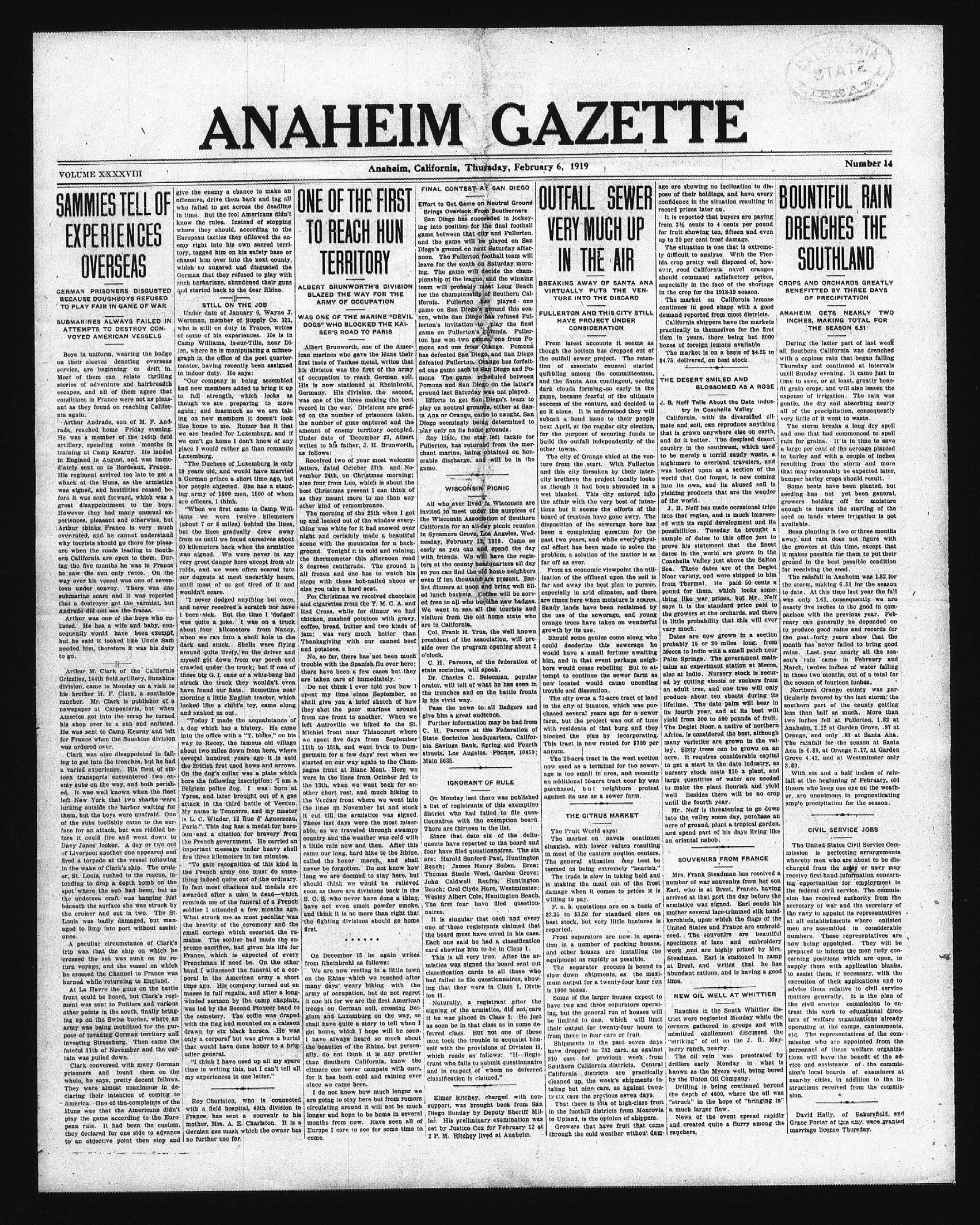
Searchable text
VOLUME XXXXVIII
SAMMIES TELL OF EXPERIENCES OVERSEAS
GERMAN PRISONERS DISGUSTED BECAUSE DOUGHBOYS REFUSED TO PLAY FAIR IN GAME OF WAR
SUBMARINES ALWAYS FAILED IN ATTEMPTS TO DESTROY CONVOYED AMERICAN VESSELS
Boys in uniform, wearing the badge on their sleeves denoting overseas service, are beginning to drift in. Most of them can relate thrilling stories of adventure and hairbreadth escapes, and all of them agree that conditions in France were not as pleasant as they found on reaching California again.
Arthur Andrade, son of M. F. Andrade, reached home Friday evening. He was a member of the 145th field artillery, spending some months in training at Camp Kearny. He landed give the enemy a chance to make an offensive, drive them back and tag all who failed to get across the deadline in time. But the fool Americans didn't know the rules. Instead of stopping where they should, according to the European tactics they followed the enemy right into his own sacred territory, tagged him on his safety base or chased him over into the next county, which so angered and disgusted the German that they refused to play with such barbarians, abandoned their guns and started back to the dear Rhine.
STILL ON THE JOB
Under date of January 6, Wayne J. Wortman, member of Supply Co. 321, who is still on duty in France, writes of some of his experiences. He is in Camp Williams, Is-sur-Tille, near Dijon, where he is manipulating a mfmeograph in the office of the post quartermaster, having recently been assigned to indoor duty. He says:
"Our company is being assembled and new members added to bring it up to full strength, which looks as though we are preparing to move again; and inasmuch as we are taking on new members it doesn't look like home to me. Rumor has it that we are headed for Luxemburg, and if we can't go home I don't know of any place I would rather go than romantic Luxemburg."
ONE OF THAT TO REACH TERRITORY
ALBERT BRUNWORTH
BLAZED THE WAKE
ARMY OF OCCUPIED
WAS ONE OF THE MOST DOGS" WHO BLOCKED SER'S ROAD TO
Albert Brunworth, oneican marines who gave first taste of Yankee men his division was the first of occupation to reach His is now stationed in Germany. His division was one of the three most record in the war. Divided on the number of the number of guns carried amount of enemy torment Under date of December writes to his father, Jas follows:
on their sleeves denoting overseas service, are beginning to drift in. Most of them can relate thrilling stories of adventure and hairbreadth escapes, and all of them agree that conditions in France were not as pleasant as they found on reaching California again.
Arthur Andrade, son of M. F. Andrade, reached home Friday evening. He was a member of the 145th field artillery, spending some months in training at Camp Kearny. He landed in England in August, and was immediately sent on to Bordeaux, France. His regiment arrived too late to get a whack at the Huns, as the armistice was signed, and hostilities ceased before it was sent forward, which was a great disappointment to the boys. However they had many unusual experiences, pleasant and otherwise, but Arthur thinks France is very much over-rated, and he cannot understand why tourists should go there for pleasure when the roads leading to Southern California are open to them. During the five months he was in France he saw the sun only twice. On the way over his vessel was one of seventeen under convoy. There was one submarine scare and it was reported that a destroyer got the varmint, but Andrade did not see the fracas.
Arthur was one of the boys who enlisted. He hsa a wife and baby, consequently would have been exempt, but he said it looked like Uncle Sam needed him, therefore it was his duty to go.
Arthur M. Clark of the California Grizzlies, 144th field artillery, Sunshine division, came in Monday on a visit to his brother H. F. Clark, a southside rancher. Mr. Clark is publisher of a newspaper at Carpenteria, but when America got into the scrap he turned his shop over to a sub and enlisted. He was sent to Camp Kearny and left for France when the Sunshine division was ordered over.
Clark was also disappointed in falling to get into the trenches, but he had a varied experience. His fleet of sixteen transports encountered two enemy subs on the way, and both perished. It was well known when the fleet left New York that two sharks were lurking outside the harbor waiting for them, but the boys were unafraid. One of the subs foolishly came to the surface for an attack, but was riddled before it could fire and went down to Davy Jones' locker. A day or two out of Liverpool another one appeared and fired a torpedo at the vessel following master, having recently been assigned to indoor duty. He says:
"Our company is being assembled and new members added to bring it up to full strength, which looks as though we are preparing to move again; and inasmuch as we are taking on new members it doesn't look like home to me. Rumor has it that we are headed for Luxemburg, and if we can't go home I don't know of any place I would rather go than romantic Luxemburg.
"The Duchess of Luxemburg is only 19 years old, and would have married a German prince a short time ago, but her people objected. She has a standing army of 1600 men, 1500 of whom are officers, I think.
"When we first came to Camp Williams we were twelve kilometers (about 7 or 8 miles) behind the lines, but the lines gradually drew away from us until we found ourselves about 60 kilometers back when the armistice was signed. We were never in any very great danger here except from air raids, and we were often scared into our dugouts at most unearthly hours, until most of us got tired of it and wouldn't scare.
"I never dodged anything but once, and never received a scratch nor have I been sick. But the time I 'dodged' was quite a joke. I was on a truck about four kilometers from Nancy, when we ran into a shell hole in the dark and stuck. Shells were flying around quite lively, so the driver and myself got down from our perch and crawled under the truck; but if one of those big G. I cans or a whiz-bang had struck the truck they wouldn't even have found our hats. Sometimes near morning a little English tractor, which looked like a child's toy, came along and snaked us out.
"Today I made the acquaintance of a dog which has a history. He came into the office with a "Y. bloke," on his way to Recey, the famous old village about two miles down from here, where several hundred years ago it is said the British first used bows and arrows. On the dog's collar was a plate which bore the following inscription: 'I am a Belgium police dog. I was born at Ypres, and later brought out of a gas attack in the third battle of Verdun. My name is Tonnerre, and my master is L. C. Winder, 12 Rue d'Aguereau, Paris." This dog has a medal for heroism and a citation for bravery from the French government. He carried an important message under heavy shell fire three kilometers in ten minutes."
To gain recognition of this kind in first taste of Yankee masters his division was the first occupation to reach His is now stationed in Germany. His division was one of the three main record in the war. Divided on the number of gun cards amount of enemy torpedoes Under date of December writes to his father, J.J., as follows:
Received two of your letters, dated October twenty-fourth on Christmas also four from Lue, who best Christmas present as they meant more other kind of remember.
The morning of the day up and looked out of the thing was white for it night and certainly made scene with the mountain ground. Tonight it is in the thermometer this 8 degrees centigrade. All frozen and one hit steps with these hobbles else you take a hard sneeze.
For Christmas we relied on cigarettes from the Red Cross, while for chicken, mashed potato coffee, bread, butter and jam; was very much Thanksgiving with omelets and potatoes.
No, so far, there had trouble with the Spanish there have been a few are taken care of imminent Do not think I ever spent my time since shall give you a brief they shot the poor from one front to another left Autreville we he Michiel front near Twe spent five days by 11th to 15th, and we germain for a few days started on our way agagne front at Blanc were in the lines from the 13th, when we woke other short rest, and the Verdun front where the lines on November it cut till the armies These last days were able, as we traveled country and the weather a little rain now and came our long, hard call called the honor masters having recently been assigned to indoor duty. He says:
"Our company is being assembled and new members added to bring it up to full strength, which looks as though we are preparing to move again; and inasmuch as we are preparing to move again; and inasmuch as we are preparing to move again; and inasmuch as we are preparing to move again; and inasmuch as we are preparing to move again; and inasmuch as we are preparing to move again; and inasmuch as we are preparing to move again; and inasmuch as we are preparing to move again; and inasmuch as we are preparing to move again; and inasmuch as we are preparing to move again; and inasmuch as we are preparing to move again; and inasmuch as we are preparing to move again; and inasmuch as we are preparing to move again; and inasmuch as we are preparing to move again; and inasmuch as we are preparing to move again; and inasmuch as we are preparing to move again; and inasmuch as we are preparing to move again; and inasmuch as we are preparing to move again; and inasmuch as we are preparing to move again; and inasmuch as we are preparing to move again; and inasmuch as we are preparing to move again; and inasmuch as we are preparing to move again; and inasmuch as we are preparing to move again; and inasmuch as we are preparing to move again; and inasmuch as we are preparing to move again; and inasmuch as we are preparing to move again; and inasmuch as we are preparing to move again; and inasmuch as we are preparing to move again; and inasmuch as we are preparing to move again; and inasmuch as we are preparing to move again; and inasmuch as we are preparing to move again; and inasmuch as we are preparing to move again; and inasmuch as we are preparing to move again; and inasmuch as we are preparing to move again; and inasmuch as we are preparing to move again; and inasmuch as we are preparing to move again;and inasmuch as we are preparing to move again;and inasmichaswearepreparingtomoveagainandinasmichaswearepreparingtomoveagainandinasmichaswearepreparingtomoveagainandinasmichaswearepreparingtomoveagainandinasmichaswearepreparingtomoveagainandinasmichaswearepreparingtomoveagainandinasmichaswearepreparingtomoveagainandinasmichaswearepreparingtomoveagainandinasmichaswearepreparingtomoveagainandinasmichaswearepreparingtomoveagainandinasmichaswearepreparingtomoveagainandinasmichaswearepreparingtomoveagainandinasmichaswearepreparingtomoveagainandinasmichaswearepreparingtomoveagainandinasmichaswearepreparingtomoveagainandinasmichaswearepreparingtomoveagainandinasmichaswearepreparingtomoveagainandinasmichaswearepreparingtomoveagainandinasmichaswearepreparingtomoveagainandinasmichaswearepreparingtomoveagainandinasmichaswearepreparingtomoveagainandinasmichaswearepreparingtomoveagainandinasmichaswearepreparingtomoveagainandinasmichaswearepreparingtomoveagainandinasmichaswearepreparingtomoveagainandinasmichaswearepreparingtomoveagainandinasmichaswearepreparingtomoveagainandinasmichaswearepreparingtomoveagainandinasmichaswearepreparingtomoveagainandinasmichaswearepreparingtomoveagainandinasmichaswearepreparingtomoveagainandinasmichaswearepreparingtomoveagainandinasmichaswearepreparingtomoveagainandinasmichaswearepreparingtomoveagainandinasmichaswearepreparingtomoveagainandinasmichaswearepreparingtomoveagainandinasmichaswearepreparingtomoveagainandinasmichaswearepreparingtomoveagainandinasmichaswearepreparingtomoveagainandinasmichaswearepreparingtomoveagainandinasmichaswearepreparingtomoveagainandinasmichaswearepreparingtomoveagainandinasmichaswearepreparingtomoveagainandinasmichaswearepreparingtomoveagainandinasmichaswearepreparingtomoveagainandinasmichaswearepreparingtomoveagainandinasmichaswearepreparingtomoveagainandinasmichaswearepreparingtomoveagainandinasmichaswearepreparingtomoveagainandinomashearengroupofthemilitarydivisionofthemilitarydivisionofthemilitarydivisionofthemilitarydivisionofthemilitarydivisionofthemilitarydivisionofthemilitarydivisionofthemilitarydivisionofthemilitarydivisionofthemilitarydivisionofthemilitarydivisionofthemilitarydivisionofthemilitarydivisionofthemilitarydivisionofthemilitarydivisionofthemilitarydivisionofthemilitarydivisionofthemilitarydivisionofthemilitarydivisionofthemilitarydivisionofthemilitarydivisionofthemilitarydivisionofthemilitarydivisionofthemilitarydivisionofthemilitarydivisionofthemilitarydivisionofthemilitarydivisionofthemilitarydivisionofthemilitarydivisionofthemilitarydivitionofthemilitarydivitionofthemilitarydivitionofthemilitarydivitionofthemilitarydivitionofthemilitarydivitionofthemilitarydivitionofthemilitarydivitionofthemilitarydivitionofthemilitarydivitionofthemilitarydivitionofthemilitarydivitionofthemilitarydivitionofthemilitarydivitionofthemilitarydivitionofthemilitarydivitionofthemilitarydivitionofthemilitarydivitionofthemilitarydivitionofthemilitarydivitionofthemilitarydivitionofthemilitarydivitionofthemilitarydivitionofthemilitarydivitionofthemilitarydivitionofthemilitarydivitionofthemilitarydivitionofthemilitarydivitionofthemilitarydivitionofthemilitarydivitionofthemilitarydivitionofthemilitarydivitionofthemilitarydivitionofthemilitarydivitionofthemilitarydivitionofthemilitarydivitionofthemilitarydivitionofthemilitarydivitionofthemilitarydivitionofthemilitarydivitionofthemilitarydivitionofthemilitarydivitionofthemilitarydivitionofthemilitarydivitionofthemilitarydivitionofthemiltorydividendoffortheasternorthwestnorthwestnorthwestnorthwestnorthwestnorthwestnorthwestnorthwestnorthwestnorthwestnorthwestnorthwestnorthwestnorthwestnorthwestnorthwestnorthwestnorthwestnorthwestnorthwestnorthwestnorthwestnorthwestnorthwestnorthwestnorthwestnorthwestnorthwestnorthwestnorthwestnorthwestnorthwestnorthwestnorthwestnorthwestnorthwestnorthwestnorthwestnorthwestnorthwestnorthwestnorthwestnorthwestnorthwestnorthwestnorthwestnorthwestnorthwestnorthwestnorthwestnorthwestnorthwestnorthwestnorthwestnorthwestnorthwestnorthwestnorthwestnorthwestnorthwestern northwestern northwestern northwestern northwestern northwestern northwestern northwestern northwestern northwestern northwestern northwestern northwestern northwestern northwestern northwestern northwestern northwestern northwestern northwestern northwestern northwestern northwestern northwestern northwestern northwestern northwestern northwestern northwestern northwestern northwestern northwestern northwestern northwestern northwestern northwestern northwestern northwestern northwestern northwestern northwestern northwestern northwestern northwestern northwestern northwestern northwestern northwestern northwestern northwesternNorth western North western North western North western North western North western North western North western North western North western North western North western North western North western North western North western North western North western North western North western North western North western North western North western North western North western North western North western North western North western North western North western North western North western North western North western North western North western North western North western North western North western North western North western North western North Western North Western North Western North Western North Western North Western North Western North Western North Western North Western North Western North Western North Western North Western North Western North Western North Western North Western North Western North Western North Western North Western North Western North Western North WesternNorth WesternNorth WesternNorth WesternNorth WesternNorth WesternNorth WesternNorth WesternNorth WesternNorth WesternNorth WesternNorth WesternNorth WesternNorth WesternNorth WesternNorth WesternNorth WesternNorth WesternNorth WesternNorth WesternNorth WesternNorth WesternNorth WesternNorth WesternNorth WesternNorth WesternNorth WesternNorth WesternNorth WesternNorth WesternNorth WesternNorth WesternNorth WesternNorth WesternNorth WesternNorth WesternNorth WesternNorth WesternNorthWesternNorthWesternNorthWesternNorthWesternNorthWesternNorthWesternNorthWesternNorthWesternNorthWesternNorthWesternNorthWesternNorthWesternNorthWesternNorthWesternNorthWesternNorthWesternNorthWesternNorthWesternNorthWesternNorthWesternNorthWesternNorthWesternNorthWesternNorthWesternNorthWesternNorthWesternNorthWesternNorthWesternNorthWesternNorthWesternNorthWesternNorthWesternNorthWesternNordestNordestNordestNordestNordestNordestNordestNordestNordestNordestNordestNordestNordestNordestNordestNordestNordestNordestNordestNordestNordestNordestNordestNordestNordestNordestNordestNordestNordestNordestNordestNordestNordestNordestNordenstNordenstNordenstNordenstNordenstNordenstNordenstNordenstNordenstNordenstNordenstNordenstNordenstNodenstNodenstNodenstNodenstNodenstNodenstNodenstNodenstNodenstNodenstNodenstNodenstNodenstNodenstNodenstNodenstNodenstNodenstNodenstNodenstNodenstNorthernNorthernNorthernNorthernNorthernNorthernNorthernNorthernNorthernNorthernNorthernNorthernNorthernNorthernNorthernNorthernNorthernNorthernNorthernNorthernNorthernNorthernNorthernNorthernNorthernNorthernNorthernNorthernNorthernNorthernNorthernNorthernNorthernNorthernNorthernNorthernNorthernNorthernNorthernNorthernNorthernNorthernNorthernNorthernNorthernNorthernNorthernNorthernNorthernNorthernNorthernNorthernNorthernNorthernNorthernNorthernNorthernNorthernNorthernNorthernNorthernNorthernNorthernNorthernNorthernNorthernNorthernNorthernNorthernNorthernNorthern Northernsnorthernsnorthernsnorthernsnorthernsnorthernsnorthernsnorthernsnorthernsnorthernsnorthernsnorthernsnorthernsnorthernsnorthernsnorthernsnorthernsnorthernsnorthernsnorthernsnorthernsnorthernsnorthernsnorthernsnorthernsnorthernsnorthernsnorthernsnorthernsnorthernsnorthernsnorthernsnorthernsnorthernsnorthernsnorthernsnorthernsnorthernsnorthernsnorthermsnorthermsnorthermsnorthermsnorthermsnorthermsnorthermsnorthermsnorthermsnorthermsnorthermsnorthermsnorthermsnorthermsnorthermsnorthermsnorthermsnorthermsnorhermesnorhermesnorhermesnorhermesnorhermesnorhermesnorhermesnorhermesnorhermes norhermes norhermes norhermes norhermes norhermes norhermes norhermes norhermes norhermes norhermes norhermes norhermes norhermes norhermes norhermes norhermes norhermes norhermes norhermes norhermes norhermes norhermes norhermes norhermes norhermes norhermes norhermes norhermes norhermes norhermes norhermes norhermes norhermes norhermes norhermes norhermes norhermes norhermes norhermes norhermes norhermes norhermes norhermes norhermes norhermes norhermes norhermes norhermes norhermes norhermes norhermes norhermes norhermes norhermes norhermes norhermes norhermes norhermes norotherhes Norotherhes Norotherhes Norotherhes Norotherhes Norotherhes Norotherhes Norotherhes Norotherhes Norotherhes Norotherhes Norotherhes Norotherhes Norotherhes Norotherhes Norotherhes Norotherhes Norotherhes Norotherhes Norotherhes Norotherhes Norotherhes Norotherhes Norotherhes Norotherhes Norotherhes Norotherhes Norotherhes Norotherhes Norotherhes Norotherhes Norotherhes Norotherhes Norotherhes Norotherhes Norotherhes Norotherhes Norotherhes Norotherhes Norotherhes NorOtherhes NorOtherhes NorOtherhes NorOtherhes NorOtherhes NorOtherhes NorOtherhes NorOtherhes NorOtherhes NorOtherhes NorOtherhes NorOtherhes NorOtherhes NorOtherhes NorOtherhes NorOtherhes NorOtherhes NorOtherhes NorOtherhes NorOtherhes NorOtherhes NorOtherhes NorOtherhes NorOtherhes NorOtherhes NorOtherhes NorOtherhes NorOtherhes NorOtherhes NorOtherhes NorOtherhes NorOtherhes NorOtherhes Nar Otherhes Nar Otherhes Nar Otherhes Nar Otherhes Nar Otherhs Nar Otherhs Nar Otherhs Nar Otherhs Nar Otherhs Nar Otherhs Nar Otherhs Nar Otherhs Nar Otherhs Nar Otherhs Nar Otherhs Nar Otherhs Nar Otherhs Nar Otherhs Nar Otherhs Nar Otherhs Nar Otherhs Nar Otherhs Nar Otherhs Nar Otherhs Nar Otherhs Nar Otherhs Nar Otherhs Nar Otherhs Nar Otherhs Nar Otherhs Nar Otherhs Nar Otherhs Nar Otherhs Nar Otherhss Nar Otherhss Nar Otherhss Nar Otherhss Nar Otherhss Nar Otherhss Nar Otherhss Nar Otherhss Nar Otherhss Nar Otherhss Nar Otherhss Nur其他hss Nur其他hss Nur其他hss Nur其他hss Nur其他hss Nur其他hss Nur其他hss Nur其他hss Nur其他hss Nur其他hss Nur其他hss Nur其他hss Nur其他hss Nur其他hss Nur其他hss Nur其他hss Nur其他hss Nur其他hss Nur其他hss Nur其他hss Nur其他hss Nur其他hss Nur其他hss Nur其他hss Nur其他hss NURDERS NURDERS NURDERS NURDERS NURDERS NURDERS NURDERS NURDERS NURDERS NURDERS NURDERS NURDERS NURDERS NURDERS NURDERS NURDERS NURDERS NURDERS NURDERS NURDERS NURDERS NURDERS NURDERS NURDERS NURDERS NURDERS NURDERS NURDERS NURDERS NURDERS NURDERS NURDERS NURDERS NURDERS NURDERS NURDERS NURDERS NURDERS NURDERS NURDERS NURDERS NURDERS NURDERS NURDERS NURDERS NURDERS NURDERS NURDERS NURDERS NURDERS NRUERDS NRUERDS NRUERDS NRUERDS NRUERDS NRUERDS NRUERDS NRUERDS NRUERDS NRUERDS NRUERDS NRUERDS NRUERDS NRUERDS NRUERDS NRUERDS NRUERDS NRUERDS NRUERDS NRUERDS NRUERDS NRUERDS NRUERDS NRUERDS NRUERDS NRUERDS NRUERDS NRUERDS NRUERDS NRUERDS NRUERDS NRUERDS NRUERDS NRUERDS NRUERDS NRUERDS NRUERDS NR URDERS NRUERDs NRUERDs NRUERDs NRUERDs NRUERDs NRUERDs NRUERDs NRUERDs NRUERDs NRUERDs NRUERDs NRUERDs NRUERDs NRUERDs NRUERDs NRUERDs NRUERDs NRUERDs NRUERDs NRUERDs NRUERDs NRUERDs NRUERDs NRUERDs NR URDERS NRUERDs NRUERDsNRUERDsNRUERDsNRUERDsNRUERDsNRUERDsNRUERDsNRUERDsNRUERDsNRUERDsNRUerdsNRuerdsNRuerdsNRuerdsNRuerdsNRuerdsNRuerdsNRuerdsNRuerdsNRuerdsNRuerdsNRuerdsNRuerdsNRuerdsNRuerdsNRuerdsNRuerdsNRuerdsNRuerdsNRuerdsNRuerdsNRuerdsNRuerdsNRuerdsNRuerdsNR URDERS NRUerdsNRUerdsNRUerdsNRUerdsNRUerdsNRUerdsNRUerdsNRUerdsNRUerdsNRUerdsNRUerdsNRUerdsNRUerdsNRUerdsNRUerdsNRUerdsNRUerdsNRUerdsNRUerdsNR URDERS NR URDERSDSR URDERSDSR URDERSDSR URDERSDSR URDERSDSR URDERSDSR URDERSDSR URDERSDSR URDERSDSR URDERSDSR URDERSDSR URDERSDSR URDERSDSR URDERSDSR URDERSDSR URDERSDSR URDERSDSR URDERSDSR URDERSDSR URDERSDSR URDEDRSD SR URDEDRSD SR URDEDRSD SR URDEDRSD SR URDEDRSD SR URDEDRSD SR URDEDRSD SR URDEDRSD SR URDEDRSD SR URDEDRSD SR URDEDRSD SR URDEDRSD SR URDEDRSD SR URDEDRSD SR URDEDRSD SR URDEDRSD SR URDEDRSD SR URDERRSD SR URDERRSD SR URDERRSD SR URDERRSD SR URDERRSD SR URDERRSD SR URDERRSD SR URDERRSD SR URDERRSD SR URDERRSD SR URDERRSD SR URDERRSD SR URDERRSD SR URDERRSD SR URDERRSD SR URDERRSD SR URDERRSD SR URDERRSD SR URDERR SD SR URDERR SD SR URDERR SD SR URDERR SD SR URDERR SD SR URDERR SD SR URDERR SD SR URDERR SD SR URDERR SD SR UD RRRRRRRRRRRRRRRRRRRRRRRRRRRRRRRRRRRRRRRRRRRRRRRRRRRRRRRRRRRRRRRRRRRRRRRRRRRRRRRRRRRRRRRRRRRRRRRRRRRRRRRRRRRRRRRRRRRRRRRRRRRRRRRRRRRRRRRRRRRRRRRRRRRRRRRRRRRRRRRRRRRRRRRRRRRRRRRRRRRRRRRRRRRRRRRRR
His fleet of sixteen transports encountered two enemy subs on the way, and both perished. It was well known when the fleet left New York that two sharks were lurking outside the harbor waiting for them, but the boys were unafraid. One of the subs foolishly came to the surface for an attack, but was riddled before it could fire and went down to Davy Jones' locker. A day or two out of Liverpool another one appeared and fired a torpedo at the vessel following in the wake of Clark's ship. The cruiser, St. Louis, rushed to the rescue, intending to drop a depth bomb on the spot where the sub had been, but as the undersea craft was hanging just beneath the surface she was struck by the cruiser and cut in two. The St. Louis was badly damaged, but managed to limp into port without assistance.
A peculiar circumstance of Clark's trip was that the ship on which he crossed the sea was sunk on its return voyage, and the vessel on which he crossed the Channel to France was burned while returning to England.
At La Havre the guns on the battle front could be heard, but Clark's regiment was sent to Poliers and various other points in the south, finally bringing up on the Swiss border, where an army was being mobilized for the purpose of invading German territory and investing Strassburg. Then came the fateful 11th of November and the curtain was pulled down.
Clark conversed with many German prisoners and found them on the whole, he says, pretty decent fellows. They were almost unanimous in declaring their intention of coming to America. One of the complaints of the Huns was that the Americans didn't play the game according to the European rule. It had been the custom, they declared for one side to advance to an objective point then stop and
On the dog's collar was a plate which bore the following inscription: 'I am a Belgium police dog. I was born at Ypres, and later brought out of a gas attack in the third battle of Verdun. My name is Tonnerre, and my master is L. C. Winder, 12 Rue d'Aguerscau, Paris.' This dog has a medal for heroism and a citation for bravery from the French government. He carried an important message under heavy shell fire three kilometers in ten minutes.
"To gain recognition of this kind in the French army one must do something indeed quite out of the ordinary. In fact most citations and medals are awarded after a man is dead—which reminds me of the funeral of a French soldier I attended a few months ago. What struck me as most peculiar was the brevity of the ceremony and the small cortege which escorted the remains. The soldier had made the supreme sacrifice, had given his life for France, which is expected of every Frenchman if need be. On the other hand I witnessed the funeral of a corporal in the American army a short time ago. His company turned out en masse in full regalia, and after a long-winded sermon by the camp chaplain, was led by the Second Pioneer band to the cemetery. The coffin was draped with the flag and mounted on a caisson drawn by six black horses. He was only a corporal but was given a burial that would have done honor to a brigadier general.
"I think I have used up all my spare time in writing this, but I can't tell all my experiences in one letter."
Roy Charlston, who is connected with a field hospital, 40th division in France, has sent a souvenir to his mother, Mrs. A. E. Charlston. It is a German gas mask which the owner has no further use for.
These last days were able, as we traveled through country and the weather a little rain now and came our long, hard callled the honor men never be forgotten. Long we are doomed should think we soon as there are divs S. O. S. who never have not even smelt and think it is no more the fighting divisions first.
On December 15 from Rheinbrohl as We are now resting on the Rhine which many days' weary army of occupation, it one bit for we are troops on German soil gium and Luxemburgh shall have quite a stog get home, which I I have always heard the beauties of the ally, do not think than Southern Californiate can never cease for it has been cold since we came here.
I do not know how are going to stay here circulating around longer and hope to go months from now. Europe I care to see come.
AHEIM GAZETT
Anaheim, California, Thursday, February 6, 1919
ONE OF THE FIRST TO REACH HUN TERRITORY
ALBERT BRUNWORTH'S DIVISION BLAZED THE WAY FOR THE ARMY OF OCCUPATION
WAS ONE OF THE MARINE "DEVIL DOGS" WHO BLOCKED THE KAI-SER'S ROAD TO PARIS
Albert Brunworth, one of the American marines who gave the Huns their first taste of Yankee metal, writes that his division was the first of the army of occupation to reach German soil. His is now stationed at Rheinbrohl, Germany. His division, the second, was one of the three making the best record in the war. Divisions are graded on the number of prisoners taken, the number of guns captured and the amount of enemy territory occupied. Under date of December 27, Albert writes to his father, J. H. Brunworth, as follows:
FINAL CONTEST AT SAN DIEGO
Effort to Get Game on Neutral Ground Brings Overlook From Southerners
San Diego has succeeded in jockeying into position for the final football game between that city and Fullerton, and the game will be played on San Diego's ground on next Saturday afternoon. The Fullerton football team will leave for the south on Saturday morning. The game will decide the championship of the league, and the winning team will probably meet Long Beach for the championship of Southern California. Fullerton has played one game on San Diego's ground this season, while San Diego has refused Fullerton's invitation to play the final game on Fullerton's grounds. Fullerton has won two games, one from Pomona and one from Orange. Pomona has defeated San Diego, and San Diego defeated Fullerton. Orange has forfeited one game each to San Diego and Pomona. The game scheduled between Pomona and San Diego on the latter's ground last Saturday was not played.
Efforts to get San Diego's team to play on neutral grounds, either at Santa Ana or Orange, came to naught, San Diego seemingly being determined to play only on its home grounds.
Roy Hale, the star left tackle for Fullerton, has returned from the merchant marine, hailing obtained on honour.
OUTFALL SEWER VERY MUCH UP IN THE AIR
BREAKING AWAY OF SANTA ANA VIRTUALLY PUTS THE VENTURE INTO THE DISCARD
FULLERTON AND THIS CITY STILL HAVE PROJECT UNDER CONSIDERATION
From latest accounts it seems as though the bottom has dropped out of the outfall sewer project. The retention of associate counsel started quibbling among the committeemen, and the Santa Ana contingent, seeing dark clouds forming~so early in the game, became fearful of the ultimate success of the venture, and decided to go it alone. It is understood they will submit a bond issue to their people next April, at the regular city election, for the purpose of securing funds to build the outfall independently of the other towns.
The city of Orange shied at the ven-
first taste of Yankee metal, writes that his division was the first of the army of occupation to reach German soil. His is now stationed at Rheinbrohl, Germany. His division, the second, was one of the three making the best record in the war. Divisions are graded on the number of prisoners taken, the number of guns captured and the amount of enemy territory occupied. Under date of December 27, Albert writes to his father, J. H. Brunworth, as follows:
Received two of your most welcome letters, dated October 27th and November 24th, on Christmas morning; also four from Lue, which is about the best Christmas present I can think of as they meant more to me than any other kind of remembrance.
The morning of the 25th when I got up and looked out of the window everything was white for it had snowed over night and certainly made a beautiful scene with the mountains for a background. Tonight it is cold and raining, the thermometer this afternoon read 8 degrees centigrade. The ground is all frozen and one has to watch his steps with these hob-nailed shoes or else you take a hard seat.
For Christmas we received chocolate and cigarettes from the Y. M. C. A. and Red Cross, while for dinner we had chicken, mashed potatoes with gravy, coffee, bread, butter and two kinds of jam; was very much better than Thanksgiving with our canned beef and potatoes.
No, so far, there has not been much trouble with the Spanish flu over here; there have been a few cases but they are taken care of immediately.
Do not think I ever told you how I spent my time since September, so shall give you a brief sketch of how they shot the poor marines around from one front to another. When we left Autreville we hiked to the St. Michiel front near Thlaucourt where we spent five days from September 11th to 15th, and went back to Dumgermain for a few days' rest when we started on our way again to the Champagne front at Blanc Mont. Here we were in the lines from October 3rd to the 13th, when we went back for another short rest, and much hiking to the Verdun front where we went into the lines on November 1st and stuck it cut till the armistice was signed. These last days were the most miserable, as we traveled through swampy country and the weather was cold with a little rain now and then. After this came our long, hard hike to the Rhine, called the honor march, and shall defeated Fullerton. Orange has forfeited one game each to San Diego and Pomona. The game scheduled between Pomona and San Diego on the latter's ground last Saturday was not played.
Efforts to get San Diego's team to play on neutral grounds, either at Santa Ana or Orange, came to naught, San Diego seemingly being determined to play only on its home grounds.
Roy Hale, the star left tackle for Fullerton, has returned from the merchant marine, hauing obtained on honorable discharge, and will be in the game.
WISCONSIN PICNIC
All who ever lived in Wisconsin are invited to meet under the auspices of the Wisconsin Association of Southern California for an all-day picnic reunion in Sycamore Grove, Los Angeles. Wednesday, February 12, 1919. Come as early as you can and spend the day with friends. We will have the registers at the county headquarters all day so you can find the old home neighbors even if ten thousand are present. Basket dinners at noon and bring well filled lunch baskets. Coffee will be served free to all who buy the new badges. We want to see all the tourists and visitors from the old home state who are in California.
Col. Frank H. True, the well known president of the association, will preside over the program opening about 2 o'clock.
C. H. Parsons, of the federation of state societies, will speak.
Dr. Charles C. Selecman, popular orator, will tell of what he has seen in the trenches and on the battlefront in his vivid way.
Pass the news to all Badgers and give him a great audience.
Further information may be had from C. H. Parsons at the Federation of State Societies headquarters, California Savings Bank, Spring and Fourth streets, Los Angeles. Phones, 10459; Main 5635.
IGNORANT OF RULE
On Monday last there was published a list of registrants of this exemption district who had failed to file questionnaires with the exemption board. There are thirteen in the list.
Since that date six of the delinquents have reported to the board and four have filed questionnaires. The six are: Harold Sanford Paul, Huntington Beach; James Henry Soden; Brea-
the city of Orange shied at the venture from the start. With Fullerton and this city forsaken by their intercity brethren the project locally looks as though it had been shrouded in a wet blanket. This city entered into the affair with the very best of intentions but it seems the efforts of the board of trustees have gone awry. The disposition of the sewerage here has been a complexing question for the past two years, and while every physical effort has been made to solve the problem, a solution of the matter is as far off as ever.
From an economic viewpoint the utilization of the effluent upon the soil is far and away the best plan to pursue, especially in arid climates, and there are times here when moisture is scarce. Sandy lands have been reclaimed by the use of the sewerage, and young orange trees have taken on wonderful growth by its use.
Should some genius come along who could deoderize this sewerage he would have a small fortune awaiting him, and in that event perhaps neighbors would cease rebelling But to attempt to continue the sewer farm as now located would cause unending trouble and dissention.
The city owns a 73-acre tract of land in the city of Stanton, which was purchased several years ago for a sewer farm, but the project was out of tune with residents of that burg and they blocked the plan by incorporating. This tract is now rented for $700 per annum.
The 20-acre tract in the west section now used as a terminal for the sewerage is too small in area, and recently an additional 10-acre tract near by was purchased, but neighbors protest against its use as a sewer farm.
THE CITRUS MARKET
The Fruit World says:
The market on navels continues sluggish, with lower values resulting in most of the eastern auction centers. The general situation may best be
On December 15 he again writes from Rheinbrohl as follows:
We are now resting in a little town on the Rhine which we reached after many days' weary hiking with the army of occupation, but do not regret it one bit for we are the first American troops on German soil, crossing Belgium and Luxemburg on the way, so shall have quite a story to tell when I get home, which I hope will be soon. I have always heard so much about the beauties of the Rhine, but personally, do not think it is any prettier than Southern California, know the climate can never compete with ours, for it has been cold and raining ever since we came here.
I do not know how much longer we are going to stay here but from rumors circulating around it will not be much longer and hope to be home in several months from now. Have seen all of Europe I care to see for some time to come.
IGNORANT OF RULE
On Monday last there was published a list of registrants of this exemption district who had failed to file questionnaires with the exemption board. There are thirteen in the list.
Since that date six of the delinquents have reported to the board and four have filed questionnaires. The six are: Harold Sanford Paul, Huntington Beach; James Henry Soden, Brea; Thomas Steele West, Garden Grove; John Caldwell Renfra, Huntington Beach; Orel Clyde Hare, Westminster; Wesley Albert Cole, Huntington Beach. The first four have filed questionnaires.
It is singular that each and every one of these registrants claimed that the board must have erred in his case. Each one said he had a classification card showing him to be in Class 1.
This is all very true. After the armistice was signed the board sent out classification cards to all those who had failed to file questionnaires, showing that they were in Class 1, Division H.
Naturally, a registrant after the signing of the armistice, did not care if he was placed in Class 1. He just as soon be in that class as in some deferred class. But not one of these men took the trouble to acquaint himself with the provisions of Division II, which reads as follows: "H—Registrant who fails to submit questionnaire and in respect of whom no deferred classification is claimed."
Elmer Ritchey, charged with non-support, was brought back from San Diego Sunday by Deputy Sheriff Miller. His preliminary examination was set by Justice Cox for February 12 at 2 P.M. Ritchey lived at Anaheim.
THE CITRUS MARKET
The Fruit World says:
The market on navels continues sluggish, with lower values resulting in most of the eastern auction centers. The general situation may best be termed as being extremely "bearish."
The trade is slow in taking hold and is making the most out of the frost damage when it comes to prices it is willing to pay.
F. o. b. quotations are on a basis of $3.35 to $3.50 for standard sizes on best stock, but very little business is reported.
Frost separators are now in operation in a number of packing houses, and other houses are installing the equipment as rapidly as possible.
The separator process is bound to slow down shipments, as the maximum output for a twenty-four hour run is 1900 boxes.
Some of the larger houses expect to have two and three separators operating, but the general run of houses will be limited to one, which will limit their output for twenty-four hours to from three to four cars or fruit.
Shipments in the past seven days have dropped to 782 cars, as against 910 cars for previous week from Southern California districts. Central California districts are practically cleaned up, the week's shipments totaling but nine cars, as against twenty-six cars the previous seven days.
That there is lots of high-class fruit in the foothill districts from Monrovia to Upland, is the opinion of shippers.
Growers that have fruit that came through the cold weather without dam-
NEWER
SH UP
AIR
SANTA ANA
THE VENISCARD
CITY STILL
UNDER
ON
It seems as
ropped out of
The retennsel started
committeemen,
angent, seeing
early in the
the ultimate
and decided to
good they will
their people
city election,
ring funds to
identify of the
age are showing no inclination to dispose of their holdings, and have every
confidence in the situation resulting in
record prices later on.
It is reported that buyers are paying
from 3½ cents to 4 cents per pound
for fruit showing ten, fifteen and even
up to 20 per cent frost damage.
The situation is one that is extremely difficult to analyze. With the Florida crop pretty well disposed of, however, good California navel oranges should command satisfactory prices,
especially in the face of the shortage
in the crop for the 1918-19 season.
The market on California lemons continues in good shape with a good demand reported from most districts.
California shippers have the markets practically to themselves for the first
tiem in years, there being but 8000 boxes of foreign lemons available.
The market is on a basis of $4.25 to $4.75, delivered, on best stock.
THE DESERT SMILED AND BLOSSOMED AS A ROSE
J. B. Neff Tells About the Date Industry in Coachella Valley
California, with its diversified climate and soil, can reproduce anything
that is grown anywhere else on earth,
and do it better. The despised desert
country in the southwest, which used
to be merely a torrid sandy waste, a
BOUNTIFUL RAIN
DRENCHES THE SOUTHLAND
CROPS AND ORCHARDS GREATLY
BENEFITTED BY THREE DAYS
OF PRECIPITATION
ANAHEIM GETS NEARLY TWO
INCHES, MAKING TOTAL FOR
THE SEASON 6.51
During the latter part of last week all Southern California was drenched with a copious rain that began falling Thursday and continued at intervals until Sunday evening. It came just in time to save, or at least, greatly benefit grain crops, and will also lessen the expense of irrigation. The rain was gentle, the dry soil absorbing nearly all of the precipitation, consequently very little of it went to waste.
The storm breaks a long dry spell and one that had commenced to spell ruin for grains. It is in time to save a large per cent of the acreage planted to harlow and with a couple of inches
THE DESERT SMILED AND BLOSSOMED AS A ROSE
J. B. Neff Tells About the Date Industry in Coachella Valley
California, with its diversified climate and soil, can reproduce anything that is grown anywhere else on earth, and do it better. The despised desert country in the southwest, which used to be merely a torrid sandy waste, a nightmare to overland travelers, and was looked upon as a section of the world that God forgot, is now coming into its own, and its abused soil is yielding products that are the wonder of the world.
J. B. Neff has made occasional trips into that region, and is much impressed with its rapid development and its possibilities. Tuesday he brought a sample of dates to this office just to prove his statement that the finest dates in the world are grown in the Coachella Valley just above the Salton Sea. These dates are of the Deglet Noor variety, and were shipped to him from Thermal. He paid 50 cents a pound for them, which looks something like war prices, but Mr. Neff says it is the standard price paid to the growers at the orchards, and there is little probability that this will ever vary much.
Dates are now grown in a section probably 15 or 20 miles long, from Mecca to Indio with a small patch near Palm Springs. The government maintains an experiment station at Mecca, also at Indio. Nursery stock is secured by cutting shoots or suckers from an adult tree, and one tree will only produce about ten shoots during its lifetime. The date palm will bear in its fourth year, and at its best will yield from 300 to 500 pounds of fruit. The Deglet Noor, a native of northern Africa, is considered the best, although many varieties are grown in the valley. Sixty trees can be grown on an acre. It requires considerable capital to get a start in the date industry, as nursery stock costs $10 a plant, and large quantities of water are needed to make the plant flourish and yield well. Besides there will be no crop until the fourth year.
Mr. Neff is threatening to go down into the valley some day, purchase an acre of ground, plant a tropical garden, and spend part of his days living like an oriental nabob.
SOUVENIRS FROM FRANCE
THURSDAY and continued at intervals until Sunday evening. It came just in time to save, or at least, greatly benefit grain crops, and will also lessen the expense of irrigation. The rain was gentle, the dry soil absorbing nearly all of the precipitation, consequently very little of it went to waste.
The storm breaks a long dry spell and one that had commenced to spell ruin for grains. It is in time to save a large per cent of the acreage planted to barley and with a couple of inches resulting from the storm and more that may reasonably be expected later, bumper barley crops should result.
Some beets have been planted, but seeding has not yet been general, growers holding off for moisture enough to insure the starting of the seed on lands where irrigation is not available.
Bean planting is two or three months away, and rain does not figure with the growers at this time, except that it makes possible for them to put their ground in the best possible condition for receiving the seed.
The rainfall in Anaheim was 1.82 for the storm, making 6.51 for the season to date. At this time last year the fall was only 1.61, consequently we are nearly five inches to the good in comparison with the previous year. February can generally be depended on to produce good rains and records for the past forty years show that the month has never failed to bring good rains. Last year nearly all the season's rain came in February and March, twelve inches of water falling in those two months, out of a total for the season of fourteen inches.
Northern Orange county was particularly favored by the last storm; the southern part of the county getting less than half as much. More than two inches fell at Fullerton, 1.82 at Anaheim, 1.12 at Garden Grove, .97 at Orange, and only .81 at Santa Ana. The rainfall for the season at Santa Ana is 4.80, at Orange 5.17, at Garden Grove 4.42, and at Westminster only 3.83.
With six and a half inches of rainfall at the beginning of February, old timers who keep one eye on the weather, are unanimous in prognosticating ample precipitation for the season.
CIVIL SERVICE JOBS
The United States Civil Service Commission is perfecting arrangements whereby men who are about to be dis-
MARKET
levels continues values resulting reduction centers.
may best be timely "bearish."
taking hold and out of the frost to prices it is
live on a basis of standard sizes on little business is
now in opera-packing houses,
installing the is possible.
access is bound to, as the maxi-ty-four hour run
houses expect to separators operaton of houses will which will limit twenty-four hours to or fruit.
least seven days cars, as against us week from districts. Central are practically's shipments to as against twen-ness seven days.
of high-class fruits from Monrovia on of shippers.
fruit that came other without damnery stock costs $10 a plant, and large quantities of water are needed to make the plant flourish and ylold well. Besides there will be no crop until the fourth year.
Mr. Neff is threatening to go down into the valley some day, purchase an acre of ground, plant a tropical garden, and spend part of his days living like an oriental nabob.
SOUVENIRS FROM FRANCE
Mrs. Frank Steadman has received a number of war souvenirs from her son Earl, who is at Brest, France, having arrived at that port the day before the armistice was signed. Earl sends his mother several lace-trimmed silk handkerchiefs, upon which the flags of the United States and France are embroidered. The souvenirs are beautiful specimens of lace and embroidery work, and are highly prized by Mrs. Steadman. Earl is stationed in camp at Brest, and writes that he has abundant rations, and is having a good time.
NEW OIL WELL AT WHITTIER
Ranches in the South Whittier district were neglected Monday while the owners gathered in groups and with admitted excitement discussed the "striking" of oil on the J. R. Mayberry ranch, nearby.
The oil vein was penetrated by drillers early Monday in what is known as the Myers well, being bored by the Union Oil Company.
Drilling is being continued beyond the depth of 4600, where the oil was "struck" in the hope of "bringing in" a much larger flow.
News of the event spread rapidly and created quite a flurry among the ranchers,
With six and a half inches of rainfall at the beginning of February, old timers who keep one eye on the weather, are unanimous in prognosticating amp'e precipitation for the season.
CIVIL SERVICE JOBS
The United States Civil Service Commission is perfecting arrangements whereby men who are about to be discharged from the army or navy may receive first-hand information concerning opportunities for employment in the federal civil service. The commission has received authority from the secretary of war and the secretary of the navy to appoint its representatives at all establishments where enlisted men are assembled in considerable numbers. These representatives are now being appointed. They will be prepared to inform the men ruly concerning positions which are open, to supply them with application blanks, to assist them, if necessary, with the execution of their applications and to advise them relative to civil service matters generally. It is the plan of the civil service commission to entrust this work to educational directors of welfare organizations already operating at the camps, cantonments, etc. The representatives of the commission who are appointed from the personnel of these welfare organizations will have the benefit of the advice and assistance of the commission's local boards of examiners at near-by cities, in addition to the instructions received from the commission.
David Hally, of Bakerfield, and Grace Porter of this city, were granted marriage license Thursday.