anaheim-gazette 1919-01-30
Scanned page
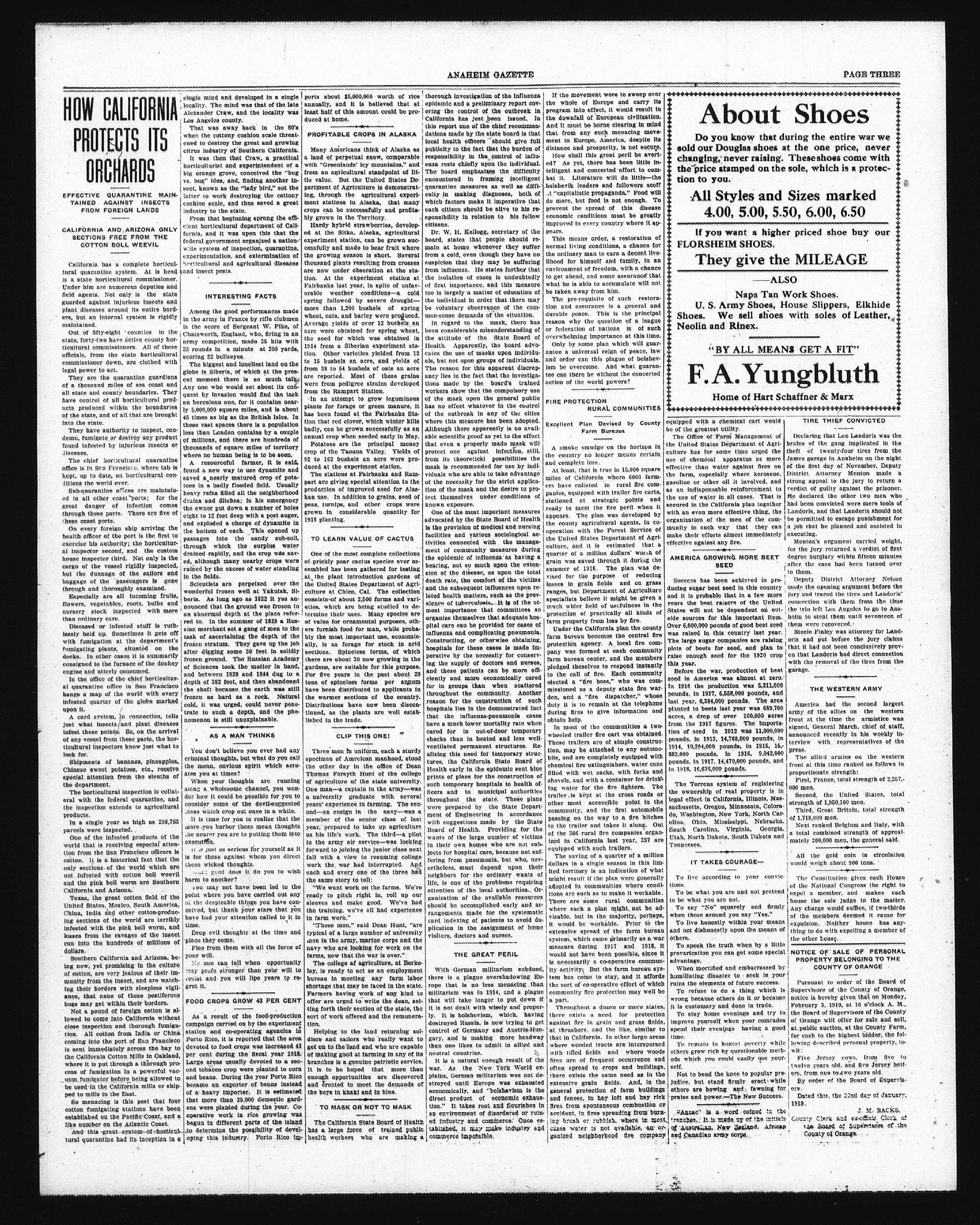
Searchable text
HOW CALIFORNIA PROTECTS ITS ORCHARDS
EFFECTIVE QUARANTINE MAIN-TAINED AGAINST INSECTS FROM FOREIGN LANDS
CALIFORNIA AND ARIZONA ONLY SECTIONS FREE FROM THE COTTON BOLL WEEVIL
California has a complete horticultural quarantine system. At is head is a state horticultural commissioner. Under him are numerous deputies and field agents. Not only is the state guarded against injurious insects and plant diseases around its entire borders, but an internal system is rigidly maintained.
Out of fifty-eight counties in the state, forty-two have active county horticultural commissioners. All of these officials, from the state horticultural commissioner down, are clothed with legal power to act.
They are the quarantine guardians of a thousand miles of sea coast and all state and county boundaries. They have control of all horticultural products produced within the boundaries of the state, and of all that are brought into the state.
They have authority to inspect, condemn, fumigate or destroy any product found infested by injurious insects or diseases.
single mind and developed in a single locality. The mind was that of the late Alexander Craw, and the locality was Los Angeles county.
That was away back in the 80's when the cottony cushion scale threatened to destroy the great and growing citrus industry of Southern California.
It was then that Craw, a practical horticulturist and superintendent of a big orange grove, conceived the "bug vs. bug" idea, and, finding another insect, known as the "lady bird," set the latter to work destroying the cottony cushion scale, and thus saved a great industry to the state.
From that beginning sprung the efficient horticultural department of California, and it was upon this that the federal government organized a nationwide system of inspection, quarantine, experimentation, and extermination of horticultural and agricultural diseases and insect pests.
INTERESTING FACTS
Among the good performances made in the army in France by rifle clubmen is the score of Sergeant W. Pike, of Chatsworth, England, who, firing in an army competition, made 35 hits with 35 rounds in a minute at 200 yards, scoring 22 bullseyes.
The biggest and loneliest land on the globe is Siberia, of which at the present moment there is so much talk. Any one who would set about its conquest by invasion would find the task an herculean one, for it contains nearly 5,000,000 square miles, and is about 45 times as big as the British Isles. In these vast spaces there is a population less than London contains by a couple of millions, and there are hundreds of thousands of square miles of territory where no human being is to be seen.
ports about $5,000,000 annually, and it is least half of this amount produced at home.
PROFITABLE CROWS
Many Americans take a land of perpetual with "Greenlands' ice from an agricultural tile value. But the department of Agriculture ing, through the ag ment stations in All crops can be successfully grown in the Terri Hardy hybrid strained at the Sitka, Alaska experiment station, ocessfully and made to the growing season thousand plants resu re are now under observation. At the experien Fairbanks last year, orable weather co spring followed by more than 1,200 bus wheat, oats, and barley. Average yields of ov ace were obtained for the seed for which 1914 from a Siberian tion. Other varieties to 15 bushels an ac t from 38 to 54 bushels are reported. Most were from pedigree from the Rampart St- In an attempt to plants fororage or has been found at th eltion that red clover, badly, can be grown an annual crop when seced Potatoes are the crop of the Tanana
They are the quarantine guardians of a thousand miles of sea coast and all state and county boundaries. They have control of all horticultural products produced within the boundaries of the state, and of all that are brought into the state.
They have authority to inspect, condemn, fumigate or destroy any product found infested by injurious insects or diseases.
The chief horticultural quarantine office is in San Francisco, where tab is kept, up to date, on horticultural conditions the world over.
Sub-quarantine offices are maintained in all other coast ports; for the great danger of infection comes through these ports. There are five of these coast ports.
On every foreign ship arriving the health officer of the port is the first to exercise his authority; the horticultural inspector second, and the custom house inspector third. Not only is the cargo of the vessel rigidly inspected, but the dunnage of the sailors and baggage of the passengers is gone through and thoroughly examined.
Especially are all incoming fruits, flowers, vegetables, roots, bulbs and nursery stock inspected with more than ordinary care.
Diseased or infested stuff is ruthlessly held up. Sometimes it gets off with fumigation at the department's fumigating plants, situated on the docks. In other cases it is summarily consigned to the furnace of the donkey engine and utterly consumed.
In the office of the chief horticultural quarantine office in San Francisco hangs a map of the world with every infested quarter of the globe marked upon it.
A card system, in connection, tells just what insects and plant diseases infest these points. So, on the arrival of any vessel from these parts, the horticultural inspectors know just what to look for.
Shipments of bananas, pineapples, Chinese sweet potatoes, etc., receive special attention from the sleuths of the department.
The horticultural inspection is collateral with the federal quarantine, and the inspection extends to agricultural products.
In a single year as high as 298,763 parcels were inspected.
One of the infested products of the world that is receiving especial attention from the San Francisco officers is cotton. It is a historical fact that the biggest and loneliest land on the globe is Siberia, of which at the present moment there is so much talk. Any one who would set about its conquest by invasion would find the task an herculean one, for it contains nearly 5,000,000 square miles, and is about 45 times as big as the British Isles. In these vast spaces there is a population less than London contains by a couple of millions, and there are hundreds of thousands of square miles of territory where no human being is to be seen.
A resourceful farmer, it is said, found a new way to use dynamite and saved a nearly matured crop of potatoes in a badly flooded field. Usually heavy rains filled all the neighborhood drains and ditches; in his emergency the owner put down a number of holes eight to 12 feet deep with a post auger, and exploded a charge of dynamite in the bottom of each. This opened up passages into the sandy sub-soil, through which the surplus water drained rapidly, and the crop was saved, although many nearby crops were ruined by the excess of water standing in the fields.
Scientists are perplexed over the wonderful frozen well at Yakutsk, Siberia. As long ago as 1822 it was announced that the ground was frozen to an abnormal depth at the place referred to. In the summer of 1829 a Russian merchant set a gang of men to the task of ascertaining the depth of the frozen stratum. They gave up the job after digging some 30 feet in solidly frozen ground. The Russian Academy of Sciences took the matter in hand, and between 1829 and 1844 dug to a depth of 382 feet, and then abandoned the shaft because the earth was still frozen as hard as a rock. Natural cold, it was urged, could never penetrate to such a depth, and the phenomenon is still unexplainable.
AS A MAN THINKS
You don't believe you ever had any criminal thoughts, but what do you call the mean, envious spirit which actuates you at times?
When your thoughts are running along a wholesome channel, you wonder how it could be possible for you to consider some of the devil-suggested ideas which crop out once in a while.
It is time for you to realize that the more you harbor these mean thoughts shearer you are to putting them into execution.
It is just as serious for yourself as it is for those against whom you direct these wicked thoughts.
Three men in uniform specimen of Amrelica the other day in Thomas Forsyth Hunt of agriculture of this One man—a captain a university graduate years' experience in Distributions have been distributed as an ensign in member of the serge year; prepared to take as his life's work. In the army air service forward to joining the fall with a view to work the war had
Chinese sweet potatoes, etc., receive special attention from the sleuths of the department.
The horticultural inspection is collateral with the federal quarantine, and the inspection extends to agricultural products.
In a single year as high as 298,763 parcels were inspected.
One of the infested products of the world that is receiving especial attention from the San Francisco officers is cotton. It is a historical fact that the only sections of the world which are not infested with cotton boll weevil and the pink boll worm are Southern California and Arizona.
Texas, the great cotton field of the United States, Mexico, South America, China, India and other cotton-producing sections of the world are terribly infested with the pink boll worm, and losses from the ravages of the insect run into the hundreds of millions of dollars.
Southern California and Arizona, being new, yet promising in the culture of cotton, are very jealous of their immunity from the insect, and are watching their borders with sleepless vigilance, that none of these pestiferous bugs may get within their borders.
Not a pound of foreign cotton is allowed to come into California without close inspection and thorough fumigation. All cotton from India or China coming into the port of San Francisco is sent immediately across the bay to the California Cotton Mills in Oakland, where it is put through a thorough process of fumigation in a powerful vacuum fumigator before being allowed to be used in the California mills or shipped to mills in the East.
So menacing is this pest that four cotton fumigating stations have been established on the Pacific Coast, and a like number on the Atlantic Coast.
And this great system of horticultural quarantine had its inception in a
When your thoughts are running along a wholesome channel, you wonder how it could be possible for you to consider some of the devil-suggested ideas which crop out once in a while.
It is time for you to realize that the more you harbor these mean thoughts she nearer you are to putting them into execution.
It is just as serious for yourself as it is for those against whom you direct these wicked thoughts.
What good does it do you to wish harm to another?
You may not have been led to the point where you have carried out any of the despicable things you have conceived, but thank your stars that you have had your attention called to it in time.
Drop evil thoughts at the time and place they come.
Flee from them with all the force of your will.
No one can tell when opportunity may prove stronger than your will to resist and you will lipe years to regret it.
FOOD CROPS GROW 43 PER CENT
As a result of the food-production campaign carried on by the experiment station and co-operating agencies in Porto Rico, it is reported that the area devoted to food crops was increased 43 per cent during the fiscal year 1918. Large areas usually devoted to a second tobacco crop were planted to corn and beans. During the year Porto Rico became an exporter of beans instead of a heavy importer. It is estimated that more than 25,000 domestic gardens were planted during the year. Cooperative work in rice growing was begun in different parts of the island to determine the possibility of developing this industry. Porto Rico im-
PORTS about $5,000,000 worth of rice annually, and it is believed that at least half of this amount could be produced at home.
PROFITABLE CROPS IN ALASKA
Many Americans think of Alaska as a land of perpetual snow, comparable with "Greenlands' icy mountains," and from an agricultural standpoint of little value. But the United States Department of Agriculture is demonstrating through the agricultural experiment stations in Alaska, that many crops can be successfully and profitably grown in the Territory.
Hardy hybrid strawberries, developed at the Sitka, Alaska, agricultural experiment station, can be grown successfully and made to bear fruit where the growing season is short. Several thousand plants resulting from crosses are now under observation at the station. At the experiment station at Fairbanks last year, in spite of unfavorable weather conditions—a cold spring followed by severe drought—more than 1,200 bushels of spring wheat, oats, and barley were produced. Average yields of over 12 bushels an acre were obtained for spring wheat, the seed for which was obtained in 1914 from a Siberian experiment station. Other varieties yielded from 12 to 15 bushels an acre, and yields of from 38 to 54 bushels of oats an acre are reported. Most of these grains were from pedigree strains developed from the Rampart Station.
In an attempt to grow leguminous plants for forage or green manure, it has been found at the Fairbanks Station that red clover, which winter kills badly, can be grown successfully as an annual crop when seeded early in May.
Potatoes are the principal money crop of the Tanana Valley. Yields of thorough investigation of the influenza epidemic and a preliminary report covering the control of the outbreak in California has just been issued. In this report one of the chief recommendations made by the state board is that local health officers should give full publicity to the fact that the burden of responsibility in the control of influenza rests chiefly upon the individual. The board emphasizes the difficulty encountered in framing intelligent quarantine measures as well as difficulty in making diagnoses, both of which factors make it imperative that each citizen should be alive to his responsibility in relation to his fellow citizens.
Dr. W. H. Kellogg, secretary of the board, states that people should remain at home whenever they suffer from a cold, even though they have no suspicion that they may be suffering from influenza. He states further that the isolation of cases is undoubtedly of first importance, and this measure too is largely a matter of education of the individual in order that there may be voluntary observance of the common-sense demands of the situation.
In regard to the mask, there has been considerable misunderstanding of the attitude of the State Board of Health. Apparently, the board advocates the use of masks upon individuals, but not upon groups of individuals. The reason for this apparent discrepancy lies in the fact that the investigations made by the board's trained workers show that the compulsory use of the mask upon the general public has no effect whatever in the control of the outbreak in any of the cities where this measure has been adopted. Although there apparently is no available scientific proof as yet to the effect that even a properly made mask will protect one against infection, still,
If the movement were to sweep over the whole of Europe and carry its program into effect, it would result in the downfall of European civilization. And it must be borne clearing in mind that from any such menacing movement in Europe, America, despite its distance and prosperity, is not secure.
How shall this great peril be averted? As yet, there has been little intelligent and concerted effort to combat it. Literature will do little—the bolshevik leaders and followers scoff at "capitalistic propaganda." Food will do more, but food is not enough. To prevent the spread of this disease economic conditions must be greatly improved in every country where it appears.
This means order, a restoration of normal living conditions, a chance for the ordinary man to earn a decent livelihood for himself and family, in an environment of freedom, with a chance to get ahead, and some assurance that what he is able to accumulate will not be taken away from him.
The pre-requisite of such restoration and assurance is a general and durable peace. This is the principal reason why the question of a league or federation of nations is of such overwhelming importance at this time.
Only by some plan which will guarantee a universal reign of peace, law and order can this plague of bolshevism be overcome. And what guarantee can there be without the concerted action of the world powers?
FIRE PROTECTION
RURAL COMMUNITIES
Excellent Plan Devised by County Farm Bureau
A smoke smudge on the horizon in the country no longer means certain
TO LEARN VALUE OF CACTUS
One of the most complete collections of prickly pear cactus species ever assembled has been gathered for testing at the plant introduction gardens of the United States Department of Agriculture at Chico, Cal. The collection consists of about 2,500 forms and varieties, which are being studied to determine their uses. Many species are of value for ornamental purposes, others furnish food for man, while probably the most important use, economically, is as forage for stock in arid sections. Spineless forms, of which there are about 30 now growing in the gardens, are suitable for this purpose. For five years in the past about 20 tons of spineless forma per annum have been distributed to applicants in the warmer sections of the country. Distributions have now been discontinued, as the plants are well established in the trade.
CLIP THIS ONE!
Three men in uniform, each a sturdy specimen of Amreican manhood, stood the other day in the office of Dean Thomas Forsyth Hunt of the college of agriculture of the state university. One man—a captain in the army—was a university graduate with several years' experience in farming. The second—an ensign in the navy—was a member of the senior class of last year; prepared to take up agriculture as his life's work. The third—a pilot in the army air service—was looking forward to joining the junior class next fall with a view to resuming college work the war had interrupted. And
The reason for this apparent discrepancy lies in the fact that the investigations made by the board's trained workers show that the compulsory use of the mask upon the general public has no effect whatever in the control of the outbreak in any of the cities where this measure has been adopted. Although there apparently is no available scientific proof as yet to the effect that even a properly made mask will protect one against infection, still, from its theoretical possibilities the mask is recommended for use by individuals who are able to take advantage of the necessity for the strict application of the mask and the desire to protect themselves under conditions of known exposure.
One of the most important measures advocated by the State Board of Health is the provision of medical and nursing facilities and various sociological activities connected with the management of community measures during the epidemic of influenza as having a bearing, not so much upon the extension of the disease, as upon the total death rate, the comfort of the victims and the subsequent influences upon related health matters, such as the prevalence of tuberculosis. It is of the utmost importance that committees so organize themselves that adequate hospital care can be provided for cases of influenza and complicating pneumonia. Constructing, or otherwise obtaining, hospitals for these cases is made imperative by the necessity for conserving the supply of doctors and nurses, and these patients can be more efficiently and more economically cared for in groups than when scattered throughout the community. Another reason for the construction of such hospitals lies in the demonstrated fact that the influenza-pneumonia cases have a much lower mortality rate when cared for in out-of-door temporary shacks than in heated and less well-ventilated permanent structures. Realizing this need for temporary structures, the California State Board of Health early in the epidemic sent blue prints of plans for the construction of such temporary hospitals to health officers and to municipal authorities throughout the state. These plans were prepared by the State Department of Engineering in accordance with suggestions made by the State Board of Health. Providing for the wants of the large number of victims in their own homes who are not subjects for hospital care, because not suffering from pneumonia, but who, nevertheless, but not upon groups of individuals.
The reason for this apparent discrepancy lies in the fact that the investigations made by the board's trained workers show that the compulsory use of the mask upon the general public has no effect whatever in the control of the outbreak in any of the cities where this measure has been adopted. Although there apparently is no available scientific proof as yet to the effect that even a properly made mask will protect one against infection, still, from its theoretical possibilities the mask is recommended for use by individuals who are able to take advantage of the necessity for the strict application of the mask and the desire to protect themselves under conditions of known exposure.
One of the most important measures advocated by the State Board of Health is the provision of medical and nursing facilities and various sociological activities connected with the management of community measures during the epidemic of influenza as having a bearing, not so much upon the extension of the disease, as upon the total death rate, the comfort of the victims and the subsequent influences upon related health matters, such as the prevalence of tuberculosis. It is of the utmost importance that committees so organize themselves that adequate hospital care can be provided for cases of influenza and complicating pneumonia. Constructing, or otherwise obtaining, hospitals for these cases is made imperative by the necessity for conserving the supply of doctors and nurses, and these patients can be more efficiently and more economically cared for in groups than when scattered throughout the community. Another reason for the construction of such hospitals lies in the demonstrated fact that the influenza-pneumonia cases have a much lower mortality rate when cared for in out-of-door temporary shacks than in heated and less well-ventilated permanent structures. Realizing this need for temporary structures, the California State Board of Health early in the epidemic sent blueprints of plans for the construction of such temporary hospitals to health officers and to municipal authorities throughout the state. These plans were prepared by the State Department of Engineering in accordance with suggestions made by the State Board of Health. Providing for the wants of the large number of victims in their own homes who are not subjects for hospital care, because not suffering from pneumonia, but who, nevertheless, but not upon groups of individuals.
The reason for this apparent discrepancy lies in the fact that the investigations made by the board's trained workers show that the compulsory use of the mask upon the general public has no effect whatever in the control of the outbreak in any of the cities where this measure has been adopted. Although there apparently is no available scientific proof as yet to the effect that even a properly made mask will protect one against infection, still, from its theoretical possibilities the mask is recommended for use by individuals who are able to take advantage of the necessity for the strict application of the mask and the desire to protect themselves under conditions of known exposure.
One of the most important measures advocated by the State Board of Health is the provision of medical and nursing facilities and various sociological activities connected with the management of community measures during the epidemic of influenza as having a bearing, not so much upon the extension of the disease, as upon the total death rate, the comfort of the victims and the subsequent influences upon related health matters, such as the prevalence of tuberculosis. It is of the utmost importance that committees so organize themselves that adequate hospital care can be provided for cases of influenza and complicating pneumonia. Constructing, or OTHERWISE obtaining, hospitals for these cases is made imperative by the necessity for conserving the supply of doctors and nurses, and these patients can be more efficiently and more economically cared for in groups than when scattered throughoutthe community. Another reason forthe constructionofsuchhospitalstohealthofficersandtomunicipalauthorities throughoutthestate.TheseplanswerepreparedbytheStateDepartmentofEngineeringInaccordancewithsuggestionsmadebytheStateBoardOfHealth.Providingforthewantsofthelargenumberofvictimsin theirownhomewhoarenotsubjectsforhospitalcare,becausenotsufferingfrompneumoniabutwho,nevertheless,butnotupongroupsofindividuals.Thereasonforthisapparentdiscrepancyliesinthefactthattheinvestigationsmadebytheboard'strainedworkersshowthatthecompulsoryuseofthemaskuponthegeneralpublichasnoeffectwhateverinthecontroloftheoutbreakinanyofthecitieswherethismeasurehasbeenadopted.Althoughthereapparentlyisnoavailablescientificproofasyettotheeffectthatevenaproperlymademaskwillprotectoneagainstinfection,sillfromitstheoreticalpossibilitiesthemaskiscommendedforusebyindividualswhoareabletotakeadvantageofthenecessityforgreatapplicationofthemaskandthedesiretoprotectthemselvesunderconditionsofknownexposure.
Oneofthemostimportantmeasures advocatedbytheStateBoardOfHealthistheprovisionofmedicalandnursingfacilitiesandvarioussociologicalactivitiesconnectedwiththemanagementofcommunitymeasuresduringtheepidemicofinfluenzaashavingabearing,nothingupontheextensionofthedisease,auponthetotaldeathrate,thecomfortofthevictimsandthesubsequentinfluencesuponrelatedhealthmatters,suchasprevailingtuberculosis.itisoftheutmostimportancethatcommitteessoorganizethemselvesthatadequatehospitalcarecanbepreservedforcasesofinfluenzaandcomplicatingpneumonia.Constructing.orotherwiseobtaining,hospitalsforthesecasesismadeimperativebythenecessityforgreatapplicationofthemaskandthedesiretoprotectthemselvesunderconditionsofknownexposure.
Oneofthemostimportantmeasures advocatedbytheStateBoardOfHealthistheprovisionofmedicalandnursingfacilitiesandvarioussociologicalactivitiesconnectedwiththemanagementofcommunitymeasuresduringtheepidemicofinfluenzaasshavingabearing,nothingupontheextensionofthedisease,auponthetotaldeathrate,thecomfortofthevictims和thesubsequentinfluencesuponrelatedhealthmatters,suchasprevailingtuberculosis.itisoftheutmostimportancethatcommitteessoorganizethemselvesthatadequatehospitalcarecanbepreservedforcasesofinfluenzaandcomplicatingpneumonia.Constructing.orotherwiseobtaining,hospitalsforthesecasesismadeimperativebythenecessityforgreatapplicationofthemaskandthedesiretoprotectthemselvesunderconditionsofknownexposure.
Oneofthemostimportantmeasures advocatedbytheStateBoardOfHealthistheprovisionofmedicalandnursingfacilitiesandvarioussociologicalactivitiesconnectedwiththemanagementofcommunitymeasuresduringtheepidemicofinfluenzaasshavingabearing,nothingupontheextensionofthedisease,auponthetotaldeathrate,thecomfortofthevictims和thesubsequentinfluencesuponrelatedhealthmatters,suchasprevailingtuberculosis.itis oftheutmostimportancethatcommitteessoorganizethemselvesthatadequatehospitalcarecanbepreservedforcasesofinfluenzaandcomplicatingpneumonia.Constructing.orotherwiseobtaining,hospitalsforthesecasesismadeimperativebythenecessityforgreatapplicationofthemaskandthedesiretoprotectthemselvesunderconditionsofknownexposure.
Oneofthemostimportantmeasures advocatedbytheStateBoardOfHealthistheprovisionofmedicalandnursingfacilitiesandvarioussociologicalactivitiesconnectedwiththemanagementofcommunitymeasuresduringtheepidemicofinfluenzaasshavingabearing,nothingupontheextensionofthedisease,auponthetotaldeathrate,thecomfortofthevictims和thesubsequentinfluencesuponrelatedhealthmatters,suchasprevailingtuberculosis.itis oftheutmostimportancethatcommitteessoorganizethemselvesthatadequatehospitalcarecanbepreservedforcasesofinfluenzaandcomplicatingpneumonia.Constructing.orotherwiseobtaining,hospitalsforthesecasesismadeimperativebythenecessityforgreatapplicationofthemaskandthedesiretoprotectthemselvesunderconditionsofknownexposure.
Oneofthemostimportantmeasures advocatedbytheStateBoardOfHealthistheprovisionofmedicalandnursingfacilitiesandvarioussociologicalactivitiesconnectedwith-themanagement-ofcommunitymeasuresduring-the_epidemic-of-influenza-as-showering-on-the-field-of-a-uniform-mountain-trail-with-a-view-to-resuming-college-water-the-hardened-interior-and-order-can-this-plague-of-sensitivity-be overcome.And what guarantee can there be without concerted action-of-the-world powers?
FIRE PROTECTION RURAL COMMUNITIES
Excellent Plan Devised by County Farm Bureau
A smoke smudge on-the horizon in-the country no longer means certain and complete loss.
At least, that is true in 15,000 square miles of California where 6000 farmers have enlisted in rural fire companies, equipped with trailer fire carts, stationed at strategic points and ready to meet-the-fire-peril when it appears. The plan was developed by-the county agricultural agents, in cooperation with-the Forest Service of-theUnitedStatesDepartmentOfAgriculture,and it is estimated that a quarter-of-a million dollars' worth_of grain was saved through it during.the summer.of1918.The plan was devised for-the-purpose-of-reducing losses in grain fields and on grass ranges, but Department.ofAgriculturespecialists believe it might be given a much wider field-of-usefulness in.the-protection-of practically all kinds.of farm property from loss by fire.
Under-the-California plan-the county farm bureau becomes-the central fire protection agency.A local fire company was formed at each community farm bureau center,and-themembers pledged themselves to respond instantly to-the call-of-fire.Each community elected a "fire boss," who was commissioned as a deputy state fire warden,and a "fire dispatcher," whose duty it is to remain at-the telephone during fires to give information and obtain help.
In most-of-the communities-a-two-wheeled trailer fire cart was obtained.These trailers are-of simple construction,m may be attached to any automobile,passing on-the-way to a fire hitches to-the trailer and takes it along.Out-of-the-366-rural fire companies organized-inCalifornia last year.,257 are equipped with such trailers.
The saving-of-a-quarter-of-a million dollars in a single season in this limi-
equipment-before-behind-the-office-to-wait-for-the-season-to-work-in-the-field-to-resume-college-water-the-hardened-interior-and-order-can-this-plague-of-sensitivity-be overcome.And what guarantee can there be without concerted action-of-the-world powers?
Thomas Forsyth Hunt of the college of agriculture of the state university. One man—a captain in the army—was a university graduate with several years' experience in farming. The second—an ensign in the navy—was a member of the senior class of last year, prepared to take up agriculture as his life's work. The third—a pilot in the army air service—was looking forward to joining the junior class next fall with a view to resuming college work the war had interrupted. And each and every one of the three had the same story to tell:
"We want work on the farms. We're ready to pitch right in, roll up our sleeves and make good. We've had the training we've all had experience in farm work."
"These men," said Dean Hunt, "are typical of a large number of university men in the army, marine corps and the navy who are looking for work on the farms, now that the war is over."
The college of agriculture, at Berkeley, is ready to act as an employment bureau in meeting any farm labor shortage that may be faced in the state. Farmers having work of any kind to offer are urged to write the dean, setting forth their section of the state, the sort of work offered and the remuneration.
Helping to the land returning soldiers and sailors who really want to get on to the land and who are capable of making good at farming in any of its branches is a genuine patriotic service. It is to be hoped that more than enough opportunities are discovered and created to meet the demands of the boys in khaki and in blue.
TO MASK OR NOT TO MASK
The California State Board of Health has a large force of trained public health workers who are making a print of plans for the construction of such temporary hospitals to health officers and to municipal authorities throughout the state. These plans were prepared by the State Department of Engineering in accordance with suggestions made by the State Board of Health. Providing for the wants of the large number of victims in their own homes who are not subjects for hospital care, because not suffering from pneumonia, but who, nevertheless, must depend upon their neighbors for the ordinary wants of life, is one of the problems requiring attention of the local authorities.. Organization of the available resources should be accomplished early and arrangements made for the systematic card indexing of patients to avoid duplication in the assignment of home visitors, doctors and nurses.
THE GREAT PERIL
With German militarism subdued, there is a plague overshadowing Europe that is no less menacing than militarism was in 1914, and a plague that will take longer to put down if it is not dealt with wisely and properly. It is bolshevism, which, having destroyed Russia, is now trying to get control of Germany and Austria-Hungary, and is making more headway than one likes to admit in allied and neutral countries.
It is a natural enough result of the war. As the New York World explains, German militarism was not destroyed until Europe was exhausted economically, and "bolshevism is the direct product of economic exhaustion." It takes root and flourishes in an environment of disordered or ruined industry and commerce. Once established, it may make industry and commerce impossible.
The saving of a quarter of a million dollars in a single season in this limited territory is an indication of what might result if the plan were generally adopted in communities where conditions are such as to make it workable. There are some rural communities where such a plan might not be advisable, but in the majority, perhaps, it would be workable. Prior to the extensive spread of the farm bureau system, which came primarily as a war measure during 1917 and 1918, it would not have been possible, since it is necessarily a co-operative community activity. But the farm bureau system has come to stay, and it affords the sort of co-operative effort of which community fire protection may well be a part.
Throughout a dozen or more states, there exists a need for protection against fire in grain and grass fields, at thrashers, and the like, similar to that in California. In other large areas where wooded tracts are interspersed with tilled fields and where woods fires are of frequent occurrence and often spread to crops and buildings, there exists the same need as in the extensive grain fields. And, in the general protection of farm buildings and fences, in hay loft and hay rick fires from spontaneous combustion or accident, in fires spreading from burning brush or rubbish, where in most cases water is not available, an organized neighborhood fire company filled with wet sacks, with forks and shovels, and with a container for drinking water for the fire fighters. The trailer is kept at the cross roads or other most accessible point in the community, and the first automobile passing on the way to a fire hitches to the trailer and takes it along. Out of the 366 rural fire companies organized in California last year, 257 are equipped with such trailers.
To livi tions.
To be to be w hi t.
To sa m when th e
To live and not o nt others.
To sp e p prevaricati ng advanti ce.
When humiliat i ng ruins th e
To re wrong h it is cus t u r e.
To st e m improve spend th e time.
To re o f others g ovd whi t self.
Not to judge o th e others o r praise s e x.
"Ana zhe fre nche s o f A u s t r a n d C a n"
About Shoes
Do you know that during the entire war we sold our Douglas shoes at the one price, never changing, never raising. These shoes come with the price stamped on the sole, which is a protection to you.
All Styles and Sizes marked
4.00, 5.00, 5.50, 6.00, 6.50
If you want a higher priced shoe buy our FLORSHEIM SHOES.
They give the MILEAGE
ALSO
Napa Tan Work Shoes.
U. S. Army Shoes, House Slippers, Elkhide Shoes. We sell shoes with soles of Leather, Neolin and Rinex.
"BY ALL MEANS GET A FIT"
F.A.Yungbluth
Home of Hart Schaffner & Marx
F.A.Yungbluth
Home of Hart Schaffner & Marx
equipped with a chemical cart would be of the greatest utility.
The Office of Farm Management of the United States Department of Agriculture has for some time urged the use of chemical apparatus as more effective than water against fires on the farm, especially where kerosene, gasoline or other oil it involved, and as an indispensable reinforcement to the use of water in all cases. That is secured in the California plan together with an even more effective thing, the organization of the men of the community in such way that they can make their efforts almost immediately effective against any fire.
AMERICA GROWING MORE BEET SEED
Success has been achieved in producing sugar beet seed in this country and it is probable that in a few more years the beet raisers of the United States will not be dependent on outside sources for this important item. Over 6,000,000 pounds of good beet seed was raised in this country last year. The large sugar companies are raising plots of beets for seed, and plan to raise enough seed for the 1920 crop this year.
Before the war, production of beet seed in America was almost at zero. In 1916 the production was 5,211,000 pounds, in 1917, 5,558,000 pounds, and last year, 6,384,000 pounds. The area planted to beets last year was 689,700 acres, a drop of over 100,000 acres from the 1917 figures. The importation of seed in 1912 was 11,000,000 pounds, in 1913, 14,768,000 pounds, in 1914, 10,294,000 pounds, in 1915, 15,883,000 pounds, in 1916, 9,042,000 pounds, in 1917, 14,470,000 pounds, and in 1918, 16,636,000 pounds.
The Torrens system of registering the ownership of real property is in legal effect in California, Illinois, Massachusetts, Oregon, Minnesota, Colorado, Washington, New York, North Carolina, Ohio, Mississippi, Nebraska, South Carolina, Virginia, Georgia, Utah, North Dakota, South Dakota and Tennessee.
TIRE THIEF CONVICTED
Declaring that Leo Landoris was the brains of the gang implicated in the theft of twenty-four tires from the James garage in Anaheim on the night of the first day of November, Deputy District Attorney Menton made a strong appeal to the jury to return a verdict of guilty against the prisoner. He declared the other two men who had been convicted were mere tools of Landoris, and that Landoris should not be permitted to escape punishment for a job that he planned and assisted in executing.
Menton's argument carried weight for the jury returned a verdict of first degree burglary within fifteen minutes after the case had been turned over to them.
Deputy District Attorney Nelson made the opening argument before the jury and traced the tires and Landoris' connection with them from the time the trio left Los Angeles to go to Anaheim to steal them until seventeen of them were recovered.
Steele Finley was attorney for Landoris and put before the jury claims that it had not been conclusively proven that Landoris had direct connection with the removal of the tires from the garage.
THE WESTERN ARMY
America had the second largest army of the allies on the western front at the time the armistice was signed. General March, chief of staff, announced recently in his weekly interview with representatives of the press.
The allied armies on the western front at this time ranked as follows in proportionate strength:
First, France, total strength of 2,257,-000 men.
Second, the United States, total strength of 1,950-100 men.
Third, Great Britain, total strength of 1,718-100 men.
Next ranked Belgium and Italy, with a total combined strength of approximately 200-000 men, the general said.
All the gold coin in circulation would weigh about 900 tons.
The Torrens system of registering the ownership of real property is in legal effect in California, Illinois, Massachusetts, Oregon, Minnesota, Colorado, Washington, New York, North Carolina, Ohio, Mississippi, Nebraska, South Carolina, Virginia, Georgia, Utah, North Dakota, South Dakota and Tennessee.
IT TAKES COURAGE—
To live according to your convictions.
To be what you are and not pretend to be what you are not.
To say "No" squarely and firmly when those around you say "Yes."
To live honestly within your means and not dishonestly upon the means of others.
To speak the truth when by a little prevarication you can get some special advantage.
When mortified and embarrassed by humiliating disaster to seek in your ruins the elements of future success.
To refuse to do a thing which is wrong because others do it or because it is customary and done in trade.
To stay home evenings and try to improve yourself when your comrades spend their evenings having a good time.
To remain in honest poverty while others grow rich by questionable methods which you could easily use yourself.
Not to bend the knee to popular prejudice, but stand firmly erect while others are bowling and fawning for praise and power.—The New Success.
"Anzac" is a word coined in the trenches. It is made up of the initials of Australian, New Zealand, African and Canadian army corps.
All the gold coin in circulation would weigh about 900 tons.
The Constitution gives each House of the National Congress the right to expel a member, and makes each house the sole judge in the matter. Any charge would suffice if two-thirds of the members deemed it cause for expulsion. Neither house has anything to do with expelling a member of the other house.
NOTICE OF SALE OF PERSONAL PROPERTY BELONGING TO THE COUNTY OF ORANGE
Pursuant to order of the Board of Supervisors of the County of Orange, notice is hereby given that on Monday, February 3., 1919, at 10 o'clock A.M., the Board of Supervisors of the County of Orange will offer for sale and sell, at public auction, at the County Farm, for cash to the highest bidder, the following described personal property, to wit:
Five Jersey cows, from five to twelve years old, and five Jersey heifers, from one to two years old.
By order of the Board of Supervisors.
Dated this, the 22nd day of January, 1919.
J. M. BACKS,
County Clerk and ex-officio Clerk of the Board of Supervisors of the County of Orange.