anaheim-gazette 1919-01-23
Scanned page
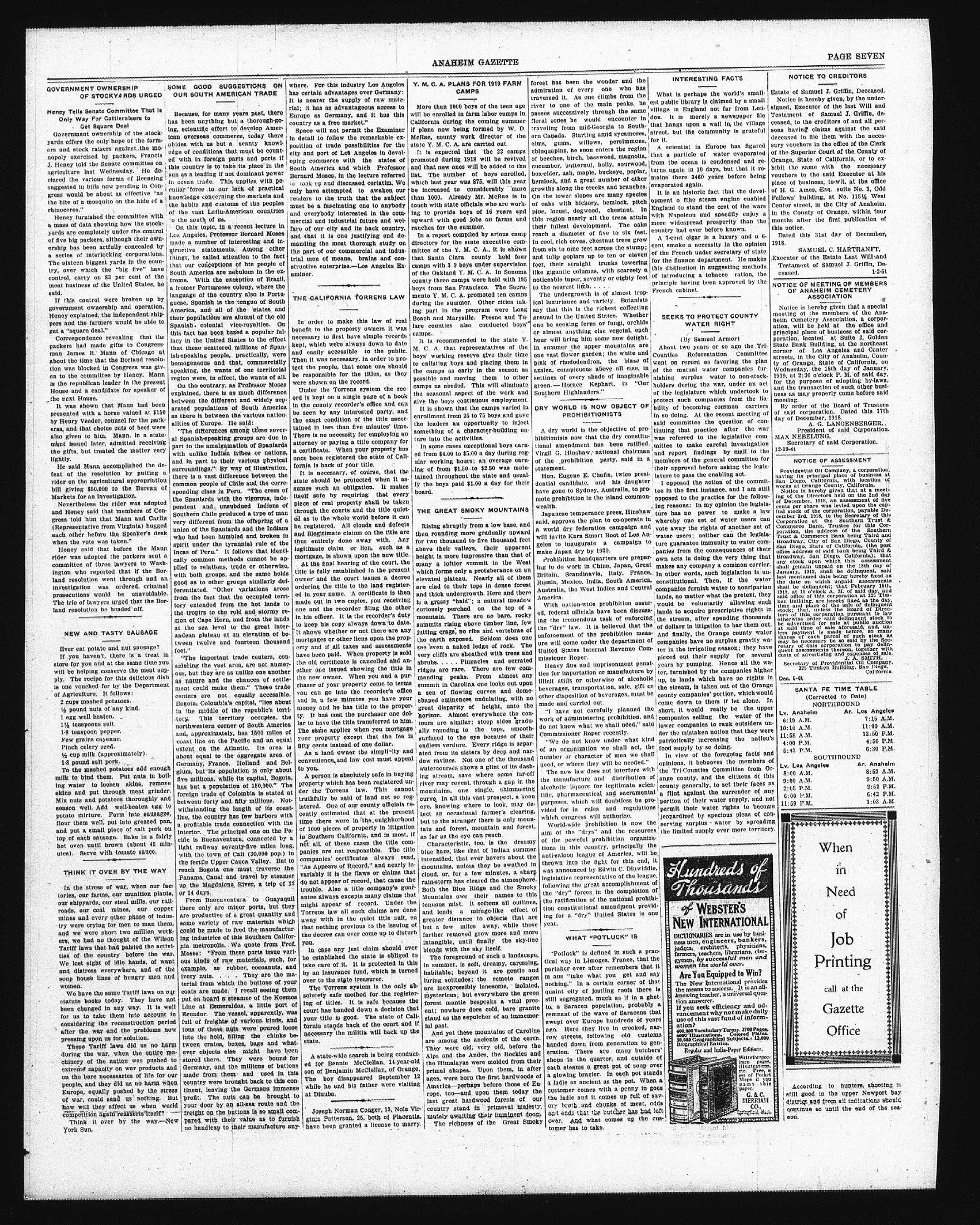
Searchable text
GOVERNMENT OWNERSHIP OF STOCKYARDS URGED
Heney Tells Senate Committee That Is Only Way For Cattleraisers to Get Square Deal
Government ownership of the stockyards offers the only hope of the farmers and stock raisers against the monopoly exercised by packers, Francis J. Heney told the Senate committee on agriculture last Wednesday. He declared the various forms of licensing suggested in bills now pending in Congress would be about as effective "as the bite of a mosquito on the hide of a rhinoceros."
Heney furnished the committee with a mass of data showing how the stockyards are completely under the control of five big packers, although their ownership has been artfully concealed by a series of interlocking corporations. The sixteen biggest yards in the country, over which the "big five" have control, carry on $3 per cent of the meat business of the United States, he said.
If this control were broken up by government ownership and operation, Heney explained, the independent shippers and the farmers would be able to get a "square deal."
Correspondence revealing that the packers had made gifts to Congressman James R. Mann of Chicago at about the time that the Borland resolution was blocked in Congress was given to the committee by Heney. Mann is the republican leader in the present House and a candidate for speaker of the next House.
It was shown that Mann had been presented with a horse valued at $150 by Henry Veeder, counsel for the packers, and that choice cuts of beef were also given to him. Mann, in a statement issued later, admitted receiving the gifts, but treated the matter very
SOME GOOD SUGGESTIONS ON OUR SOUTH AMERICAN TRADE
Because, for many years past, there has been anything but a thorough-going scientific effort to develop American overseas commerce, today there abides with us but a scanty knowledge of conditions that must be counted with in foreign parts and ports if this country is to take its place in the sun as a leading not dominant power in ocean trade. This applies with peculiar force to our lack of practical knowledge concerning the markets and the habits and customs of the peoples of the vast Latin-American countries to the south of us.
On this topic, in a recent lecture in Los Angeles, Professor Bernard Moses made a number of interesting and instructive statements. Among other things, he called attention to the fact that our conceptions of hte people of South America are nebulous in the extreme. With the exception of Brazil, a former Portuguese colony, where the language of the country also is Portuguese, Spanish is the tongue of South America, and all of the states and their populations are alumni of the old Spanish-colonial vice-royalties. On this fact has been based a popular fallacy in the United States to the effect that these scattered millions of Spanish-speaking people, practically, were homogeneous and that, commercially speaking, the wants of one territorial region were, in effect, the wants of all.
On the contrary, as Professor Moses explained, there is as much difference between the different and widely separated populations of South America as there is between the various nationalities of Europe. He said:
"The differences among these several Spanish-speaking groups are due in part to the amalgamation of Spaniards with unlike Indian tribes or nations,
where. For this industry we has certain advantages over it is nearer the supply or trial; it has as advantaged Europe as Germany, and country as a free market."
Space will not permit it in detail to follow the position of trade possibility city and port of Los Angelesoping commerce with the South America and which Bernard Moses, in the lecto to look up and discussed only have attempted to readers to the truth that must be a fascinating one and everybody interested mercial and industrial future of our city and its land and that it is one justification manding the most thorough part of our commercial trial men of means, brastructive enterprise.—Los aminer.
THE CALIFORNIA TOP
In order to make this benefit to the property owner necessary to first have seen by any interest the exact condition of trained in less than five There is no necessity for attorney or paying a title a certificate. When you once been registered tha
about the time that the Borland resolution was blocked in Congress was given to the committee by Heney. Mann is the republican leader in the present House and a candidate for speaker of the next House.
It was shown that Mann had been presented with a horse valued at $150 by Henry Veeder, counsel for the packers, and that choice cuts of beef were also given to him. Mann, in a statement issued later, admitted receiving the gifts, but treated the matter very lightly.
He said Mann accomplished the defeat of the resolution by putting a rider on the agricultural appropriation bill giving $50,000 to the Bureau of Markets for an investigation.
Nevertheless the rider was adopted and Heney said that members of Congress told him that Mann and Carlin (Representative from Virginia) hugged each other before the Speaker's desk when the vote was taken."
Heney said that before the Mann rider was adopted the packers sent a committee of three lawyers to Washington who reported that if the Borland resolution went through and an investigation was ordered, criminal prosecutions would be unavoidable. The trio of lawyers urged that the Borland resolution be headed off.
NEW AND TASTY SAUSAGE
Ever eat potato and nut sausage?
If you haven't, there is a treat in store for you and at the same time you will be helping conserve the meat supply. The recipe for this delicious dish is one vouched for by the Department of Agriculture. It follows:
2 cups mashed potatoes.
½ pound nuts of any kind.
1 egg well beaten.
1½ teaspoons salt.
1-8 teaspoon pepper.
Few grains cayenne.
Pinch celery seed.
½ cup milk (approximately).
1-8 pound salt pork.
To the mashed potatoes add enough milk to bind them. Put nuts in boiling water to loosen skins, remove skins and put through meat grinder. Mix nuts and potatoes thoroughly and season well. Add well-beaten egg to potato mirture. Form into sausages, flour them well, put into greased pan, and put a small piece of salt pork on top of each sausage. Bake in a fairly hot oven until brown (about 45 minutes). Serve with tomato sauce.
The important trade centers, considering the vast area, are not numerous, but they are as unlike one another as nature and the chances of settlement could make them." These trade centers are not equally accessible. Bogota, Colombia's capital, "lies about in the middle of the republic's territory. This territory occupies the northwestern corner of South America and, approximately, has 1500 miles of coast line on the Pacific and an equal extent on the Atlantic. Its area is about equal to the aggregate area of Germany, France, Holland and Belgium, but its population is only about five millions, while its capital, Bogota, has but a population of 150,000." The foreign trade of Colombia is stated at between forty and fifty millions. Notwithstanding the length of its coastline, the country has few harbors with a profitable trade connection with the interior. The principal one on the Pacific is Buenaventura, connected by a light railway seventy-five miles long, with the town of Cali (30,000 pop.) in the fertile Upper Cauca Valley. But to homogeneous and that, commercially speaking, the wants of one territorial region were, in effect, the wants of all.
On the contrary, as Professor Moses explained, there is as much difference between the different and widely separated populations of South America as there is between the various nationalities of Europe. He said:
"The differences among these several Spanish-speaking groups are due in part to the amalgamation of Spaniards with unlike Indian tribes or nations, and in part to their various physical surroundings." By way of illustration, there is a vast difference between the common people of Chile and the corresponding class in Peru. "The cross of the Spaniards with the vigorous, independent and unsubdued Indians of Southern Chile produced a type of man very different from the offspring of a union of the Spaniards and the Indians who had been humbled and broken in spirit under the tyrannical rule of the Incas of Peru." It follows that identically common methods cannot be applied to relations, trade or otherwise, with both groups, and the same holds good as to other groups similarly differentiated. "Other variations arise from the fact that the occupied territory extended from the hot lands to the tropics to the roid and stormy region of Cape Horn, and from the lands at the sea level to the great interandean plateau at an elevation of between twelve and fourteen thousand feet."
"The important trade centers, considering the vast area, are not numerous, but they are as unlike one another as nature and the chances of settlement could make them." These trade centers are not equally accessible. Bogota, Colombia's capital, "lies about in the middle of the republic's territory. This territory occupies the northwestern corner of South America and, approximately, has 1500 miles of coast line on the Pacific and an equal extent on the Atlantic. Its area is about equal to the aggregate area of Germany, France, Holland and Belgium, but its population is only about five millions, while its capital, Bogota, has but a population of 150,000." The foreign trade of Colombia is stated at between forty and fifty millions. Notwithstanding the length of its coastline, the country has few harbors with a profitable trade connection with the interior. The principal one on the Pacific is Buenaventura, connected by a light railway seventy-five miles long, with the town of Cali (30,000 pop.) in the fertile Upper Cauca Valley. But to homogeneous and that, commercially speaking, the wants of one territorial region were, in effect, the wants of all.
On the contrary, as Professor Moses explained, there is as much difference between the different and widely separated populations of South America as there is between the various nationalities of Europe. He said:
"The differences among these several Spanish-speaking groups are due in part to the amalgamation of Spaniards with unlike Indian tribes or nations, and in part to their various physical surroundings." By way of illustration, there is a vast difference between the common people of Chile and the corresponding class in Peru. "The cross of the Spaniards with the vigorous, independent and unsubdued Indians of Southern Chile produced a type of man very different from the offspring of a union of the Spaniards and the Indians who had been humbled and broken in spirit under the tyrannical rule of the Incas of Peru." It follows that identically common methods cannot be applied to relations, trade or otherwise, with both groups, and the same holds good as to other groups similarly differentiated. "Other variations arise from the fact that the occupied territory extended from the hot lands to the tropics to the roid and stormy region of Cape Horn, and from the lands at the sea level to the great interandean plateau at an elevation of between twelve and fourteen thousand feet."
"The important trade centers, considering the vast area, are not numerous, but they are as unlike one another as nature and the chances of settlement could make them." These trade centers are not equally accessible. Bogota, Colombia's capital, "lies about in the middle of the republic's territory. This territory occupies the northwestern corner of South America and, approximately, has 1500 miles of coast line on the Pacific and an equal extent on the Atlantic. Its area is about equal to the aggregate area of Germany, France, Holland and Belgium, but its population is only about five millions, while its capital, Bogota, has but a population of 150,000." The foreign trade of Colombia is stated at between forty and fifty millions. Notwithstanding the length of its coastline, the country has few harbors with a profitable trade connection with the interior. The principal one on the Pacific is Buenaventura, connected by a light railway seventy-five miles long, with the town of Cali (30,000 pop.) in the fertile Upper Cauca Valley. But to homogeneous and that, commercially speaking, the wants of one territorial region were, in effect, the wants of all.
On the contrary, as Professor Moses explained, there is as much difference between the different and widely separated populations of South America as there is between the various nationalities of Europe. He said:
"The differences among these several Spanish-speaking groups are due in part to the amalgamation of Spaniards with unlike Indian tribes or nations, and in part to their various physical surroundings." By way of illustration, there is a vast difference between the common people of Chile and the corresponding class in Peru. "The cross of the Spaniards with the vigorous, independent and unsubdued Indians of Southern Chile produced a type of man very different from the offspring of a union of the Spaniards and the Indians who had been humbled and broken in spirit under the tyrannical rule of the Incas of Peru." It follows that identically common methods cannot be applied to relations, trade or otherwise, with both groups, and the same holds good as to other groups similarly differentiated. "Other variations arise from the fact that the occupied territory extended from the hot lands to the tropics to the roid and stormy region of Cape Horn, and from the lands at the sea level to the great interandean plateau at an elevation of between twelve and fourteen thousand feet."
"A person is absolutely property which has been deferred by Torrens law truthfully be said if I listered. One of our coerce estimated that time there were in title 1000 pieces of property in Southern California not all, of these case panies are not responsible companies' certificates."
To the mashed potatoes add enough milk to bind them. Put nuts in boiling water to loosen skins, remove skins and put through meat grinder. Mix nuts and potatoes thoroughly and season well. Add well-beaten egg to potato mixture. Form into sausages, flour them well, put into greased pan, and put a small piece of salt pork on top of each sausage. Bake in a fairly hot oven until brown (about 45 minutes). Serve with tomato sauce.
THINK IT OVER BY THE WAY
In the stress of war, when our factories, our farms, our munition plants, our shipyards, our steel mills, our railroads, our coal mines, our copper mines and every other phase of industry were crying for men to man them, and we were short two million workers, we had no thought of the Wilson Tariff laws that had palsied the activities of the country before the war. We lost sight of idle hands, of want and distress everywhere, and of the soup house lines of hungry men and women.
We have the same Tariff laws on our statute books today. They have not been changed in any way. It is well for us to take them into account in considering the reconstruction period after the war and the problems now pressing upon us for solution.
These Tariff laws did us no harm during the war, when the entire machinery of the nation was pushed to extreme capacity on war products and on the bare necessaries of life for our people, and they did us no harm when Europe, equally pushed by the stress of war, could send us nothing. But how will they affect us when world competition again reasserts itself?
Think it over by the way.—New York Sun.
ANAHEIM GAZETTE
where. For this industry Los Angeles has certain advantages over Germany: It is nearer the supply of raw material; it has as advantageous access to Europe as Germany, and it has this country as a free market."
Space will not permit the Examiner in detail to follow the remarkable exposition of trade possibilities for the city and port of Los Angeles in developing commerce with the states of South America and which Professor Bernard Moses, in the lecture referred to look up and discussed cerlatim. We only have attempted to awaken our readers to the truth that the subject must be a fascinating one to anybody and everybody interested in the commercial and industrial future and welfare of our city and its back country, and that it is one justifying and demanding the most thorough study on the part of our commercial and industrial men of means, brains and constructive enterprise.—Los Angeles Examiner.
THE CALIFORNIA TORRENS LAW
In order to make this law of real benefit to the property owners it was necessary to first have simple records kept, which were always down to date and easily accessible to the public. Then it was necessary, in order to protect the people, that some one should be responsible for the titles, as they were shown on the record.
Under the Torrens system the record is kept on a single page of a book in the county recorder's office and can be seen by any interested party, and the exact condition of the title ascertained in less than five minutes' time. There is no necessity for employing an attorney or paying a title company for a certificate. When your property has once been registered the state of Cali-
Y. M. C. A. PLANS FOR 1919 FARM CAMPS
More than 1000 boys of the teen age will be enrolled in farm labor camps in California during the coming summer if plans now being formed by W. D. McRae, county work director of the state Y. M. C. A. are carried out.
It is expected that the 22 camps promoted during 1918 will be revived and that new ones will be added to the list. The number of boys enrolled, which last year was 875, will this year be increased to considerably more than 1000. Already Mr. McRae is in touch with state officials who are working to provide boys of 16 years and upward with good jobs on farms and ranches for the summer.
In a report compiled by arious camp directors for the state executive committee of the Y. M. C. A., it is shown that Santa Clara county held four camps with 39 boys under supervision of the Oakland Y. M. C. A. In Sonoma county three camps were held with 195 boys from San Francisco. The Sacramento Y. M. C. A. promoted ten camps during the summer. Other cities taking part in the program were Long Beach and Marysille. Fresno and Tulare counties also conducted boys' camps.
It is recommended to the state Y. M. C. A. that representatives of the boys' working reserve give their time to enlisting boys and placing them in the camps as early in the season as possible and moving them to other camps as needed. This will eliminate the seasonal aspect of the work and give the boys continuous employment.
It is shown that the camps varied in enrollment from 25 to 75 boys and gave the leaders an opportunity to inject something of a character-building nature into the activities.
In some cases exceptional boys earned from $4.00 to $5.00 a day during reg-
forest has been the wonder and the admiration of every one who has traversed it. As one climbs from the river to one of the main peaks, he passes successively through the same floral zones he would encounter in travelling from mid-Georgia to Southern Canada. Starting amid sycamores, elms, gums, willows, persimmons, chinquapins, he soon enters the region of beeches, birch, basswood, magnolia, cucumber, butternut, holly, sourwood, box-elder, ash, maple, buckeye, poplar, hemlock, and a great number of other growths along the creeks and branches.
On the lower slopes are many species of oaks with hickory, hemlock, pitch pine, locust, dogwood, chestnut. In this region nearly all the trees attain their fullest development. The oaks reach a diameter of five to six feet.
In cool, rich coves, chestnut trees grow from six to nine feet across the stump; and tulip poplars up to ten or eleven feet, their straight trunks towering like gigantic columns, with scarcely a noticeable taper, seventy or eighty feet to the nearest limb.
The undergrowth is of almost tropical luxuriance and variety. Botanists say that this is the richest collecting ground in the United States. Whether one be seeking ferns or fungi, orchids or almost anything else vegetal, each hour will bring him some new delight.
In summer the upper mountains are one vast flower garden; the white and pink of rhododendron, the blaze of azalea, conspicuous above all ease, in settings of every shade of imaginable green. — Horace Kephart, in "Our Southern Highlanders."
DRY WORLD IS NOW OBJECT OF PROHIBITIONISTS
A dry world is the objective of prohibitionists now that the dry constitutional amendment has been ratified. Virgil G. Hinshaw, national chairman
INTERESTS
What is perfect public library village in England. It is made that hangs up street, but there for it.
A scientist that a particle from the ocean turns again in mains there evaporated ago.
An historian that ousted England to stay with Napoleon more widespread country had eased.
A 7-cent cigar smoke a part of the French finance this distinction of introducing principle having French cabinets.
SEEKS TO WAY (By About two Counties Re went on record of the mutual nishing surplus holders during of the legislation protect such ability of beech in so doing said commit- tinuing that it was referred mittee to man and report
Under the Torrens system the record is kept on a single page of a book in the county recorder's office and can be seen by any interested party, and the exact condition of the title ascertained in less than five minutes' time. There is no necessity for employing an attorney or paying a title company for a certificate. When your property has once been registered the state of California is back of your title.
It is necessary, of course, that the state should be protected when it assumes such an obligation. It makes itself safe by requiring that every piece of real property shall be taken through the courts and the title quieted as to the whole world before it can be registered. All clouds and defects and illegitimate claims on the title are thus entirely done away with. Any legitimate claim or lien, such as a mortgage, is shown upon the new title.
At the final hearing of the court, the title is fully established in the present owner and the court issues a decree ordering the title to the land registered in your name. A certificate is then made out in two copies, you receiving one and the recorder filing the other in his officer. It is the recorder's duty to keep his copy always down to date. It shows whether or not there are any mortgages or other liens upon the property and if all taxes and assessments have been paid. When property is sold the old certificate is cancelled and another one issued showing the title in the new owner. When you and a purchaser of your property come to terms you can go into the recorder's office and in a few minutes you have your money and he has title to the property. It has cost the purchaser one dollar to have the title transferred to him. The same applies when you mortgage your property except that the fee is fifty cents instead of one dollar.
As a land owner the simplity and convenience, and low cost must appeal to you.
A person is absolutely safe in buying property which has been registered under the Torrens law. This cannot truthfully be said of land not so registered. One of our county officials recently estimated that at the present time there were in the neighborhood of 1000 pieces of property in litigation in Southern California, and in most, if not all, of these cases the title companies are not responsible. The title companies' certificates always read, "The Title of Record" and nearly in
Rising abruptly from a low base, and then rounding more gradually upward for two thousand to five thousand feet above their valleys, their apparent height is more impressive than that of many a loftier summit in the West which forms only a protuberance on an elevated plateau. Nearly all of them are clad to their tops in dense forest and thick undergrowth. Here and there is a grassy "baid"; a natural meadow curiously perched on the top of a mountain. There are no bare, rocky summits rising above timber line, few jutting crags, no ribs and vertebrae of the earth exposed. Seldom does one even a naked ledge of rock. The very cliffs are sheathed with trees and shrubs. Pinnacles and serrated ridges are rare. There are few commanding peaks. From almost any summit in Carolina one looks out upon a sea of flowing curves and domes shaped eminences undulating, with no great disparity of height, unto the horizon. Almost everywhere the contours are similar: steep sides gradually rounding to the tops, smooth surfaced to the eye because of their endless verdure. Every ridge is separated from its sisters by deep and narrow ravines. Not one of the thousand watercourses shows a glint of its dashing stream, save where some far-off river may reveal, through a gap in the mountains, one single, shimmering curve. In all this vast prospect, a keen eye, knowing where to look, may detect an occasional farmer's clearing, but to the stranger there is only mountain and forest, mountain and forest, as far as the eye can reach.
Characteristic, too, is the dreamy blue haze, like that of Indian summer intensified, that ever hovers about the mountains they be swathed in pink of rhododendron, the blaze of azalea, conspicuous above all ease, in settings of every shade of imaginable green. — Horace Kephart, in "Our Southern Highlanders."
DRY WORLD IS NOW OBJECT OF PROHIBITIONISTS
A dry world is the objective of prohibitionists now that the dry constitutional amendment has ratified. Virgil G. Hinshaw, national chairman of the prohibition party, said in a statement.
Hon. Eugene E. Chafin, twice presidential candidate, and his daughter have gone to Sydney, Australia, to promote prohibition in the island commonwealth.
Japanese temperance press, Hinshaw said, approve the plan to co-operate in a world dry federation campaign and will invite Kara Smart Root of Los Angeles to inaugurate a campaign to make Japan dry by 1930.
Prohibition headquarters are preparing to do work in China, Japan, Great Britain, Scandinavia, Italy, France, Russia, Mexico, India, South America, Australia, the West Indies and Central America.
With nation-wide prohibition assured, federal officials have been discussing the tremendous task of enforcing the "dry" law. It is believed that the enforcement of the prohibition measure will come under the department of United States Internal Revenue Commissioner Roper.
Heavy fine and imprisonment penalties for importation or manufacture by illicit stills or otherwise of alcoholic beverages, transportation, sale, gift or other disposition of beverages, must be made and carried out.
"I have not carefully planned the work of administering prohibition, and do not know what we shall need," said Commissioner Roper recently.
"We do not know under what kind of an organization we shall act, the number or character of men we shall need, or where they will be needed."
The new law does not interfere with the manufacture and distribution of alcoholic liquors for legitimate scientific, pharmaceutical and sacramental purposes, which will doubtless be provided for in rules and regulations which congress will authorize.
World-wide prohibition is now the aim of the "drys" and the resources of powerful prohibition organizations in this country, principally the anti-saloon league of America, will be thrown into the fight for this end, it
A person is absolutely safe in buying property which has been registered under the Torrens law. This cannot truthfully be said of land not so registered. One of our county officials recently estimated that at the present time there were in the neighborhood of 1000 pieces of property in litigation in Southern California, and in most, if not all, of these cases the title companies are not responsible. The title companies' certificates always read, "As Appears of Record," and nearly invariably it is the flaws or claims that do not appear of record, that cause the trouble. Also a title company's guarantee always exceeds many claims that might appear of record. Under the Torrens law all such claims are done away with in the quiet title suit, so that nothing previous to the issuing of the decree can ever come up to disturb you.
In case any just claim should ever be established the state is obliged to take care of it. It is protected in this by an insurance fund, which is turned over to the state treasurer.
The Torrens system is the only absolutely safe method for the registering of titles. It is safe because the court has handed down a decision that your title is good. The state of California stands back of the court and if necessary the militia will back up the state.
A state-wide search is being conducted for Bennie McClellan, 14-year-old son of Benjamin McClellan, of Orange. The boy disappeared September 12 while he and his father were visiting at Dinuba.
Joseph Norman Conger, 33, Nola Virginia Patterson, 25, both of Placentia, have been granted a license to marry.
The new law does not interfere with the manufacture and distribution of alcoholic liquors for legitimate scientific, pharmaceutical and sacramental purposes, which will doubtless be provided for in rules and regulations which congress will authorize.
World-wide prohibition is now the aim of the "drys" and the resources of the powerful prohibition organizations in this country, principally the anti-saloon league of America, will be thrown into the fight for this end, it was announced by Edwin C. Dinwiddie, legislative representative of the league, following the great accomplishment of the "dry" forces in the completion of the ratification of the national prohibition constitutional amendment providing for a "dry" United States in one year.
WHAT "POTLUCK" IS
"Potluck" is defined in such a practical way in Limoges, France, that the partaker ever after remembers that it mans "take what you get and say nothing." In a certain corner of that quaint city of jostling roofs there is still segregated, much as if in a ghetto, a Saracen population, probably a remnant of the wave of Saracens that swept over Europe hundreds of years ago. Here they live in crooked, narrow streets, following old customs handed down from generation to generation. There are many butchers' shops in the quarter, and outside of each steams a great pot of soup over a glowing brazier. In each pot stands a ladle as ancient as the pot. When a customer comes with a penny in goes the ladle and it comes up full of savory broth and chunks of meat, odds and ends that the butcher has had left over. And what comes up the customer has to take.
INTERESTING FACTS
What is perhaps the world's smallest public library is claimed by a small village in England not far from London. It is merely a newspaper file that hangs upon a wall in the village street, but the community is grateful for it.
A scientist in Europe has figured that a particle of water evaporated from the ocean is condensed and returns again in 10 days, but that it remains there 3460 years before being evaporated again.
It is an historic fact that the development of the steam engine enabled England to stand the cost of the wars with Napoleon and speedily enjoy a more widespread prosperity than the country had ever before known.
A 7-cent cigar is a luxury and a 6-cent smoke a necessity in the opinion of the French under secretary of state for the finance department. He makes this distinction in suggesting methods of introducing a tobacco ration, the principle having been approved by the French cabinet.
SEEKS TO PROTECT COUNTY WATER RIGHT
(By Samuel Armor)
About two years or so ago the Tri-Counties Reforestation Committee went on record as favoring the plan of the mutual water companies furnishing surplus water to non-stockholders during the war, under an act of the legislature which undertook to protect such companies from the liability of becoming common carriers in so doing. At the recent meeting of said committee the question of continuing that practice after the war was referred to the legislative committee to make careful investigation and report findings by mail to the
NOTICE TO CREDITORS
Estate of Samuel J. Griffin, Deceased.
Notice is hereby given, by the undersigned, Executor of the last Will and Testament of Samuel J. Griffin, deceased, to the creditors of and all persons having claims against the said deceased to file them with the necessary vouchers in the office of the Clerk of the Superior Court of the County of Orange, State of California, or to exhibit the same with the necessary vouchers to the said Executor at his place of business, to-wit, at the office of H. G. Ames, Esq. suite No. 1, Odd Fellows' building, at No. 115½ West Center street, in the City of Anaheim, in the County of Orange, within four months after the first publication of this notice.
Dated this 31st day of December, 1918.
SAMUEL C. HARTRANFT,
Executor of the Estate Last Will and Testament of Samuel J. Griffin, Deceased.
NOTICE OF MEETING OF MEMBERS OF ANAHEIM CEMETERY ASSOCIATION
Notice is hereby given that a special meeting of the members of the Anaheim Cemetery Association, a corporation, will be held at the office and principal place of business of said corporation, located at Suite 2, Golden State Bank Building, at the northeast corner of Los Angeles and Center streets, in the City of Anaheim, County of Orange, State of California, on Wednesday, the 15th day of January, 1919, at 2:30 o'clock P.M. of said day, for the purpose of adopting by-laws, and the transaction of such other business as may properly come before said meeting.
By order of the Board of Trustees of said corporation. Dated this 17th day of December, 1918.
A. G. LANGENBERGER,
President of said Corporation.
MAX NEBELUNG,
Secretary of said Corporation.
12-19-4t
OBJECT OF ITS
active of provity constituent ratified,
special chairman,
said in a
twice presidents daughter
aralia, to promand commonness, Hinshaw
co-operate in
campaign and
mot of Los Ancampaign to
are preparJapan, Great
aly, France,
South America,
and Central
obition assurbeen discussof enforcing
moved that the
bibition measudepartment of
revenue Comment penalmanufacture by
of alcoholic
sale, gift or
images, must be
planned the
exhibition, and
shall need," said
county.
over what kind
shall act, the
men we shall
be needed."
interfere with distribution of ultimate scientical sacramental tubless be prol regulations honorize.
is now the resources organization principally the America, will be for this end, it went on record as favoring the plan of the mutual water companies furnishing surplus water to non-stock-holders during the war, under an act of the legislature which undertook to protect such companies from the liability of becoming common carriers in so doing. At the recent meeting of said committee the question of continuing that practice after the war was referred to the legislative committee to make careful investigation and report findings by mail to the members of the general committee for their approval before asking the legislature to pass the enabling act.
I opposed the action of the committee in the first instance, and I am still opposed to the practice for the following reasons: In my opinion the legislature has no power to make a law whereby one set of water users can vote away the rights of another set of water users; neither can the legislature guarantee immunity to water companies from the consequences of their own acts in doing the very thing that makes any company a common carrier. In other words, such legislation is unconstitutional. Then, if the water companies furnish water to nonriparian lands, no matter what the pretext, they would be voluntarily allowing such lands to acquire prescriptive rights in the stream, after spending thousands of dollars in litigation to bar them out. And finally, the Orange county water companies have no surplus gravity water in the irrigating season; they have pieced out their supply for several years by pumping. Hence all the water, furnished by the companies higher up, to lands which have no rights in the stream, is taken out of the Orange county companies' portion, which would come down to them if let alone. In short, it would really be the upper companies selling the water of the lower companies to rank outsiders under the mistaken notion that they were patriotically increasing the nation's food supply by so doing.
In view of the foregoing facts and opinions, it behooves the members of the Tri-Counties Committee from Orange county, and the citizens of this county generally, to set their faces as a flint against the surrender of any portion of their water supply, and not permit their water rights to become jeopardized by specious pleas of conserving surplus water by spreading the limited supply over more territory.
NOTICE OF ASSESSMENT
Providential Oil Company, a corporation having its principal place of business at San Diego, California, with location of works at Orange County, California.
Notice is hereby given that at a meeting of the Directors held on the 2nd day of December, 1918, an assessment of five cents per share was levied upon the capital stock of the corporation, payable December 3rd, 1918, to the Secretary of this Corporation at the Southern Trust & Commerce Bank, Trustee for this Corporation, the address of the Southern Trust & Commerce Bank being Third and Broadway, City of San Diego, County of San Diego, State of California, (the post office address of said bank being Third & Broadway, San Diego, California); that any stock upon which this assessment shall gemain unpaid on the 18th day of January, 1919, shall be delinquent, said last mentioned date being hereby fixed as the date on which unpaid assessments shall be delinquent; that February 15th, 1919, at 10 o'clock A.M. of said day, and office of this corporation at 325 Timken Building, are hereby fixed as the day time and place of the sale of delinquent stock; that, unless the Board of Directors of this corporation pursuant to law otherwise order said delinquent stock to be advertised for sale at public auction at said time of sale aforesaid, and, unless payment in made before, so many shares of each parcel of such stock as may be necessary be so sold by the Secretary of this corporation to pay delinquent assessments thereon, together with costs of advertising and expenses of sale.
J. A. SMITH,
Secretary of Providential Oil Company,
325 Timken Building, San Diego,
California.
Dec. 5-6t
SANTA FE TIME TABLE
(Corrected to Date)
NORTHBOUND
Lv. Anaheim Ar. Los Angeles
6:19 A.M. 7:15 A.M.
10:10 A.M. 11:00 A.M.
11:58 A.M. 12:50 P.M.
4:00 P.M. 4:50 P.M.
5:43 P.M. 6:30 P.M.
SOUTHBOUND
Lv. Los Angeles Ar. Anaheim
8:00 A.M. 8:52 A.M.
9:00 A.M. 9:50 A.M.
2:05 P.M. 2:52 P.M.
6:00 P.M. 6:42 P.M.
11:59 P.M. 1:03 A.M.
Hundreds of Thousands
of WEBSTER'S
NEW INTERNATIONAL
DICTIONARIES are in use by business men, engineers, bankers, judges, architects, physicians, farmers, teachers, librarians, clergymen, by successful men and women the world over.
Are You Equipped to Win?
The New International provides the means to success. It is an all-knowing teacher, a universal question answerer.
If you seek efficiency and advancement why not make daily use of this vast fund of information?
400,000 Vocabulary Terms. 2700 Pages.
6000 Illustrations. Colored Plates.
38,000 Geographical Subjects. 12,000 Biographical Entries.
Regular and India-Paper Editions.
Write for specimen pages, illustrations, etc. Free, a set of Pocket Maps if you name this paper.
G. & C. MERRIAM CO., Gapfried-Mason.
When in Need of Job Printing call at the Gazette Office
According to hunters, shooting is still good in the upper Newport bay district and from all indications should continue so until the end of the season.