anaheim-gazette 1919-01-09
Scanned page
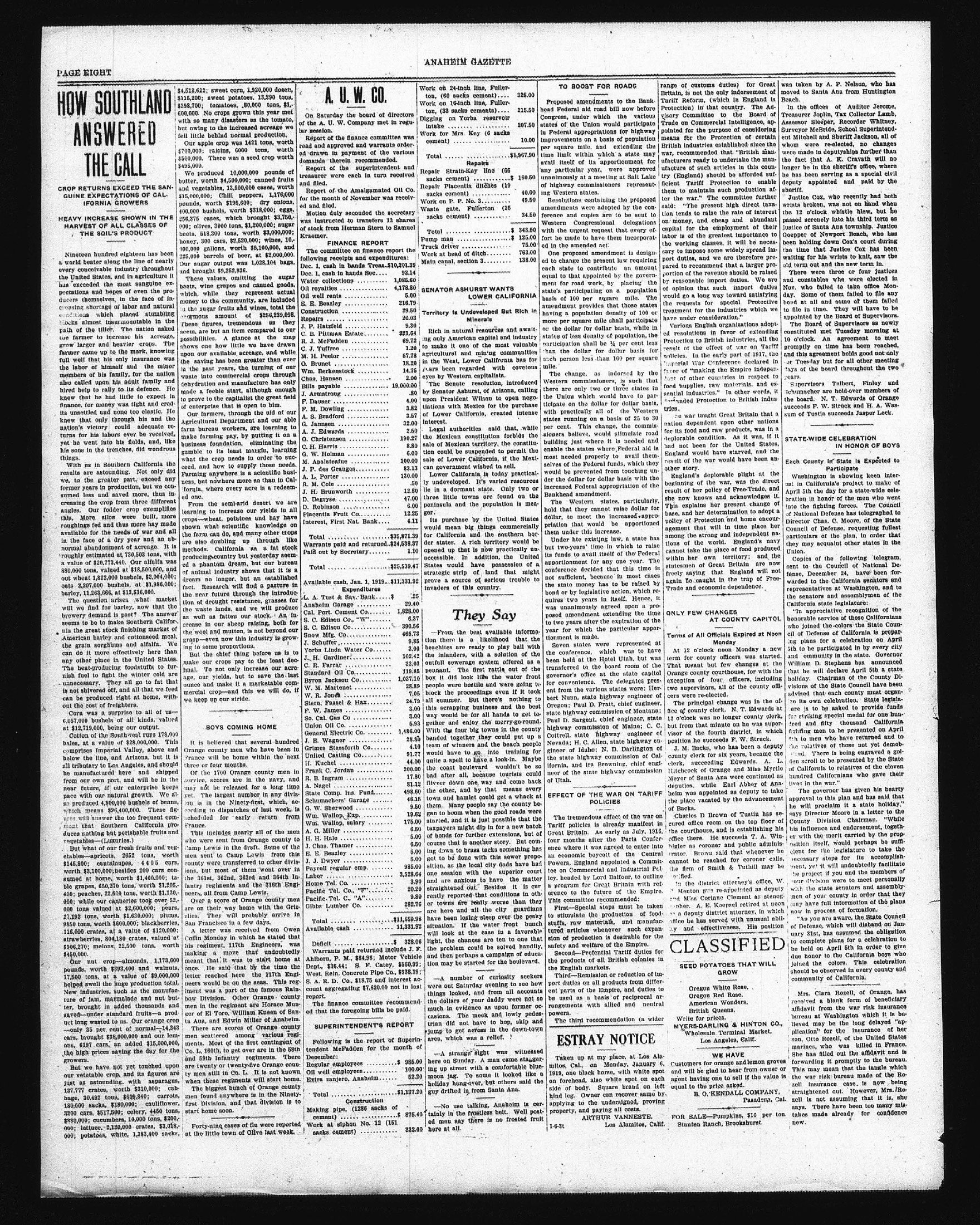
Searchable text
HOW SOUTHLAND ANSWERED THE CALL
CROP RETURNS EXCEED THE SANGUINE EXPECTATIONS OF CALIFORNIA GROWERS
HEAVY INCREASE SHOWN IN THE HARVEST OF ALL CLASSES OF THE SOIL'S PRODUCT
Nineteen hundred eighteen has been a world beater along the line of nearly every conceivable industry throughout the United States, and in agriculture it has exceeded the most sanguine expectations and hopes of even the producers themselves, in the face of increasing shortage of labor and natural conditions which placed stumbling blocks almost insurmountable in the path of the tiller. The nation asked the farmer to increase his acreage, grow larger and heavier crops. The farmer came up to the mark, knowing full well that his only insurance was the labor of himself and the minor members of his family, for the nation also called upon his adult family and hired help to rally to its defence. He knew that he had little to expect in finance, for money was tight and credits unsettled and none too elastic. He knew that only through his and the nation's victory could adequate returns for his labors ever be received, yet he went into his fields, and, like his sons in the trenches, did wondrous things.
$4,513,622; sweet corn, 1,920,000 dozen, $115,200; sweet potatoes, 13,290 tons, $398,700; tomatoes, 80,000 tons, $1-600,000. No crops grown this year met with so many disasters as the tomato, but owing to the increased acreage we fell little behind normal production.
Our apple crop was 1421 tons, worth $700,000; raisins, 6000 tons, worth $500,000. There was a seed crop worth $495,000.
We produced 10,000,000 pounds of butter, worth $4,500,000; canned fruits and vegetables, 13,500,000 cases, worth $15,000,000; Chill peppers, 1,176,000 pounds, worth $195,600; dry onions, 400,000 bushels, worth $318,000; eggs, 256,375 cases, which brought $3,750; olives, 3000 tons, $1,200,000; sugar beets, 518,300 tons, worth $3,000,000; honey, 300 cars, $2,520,000; wines, 10-900,000 gallons, worth $5,100,000; and 225,000 barrels of beer, at $2,000,000.
Our sugar output was 1,O28,1O4 bags, and brought $9,252,936.
These values, omitting the sugar beets, wine grapes and canned goods, which, while they represent actual money to the community, are included in the sugar fruits and wines, total the enormous amount of $256,239.998.
These figures, tremendous as they seem, are but an item compared to our possibilities. A glance at the map shows one how little we have drawn upon our available acreage, and while the saving has been greater than ever in the past years, the turning of our waste into commercial crops through dehydration and manufacture has only made a feeble start, although enough to prove to the capitalist the great field of enterprise that is open to him.
Our farmers, through the aid of our Agricultural Department and our able farm bureau workers, are learning to make farming pay by putting it on a business foundation, eliminating the gamble to its least margin, learning...
fun well that his only insurance was the labor of himself and the minor members of his family, for the nation also called upon his adult family and hired help to rally to its defence. He knew that he had little to expect in finance, for money was tight and credits unsettled and none too elastic. He knew that only through his and the nation's victory could adequate returns for his labors ever be received, yet he went into his fields, and, like his sons in the trenches, did wondrous things.
With us in Southern California the results are astounding. Not only did we, to the greater part, exceed any former years in production, but we consumed less and saved more, thus increasing the crop from three different angles. Our fodder crop exemplifies this. More silos were built, more roughings fed and thus more hay made available for the needs of war and all in the face of a dry year and an abnormal abandonment of acreage. It is roughly estimated at 730,503 tons, with a value of $20,773,440. Our alfalfa was 880,000 tons, valued at $18,500,000, and out wheat 1,822,000 bushels, $2,004,000; oats 2,207,000 bushels, at $1,986,000; barley, 11,263,666, at $13,516,000.
The question arises what market will we find for barley, now that the brewery demand is past? The answer seems to be to make Southern California the great stock finishing market of American barley and cottonseed meal. the grain sorghums and alfalfa. We can do it more effectively here than any other place in the United States. The heat-producing foodstuffs to furnish fuel to fight the winter cold are unnecessary. They all go to fat that is not shivered off, and all that we feed can be produced right at home, without the cost of freighters.
Corn was a surprise to all of us—6,057,000 bushels of all kinds, valued at $12,719,000, being our output.
Cotton of the Southwest runs 178,000 bales, at a value of $28,000,000. This comprises Imperial Valley, above and below the line, and Arizona, but it is all tributary to Los Angeles, and should be manufactured here and shipped from our own port, and will be in the near future, if our enterprise keeps pace with our natural growth. We also produced 4,800,000 bushels of beans, which means $26,400,000. These figures will answer the too frequent comment that Southern California produces nothing but perishable fruits and vegetables—(Luxuries.).
But what of our fresh fruits and vegetables—apricots, 2652 tons, worth $145,800; cantaloupes, 4405 cars,
Our farmers, through the aid of our Agricultural Department and our able farm bureau workers, are learning to make farming pay, by putting it on a business foundation, eliminating the gamble to its least margin, learning what the crop needs in order to succeed, and how to supply those needs. Farming anywhere is a scientific business, but nowhere more so than in California, where every acre is a redeemed one.
From the semi-arid desert we are learning to increase our yields in all crops—wheat, potatoes and hay have shown what scientific knowledge on the farm can do, and many other crops are also doubling up through like methods. California as a fat stock producing country but yesterday seemed a phantom dream, but our bureau of animal industry shows that it is a dream no longer, but an established fact. Research will find a pasture in the near future through the introduction of drought resistance, grasses for the waste lands, and we will produce as well as fatten our stock. An increase in our sheep raising both for the wool and mutton is not beyond our grasp—even now this industry is growing to some proportions.
But the chief thing before us is to make our crops pay to the least decimal. To not only increase our acreage, our yields, but to save the last ounce and make it a marketable commercial crop—and this we will do, if we keep up our stride.
BOYS COMING HOME
It is believed that several hundred Orange county men who have been in France will be home within the next three or four months.
Of the 1700 Orange county men in service, scores are in the navy, and may not be released for a long time yet. The largest number in any division is in the Ninety-first, which according to dispatches of last week, is scheduled for early return from France.
This includes nearly all of the men who were sent from Orange county to Camp Lewis in the draft. Some of the men sent to Camp Lewis from this county were transferred to other divisions.
O. Brunet
Wm. Berkenstock
Chas. Hansen
Bills payable
J. Armstrong
F. Dauser
F. M. Dowling
A. S. Bradford
G. Janssen
A. J. Edwards
O. Christensen
C. H. Harris
G. W. Holman
M. Apalateafue
J. P. des Granges
A. L. Porter
R. M. Cole
J. H. Brunworth
D. Degryse
D. Robinson
Placentia Fruit Co.
Interest, First Nat.B
Total
Warrants paid and repaid out by Secretary
Total
Available cash Jan. 1 Expendit
L. A. Tust & Sav. B.
Ansaheim Garage
Cal. Port. Cement Co.
S.C. Edison Co., "W"
S.C. Edison Co.
Snow Mfg. Co.
J. Schuffer
Yorba Linda Water Co.
J. H. Gardiner
C.R. Farrar
Standard Oil Co.
Byron Jackson Co.
W.M. Martenet
W.R. Jones
Stern, Fassel & Haxe
F.W. James
So.Cal.Gas Co.
Union Oil Co.
General Electric Co.
J.E.Wagner
Grimes Stassforth Co.
United Casting Co.
H.Kuchel
Frank C.Jordan
R.B.Ingram
A.Nagel
State Comp.Ins.Fu
Schumachers' Garage
G.W.Sherwood
Wm.Wallop.Exp.
Wm.Wallop,salary
A.G.Miller
H.H.Hale
J.Chars.Thamer
E.E.Bezazley
J.J.Dwyer
be manufactured here and shipped from our own port, and will be in the near future, if our enterprise keeps pace with our natural growth. We also produced 4,800,000 bushels of beans, which means $26,400,000. These figures will answer the too frequent comment that Southern California produces nothing but perishable fruits and vegetables—(Luxuries.)
But what of our fresh fruits and vegetables—apricots, 2652 tons, worth $145,800; cantaloupes, 4,405 cars, worth $3,100,000; besides 200 cars consumed at home, worth $1,400,000; table grapes, 650,270 tons, worth $1,205,400; peaches, 22,500 tons, worth $1,130,000; while our canneries took over 52,000 tons valued at $2,600,000; pears, 27,192 tons, worth $1,630,000; plums, 9850 tons, worth $600,000; blackberries, 116,000 crates, at a value of $120,000; strawberries, 804,180 crates, valued at $906,270; melons, 22,500 tons, worth $450,000.
Our nut crop—almonds, 1,173,600 pounds, worth $393,400 and walnuts, 17,500 tons, at a value of $9,000,000 helped swell the huge production total. New industries, such as the manufacture of jam, marmalade and nut butter, brought in added thousands and saved—under standard fruits—a product long wasted to us. Our orange crop—only 35 per cent of normal—14,343 cars, brought $38,000,000 and our lemons, 6197 cars, an added $15,000,000, the high prices saving the day for the growers.
But we have not yet touched upon our vetetable crop, and its figures are just as astounding with asparagus, 137,777 crates, worth $310,000; cabbage, 30,492 tons, $699,840; carrots, 180,000 sacks,$180,000; cauliflower, 320 cars,$517,500; celery, 445 tons,$880,000; cucumbers, 10,000 tons,$200,000; lettuce, 2,120,000 crates,$3,018,000; potatoes white,1,383,400 sacks,
Of the 1700 Orange county men in service,scores are in the navy,and may not be released for a long time yet. The largest number in any division is in the Ninety-first which,a according to dispatches of last week.is scheduled for early return from France.
This includes nearly all of the men who were sent from Orange county to Camp Lewis in the draft. Some of the men sent to Camp Lewis from this county were transferred to other divisions,but most of them went over in the 361st,the 362nd,the 363rd and 364th Infantry regiments and the 316th Engineers.all from Camp Lewis.
Over a score of Orange county men are on their way home with the Grizzlies. They will probably arrive in San Francisco in a few days.
A letter was received from Owen Coffin Monday in which he stated that his regiment,117th Engineers,was making a move that undoubtedly meant that it was to start home at once. He said that by the time the letter reached here the 117th Engineers would be on the seas. This regiment was a part of the famous Rainbow Division. Other Orange county men in the regiment are Horace Munger of El Toro.William Kneen of Santa Ana,and Edwin Miller of Anaheim.
There are scores of Orange county men scattered among various regiments.Most of the first contingent of Co.L.16oth.to get over are in the 58th and 59th Infantry regiments. There are twenty or twenty-five Orange county men still in Co.L.It is not known when these regiments will start home.
The biggest bunch of Orange county men found anywhere is in the Ninety-first Division,and that division is to start home soon.
Forty-nine cases of flu were reported at the little town of Olive last week.
Frank C.Jordan ... R.B.Ingram ... A.Nagel ... State Comp.Ins.Fu Schumachers'Garage ... G.W.Sherwood ... Wm.Wallop.Exp... A.G.Miller ... H.H.Hale ... J.Char.Shamer ... E.E.Beazley ... J.J.Dwyer ... Payroll regular emp Labor ... Home Tel.Co... Pacific Tel.Co.,"F Pacific.Tel.C.,"A" Gibbs Lumber Co.
Total Available cash Deficit Warrants paid ret Ahlborn,P.M.,$84. Dept.,$36.44;S.West.Rein.Concrete S.A.R.D.Co.,$18.count aggregating report.
The finance com ed that the foregoin
SUPERINTENDEN
Following is the tendent McFadden December:
Regular employees Oil well employees Extra zanjero,Anh
Total Constr Making pipe,(1286 cement) Work at siphon No sacks cement)
A. U. W. CO.
On Saturday the board of directors of the A. U. W. Company met in regular session.
Report of the finance committee was read and approved and warrants ordered drawn in payment of the various demands therein recommended.
Report of the superintendent and treasurer were each in turn received and filed.
Report of the Amalgamated Oil Co. for the month of November was received and filed.
Motion duly seconded the secretary was instructed to transfers 13 shares of stock from Herman Stern to Samuel Kraemer.
FINANCE REPORT
The committee on finance report the following receipts and expenditures:
Dec. 1, cash in hands Treas.$10,201.39
Dec. 1, cash in hands Sec... 92.14
Water collections 1,085.60
Oil royalties 4,178.80
Oil well rents 5.00
E. E. Beazley 216.79
Construction 29.50
Repairs 20.03
J. P. Hatzfeld 9.30
C. B. Pittman Estate 221.64
R. J. McFadden 69.72
C. J. Tuffree 1.20
M. H. Peelor 57.78
O. Brunet 18.20
Wm. Berkenstock 14.75
Chas. Hansen 2.00
Bills payable 19,000.00
J. Armstrong .80
F. Dauser 4.00
F. M. Dowling 3.82
A. S. Bradford 3.57
G. Jannsen 32.00
A. J. Edwards 2.50
O. Christensen 190.27
C. H. Harris 8.80
G. W. Holman 6.00
Work on 24-inch line, Fullerton, (60 sacks cement)... 328.00
Work on 16-inch line, Fullerton, (33 sacks cement)... 215.50
Digging on Yorba reservoir intake ... 207.50
Work for Mrs. Key (6 sacks cement) ... 10.00
Total $1,967.90
Repairs
Repair Strain-Key Line (66 sacks cement) $160.50
Repair Placentia ditches (19 sacks cement) 40.00
Work on P. P. No. 3 ... 49.50
Waste gate, Fullerton (26 sacks cement) 34.50
Total $343.50
Pump man $125.00
Truck driver 75.00
Work at head of ditch ... 763.00
Main canal, section 3 ... 138.00
SENATOR ASHURST WANTS LOWER CALIFORNIA
Territory is Undeveloped But Rich in Minerals
Rich in natural resources and awaiting only American capital and industry to make it one of the most valuable agricultural and mining communities in the West, Lower California has for years been regarded with covetous eyes by Western capitalists.
The Senate resolution, introduced by Senator Ashurst, of Arizona, calling upon President Wilson to open negotiations with Mexico for the purchase of Lower California, created intense interest.
Legal authorities said that, while the Mexican constitution forbids the sale of Mexican territory, the constitution could be suspended to permit the range of oil Britain is Tariff Referee Protection.
Visory Commission Trade on O'Connell pointed for means for British indictment war, recommissioners manufacture or try (England) efficient Taxation them to waist said: "The nation tends on money, capital for labor is of the working class to import port duties pared to reduction of by reason of opinions would go after the request treatment have underlined.
Various red resolutions Protection result of policies.
Imperial favor of oil content of food supply essential in demand tries.
We want nation design for its food deplorable had not England
O. Brunet 18.20
Wm. Berkenstock 14.75
Chas. Hansen 2.00
Bills payable 19,000.00
J. Armstrong .80
F. Dauser 4.00
F. M. Dowling 3.82
A. S. Bradford 3.57
G. Jannsen 32.00
A. J. Edwards 2.50
O. Christensen 190.27
C. H. Harris 8.80
G. W. Holman 6.00
M. Apalateafue 100.00
J. P. des Granges 83.13
A. L. Porter 130.00
R. M. Cole .50
J. H. Brunworth 12.80
D. Degryse 47.00
D. Robinson 6.00
Placentia Fruit Co. 12.25
Interest, First Nat. Bank 4.11
Total $35,871.39
Warrants paid and returned $24,538.37
Paid out by Secretary 1.10
Total $25,539.47
Available cash, Jan. 1, 1919 $11,331.92
Expenditures
L. A. Tust & Sav. Bank $ .25
Anaheim Garage 29.40
Cal. Port. Cement Co. 1,828.00
S. C. Edison Co., "W" 6.37
S.C.Edison Co 390.56
Snow Mfg. Co 465.73
J.Schuffer 9.85
Yorba Linda Water Co 3.00
J.H.Gardiner 102.42
C.R.Farrar 33.03
Standard Oil Co 119.85
Byron Jackson Co 1,037.10
W.M.Martenet 28.89
W.R.Jonea 7.05
Stern,Fassel & Hax 24.79
F.W.James 3.00
So.Cal.GasCo 3.00
Union Oil Co 5.93
General Electric Co 1,486.00
J.E.Wagner 28.80
Grimes Stassforth Co 4.10
United Casting Co 91.77
H.Kuchel 44.00
Frank C.Jordan 200.00
R.B.Ingram 17.80
A.Nagel 81.12
State Comp.Ins.Fund 498.60
Schumachers'Garage 46.15
G.W.Sherwood 9.50
Wm.Wallop,Exp 19.62
Wm.Wallop,salary 175.00
A.G.Miller 6.50
H.H.Hale 5.00
J.Char.Shaver 6.50
E.E.Bazley 5.00
J.J.Dwyer 5.00
The Senate resolution, introduced by Senator Ashurst, of Arizona, calling upon President Wilson to open negotiations with Mexico for the purchase of Lower California, created intense interest.
Legal authorities said that, while the Mexican constitution forbids the sale of Mexican territory, the constitution could be suspended to permit the sale of Lower California, if the Mexican government wished to sell.
Lower California is today practically undeveloped. It's varied resources lie in a dormant state. Only two or three little towns are found on the peninsula and the population is meager.
Its purchase by the United States would mean big things commercially for California and the southern border states. A rich territory would be opened up that is now practically unaccessible.
In addition, the United States would have possession of a strategic strip of land that might prove a source of serious trouble to invaders of this country.
They Say
—From the best available information there is a likelihood that the beachites are ready to play ball with the inlanders, with a solution of the outfall sewerage system offered as a pennant.
The first rattle out of the box it did look like the water front people were hostile and were going to block the proceedings even if it took all summer.
But there's nothing to scrapping business and the best way would be for all hands to get together and enjoy the merry-go-round.
With the four big towns in the county banded together they could put up a team of winners and the beach people would have to go into training for quite a spell to have a look-in.
Maybe the coast boulevard wouldn't be so bad after all, because tourists could flivver down one way and come back the other, and by that means every town and hamlet could get a whack at them.
Many people say the county began to boom when the good roads were started, and it is just possible that the taxpayers might dip in for a new batch of bonds for further extensions, but of course that is another story.
But coming down to brass tacks something has got to be done with this sewer proposition as the local city dads have had in the West, Lower California has for years been regarded with covetous eyes by Western capitalists.
The Senate resolution, introduced by Senator Ashurst, of Arizona, calling upon President Wilson to open negotiations with Mexico for the purchase of Lower California, created intense interest.
Legal authorities said that, while the Mexican constitution forbids the sale of Mexican territory, the constitution could be suspended to permit the sale of Lower California, if the Mexican government wished to sell.
Lower California is today practically undeveloped.
It's varied resources lie in a dormant state.
Only two or three little towns are found on the peninsula and the population is meager.
Its purchase by the United States would mean big things commercially for California and the southern border states.
A rich territory would be opened up that is now practically unaccessible.
In addition, the United States would have possession of a strategic strip of land that might prove a source of serious trouble to invaders of this country.
They Say
—From the best available information there is a likelihood that the beachites are ready to play ball with the inlanders, with a solution of the outfall sewerage system offered as a pennant.
The first rattle out of the box it did look like the water front people were hostile and were going to block the proceedings even if it took all summer.
But there's nothing to scrapping business and the best way would be for all hands to get together and enjoy the merry-go-round.
With the four big towns in the county banded together they could put up a team of winners and the beach people would have to go into training for quite a spell to have a look-in.
Maybe the coast boulevard wouldn't be so bad after all, because tourists could flivver down one way and come back the other, and by that means every town and hamlet could get a whack at them.
Many people say the county began to boom when the good roads were started, and it is just possible that the taxpayers might dip in for a new batch of bonds for further extensions, but of course that is another story.
But coming down to brass tacks something has got to be done with this sewer proposition as the local city dads have had in the West, Lower California has for years been regarded with covetous eyes by Western capitalists.
The change, as indorsed by the Western commissioners, is such that there are only two or three states in the Union which would have to participate on the dollar for dollar basis, with practically all of the Western states running on a basis of 25 to 30 per cent.
This change, the commissioners believe, would stimulate road building just where it is needed and enable the states where Federal aid is most needed properly to avail themselves of the Federal funds, which they would be prevented from touching under the dollar for dollar basis with the increased Federal appropriation of the Bankhead amendment.
The Western states, particularly, hold that they cannot raise dollar for dollar, to meet the increased appropriation that would be apportioned them under this increase.
Under hte existing law, a state has but two-years' time in which to raise its funds to avail itself of the Federal apportionment for any one year.
The conference decided that this time is not sufficient, because in most cases the state money has to be raised by bond or by legislative action, which requires two years in itself.
It was unanimously agreed upon a proposed amendment extending the time to two years after the expiration of the year for which the particular apportionment is made.
Seven states were represented at the conference, which was to be held at the Hotel Utah, but was transferred to the board room of the governor's office at the state capitol for convenience.
The delegates present from the various states were: Herbert Nunn, state highway engineer of Oregon; Paul D.Pratt, chief engineer, state highway commission of Montana; Paul D.Sargent, chief engineer, state highway commission of Maine; C.C.Ottrell, state highway engineer of Nevada; H.C.Allen, state highway engineer of Idaho; N.D.Darlington of the state highway commission of California; and Ira Browning, chief engineer of the state highway commission of Utah.
EFFECT OF THE WAR ON TARIFF POLICIES
The tremendous effect of the war on Tariff policies is already manifest in Great Britain.
As early as July, 1916, four months after the Paris Conference where it was agreed to enter into an economic boycott of the Central Powers, England appointed a Committee of The War on Tariff Policies is already manifest in Great Britain.
As early as July, 1916, four months after the Paris Conference where it was agreed to enter into an economic boycott of the Central Powers, England appointed a Committee of The War on Tariff Policies is already manifest in Great Britain.
At 12 o'clock term for That meeting Orange coat exception two superiors were
The price of coffee at 12 o'clock but from visor position
J.M.L county clerk, s Hitchcock Meyer of deputies helm wasthe placeof Backs
Charles cured offthe court office therigler acritor cannot
Frank C. Jordan 200.00
R. B. Ingram 17.80
A. Nagel 81.12
State Comp. Ins. Fund 498.60
Schumachers' Garage 48.15
G. W. Sherwood 9.50
Wm. Wallop, Exp. 19.62
Wm. Wallop, salary 175.00
A. G. Miller 6.50
H. H. Hale 5.00
J. Chas. Thamer 6.50
E. E. Beazley 5.00
J. J. Dwyer 5.00
Payroll regular emp. 985.00
Labor 3,528.64
Home Tel. Co. 3.90
Pacific Tel. Co., "F" 20.20
Pacific Tel. C., "A" 9.80
Gibbs Lumber Co. 282.76
Total $11,659.98
Available cash 11,331.92
Deficit $328.06
Warrants paid returned include J. F. Ahlborn, P. M., $84.98; Motor Vehicle Dept., $36.44; S. F. Catey, $560.99; West Rein, Concrete Pipe Co., $938.19; S.A.R.D.Co., $18.75 and interest account aggregating $7,620.00 not in last report.
The finance committee recommended that the foregoing bills be paid.
SUPERINTENDENT'S REPORT
Following is the report of Superintendent McFadden for the month of December:
Regular employees $985.00
Oil well employees 100.00
Extra zanjero, Anaheim 52.20
Total $1,137.20
Construction
Making pipe, (1286 sacks of cement) $875.40
Work at siphon No. 12 (151 sacks cement) 332.00
A number of curiosity seekers were out Saturday evening to see how things looked, and from all accounts the dollars of your daddy were not so much in evidence as upon former occasions. The meek and lowly pedestrian did not have to hop, skip and jump to get across in the down-town area, which was a relief.
A strange sight was witnessed here on Sunday. A man came staggering up street with a comfortable blue moon jag. To some it looked like a holiday hang-over, but others said the guy drifted in from Santa Ana.
No use talking, Anaheim is certainly in the frostless belt. Well posted men say there is no frosted fruit here at all.
EFFECT OF THE WAR ON TARIFF POLICIES
The tremendous effect of the war on Tariff policies is already manifest in Great Britain. As early as July, 1916, four months after the Paris Conference where it was agreed to enter into an economic boycott of the Central Powers, England appointed a Committee on Commercial and Industrial Policy, headed by Lord Balfour, to outline a program for Great Britain with reference to the future of the Empire.
This committee recommended:
First—Special steps must be taken to stimulate the production of foodstuffs, raw materials, and manufactured articles whenever such expansion of production is desirable for the safety and welfare of the Empire.
Second—Prefential Tariff duties for the products of all British colonies in the English markets.
Third—Remission or reduction of import duties on all products from different parts of the Empire, and duties to be used as a basis of reciprocal arrangements with allied and neutral powers.
The third recommendation (a wider ESTRAY NOTICE)
Taken up at my place, at Los Alamitos, Cal., on Monday, January 6, 1919, one black horse, with white spot on forehead, also white spot on each side of body. Square brand on left hind leg. Owner can recover same by applying to the undersigned, proving property, and paying all costs.
ARTHUR VANNESTE.
Los Alamitos, Calif.
1-6-3t
A. P. Nelson, who has moved to Santa Ana from Huntington Beach,
in the offices of Auditor Jerome, Treasurer Joplin, Tax Collector Lamb, Assessor Sleeper, Recorder Whitney, Surveyor McBride, School Superintendent Mitchell and Sheriff Jackson, all of whom were re-elected, no changes were made in deputyships further than the fact that A. K. Cravath will no longer be in the sheriff's office, where he has been serving as a special civil deputy appointed and paid by the sheriff.
Justice Cox, who recently had both wrists broken, was not on hand when the 12 o'clock whistle blew, but he passed serenely into his third term as Justice of Santa Ana township. Justice Goepper of Newport Beach, who has been holding down Cox's court during the time that Justice Cox has been waiting for his wrists to knit, saw the old term out and the new term in.
There were three or four justices and constables who were elected in Nov. who failed to take office Monday. Some of them failed to file any bond at all and some of them failed to file in time. They will have to be appointed by the Board of Supervisors.
The Board of Supervisors as newly constituted met Tuesday morning at 10 o'clock. An agreement to meet promptly on time has been reached, and this agreement holds good not only for Tuesday but for all other meeting days of the board throughout the two years.
Supervisors Talbert, Finley and Schumacher are hold-over members of the board. N. T. Edwards of Orange succeeds F. W. Struck and H. A. Wassum of Tustin succeeds Jasper Leck.
STATE-WIDE CELEBRATION
IN HONOR OF BOYS
Imperial War Conference declared in favor of "making the Empire independent of other countries in respect to food supplies, raw materials, and essential industries." In other words, it demanded Protection to British industries.
The war taught Great Britain that a nation dependent upon other nations for its food and raw products, was in a deplorable condition. As it was, if it had not been for the United States, England would have starved, and the result of the war would have been another story.
England's deplorable plight at the beginning of the war, was the direct result of her policy of Free-Trade, and she now knows and acknowledges it. This explains her present change of base, and her determination to adopt a policy of Protection and home encouragement that will in time place her among the strong and independent nations of the world. England's navy cannot take the place of food produced within her own territory; and the statesmen of Great Britain are now freely saying that England will not again be caught in the trap of Free-Trade and economic dependence.
ONLY FEW CHANGES AT COUNTY CAPITOL
Terms of All Officials Expired at Noon Monday
At 12 o'clock noon Monday a new term for county officers was started. That meant but few changes at the Orange county courthouse, for with the exception of four officers, including two supervisors, all of the county officers were re-elected.
The principal change was in the office of county clerk. N. T. Edwards at 12 o'clock was no longer county clerk, but from that minute on he was supervisor of the fourth district, in which position he succeeds F. W. Struck.
J. M. Backs, who has been a deputy county clerk for six years, became the clerk, succeeding Edwards. A. L. Hitchcock of Orange and Miss Myrtle Meyer of Santa Ana were continued as deputies, while Earl Abbey of Anaheim was appointed as deputy to take the place vacated by the advancement of Backs.
Charles D Brown of Tustin has secured office room on the top floor of the courthouse, and is establishing his office there. He succeeds T. A. Winigler as coroner and public administrator. Brown said that whenever he cannot be reached for coroner calls,
For Tuesday but for all other meeting days of the board throughout the two years.
Supervisors Talbert, Finley and Schumacher are hold-over members of the board. N. T. Edwards of Orange succeeds F. W. Struck and H. A. Wasum of Tustin succeeds Jasper Leck.
STATE-WIDE CELEBRATION IN HONOR OF BOYS
Each County in State is Expected to Participate
Washington is showing keen interest in California's project to make of April 5th the day for a state-wide celebration in honor of the men who went into the fighting forces. The Council of National Defense has telegraphed to Director Chas. C. Moore, of the State Council of Defense, requesting fullest particulars of the plan, in order that they may acquaint other states in the Union.
Copies of the following telegram, sent to the Council of National Defense, December 24, have been forwarded to the California senators and representatives at Washington, and to the senators and assemblymen of the California state legislature:
"In appreciative recognition of the honorable service of those Californians who joined the colors the State Council of Defense of California is preparing plans for a celebration on April 5th to be participated in by every city and community in the state. Governor William D. Stephens has announced that he will declare April 5th a state holiday. Chairman of the County Divisions of the State Council have been advised that each county must organize its own celebration. State legislation is to be asked to provide funds for striking special medal for one hundred and fifty thousand California fighting men to be presented on April 5th to men who have returned and to the relatives of those not yet demobiled. There is being engraved a golden scroll to be presented by the State of California to relatives of the eleven hundred Californians who gave their lives in the war."
The governor has given his hearty approval to this plan and has said that he will proclaim it a state holiday," says Director Moore in a letter to the County Division Chairman. "While his influence and endorsement, together with the merit carried by the proposition itself, would perhaps be sufficient for the legislature to take the necessary steps for its accomplishment, not it will undoubtedly facilitate..."
Hitchcock of Orange and Miss Myrtle Meyer of Santa Ana were continued as deputies, while Earl Abbey of Anaheim was appointed as deputy to take the place vacated by the advancement of Backs.
Charles D Brown of Tustin has secured office room on the top floor of the courthouse, and is establishing his office there. He succeeds T. A. Winbigler as coroner and public administrator. Brown said that whenever he cannot be reached for coroner calls, the firm of Smith & Tuthill may be notified.
In the district attorney's office, W. Menton was re-appointed as deputy and Miss Corinne Clement as stenogopher. A. E. Koepsel retired at noon in a deputy district attorney, in which office he has served with unusual ability and effectiveness. His position
CLASSIFIED
SEED POTATOES THAT WILL GROW
Oregon White Rose,
Oregon Red Rose,
American Wonders,
British Queens.
Write for prices.
MYERS-DARLING & HINTON CO., Wholesale Terminal Market,
Los Angeles, Calif.
WE HAVE
Customers for orange and lemon groves and will be glad to hear from owner or agent having one to sell if the value is equal to the price asked.
B. O. KENDALL COMPANY,
Pasadena, Cal.
FOR SALE—Pumpkins, $10 per ton.
Stanton Ranch, Brookshurst.
Mrs. Clara Rozell, of Orange, has received a blank form of beneficiary affidavit from the war risk insurance bureau at Washington which it is believed may be the long delayed "application" for the insurance of her son, Otto Rozell, of the United States marines, who was killed in France. She has filled out the affidavit and is forwarding it promptly to the bureau. This may mean that the tangle which the war risk bureau made of the Rozell insurance case is now being straightened out. However, Mrs./Rozell is not assuming that it is, she says. There have been too many mistakes made already for confidence new.