anaheim-gazette 1919-01-09
Scanned page
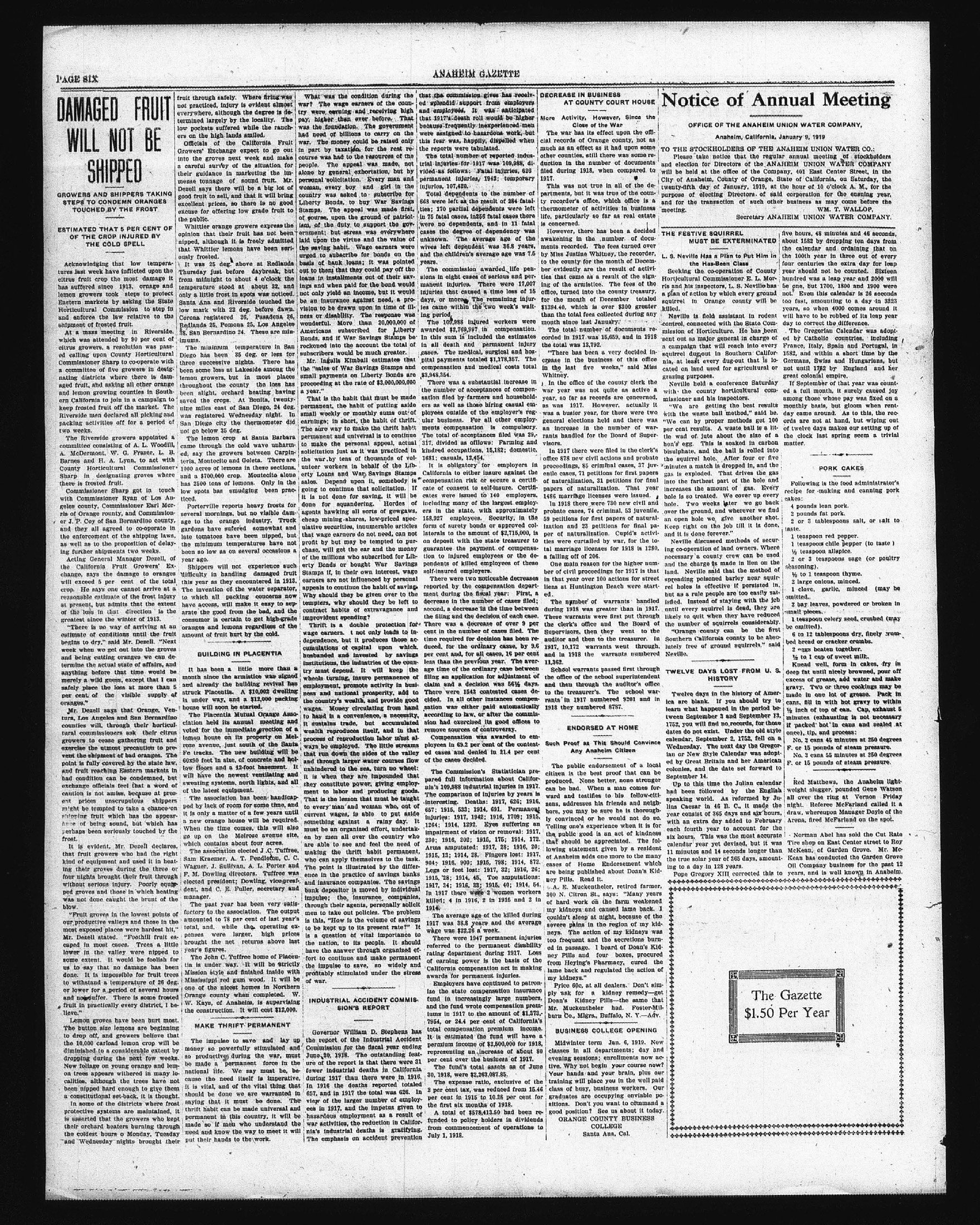
Searchable text
DAMAGED FRUIT
WILL NOT BE SHIPPED
GROWERS AND SHIPPERS TAKING STEPS TO CONDEMN ORANGES TOUCHED BY THE FROST
ESTIMATED THAT 5 PER CENT OF THE CROP INJURED BY THE COLD SPELL
Acknowledging that low temperatures last week have inflicted upon the citrus fruit crop the most damage it has suffered since 1913, ornage and lemon growers took steps to protect Eastern markets by asking the State Horticultural Commission to step in and enforce the law relative to the shipment of frosted fruit.
At a mass meeting in Riverside, which was attended by 90 per cent of citrus growers, a resolution was passed calling upon County Horticultural Commissioner Sharp to co-operate with a committee of five growers in designating districts where there is damaged fruit, and asking all other orange and lemon growing counties in Southern California to join in a campaign to keep frosted fruit off the market. The Riverside men declared all picking and packing activities off for a period of two weeks.
The Riverside growers appointed a committee consisting of A. L. Woodill, A. McDermont, W. G. Fraser, L. B. fruit through safely. Where firing was not practiced, injury is evident almost everywhere, although the degree is determined largely by the locality. The low pockets suffered while the ranchers on the high lands smiled.
Officials of the California Fruit Growers' Exchange expect to go out into the groves next week and make a careful survey of the situation for their guidance in marketing the immense tonnage of sound fruit. Mr. Dezell says there will be a big lot of good fruit to sell, and that it will bring excellent prices, so there is no good excuse for offering low grade fruit to the public.
Whittier orange growers express the opinion that their fruit has not been nipped, although it is freely admitted that Whittier lemons have been seriously frosted.
It was 25 deg. above at Redlands Thursday just before daybreak, but from midnight to about 4 o'clock the temperature stood at about 32, and only a little frost in spots was noticed. Santa Ana and Riverside touched the low mark with 22 deg. before dawn. Corona registered 26, Pasadena 26, Redlands 25, Pomona 25, Los Angeles 38, San Bernardino 24. These are minimums.
The minimum temperature in San Diego has been 35 deg. or less for three successive nights. There has been some loss at Lakeside among the lemon growers, but in most places throughout the county the loss has been slight, orchard heating having saved the crops. At Bonita, twenty-nine miles east of San Diego, 24 deg. was registered Wednesday night. In San Diego city the thermometer did not go below 35 deg.
The lemon crop at Santa Barbara came through the cold wave unharmed, say the growers between Carpin-What was the condition war? The wage earner try were earning and pay higher than ever was the foundation. They had need of billions to war. The money could in part by taxation, the course was had to the people. The appeal alone by general exhort personal solicitation. The woman, every boy and country was asked to Liberty Bonds, to buy Stamps. The appeal of course, upon the grism, of the duty to government; but stress was laid upon the virtue as the saving habit. War urged to subscribe for basis of bank loans; out to them that they may loans in installments ofings and when paid for not only yield an income be an insurance against vision to be drawn upness or disability. The wonderful. More than Americans subscriber Bonds, and if War Said reckoned into the acco subscribers would be.
Mr. Ingalls Kimball the "sales of War Save small payments on Life proceeding at the rate a year."
That is the habit that permanent, the habitat small weekly or monthly earnings; in short, the sure way to make permanent and universal to make the personal solicitation just as it
Commissioner Sharp to co-operate with a committee of five growers in designating districts where there is damaged fruit, and asking all other orange and lemon growing counties in Southern California to join in a campaign to keep frosted fruit off the market. The Riverside men declared all pickling and packing activities off for a period of two weeks.
The Riverside growers appointed a committee consisting of A. L. Woodill, A. McDermont, W. G. Fraser, L. B. Barnes and H. A. Lynn, to act with County Horticultural Commissioner Sharp in designating groves where there is frosted fruit.
Commissioner Sharp got in touch with Commissioner Ryan of Los Angeles county, Commissioner Earl Morris of Orange rounty, and Commissioner J. P. Coy of San Bernardino county, and they all agreed to co-operate in the enforcement of the shipping laws, as well as to the proposition of delaying further shipments two weeks.
Acting General Manager Dezell, of the California Fruit Growers' Exchange, says the damage to oranges will exceed 5 per cent of the total crop. He says one cannot arrive at a reasonable estimate of the frost injury at present, but admits that the extent of the loss in that direction is the greatest since the winter of 1913.
“There is no way of arriving at an estimate of conditions until the fruit begins to dry,” said Mr. Dezell. “Next week when we get out into the groves and being cutting oranges we can determine the actual state of affairs, and anything before that time would be merely a wild guess, except that I can safely place the loss at more than 5 per cent of the visible supply of oranges.”
Mr. Dezell says that Orange, Ventura, Los Angeles and San Bernardino counties will, through their horticultural commissioners ask their citrus growers to cease gathering fruit and exercise the utmost precaution to prevent the shipment of bad oranges. The point is fully covered by the state law, and fruit reaching Eastern markets in bad condition can be condemned, but exchange officials feel that a word of caution is not amiss, because at present prices unscrupulous shippers might be tempted to take a chance on shipping fruit which has the appearance of being sound, but which has perhaps been seriously touched by the frost.
It is evident, Mr. Dezell declares, that fruit growers who had the right kind of equipment and used it in heat-treated plants have some loss at Lakeside among the lemon growers, but in most places throughout the county the loss has been slight, orchard heating having saved the crops. At Bonita, twenty-nine miles east of San Diego, 24 deg. was registered Wednesday night. In San Diego city the thermometer did not go below 35 deg.
The lemon crop at Santa Barbara came through the cold wave unharmed, say the growers between Carpinteria, Montecito and Goleta. There are 1000 acres of lemons in these sections, and a $700,000 crop. Montecito alone has 2500 tons of lemons. Only in the low spots has smudging been practiced.
Porterville reports heavy frosts for several mornings, but no visible damage to the orange industry. Truck gardens have suffered somewhat and late tomatoes have been nipped, but the minimum temperatures have not been so low as on several occasions a year ago.
Shippers will not experience such difficulty in handling damaged fruit this year as they encountered in 1913. The invention of the water separator, to which all packing concerns now have access, will make it easy to separate the good from the bad, and the consumer is certain to get high-grade oranges and lemons regardless of the amount of fruit hurt by the cold.
BUILDING IN PLACENTIA
It has been a little more than a month since the armistice was signed and already the building revival has struck Placentia. A $10,002 dwelling is under way, and a $12,000 packing house will soon be started.
The Placentia Mutual Orange Association held its annual meeting and voted for the immediate erection of a lemon house on its property on Melrose avenue, just south of the Santa Fe tracks. The new building will be 60x90 feet in size, of concrete and hollow floors and a 12-foot basement. It will have the newest ventilating and sweating systems, north lights, and all of the latest equipment.
The association has been handicapped by lack of room for some time, and it is only a matter of a few years until a new orange house will be required. When the time comes, this will also go up on the Melrose avenue site, which contains about four acres.
The association elected J.C. Tuffree, Sam Kraemer, A.T. Pendleton, C.C. Warner, L.Sullivan, A.L.Porter and Mr. Ingalls Kimball the "sales of War Savings" small payments on L.L.proceeding at the rate a year."
That is the habit that permanent, the habit small weekly or monthly earnings; in short, the sure way to make permanent and universally to make the personal solicitation just as it is the war.by tens of thousands workers in beaty Loans and War sales. Depend upon going to continue than it is not done for sure done for squander agents hawking all cheap mining shares,ulative securities, inn that wage earners do profit by but may be chase, will get the ear of the millions who suffer Bonds or bought Stamps if, in their own earners are not influe appeals to continue tha Why should they be tempters, why should contract habits of e improvident spending.
Thrift is a double wage earners. t not dependence, but it p cumulations of capitals husbanded and invest institutions,the industry must depend. It wheels turning, insure employment,promote ness and national phe country's wealth wages.Money circula to hand is a conveni it sustains trade,b wealth reproduces its process of reproduction ways employed." That run down the s and through larger w unhindered to the se it is when they are they constitute power to labor and That is the lesson tha to every man and w current wages.is al something against must be an organized en by men all over are able to see and making the thrift who can apply them
and fruit reaching Eastern markets in bad condition can be condemned, but exchange officials feel that a word of caution is not amiss, because at present prices unscrupulous shippers might be tempted to take a chance on shipping fruit which has the appearance of being sound, but which has perhaps been seriously touched by the frost.
It is evident, Mr. Dezell declares, that fruit growers who had the right kind of equipment and used it in heating their groves during the three or four nights brought their fruit through without serious injury. Poorly equipped groves and those in which heating was not done caught the brunt of the blow.
"Fruit groves in the lowest points of our productive valleys and those in the most exposed places were hardest hit," Mr. Dezell stated. "Foothill fruit escaped in most cases. Trees a little lower in the valley were nipped to some extent. It would be foolish for us to say that no damage has been done. It is impossible for fruit trees to withstand a temperature of 26 deg. or lower for a period of several hours and not suffer. There is some frosted fruit in practically every district, I believe."
Lemon groves have been hurt most. The button size lemons are beginning to drop off, and growers believe that the 10,000 carload lemon crop will be diminished to a considerable extent by dropping during the next few weeks. New foliage on young orange and lemon trees appears withered in many localities, although the trees have not been nipped hard enough to give them a constitutional set-back, it is thought.
In some of the districts where frost protective systems are maintained, it is asserted that the growers who kept their orchard heaters burning through the coldest hours o Monday, Tuesday and Wednesday nights brought their low floors and a lowest ventilation will have the newest ventilating and sweating systems, north lights, and all of the latest equipment.
The association has been handicapped by lack of room for some time, and it is only a matter of a few years until a new orange house will be required. When the time comes, this will also go up on the Melrose avenue site, which contains about four acres.
The association elected J.C. Tuffree, Sam Kraemer, A.T. Pendleton, C.C. Wagner, J.Sullivan, A.L. Porter and F.M.Dowling directors. Tuffree was elected president; Dowling, vice-president, and C.E.Fuller, secretary and manager.
The past year has been very satisfactory to the association. The output amounted to 78 per cent of last year's total, and, while the operating expenses were larger, high prices brought the net returns above last year's figures.
The John C. Tuffree home of Placentia is under way. It will be strictly Mission style and finished inside with Mississippi red gum wood. It will be one of the nicest homes in Northern Orange county when completed. W.W.Kays, of Anaheim, is supervising the construction. It will cost $12,000.
MAKE THRIFT PERMANENT
The impulse to save and lay up money so powerfully stimulated and so productive during the war, must be made a permanent force in the national life. We say must be, because the need itself is imperative, it is vital, and of the vital thing that should be done we are warranted in saying that it must be done. The thrift habit can be made universal and permanent in this country, it will be made so if men who understand the need and know the way to meet it will put their hands to the work.
Governor William the report of the I Commission for the June 30, 1918. The ure of the report is fewer industrial deeds during 1917 than tha In 1916 the deaths 657, and in 1917 the view of the larger rees in 1917, and the hazardous employm war activities, the reia's industrial dea The emphasis on a
ANAHEIM GAZETTE
What was the condition during the war? The wage earners of the country were earning and receiving high pay, higher than ever before. That was the foundation. The government had need of billions to carry on the war. The money could be raised only in part by taxation, for the rest course was had to the resources of the people. The appeal was made, not alone by general exhortation, but by personal solicitation. Every man and woman, every boy and girl in the country was asked to subscribe for Liberty Bonds, to buy War Savings Stamps. The appeal was made first, of course, upon the ground of patriotism, of the duty to support the government; but stress was everywhere laid upon the virtue and the value of the saving habit. Wage earners were urged to subscribe for bonds on the basis of bank loans; it was pointed out to them that they could pay off the loans in installments out of their savings and when paid for the bond would not only yield an income, but it would be an insurance against need, a provision to be drawn upon in time of illness or disability. The response was wonderful. More than 20,000,000 of Americans subscribed for Liberty Bonds, and if War Savings Stamps be reckoned into the account the total of subscribers would be much greater.
Mr. Ingalls Kimball estimates that the "sales of War Savings Stamps and small payments on Liberty Bonds are proceeding at the rate of $3,000,000,000 a year."
That is the habit that must be made permanent, the habit of putting aside small weekly or monthly sums out-of earnings; in short, the habit of thrift. The sure way to make the thrift habit permanent and universal is to continue to make the personal appeal, actual solicitation just as it was practiced in thousands of real estate.
that the commission gives has received splendid support from employers and employees. It was anticipated that 1917's death roll would be higher because frequently inexperienced men were assigned to hazardous work, but this fear was, happily, dispelled when the reports were tabulated.
The total number of reported industrial injuries for 1917 was 109,988, divided as follows: Fatal injuries, 626 permanent injuries, 1942; temporary injuries, 107,420.
Total dependents to the number of 668 were left as the result of 284 fatalities; 170 partial dependents were left in 75 fatal cases, in 256 fatal cases there were no dependents, and in 11 fatal cases the degree of dependency was unknown. The average age of the wives left dependent was 36.8 years, and the children's average age was 7.5 years.
The commission awarded life pensions in eight cases of serious and permanent injuries. There were 17,007 injuries that caused a time loss of 15 days, or more. The remaining injuries came within the two week's waiting period.
The 109,988 injured workers were awarded $2,769,997 in compensation. In this sum is included the estimates in all death and permanent injury cases. The medical, surgical and hospital payments totaled $1,178,357. The compensation and medical costs total $3,948,354.
There was a substantial increase in the number of acceptances of compensation filed by farmers and householders as well as those hiring casual employees outside of the employer's regular business. For all other employments compensation is compulsory. The total of acceptances filed was 29,317, divided as follows: Farming and kindred occupations, 15,182; domestic, 1691; civil services, 14,545.
DECREASE IN BUSINESS AT COUNTY COURT HOUSE
More Activity, However, Since the Close of the War
The war has its effect upon the official records of Orange county, not as much as an effect as it had upon some other counties, still there was some reduction in the number of documents filed during 1918, when compared to 1917.
This was not true in all of the departments, but it was true of the county recorder's office, which office is a thermometer of activities in business life, particularly so far as real estate is concerned.
However, there has been a decided awakening in the number of documents recorded. The fees turned over by Miss Justine Whitney, the recorder, to the county for the month of December evidently are the result of activies that came as a result of the signing of the armistice. The fees of the office, turned into the county treasury, for the month of December totaled $1394.40, which is over $300 greater than the total fees collected during any month since last January.
The total number of documents recorded in 1917 was 15,659, and in 1918 the total was 13,792.
"There has been a very decided increase in the business of this office in the last five weeks," said Miss Whitney.
In the office of the county clerk the war year was not quite as active a year, so far as records are concerned, as was 1917. However, actually it was a busier year, for there were two general elections held and there was an increase in the number of warrants handled for the Board of Supervisors.
In 1917 there were filed in the clerk's office with the missioners.
"We can per cent rite heen's egg bisulphate."
Mr. Ingalls Kimbali estimates that the "sales of War Savings Stamps and small payments on Liberty Bonds are proceeding at the rate of $3,000,000,000 a year."
That is the habit that must be made permanent, the habit of putting aside small weekly or monthly sums out-of-earnings; in short, the habit of thrift. The sure way to make the thrift habit permanent and universal is to continue to make the personal appeal, actual solicitation just as it was practiced in the war, by tens of thousands of volunteer workers in behalf of the Liberty Loans and War Savings Stamps sales. Depend upon it, somebody is going to continue that solicitation. If it is not done for saving, it will be done for squandering. Hordes of agents hawking all sorts of gewgaws, cheap mining shares, low-priced speculative securities, innumerable articles that wage earners do not need, can not profit by but may be tempted to purchase, will get the ear and the money of the millions who subscribed for Liberty Bonds or bought War Savings Stamps if, in their own interest, wage earners are not influenced by personal appeals to continue the habit of savings. Why should they be given over to the tempters, why should they be left to contract habits of extravagance and improvident spending?
Thrift is a double protection for wage earners. It not only leads to independence, but it produces those accumulations of capital upon which husbanded and invested by savings institutions, the industries of the country must depend. It will keep the wheels turning, insure permanence of employment, promote activity in business and national prosperity, add to the country's wealth, and provide good wages. Money circulating from hand to hand is a convenience, a necessity, it sustains trade, but accumulated wealth reproduces itself, and in that process of reproduction labor must always be employed. The little streams that run down the sides of the valley and through larger water courses flow unhindered to the sea, turn no wheel: it is when they are impounded that they constitute power, giving employment to labor and producing goods.
That is the lesson that must be taught to every man and woman who, out of current wages, is able to put aside something against a rainy day. Must be an organized effort, undertaken by men all over the country who are able to see and feel the need of making the thrift habit permanent, who can apply themselves to the task.
There was a substantial increase in the number of acceptances of compensation filed by farmers and householders as well as those hiring casual employees outside of the employer's regular business. For all other employments compensation is compulsory. The total of acceptances filed was 29.317, divided as offlows: Farming and kindred occupations, 15,182; domestic, 1681; casuals, 12,454.
It is obligatory for employers in California to either insure against the compensation risk or secure a certificate of consent to self-insure. Certificates were issued to 140 employers, including many of the largest employers in the state, with approximately 158,927 employees. Security, in the form of surety bonds or approved collateral to the amount of $2,715,000, is on deposit with the state treasurer to guarantee the payment of compensation to injured employees or the dependents of killed employees of these self-insured employers.
There were two noticeable decreases reported by the compensation department during the fiscal year: First, a decrease in the number of cases filed; second, a decrease in the time between the filing and the decision of each case. There was a decrease of over 9 per cent in the number of cases filed. The time required for decision has been reduced, for the ordinary casse, by 9.6 per cent and, for all cases, 16 per cent less than the previous year. The average time of the ordinary case between filing an application for adjustment of claim and a decision was 56½ days. There were 1543 contested cases decided. In all other instances compensation was either paid automatically according to law, or after the commission had exercised its good offices to remove sources of controversy.
Compensation was awarded to employees in 69.2 per cent of the contested cases and denied in 21.4 per cent of the cases decided.
The Commission's Statistician prepared full information about California's 109,988 industrial injuries in 1917. The comparison of injuries by years is interesting. Deaths: 1917, 626; 1916, 657; 1915, 533; 1914, 691. Permanent injuries: 1917, 1942; 1916, 1709; 1915, 1264; 1914, 1292. Eyes suffering an impairment of vision or removal: 1917, 230; 1916, 202; 1915, 175; 1914, 172. Arms amputated: 1917, 28; 1916, 20; 1915, 13; 1914, 28. Fingers lost: 1917, 904; 1916, 900; 1915, 798; 1914, 872.
In the office of the county clerk the war year was not quite as active a year, so far as records are concerned, as was 1917. However, actually it was a busier year, for there were two general elections held and there was an increase in the number of warrants handled for the Board of Supervisors.
In 1917 there were filed in the clerk's office 878 new civil actions and probate proceedings, 85 criminal cases, 37 juvenile cases, 71 petitions for first papers of naturalization, 31 petitions for final papers of naturalization. That year 1486 marriage licenses were issued.
In 1918 there were 730 new civil and probate cases, 74 criminal, 53 juvenile, 59 petitions for first papers of naturalization and 23 petitions for final paper of naturalization. Cupid's activities were curtailed by war, for the total marriage licenses for 1918 is 1280, a falling off of 206.
One main reason for the higher number of civil proceedings for 1917 is that in that year over 100 actions for street liens at Huntington Beach were started.
The number of warrants handled during 1918 was greater than in 1917. These warrants were first put through the clerk's office and the Board of Supervisors. then they went to the auditor and then to the treasurer. In 1917, 10,172 warrants went through and in 1918 the warrants numbered 11,362.
School warrants passed first through the office of the school superintendent and then through the auditor's office to the treasurer's. The school warrants in 1917 numbered 9201 and in 1918 they numbered 8787.
ENDORSED AT HOME
Such Proof as This Should Convince Any Anaheim Citizen
The public endorsement of a local citizen is the best proof that can be produced. None better, none stronger can be had. When a man comes forward and testifies to his fellow-citizens addresses his friends and neighbors you may be sure he is thoroughly convinced or he would not do so. Telling one's experience when it is for the public good is an act of kindness that should be appreciated. The following statement given by a resident of Anaheim adds one more to the many cases of Home Endorsement which
INDUSTRIAL ACCIDENT COMMISSION'S REPORT
Governor William D. Stephens has the report of the Industrial Accident Commission for the fiscal year ending June 30, 1918. The outstanding feature of the report is that there were 31 fewer industrial deaths in California during 1917 than there were in 1916. In 1916 the deaths reported totaled 657, and in 1917 the total was 626. In view of the larger number of employees in 1917, and the impetus given to hazardous employment as a result of war activities, the reduction in California's industrial deaths is gratifying. The emphasis on accident prevention
The Commission's Statistician prepared full information about California's 109,988 industrial injuries in 1917. The comparison of injuries by years is interesting. Deaths: 1917, 626; 1916, 657; 1915, 533; 1914, 691. Permanent injuries: 1917, 1942; 1916, 1709; 1915, 1264; 1914, 1292. Eyes suffering an impairment of vision or removal: 1917, 230; 1916, 202; 1915, 175; 1914, 172. Arms amputated: 1917, 28; 1916, 20; 1915, 13; 1914, 28. Fingers lost: 1917, 904; 1916, 900; 1915, 798; 1914, 872. Legs or feet lost: 1917, 32; 1916, 26; 1915, '28; 1914, 45. Toe amputations: 1917, 34; 1916, 33; 1915, 40; 1914, 54. In 1917 there were 2 women workers killed; 4 in 1916, 2 in 1915 and 2 in 1914.
The average age of the killed during 1917 was 38.8 years and the average wage was $22.26 a week.
There were 1947 permanent injuries referred to the permanent disability rating department during 1917. Loss of earning power is the basis of the California compensation act in making awards for permanent injuries.
Employers have continued to patronize the state compensation insurance fund in increasingly large numbers, and the fund wrote compensation premiums in 1917 to the amount of $1,373,-7954, or 24.4 per cent of California's total compensation premium income. It is estimated the fund will have a premium income of $2,500,000 for 1918, representing an increase of about 80 per cent over the business of 1917.
The fund's total assets as of June 30, 1918, were $2,263,087.85.
The expense ratio, exclusive of the 2 per cent tax, was reduced from 15.46 per cent in 1915 to 10.28 per cent for the first six months of 1918.
A total of $578,413.50 had been refunded to policy holders in dividends from commencement of operations to July 1, 1918.
A.E. Muckentheler, retired farmer, 300 N. Citron St., says: "Many years of hard work on the farm weakened my kidneys and caused lame back. I couldn't sleep at night, because of the severe pains in the region of my kidneys. The action of my kidneys was too frequent and the secretions burned in passage. I heard of Doan's Kidney Pills and four boxes, procured from Heying's Pharmacy, cured the lame back and regulated the action of my kidneys."
Price $60c at all dealers. Don't simply ask for a kidney remedy—get Doan's Kidney Pills—the same that Mr. Muckentheler had. Foster-Milburn Co., Mlgrs., Buffalo, N.Y.-Adv.
BUSINESS COLLEGE OPENING
Midwinter term Jan. 6, 1919. New classes in all departments; day and evening sessions; enrollments now active. Why not begin your course now? Your hands and your brain, plus our training will place you in the well paid class of busy, business workers. Our graduates are occupying enviable positions. Don't you want to command a good position? See us about it today.
ORANGE COUNTY BUSINESS
COLLEGE
Santa Ana, Cal.
Notice of Annual Meeting
OFFICE OF THE ANAHEIM UNION WATER COMPANY,
Anaheim, California, January 9, 1919
TO THE STOCKHOLDERS OF THE ANAHEIM UNION WATER CO.:
Please take notice that the regular annual meeting of stockholders and election for Directors of the ANAHEIM UNION WATER COMPANY will be held at the office of the Company, 401 East Center Street, in the City of Anaheim, County of Orange, State of California, on Saturday, the twenty-fifth day of January, 1919, at the hour of 10 o'clock A.M., for the purpose of electing Directors of said corporation for the ensuing year, and for the transaction of such other business as may come before the meeting.
WM. T. WALLOP,
Secretary ANAHEIM UNION WATER COMPANY.
THE FESTIVE SQUIRREL
MUST BE EXTERMINATED
L. S. Neville Has a Plan to Put Him in the Has-Been Class
Seeking the co-operation of County Horticultural Commissioner E. L. Morris and his inspectors, L. S. Neville has a plan of action by which every ground squirrel in Orange county will be killed.
Neville is field assistant in rodent control, connected with the State Commission of Horticulture. He has been sent out as major general in charge of a campaign that will reach into every squirrel dug-out in Southern California, at least every dug-out that is located on land used for agricultural or grazing purposes.
Neville held a conference Saturday with the county horticultural commissioner and his inspectors.
"We are getting the best results with the waste ball method," said he. "We can by proper methods get 100 per cent results. A waste ball is a little wad of jute about the size of a hen's egg. This is soaked in carbon bisulphate, and the ball is rolled into five hours, 48 minutes and 46 seconds, about 1582 by dropping ten days from the calendar and ordaining that on the 100th year in three out of every four centuries the extra day for leap year should not be counted. Sixteen hundred was a leap year and 2000 will be one, but 1700, 1800 and 1900 were not. Even this calendar is 26 seconds too fast, amounting to a day in 3323 years, so when 4000 comes around it will have to be robbed of its leap year day to correct the difference.
The Gregorian Calendar was adopted by Catholic countries, including France, Italy, Spain and Portugal, in 1582, and within a short time by the Germans, Swiss and Hungarians, but not until 1752 by England and her great colonial empire.
If September of that year was counted a full month, it surely caused joy among those whose pay was fixed on a monthly basis, but gloom when rent-day came around. As to this, the records are not at hand, but wilping out of twelve days makes our setting up of the clock last spring seem a trivial matter."
TWELVE DAYS LOST FROM U. S. HISTORY
Twelve days in the history of America are blank. If you should try to learn what happened in the period between September 3 and September 13, 1752, you will find no records, for those dates do not exist. Under the old style calendar, September 2, 1752, fell on a Wednesday. The next day the Gregorian or New Style Calendar was adopted by Great Britain and her American colonies, and the date set forward to September 14.
Up to this time the Julian calendar had been followed by the English speaking world. As reformed by Julius Caesar in 46 B. C., it made the year consist of 365 days and six hours, with an extra day added to February each fourth year to account for the six hours. This was the most accurate calendar year yet devised, but it was 11 minutes and 14 seconds longer than the true solar year of 365 days, amounting to about 198 years.
Neville held a conference Saturday with the county horticultural commissioner and his inspectors.
"We are getting the best results with the waste ball method," said he. "We can by proper methods get 100 per cent results. A waste ball is a little wad of jute about the size of a hen's egg. This is soaked in carbon bisulphate, and the ball is rolled into the squirrel hole. After four or five minutes a match is dropped in, and the gas is exploded. That drives the gas into the farthest part of the hole and increases the amount of gas. Every hole is so treated. We cover up every hole. Two weeks later we go back over the ground, and wherever we find an open hole we give another shot. Keep right on the job till it is done, and it is done forever."
Neville discussed methods of securing co-operation of land owners. Where necessary a county crew can be used and the charge is made in lien on the land. Neville said that the method of spreading poisoned barley near squirrel holes is effective if persisted in, but as a rule people are too easily satisfied. Instead of staying with the job until every squirrel is dead, they are likely to quit when they have reduced the number of squirrels considerably.
"Orange county can be the first Southern California county to be absolutely free of ground squirrels," said Neville.
PORK CAKES
Following is the food administrator's recipe for making and canning pork cakes:
4 pounds lean pork.
2 pounds fat pork.
2 or 3 tablespoons salt, or salt to taste.
1 teaspoon red pepper.
1 teaspoon chile pepper (to taste)
½ teaspoon allspice.
2 or 3 teaspoons sage (or poultry seasoning).
½ to 1 teaspoon thyme.
2 large onions, minced.
1 clove, garlic, minced (may be omitted).
2 bay leaves, powdered or broken in small pieces.
1 teaspoon celery seed, crushed (may be omitted).
6 to 12 tablespoons dry, finely crumbed bread or cracker crumbs.
2 eggs beaten together.
½ to 1 cup of sweet milk.
Knead well, form in cakes, fry in deep fat until nicely browned, pour off excess of grease, add water and make gravy. Two or three cookings may be made in one lot of grease. Pack in cans, fill in with hot gravy to within ¼ inch of top of can. Cap, exhaust 5 minutes (exhausting is not necessary if packed hot in cans and sealed at once), tip, and process:
No. 2 cans 45 minutes at 250 degrees F. or 15 pounds of steam pressure.
No. 3 cans 55 minutes at 250 degrees F. or 15 pounds of steam pressure.
Red Matthews, the Anaheim lightweight slugger, pounded Gene Watson all over the ring at Vernon Friday night. Referee McFarland called it a draw, whereupon Manager Doyle of the Arena, fired McFarland on the spot.
Norman Abel has sold the Cut Rate Tire shop on East Center street to Roy McKean, of Garden Grove. Mr. McKean has conducted the Garden Grove Oil Company business for the past 12
Up to this time the Julian calendar had been followed by the English speaking world. As reformed by Julius Caesar in 46 B. C., it made the year consist of 365 days and six hours, with an extra day added to February each fourth year to account for the six hours. This was the most accurate calendar year yet devised, but it was 11 minutes and 14 seconds longer than the true solar year of 365 days, amounting to a day in 128 years.
Pope Gregory XIII corrected this to
Red Matthews, the Anaheim lightweight slugger, pounded Gene Watson all over the ring at Vernon Friday night. Referee McFarland called it a draw, whereupon Manager Doyle of the Arena, fired McFarland on the spot.
Norman Abel has sold the Cut Rate Tire shop on East Center street to Roy McKean, of Garden Grove. Mr. McKean has conducted the Garden Grove Oil Company business for the past 12 years, and is well known in Anaheim.
The Gazette
$1.50 Per Year