anaheim-gazette 1919-01-09
Scanned page
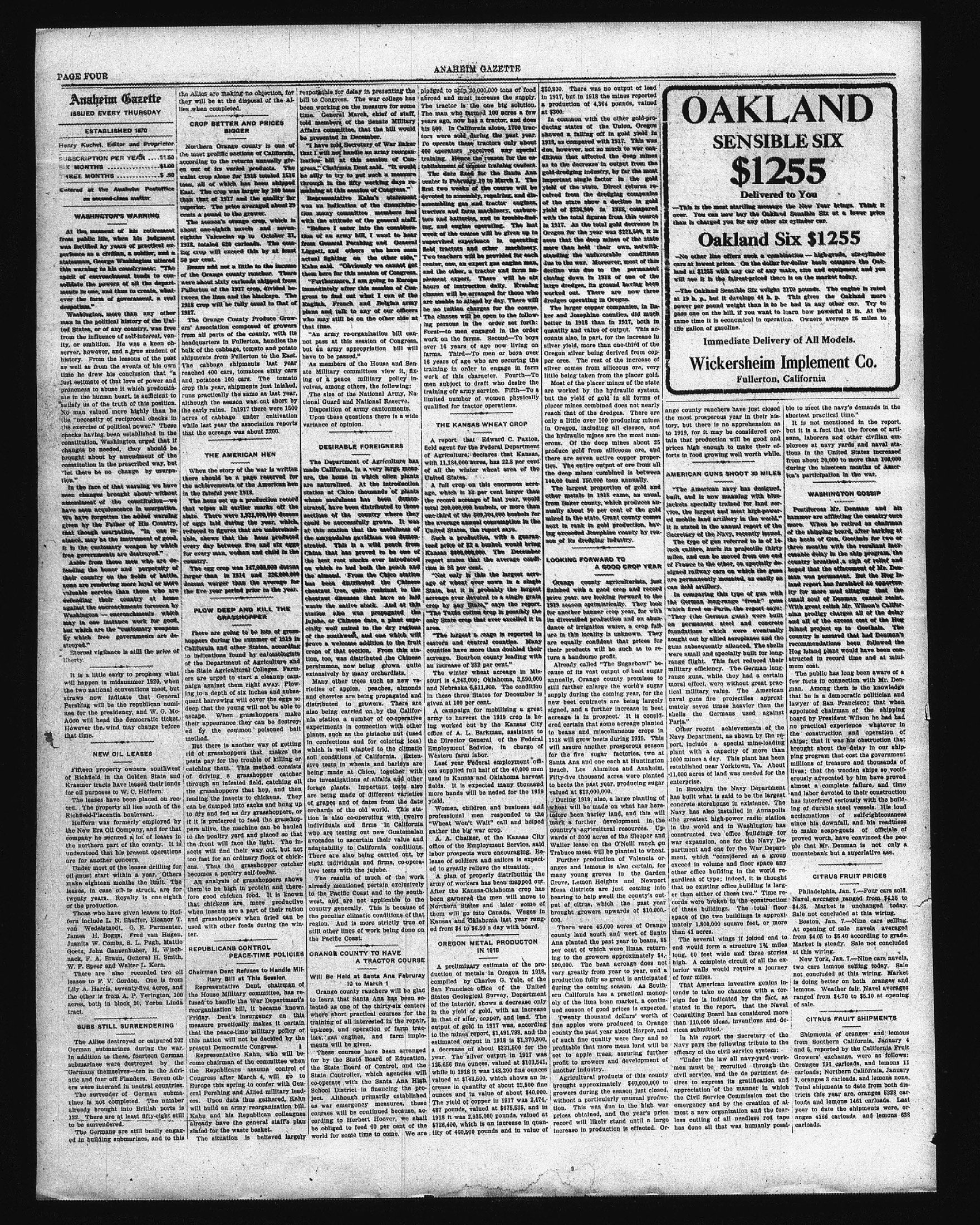
Searchable text
Anaheim Gazette
ISSUED EVERY THURSDAY
ESTABLISHED 1870
Henry Kuchel, Editor and Proprietor
SUBSCRIPTION PER YEAR ... $1.50
SIX MONTHS ... $1.00
THREE MONTHS ... $ .50
Entered at the Anaheim Postoffice on second-class matter
WASHINGTON'S WARNING
At the moment of his retirement from public life, when his judgment was fulfilled by years of practical experience as a civilian, a soldier, and a stateman, George Washington offered this warning to his countrymen: "The spirit of encroachment tends to consolidate the powers of all the departments in one, and thus to create, whatever the form of government, a real despotism."
Washington, more than any other man in the political history of the United States, or of any country, was free from the influence of self-interest, vanity, or ambition. He was a keen observer, however, and a true student of history. From the lessons of the past as well as from the events of his own time he drew his conclusion that "a just estimate of that love of power and proneness to abuse it which predominate in the human heart, is sufficient to satisfy us of the truth of this position. No man valued more highly than he the "necessity of reciprocal checks in the exercise of political power." These checks having been established in the constitution, Washington urged that if changes be needed, they should be brought about by amendment of the Allies are making no objection, for they will be at the disposal of the Allies when completed.
CROP BETTER AND PRICES BIGGER
Northern Orange county is one of the most prolific sections of California, according to the returns annually given out of its varied products. The walnut crop alone for 1913 totaled 1516 tons, all of which has been shipped East. The crop was larger by 100 tons than that of 1917 and the quality far superior. The price averaged about 29 cents a pound to the grower.
The season's orange crop, which is about one-eighth mavels and seven-eighth Valencias up to October 31, 1918, totaled 620 caribades. The coming crop will exceed this by at least 50 per cent.
Beams add not a little to the income of the Orange county rancher. There were about sixty caribades shipped from Fullerton of the 1917 crop, divided between the lima and the blackeye. The 1918 crop will be fully equal to that of 1917.
The Orange County Produce Growers' Association composed of growers from all parts of the county, with its headquarters in Fullerton, handles the bulk of the cabbage, tomato and potato shipments from Fullerton to the East. The cabbage shipments last year reached 400 cars, tomatoes sixty cars and potatoes 100 cars. The tomato crop this year, shipments just finished, runs practically the same as last year, although the season was cut short by the early rains. In 1917 there were 1500 acres of cabbage under cultivation while last year the association reports that the acreage was about 2200.
THE AMERICAN HEN
responsible for delay for bill to Congress. They been working on the time. General March told members of the Affairs committee, that be presented in December.
"I have told Secretary that I will not handle a situation bill at this gras," Chairman Deming be silly to try to put through in the fifty waking at this session.
Representative Kaplan was an indication of tension many committees with the attitude of "Before I enter into this plan of an army bill from General Parahh Liggett, and others actual fighting on Kahn said. Obviously them here for this season."
Furthermore, I am immediately after this greet to find out what English, French and plans and talk to any who still be on that time.
"An army re-organized not pass at this session but an army approves have to be passed."
As members of the Military committee of a peace mil volves among others.
The size of the National Guard and National Disposition of army Upon these questions variance of opinion.
as well as from the events of his own time he drew his conclusion that "a just estimate of that love of power and proneness to abuse it which predominate in the human heart, is sufficient to satisfy us of the truth of this position. No man valued more highly than he the "necessity of reciprocal checks in the exercise of political power." These checks having been established in the constitution, Washington urged that if changes be needed, they should be brought about by amendment of the constitution in the prescribed way, but "let there be no change by usurpation."
In the face of that warning we have seen changes brought about without amendment of the constitution—we have seen acquiescence in usurpation. We have forgotten the added warning given by the Father of His Country, that though usurpation, "In one instance, may be the instrument of good, it is the customary weapon by which free governments are destroyed."
Aside from these men who are defending the honor and perpetuity of their country on the fields of battle, none are rendering more loyal or more valuable service than those who are defending their country at home against the encroachments foreseen by Washington — encroachments which may in one instance work for good, but which are the "customary weapons by which free governments are destroyed."
Eternal vigilance is still the price of liberty.
It is a little early to prophesy what will happen in midsummer 1920, when the two national conventions meet, but straws now indicate that General Pershing will be the republican nominee for the presidency, and W. G. McAdoo will head the democratic ticket. However the wind may change before that time.
NEW OIL LEASES
Fifteen property owners southwest of Richfield in the Golden State and Kraemer tracts have leased their lands for oil purposes to W. C. Heffern.
The leases have been placed on record. The property all lies south of the Richfield-Placentia boulevard.
Heffern was formerly employed by the New Era Oil Company, and for that company he secured a lot of leases in the northern part of the county. It is understood that his present operations are for another concern.
The cabbage shipments last year reached 400 cars, tomatoes sixty cars and potatoes 100 cars. The tomato crop this year, shipments just finished, runs practically the same as last year, although the season was cut short by the early rains. In 1917 there were 1500 acres of cabbage under cultivation while last year the association reports that the acreage was about 2200.
THE AMERICAN HEN
When the story of the war is written there should be a page reserved for the achievements of the American hen in the fateful year 1818.
The hen set up a production record that wipes all earlier marks off the slate. There were 1,521,000,000 doses of eggs laid during the year, which reduced to figures that are understandable, shows that the hen produced every day between five and six eggs for every man, woman and child in the country.
The egg crop was 147,000,000 doses larger than in 1814 and 228,000,000 doses wagerer than the average for the five year period prior to the year.
PLOW DEEP AND KILL THE GRASSHOPPER
There are going to be lots of grasshoppers during the summer of 1819 in California and other States, according to indications found by entombologists of the Department of Agriculture and the State Agricultural Colleges. Farmers are urged to start a cleanup campaign against them right away. Plowing to a depth of six inches and subsequent harrowing will cover the eggs so deep that the young will not be able to escape. When grasshoppers make their appearance they can be destroyed by the common poisoned bait method.
But there is another way of getting rid of grasshoppers that makes the pests pay for the trouble of killing or catching them. This method consists of driving a grasshopper catcher through an infested field, catching all the grasshoppers that hop, and then feeding the insects to chickens. They can be dumped into sacks and hung up to dry and fed as dry grasshoppers, or if it is preferred to feed the grasshoppers alive, the machine can be hauled to the poultry yard and placed so that the front will face the light. The insects will find their way out, but not too fast for an ordinary flock of chickens.
Thus the grasshopper catcher
As members of the Military committing of a peace milievoles among others.
The size of the National Guard and Natio Disposition of army Upon these question variance of opinion.
DESIRABLE FO
The Department o made California, in arure, the home in w are naturalised. At station at Chico th whose usefulness has strated, have been d sections of the co could be successful at this station that tthe amygdala gave stated. This is a China that has provi best root stock on which to bad be almand. From has been distribut chestnut tree, quilting chestnut diseases to waste the native at station also was juluba, or Chinese cally well suited to of the southwest, an prove a welcome ad crops of that section tion, too, was distr persimmon, now be extensively by many.
Many other trees rietles of apples, and cherries are being distributed to grow also being carried via nia station a numb experiments in com plants, such as th e in confections and which is well adapt soil conditions of C sive tests in wheath being made at Chiche investigations o forage plants. Im are being made o f grapes and o d orchards of the old tion is also co-open individuals and fi who are testing ou avocados to ascertain adaptability to Cali There are also be eight individuals a
Fifteen property owners southwest of Richfield in the Golden State and Kraemer tracts have leased their lands for oil purposes to W. C. Heffern.
The leases have been placed on record. The property all lies south of the Richfield-Placentia boulevard.
Heffern was formerly employed by the New Era Oil Company, and for that company he secured a lot of leases in the northern part of the county. It is understood that his present operations are for another concern.
Under most of the leases drilling for oil must start within a year. Others make eighteen months the limit. The leases, in case oil is struck, are for twenty years. Royalty is one eighth of the production.
Those who have given leases to Heffern include L. N. Shaffer, Eleanor T. von Wedelstaedt, G. E. Parmenter, James H. Boggs, Fred van Hagen, Juanita W. Combs, S. L. Pugh, Mattle Goetz, John Ganzenhuber, H. Wischnack, F. A. Braun, General H. Smith, W. F. Speer and Walter L. Kern.
There are also recorded two oil leases to F. V. Gordon. One is from Lily A. Harris, seventy-five acres, and the other is from A. P. Yerington, 100 acres, both in block 20, Yorba Linda tract.
SUBS STILL SURRENDERING
The Allies destroyed or catpured 202 German submarines during the war. In addition to these, fourteen German submarines were destroyed by the Germans themselves—ten in the Adriatic and four off Flanders. Seven others were interned in neutral countries.
The surrender of German submarines is not completed. The number already brought into British ports is 122. There are at least fifty-eight still to be surrendered.
The Germans are still busily engaged in building submarines, and to this catching them.
This method consists of driving a grasshopper catcher through an infested field, catching all the grasshoppers that hop, and then feeding the insects to chickens. They can be dumped into sacks and hung up to dry and fed as dry grasshoppers, or if it is preferred to feed the grasshoppers alive, the machine can be hauled to the poultry yard and placed so that the front will face the light. The insects will find their way out, but not too fast for an ordinary flock of chickens. Thus the grasshopper catcher becomes a poultry self-feeder.
An analysis of grasshoppers shows them to be high in protein and therefore good chicken food. It is known that chickens are more productive when insects are a part of their ration and grasshoppers when dried can be used with other feeds during the winter.
REPUBLICANS CONTROL PEACE-TIME POLICIES
Chairman Dent Refuses to Handle Military Bill at This Session
Representative Dent, chairman of the House Military committee, has refused to handle the War Department's reorganization bill, it became known Friday. Dent's insurgency on this measure practically makes it certain that the peace-time military policy of this nation will not be decided by the present Democratic Congress.
Representative Kahn, who will become chairman of the committee when the Republicans assume control of Congress after March 4, will go to Europe this spring to confer with General Pershing and Allied military leaders. Upon data thus gathered, Kahn will build an army reorganization bill. Kahn and his Republican colleagues already have the general staff's plan slated for the waste basket.
The situation is believed largely being made at Charge the investigations of forage plants. Immediately there are being made of grapes and of daffords of the old tion is also co-open individuals and fi who are testing our avocados to ascertain adaptability to Cali There are also being eight individuals active tests with the results of m already mentioned to the Pacific Coast west, and are not country generally. the peculiar climate region. And is m still other lines of the Pacific Coast.
ORANGE COUNTY A T
Will Be Held at S 10 to M Orange county rale to learn that Sanctuary lected as one of th where short practic training of all inter up-keep, and oper tors; gas engines; ments will be given These courses b for by the Staté l State Board o State Controller, w co-operate with th School District in project. Although p as war emergency courses will be coording to Herbert be obliged to feed world for some time
ANAHEIM GAZETTE
responsible for delay in presenting the bill to Congress. The war college has been working on the measure for some time. General March, chief of staff, told members of the Senate Military Affairs committee, that the bill would be presented in December.
"I have told Secretary of War Baker that I will not handle an army reorganization bill at this session of Congress," Chairman Deut said. "It would be silly to try to put such a measure through in the fifty working days remaining at this session of Congress."
Representative Kahn's statement was an indication of the dissatisfaction many committee members feel with the attitude of the general staff.
"Before I enter into the consideration of an army bill, I want to hear from General Parahing and General Liggett, and others who have seen actual fighting on the other side," Kahn said. "Obviously we cannot get them here for this session of Congress."
Furthermore, I am going to Europe immediately after this session of Congress to find out what I can of the English, French and Belgian army plans and talk to any of our officers who may still be on the other side at that time.
"An army re-organization bill cannot pass at this session of Congress, but an army appropriation bill will have to be passed."
As members of the House and Senate Military committees view it, fixing of a peace military policy involves, among others, the following:
The size of the National Army, National Guard and National Reserve.
Disposition of army cantonments.
Upon these questions there is a wide variance of opinion.
THE KANSAS WHEAT CROP
A report that Edward C. Paxton, field agent for the Federal Department of Agriculture, declares that Kansas,
$50,800. There was no output of lead in 1917, but in 1918 the mines reported a production of 4,364 pounds, valued at $300.
In common with the other gold-producing states of the Union, Oregon showed a falling off in gold yield in 1918, as compared with 1917. This was due, however, not so much to war conditions that affected the deep mines as to the decrease in output from the gold-dredging industry, by far the most important single factor in the gold yield of the state. Direct returns received from the dredging companies of the state show a decline in gold yield of $238,900 in 1918, compared with the total figures from this source in 1917. As the total gold decrease in Oregon for the year was $221,500, it is seen that the deep mines of the state more than held their own, notwithstanding the unfavorable conditions due to the war. Moreover, most of this decline was due to the permanent closing down in 1918 of one of the large dredges, its ground having been worked out. There are now three dredges operating in Oregon.
The larger copper companies, in Baker and Josephine counties, did much better in 1918 than in 1917, both in quantity and value of output. This accounts also, in part, for the increase in silver yield, more than one-third of the Oregon silver being derived from copper ores. The rest of the increase of silver comes from siliceous ore, very little being taken from the placer gold.
Most of the placer mines of the state are worked by the hydraulic system, but the yield of gold in all forms of placer mines combined does not nearly reach that of the dredges. There are only a little over 100 producing mines in Oregon, including all classes, and the hydraulic mines are the most numerous. Of the deep mines about 25 produce gold from siliceous ore, and they are active copper proper.
As members of the House and Senate Military committees view it, fixing of a peace military policy involves, among others, the following:
The size of the National Army, National Guard and National Reserve.
Disposition of army cantonments.
Upon these questions there is a wide variance of opinion.
DESIRABLE FOREIGNERS
The Department of Agriculture has made California, in a very large measure, the home in which olen plants are naturalised. At the introduction station at Chico thousands of plants whose usefulness has been demonstrated, have been distributed to those sections of the country where they could be successfully grown. It was at this station that the usefulness of the anygadalen gavilhan was demonstrated. This is a wild peach from China that has proved to be one of the best root stocks ever introduced on which to bud both the peach and the almond. From the Chico station has been distributed the Chinese chestnut tree, quite resistant to the chestnut diseases that have so halted waste the native stock. And at this station also was propagated the jujuba, or Chinese date, a plant especially well suited to the dry regions of the southwest, and one which will prove a welcome addition to the fruit crops of that section. From this station, too, was distributed the Chinese persimmon, now being grown quite extensively by many orchardists.
Many other trees such as new varieties of apples, peaches, almonds and cherries are being propagated and distributed to growers. There are also being carried on by the California station a number of co-operative experiments in connection with other plants, such as the pistache nut (used in confections and for coloring ice) which is well adapted to the climatic soil conditions of California. Extensive tests in wheats and barleys are being made at Chico, together with the investigations of alfalfa and other forage plants. Important tests also are being made of different varieties of grapes and of dates from the date orchards of the old world. This station is also co-operating with twelve individuals and firms in California who are testing out new Guatemalan avocados to ascertain their value and adaptability to California conditions. There are also being carried out, by eight individuals and firms, co-operating with Edward C. Paxton, field agent for the Federal Department of Agriculture; declares that Kansas, with 11,184,000 acres, has 22.8 per cent of all the winter wheat area of the United States.
A full crop on this enormous acreage, which is 13 per cent larger than the record acreage of last year, would total 200,000,000 bushels, or more than one-third of the 509,304,000 bushels for the average annual consumption in the United States, the report says.
Such a production, with a guaranteed price of $2 a bushel, would bring Kansas $400,000,000. The December report states that the average condition is 93 per cent.
"Not only is this the largest acreage of wheat ever sown in a single State, but it is probably the largest acreage ever devoted to a single grain crop by any State," says the report. "The Texas cotton crop is possibly the only State crop that ever excelled it in area."
"The largest acreage is reported in eastern and central counties. Many counties have more than doubled their acreage. Bourbon county leading with an increase of 232 per cent."
The winter wheat acreage in Missouri is 4,243,000; Oklahoma is 3,590,000 and Nebraska 5,511,000. The condition in these three States for December is given at 100 per cent.
A campaign for mobilizing a great army to harvest the 1919 crop is being worked out by the Kansas City office of A. L. Barkman, assistant to the Director General of the Federal Employment Service, in charge of Western farm labor.
Last year Federal employment offices supplied full half of the 40,000 men used in Kansas and Oklahoma harvest fields. It is expected many thousand more hands will be needed for the 1919 yield.
Women, children and business and professional men responded to the "Wheat Won't Wait" call and helped gather the big war crop.
A. A. Chalker, of the Kansas City office of the Employment Service, said labor prospects were encouraging. Release of soldiers and sailors is expectable for 16 years of age who are securing the training in order to engage in farm work of this character. Fourth—To men subject to draft who desire the training or army service. Fifth—To a limited number of women physically qualified for tractor operations.
THE KANSAS WHEAT CROP
A report that Edward C. Paxton, field agent for the Federal Department of Agriculture; declares that Kansas, with 11,184,000 acres, has 22.8 per cent of all the winter wheat area of the United States.
A full crop on this enormous acreage, which is 13 per cent larger than the record acreage of last year, would total 200,000,000 bushels, or more than one-third of the 509,304,000 bushels for the average annual consumption in the United States, the report says.
Such a production, with a guaranteed price of $2 a bushel, would bring Kansas $400,000,000. The December report states that the average condition is 93 per cent.
"Not only is this the largest acreage of wheat ever sown in a single State, but it is probably the largest acreage ever devoted to a single grain crop by any State," says the report. "The Texas cotton crop is possibly the only State crop that ever excelled it in area."
"The largest acreage is reported in eastern and central counties. Many counties have more than doubled their acreage. Bourbon county leading with an increase of 232 per cent."
The winter wheat acreage in Missouri is 4,243,000; Oklahoma is 3,590,000 and Nebraska 5,511,000. The condition in these three States for December is given at 100 per cent.
A campaign for mobilizing a great army to harvest the 1919 crop is being worked out by the Kansas City office of A. L. Barkman, assistant to the Director General of the Federal Employment Service, in charge of Western farm labor.
Last year Federal employment offices supplied full half of the 40,000 men used in Kansas and Oklahoma harvest fields. It is expected many thousand more hands will be needed for the 1919 yield.
Women, children and business and professional men responded to the "Wheat Won't Wait" call and helped gather the big war crop.
A. A. Chalker, of the Kansas City office of the Employment Service, said labor prospects were encouraging. Release of soldiers and sailors is expectable for 16 years of age who are securing the training in order to engage in farm work of this character. Fourth—To men subject to draft who desire the training or army service. Fifth—To a limited number of women physically qualified for tractor operations.
LOOKING FORWARD TO A GOOD CROP YEAR
Orange county agriculturists just finished with a good crop and record price year. are looking forward to the 1819 season optimistically. They look for another banner crop year, for with its diversified production and an abundance of irrigation water, a crop failure in this locality is unknown. They are equally confident that prices for their products will be such as to return a handsome profit.
Already called "The Sugarbowl" because of its vast output of beet sugar annually. Orange county promises to still further enlarge the world's sugar supply during the coming year, for the new beet contracts are being largely signed, and a further increase in beet acreage is in prospect. It is considered certain that some acreage planted to beans and miscellaneous crops in 1918 will grow beets during 1919. This will assure another prosperous season for the five sugar factories, two at Santa Ana and one each at Huntington Beach. Los Alamitos and Anaheim. Fifty-five thousand acres were planted to beets the past year, producing sugar valued at $12,000,000.
During 1919, also a large planting of wheat will be made on what has hereforebeen barley land, and this will mark a further development in the country's agricultural resources. Upwards of 2000 acres of the Sleeper and Waller lease on the O'Neill ranch on Trabuco mesa will be planted to wheat.
Further production of Valencia oranges is also certain for range countryside.
range countryside
naval mall
naval mall
enterprise
enterprise
entertainment
entertainment
entertainment
entertainment
entertainment
entertainment
entertainment
entertainment
entertainment
entertainment
entertainment
entertainment
entertainment
entertainment
entertainment
entertainment
entertainment
entertainment
entertainment
entertainment
entertainment
entertainment
entertainment
entertainment
entertainment
entertainment
entertainment
entertainment
entertainment
entertainment
entertainment
entertainment
entertainment
entertainment
entertainment
entertainment
entertainment
entertainment
entertainment
entertainment
entertainment
entertainment
entertainment
entertainment
entertainment
entertainment
entertainment
entertainment
entertainment
entertainment
entertainment
entertainment
entertainment
entertainment
entertainment
entertainment
entertainment
entertainment
entertainment
entreatement
entreatement
entreatement
entreatement
entreatement
entreatement
entreatement
entreatement
entreatement
entreatement
entreatement
entreatement
entreatement
entreatement
entreatement
entreatement
entreatement
entreatement
entreatement
entreatement
entreatement
entreatement
entreatement
entreatement
entreatement
entreatement
entreatement
entreatement
entreatement
entreatement
entreatement
entreatement
entreatement
entreatement
entreatement
entreatement
entreatement
entrattement
entrattement
entrattement
entrattement
entrattement
entrattement
entrattement
entrattement
entrattement
entrattement
entrattement
entrattement
entrattement
entrattemenentrattemenentrattemenentrattemenentrattemenentrattemenentrattemenentrattemenentrattemenentrattemenentrattemenentrattemenentrattemenentrattemenentrattemenentrattemenentrattemenentrattemenentrattemenentrattemenentrattemenentrattemenentrattemenentrattemenentrattemenentrattemenentrattemenentrattemenentrattemenentrattemenentrattmenentrattemenentrattemenentrattemenentrattemenentrattemenentrattemenentrattemenentrattemenentrattemenentrattmenentrattmenentrattmenentrattmenentrattmenentrattmenentrattmenentrattmenentrattmenentrattmenentrattmenentrattmenentrattmenentrattmenentrattmenentrattmenentrattmenentrattmenentrattmenentrattmenentrattmenentrattmenentrattmenentrattmenentrattmenentrattmenentrattmenentrattmenentrattmenentrattmenentrattmenentrattmenentrattmenentrattmenentrattmenentrattmenentrATTEN
Other Navy Dept., inc.
plant wi.
1000 mil.
establish.
11,000 ar.
enterpris.
In Brush has built concrete Navy h.
the gree.
in construc.
war exp.
partme.
ment,
wexceed.
am.
range counte.
the most.
butto.
to 1919,
tain tta.
price hi.
forts in f.
AMERICAN
"The A built,
and jackets sive,
service,
it is state Secretiary."
"The A built,
and jackets sive,
service,
it is state Secretiary."
"The A built,
and jackets sive,
service,
it is state Secretiary."
ORANGE COUNTY TO HAVE A TRACTOR COURSE
Will Be Held at Santa Ana February 10 to March 1
Orange county ranchers will be glad to learn that Santa Ana has been selected as one of the thirty-six centers where short practical courses for the training of all interested in the repair, up-keep, and operation of farm tractors, gas engines, and farm implements will be given.
These courses have been arranged for by the State Board of Education, the State Board of Control, and the State Controller, which agencies will co-operate with the Santa Ana High School District in financing the project. Although primarily established as war emergency measures, these courses will be continued because, according to Herbert Hoover, we shall be obliged to feed 60 per cent of the world for some time to come. We are
OREGON METAL PRODUCTION IN 1918
A preliminary estimate of the production of metals in Oregon in 1918, compiled by Charles G. Yale, of the San Francisco office of the United States Geological Survey, Department of the Interior, shows a decrease only in the yield of gold, with an increase in that of silver, copper, and lead. The output of gold in 1917 was, according to the mines report, $1,491,798, and the estimated output in 1918 is $1,270,300, a decrease of about $221,500 for the year. The silver output in 1917 was 125,656 fine ounces, valued at $103,541, while in 1918 it was 148,200 fine ounces valued at $143,500, which shows an increase in quantity of about 22,500 fine ounces and in value of about $40,000. The yield of copper in 1917 was 2,474.487 pounds, valued at $675,535, and in 1918 it was 2,935,000 pounds, valued at $726,400, which is an increase in quantity of 460,500 pounds and in value of
Agricultural products of this county brought approximately $40,000,000 to growers during the season just closed, without a particularly unusual production. This was due to the high war prices obtained, and the year's price record will likely stand until a large increase in production is effected. Orchards supplied full half of the 40,000 men used in Kansas and Oklahoma harvest fields. It is expected many thousand more hands will be needed for the 1919 yield.
Women, children and business and professional men responded to the "Wheat Won't Wait" call and helped gather the big war crop.
A. A. Chalker, of the Kansas City office of the Employment Service, said labor prospects were encouraging. Release of soldiers and sailors is expected to greatly relieve the situation.
A plan of properly distributing the army of workers has been mapped out. After the Kansas-Oklahoma crop has been garnered the men will move to Northern States and later some of them will go into Canada. Wages in Kansas and Oklahoma last year ranged from $4 to $6.50 a day with board.
There were 45,000 acres of Orange county land south and west of Santa Ana planted the past year to beans, 85 per cent of which were limas, returning to the growers approximately $4.,500,000. The bean acreage does not vary greatly from year to year, and a production fully as great is anticipated during the coming season. As Southern California has a practical monopoly of the lima bean market, a continued season of good prices is expected.
Twenty thousand dollars' worth of fine apples were produced in Orange county the past year about Harper, and of such fine quality they and so profitable that more mesa land will be set to apple trees, assuring further profit to growers and development of another industry.
OAKLAND
SENSIBLE SIX
$1255
Delivered to You
—This is the most startling message the New Year brings. Think it over. You can now buy the Oakland Sensible Six at a lower price than is charged you for any other six cylinder car.
Oakland Six $1255
—No other line offers such a combination — high-grade, six-cylinder cars at lowest prices. On the dollar for-dollar basis compare the Oakland at $1255 with any car of any make, size and equipment and you will see it is the fairest-priced there in on the market today.
—The Oakland Sensible Six weighs 2170 pounds. The engine is rated at 19 h.p., but it develops 44 h.p. This gives the Oakland more power per pound weight than is to be had in any other car. Try to pass one on the hill, if you want to learn how powerful it is. At the same time it is economical in operation. Owners average 25 miles to the gallon of gasoline.
Immediate Delivery of All Models.
Wickersheim Implement Co.
Fullerton, California
ange county ranchers have just closed the most prosperous year in their history, but there is no apprehension as to 1919, for it may be considered certain that production will be good and prices high enough to make their efforts in food growing well worth while.
ble to meet the navy's demands in the shortest practical time."
It is not mentioned in the report, but it is a fact that the forces of artisans, laborers and other civilian employees at navy yards and naval stations in the United States increased
Wickersheim Implement Co.
Fullerton, California
ANGEICAN GUNS SHOOT 30 MILES
"The American navy has designed, built, and is now manning with blue-jackets specially trained for land service, the largest and most high-powered mobile land artillery in the world." It is stated in the annual report of the Secretary of the Navy, recently issued.
The type of gun referred to is of 14-inch calibre, hurles its projectile thirty miles, and can be moved from one end of France to the other, on specially designed railway cars on which the guns are permanently mounted, as easily as can hold artillery.
In comparing this type of gun with the German long-range "freak" guns which fired on Paris, the report says: "They (the German guns) were built on permanent steel and concrete foundations which were eventually sought out by allied aeroplanes and the guns subsequently silenced. The shells were small and specially built for long-range flight. This fact reduced their military efficiency. The German long-range guns, while they had a certain moral effect, were without great practical military value. The American naval guns fire projectiles approximately seven times heavier than the shells the Germans used against Paris."
Other recent achievements of the Navy Department, as shown by the report, include a special mine-loading plant with a capacity of more than 1000 mines a day. This plant has been established near Yorktown, Va. About 11,000 acres of land was needed for the enterprise.
In Brooklyn the Navy Department has built what is said to be the largest concrete storehouse in existence. The Navy has also installed in Annapolis the greatest high-power radio station in the world and in Washington has constructed two office buildings for war expansion, one for the Navy Department and one for the War Department, which "considered as a group exceed in volume and floor space any able to meet the navy's demands in the shortest practical time."
It is not mentioned in the report, but it is a fact that the forces of artisans, laborers and other civilian employees at navy yards and naval stations in the United States increased from about 20,000 to more than 100,000 during the nineteen months of America's participation in the war.
WASHINGTON GOSSIP
Pentiferous Mr. Denman and his hammer are afflicting the country once more. When he retired as chairman of the shipping board, after barking at the boots of Gen. Goethals for two or three months with the resultant inconvenient delay in the ship program, the country breathed a sigh of relief and hoped that the effacement of Mr. Denman was permanent. But the Hog Island report has furnished an opportunity for more mud sliding that the small soul of Denman cannot resist. With great rolish Mr. Wilson's California prodigy charges all of the delay and all of the excess cost of the Hog Island project up to Goethals. The country is assured that had Denman's recommendations been followed the Hog Island plant would have been constructed in record time and at minimum cost.
The public has long been aware of a few facts in connection with Mr. Denman. Among them is the knowledge that he is a democratic politician and lawyer of San Francisco; that when appointed chairman of the shipping board by President Wilson he had no practical experience whatever in the construction and operation of ships; that it was his obstruction that brought about the delay in our shipping program that cost the government millions of treasure and thousands of lives; that the wooden ships so vociferously advocated by him have proved almost a complete failure, and time and labor devoted to their construction has interfered seriously with the building of durable steel vessels. His loud acclamations of self-righteousness since his downfall, and his readiness to make scape-goats of officials of proved worth, have convinced the people that Mr. Denman is not only a mountebank but a superlative ass.
large planting of corn what has here-land, and this will development in the far resources. Upof the Sleeper and MO'Neill ranch on planted to wheat. Of Valencia or also certain, for in the Garden is and Newport must coming into the county's out-ward the past year awards of $10,000.
acres of Orange and west of Santa year to beans, 85 were limas, return approximately $4., increase does not bear to year, and a great is anticipated season. As South-practical monopoly market, a continuces is expected. Dollar's worth of produced in Orange about Harper, and where they and so timesa land will be assuring further and development of acts of this county only $40,000,000 to season just closed, by unusual produc-tion to the high war all the year's price land until a large ion is effected. Or
In Brooklyn the Navy Department has built what is said to be the largest concrete storehouse in existence. The Navy has also installed in Annapolis the greatest high-power radio station in the world and in Washington has constructed two office buildings for war expansion, one for the Navy Department and one for the War Department, which "considered as a group exceed in volume and floor space any other office building in the world regardless of type; indeed, it is thought that no existing office building is larger than either of these two." Time records were broken in the construction of these buildings. The total floor space of the two buildings is approximately 1,800,000 square feet, or more than 41 acres.
The several wings if joined end to end would form a structure 1% miles long, 60 feet wide and three stories high. A complete circuit of all the exterior walls would require a journey of four miles.
That American inventive genius intends to take no chances with a foreign foe is indicated by the fact, as stated in the report, that the Naval Consulting Board has considered more than 110,000 ideas, inventions and devices submitted.
In his report the Secretary of the Navy pays the following tribute to the efficacy of the civil service system:
"Under the law all navy-yard workmen must be recruited through the civil service, and the de partment desires to express its gratification and appreciation of the manner in which the Civil Service Commission met the emergency and by the creation of almost a new organization and the fearless cutting of all needless red tape has done all that was humanly possi-lives; that the wooden ships so vociferously advocated by him have proved almost a complete failure, and time and labor devoted to their construction has interfered seriously with the building of durable steel vessels. His loud acclamations of self-righteousness since his downfall, and his readiness to make scape-goats of officials of proved worth, have convinced the people that Mr. Denman is not only a mountebank but a superlative ass."
CITRUS FRUIT PRICES
Philadelphia, Jan. 7.—Four cars sold. Navel averages ranged from $4.35 to $4.85. Market is unchanged today. Sale not concluded at this wiring.
Boston, Jan. 7.—Nine cars selling. At opening of sale navels averaged from $4.05 to $5.40 according to grade. Market is steady. Sale not concluded at this wiring.
New York, Jan. 7.—Nine cars navels, two cars lemons selling today. Sale not concluded at this wiring. Market is doing better on both oranges and lemons. Weather fair. Navel averages ranged from $4.70 to $5.10 at opening of sale.
CITRUS FRUIT SHIPMENTS
Shipments of oranges and lemons from Southern California, January 4 and 5, reported by the California Fruit Growers' exchange, were as follows: Oranges 191 carloads, and lemons 11 carloads; Northern California, January 3, oranges 3 carloads, and lemons none. Total shipments to date from both districts this year are, oranges 5228 carloads and lemons 1461 carloads. Last year to date the shipments were, oranges 4166 carloads and lemons 638 carloads.