anaheim-gazette 1919-01-02
Scanned page
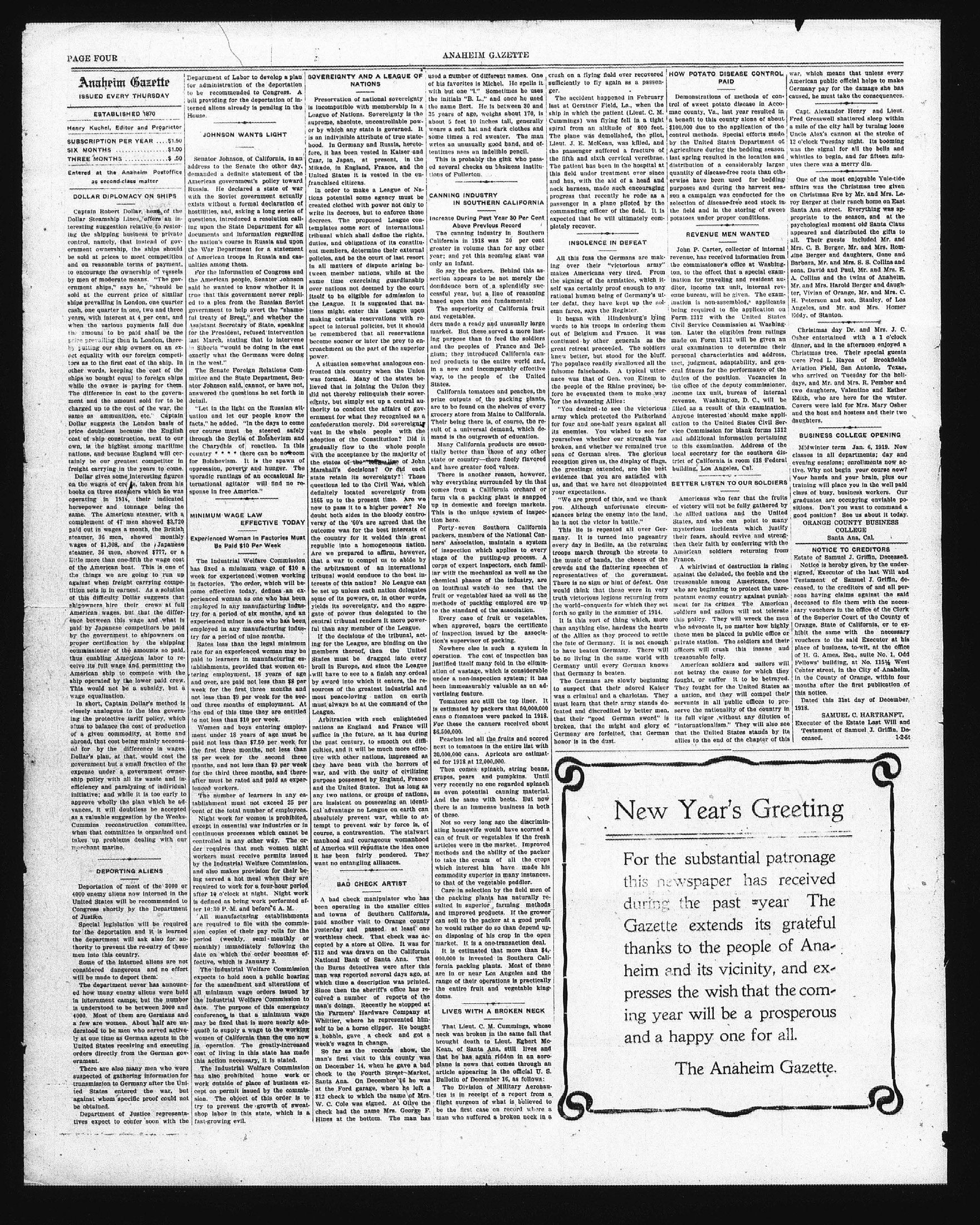
Searchable text
Anaheim Gazette
ISSUED EVERY THURSDAY
ESTABLISHED 1870
Henry Kuchel, Editor and Proprietor
SUBSCRIPTION PER YEAR ... $1.50
SIX MONTHS ... $1.00
THREE MONTHS ... $ .50
Entered at the Anaheim Postoffice as second-class matter
DOLLAR DIPLOMACY ON SHIPS
Captain Robert Dollar, head of the Dollar Steamship Lines, offers an interesting suggestion relative to restoring the shipping business to private control, namely, that instead of government ownership, the ships should be sold at prices to meet competition and on reasonable terms of payment, to encourage the ownership of vessels by men of moderate means. "The government ships," says he, "should be sold at the current price of similar ships prevailing in London, one quarter cash, one quarter in one, two and three years, with interest at 4 per cent, and when the various payments fall due the amount to be paid shall be the price prevailing then in London, thereby putting our ship owners on an exact equality with our foreign competitors as to the first cost of the ship. In other words, keeping the cost of the ships so bought equal to foreign ships while the owner is paying for them. The difference in cost to the government and the amount sold for to be charged up to the cost of the war, the same as ammunition, etc." Captain Dollar suggests the London basis of price doubtless because the English cost of ship construction, next to our own, is the highest among maritime nations, and because England will cer-
Department of Labor to develop a plan for administration of the deportation to be recommended to Congress. A bill providing for the deportation of interned aliens already is pending in the House.
JOHNSON WANTS LIGHT
Senator Johnson, of California, in an address to the Senate the other day, demanded a definite statement of the American government's policy toward Russia. He declared a state of war with the Soviet government actually exists without a formal declaration of hostilities, and asking a long series of questions, introduced a resolution calling upon the State Department for all documents and information regarding the nation's course in Russia and upon the War Department for a statement of American troops in Russia and casualties among them.
For the information of Congress and the American people, Senator Johnson said he wanted to know whether it is true that this government never replied to a plea from the Russian Soviet government to help avert the "shameful treaty of Brest," and whether the Assistant Secretary of State, speaking for the President, refused intervention last March, stating that to intervene in Siberia "would be doing in the east exactly what the Germans were doing in the west."
The Senate Foreign Relations Committee and the State Department, Senator Johnson said, cannot, or have not, answered the questions he set forth in detail.
"Let in the light on the Russian situation and let our people know the facts," he added. "In the days to come our course must be steered safely through the Scylia of Bolshevism and the Charydbis of reaction. In this country **** there can be no room Preservation of n is incompatible with League of Nations supreme, absolute, or by which any state is an indivisible attitude. In Germany we fore, it has been very Czar, in Japan, and Mikado, in England United States it is franchised citizens.
In order to makeations potential some created clothed with write its decrees, be decrees. The pro-templates some some tribunal which shall duties, and obligate members, deter policies, and be there in all matters of between member nat-same time exercise over nations not do itself to be eligible League. It is tions might enter making certain respect to internal po-be remembered that become sooner or ler croachment on the power.
A situation some-fronted this country was formed. Man-lieved that in John did not thereby re-elegnty, but simply thority to conduct enrmment for what th-confederation mere vest in the whole adoption of the Cgradually flow to with the acceptance
tors as to the first cost of the ship. In other words, keeping the cost of the ships so bought equal to foreign ships while the owner is paying for them. The difference in cost to the government and the amount sold for to be charged up to the cost of the war, the same as ammunition, etc.' Captain Dollar suggests the London basis of price doubtless because the English cost of ship construction, next to our own, is the highest among maritime nations, and because England will certainly be our greatest competitor in freight carrying in the years to come.
Dollar gives some interesting figures on the wages of crews, taken from his books on three steamers which he was operating in 1914, their indicated horsepower and tonnage being the same. The American steamer, with a complement of 47 men showed $3,720 paid out in wages a month, the British steamer, 36 men, showed monthly wages of $1,308, and the Japanese steamer, 36 men, showed $777, or a little more than one-fifth the wage cost of the American boat. This is one of the things we are going to run up against when freight carrying competition sets in in earnest. As a solution of this difficulty Dollar suggests that shipowners hire their crews at full American wages, but that the difference between this wage and what is paid by Japanese competitors be paid by the government to shipowners on proper certification by the shipping commissioner of the amounts so paid, thus enabling American labor to receive its full wage and permitting the American ship to compete with the ship operated by the lower paid crew. This would not be a subsidy, but a wage equalization.
In short, Captain Dollar's method is closely analogous to the idea governing the protective tariff policy, which aims to balance the cost of production of a given commodity, at home and abroad, that cost being mainly accounted for by the difference in wages. Dollar's plan, at that, would cost the government but a small fraction of the expense under a government ownership policy with all its waste and inefficiency and paralyzing of individual initiative; and while it is too early to approve wholly the plan which he advances, it will doubtless be accepted as a valuable suggestion by the Weeks-Cummins reconstruction committee, when that committee is organized and takes up problems dealing with our merchant marine.
MINIMUM WAGE LAW
EFFECTIVE TODAY
Experienced Woman in Factories Must Be Paid $10 Per Week
The Industrial Welfare Commission has fixed a minimum wage of $10 a week for experienced women working in factories. The order, which will become effective today, defines an experienced woman as one who has been employed in any manufacturing industry for a period of six months, and an experienced minor is one who has been employed in any manufacturing industry for a period of nine months.
Rates less than the legal minimum rate for an experienced woman may be paid to learners in manufacturing establishments, provided that women entering employment, 18 years of age and over, are paid not less than $8 per week for the first three months and not less than $9 per week for the second three months of employment. At the end of this time they are entitled to not less than $10 per week.
Women and boys entering employment under 18 years of age must be paid not less than $7.50 per week for the first three months, not less than $8 per week for the second three months, and not less than $9 per week for the third three months, and thereafter must be rated and paid as experienced workers.
The number of learners in any establishment must not exceed 25 percent of the total number of employees.
Night work for women is prohibited, except in essential war industries or in continuous processes which cannot be controlled in any other way. The order requires that such women night workers must receive permits issued by the Industrial Welfare Commission,
A situation some fronted this country was formed. Man lieved that in join did not thereby reeignty, but simply thority to conduct enrmment for what t confederation mere vest in the whole adoption of the C gradually flow to with the acceptance the states of the Marshall's decision state retain its s questions led to th definitely located 1865 up to the pre now to pass it to a doubt both sides in verses of the '60's outcome was for th country for it republic into a h Are we prepared that a war to cone arbitrament o tribunal would conferests of this natio be set up unless es some of its powers yields its sovereign gate of power th central tribunal reful than any memb If the decisions ling for the League members thereof, States must be broil in Europe, and will have to see to by sword into which sources of the gre most peace-loving must always be at League.
Arbitration with nations as England suffice in the futu past century, culties, and it will vive with other n they have been war, and with th purpose possessed and the United St any two nations, are insistent on p cal advantage no absolutely prevent tempt to prevent course, a contrave manhood and court of America will re it has been fair want no entangling
expense under a government ownership policy with all its waste and inefficiency and paralyzing of individual
initiative; and while it is too early to
approve wholly the plan which he advances, it will doubtless be accepted as a valuable suggestion by the Weeks-Cummins reconstruction committee,
when that committee is organized and takes up problems dealing with our merchant marine.
DEPORTING ALIENS
Deportation of most of the 3000 or 4000 enemy aliens now interned in the United States will be recommended to Congress shortly by the Department of Justice.
Special legislation will be required for the deportation and it is learned the department will ask also for authority to prevent the re-entry of these men into this country.
Some of the interned aliens are not considered dangerous and no effort will be made to deport them:
The department never has announced how many enemy aliens were held in internment camps; but the number is understood to be between 3000 and 4000. Most of them are Germans and a few are women. About half are understood to be men who served actively at one time as German agents in the United States receiving and executing orders directly from the German government.
There are also many men who were suspected of gathering information for transmission to Germany after the United States entered the war, but against whom specific proof could not be obtained.
Department of Justice representatives expect to confer soon with the
for the third three months, and thereafter must be rated and paid as experienced workers.
The number of learners in any establishment must not exceed 25 per cent of the total number of employees.
Night work for women is prohibited, except in essential war industries or in continuous processes which cannot be controlled in any other way. The order requires that such women night workers must receive permits issued by the Industrial Welfare Commission, and also makes provision for their being served a hot meal when they are required to work for a four-hour period after 10 o'clock at night. Night work is defined as being performed after 10:30 P.M. and before 6 A.M.
All manufacturing establishments are required to file with the commission copies of their pay rolls for the period (weekly, semi-monthly or monthly) immediately following the date on which the order becomes effective, which is January 2.
The Industrial Welfare Commission expects to hold soon a public hearing for the amendment and alterations of all minimum wage orders issued by the Industrial Welfare Commission to date. The purpose of this emergency conference is that a minimum wage may be fixed that is more nearly adequate to supply a wage to the working women of California than the one now in operation. The greatly-increased cost of living in this state has made this action necessary, it is stated.
The Industrial Welfare Commission has also prohibited home work or work outside of place of business except on permit issued by the commission. The object of this order is to try to prevent the growth of sweatshop labor in this state, which is a fast-growing evil.
BAD CHECK
A bad check was been operating in and towns of any two nations, are insistent on paying advantage no absolutely prevent tempt to prevent course, a contravene manhood and course of America will result it has been fair want no entangling...
ANAHEIM GAZETTE
SOVEREIGNTY AND A LEAGUE OF NATIONS
Preservation of national sovereignty is incompatible with membership in a League of Nations. Sovereignty is the supreme, absolute, uncontrollable power by which any state is governed. It is an indivisible attribute of true statehood. In Germany and Russia, heretofore, it has been vested in Kaiser and Czar, in Japan, at present, in the Mikado, in England, France, and the United States it is vested in the enfranchised citizens.
In order to make a League of Nations potential some agency must be created clothed with power not only to write its decrees, but to enforce those decrees. The proposed League contemplates some sort of international tribunal which shall define the rights, duties, and obligations of its constituent members, determine their external policies, and be the court of last resort in all matters of dispute arising between member nations, while at the same time exercising guardianship over nations not deemed by the court itself to be eligible for admission to the League. It is suggested that nations might enter this League upon making certain reservations with respect to internal policies, but it should be remembered that all reservations become sooner or later the prey to encroachment on the part of the superior power.
A situation somewhat analogous confronted this country when the Union was formed. Many of the states believed that in joining the Union they did not thereby relinquish their sovereignty, but simply set up a central authority to conduct the affairs of government for what they recognized as a confederation merely. Did sovereignty vest in the whole people with the adoption of the Constitution? Did it gradually flow to the whole people with the acceptance by the majority of
used a number of different names. One of his favorites is Michel. He spells it with but one "L." Sometimes he uses the initials "B. L," and once he used the name Bert. He is between 30 and 35 years of age, weighs about 170, is about 5 feet 10 inches tall, generally wears a soft hat and dark clothes and sometimes a red sweater. The man writes an unusually good hand, and oftentimes uses an indelible pencil.
This is probably the ginkgo who passed several checks on bhsiness institutions of Fullerton.
CANNING INDUSTRY IN SOUTHERN CALIFORNIA
Increase During Past Year 30 Per Cent Above Previous Record
The canning industry in Southern California in 1918 was 30 per cent greater in volume than for any other year; and yet this seeming giant was only an infant.
So say the packers. Behind this assertion appears to be not merely the dominidence born of a splendidly successful year, but a line of reasoning based upon this one fundamental:
The superiority of California fruit and vegetables.
ders made a ready and unusually large market. But these served a more lasting purpose than to feed the soldiers and the peoples of France and Belgium; they introduced California canned products to the entire world and, in a new and incomparably effective way, to the people of the United States.
California tomatoes and peaches, the prize outputs of the packing plants, are to be found on the shelves of every grocery store from Maine to California. Their being there is, of course, the result of a universal demand, which demand is the outgrowth of education.
Many California products are essentially better than those of any other
crash on a flying field ever recovered sufficiently to fly again as a passenger.
The accident happened in February last at Geratner Field, La., when the ship in which the patient (Lieut. C. M. Cummings) was flying fell in a tight spiral from an altitude of 800 feet. The plane was demolished, the pilot, Lieut. J. E. McKean, was killed, and the passenger suffered a fracture of the fifth and sixth cervical vertebrae. The patient has been in the hospital at this field under treatment ever since and has, with the aid of a head and neck harness, made such encouraging progress that recently he rode as a passenger in a plane piloted by the commanding officer of the field. It is expected that he will ultimately completely recover.
INSOLENCE IN DEFEAT
All this fuss the Germans are making over their "victorious army" makes Americans very tired. From the signing of the armistice, which itself was certainly proof enough to any rational human being of Germany's utter defat, they have kept up the solemn farce, says the Register.
It began with Hindenburg's lying words to his troops in ordering them out of Belgium and France. It was continued by other generals as the great retreat proceeded. The soldiers knew better, but stood for the bluff. The populace readily swallowed all the fulsome falsehoods. A typical utterance was that of Gen. von Einem to the people of the Rhine province, before he evacuated them to make way for the advancing Allies:
"You desired to see the victorious army which protected the Fatherland for four and one-half years against all its enemies. You wished to see for yourselves whether our strength was broken, and whether we remained true sons of German sires. The glorious
HOW POWERful
Demons trolled on mac counts $100,000 control by the Agriculturist last spell distributes quantity erwise purposes son a case selection the field potatoes.
REASONS
John received the commission to tenor, to enlistment ditor, if enue bui nation being re-formed Civil Service ton. La made oral ex- personal tact, ju- erial filtr duties in offi- income revenue filled al Anyone cation service Co- ad and added to this local s
A situation somewhat analogous confronted this country when the Union was formed. Many of the states believed that in joining the Union they did not thereby relinquish their sovereignty, but simply set up a central authority to conduct the affairs of government for what they recognized as a confederation merely. Did sovereignty vest in the whole people with the adoption of the Constitution? Did it gradually flow to the whole people with the acceptance by the majority of the states of the treaty line of John Marshall's decisions? Or did each state retain its sovereignty? Those questions led to the Civil War, which definitely located sovereignty from 1865 up to the present time. Are we now to pass it to a higher power? No doubt both sides in the bloody controversy of the '60s are agreed that the outcome was for the best interests of the country for it welded this great republic into a homogeneous nation. Are we prepared to affirm, however, that a war to compel us to abide by the arbitrament of an international tribunal would conduce to the best interests of this nation? No League can be set up unless each nation delegates some of its powers, or, in other words, yields its sovereignty, and the aggregate of power thus delegated to the central tribunal renders it more powerful than any member of the League.
If the decisions of the tribunal, acting for the League, are binding on the members thereof, then the United States must be dragged into every broil in Europe, and since the League will have to see to a finish any ordeal by sword into which it enters, the resources of the greatest industrial and most peace-loving nation on earth must always be at the command of the League.
Arbitration with such enlightened nations as England and France will suffice in the future, as it has during the past century, to smooth out difficulties, and it will be much more effective with other nations, impressed as they have been with the horrors of war, and with the unity of civilizing purpose possessed by England, France and the United States. But as long as any two nations, or groups of nations, are insistent on possessing an identical advantage no League on earth can absolutely prevent war, while to attempt to prevent war by force is, of course, a contravention. The stalwart manhood and courageous womanhood of America will repudiate the idea once it has fairly pondered. They want no entangling alliances.
California tomatoes and peaches, the prize outputs of the packing plants, are to be found on the shelves of every grocery store from Maine to California. Their being there is, of course, the result of a universal demand, which demand is the outgrowth of education.
Many California products are essentially better than those of any other state or country—more finely flavored and have greater food values.
There is another reason, however, why everything surrounded by tin that comes from a California orchard or farm via a packing plant is snapped up in domestic and foreign markets. This is the unique system of inspection here.
Forty-seven Southern California packers, members of the National Canners' Association, maintain a system of inspection which applies to every stage of the putting-up process. A corps of expert inspectors, each familiar with the mechanical as well as the chemical phases of the industry, are on lontinal watch to see that the fruit or vegetables used as well as the methods of packing employed are up to the standard of the association.
Every case of fruit or vegetables, when approved, bears the certificate of inspection issued by the association's supervisor of packing.
Nowhere else is such a system in operation. The cost of inspection has justified itself many fold in the elimination of wastage, which is considerable under a non-inspection system; it has been immeasurably valuable as an advertising feature.
Tomatoes are still the top liner. It is estimated by packers that 50,000,000 cans o f tomatoes were packed in 1918. For these the canners received about $6,500,000.
Peaches led all the fruits and scored next to tomatoes in the entire list with 20,000,000 cans. Apricots are estimated for 1918 at 12,000,000.
Then comes spinach, string beans, grapes, pears and pumpkins. Until very recently no one regarded spinach as even potential canning material. And the same with beets. But now there is an immense business in both of these.
Not so very long ago the discriminating housewife would have scorned a can of fruit or vegetables if the fresh articles were in the market. Improved methods and the ability of the packer to take the cream of all the crops
The populace readily swallowed all the fulsome falsehoods. A typical utterance was that of Gen. von Einem to the people of the Rhine province, before he evacuated them to make way for the advancing Allies:
"You desired to see the victorious army which protected the Fatherland for four and one-half years against all its enemies. You wished to see for yourselves whether our strength was broken, and whether we remained true sons of German sires. The glorious reception given us, the display of flags, the greetings extended, are the best evidence that you are satisfied with us, and that we have not disappointed your expectations.
"We are proud of this, and we thank you. Although unfortunate circumstances bring the enemy into the land, he is not the victor in battle."
This lie is repeated all over Germany. It is turned into pageantry every day in Bedlinn, as the returning troops march through the streets to music of bands, the cheers of the crowds and the flattering speeches of representatives of the government. There is no sign or hint of defeat. One would think that those were in very truth victorious legions returning from the world-conquests for which they set forth so gallly in the summer of 1914.
It is this sort of thing which, more than anything else, hardens the hearts of the Allies as they proceed to settle the fate of Germany. It is not enough to have beaten Germany. There will be no living in the same world with Germany until every German knows that Germany is beaten.
The Germans are slowly beginning to suspect that their adored Kaiser was a criminal and a charletan. They must learn that their army stands defeated and discredited by better men, that their "good German sword" is broken, that the might and glory of Germany are forfeited, that German honor is in the dust."
BAD CHECK ARTIST
A bad check manipulator who has been operating in the smaller cities and towns of Southern California, paid another visit to Orange county yesterday and passed at least one worthless check. That check was accepted by a store at Olive. It was for $12 and was drawn on the California National Bank of Santa Ana. That the Burns detectives were after this man was reported several days ago, at which time a description was printed. Since then the sheriff's office has received a number of reports of the man's doings. Recently he stopped at the Farmers' Hardware Company at Whittier, where he represented himself to be a horse clipper. He bought a hobble, gave a check and got a week's wages in change.
So far as the records show, the man's first visit to this county was on December 14, when he gave a bad check to the Fourth Street Market, Santa Ana. On December 16 he was at the Ford garage, where he left a $12 check to which the name of Mrs. W. C. Cole was signed. At Olive the check had the name Mrs. George F. Hines at the bottom. The man has
Then comes spinach, string beans, grapes, pears and pumpkins. Until very recently no one regarded spinach as even potential canning material. And the same with beets. But now there is an immense business in both of these.
Not so very long ago the discriminating housewife would have scorned a can of fruit or vegetables if the fresh articles were in the market. Improved methods and the ability of the packer to take the cream of all the crops which interest him have made his commodity superior in many instances, to that of the vegetable peddler.
Care in selection by the field men of the packing plants has naturally resulted in superior farming methods and improved products. If the grower can sell to the packer at a good profit he would rather do so than depend upon disposing of his crop in the open market. It is a one-transaction deal.
It is estimated that more than $4,000,000 is invested in Southern California packing plants. Most of these are in or near Los Angeles and the range of their operations is practically the entire fruit and vegetable kingdoms.
LIVES WITH A BROKEN NECK
That Lieut. C. M. Cummings, whose neck was broken in the same fall that brought death to Lieut. Egbert McKean, of Santa Ana, still lives and that he has again ridden in an aeroplane is news that comes through an article appearing in the official U. S. Bulletin of December 16, as follows:
The Division of Military Aerohautics is in receipt of a report from a flight surgeon of what is believed to be the first case on record where a man who suffered a broken neck in a
HOW POTATO DISEASE CONTROL PAID
Demonstrations of methods of control of sweet potato disease in Accoumac county, Va., last year resulted in a benefit to this county alone of about $100,000 due to the application of the control methods. Special efforts made by the United States Department of Agriculture during the bedding season last spring resulted in the location and distribution of a considerably larger quantity of disease-free roots than otherwise have been used for bedding purposes and during the harvest season a campaign was conducted for the selection of disease-free seed stock in the field and in the storing of sweet potatoes under proper conditions.
REVENUE MEN WANTED
John P. Carter, collector of internal revenue, has received information from the commissioner's office at Washington, to the effect that a special examination for traveling and resident auditor, income tax unit, internal revenue bureau, will be given. The examination is non-assembled, applicants being required to file application on Form 1312 with the United States Civil Service Commission at Washington. Later the eligibles from ratings made on Form 1312 will be given an oral examination to determine their personal characteristics and address, tact, judgment, adaptability, and general fitness for the performance of the duties of the position. Vacancies in the office of the deputy commissioner, income tax unit, bureau of internal revenue, Washington, D.C., will be filled as a result of this examination. Anyone interested should make application to the United States Civil Service Commission for blank forms 1312 and additional information pertaining to this examination. Address of the local secretary for the southern district, which means that unless every American public official helps to make Germany pay for the damage she has caused, he must take the consequences.
Capt. Alexander Henry and Lieut. Fred Gresswell shattered sleep within a mile of the city hall by turning loose Uncle Alex's cannon at the stroke of 12 o'clock Tuesday night. Its booming was the signal for all the bells and whistles to begin, and for fifteen minutes there was a merry din.
One of the most enjoyable Yule-tide affairs was the Christmas tree given on Christmas Eve by Mr. and Mrs. Leroy Berger at their ranch home on East Santa Ana street. Everything was appropriate to the season, and at the psychological moment old Santa Claus appeared and distributed the gifts to all. Their guests included Mr. and Mrs. C. B. Berger, Mr. and Mrs. Romaine Berger and daughters, Gene and Barbara, Mr. and Mrs. S. S. Collins and sons, David and Paul, Mr. and Mrs. E. A. Collins and the twins of Anaheim, Mr. and Mrs. Harold Berger and daughter, Vivian of Orange, Mr. and Mrs. C. H. Peterson and son, Stanley, of Los Angeles, and Mr. and Mrs. Homer Eddy, of Stanton.
Christmas day Dr. and Mrs. J. C. Osher entertained with a 1 o'clock dinner, and in the afternoon enjoyed a Christmas tree. Their special guests were Fred L. Hayes of Brookfields Aviation Field, San Antonio, Texas, who arrived on Tuesday for the holidays, and Mr. and Mrs. R. Pember and two daughters, Valentine and Esther Edith, who are here for the winter. Covers were laid for Mrs. Mary Osher and the host and hostess and their two daughters.
BUSINESS COLLEGE OPENING
Midwinter term Jan. 6, 1919. New classes in all departments; day and
This, and we thank fortunate circumstance into the land, on battle."
Used all over Germany as the returning march to the streets to cheer the cheers of the government. Point of defeat. One case were in very serious returning from for which they set summer of 1914. Nothing which, more hardens the hearts proceed to settle it. It is not enough many. There will same world with German knowsaten.
Slowly beginning their adored Kaiser a charletan. They our army stands deed by better men, German sword" is right and glory of used, that German tact, judgment, adaptability, and general fitness for the performance of the duties of the position. Vacancies in the office of the deputy commissioner, income tax unit, bureau of internal revenue, Washington, D.C., will be filled as a result of this examination. Anyone interested should make application to the United States Civil Service Commission for blank forms 1312 and additional information pertaining to this examination. Address of the local secretary for the southern district of California is room 618 Federal building, Los Angeles, Cal.
BETTER LISTEN TO OUR SOLDIERS
Americans who fear that the fruits of victory will not be fully gathered by the allied nations and the United States, and who can point to many mysterious incidents which justify their fears, should revive and strengthen their faith by conferring with the American soldiers returning from France.
A whirlwind of destruction is rising against the deluded, the feeble and the treasonable among Americans, those who are beginning to protect the unrepentant enemy country against punishment for its crimes The American soldiers and sailors will not tolerate this policy. They will wreck the men who advocate it, no matter how highly these men be placed in public office or private station. The soldiers and their officers will crush this insane and treasonable folly.
American soldiers and sailors will not betray the cause for which they fought, or suffer it to be betrayed. They fought for the United States as a nation, and they will compel their servants in all public offices to preserve the nationality of the country in its full vigor without any dilution of "internationalism." They will also see that the United States stands by its allies to the end of the chapter of this
BUSINESS COLLEGE OPENING
Midwinter term Jan. 6, 1919. New classes in all departments; day and evening sessions; enrollments now active. Why not begin your course now? Your hands and your brain, plus our training will place you in the well paid class of busy, business workers. Our graduates are occupying enviable positions. Don't you want to command a good position? See us about it today.
ORANGE COUNTY BUSINESS COLLEGE
Santa Ana, Cal.
NOTICE TO CREDITORS
Estate of Samuel J. Griffin, Deceased.
Notice is hereby given, by the undersigned, Executor of the last Will and Testament of Samuel J. Griffin, deceased, to the creditors of and all persons having claims against the said deceased to file them with the necessary vouchers in the office of the Clerk of the Superior Court of the County of Orange, State of California, or to exhibit the same with the necessary vouchers to the said Executor at his place of business, to-wit, at the office of H. G. Ames, Esq., suite No. 1, Odd Fellows' building, at No. 115½ West Center street, in the City of Anaheim, in the County of Orange, within four months after the first publication of this notice.
Dated this 31st day of December, 1918.
SAMUEL C. HARTRANFT,
Executor of the Estate Last Will and Testament of Samuel J. Griffin, Deceased.
New Year's Greeting
For the substantial patronage
New Year's Greeting
For the substantial patronage this newspaper has received during the past year The Gazette extends its grateful thanks to the people of Anaheim and its vicinity, and expresses the wish that the coming year will be a prosperous and a happy one for all.
The Anaheim Gazette.