anaheim-gazette 1919-01-02
Scanned page
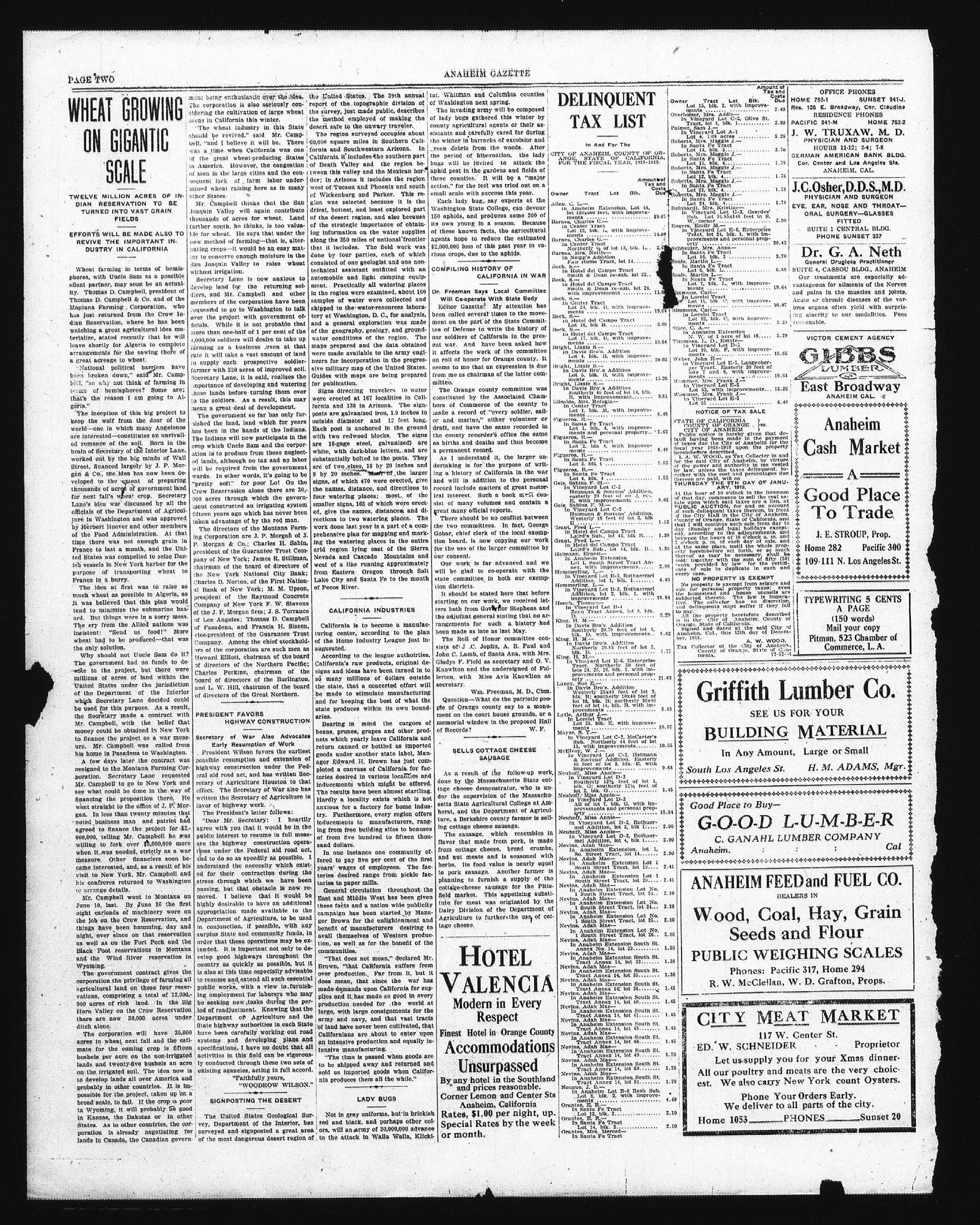
Searchable text
WHEAT GROWING ON GIGANTIC SCALE
TWELVE MILLION ACRES OF INDIAN RESERVATION TO BE TURNED INTO VAST GRAIN FIELDS
EFFORTS WILL BE MADE ALSO TO REVIVE THE IMPORTANT INDUSTRY IN CALIFORNIA
Wheat farming in terms of hemispheres, with Uncle Sam as a possible silent partner, may soon be an actuality. Thomas D. Campbell, president of Thomas D. Campbell & Co. and of the Montana Farming Corporation, who has just returned from the Crow Indian Reservation, where he has been watching a great agricultural idea materialize, stated recently that he will leave shortly for Algeria to complete arrangements for the sowing there of a great acreage to wheat.
"National political barriers have been broken down," said Mr. Campbell, "so why not think of farming in terms of hemispheres? Some are; that's the reason I am going to Algeria."
The inception of this big project to keep the wolf from the door of the world—one in which many Angelenos are interested—constitutes an unrivalled romance of the soil. Born in the brain of Secretary of the Interior Lane, ment being enthusiastic over the idea. The corporation is also seriously considering the cultivation of large wheat areas in California this winter.
"The wheat industry in this State should be revived," said Mr. Campbell, "and I believe it will be. There was a time when California was one of the great wheat-producing States in America. However, the congestion of men in the large cities and the consequent lack of farm labor undermined wheat raising here as in many other States.
Mr. Campbell thinks that the San Joaquin Valley will again contribute thousands of acres for wheat. Land farther south, he thinks, is too valuable for wheat. He says that under the new method of farming—that is, alternating crops—it would be an easy matter to conserve enough moisture in the San Joaquin Valley to raise wheat without irrigation.
Secretary Lane is now anxious to develop land for the returning soldiers, and Mr. Campbell and other members of the corporation have been requested to go to Washington to talk over the project with government officials. While it is not probable that more than one-half of 1 per cent of the 4,000,000 soldiers will desire to take up farming as a business, even at that rate it will take a vast amount of land to supply each prospective soldier-farmer with 320 acres of improved soil. Secretary Lane, it is said, realizes the importance of developing and watering these lands before turning them over to the soldiers. As a result, this may mean a great deal of development.
The government so far has only furnished the land, land which for years has been in the hands of the Indians. The Indians will now participate in the crop which Uncle Sam and the corporation is to produce from these neglect-
"National political barrriers have been broken down," said Mr. Campbell, "so why not think of farming in terms of hemispheres? Some are; that's the reason I am going to Algeria."
The inception of this big project to keep the wolf from the door of the world—one in which many Angelenos are interested—constitutes an unrivalled romance of the soil. Born in the brain of Secretary of the Interior Lane, worked out by the big minds of Wall Street, financed largely by J. P. Morgan & Co., the idea has now been developed to the extent of preparing thousands of acres of government land for next fall's wheat crop. Secretary Lane's idea was discussed by all the officials of the Department of Agriculture in Washington and was approved by Herbert Hoover and other members of the Food Administration. At that time there was not enough grain in France to last a month, and the United States was compelled to seize Danish vessels in New York harbor for the purpose of transporting wheat to France in a hurry.
The idea at first was to raise as much wheat as possible in Algeria, as it was believed that this plan would tend to minimize the submarine hazard. But things were in a sorry mess. The cry from the Allied nations was insistent: "Send us food!" More wheat had to be produced—that was the only solution.
Why should not Uncle Sam do it? The government had no funds to devote to the project, but there were millions of acres of land within the United States under the jurisdiction of the Department of the Interior which Secretary Lane decided could be used for this purpose. As a result, the Secretary made a contract with Mr. Campbell, with the belief that money could be obtained in New York to finance the project as a war measure. Mr. Campbell was called from his home in Pasadena to Washington.
A few days later the contract was assigned to the Montana Farming Corporation. Secretary Lane requested Mr. Campbell to go to New York and see what could be done in the way of financing the proposition there. He went straight to the office of J. P. Morgan. In less than twenty minutes that noted business man and patriot had agreed to finance the project for $2,000,000, telling Mr. Campbell he was willing to fork over $3,000,000 more when it was needed, strictly as a war measure. Other financiers soon be interested and on a result of his supply each prospective soldier-farmer with 320 acres of improved soil. Secretary Lane, it is said, realizes the importance of developing and watering these lands before turning them over to the soldiers. As a result, this may mean a great deal of development.
The government so far has only furnished the land, land which for years has been in the hands of the Indians. The Indians will now participate in the crop which Uncle Sam and the corporation is to produce from these neglected lands, although no tax and no labor will be required from the government wards. In other words, it's going to be "pretty soft" for poor Lo! On the Crow Reservation alone there are 30,000 acres through which the government constructed an irrigating system fifteen years ago which has never been taken advantage of by the red man.
The directors of the Montana Farming Corporation are J. P. Morgah of J. P. Morgan & Co.; Charles H. Sabin, president of the Guarantee Trust Company of New York; James R. Stillman, chairman of the board of directors of the New York National City Bank; Charles D. Norton, of the First National Bank of New York; M. M. Upson, president of the Raymond Concrete Company of New York F. W. Stevens of the J. P. Morgan firm; J. S. Torrance of Los Angeles; Thomas D. Campbell of Pasadena, and Francis H. Sisson, vice-president of the Guarantee Trust Company. Among the chief stockholders of the corporation are such men as Howard Elliott, chairman of the board of directors of the Northern Pacific; Charles Perkins, chairman of the board of directors of the Burlington, and L. W. Hill, chairman of the board of directors of the Great Northern.
PRESIDENT FAVORS
HGHWAY CONSTRUCTION
Secretary of War Also Advocates
Early Resumption of Work
President Wilson favors the earliest possible resumption and extension of highway construction under the Federal aid road act, and has written Secretary of Agriculture Houston to that effect. The Secretary of War also has written the Secretary of Agriculture in favor of highway work.
The President's letter follows:
"Dear Mr. Secretary: I heartily agree with you that it would be in the public interest to resume in full measure the highway construction operations under the Federal aid road act, and to do so as speedily as possible. I understand the necessity which exist-
neers for incorporative military map Guides with maps for publication.
Signs directing were erected at 11 fornia and 138 in posts are galvanized outside diameter Each post is anchored with two redwood are 18-gage steel white, with dark-substantially bolts are of two sizes, 9 by 20 inches signs, of which 47 names, distance four watering plant smaller signs, 165 ed, give the name rections to two work done last year prehensive plan fo ing the watering arid region lying Nevada and Cascade west of a line run from Eastern O Lake City and Sacrifices River.
CALIFORNIA
California is to turing center, ac ad of the Home Induugated.
According to California's raw signs and ideas he so many million state that a be made to stim and for keeping state produces w arles.
Bearing in my beans, prunes, greeets which yearly return canned or goods under ano-ager Edward H.. pleted a canvassories desired in inducements whi The results have Hardly a locality anxious for a fa- try. Furthermore inducements to ing from free buo f from five hund sand dollars.
In one instance fered to pay five
Secretary Lane requested Mr. Campbell to go to New York and see what could be done in the way of financing the proposition there. He went straight to the office of J. P. Morgan. In less than twenty minutes that noted business man and patriot had agreed to finance the project for $2,000,000, telling Mr. Campbell he was willing to fork over $3,000,000 more when it was needed, strictly as a war measure. Other financiers soon became interested, and, as a result of his visit to New York, Mr. Campbell and his confreres returned to Washington to arrange details.
Mr. Campbell went to Montana on June 10, last. By June 16 the first eight carloads of machinery were on the job on the Crow Reservation, and things have been humming, day and night, ever since on that reservation as well as on the Fort Peck and the Black Foot reservations in Montana and the Wind River reservation in Wyoming.
The government contract gives the corporation the privilege of farming all agricultural land on these four reservations, comprising a total of 12,000-000 acres of rich land. In the Big Horn Valley on the Crow Reservation there are now 30,000 acres under ditch alone.
The corporation will have 35,000 acres in wheat next fall and the estimate for the coming crop is fifteen bushels per acre on the non-irrigated lands and twenty-five bushels an acre on the irrigated soil. The idea now is to develop lands all over America and probably in other countries. It is impossible for the project, taken up on a broad scale, to fail. If the crop is poor in Wyoming, it will probably be good in Kansas, the Dakotas or in other States. As to other countries, the corporation is already negotiating for lands in Canada, the Canadian govern-
Dear Mr. Secretary: I heartily agree with you that it would be in the public interest to resume in full measure the highway construction operations under the Federal aid road act, and to do so as speedily as possible. I understand the necessity which existed for their contraction during the stress through which we have been passing, but that obstacle is now removed. I believe that it would be highly desirable to have an additional appropriation made available to the Department of Agriculture, to be used in conjunction, if possible, with any surplus State and community funds, in order that these operations may be extended. It is important not only to develop good highways throughout the country as quickly as possible, but it is also at this time especially advisable to resume and extend all such essential public works, with a view to furnishing employment for laborers who may be seeking new tasks during the period of readjustment. Knowing that the Department of Agriculture and the State highway authorities in each State have been carefully working out road systems and developing plans and specifications, I have no doubt that all activities in this field can be vigorously conducted through these two sets of existing agencies, acting in full accord.
"Faithfully yours,
WOODROW WILSON."
SIGNPOSTING THE DESERT
The United States Geological Survey, Department of the Interior, has surveyed and signposted a great area of the most dangerous desert region of
ANAHEIM GAZETTE
DELINQUENT TAX LIST
In And For The
CITY OF ANAHEIM, COUNTY OF ORANGE, STATE OF CALIFORNIA, FOR THE FISCAL YEAR, 1918-1919.
Amount of Tax and Costs Due
Owner Tract Lot Blk. Due
Allen, C. L.—in Anaheim Extension, Lot 48, lot 120x300 feet, with improvements $9.67
Barnes, Charles G.—in Center Tract Lot 12, blk. L, with improvements 14.09
Barnes, Charles G.—in Center Tract Northery, lot 13, blk. L. 2.41
Barnes, Mrs. Nettle—in Neipp's Addition Fair Home Tract, lot 14. 3
Beck, S.—in Hotel del Campo Tract Smith & Dean re-sub, lot 23.
Beck, S.—in Hotel del Campo Tract Lot 16, blk. B. 2.09
Beck, S.—in Hotel del Campo Tract Lot 17, blk. B, with improvements 19.64
Bright, Lizzie S.—in Davis Bro.'s Addition Lot 4, blk. B, with improvements 20.03
Bright, Lizzie S.—in Davis Bro.'s Addition Lot 5, blk. B, with improvements 15.26
Bright, Lizzie S.—in Davis Bro.'s Addition Southerly 40 feet of lot 14, blk. B, with improvements 9.81
Elisida, Mrs. Retuglia—in Center Tract Lot 1, blk. M, with improvements 8.48
Figueroa, R.—in Santa Fe Tract Lot 1, blk. B, with improvements 2.67
Figueroa, R.—in Santa Fe Tract Lot 2, blk. B, with improvements 6.48
COMPILING HISTORY OF CALIFORNIA IN WAR
Dr. Freeman Says Local Committee Will Co-operate With State Body
Editor Gazette: My attention has been called several times to the movement on the part of the State Committee of Defense to write the history of our soldiers of California in the present war. And have been asked how it affects the work of the committee on roll of honor for Orange county. It seems to me that an expression is due from me as chairman of the latter committee.
The Orange county committee was constituted by the Associated Chambers of Commerce of the county to make a record of "every soldier, sailor and marine," either volunteer or draft, and have the same recorded in the county recorder's office the same as births and deaths and thus become a permanent record.
As I understand it, the larger unthe United States. The 39th annual report of the topographic division of the survey, just made public, describes the method employed of making the desert safe to the unwary traveler.
The region surveyed occupies about 60,000 square miles in Southern California and Southwestern Arizona. In California it includes the southern part of Death Valley and the region between this valley and the Mexican border; in Arizona it includes the region west of Tucson and Phoenix and south of Wickenburg and Parker. This region was selected because it is the driest, hottest, and least explored part of the desert region, and also because of the strategic importance of obtaining information on the water supplies along the 350 miles of national frontier that it includes. The field work was done by four parties, each of which consisted of one geologist and one nontechnical assistant outfitted with an automobile and light camping equipment. Practically all watering places in the region were examined, about 160 samples of water were collected and shipped to the water-resources laboratory at Washington, D.C., for analysis, and a general exploration was made of the geography, geology, and ground-water conditions of the region. The maps prepared and the data obtained were made available to the army engineers for incorporation in the progressive military map of the United States. Guides with maps are being prepared for publication.
Signs directing travelers to water were erected at 167 localities in California and 138 in Arizona. The signposts are galvanized iron, 1.9 inches in outside diameter and 12 feet long. Each post is anchored in the ground with two redwood blocks. The signs are 18-gage steel, galvanized; are white, with dark-blue letters, and are attached to the posts.
DELINQUENT TAX LIST
In And For The
CITY OF ANAHEIM, COUNTY OF ORANGE, STATE OF CALIFORNIA,
FOR THE FISCAL YEAR, 1918-1919.
Amount of Tax and Costs Due
Owner Tract Lot Blk.Due
Allen, C. L.—in Anaheim Extension, Lot 48,
lot 120x300 feet, with improvements $9.67
Barnes, Charles G.—in Center Tract Lot 12, blk. L, with improvements 14.09
Barnes, Charles G.—in Center Tract Northery, lot 13, blk. L. 2.41
Barnes, Mrs. Nettle—in Neipp's Addition Fair Home Tract, lot 14. 3
Beck, S.—in Hotel del Campo Tract Smith & Dean re-sub, lot 23.
Beck, S.—in Hotel del Campo Tract Lot 16, blk. B. 2.09
Beck, S.—in Hotel del Campo Tract Lot 17, blk. B, with improvements 19.64
Bright, Lizzie S.—in Davis Bro.'s Addition Lot 4, blk. B, with improvements 20.03
Bright, Lizzie S.—in Davis Bro.'s Addition Lot 5, blk. B, with improvements 15.26
Bright, Lizzie S.—in Davis Bro.'s Addition Southerly 40 feet of lot 14, blk. B, with improvements 9.81
Elisida, Mrs. Retuglia—in Center Tract Lot 1, blk. M, with improvements 8.48
Figueroa, R.—in Santa Fe Tract Lot 1, blk. B, with improvements 2.67
Figueroa, R.—in Santa Fe Tract Lot 2, blk. B, with improvements 6.48
CALIFORNIA INDUSTRIES
California is to become a manufacturing center, according to the plan of the Home Industry League just inaugurated.
According to the league authorities, California's raw products, original designs and ideas have been turned in to so many millions of dollars outside the state, that a concerted effort will be made to stimulate manufacturing and for keeping the best of what the state produces within its own boundaries.
Bearing in mind the cargoes of beans, prunes, grapes and other products which yearly leave California and return canned or bottled as imported goods under another state label, Manager Edward H. Brown has just completed a canvass of California for factories desired in various localities and inducements which might be offered. The results have been almost startling. Hardly a locality exists which is not anxious for a factory for home industry. Furthermore, every region offers inducements to manufacturers, ranging from free building sites to bonuses of from five hundred to fifteen thousand dollars.
In one instance one community offered to pay five per cent of the first meers for incorporation in the progressive military map of the United States. Guides with maps are being prepared for publication.
Signs directing travelers to water were erected at 167 localities in California and 138 in Arizona. The signposts are galvanized iron, 1.9 inches in outside diameter and 12 feet long. Each post is anchored in the ground with two redwood blocks. The signs are 18-gage steel, galvanized; are white, with dark-blue letters, and are substantially bolted to the posts. They are of two sizes, 18 by 20 inches and 9 by 20 inches. Most of the larger signs, of which 470 were erected, give the names, distance, and directions to four watering places; most of the smaller signs, 165 of which were erected, give the names, distances, and directions to two watering places. The work done last year is a part of a comprehensive plan for mapping and marking the watering places in the entire arid region lying east of the Sierra Nevada and Cascade Mountains and west of a line running approximately from Eastern Oregon through Salt Lake City and Santa Fe to the mouth of Pecos River.
As I understand it, the larger undertaking is for the purpose of writing a history of California in the war and will in addition to the personal record include matters of great historical interest. Such a book must consist of many volumes and contain a great many official reports.
There should be no conflict between the two committees. In fact, George Gobar, chief clerk of the local exemption board, is now copying our work for the use of the larger committee by our consent.
Our work is far advanced and we will be glad to co-operate with the state committee in both our exemption districts.
It should be stated here that before starting on our work, we received letters both from Governor Stephens and the adjutant general stating that no arrangements for such a history had been made as late as last May.
The Roll of Honor committee consists of J.C. Joplin, A.B. Paul and John C. Lamb, of Santa Ana, with Mrs. Gladys F. Field as secretary and O.V. Knowlton and the undersigned of Fulerton, with Miss Avis Knowlton as secretary.
Wm. Freeman, M.D., Chm.
Question—What do the patriotic people of Orange county say to a monument on the court house grounds, or a memorial window in the proposed Hall of Records?
W.F.
SELLS COTTAGE CHEESE SAUSAGE
As a result of the follow-up work done by the Massachusetts State cottage cheese demonstrator, who is under the supervision of the Massachusetts State Agricultural College at Amherst, and the Department of Agriculture, a Berkshire county farmer is selling cottage cheese sausage.
The sausage, which resembles in flavor that made from pork, is made from cottage cheese, bread crumbs, and nut meats and is seasoned with herbs. Its food value is nearly equal
HOTEL VALENCIA Modern in Every Respect
Finest Hotel in Orange County Accommodations Unsurpassed
By any hotel in the Southland and prices reasonable.
Corner Lemon and Center Sts Anaheim, California
Rates, $1.00 per night, up.
Special Rates by the week or month.
LADY BUGS
Not in gray uniforms, but in brickish red and black, and perhaps other colors, will an army of 30,000,000 advance to the attack in Walla Walla, Klicki-
QUENT
LIST
Amount of Tax and Costs Due
Owner Tract Lot Blk. Lot 15, blk. 2, with improvements 2.49
Overholser, Mrs. Addie— In Vineyard Lot C-2, Olive St. Tract, lot 1, blk. 1 2.90
Palmer, Sam J. In Vineyard Lot A-1 Lot 4, 108 acres 5.28
Roberts, Mrs. Maggie J.— In Santa Fe Tract Lot 13, blk. 3 3.70
Roberts, Mrs. Maggie J.— In Santa Fe Tract Lot 11, blk. 4 1.78
Roberts, Mrs. Maggie J.— In Santa Fe Tract Lot 12, blk. 4 1.78
Roberts, Mrs. Maggie J.— In Santa Fe Tract Lot 22, blk. 4 1.78
Roberts, Mrs. Maggie J.— In Santa Fe Tract Lot 24, blk. 4 1.78
Relinhardt, Mrs. Kristine— In Vineyard Lot G-3, Geerdes' Sub. Lot 91.85x140 feet in S.W., corner 2.90
Rogers, Emily M.— In Vineyard Lot E-6, Enterprise Tract, lot 24, blk. 1, with improvements and personal property 20.43
Schnelder, Mrs. Anna— In Santa Fe Tract Lot 16, blk. 3 3.70
Seale, Martin L.— In Santa Fe Tract Lot 6, blk. L 6.88
Seale, Martin L.— In Santa Fe Tract Lot 7, blk. L, with improvements 19.64
Immons, Carl— In Lorelel Tract Lot 11, blk. C, with improvements 10.07
Simmons, Carl— In Lorelel Tract Lot 12, blk. C, with improvements 5.29
Stice, C.A.— In Anheim Extension N.W.of 1 acre of lot 48...5.29
Timmons, L.D., Estate— In Vineyard Lot D-5 Lot 10, blk. F, with improvements 15.65
Weber, John E.— In Vineyard Lot E-5, Langenberger Tract. Easterly 30 feet of lots 7 and 8, with improvements 19.64
Wommer, Mrs. Frank J.— In Vineyard Lot E-5 Lot 53, with improvements...13.26
Wommer, Mrs. Frank J.— In Vineyard Lot E-5 Lot 55 6.48
OFFICE PHONES
HOME 753-1 SUNSET 341-J.
Res. 125 E.Broadway, Cor.Claudina RESIDENCE PHONES
PACIFIC 341-M HOME 753-2
J.W.TRUXAW.M.D.
PHYSICIAN AND SURGEON
HOURS 11-12; 2-4; 7-8
GERMAN AMERICAN BANK BLDG.
Cor.Center and Los Angeles Sts.
ANAHEIM,CAL.
J.C.Osher,D.D.S.,M.D.
PHYSICIAN AND SURGEON
EYE, EAR, NOSE AND THROAT—ORAL SURGERY—GLASSES FITTED
SUITE 1 CENTRAL BLDG.
PHONE SUNSET 337
Dr.G.A.Neth
General Drugless Practitioner
SUITE 4,CASSOU BLDG.,ANAHEIM
Our treatments are especially advantageous for ailments of the Nerves and pains in the muscles and joints.
Acute or chronic diseases of the various organs often yield with surprising alacrity to our modalities.Fees reasonable.
VICTOR CEMENT AGENCY
GIBBS LUMBER
East Broadway ANAHEIM CAL.
NOTICE OF TAX SALE
STATE OF CALIFORNIA )
COUNTY OF ORANGE )
CITY OF ANAHEIM
Public notice is hereby given that default having been made in the payment of taxes due the City of Anaheim for the fiscal year 1918-1919 upon the property hereinbefore described.
A.W.WOOD.as Tax Collector in and
NOTICE OF TAX SALE
STATE OF CALIFORNIA
COUNTY OF ORANGE
CITY OF ANAHEIM
Public notice is hereby given that default having been made in the payment of taxes due the City of Anaheim for the fiscal year 1918-1919 upon the property hereinbefore described.
L.A.W.O.D. as Tax Collector in and for the said City of Anaheim, by virtue of the power and authority in me vested by law, unless the taxes delinquent, together with the cost and percentages due thereon are paid, will on THURSDAY THE 9TH DAY OF JANUARY, 1919,
At the hour of 10 o'clock in the forenoon of that day, commence to sell the real estate upon which said taxes are a lien, at PUBLIC AUCTION, for and on account of such delinquent taxes thereon, in front of the City Hall in the City of Anaheim, County of Orange, State of California, and that I will continue such sale from day to day (Sunday and legal holidays excepted), according to the adjournments, and between the hours of 10 o'clock a.m. and 2 o'clock p.m. of each day of sale, and at the same place, until the whole property hereinbefore set forth, or so much thereof as may be necessary, shall be sold; together with the sum of city (50) cents, provided by law for the certificate of sale in duplicate in each and every case.
NO PROPERTY IS EXEMPT
No property is exempt from seizure and sale for personal property taxes; even the homestead and house utensils are subjected thereto. The law is imperative. The collector has no discretion, and delinquents must suffer if they fail to pay.
All the property heretofore described is in the City of Anaheim, County of Orange, State of California.
Signed and dated at the said City of Anaheim, Cal., this 12th day of December, 1918.
A. W. WOOD,
Tax Collector of the City of Anaheim, County of Orange, State of California.
TYPEWRITING 5 CENTS
A PAGE
(150 words)
Mail your copy
Pitman, 523 Chamber of Commerce, L. A.
Griffith Lumber Co.
SEE US FOR YOUR BUILDING MATERIAL
In Any Amount, Large or Small
South Los Angeles St. H. M. ADAMS, Mgr.
Good Place to Buy—
G-O-O-D L-U-M-B-E-R
C. GANAHL LUMBER COMPANY
Anaheim: Cal
Good Place to Buy—
G-O-O-D L-U-M-B-E-R
C. GANAHL LUMBER COMPANY
Anaheim. Cal
ANAHEIM FEED and FUEL CO.
DEALERS IN
Wood, Coal, Hay, Grain
Seeds and Flour
PUBLIC WEIGHING SCALES
Phones: Pacific 317, Home 294
R. W. McClellan, W. D. Grafton, Props.
CITY MEAT MARKET
117 W. Center St.
ED. W. SCHNEIDER Proprietor
Let us supply you for your Xmas dinner.
All our poultry and meats are the very choicest. We also carry New York count Oysters.
Phone Your Orders Early.
We deliver to all parts of the city.
Home 1053 PHONES Sunset 20