anaheim-gazette 1918-12-26
Scanned page
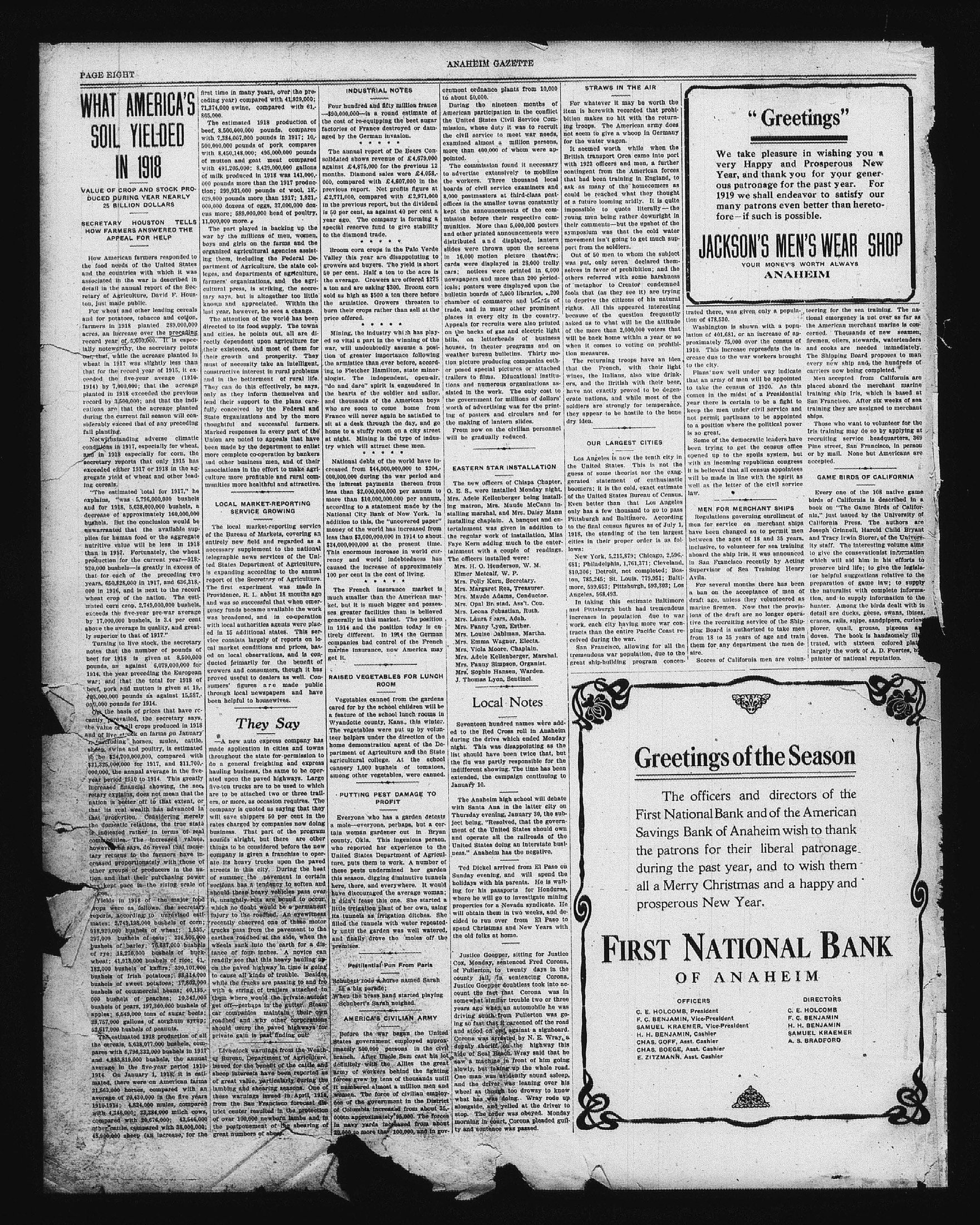
Searchable text
WHAT AMERICA'S SOIL YIELDED IN 1918
VALUE OF CROP AND STOCK PRODUCED DURING YEAR NEARLY 25 BILLION DOLLARS
SECRETARY HOUSTON TELLS HOW FARMERS ANSWERED THE APPEAL FOR HELP
How American farmers responded to the food needs of the United States and the countries with which it was associated in the war is described in detail in the annual report of the Secretary of Agriculture, David F. Houston, just made public.
For wheat and other leading cereals and for potatoes, tobacco and cotton, farmers in 1918 planted 289,000,000 acres, an increase over the preceding record year of 5,600,000. It is especially noteworthy, the secretary points out that, while the acreage planted in wheat in 1917 was slightly less than that for the record year of 1915, it exceeded the five-year average (1910-1914) by 7,000,000; that the acreage planted in 1918 exceeded the previous record by 3,500,000; and that the indications are that the acreage planted during the current fall season will considerably exceed that of any preceding fall planting.
Notwithstanding adverse climatic conditions in 1917, especially for wheat, and in 1918 especially for corn, the first time in many years, over the preceding year) compared with 41,929,000; 71,374,000 swine, compared with 61,865,000.
The estimated 1918 production of beef, 8,500,000,000 pounds, compares with 7,384,007,000 pounds in 1917; 10,500,000,000 pounds of pork compares with 8,450,148,000; 495,000,000 pounds of mutton and goat meat compared with 491,205,000; 8,429,000,000 gallons of milk produced in 1918 was 141,000,000 pounds more than the 1917 production; 299,921,000 pounds of wool, 18,029,000 pounds more than 1917; 1,921,000,000 dozens of eggs, 37,000,000 dozens more; 589,000,000 head of poultry, 11,000,000 more.
The part played in backing up the war by the millions of men, women, boys and girls on the farms and the organized agricultural agencies assisting them, including the Federal Department of Agriculture, the state colleges, and departments of agriculture, farmers' organizations, and the agricultural press, is striking. The secretary says, but is altogether too little known and appreciated. Within the last year, however, he sees a change.
The attention of the world has been directed to its food supply. The towns and cities, he points out, all are directly dependent upon agriculture for their existence, and most of them for their growth and prosperity. They must of necessity take an intelligent, constructive interest in rural problems and in the betterment of rural life. They can do this effectively; he says, only as they inform themselves and lend their support to the plans carefully conceived by the Federal and State organizations and by the more thoughtful and successful farmers. Marked responses in every part of the Union are noted to appeals that have been made by the department to enlist more complete co-operation by bankers.
INDUS
Four hundred—$90,000,000—the cost of re-electors of Framed by the Geography
The annual solidified shows against £4,875 months. Diameter 65mm; compared previous reports £2,771,000; cost in the previous year is 50 per cent; year ago. The special reserve to the diamond.
Broom corn Valley this year growers and buy 50 per cent. He the average. On a ton and are sold as high as the armistice burn their crop price offered.
Mining,the ed so vital a p war will unde tion of greater the armistice being to Fletcher alogist. The "do and dare"the hearts off and thousands who are soon France will not sit at a desk home to a stud at night. Min try which will
wheat in 1917 was slightly less than that for the record year of 1915, it exceeded the five-year average (1910-1914) by 7,000,000; that the acreage planted in 1918 exceeded the previous record by 3,500,000; and that the indications are that the acreage planted during the current fall season will considerably exceed that of any preceding fall planting.
Notwithstanding adverse climatic conditions in 1917, especially for wheat, and in 1918 especially for corn, the secretary reports that only 1915 has exceeded either 1917 or 1918 in the aggregate yield of wheat and other leading cereals.
"The estimated total for 1917," he explains, "was 5,796,000,000 bushels and for 1918, 5,638,000,000 bushels, a decrease of approximately 160,000,000 bushels. But the conclusion would be unwarranted that the available supplies for human food or the aggregate nutritive value will be less in 1918 than in 1917. Fortunately, the wheat production for the current year—918,-920,000 bushels—is greatly in excess of that for each of the preceding two years, 650,828,000 in 1917, and 636,318,-000 in 1916, and is next to the record wheat crop of the nation. The estimated corn crop, 2,749,000,000 bushels, exceeds the five-year pre-war average by 17,000,000 bushels, is 3.4 per cent above the average in quality, and greatly superior to that of 1917."
Turning to live stock, the secretary notes that the number of pounds of beef for 1918 is given at 8,500,000 pounds, as against 6,079,000,000 for 1914, the year preceding the European war; and that the total for 1918 of beef, pork and mutton is given at 19,-495,000,000 pounds as against 15,587,-000,000 pounds for 1914.
On the basis of prices that have recently prevailed, the secretary says, the value of ball crops produced in 1918 and of live stock on farms on January 24 includes horses, mules, cattle, sheep, swine and poultry, is estimated to be $24,700,000,000 compared with $21,325,000,000 for 1917, and $11,700,-000,000 the annual average in the five-year period 1910 to 1914. This greatly increased financial showing, the secretary explains, does not mean that the nation is better off to that extent, or that its real wealth has advanced in that proportion. Considering merely the domestic relations, the true state is indicated rather in terms of real commodities. The increased values, however he says, do reveal that monetary returns to the farmers have increased proportionately with those of
LOCAL MARKET-REPORTING SERVICE GROWING
The local market-reporting service of the Bureau of Markets, covering an entirely new field and regarded as a necessary supplement to the national telegraphic news services of the United States Department of Agriculture, is expanding according to the annual report of the Secretary of Agriculture. The first experiment was made in Providence, R. L., about 18 months ago and was so successful that when emergency funds became available the work was broadened, and in co-operation with local authorities agents were placed in 15 additional states. This service consists largely of reports on local market conditions and prices, based on local observations, and is conducted primarily for the benefit of growers and consumers, though it has proved useful to dealers as well. Consumers' figures are made public through local newspapers and have been helpful to housewives.
They Say
A new auto express company has made application in cities and towns throughout the state for permission to do a general freighting and express hauling business, the same to be operated upon the paved highways. Large five-ton trucks are to be used to which are to be attached two or three trailers, or more, as occasion requires. The company is quoted as saying that they will save shippers 50 per cent in the rates charged by companies now doing business. That part of the program sounds alright, but there are other things to be considered before the new company is given a franchise to operate its heavy trucks upon the paved must of necessity take an intelligent, constructive interest in rural problems and in the betterment of rural life. They can do this effectively he says only as they inform themselves and lend their support to the plans carefully conceived by the Federal and State organizations and by the more thoughtful and successful farmers. Marked responses in every part of the Union are noted to appeals that have been made by the department to enlist more complete co-operation by bankers and other business men, and of their associations in the effort to make agriculture more profitable and rural communities more healthful and attractive.
Everyone cares for by a feature of Wyandotte County who reports United States puts
000,000, the annual average in the five-year period 1910 to 1914. This greatly increased financial showing, the secretary explains, does not mean that the nation is better off to that extent, or that its real wealth has advanced in that proportion. Considering merely the domestic relations, the true state is indicated rather in terms of real commodities. The increased values, however, he says, do reveal that monetary returns to the farmers have increased proportionately with those of other groups of producers in the nation and that their purchasing power kept pace in the rising scale of prices.
Yields in 1918 of the major food crops were as follows: the secretary reports, according to unrevised estimates; 2,749,198,000 bushels of corn; 918,920,000 bushels of wheat; 1,535,297,000 bushels of oats; 236,505,000 bushels of barley; 76,687,000 bushels of rye; 18,270,000 bushels of buckwheat; 41,918,000 bushels of rice; 61,182,000 bushels of kaffirs; 390,101,000 bushels of Irish potatoes; 88,114,000 bushels of sweet potatoes; 17,802,000 bushels of commercial beans; 40,185,000 bushels of peaches; 10,342,000 bushels of pears; 197,360,000 bushels of apples; 6,549,000 tons of sugar beets; 29,757,000 gallons of sorghum syrup; 52,617,000 bushels of peanuts.
The estimated 1918 production of all the cereals, 5,638,077,000 bushels, compares with 5,796,332,000 bushels in 1917 and 4,883,819,000 bushels, the annual average in the five-year period 1910-1914. On January 1, 1918 it is estimated there were on American farms 21,563,000 horses, compared with an average of 20,430,000 in the five years 1910-1914; 4,824,000 mules, compared with 4,346,000; 23,224,000 milch cows, compared with 20,676,000; 43,546,000 other cattle, compared with 38,000,000; 48,900,000 sheep (an increase for the hauling business, the same to be operated upon the paved highways. Large five-ton trucks are to be used to which are to be attached two or three trailers, or more, as occasion requires. The company is quoted as saying that they will save shippers 50 per cent in the rates charged by companies now doing business. That part of the program sounds alright, but there are other things to be considered before the new company is given a franchise to operate its heavy trucks upon the paved streets in this city. During the heat of summer the pavement in certain sections has a tendency to soften and should these heavy vehicles pass over it, unsightly ruts are bound to occur, which no doubt would be a permanent injury to the roadbed. An eyewitness recently observed one of these motor trucks pass from the pavement to the earthen roadbed at the side, when the wheels sank into the earth for a distance of four inches. A novice can readily see that this heavy hauling on the paved highway in time is going to cause all kinds of trouble. Besides while the trucks are passing to and fro with a string of trailers attached to them where would the private autoist get off—perhaps in the gutter. Steam car companies maintain their own roadbed and why other corporations should usurp the paved highways for private gain is past finding out:
Live-stock warnings from the Weather Bureau, Department of Agriculture, issued for the benefit of the cattle and sheep interests have been reported as of great value, particularly during the lambing and shearing seasons. One of these warnings issued in April, 1918, from the San Francisco forecast district center resulted in the protection of over 100,000 newborn lambs and in the postponement of big shearing of great numbers of sheep.
INDUSTRIAL NOTES
Four hundred and fifty million francs—$90,000,000—is a round estimate of the cost of re-equipping the beet sugar factories of France destroyed or damaged by the German invasion.
The annual report of De Beers Consolidated shows revenue of £4,679,000 against £4,875,000 for the previous 12 months. Diamond sales were £4,058,000, compared with £4,607,000 in the previous report. Net profits figure at £2,771,000, compared with £2,971,000 in the previous report, but the dividend is 50 per cent, as against 40 per cent a year ago. The company is forming a special reserve fund to give stability to the diamond trade.
Broom corn crops in the Palo Verde Valley this year are disappointing to growers and buyers. The yield is short 50 per cent. Half a ton to the acre is the average. Growers are offered $275 a ton and are asking $300. Broom corn sold as high as $500 a ton there before the armistice. Growers threaten to burn their crops rather than sell at the price offered.
Mining, the industry which has played so vital a part in the winning of the war, will undoubtedly assume a position of greater importance following the armistice than ever before, according to Fletcher Hamilton, state mineralogist. The independent, open-air "do and dare" spirit is engendered in the hearts of the soldier and sailor, and thousands of the American boys who are soon to come home from France will never again be satisfied to sit at a desk through the day, and go home to a stuffy room on a city street at night. Mining is the type of industry which will attract these men.
ORNMENT ORDNANCE PLANTS FROM 10,000 TO about 50,000.
During the nineteen months of American participation in the conflict the United States Civil Service Commission, whose duty it was to recruit the civil service to meet war needs, examined almost a million persons, more than 400,000 of whom were appointed.
The commission found it necessary to advertise extensively to mobilize the workers. Three thousand local boards of civil service examiners and 8,000 postmasters at third-class post-offices in the smaller towns constantly kept the announcements of the commission before their respective communities. More than 5,000,000 posters and other printed announcements were distributed and displayed, lantern slides were thrown upon the screens in 16,000 motion picture theaters; cards were displayed in 28,000 trolly cars; notices were printed in 6,000 newspapers and more than 200 periodicals; posters were displayed upon the bulletin boards of 3,000 libraries, 2,200 chamber of commerce and boards of trade, and in many other prominent places in every city in the country. Appeals for recruits were also printed on the backs of gas and electric light bills, on letterheads of business houses, in theater programs and on weather bureau bulletins. Thirty motion picture producing companies either posed special pictures or attached trailers to films. Educational institutions and numerous organizations assisted in the work. The only cost to the government for millions of dollars' worth of advertising was for the printing of posters and circulars and for the making of lantern slides.
From now on the civilian personnel will be gradually reduced.
STRAWS IN THE AIR
For whatever it may be worth the item is herewith recorded that prohibition makes no hit with the returning troops. The American army does not seem to give a whoop in Germany for the water wagon.
It seemed worth while when the British transport Orca came into port with 1923 officers and men, a further contingent from the American forces that had been training in England, to ask as many of the homecomers as could be reached what they thought of a future looming aridly. It is quite impossible to quote literally—the young men being rather downright in their comments—but the upshot of the symposium was that the cold water movement isn't going to get much support from the soldiers.
Out of 50 men to whom the subject was put, only seven declared themselves in favor of prohibition; and the others referred with some harshness of metaphor to Creator condemned fools that (as they see it) are trying to deprive the citizens of his natural rights. All this appeared interesting because of the question frequently asked as to what will be the attitude of the more than 2,000,000 voters that will be back home within a year or so when it comes to voting on prohibition measures.
The returning troops have an idea that the French, with their light wines, the Italians, also wine drinkers, and the British with their beer, have not exactly proved to be degenerate nations, and while most of the soldiers are strongly for temperance, they appear to be hostile to the bone dry idea.
OUR LARGEST CITIES
National debts of the world have increased from $44,000,000,000 to $204,000,000,000 during the war period and the interest payments thereon from less than $2,000,000,000 per annum to more than $10,000,000,000 per annum, according to a statement made by the National City Bank of New York. In addition to this, the "uncovered paper" money of the world has increased from less than $3,000,000,000 in 1914 to about $24,000,000,000 at the present time. This enormous increase in world currency and world indebtedness has caused the increase of approximately 100 per cent in the cost of living.
The French insurance market is much smaller than the American market, but it is much bigger and possesses greater facilities than is believed generally in this market. The position in 1914 and the position today is entirely different. In 1914 the German companies had control of the French marine insurance, now America may get it.
RAISED VEGETABLES FOR LUNCH ROOM
Vegetables canned from the gardens cared for by the school children will be a feature of the school lunch rooms in Wyandotte county, Kans., this winter. The vegetables were put up by volunteer helpers under the direction of the home demonstration agent of the Department of Agriculture and the State agricultural college. At the school cannery 1,000 bushels of tomatoes, among other vegetables, were canned.
PUTTING PEST DAMAGE TO PROFIT
Everyone who has a garden detests a mole—everyone, perhaps, but a certain woman gardener out in Bryan county, Okla. This ingenious person, who reported her experience to the United States Department of Agriculture, puts them to work. A number of picture producing companies either posed special pictures or attached trailers to films. Educational institutions and numerous organizations assisted in the work. The only cost to the government for millions of dollars' worth of advertising was for the printing of posters and circulars and for the making of lantern slides.
From now on the civilian personnel will be gradually reduced.
EASTERN STAR INSTALLATION
The new officers of Chispa Chapter, O. E. S., were installed Monday night. Mrs. Adele Kellenberger being installing matron, Mrs. Maude McCann installing marshal, and Mrs. Daisy Mann installing chaplain. A banquet and entertainment was given in addition to the regular work of installation, Miss Faye Kern adding much to the entertainment with a couple of readings. The officers installed were:
Mrs. H. O. Henderson, W. M.
Elmer Metcalf, W. P.
Mrs. Polly Kern, Secretary.
Mrs. Margaret Rea, Treasurer.
Mrs. Maude Adams, Conductor.
Mrs. Opal Bratstad, Ass't. Con.
Mrs. Leona Sebastian, Ruth.
Mrs. Laura Sears, Adah.
Mrs. Fanny Lyon, Esther.
Mrs. Louise Dahlman, Martha.
Mrs. Emma Wagner, Electa.
Mrs. Viola Moore, Chaplain.
Mrs. Adele Kellenberger, Marshal.
Mrs. Fanny Simpson, Organist.
Mrs. Sophie Hansen, Warden.
J. Thomas Lyon, Sentinel.
Local Notes
Seventeen hundred names were added to the Red Cross roll in Anaheim during the drive which ended Monday night. This was disappointing as the list should have been twice that, but the flu was partly responsible for the indifferent showing. The time has been extended, the campaign continuing to January 10.
The Anaheim high school will debate with Santa Ana in the latter city on Thursday evening, January 30, the subject being, "Resolved, that the government of the United States should own and operate all the railroads of the United States doing an interstate business." Anaheim has the negative.
OUR LARGEST CITIES
Los Angeles is now the tenth city in the United States. This is not the guess of some theorist nor the exaggerated statement of enthusiastic boomers; it is the cold, exact estimate of the United States Bureau of Census. Even better than that Los Angeles only has a few thousand to go to pass Pittsburgh and Baltimore. According to the final census figures as of July 1, 1918, the standing of the ten largest cities in their proper order is as follows:
New York, 5,215,879; Chicago, 2,596,681; Philadelphia, 1,761,371; Cleveland, 810,306; Detroit, not completed; Boston, 785,245; St. Louis, 779,951; Baltimore, 599,653; Pittsburgh, 593,303; Los Angeles, 568,493.
In taking this estimate Baltimore and Pittsburgh both had tremendous increases in population due to war work, each city having more war contracts than the entire Pacific Coast received during the war.
San Francisco, allowing for all the tremendous war population, due to the great ship-building program concen-
PUTTING PEST DAMAGE TO PROFIT
Everyone who has a garden detests a mole—everyone, perhaps, but a certain woman gardener out in Bryan county, Okla. This ingenious person, who reported her experience to the United States Department of Agriculture, puts them to work. A number of these pests undermined her garden this season, digging diminutive tunnels here, there, and everywhere. It would have discouraged the average woman; it didn't feeze this one. She started a little irrigation plant of her own, using its tunnels as irrigation ditches. She filled the tunnels with water repeatedly until the garden was well watered, and finally drove the moles off the premises.
Pestilential Pun From Parla
Schubert rode a horse named Sarah In a big parade;
When the brass band started playing Schubert's Sarah neighed.
AMERICA'S CIVILIAN ARMY
Before the war began the United States government employed approximately 500,000 persons in the civil branch. After Uncle Sam cast his lot definitely with the Allies the great army of workers behind the fighting forces grew by tens of thousands until it numbered almost a million men and women. The force of civilian employees of the government in the District of Columbia increased from about 35,000 to approximately 95,000. The forces in navy yards increased from about 20,000 to more than 100,000, and in government indifferent showing. The time has been extended, the campaign continuing to January 10.
The Anaheim high school will debate with Santa Ana in the latter city on Thursday evening, January 30, the subject being, "Resolved, that the government of the United States should own and operate all the railroads of the United States doing an interstate business." Anaheim has the negative.
Ted Dickel arrived from El Paso on Sunday evening, and will spend the holidays with his parents. He is waiting for his passports for Honduras, where he will go to investigate mining properties for a Nevada syndicate. He will obtain them in two weeks, and decided to run over from El Paso to spend Christmas and New Years with the old folks at home.
Justice Goepper, sitting for Justice Cox, Monday, sentenced Fred Corona, of Fullerton, to twenty days in the county jail, in sentencing Corona, Justice Goepper doubtless took into account the fact that Corona was in somewhat similar trouble two or three years ago when an automobile he was driving south from Fullerton was going so fast that it careened off the road and stood on end against a signboard. Corona was arrested by N. E. Wray, a deputy sheriff, on the highway this side of Seal Beach. Wray said that he saw a machine in front of him going slowly, but taking up the whole road. One man was evidently sound asleep, and the driver was leaning over his wheel as though too drowsy to know what has been doing. Wray rode up alongside, and yelled at the driver to stop. The order was obeyed. Monday morning in court, Corona pleaded guilty and sentence was passed.
"Greetings"
We take pleasure in wishing you a very Happy and Prosperous New Year, and thank you for your generous patronage for the past year. For 1919 we shall endeavor to satisfy our many patrons even better than heretofore—if such is possible.
JACKSON'S MEN'S WEAR SHOP
YOUR MONEY'S WORTH ALWAYS
ANAHEIM
trated there, was given only a population of 478,530.
Washington is shown with a population of 401,681, or an increase of approximately 75,000 over the census of 1910. This increase represents the increase due to the war workers brought to the city.
Plans now well under way indicate that an army of men will be appointed to take the census of 1920. As this comes in the midst of a Presidential year there is certain to be a fight to keep the men under civil service and not permit partisans to be appointed to a position where the political power is so great.
Some of the democratic leaders have been trying to get the census office opened up to the spoils system, but teering for the sea training. The national emergency is not over as far as the American merchant marine is concerned. Thousands of new seamen, firemen, oilers, stewards, watertenders and cooks are needed immediately. The Shipping Board proposes to man every new ship and the hundreds of carriers now being completed.
Men accepted from California are placed aboard the merchant marine training ship Iris, which is based at San Francisco. After six weeks of sea training they are assigned to merchant ships.
Those who want to volunteer for the Iris training may do so by applying at recruiting service headquarters, 369 Pine street, San Francisco, in person or by mail. None but Americans are
GREEST CITIES
is now the tenth city in states. This is not the mythorist nor the exagement of enthusiastic the cold, exact estimate States Bureau of Census. an that Los Angeles thousand to go to pass Baltimore. According figures as of July 1, king of the ten largest proper order is as follows: Chicago, 2,596; California, 1,761,371; Cleveland, not completed; Boston, Louis, 779,951; Baltimore, 593,303; Los Angeles estimate Baltimore both had tremendous population due to war having more war con- entire Pacific Coast re- the war.
co, allowing for all the war population, due to the leading program concen- to the city.
Plans now well under way indicate that an army of men will be appointed to take the census of 1920. As this comes in the midst of a Presidential year there is certain to be a fight to keep the men under civil service and not permit partisans to be appointed to a position where the political power is so great.
Some of the democratic leaders have been trying to get the census office opened up to the spoils system, but with an incoming republican congress it is believed that all census appointees will be made in line with the spirit as well as the letter of the civil service law.
MEN FOR MERCHANT SHIPS
Regulations governing enrollment of men for service on merchant ships have been changed so to permit men between the ages of 18 and 35 years, inclusive, to volunteer for sea training aboard the ship Iris, it was announced in San Francisco recently by Acting Supervisor of Sea Training Henry Avila.
For several months there has been a ban on the acceptance of men of draft age, unless they volunteered as marine firemen. Now that the provisions of the draft are no longer operative the recruiting service of the Shipping Board is authorized to take men from 18 to 35 years of age and train them for any department the men desire.
Scores of California men are volun-
every new ship and the hundreds of carriers now being completed.
Men accepted from California are placed aboard the merchant marine training ship Iris, which is based at San Francisco. After six weeks of sea training they are assigned to merchant ships.
Those who want to volunteer for the Iris training may do so by applying at recruiting service headquarters, 369 Pine street, San Francisco, in person or by mail. None but Americans are accepted.
GAME BIRDS OF CALIFORNIA
Every one of the 108 native game birds of California is described in a book on "The Game Birds of California," just issued by the University of California Press. The authors are Joseph Grinnell, Harold Child Bryant and Tracy Irwin Storer, of the University staff. The interesting volume aims to give the conservationist information which will aid him in his efforts to preserve bird life; to give the legislator helpful suggestions relative to the preparation of game law; to supply the naturalist with complete information, and to supply information to the hunter. Among the birds dealt with in detail are ducks, geese, swans, ibises, cranes, rails, snipe, sandpipers, curlew plover, quail, grouse, pigeons and doves. The book is handsomely illustrated, with sixteen colored plates largely the work of A. D. Fuertes, b painter of national reputation.
Greetings of the Season
The officers and directors of the First National Bank and of the American Savings Bank of Anaheim wish to thank the patrons for their liberal patronage during the past year and to wish them
The officers and directors of the First National Bank and of the American Savings Bank of Anaheim wish to thank the patrons for their liberal patronage during the past year, and to wish them all a Merry Christmas and a happy and prosperous New Year.
FIRST NATIONAL BANK
OF ANAHEIM
OFFICERS
C. E. HOLCOMB, President
F. C. BENJAMIN, Vice-President
SAMUEL KRAEMER, Vice-President
H. H. BENJAMIN, Cashier
CHAS. GOFF, Asst. Cashier
CHAS. BOEGE, Asst. Cashier
E. ZITZMANN, Asst. Cashler
DIRECTORS
C. E. HOLCOMB
F. C. BENJAMIN
H. H. BENJAMIN
SAMUEL KRAEMER
A. S. BRADFORD