anaheim-gazette 1918-12-26
Scanned page
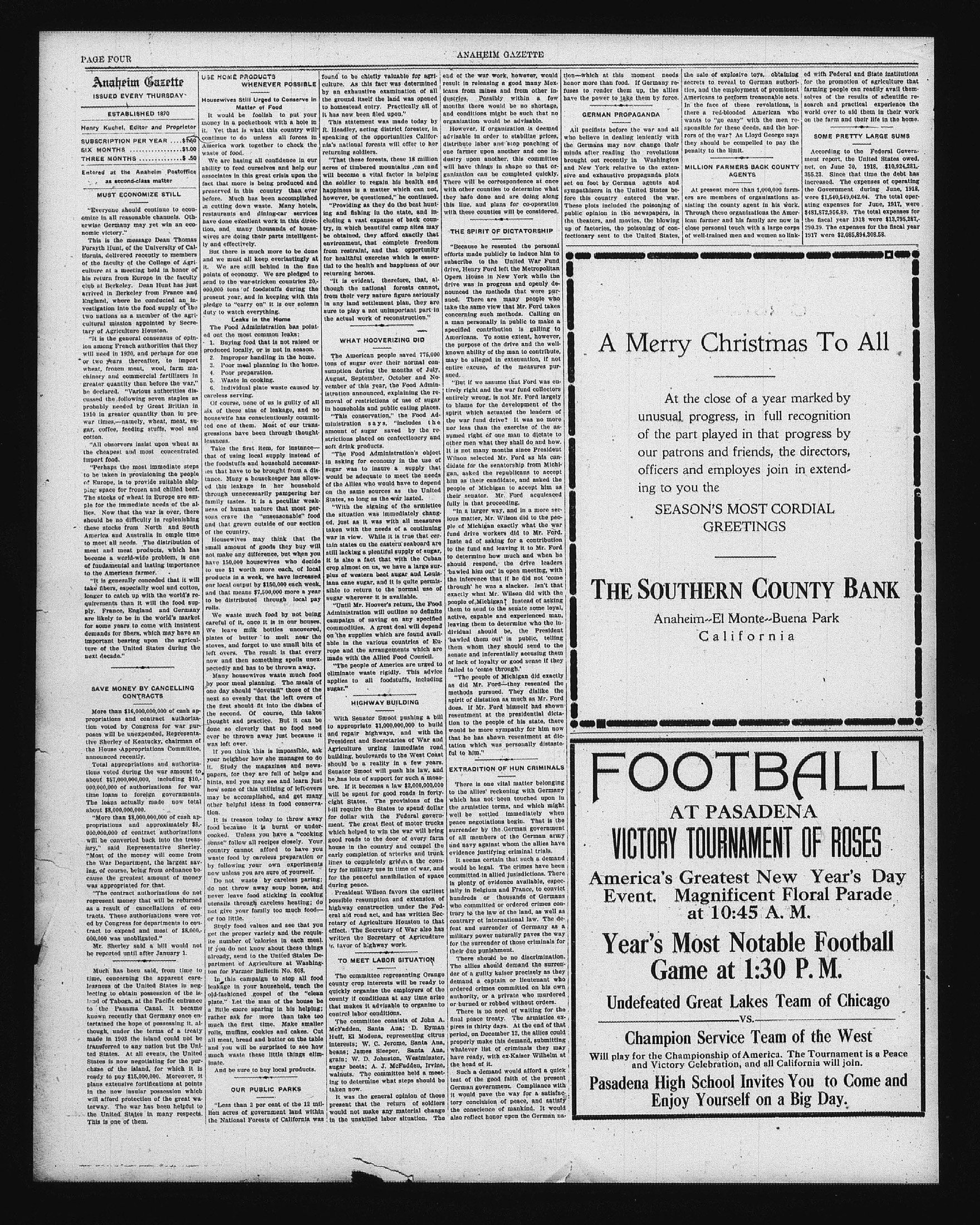
Searchable text
Anaheim Gazette
ISSUED EVERY THURSDAY
ESTABLISHED 1870
Henry Kuchel, Editor and Proprietor
SUBSCRIPTION PER YEAR ... $150
SIX MONTHS ... $1.00
THREE MONTHS ... $ .50
Entered at the Anaheim Postoffice as second-class matter
MUST ECONOMIZE STILL
"Everyone should continue to economize in all reasonable channels. Otherwise Germany may yet win an economic victory."
This is the message Dean Thomas Forsyth Hunt, of the University of California, delivered recently to members of the faculty of the College of Agriculture at a meeting held in honor of his return from Europe in the faculty club at Berkeley. Dean Hunt has just arrived in Berkeley from France and England, where he conducted an investigation into the food supply of the two nations as a member of the agricultural mission appointed by Secretary of Agriculture Houston.
"It is the general consensus of opinion among French authorities that they will need in 1920, and perhaps for one or two years thereafter, to import wheat, frozen meat, wool, farm machinery and commercial fertilizers in greater quantity than before the war," he declared. "Various authorities discussed the following seven staples as probably needed by Great Britain in 1910 in greater quantity than in pre-war times—namely, wheat, meat, sugar, coffee, feeding stuffs, wool and cotton."
"All observers insist upon wheat as the cheapest and most concentrated USE HOME PRODUCTS WHENEVER POSSIBLE
Housewives Still Urged to Conserve in Matter of Food
It would be foolish to put your money in a pocketbook with a hole in it. Yet that is what this country will continue to do unless all forces in America work together to check the waste of food.
We are basing all confidence in our ability to feed ourselves and help our associates in this great crisis upon the fact that more is being produced and preserved in this country than ever before. Much has been accomplished in cutting down waste. Many hotels, restaurants and dining-car services have done excellent work in this direction, and many thousands of housewives are doing their parts intelligently and effectively.
But there is much more to be done and we must all keep everlastingly at it. We are still behind in the fine points of economy. We are pledged to send to the war-stricken countries 20,000,000 tons of foodstuffs during the present year, and in keeping with this pledge to "carry on" it is our solemn duty to watch everything.
Leaks in the Home
The Food Administration has pointed out the most common leaks:
1. Buying food that is not raised or produced locally, or is not in season.
2. Improper handling in the home.
3. Poor meal planning in the home.
4. Poor preparation.
5. Waste in cooking.
6. Individual plate waste caused by careless serving.
Of course, none of us is guilty of all six of these sins of leakage, and no housewife has conscientiously committed one of them. Most of our transgressions have been through thoughtlessness.
Take the first item, for instance—that of using local supply instead of found to be chick culture. As tha by an exhaustive ground its to homestead e This statement R. Headley, acc speaking of th nia's national returning soldi That these acres of timber will become a the soldier to happiness is a however, be qu Providing a ing and fishing cluding a vast try, in which b be obtained, t environment, t from restraint for healthful o tial to the head returning herc It is eviden though the na from their ver In any land sure to play a the actual wo
SAVE MONEY BY CANCELLING CONTRACTS
More than $16,000,000,000 of cash appropriations and contract authorization voted by Congress for war purposes will be unexpended. Representative Sherley of Kentucky, chairman of the House Appropriations Committee, announced recently.
Total appropriations and authorizations voted during the war amount to about $57,000,000,000, including $10,000,000,000 of authorizations for war time loans to foreign governments. The loans actually made now total about $8,000,000,000.
More than $8,000,000,000 of cash appropriations and approximately $8,000,000,000 of contract authorizations will be converted back into the treasury," said Representative Sherley. "Most of the money will come from the War Department, the largest savior two years thereafter, to import wheat, frozen meat, wool, farm machinery and commercial fertilizers in greater quantity than before the war," he declared. "Various authorities discussed the following seven staples as probably needed by Great Britian in 1910 in greater quantity than in pre-war times—namely, wheat, meat, sugar, coffee, feeding stuffs, wool and cotton.
"All observers insist upon wheat as the cheapest and most concentrated import food.
"Perhaps the most immediate steps to be taken in provisioning the people of Europe, is to provide suitable shipping space for frozen and chilled beef. The stocks of wheat in Europe are ample for the immediate needs of the allies. Now that the war is over, there should be no difficulty in replenishing these stocks from North and South America and Australia in ample time to meet all needs. The distribution of meat and meat products, which has become a world-wide problem, is one of fundamental and lasting importance to the American farmer.
"It is generally conceded that it will take fibers, especially wool and cotton, longer to catch up with the world's requirements than it will the food supply. France, England and Germany are likely to be in the world's market for some years to come with insistent demands for fibers, which may have an important bearing upon the agriculture of the United States during the next decade."
Poor meal planning in the home.
Poor preparation.
Waste in cooking.
Individual plate waste caused by careless serving.
Of course, none of us is guilty of all six of these sins of leakage, and no housewife has conscientiously committed one of them. Most of our transgressions have been through thoughtlessness.
Take the first item, for instance—that of using local supply instead of the foodstuffs and household necessaries that have to be brought from a distance. Many a housekeeper has allowed this leakage in her household through unnecessarily pampering her family tastes. It is a peculiar weakness of human nature that most persons crave the "unseasonable" food and that grown outside of our section of the country.
Housewives may think that the small amount of goods they buy will not make any difference, but when you have 150,000 housewives who decide to use $1 worth more each, of local products in a week, we have increased our local output by $150,000 each week, and that means $7,500,000 more a year to be distributed through local pay rolls.
We waste much food by not being careful of it, once it is in our houses. We leave milk bottles uncovered, plates of butter to melt near the stoves, and forget to use small bits of left overs. The result is that every now and then something spoils unexpectedly and has to be thrown away.
Many housewives waste much food by poor meal planning. The meals of one day should "dovetall" those of the next so evenly that the left overs of the first should fit into the dishes of the second. Of course, this takes thought and practice. But it can be done so cleverly that no food need ever be thrown away just because it was left over.
If you think this is impossible, ask your neighbor how she manages to do it. Study the magazines and newspapers, for they are full of helps and hints, and you may see and learn just how some of this utilizing of left-overs may be accomplished, and get many other helpful ideas in food conservation.
It is treason today to throw away food because it is burnt or undercooked. Unless you have a "cooking sense" follow all recipes closely. Your country cannot afford to have you waste food by careless preparation or by following your own experiments.
With Senate approval and repair President and Agriculture building, bourbon should be a Senator Smoot he has lots of use. If it be will be spent eight States; bill require for dollar wagerment. The government which helped good roads to house in the early complex lines to com
tions voted during the war amount to about $57,000,000,000, including $10,000,000,000 of authorizations for war time loans to foreign governments. The loans actually made now total about $8,000,000,000.
"More than $8,000,000,000 of cash appropriations and approximately $8,000,000,000 of contract authorizations will be converted back into the treasury," said Representative Sherley. "Most of the money will come from the War Department, the largest saving, of course, being from ordnance because the greatest amount of money was appropriated for that.
"The contract authorizations do not represent money that will be returned as a result of cancellations of contracts. These authorizations were voted by Congress for departments to contract to expend and most of $8,000,000,000 was unobligated."
Mr. Sherley said a bill would not be reported until after January 1.
Much has been said, from time to time, concerning the apparent carelessness of the United States in neglecting to obtain possession of the island of Taboga, at the Pacific entrance to the Panama Canal. It became known recently that Germany once entertained the hope of possessing it, although, under the terms of a treaty made in 1903 the island could not be transferred to any nation but the United States. At all events, the United States is now negotiating for the purchase of the island, for which it is ready to pay $15,000,000. Moreover, it plans extensive fortifications at points in the new insular possession which will afford protection of the great waterway. The war has been helpful to the United States in many respects. This is one of them.
OUR PUBLIC PARKS
"Less than 2 per cent of the 12 million acres of government land within the National Forests of California was papers, for they are full of helps and hints, and you may see and learn just how some of this utilizing of left-overs may be accomplished, and get many other helpful ideas in food conservation.
It is treason today to throw away food because it is burnt or undercooked. Unless you have a "cooking sense" follow all recipes closely. Your country cannot afford to have you waste food by careless preparation or by following your own experiments now unless you are sure of yourself.
Do not waste by careless paring; do not throw away soup bones, and never leave food sticking in cooking utensils through careless heating; do not give your family too much food—or too little.
Study food values and see that you get the proper variety and the requisite number of calories in each meal. If you do not know about these things already, send to the United States Department of Agriculture at Washington for Farmer Bulletin No. 808.
In this campaign to stop all food leakage in your household, teach the old-fashioned gospel of the "clean plate." Let the man of the house be a little more sparing in his helping; rather ask for more than take too much the first time. Make smaller rolls, muffins, cookies and cakes. Cut all meat, bread and butter on the table and you will be surprised to see how much waste these little things eliminate.
And be sure to buy local products.
THE COMMUNITY CROP COUNTY ORGANIZATION
COUNTY IF COUNTY THAT MAKES IT CONTROL LABOR
The comm
McFadden,
Huff, El Mo
interests; W
beans; Jam
grain; W. D
sugar beets;
walnuts. Th
ing to deter
taken now.
It was th
present that
would not m
in the unsk
POSSIBLE conserve in put your hole in country will forces in check the force in our help our upon the introduced and than ever compliled any hotels, services this direc of house intelligent to be done hastingly at the fine pledged to countries 20, during the war with this our solemn has point-asks: raised or season. the home. the home.
caused by utility of all age, and no only commit our transh thought instance—instead of found to be chiefly valuable for agriculture. As this fact was determined by an exhaustive examination of all the ground itself the land was opened to homestead entry. Practically all of it has now been filed upon."
This statement was made today by R. Headley, acting district forester, in speaking of the opportunities California's national forests will offer to her returning soldiers.
"That these forests, these 18 million acres of timbered mountains can and will become a vital factor in helping the soldier to regain his health and happiness is a matter which can not, however, be questioned," he continued.
"Providing as they do the best hunting and fishing in the state, including a vast expanse of back country, in which beautiful camp sites may be obtained, they afford exactly that environment, that complete freedom from restraint, and that opportunity for healthful exercise which is essential to the health and happiness of our returning heroes.
"It is evident, therefore, that, although the national forests cannot, from their very nature figure seriously in any land settlement plan, they are sure to play a not unimportant part in the actual work of reconstruction."
WHAT HOOVERIZING DID
The American people saved 775,000 tons of sugar over their normal consumption during the months of July, August, September, October and November of this year, the Food Administration announced, explaining the removal of restrictions of use of sugar in households and public eating places.
"This conservation," the Food Administration says, "includes the amount of sugar saved by the restrictions placed on confectionery and soft drink products."
"The Food Administration's object end of the war work, however, would result in releasing a good many Mexicans from mines and from other industries. Possibly within a few months there would be no shortage, and conditions might be such that no organization would be advisable.
However, if organization is deemed advisable in order to stabilize prices, distribute labor and stop poaching of one farmer upon another and one industry upon another, this committee will have things in shape so that organization can be completed quickly. There will be correspondence at once with other counties to determine what they hafe done and are doing along this line, and plans for co-operation with these counties will be considered.
THE SPIRIT OF DICTATORSHIP
"Because he resented the personal efforts made publicly to induce him to subscribe to the United War Fund drive, Henry Ford left the Metropolitan Opera House in New York while the drive was in progress and openly denounced the methods that were pursued. There are many people who take the same view that Mr. Ford takes concerning such methods. Calling on a man personally in public to make a specified contribution is galling to Americans. To some extent, however, the purpose of the drive and the well-known ability of the man to contribute, may be alleged in extenuation, if not entire excuse, of the measures pursued.
But if we assume that Ford was entirely right and the war fund collectors entirely wrong, is not Mr. Ford largely to blame for the development of the spirit which actuated the leaders of the war fund drive? It was no more nor less than the exercise of the assumed right of one man to dictate to other men what they shall do and how. It is not many months since President Wilson selected Mr. Ford as his can-tion—which at this moment needs honor more than food. If Germany refuses to render them up, the allies have the power to take them by force.
GERMAN PROPAGANDA
All pacifists before the war and all who believe in dealing leniently with the Germans may now change their minds after reading the revelations brought out recently in Washington and New York relative to the extensive and exhaustive propaganda plots set on foot by German agents and sympathizers in the United States before this country entered the war. These plots included the poisoning of public opinion in the newspapers, in theaters, and movies, the blowing up of factories, the poisoning of confectionary sent to the United States,
A Merry
At the unusual part of the parish our patron officers are ing to you SEASON
THE SOUTH Anaheim
FOOD AT VICTORY TOWN
the home.
caused by
guilty of all
age, and no
only commitfrom a dishas allowhousehold
pering her
bullar weakmost permanable" food
your section
that the
buy buy will
at when you
who decide
which, of local
be increased
each week,
more a year
local pay
not being
our houses,
uncovered,
near the
small bits of
that every
epolls unexwn away.
much food
meals of
those of the
aft overs of
the dishes of
this takes
it can be
food need
because it
possible, ask
images to do
and news
of helps and
learn just
of left-overs
will get many
and conservathrow away
or undera "cooking
closely. Your
to have you
separation or
experiments
tons of sugar over their normal consumption during the months of July,
August, September, October and November of this year, the Food Administration announced, explaining the removal of restrictions of use of sugar in households and public eating places.
"This conservation," the Food Administration says, "includes the amount of sugar saved by the restrictions placed on confectionery and soft drink products.
"The Food Administration's object in asking for economy in the use of sugar was to insure a supply that would be adequate to meet the needs of the Allies who would have to depend on the same sources as the United States, so long as the war lasted.
"With the signing of the armistice the situation was immediately changed, just as it was with all measures taken with the needs of a continuing war in view. While it is true that certain states on the eastern seaboard are still lacking a plentiful supply of sugar, it is also a fact that with the Cuban crop almost on us, we have a large surplus of western beet sugar and Louisiana cane sugar, and it is quite permissible to return to the normal use of sugar wherever it is available.
"Until Mr. Hoover's return, the Food Administration will outline no definite campaign of saving on any specified commodities. A great deal will depend on the supplies which are found available in the various countries of Europe and the arrangements which are made with the Allied Food Council.
"The people of America are urged to eliminate waste rigidly. This advice applies to all foodstuffs, including sugar."
HIGHWAY BUILDING
With Senator Smoot pushing a bill to appropriate $1,000,000,000 to build and repair highways, and with the President and Secretaries of War and Agriculture urging immediate road building, boulevards to the West Coast should be a reality in a few years. Senator Smoot will push his law, and he has lots of support for such a measure. If it becomes a law $2,000,000,000 will be spent for good roads in forty-eight States. The provisions of the bill require the States to spend dollar for dollar with the Federal government. The great fleet of motor trucks which helped to win the war will bring good roads to the door of every farm house in the country and compel the early completion of arteries and trunk lines to completely gridrion the coun-
EXTRADITION OF HUN CRIMINALS
There is one vital matter belonging to the allies' reckoning with Germany which has not been touched upon in the armistice terms, and which might well be settled immediately when peace negotiations begin. That is the surrender by the German government of all members of the German army and navy against whom the allies have evidence justifying criminal trials.
It seems certain that such a demand
Senator Smoot will push his law, and he has lots of support for such a measure. If it becomes a law $2,000,000,000 will be spent for good roads in forty-eight States. The provisions of the bill require the States to spend dollar for dollar with the Federal government. The great fleet of motor trucks which helped to win the war will bring good roads to the door of every farm house in the country and compel the early completion of arteries and trunk lines to completely grid the country for military use in time of war, and for the peaceful annihilation of space during peace.
President Wilson favors the earliest possible resumption and extension of highway construction under the Federal aid road act, and has written Secretary of Agriculture Houston to that effect. The Secretary of War also has written the Secretary of Agriculture to favor of highway work.
TO MEET LABOR SITUATION
The committee representing Orange county crop interests will be ready to quickly organize the employers of the county if conditions at any time arise that makes it advisable to organize to control labor conditions.
The committee consists of John A. McFadden, Santa Ana; D. Eyman Huff, El Modena, representing citrus interests; W. C. Jerome, Santa Ana, beans; James Sleeper, Santa Ana, grain; W. D. Johnston, Westminster, sugar beets; A. J. McFadden, Irvine, walnuts. The committee held a meeting to determine what steps should be taken now.
It was the general opinion of those present that the return of soldiers would not make any material change in the unskilled labor situation. The
There is one vital matter belonging to the allies' reckoning with Germany which has not been touched upon in the armistice terms, and which might well be settled immediately when peace negotiations begin. That is the surrender by the German government of all members of the German army and navy against whom the allies have evidence justifying criminal trials.
It seems certain that such a demand would be legal. The crimes have been committed in allied jurisdictions. There is plenty of evidence available, especially in Belgium and France, to convict hundreds or thousands of Germans who committed or ordered crimes contrary to the law of the land, as well as contrary to international law. The defeat and surrender of Germany as a military power naturally paves the way for the surrender of those criminals for their due punishment.
There should be no discrimination. The allies should demand the surrender of a guilty kaiser precisely as they demand a captain or lieutenant who ordered crimes committed on his own authority, or a private who murdered or burned or robbed without orders.
There is no need of waiting for the final peace treaty. The armistice expires in thirty days. At the end of that period, on December 12, the allies could properly make this demand, submitting whatever list of criminals they may have ready, with ex-Kaiser Wilhelm at the head of it.
Such a demand would afford a quick test of the good faith of the present German government. Compliance with it would pave the way for a satisfactory conclusion of peace, and satisfy the conscience of mankind. It would also reflect honor upon the German na-
this moment needs food. If Germany retakes them up, the allies
to take them by force.
PROPAGANDA
before the war and all
releasing leniently with
may now change their
ing the revelations
ently in Washington
relative to the extenive propaganda plots
German agents and
the United States bey entered the war.
induced the poisoning of
in the newspapers, in
movies, the blowing
the poisoning of conto the United States,
the sale of explosive toys, obtaining
secrets to reveal to German authorities, and the employment of prominent
Americans to perform treasonable acts.
In the face of these revelations, is there a red-blooded American who wants to "go easy" with the men responsible for these deeds, and the horrors of the war? As Lloyd George says they should be compelled to pay the penalty to the limit.
MILLION FARMERS BACK COUNTY AGENTS
At present more than 1,000,000 farmers are members of organizations assisting the county agent in his work.
Through these organizations the American farmer and his family are now in close personal touch with a large corps of well-trained men and women so link-
ed with Federal and State institutions
for the promotion of agriculture that farming people can readily avail them-selves of the results of scientific research and practical experience the world over to aid them in their work on the farm and their life in the home.
SOME PRETTY LARGE SUMS
According to the Federal Govemment report, the United States owed,
net, on June 30, 1918, $10,924,281.355.23. Since that time the debt has increased. The expenses of operating
the Government during June, 1918,
were $1,540,549,042.04. The total operating expenses for June, 1917, were
$481,872,956.89. The total expenses for
the fiscal year 1918 were $13,795,287.290.39. The expenses for the fiscal year
1917 were $2,085,894,308.58.
A Merry Christmas To All
At the close of a year marked by unusual progress, in full recognition of the part played in that progress by our patrons and friends, the directors,
At the close of a year marked by unusual progress, in full recognition of the part played in that progress by our patrons and friends, the directors, officers and employes join in extending to you the
SEASON'S MOST CORDIAL
GREETINGS
THE SOUTHERN COUNTY BANK
Anaheim--El Monte--Buena Park
California
FOOTBALL
AT PASADENA
VICTORY TOURNAMENT OF ROSES
AT PASADENA
VICTORY TOURNAMENT OF ROSES
America's Greatest New Year's Day
Event. Magnificent Floral Parade
at 10:45 A.M.
Year's Most Notable Football
Game at 1:30 P.M.
Undefeated Great Lakes Team of Chicago
vs.
Champion Service Team of the West
play for the Championship of America. The Tournament is a Peace
and Victory Celebration, and all California will join.
Pasadena High School Invites You to Come and
Enjoy Yourself on a Big Day.