anaheim-gazette 1918-12-05
Scanned page
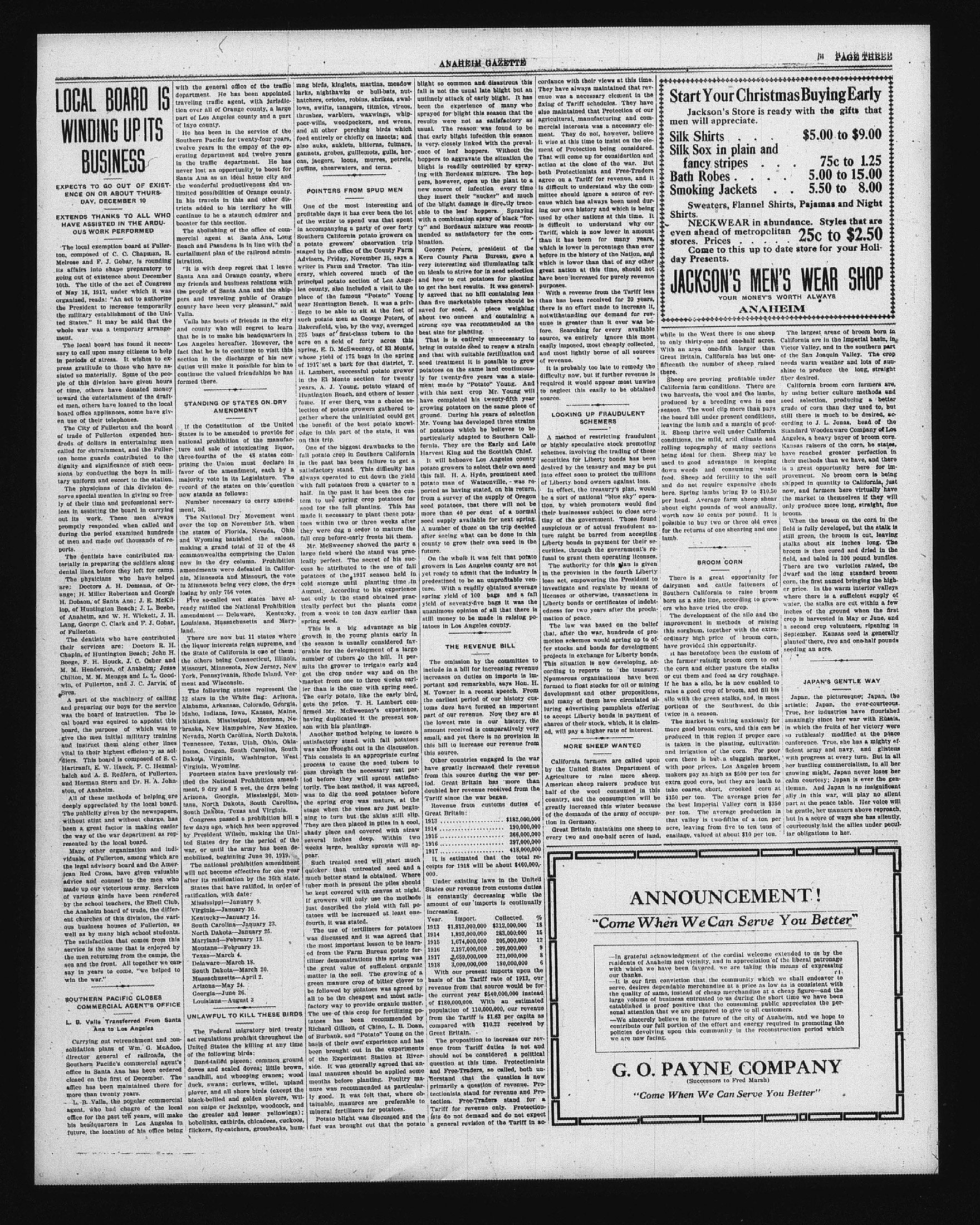
Searchable text
LOCAL BOARD IS WINDING UP ITS BUSINESS
EXPECTS TO GO OUT OF EXISTENCE ON OR ABOUT THURSDAY, DECEMBER 10
EXTENDS THANKS TO ALL WHO HAVE ASSISTED IN THE ARDUOUS WORK PERFORMED
The local exemption board at Fullerton, composed of C. C. Chapman, R. Melrose and F. J. Gobar, is rounding its affairs into shape preparatory to going out of existence about December 10th. The title of the act of Congress of May 18, 1917, under which it was organized, reads: "An act to authorize the President to increase temporarily the military establishment of the United States." It may be said that the whole war was a temporary arrangement.
The local board has found it necessary to call upon many citizens to help in periods of stress. It wishes to express gratitude to those who have assisted so materially. Some of the people of this division have given hours of time, others have donated money toward the entertainment of the drafted men, others have loaned to the local board office appliances, some have given use of their telephones.
The City of Fullerton and the board of trade of Fullerton expended hundreds of dollars in entertaining men called for entrainment, and the Fuller-home gardens contributed to the with the general office of the traffic department. He has been appointed travelling traffic agent, with jurisdiction over all of Orange county, a large part of Los Angeles county and a part of Inyo county.
He has been in the service of the Southern Pacific for twenty-four years, twelve years in the empoy of the operating department and twelve years in the traffic department. He has never lost an opportunity to boost for Santa Ana as an ideal home city and the wonderful productiveness and unlimited possibilities of Orange county. In his travels in this and other districts added to his territory he will continue to be a staunch admirer and booster for this section.
The abolishing of the office of commercial agent at Santa Ana, Long Beach and Pasadena is in line with the curtailment plan of the railroad administration.
"It is with deep regret that I leave Santa Ana and Orange county, where my friends and business relations with the people of Santa Ana and the shippers and traveling public of Orange county have been very pleasant," said Valla.
Valla has hosts of friends in the city and county who will regret to learn that he is to make his headquarters in Los Angeles hereafter. However, the fact that he is to continue to visit this section in the discharge of his new duties will make it possible for him to continue the valued friendships he has formed there.
STANDING OF STATES ON DRY AMENDMENT
If the Constitution of the United States is to be amended to provide for national prohibition of the manufacture and sale of intoxicating liquor, three-fourths of the 48 states com-mng birds, kinglets, mallks, nighthawks or hachers, oroles, robins lows, swifts, tanagers, thrushes, warblers, worms poor-wills, woodpeckers and all other perching feed entirely or chiefly also auks, auklets, bilt gannets, grebes, guillemons, jaegers, loons, puffins, shearwaters, an-
POINTERS FROM
One of the most profitable days it has ever of the writer to spend in accompanying a parish Southern California potato growers' old staged by the office of the Advisers, Friday, November writer in Farm and Travelery, which covered principal potato sections les county, also included place of the famous near Huntington Beach illege to be able to sit such potato men as G. Bakersfield, who, by the 225 bags of first-class acre on a field of four spring, E. D. McSweeney whose yield of 175 bags of 1917 set a bark for H. Lambert, successful in the El Monte section years, A. J. Young, p Huntington Beach, and fame. If ever there was selection of potato grower gether where the unintimidation the benefit of the best edge in this part of this trip.
One of the biggest fall potato crop in Sou-
in periods of stress. It wishes to press gratitude to those who have assisted so materially. Some of the people of this division have given hours of time, others have donated money toward the entertainment of the drafted men, others have loaned to the local board office appliances, some have given use of their telephones.
The City of Fullerton and the board of trade of Fullerton expended hundreds of dollars in entertaining men called for entrainment, and the Fullerton home guards contributed to the dignity and significance of such occasions by conducting the boys in military uniform and escort to the station.
The physicians of this division deserve special mention in giving so freely of their time and professional services in assisting the board in carrying out its work. These men always promptly responded when called and during the period examined hundreds of men and made out thousands of reports.
The dentists have contributed materially in preparing the soldiers along dental lines before they left for camp.
The physicians who have helped are; Doctors A. H. Domann, of Orange; H. Miller Robertson and George H. Dobson, of Santa Ana; J. E. McKillip, of Huntington Beach; J. L. Beebe, of Anaheim, and W. H. Wickett, J. H. Lang, George C. Clark and F. J. Gobar, of Fullerton.
The dentists who have contributed their services are: Doctors R. H. Chapin, of Huntington Beach; John H. Boege, F. H. Houck, J. C. Osher and M. M. Henderson, of Anaheim; Jesse Chilton, M. M. Menges and L. L. Goodwin, of Fullerton, and J. C. Jarvis, of Brea.
A part of the machinery of calling and preparing our boys for the service was the board of instruction. The local board was equired to appoint this board, the purpose of which was to give the men initial military training and instruct them along other lines vital to their highest efficiency as soldiers. This board is composed of S. C. Hartranft, E. W. Hauck, F. C. Hezmalhach and A. S. Redfern, of Fullerton, and Herman Stern and Dr. H. A. Johnston, of Anaheim.
All of these methods of helping are deeply appreciated by the local board. The publicity given by the newspapers, without stint and without charge, has been a great factor in making easier the way of the war department as represented by the local board.
Many other organization and individuals, of Fullerton, among which are the local advisory board and the Ameri-
STANDING OF STATES ON.DRY AMENDMENT
If the Constitution of the United States is to be amended to provide for national prohibition of the manufacture and sale of intoxicating liquor, three-fourths of the 48 states comprising the Union must declare in favor of the amendment, each by a majority vote in its Legislature. The record of the states on this question now stands as follows:
Number necessary to carry amendment, 36.
The National Dry Movement went over the top on November 5th, when the states of Florida, Nevada, Ohio and Wyoming banished the saloon, making a grand total of 32 of the 48 commonwealths comprising the Union now in the dry column. Prohibition amendments were defeated in California, Minnesota and Missouri, the vote in Minnesota being very close, the drys losing by only 756 votes.
Five so-called wet states have already ratified the National Prohibition amendment — Delaware, Kentucky, Louisiana, Massachusetts and Maryland.
There are now but 11 states where the liquor interests reign supreme, and the State of California is one of them; the others being Connecticut, Illinois, Missouri, Minnesota, New Jersey, New York, Pennsylvania, Rhode Island, Verment and Wisconsin.
The following states represent the 32 stars in the White flag: Arizona, Alabama, Arkansas, Colorado, Georgia, Idaho, Indiana, Iowa, Kansas, Maine, Michigan, Mississippi, Montana, Nebraska, New Hampshire, New Mexico, Nevada, North Carolina, North Dakota, Tennessee, Texas, Utah, Ohio, Oklahoma, Oregon, South Carolina, South Dakota, Virginia, Washington, West Virginia, Wyoming.
Fourteen states have previously ratified the National Prohibition amendment, 9 dry and 5 wet, the drys being Arizona, Georgia, Mississippi, Montana, North Dakota, South Carolina, South Dakota, Texas and Virginia.
Congress passed a prohibition bill a few days ago, which has been approved by President Wilson, making the United States dry for the period of war, or until the army has been demobilized, beginning June 30, 1919.
The national prohibition amendment duties will make it possible for him to continue the valued friendships he has formed there.
of 1917 set a bark for H. Lambert, successful in the El Monte section years. A. J. Young, p.p.Huntington Beach,and fame. If ever there was selection of potato grower together where the unimaginable benefit of the best edge in this part of town on this trip.
One of the biggest fall potato crop in Southern in the past has been satisfactory stand. The always operated to cut with fall potatoes from half. In the past it had to use spring creeed for the fall plant made it necessary to to trees within two or three they were dug n order fall crop before early fall.
Mr. McSweeney shows large field where technically perfect. The success he attributed to potatoes of the 1917 cold storage until August. According to not only is the stand technically perfect but that from a week to ten spring seed.
This is a big growth in the young season is usually oracle for the development number of tubers 40 mits the grower to get the crop under market from one to another than is the case The early potato, like gets the price. T.firmed Mr. McSweeney having duplicated it son with his planting.
Another method he satisfactory stand was also brought out This consists in an access process to cause tha pass through the new lod before they will torily. The best meth was to dig the seedthe spring crop was stage when the vine ning to turn but they are then placed shady place and co several inches de weeks large healthy pear.
Such treated seed
All of these methods of helping are deeply appreciated by the local board. The publicity given by the newspapers, without stint and without charge, has been a great factor in making easier the way of the war department as represented by the local board.
Many other organization and individuals, of Fullerton, among which are the legal advisory board and the American Red Cross, have given valuable advice and counsel to the men who made up our victorious army. Services of various kinds have been rendered by the school teachers, the Ebell Club, the Anaheim board of trade, the different churches of this division, the various business houses of Fullerton, as well as by many high school students. The satisfaction that comes from this service is the same that is enjoyed by the men returning from the camps, the sea and the front. All together we can say in years to come, "we helped to win the war."
SOUTHERN PACIFIC CLOSES COMMERCIAL AGENT'S OFFICE
L. B. Valla Transferred From Santa Ana to Los Angeles
Carrying out retrenchment and consolidation plans of Wm. G. McAdoo, director general of railroads, the Southern Pacific's commercial agent's office in Santa Ana has been ordered closed on the first of December. The office has been maintained there for more than twenty years.
L. B. Valla, the popular commercial agent, who had chagre of the local office for the past ten years, will make his headquarters in Los Angeles in future, the location of his office being
Fourteen states have previously ratified the National Prohibition amendment, 9 dry and 5 wet, the drys being Arizona, Georgia, Mississippi, Montana, North Dakota, South Carolina, South Dakota, Texas and Virginia.
Congress passed a prohibition bill a few days ago, which has been approved by President Wilson, making the United States dry for the period of the war, or until the army has been demobilized, beginning June 30, 1919.
The national prohibition amendment will not become effective for one year after its ratification by the 36th state.
States that have ratified, in order of ratification, with date:
Mississippi—January 9.
Virginia—January 10.
Kentucky—January 14.
South Carolina—January 23.
North Dakota—January 25.
Maryland—February 13.
Montana—February 19.
Texas—March 4.
Delaware—March 18.
South Dakota—March 20.
Massachusetts—April 2.
Arizona—May 24.
Georgia—June 26.
Louisiana—August 3
UNLAWFUL TO KILL THESE BIRDS
The Federal migratory bird treaty act regulations prohibit throughout the United States the killing at any time of the following birds:
Band-tailed pigeon; common ground doves and scaled doves; little brown, sandhill, and whooping cranes; wood duck, swans; curlews, willet, upland plover, and all shore birds (except the black-bellied and golden plovers, Wilson snipe or jacksnipe, woodcock, and the greater and lesser yellowlegs); bobolinks, catbirds, chicadees, cuckoos, flickers, fly-catchers, grossbeaks, hum-
mng birds, kinglets, martins, meadow larks, nighthawks or bull-bats, nut-hatchers, orioles, robins, shrikes, swallows, swifts, tanagers, titmice, vireos, thrushes, warblers, waxwings, whippoor-wills, woodpeckers, and wrens, and all other perching birds which feed entirely or chiefly on insects; and also auks, auklets, bitterns, fulmars, gannets, grebes, guillemotts, gulls, herons, Jaegers, loons, murres, petrels, puffins, shearwaters, and terns.
POINTERS FROM SPUD MEN
One of the most interesting and profitable days it has ever been the lot of the writer to spend was that spent in accompanying a party of over forty Southern California potato growers on a potato growers' observation trip staged by the office of the County Farm Advisers, Friday, November 15, says a writer in Farm and Tractor. The itinerary, which covered much of the principal potato section of Los Angeles county, also included a visit to the place of the famous "Potato" Young near Huntington Beach. It was a privilege to be able to sit at the feet of such potato men as George Peters, of Bakersfield, who, by the way, averaged 225 bags of first-class tubers to the acre on a field of forty acres this spring, E. D. McSweeney, of El Monte, yield of 175 bags in the spring of 1917 set a bark for that district, T. H. Lambert, successful potato grower in the El Monte section for twenty years, A. J. Young, potato wizard of Huntington Beach, and others of lesser fame. If ever there was a choice selection of potato growers gathered together where the uninitiated could get the benefit of the best potato knowledge in this part of the state, it was on this trip.
One of the biggest drawbacks to the fall potato crop in Southern California is not the usual late blight but an untimely attack of early blight. It has been the experience of many who sprayed for blight this season that the results were not as satisfactory as usual. The reason was found to be that early blight infection this season is very closely linked with the prevalence of leaf hoppers. Without the hoppers to aggravate the situation the blight is readily controlled by spraying with Bordeaux mixture. The hoppers, however, open up the plant to a new source of infection every time they insert their "sucker" and much of the blight damage is directly traceable to the leaf hoppers. Spraying with a combination spray of black "forty" and Bordeaux mixture was recommended as satisfactory for the combination.
George Peters, president of the Kern County Farm Bureau, gave a very interesting and illuminating talk on ideals to strive for in seed selection and how to cut potatoes for planting to get the best results. It was generally agreed that no hill containing less than five marketable tubers should be saved for seed. A piece weighing about two ounces and containing a strong eye was recommended as the best size for planting.
That is entirely unnecessary to bring in outside seed to renew a strain and that with suitable fertilization and seed treatment it is possible to grow potatoes on the same land continuously for twenty-five years was a statement made by "Potato" Young. And with this next crop Mr. Young will have completed his twenty-fifth year growing potatoes on the same piece of ground. During his years of selection Mr. Young has developed three strains of potatoes which he believes to be particularly adapted to Southern California. They are the Early and Late Harvest King and the Scottish Chief.
LOOKING UP FRAUDULENT SCHEMERS
A method of restricting fraudulent or highly speculative stock promoting schemes, involving the trading of these cordance with their views at this time. They have always maintained that revenue was a necessary element in the fixing of Tariff schedules. They have also maintained that Protection of our agricultural, manufacturing and commercial interests was a necessary element. They do not, however, believe it wise at this time to insist on the element of Protection being considered. That will come up for consideration and action at the close of the war. But both Protectionists and Free-Traders agree on a Tariff for revenue, and it is difficult to understand why the committee should ignore a source of revenue which has always been used during our own history and which is being used by other nations at this time. It is difficult to understand why our Tariff, which is now lower in amount than it has been for many years, which is lower in percentage than ever before in the history of the Nation, and which is lower than that of any other great nation at this time, should not have been increased for purely revenue purposes.
With a revenue from the Tariff less than has been received for 20 years, there is no effort made to increase it, notwithstanding our demand for revenue is greater than it ever was before. Searching for every available source, we entirely ignore this most easily imposed, most cheaply collected, and most lightly borne of all sources of revenue.
It is probably too late to remedy the difficulty now, but if further revenue is required it would appear most unwise to neglect this easily to be obtained source.
LOOKING UP FRAUDULENT SCHEMERS
A method of restricting fraudulent or highly speculative stock promoting schemes, involving the trading of these cordance with their views at this time. They have always maintained that revenue was a necessary element in the fixing of Tariff schedules. They have also maintained that Protection of our agricultural, manufacturing and commercial interests was a necessary element. They do not, however, believe it wise at this time to insist on the element of Protection being considered. That will come up for consideration and action at the close of the war. But both Protectionists and Free-Traders agree on a Tariff for revenue, and it is difficult to understand why the committee should ignore a source of revenue which has always been used during our own history and which is being used by other nations at this time. It is difficult to understand why our Tariff, which is now lower in amount than it has been for many years, which is lower in percentage than ever before in the history of the Nation, and which is lower than that of any other great nation at this time, should not have been increased for purely revenue purposes.
With a revenue from the Tariff less than has been received for 20 years, there is no effort made to increase it, notwithstanding our demand for revenue is greater than it ever was before. Searching for every available source, we entirely ignore this most easily imposed, most cheaply collected, and most lightly borne of all sources of revenue.
It is probably too late to remedy the difficulty now, but if further revenue is required it would appear most unwise to neglect this easily to be obtained source.
Sheep are California's two harvested produce I season. The board board leaving them it. Sheep conditions rolling top being ideal.
of 1917 set a bark for that district, T. H. Lambert, successful potato grower in the El Monte section for twenty years, A. J. Young, potato wizard of Huntington Beach, and others of lesser fame. If ever there was a choice selection of potato growers gathered together where the uninitiated could get the benefit of the best potato knowledge in this part of the state, it was on this trip.
One of the biggest drawbacks to the fall potato crop in Southern California in the past has been failure to get a satisfactory stand. This difficulty has always operated to cut down the yield with fall potatoes from a quarter to a half. In the past it has been the custom to use spring crop potatoes for seed for the fall planting. This has made it necessary to plant these potatoes within two or three weeks after they were dug n order to mature the fall crop before early frosts hit them.
Mr. McSweeney showed the party a large field where the stand was practically perfect. The secret of his success he attributed to the use of fall potatoes of the 1917 season held in cold storage until planting time in August. According to his experience not only is the stand obtained practically perfect but the plants come from a week to ten days earlier than spring seed.
This is a big advantage as big growth in the young plants early in the season is usually considered favorable for the development of a large number of tubers to the hill. It permits the grower to irrigate early and get the crop under way and on the market from one to three weeks earlier than is the case with spring seed. The early potato, like the early bird, gets the price. T. H. Lambert confirmed Mr. McSweeney's experience, having duplicated it the present season with his plantings.
Another method helping to insure a satisfactory stand with fall potatoes was also brought out in the discussion. This consists in an appropriate curing process to cause the seed tubers to pass through the necessary rest period before they will sprout satisfactorily. The best method, it was agreed, was to dig the seed potatoes before the spring crop was mature, at the stage when the vines are just beginning to turn but the skins still slip. They are then placed in piles in a cool, shady place and covered with straw several inches deep. Within two weeks large, healthy sprouts will appear.
Such treated seed will start much seed treatment it is possible to grow potatoes on the same land continuously for twenty-five years was a statement made by "Potato" Young. And with this next crop Mr. Young will have completed his twenty-fifth year growing potatoes on the same piece of ground. During his years of selection Mr. Young has developed three strains of potatoes which he believes to be particularly adapted to Southern California. They are the Early and Late Harvest King and the Scottish Chief.
It will behoove Los Angeles county potato growers to select their own seed this fall. H. A. Hyde, prominent seed potato man of Watsonville, was reported as having stated, on his return, from a survey of the supply of Oregon seed potatoes, that there will not be more than 40 per cent of a normal seed supply available for next spring. A number of those on the trip decided after seeing what can be done in this county to grow their own seed in the future.
On the whole it was felt that potato growers in Los Angeles county are not yet ready to admit that the industry is predestined to be an unprofitable venture. With a readily obtained average spring yield of 100 bags and a fall yield of seventy-five bags it was the unanimous opinion of all that there is still money to be made in raising potatoes in Los Angeles county.
THE REVENUE BILL
The omission by the committee to include in a bill for increasing revenue increases on duties on imports is important and remarkable, says Hon. H. M. Towner in a recent speech. From the earliest period of our history customs dues have formed an important part of our revenue. Now they are at the lowest rate in our history, the amount received is comparatively very small, and yet there is no provision in this bill to increase our revenue from this source.
Other countries engaged in the war have greatly increased their revenue from this source during the war period. Great Britain has more than doubled her revenue received from the Tariff since the war began.
Revenue from customs duties of Great Britain:
1913 $182,000,000
1914 190,000,000
1915 266,000,000
1916 397,000,000
1917 418,000,000
It is estimated that the total receipts for 1918 will be about $460,000-
LOOKING UP FRAUDULENT SCHEMERS
A method of restricting fraudulent or highly speculative stock promoting schemes, involving the trading of these securities for Liberty bonds has been deserved by the teasury and may be put into effect soon to protect the millions of Liberty bond owners against loss.
In effect, the treasury's plan, would be a sort of national "blue sky" operation, by which promoters would find their businesses subject to close scrutiny of the government. Those found suspicious or of actual fraudulent nature might be barred from accepting Liberty bonds in payment for their securities, through the government's refusal to grant them operating licenses.
The authority for this plan is given in the provision in the fourth Liberty loan act, empowering the President to investigate and regulate by means of licenses or otherwise, transactions in Liberty bonds or certificates of indebtedness for two years after the proclamation of peace.
The law was based on the belief that, after the war, hundreds of promotion schemes would spring up to offer stocks and bonds for development projects in exchange for Liberty bonds. This situation is now developing, according to reports to the treasury. Numerous organizations have been formed to float stocks for oil or mining development and other propositions, and many of them have circulated alluring advertising pamphlets offering to accept Liberty bonds in payment of shares of their stock, which it is claimed, will pay a higher rate of interest.
MORE SHEEP WANTED
California farmers are called upon by the United States Department of Agriculture to raise more sheep. American sheep raisers produce but half of the wool consumed in this country, and the consumption will be greatly increased this winter because of the demands of the army of occupation in Germany.
Great Britain maintains one sheep to every two and one-half acres of land,
fifteenth there.
Sheep are California's two harvests produced by season. The board buys them it. Sheep conditions, rolling top being ideal used to go down weeds feed. Sheep and do not here. Spring per head about eight worth now possible to for the retails lamb.
There is dairymen Southern born as a farmer who hides The devil improvement this sorghum ordinary have proven it has had the farmer corn or cut them if he has raised a goose silo with two portions twice in a row The maize more good produced is taken and irrigated corn there with poor makers extra good take coast $150 per ton that valley acre, leaves ensilage,
```
pass through the necessary rest period before they will sprout satisfactorily. The best method, it was agreed, was to dig the seed potatoes before the spring crop was mature, at the stage when the vines are just beginning to turn but the skins still slip. They are then placed in piles in a cool, shady place and covered with straw several inches deep. Within two weeks large, healthy sprouts will appear.
Such treated seed will start much quicker than untreated seed and a much better stand is obtained. Where tuber moth is present the piles should be kept covered with canvas at night. If growers will only use the methods just described the yield with fall potatoes will be increased at least one-fourth, it was stated.
The use of tertillizers for potatoes was discussed and it was agreed that the most important lesson to be learned from the Farm Bureau potato fertilizer demonstrations this spring was the great value of sufficient organic matter in the soil. The growing of a green manure crop of bitter clover to be followed by potatoes was agreed by all to be the cheapest and most satisfactory way to provide organic matter. The use of this crop for fertilizing potatoes has been recommended by Richard Gillson, of Chino, L. B. Doan, of Burbank, and "Potato" Young on the basis of their own experience and has been brought out in the experiments of the Experiment Station at Riverside. It was generally agreed that animal manures should be applied some months before planting. Poultry manure was recommended as particularly good. It was felt that, where obtainable, manures are preferable to mineral fertilizers for potatoes.
Potato blight was discussed and the fact was brought out that the potato
Revenue from customs duties of Great Britain:
1913 $182,000,000
1914 190,000,000
1915 266,000,000
1916 397,000,000
1917 418,000,000
It is estimated that the total receipts for 1918 will be about $460,000,-000.
Under existing laws in the United States our revenue from customs duties is constantly decreasing while the amount of our imports is continually increasing.
Year. Import. Collected. %
1913 $1,813,000,000 $312,000,000 18
1914 1,893,000,000 283,000,000 15
1915 1,674,000,000 205,000,000 12
1916 2,197,000,000 209,000,000 9
1917 2,659,000,000 221,000,000 8
1918 3,000,000,000 180,000,000 6
With our present imports upon the basis of the Tariff rate of 1913, our revenue from that source would be for the current year $540,000,000 instead of $180,000,000. With an estimated population of 110,000,000, our revenue from the Tariff is $1.63 per capita as compared with $1.22 received by Great Britain.
The proposition to increase our revenue from Tariff duties is not and should not be considered a political question at this time. Protectionists and Free-Traders, so called, both understand that the question is now primarily a question of revenue. Protectionists stand for revenue and Protection. Free-Traders stand for a Tariff for revenue only. Protectionists do not demand and do not expect a general revision of the Tariff in ac-
Start Your Christmas Buying Early
Jackson’s Store is ready with the gifts that men will appreciate.
Silk Shirts $5.00 to $9.00
Silk Sox in plain and fancy stripes 75c to 1.25
Bath Robes 5.00 to 15.00
Smoking Jackets 5.50 to 8.00
Sweaters, Flannel Shirts, Pajamas and Night Shirts.
NECKWEAR in abundance. Styles that are even ahead of metropolitan stores. Prices 25c to $2.50
Come to this up to date store for your Holiday Presents.
JACKSON’S MEN’S WEAR SHOP
YOUR MONEY’S WORTH ALWAYS
ANAHEIM
while in the West there is one sheep to only thirty-one and one-half acres. With an area one-fifth larger than Great Britain, California has but one-fifteenth the number of sheep raised there.
Sheep are proving profitable under California farm conditions. There are two harvests, the wool and the lambs, produced by a breeding ewe in one season. The wool clip more than pays the board bill under present conditions, leaving the lamb and a margin of profit. Sheep thrive well under California conditions, the mild, arid climate and rolling topography of many sections being ideal for them. Sheep may be
The largest area of broom born in California are in the Imperial basin, in Victor Valley, and in the southern part of the San Joaquin Valley. The crop needs warm weather and lots of sunshine to produce the long, straight fiber desired.
California broom corn farmers are, by using better culture methods and seed selection, producing a better grade of corn than they used to, but still there is much to be desired, according to J. L. Jonas, head of the Standard Woodenware Company of Los Angeles, a heavy buyer of broom corn. Kansas raisers of the corn, he states, have reached greater perfection in
To remedy the farmer revenue is most unwise to be obtained fifteenth the number of sheep raised there.
Sheep are proving profitable under California farm conditions. There are two harvests, the wool and the lambs, produced by a breeding ewe in one season. The wool clip more than pays the board bill under present conditions, leaving the lamb and a margin of profit. Sheep thrive well under California conditions, the mild, arid climate and rolling topography of many sections being ideal for them. Sheep may be used to good advantage in keeping down weeds and consuming waste feed. Sheep add fertility to the soil and do not require expensive sheds here. Spring lambs bring $9 to $10.50 per head. Average farm sheep shear about eight pounds of wool annually, worth now 50 cents per pound. It is possible to buy two or three old ewes for the returns of one shearing and one lamb.
BROOM CORN
There is a great opportunity for dairymen and cattle fatteners of Southern California to raise broom born as a side line, according to growers who have tried the crop.
The development of the silo and the improvement in methods of raising this sorghum, together with the extraordinary high price of broom corn, have provided this opportunity.
It has heretofore been the custom of the farmer raising broom corn to cut the corn and either pasture the stalks or cut them and feed as dry roughage. If he has a silo, he is now enabled to raise a good crop of broom, and fill his silo with the green stalks, and, in most portions of the Southwest, do this twice in a season.
The market is waiting anxiously for more good broom corn, and this can be produced in this region if proper care is taken in the planting, cultivation and irrigation of the corn. For poor corn there is but a sluggish market, with poor prices. Los Angeles broom makers pay as high as $500 per ton for extra good corn, but they are loath to take coarse, short, crooked corn at $150 per ton. The average price for the best Imperial Valley corn is $350 per ton. The average production in that valley is two-fifths of a ton per acre, leaving from five to ten tons of ensilage, valued at about $10 per ton.
California broom corn farmers are, by using better culture methods and seed selection, producing a better grade of corn than they used to, but still there is much to be desired, according to J. L. Jonas, head of the Standard Woodenware Company of Los Angeles, a heavy buyer of broom corn. Kansas raisers of the corn, he states, have reached greater perfection in their methods than we have, and there is a great opportunity here for improvement. No broom corn is being shipped in quantity to California, just now, and farmers here virtually have the market to themselves if they will only produce more long, straight, fine broom.
When the broom on the corn in the field is fully developed, but the stalk is still green, the broom is cut, leaving stalks about six inches long. The broom is then cured and dried in the field, and baled in 300 pound bundles. There are two varieties raised, the dwarf and the long standard broom corn, the first named bringing the higher price. In the warm interior valleys where there is a sufficient supply of water, the stalks are cut within a few inches of the ground when the first crop is harvested in May or June, and a second crop volunteers, ripening in September. Kansas seed is generally planted there, two and one-half pounds seeding an acre.
JAPAN'S GENTLE WAY
Japan, the picturesque; Japan, the artistic; Japan, the ever-courteous. True, her industries have flourished amazingly since her war with Russia, in which the fruits of her victory were so ruthlessly modified at the peace conference. True, she has a mighty efficient army and navy, and glistens with progress at every turn. But in all her hustling commercialism, in all her growing might, Japan never loses her calm courtesy; Japan is ever the gentleman. And Japan is no insignificant ally in this war, will play no silent part at the peace table. Her voice will be gentle, her manners above reproach, but in a score of ways she has silently, courteously laid the allies under peculiar obligations to her.
ANNOUNCEMENT!
Come When We Can Serve You Better"
In grateful acknowledgment of the cordial welcome extended to us by the residents of Anaheim and vicinity, and in appreciation of the liberal patronage with which we have been favored, we are taking this means of expressing our thanks.
It is our firm conviction that the community which we shall endeavor to serve, desires dependable merchandise at a price as low as is consistent with the quality of same, instead of cheap merchandise at a cheap figure—and the large volume of business entrusted to us during the short time we have been established is proof positive that the consuming public appreciates the personal attention that we are prepared to give to all customers.
We sincerely believe in the future of the city of Anaheim, and we hope to contribute our full portion of the effort and energy required in promoting the vehicles devolving upon this community in the reconstruction period which we are now facing.
G. O. PAYNE COMPANY
(Successors to Fred Marsh)
“Come When We Can Serve You Better”