anaheim-gazette 1918-11-21
Scanned page
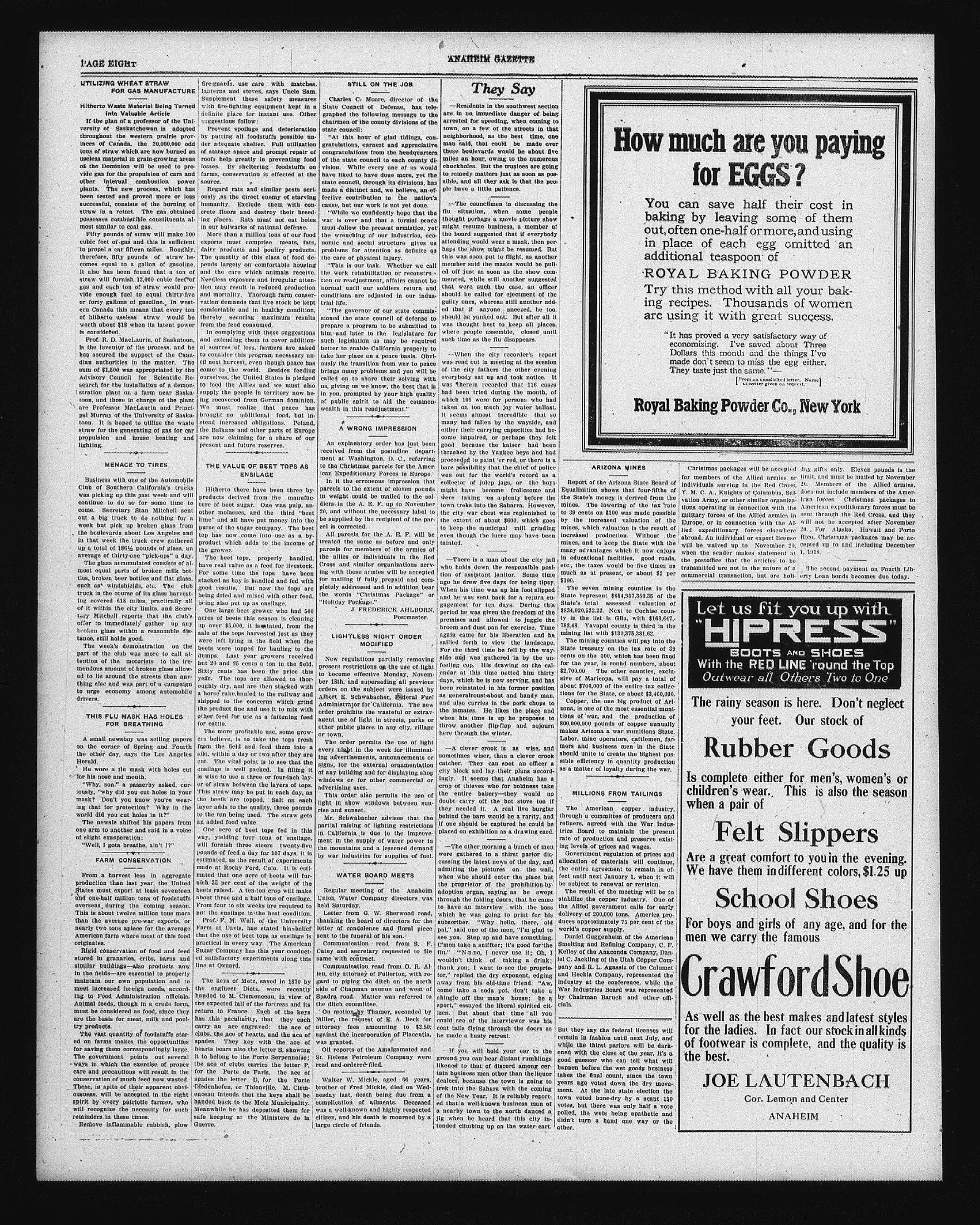
Searchable text
UTILIZING WHEAT STRAW FOR GAS MANUFACTURE
Hitherto Waste Material Being Turned Into Valuable Article
If the plan of a professor of the University of Saskatchewan is adopted throughout the western prairie provinces of Canada, the 20,000,000 odd tons of straw which are now burned as useless material in grain-growing areas of the Dominion will be used to provide gas for the propulsion of cars and other internal combustion power plants. The new process, which has been tested and proved more or less successful, consists of the burning of straw in a retort. The gas obtained possesses combustible constituents almost similar to coal gas.
Fifty pounds of straw will make 300 cubic feet of gas and this is sufficient to propel a car fifteen miles. Roughly, therefore, fifty pounds of straw becomes equal to a gallon of gasoline. It also has been found that a ton of straw will furnish 12,000 cubic feet of gas and each ton of straw would provide enough fuel to equal thirty-five or forty gallons of gasoline. In western Canada this means that every ton of hitherto useless straw would be worth about $18 when its latent power is considered.
Prof. R. D. MacLaurin, of Saskatoon, is the inventor of the process, and he has secured the support of the Canadian authorities in the matter. The sum of $1,500 was appropriated by the Advisory Council for Scientific Research for the installation of a demonstration plant on a farm near Saskatoon, and those in charge of the plant are Professor MacLaurin and Principal Murray of the University of Saskatoon. It is hoped to utilize the waste straw for the generating of gas for car propulsion and house heating and lighting.
fire-guards, use care with matches, lanterns and stoves, says Uncle Sam. Supplement these safety measures with fire-fighting equipment kept in a definite place for instant use. Other suggestions follow:
Prevent spoilage and deterioration by putting all foodstuffs possible under adequate shelter. Full utilization of storage space and prompt repair of roofs help greatly in preventing food losses. By sheltering foodstuffs on farms, conservation is effected at the source.
Regard rats and similar pests seriously as the direct enemy of starving humanity. Exclude them with concrete floors and destroy their breeding places. Rats must not eat holes in our bulwarks of national defense.
More than a million tons of our food exports must comprise meats, fats, dairy products and poultry products. The quantity of this class of food depends largely on comfortable housing and the care which animals receive. Needless exposure and irregular attention may result in reduced production and mortality. Thorough farm conservation demands that live stock be kept comfortable and in healthy condition, thereby securing maximum results from the feed consumed.
In complying with these suggestions and extending them to cover additional sources of loss, farmers are asked to consider this program necessary until next harvest, even though peace has come to the world. Besides feeding ourselves, the United States is pledged to feed the Allies and we must also supply the people in territory now being recovered from German dominion. We must realize that peace has brought no additional food, but instead increased obligations. Poland, the Balkans and other parts of Europe are now claiming for a share of our present and future reserves.
STILL
Charles C. State Council graphed the four chairmen of the state council:
"At this hour gratulations, ex congratulations of the state council vision. While have liked to be state council, made a distinct fective contrib cause, but our"
"While we can war is over and must follow ther e wrenching nomic and social problems for a care of phy"
"This is our work rehailation or readjust normal until our conditions are trial life."
"The governor sioned the state prepare a prog him and later such legislation better to enable take her place ousely the trans brings many pr pro called on to sh us, giving us w in you, prompted of public spirit wealth in this r"
A WRON
MENACE TO TIRES
Business with one of the Automobile Club of Southern California's trucks was picking up this past week and will continue to do so for some time to come. Secretary Stan Mitchell sent out a big truck to do nothing for a week but pick up broken glass from the boulevards about Los Angeles and in that week the truck crew gathered up a total of 186½ pounds of glass, an average of thirty-one "pick-ups" a day.
The glass accumulated consists of almost equal parts of broken milk bottles, broken beer bottles and flat glass, such as windshields, etc. The club truck in the course of its glass harvesting covered 618 miles, practically all of it within the city limits, and Secretary Mitchell reports that the club's offer to immediately gather up any broken glass within a reasonable distance, still holds good.
The week's demonstration on the part of the club was more to call attention of the motorists to the tremendous amount of broken glass allowed to lie around the streets than anything else and was part of a campaign to urge economy among automobile drivers.
THIS FLU MASK HAS HOLES FOR BREATHING
A small newsboy was selling papers on the corner of Spring and Fourth the other day, says the Los Angeles Herald.
He wore a flu mask with holes cut for his nose and mouth.
"Why, son," a passerby asked, curiously, "why did you cut holes in your mask? Don't you know you're wearing that for protection? Why in the world did you cut holes in it?"
The newsie shifted his papers from one arm to another and said in a voice of slight exasperation:
"Well, I got breathe, ain't I?"
FARM CONSERVATION
THE VALUE OF BEET TOPS AS ENSILAGE
Hitherto there have been three by-products derived from the manufacture of beet sugar. One was pulp, another molasses, and the third "beet lime" and all have put money into the purse of the sugar company. The beet top has now come into use as a by-product which adds to the income of the grower.
The beet tops, properly handled, have real value as a feed for livestock. For some time the tops have been stacked as hay is handled and fed with good results. But now the tops are being dried and mixed with other feed, being also put up as ensilage.
One large beet grower who had 500 acres of beets this season is cleaning up over $5,000, it is tated, from the sale of the tops harvested just as they were left lying in the field when the beets were topped for hauling to the dumps. Last year growers received but 20 and 25 cents a ton in the field. Sixty cents has been the price this year. The tops are allowed to thoroughly dry, and are then stacked with a horse rake, hauled to the railway and shipped to the concerns which grind the product fine and use it to mix with other feed for use as a fattening feed for cattle.
The more profitable use, some growers believe, is to take the tops fresh from the field and feed them into a silo, within a day or two after they are cut. The vital point is to see that the ensilage is well packed. In filling it is wise to use a three or four-inch layer of straw between the layers of tops. This straw may be put in each day, as the beets are topped. Salt on each layer adds to the quality, three pounds to the ton being used. The straw gets an added food value.
One acre of beet tops fed in this way, yielding four tons of ensilage, will furnish three steers twenty-five pounds of feed a day for 107 days, it is estimated, as the result of experiments mostly the transient brings many prairies called on to shove us, giving us wee in you, prompted of public spirit wealth in this new present and future reserves.
A WRONG
An explanation received from ment at Washington to the Christmas Expedition.
In it the error parcels to the e-mail in weight could diers in the A.A., 20, and without be supplied by the cel is corrected.
All parcels for treated the same parcels for men the allies or in Cross and similar with those are for mailing if they pletely addressed the words "Chief Holiday Packa J.F.R.
LIGHTLESS
New regulation present restrictive to become effect ber 18th, and su orders on the s Albert E. Schw Administrator for order prohibits agent use of light other-public place or town.
The order per every night in t ing advertisement signs, for the e f of any building windows or for advertising uses.
This order allow light in show rise and sunset.
Mr. Schwabac partial raising o in California is ment in the suphe mountains ad by war industry.
He wore a flu mask with holes cut for his nose and mouth.
"Why, son," a passerby asked, curiously, "why did you cut holes in your mask? Don't you know you're wearing that for protection? Why in the world did you cut holes in it?"
The newsie shifted his papers from one arm to another and said in a voice of slight exasperation:
"Well, I gota breathe, ain't I?"
FARM CONSERVATION
From a harvest less in aggregate production than last year, the United States must export at least seventeen and one-half million tons of foodstuffs overseas during the coming season. This is about twelve million tons more than the average pre-war exports, or nearly two tons apiece for the average American farm where most of this food originates.
Rigid conservation of food and feed stored in granaries, cribs, barns and similar buildings—also products now in the fields—are essential to properly maintain our own population and to meet increased foreign needs, according to Food Administration officials. Animal feeds, though in a crude form, must be considered as food, since they are the basis for meat, milk and poultry products.
The vast quantity of foodstuffs stored on farms makes the opportunities for saving them correspondingly large. The government points out several ways in which the exercise of proper care and precautions will result in the conservation of much feed now wasted. These, in spite of their apparent obliviousness, will be accepted in the right spirit by every patriotic farmer, who will recognize the necessity for such reminders in these times.
Remove inflammable rubbish, plow ensilage is well packed. In filling it is wise to use a three or four-inch layer of straw between the layers of tops. This straw may be put in each day, as the beets are topped. Salt on each layer adds to the quality, three pounds to the ton being used. The straw gets an added food value.
One acre of beet tops fed in this way, yielding four tons of ensilage, will furnish three steers twenty-five pounds of feed a day for 107 days, it is estimated, as the result of experiments made at Rocky Ford, Colo. It is estimated that one acre of beets will furnish 35 per cent of the weight of the beets raised. A ten-ton crop will make about three and a half tons of ensilage. From four to six weeks are required to put the ensilage in the best condition.
Prof. F. M. Woll, of the University Farm at Davis, has stated his belief that the use of beet tops as ensilage is practical in every way. The American Sugar Company has this year conducted satisfactory experiments along this line at Oxnard.
The keys of Metz, saved in 1870 by the engineer Dietz, were recently handed to M. Clemenceau, in view of the expected fall of the fortress and its return to France. Each of the keys has this peculiarity, that they each carry an ace engraved: the ace of clubs, the ace of hearts, and the ace of spades. They key with the ace of hearts bears also the letter S, showing it to belong to the Porte Serpennoise; the ace of clubs carries the letter P, for the Porte de Paris, the ace of spades the letter D, for the Porte Difedenhofen, or Thionville. M. Clemenceau intends that the keys shall be handed back to the Metz Municipality. Meanwhile he has deposited them for safe keeping at the Ministere de la Guerre.
WATER HARDWARE
Regular meeting Union Water Co., held Saturday.
Letter from O thankking the board letter of condolence sent to the funeral Communication Catey and secret same with contra Communication len, city attorney gard to piping the side of Chapman Spadra road. M. the ditch committee On motion by Miller, the request attorney fees against the incorn was granted.
Oil reports of St. Helens Petro read and ordered.
Walter W. Mit brother of Fred nnesday last, dead complication of was a well-known citizen, and his d large circle of frie
STILL ON THE JOB
Charles C. Moore, director of the State Council of Defense, has telegraphed the following message to the chairmen of the county divisions of the state council:
"At this hour of glad tidings, congratulations, earnest and appreciative congratulations from the headquarters of the state council to each county division. While every one of us would have liked to have done more, yet the state council, through its divisions, has made a distinct and, we believe, an effective contribution to the nation's cause, but our work is not yet done.
While we confidently hope that the war is over and that a formal peace must follow the present armistice, yet the wrenching of our industries, economic and social structure gives us problems for attention as definite as the care of physical injury.
This is our task. Whether we call the work rehabilitation or reconstruction or readjustment, affairs cannot be normal until our soldiers return and conditions are adjusted in our industrial life.
The governor of our state commissioned the state council of defense to prepare a program to be submitted to him and later to the legislature for such legislation as may be required better to enable California properly to take her place on a peace basis. Obviously the transition from war to peace brings many problems and you will be called on to share their solving with us, giving us we know, the best that is in you, prompted by your high quality of public spirit to aid the commonwealth in this readjustment."
A WRONG IMPRESSION
An explanatory order has just been received from the postoffice department at Washington D.C.
They Say
Residents in the southwest section are in no immediate danger of being arrested for speeding, when coming to town, on a few of the streets in that neighborhood, as the best time, one man said, that could be made over these boulevards would be about five miles an hour, owing to the numerous chuckholes. But the trustees are going to remedy matters just as soon as possible, and all they ask is that the people have a little patience.
The councilmen in discussing the flu situation, when some people thought perhaps a movie picture show might resume business, a member of the board suggested that if everybody attending would wear a mask, then perhaps the show might be resumed. But this was soon put to flight, as another member said the masks would be pulled off just as soon as the show commenced, while still another suggested that were such the case, an officer should be called for ejection of the guilty ones, whereas still another added that if anyone sneezed, he too, should be yanked out. But after all it was thought best to keep all places, where people assemble, closed until such time as the flu disappears.
When the city recorder's report was read out in meeting at the session of the city fathers the other evening everybody sat up and took notice. It was therein recorded that 116 cases had been tried during the month, of which 105 were for persons who had taken on too much joy water ballast. It seems almost incredible that so many had fallen by the wayside, and either their carrying capacities had become impaired, or perhaps they felt good because the kaiser had been thrashed by the Yankee boys and had
A WRONG IMPRESSION
An explanatory order has just been received from the postoffice department at Washington, D. C., referring to the Christmas parcels for the American Expeditionary Forces in Europe.
In it the erroneous impression that parcels to the extent of eleven pounds in weight could be mailed to the soldiers in the A. E. F. up to November 20, and without the necessary label to be supplied by the recipient of the parcel is corrected.
All parcels for the A. E. F. will be treated the same as before and only parcels for members of the armies of the allies or individuals in the Red Cross and similar organizations serving with those armies will be accepted for mailing if fully prepaid and completely addressed and in addition bear the words "Christmas Package" or "Holiday Package."
J. FREDERICK AHLBORN, Postmaster.
LIGHTLESS NIGHT ORDER MODIFIED
New regulations partially removing present restrictions on the use of light to become effective Monday, November 18th, and superseding all previous orders on the subject were issued by Albert E. Schwabacher, Federal Fuel Administrator for California. The new order prohibits the wasteful or extra-agent use of light in streets, parks or other public places in any city, village or town.
The order permits the use of light every night in the week for illuminating advertisements, announcements or signs, for the external ornamentation of any building and for displaying shop windows or for other commercial or advertising uses.
This order also permits the use of light in show windows between sunrise and sunset.
Mr. Schwabacher advises that the partial raising of lighting restrictions in California is due to the improvement in the supply of water power in the mountains and a lessened demand by war industries for supplies of fuel.
was read out in meeting at the session of the city fathers the other evening everybody sat up and took notice. It was therein recorded that 116 cases had been tried during the month, of which 105 were for persons who had taken on too much joy water ballast. It seems almost incredible that so many had fallen by the wayside, and either their carrying capacities had become impaired, or perhaps they felt good because the kaiser had been thrashed by the Yankee boys and had proceeded to paint 'er red, or there is a bare possibility that the chief of police was out for the world's record as a collector of julep jags, or the boys might have become frolicsome and were taking on a plenty before the town treks into the Saharra. However, the city war chest was replenished to the extent of about $600, which goes to keep the municipal mill grinding even though the lucre may have been tainted.
There is a man about the city jail who holds down the responsible position of assistant janitor. Some time ago he drew five days for being tipsy. When his time was up his foot slipped and he was sent back for a return engagement for ten days. During this period he was given the freedom of the premises and allowed to juggle the broom and dust pan for exercise. Time again came for his liberation and he sallied forth to view the landscape. For the third time he fell by the way-side and was gathered in by the feeling cop. His drawing on the calendar at this time netted him thirty days, which he is now serving, and has been reinstated in his former position as generalroust-about and handy man, and also carries in the pork chops to the inmates. He likes the place and when his time is up he proposes to throw another flip-flap and sojourn here through the winter.
A clever crook is as wise, and sometimes wiser, than a clever crook catcher. They can spot an officer a city block and lay their plans accordingly. It seems that Anaheim has a crop of thieves who for boldness take the entire bakery—they would no doubt carry off the hot stove too if they needed it. A real live burglar behind the bars would be a rarity, and if one should be captured he could be placed on exhibition as a drawing card.
The other morning a bunch of men were gathered in a thirst parlor discussing the latest news of the day, and
ARIZONA MINES
Report of the Arizona State Board of Equalization shows that four-fifths of the State's money is derived from the mines. The lowering of the tax rate to 39 cents on $100 was made possible by the increased valuation of the mines, which valuation is the result of increased production. Without the mines, and to keep the State with the many advantages which it now enjoys in educational facilities, good roads, etc., the taxes would be five times as much as at present, or about $2 per $100.
The seven mining counties in the State represent $654,957,350.35 of the State's total assessed valuation of $834,020,532.22. Next to Cochise county in the list is Gila, with $163,647,-782.48. Yavapai county is third in the mining list with $130,375,381.62.
The mining counties will pay into the State treasury on the tax rate of 39 cents on the 100, which has been fixed for the year, in round numbers, about $2,700.00. The other counties, exclusive of Maricopa, will pay a total of about $700,000 of the entire tax collections for the State, or about $3,400,000.
Copper, the one big product of Arizona, is one of the most essential munitions of war, and the production of 800,000,000 pounds of copper annually makes Arizona a war munitions State. Labor, mine operators, cattlemen, farmers and business men in the State should unite to create the highest possible efficiency in quantity production as a matter of loyalty during the war.
MILLIONS FROM TAILINGS
The American copper industry, through a committee of producers and refiners, agreed with the War Industries Board to maintain the present rate of production and preserve existing levels of prices and wages.
Government regulation of prices and allocation of materials will continue,
WATER BOARD MEETS
Regular meeting of the Anaheim Union Water Company directors was held Saturday.
Letter from G. W. Sherwood read, thanking the board of directors for the letter of condolence and floral piece sent to the funeral of his son.
Communication read from S. F. Catey and secretary requested to file same with contract.
Communication read from O. R. Allen, city attorney of Fullerton, with regard to piping the ditch on the north side of Chapman avenue and west of Spadra road. Matter was referred to the ditch committee.
On motion by Thamer, seconded by Miller, the request of E. A. Beck for attorney fees amounting to $2.50; against the incorporation of Placentia, was granted.
Oil reports of the Amalgamated and St. Helens Petroleum Company were read and ordered filed.
Walter W. Mickle, aged 66 years, brother of Fred Mickle, died on Wednesday last, death being due from a complication of ailments. Deceased was a well-known and highly respected citizen, and his death is mourned by a large circle of friends.
The other morning a bunch of men were gathered in a thirst parlor discussing the latest news of the day, and admiring the pictures on the wall, when who should enter the place but the proprietor of the prohibition-by-adoption organ, saying as he swept through the folding doors, that he came to have an interview with the boss which he was going to print for his subscriber. "Why hello, there, old pal," said one of the men, "I'm glad to see you. Step up and have something. C'mon take a sniffler; it's good for the flu." "N-n-no, I never use it; Oh, I wouldn't think of taking a drink; thank you; I want to see the proprietor," replied the dry exponent, edging away from his old-time friend. "Aw, come take a soda pot, don't take a shingle off the man's house; be a sport," essayed the liberal spirited citizen. But about that time all you could see of the interviewer was his coat tails flying through the doors as he made a hasty retreat.
If you will hold your ear to the ground you can hear distant rumblings likened to that of discord among certain business men other than the liquor dealers, because the town is going to trek into the Sahara with the coming of the New Year. It is reliably reported that a well-known business man of a nearby town to the north danced a jig when he heard that this city intended climbing up on the water cart.
MILLIONS FROM TAILINGS
The American copper industry, through a committee of producers and refiners, agreed with the War Industries Board to maintain the present rate of production and preserve existing levels of prices and wages.
Government regulation of prices and allocation of materials will continue, the entire agreement to remain in effect until next January 1, when it will be subject to renewal or revision.
The result of the meeting will be to stabilize the copper industry. One of the Allied government calls for early delivery of 200,000 tons. America produces approximately 75 per cent of the world's copper supply.
Daniel Guggenheim of the American Smelting and Refining Company, C. F. Kelley of the Anaconda Company, Daniel C. Jackling of the Utah Copper Company and R. L. Agassiz of the Calumet and Heckla Company, represented the industry at the conference, while the War Industries Board was represented by Chairman Baruch and other officials.
But they say the federal licenses will remain in fashion until next July, and while the thirst parlors will be darkened with the close of the year, it's a good guesser who can tell what will happen before the wet goods business takes the final count, since the town years ago voted down the dry movement. At the late state election the town voted bone-dry by a scant 150 votes, but there was only half a vote polled, the wets being apathetic and didn't turn a hand one way or the other.
How much are you paying for EGGS?
You can save half their cost in baking by leaving some of them out, often one-half or more, and using in place of each egg omitted an additional teaspoon of ROYAL BAKING POWDER
Try this method with all your baking recipes. Thousands of women are using it with great success.
"It has proved a very satisfactory way of economizing. I've saved about Three Dollars this month and the things I've made don't seem to miss the egg either. They taste just the same."
[From an unsolicited letter, Name]
of writer given on request.
Royal Baking Powder Co., New York
Royal Baking Powder Co., New York
Christmas packages will be accepted for members of the Allied armies or individuals serving in the Red Cross, Y. M. C. A. Knights of Columbus, Salvation Army, or other similar organizations operating in connection with the military forces of the Allied armies in Europe, or in connection with the Allied expeditionary forces elsewhere abroad. An individual or export license will be waived up to November 20, when the sender makes statement at the postoffice that the articles to be transmitted are not in the nature of a commercial transaction, but are holiday gifts only. Eleven pounds is the limit, and must be mailed by November 20. Members of the Allied armies, does not include members of the American forces. Christmas packages to American expeditionary forces must be sent through the Red Cross, and they will not be accepted after November 20., For Alaska, Hawaii and Porto Rico. Christmas packages may be accepted up to and including December 1, 1918.
The second payment on Fourth Liberty Loan bonds becomes due today.
Let us fit you up with "HIPRESS"
BOOTS AND SHOES
With the RED LINE around the Top
Outwear all Others Two to One
The rainy season is here. Don't neglect your feet. Our stock of Rubber Goods
Is complete either for men's, women's or children's wear. This is also the season when a pair of Felt Slippers
Are a great comfort to you in the evening.
Is complete either for men's, women's or children's wear. This is also the season when a pair of
Felt Slippers
Are a great comfort to you in the evening. We have them in different colors, $1.25 up
School Shoes
For boys and girls of any age, and for the men we carry the famous
CrawfordShoe
As well as the best makes and latest styles for the ladies. In fact our stock in all kinds of footwear is complete, and the quality is the best.
JOE LAUTENBACH
Cor. Lemon and Center
ANAHEIM