anaheim-gazette 1918-11-14
Scanned page
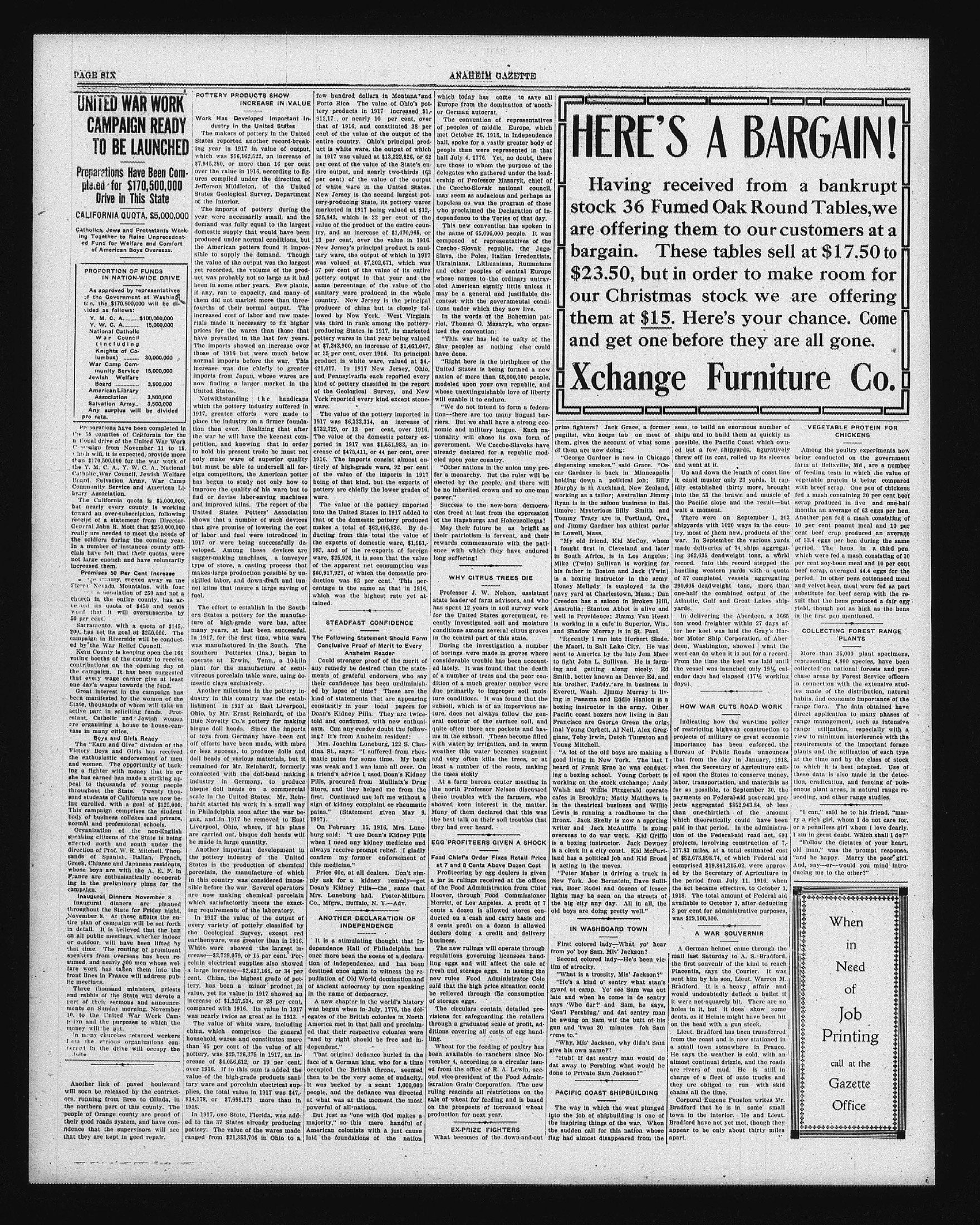
Searchable text
UNITED WAR WORK
CAMPAIGN READY
TO BE LAUNCHED
Preparations Have Been Completed for $170,500,000 Drive in This State
CALIFORNIA QUOTA, $5,000,000
Catholics, Jews and Protestants Working Together to Raise Unprecedented Fund for Welfare and Comfort of American Boys Overseas.
PROPORTION OF FUNDS IN NATION-WIDE DRIVE
As approved by representatives of the Government at Washington, the $170,500,000 will be divided as follows:
Y. M. C. A.....$100,000,000
Y. W. C. A.....15,000,000
National Catholic War Council (including Knights of Columbus) .....30,000,000
War Camp Community Service 15,000,000
Jewish Welfare Board .....3,500,000
American Library Association ...3,500,000
Salvation Army..3,500,000
Any surplus will be divided pro rata.
Preparations have been completed in the 58 counties of California for the national drive of the United War Work Campaign from November 11 to 18. Which will, it is expected, provide more pottery products show increase in value
Work Has Developed Important Industry in the United States
The makers of pottery in the United States reported another record-breaking year in 1917 in value of output, which was $56,162,522, an increase of $7,945,280, or more than 16 per cent over the value in 1916, according to figures compiled under the direction of Jefferson Middleton, of the United States Geological Survey, Department of the Interior.
The imports of pottery during the year were necessarily small, and the demand was fully equal to the largest domestic supply that would have been produced under normal conditions, but the American potters found it impossible to supply the demand. Though the value of the output was the largest yet recorded, the volume of product was probably not so large as it had been in some other years. Few plants, if any, ran to capacity, and many of them did not market more than three-fourths of their normal output. The increased cost of labor and raw materials made it necessary to fix higher prices for the wares than those that have prevailed in the last few years. The imports showed an increase over those of 1916 but were much below normal imports before the war. This increase was due chiefly to greater imports from Japan, whose wares are now finding a larger market in the United States.
Notwithstanding the handicaps which the pottery industry suffered in 1917, greater efforts were made to place the industry on a firmer foundation than ever. Realizing that after the war he will have the keenest competition, and knowing that in order to hold his present trade he must not few hundred dollars Porto Rico. The pottery products in 912,17., or nearly that of 1916, and cent of the value entire country. In 1917 was valued per cent of the vat output, and per cent) of the white ware in New Jersey is the tery-producing St marketed in 1917. 535,843, which is value of the product and an increase 13 per cent, over New Jersey's primary ware, the out was valued at $57 per cent of the pottery output in same percentage sanitary ware pr country. New Jersey producer of chin lowed by New Y was third in rank producing States pottery wares in th at $7,243,900, an or 25 per cent, over product is white 421,017. In 1917 and Pennsylvania kind of pottery cl of the Geological York reported even ware.
The value of the 1917 was $6,333,323; $732,729, or 13 p The value of the ported in 1917 w crease of $475,411
Preparations have been completed in the 58 counties of California for the national drive of the United War Work Campaign from November 11 to 18. Which will, it is expected, provide more than $170,500,000 for the war work of the Y. M. C. A., Y. W. C. A., National Catholic War Council, Jewish Welfare Board, Salvation Army, War Camp Community Service and American Library Association.
The California quota is $5,000,000, but nearly every county is working toward an over-subscription, following receipt of a statement from Director-General John R. Mott that $250,000,000 really are needed to meet the needs of the soldiers during the coming year. In a number of instances county officials have felt that their quotas were not large enough and have voluntarily increased them.
Promises 50 Per Cent Increase
County, rucked away in the Sierra Nevada Mountains, with four populations of 250 and not a church in the entire county, has accepted its quota of $450 and sends word that it will oversubscribe by 50 per cent.
Sacramento, with a quota of $145,200, has set its goal at $250,000. The campaign in Riverside will be conducted by the War Relief Council.
Kern County is keeping open the 166 voting booths of the county to receive contributions on the opening day of the campaign. It has been suggested that every wage earner give at least one day's wages towards the fund.
Great interest in the campaign has been manifested by the women of the State, thousands of whom will take an active part in soliciting funds. Protestant, Catholic and Jewish women are organizing a house to house canvass in many cities.
Boys and Girls Ready
The "Earn and Give" division of the Victory Boys and Girls has received the enthusiastic endorsement of men and women. The opportunity of backing a fighter with money that he or she has earned has made a striking appeal to thousands of young people throughout the State. Twenty thousand students of California are now being enrolled, with a goal of $125,000. This campaign comprises the student body of business colleges and private, normal and professional schools.
Organization of the non-English speaking citizens of the State is being effected north and south under the direction of Prof. W. R. Mitchell. Thousands of Spanish, Italian, French, Greek, Chinese and Japanese residents.
Notwithstanding the handicaps which the pottery industry suffered in 1917, greater efforts were made to place the industry on a firmer foundation than ever. Realizing that after the war he will have the keenest competition, and knowing that in order to hold his present trade he must not only make ware of superior quality but must be able to undersell all foreign competitors, the American potter has begun to study not only how to improve the quality of his ware but to find or devise labor-saving machines and improved kilns. The report of the United States Potters' Association shows that a number of such devices that give promise of lowering the cost of labor and fuel were introduced in 1917 or were being successfully developed. Among these devices are sagger-making machines, a lonveyor type of stove, a casting process that makes-large production possible by unskilled labor, and down-draft and tunnel kilns that insure a large saving of fuel.
The effort to establish in the Southern States a pottery for the manufacture of high-grade ware has, after many years, at last been successful. In 1917, for the first time, white ware was manufactured in the South. The Southern Potteries (Ins.), began to operate at Erwin, Tenn., a 10-kiln plant for the manufacture of semitreous porcelain table ware, using domestic clays exclusively.
Another milestone in the pottery industry in this country was the establishment in 1917 at East Liverpool, Ohio, by Mr. Ernst Reinhardt, of the Bisc Novelty Co.'s pottery for making bisque doll heads. Since the imports of toys from Germany have been cut off efforts have been made, with mbre or less success, to produce dolls and doll heads of various materials, but it remained for Mr. Reinhardt, formerly connected with the doll-head making industry in Germany, to produce bisque doll heads on a commercial scale in the United States. Mr. Reinhardt started his work in a small way in Philadelphia soon after the war began, and in 1917 he removed to East Liverpool, Ohio, where, if his plans are carried out, bisque doll heads will be made in large quantity.
Another important development in the pottery industry of the United States is the production of chemical normal imports before the war. This increase was due chiefly to greater imports from Japan, whose wares are now finding a larger market in the United States.
Notwithstanding the handicaps which the pottery industry suffered in 1917, greater efforts were made to place the industry on a firmer foundation than ever. Realizing that after the war he will have the keenest competition, and knowing that in order to hold his present trade he must not only make ware of superior quality but must be able to undersell all foreign competitors, the American potter has begun to study not only how to improve the quality of his ware but to find or devise labor-saving machines and improved kilns. The report of the United States PotTERS' Association shows that a number of such devices that give promise of lowering the cost of labor and fuel were introduced in 1917 or were being successfully developed. Among these devices are sagger-making machines, a lonveyor type of stove, a casting process that makes-large production possible by unskilled labor, and down-draft and tunnel kilns that insure a large saving of fuel.
The effort to establish in the Southern States a pottery for the manufacture of high-grade ware has, after many years, at last been successful. In 1917, for the first time, white ware was manufactured in the South. The Southern Potteries (Ins.), began to operate at Erwin, Tenn., a 10-kiln plant for the manufacture of semitreous porcelain table ware, using domestic clays exclusively.
Another milestone in the pottery industry in this country was the establishment in 1917 at East Liverpool, Ohio, by Mr. Ernst Reinhardt, of the Bisc Novelty Co.'s pottery for making bisque doll heads. Since the imports of toys from Germany have been cut off efforts have been made with mbre or less success, to produce dolls and doll heads of various materials, but it remained for Mr. Reinhardt, formerly connected with the doll-head making industry in Germany, to produce bisque doll heads on a commercial scale in the United States. Mr. Reinhardt started his work in a small way in Philadelphia soon after the war began, and in 1917 he removed to East Liverpool, Ohio, where, if his plans are carried out, bisque doll heads will be made in large quantity.
Mrs. Joachim Luina St., says: "I amatic pains for so weak and I was a friend's advice I Pills, procured from Store, and they buy first. Continued use sign of kidney compains." (Statemei 1907).
On February 18 burg said: "I use when I need any kind of pottery cloth or of the Geological York reported evenware.
The value of the 1917 was $6,333,333; $732,729; or 13 pts. The value of the ported in 1917 was crease of $475,411; 1916. The importance tirely of high-grade of the value of being of that kind pottery are chiefly ware.
The value of th into the United State that of the domes makes a total of ducting from this exports of do 983, and of the m ware,$25,926; it is of the apparent m $60,917,927; of whi duction was 92 percentage is the sa which was he tained.
STEADFAST
The Following Sta Conclusive Proof Anahelic Could stronger p any remedy be dements of grateful their confidence h ed by lapse of th kind of statements constantly in your Doan's Kidney Pill told and confirmed asm. Can any read ing? It's from Ana Mrs. Joachim Luina St., says: "I matic pains for so weak and I was a friend's advice I Pills, procured from Store, and they buy first. Continued u sign of kidney compains." (Statemei 1907).
ing a fighter with money that he or she has earned has made a striking appeal to thousands of young people throughout the State. Twenty thousand students of California are now being enrolled, with a goal of $125,000. This campaign comprises the student body of business colleges and private, normal and professional schools.
Organization of the non-English speaking citizens of the State is being effected north and south under the direction of Prof. W. R. Mitchell. Thousands of Spanish, Italian, French, Greek, Chinese and Japanese residents, whose boys are with the A. E. F. in France are enthusiastically co-operating in the preliminary plans for the campaign.
Inaugural Dinners November 8
Inaugural dinners are planned throughout the State for Friday night, November 8. At these affairs the entire plan of campaign will be set forth in detail. It is believed that the ban on all public meetings, whether indoor or outdoor, will have been lifted by that time. The routing of prominent speakers from overseas has been resumed, and nearly 200 men whose welfare work has taken them into the front lines in France will address public meetings.
Three thousand ministers, priests and rabbis of the State will devote a part of their sermons and announcements on Sunday morning, November 10, to the United War Work Campaign and the purposes to which the money will be put.
In many churches returned workers from the various organizations concerned in the drive will occupy the labor.
Another link of paved boulevard will soon be released by the contractors, running from Brea to Olinda, in the northern part of this county. The people of Orange county are proud of their good roads system, and have confidence that the supervisors will see that they are kept in good repair.
Another important development in the pottery industry of the United States is the production of chemical porcelain, the manufacture of which in this country was considered impossible before the war. Several operators are now making chemical porcelain which satisfactorily meets the exacting requirements of the laboratory.
In 1917 the value of the output of every variety of pottery classified by the Geological Survey, except red earthenware, was greater than in 1916. White ware showed the largest increase—$2,729,079, or 15 per cent. Porcelain electrical supplies also showed a large increase—$2,417,166, or 34 per cent. China, the highest grade of pottery, has been a minor product in value, yet its value in 1917 showed an increase of $1,327,534, or 28 per cent, compared with 1916. Its value in 1917 was nearly twice as great as in 1913.
The value of white ware, including china, which comprises the general household wares and constitutes more than 45 per cent of the value of all pottery, was $25,726,375 in 1917, an increase of $4,056,612, or 19 per cent, over 1916. If to this sum is added the value of the high-grade products sanitary ware and porcelain electrical supplies, the total value in 1917 was $47,814,178, or $7,998,179 more than in 1916.
In 1917, one State, Florida, was added to the 37 States already producing pottery. The value of the wares made ranged from $21,353,706 in Ohio to a connected with the doll-head making industry in Germany, to produce bisque doll heads on a commercial scale in the United States. Mr. Reinhardt started his work in a small way in Philadelphia soon after the war began, and in 1917 he removed to East Liverpool, Ohio, where, if his plans are carried out, bisque doll heads will be made in large quantity.
Another important development in the pottery industry of the United States is the production of chemical porcelain, the manufacture of which in this country was considered impossible before the war. Several operators are now making chemical porcelain which satisfactorily meets the exacting requirements of the laboratory.
In 1917 the value of the output of every variety of pottery classified by the Geological Survey, except red earthenware, was greater than in 1916. White ware showed the largest increase—$2,729,079, or 15 per cent. Porcelain electrical supplies also showed a large increase—$2,417,166, or 34 per cent. China, the highest grade of pottery, has been a minor product in value, yet its value in 1917 showed an increase of $1,327,534, or 28 per cent, compared with 1916. Its value in 1917 was nearly twice as great as in 1913.
The value of white ware, including china, which comprises the general household wares and constitutes more than 45 per cent of the value of all pottery, was $25,726,375 in 1917, an increase of $4,056,612, or 19 per cent, over 1916. If to this sum is added the value of the high-grade products sanitary ware and porcelain electrical supplies, the total value in 1917 was $47,814,178, or $7,998,179 more than in 1916.
In 1917 one State, Florida was added to the 37 States already producing pottery. The value of the wares made ranged from $21,353,706 in Ohio to a connected with the doll-head making industry in Germany, to produce bisque doll heads on a commercial scale in the United States. Mr. Reinhardt started his work in a small way in Philadelphia soon after the war began,and in 1917 he removed to East Liverpool, Ohio where, if his plans are carried out,bisque doll heads will be made in large quantity.
Another important development in the pottery industry of the United States is the production of chemical porcelain,the manufacture of which in this country was considered impossible before the war. Several operators are now making chemical porcelain which satisfactorily meets the exacting requirements of the laboratory.
In 1917 the value of the output of every variety of pottery classified by the Geological Survey except red earthenware was greater than in 1916. White ware showed the largest increase—$2,729,079,or 15 per cent.Porcelain electrical supplies also showed a large increase—$2,417,166,or 34 per cent.中国,the highest grade.of.pottery,has.been.a.minor.product.in.value,yet its.value.in.1917.showedanincrease.of.$1,327,534.or28percent.compared.with.1916.Its.value.in.1917wasnearly.twice.as.great.asin.1913.
The value of white ware,包括 china,which comprises the general household wares和 constitutes more than 45 per cent.of.thevalue.of.allpottery.was $25,726,375in 1917,anincreaseof $4,056,612,或19percent。over 1916.Iftothissumisaddedthevalueofthehigh-gradeproducts sanitarywareandporcelainelectricalsupplies,thetotalvaluein1917was$47,814,178,或$7,998,179morethanin 1916.
In 1917 one State,Florida,was added tothe37Statesalreadyproducingpottery.Thevalueofthewaresmaderangedfrom$21,353,706inOhiotoa
It is a stimulating dependence Hall once more been tionofindependence destined once again pudiationOfOldWoof ancient autocraciesinthenameofdemains.AnewchapterinwasbegunwheninegatesoftheBritishAmerica metinhadcedthattheirrespectandbyrightshowdependent."
That original defianceofaGermankinderoccupiedtheBritishthentobe-theveryItwasbackedbypeoples,andthedefatwhatwasatthepowerfulofallnation.
But just as "onemajority," so thisAmericancolonistslaidthefoundation
ANAHEIM GAZETTE
few hundred dollars in Montana* and Porto Rico. The value of Ohio's pottery products in 1917 increased $1,912,17., or nearly 10 per cent, over that of 1916, and constituted 38 per cent of the value of the output of the entire country. Ohio's principal product is white ware, the output of which in 1917 was valued at $13,222,826, or 62 per cent of the value of the State's entire output, and nearly two-thirds (63 per cent) of the value of the output of white ware in the United States. New Jersey is the second largest pottery-producing State, its pottery wares marketed in 1917 being valued at $12,535,843, which is 22 per cent of the value of the product of the entire country, and an increase of $1,470,965, or 13 per cent, over the value in 1916. New Jersey's principal product is sanitary ware, the output of which in 1917 was valued at $7,202,671, which was 57 per cent of the value of its entire pottery output in that year and the same percentage of the value of the sanitary ware produced in the whole country. New Jersey is the principal producer of China but is closely followed by New York. West Virginia was third in rank among the pottery-producing States in 1917, its marketed pottery wares in that year being valued at $7,243,900, an increase of $1,463,047, or 25 per cent, over 1916. Its principal product is white ware, valued at $4,-421,017. In 1917 New Jersey, Ohio, and Pennsylvania each reported every kind of pottery classified in the report of the Geological Survey, and New York reported every kind except stoneware.
The value of the pottery imported in 1917 was $6,333,314, an increase of $732,729, or 13 per cent, over 1916. The value of the domestizic pottery exported in 1917 was $1,551,983, an increase of $475,411, or 44 per cent, over which today has come to save all Europe from the domination of another German autocrat.
The convention of representatives of peoples of middle Europe, which met October 26, 1918, in Independence hall, spoke for a vastly greater body of people than were represented in that hall July 4, 1776. Yet, no doubt, there are those to whom the purpose of the delegates who gathered under the leadership of Professor Masaryk, chief of the Czecho-Slovak national council, may seem as audacious and perhaps as hopeless as was the program of those who proclaimed the Declaration of Independence to the Tories of that day.
This new convention has spoken in the name of 65,000,000 people. It was composed of representatives of the Czecho-Slovak republic, the JugoSlavs, the Poles, Italian Irredentists, Ukrainians, Lithuanians, Rumanians and other peoples of central Europe whose names to the ordinary untraveled American signify little unless it may be a general and justifiable contest with the governmental conditions under which they now live.
In the words of the Bohemian patriot, Thomas G. Masaryk, who organized the convention:
"This war has led to unity of the Slav peoples as nothing else could have done.
"Right here in the birthplace of the United States is being formed a new nation of more than 65,000,000 people, modeled upon your own republic, and whose unextinguishable love of liberty will enable it to endure.
"We do not intend to form a federation—there are too many lingual barriers. But we shall have a strong economic and military league. Each nationality will choose its own form of government. We Czecho-Slavoks have already declared for a republic mod-
This greater reserves are in the indicapses offered in trade to foundafter last order must not be equally all-for-form now but to machines of the association devices one cost placed in daily deies are conveyer that by un-tuning of the making imports cutembre and but it merely making produce commercial Reinforcing way bear East plans will cont in United chemical
STEADFAST CONFIDENCE
The Following Statement Should Form Conclusive Proof of Merit to Every Anaheim Reader
Could stronger proof of the merit of any remedy be desired than the statements of grateful endorsers who say their confidence has been undiminished by lapse of time? These are the kind of statements that are appearing constantly in your local papers for Doan's Kidney Pills. They are twice-told and confirmed, with new enthusiasm. Can any reader doubt the following? It's from Anaheim resident:
Mrs. Joachim Luneburg, 122 S. Claudina St., says: "I suffered from rheumatic pains for some time. My back was weak and I was lame all over. On a friend's advice I used Doan's Kidney Pills, procured from Mullinix's Drug Store, and they helped me from the first. Continued use left without a sign of kidney complaint or rheumatic pains." (Statement given May 9, 1907).
On February 15, 1916, Mrs. Luneburg said: "I use Doan's Kidney Pills when I need any kidney medicine and always receive prompt relief. I gladly confirm my former endorsement of this medicine."
RIGHT here in the birthplace of the United States is being formed a new nation of more than 65,000,000 people, modeled upon your own republic, and whose unextinguishable love of liberty will enable it to endure.
"We do not intend to form a federation—there are too many lingual barriers. But we shall have a strong economic and military league. Each nationality will choose its own form of government. We Czecho-Slavoks have already declared for a republic modeled upon your country.
"Other nations in the union may prefer a monarchy. But the ruler will be elected by the people, and there will be no inherited crown and no one-man power."
Success to the new-born democracies freed at last from the oppression of the Hapsburgs and Hohenzollerns!
May their future be as bright as their patriotism is fervent, and their rewards commensurate with the patience with which they have endured long suffering!
WHY CITRUS TREES DIE
Professor J. W. Nelson, assistant state leader of farm advisors, and who has spent 12 years in soil survey work for the United States government, recently investigated soil and moisture conditions among several citrus groves in the central part of this state.
During the investigation a number of borings were made in groves where considerable trouble has been accounted lately. It was found that the death of a number of trees and the poor condition of a much greater number were due primarily to improper soil moisture conditions. It was found that the subsolil, which is of an impervious nature, does not always follow the general contour of the surface soil, and quite often there are pockets and basins in the subsolil. These become filled with water by irrigation, and in warm weather this water becomes stagnant and very often kills the trees, or at least a number of the roots, making the trees sickly.
At a farm bureau center meeting in the north Professor Nelson discussed these troubles with the farmers, who showed keen interest in the matter. Many of them declared that this was the best talk on their soil troubles that they had ever heard.
EGG PROFITEERS GIVEN A SHOCK
Food Chief's Order Fixes Retail Price at 7 and 8 Cents Above Dezen Cost
prize fighters? Jack Grace, a former pugilist, who keeps tab on most of them, gives the account of what some of them are now doing:
"George Gardner is now in Chicago dispensing smokes," said Grace. "Oscar Gardner is back in Minneapolis holding down a political job; Billy Murphy is in Auckland, New Zealand, working as a tailor; Australian Jimmy Ryan is in the saloon business in Baltimore; Mysterious Billy Smith and Tommy Tracy are in Portland, Ore., and Jimmy Gardner has athirst parlor in Lowell, Mass.
"My old friend, Kid McCoy, whom I fought first in Cleveland and later in South Africa, is in Los Angeles; Mike (Twin) Sullivan is working for his father in Boston and Jack (Twin) is a boxing instructor in the army. Honey Mellody is employed in the navy yard at Charlestown, Mass.; Dan Creedon has a saloon in Broken Hill, Australia; Stanton Abbot is alive and well in Providence; Jimmy Van Heest is working in a cafe in Superior, Wis., and Shadow Murray is in St. Paul.
"Recently I ran into Herbert Slade, the Maori, in Salt Lake City. He was sent to America by the late Jem Mace to fight John L. Sullivan. He is farming and getting along nicely. Ed Smith, better known as Denver Ed, and his brother, Paddy, are in business in Everett, Wash. Jimmy Murray is living in Panama and Eddie Hanlon is a boxing instructor in the army. Other Pacific coast boxes now living in San Francisco are George Green the original Young Corbett, Al Neill, Alex Greggians, Toby Irwin, Dutch Thurston and Young Mitchell.
"A lot of the old boys are making a good living in New York. The last I heard of Frank Erne he was conducting a boxing school. Young Corbett is working on the stock exchange; Andy Walsh and Willie Fitzgerald operate cafes in Brooklyn; Matty Matthews is in thetheatrical business and Willie Lewis is running a roadhouse In the Bronx. Jack Skelly is now a sporting writer and Jack McAuliffe is going overseas to do war work. Kid Griffo is a boxing instructor. Jack Downey is a clerk in a city court. Kid McPartland has a political job and Kid Broad is seas, ships possible bus threw ww up it could idly enter into the Pa pal wait at them shipyards try m m war made 36 records hustlin of 37 290,605 one-had Atlanta yards. In d ton wen her borer Mdeen west c o From the ve endar days).
HOW
India of rest project import Bureau that fr when t ed upon labor far as payment jects a than which paid im ion project 377.83 of $52.45
On February 15, 1916, Mrs. Luneburg said: "I use Doan's Kidney Pills when I need any kidney medicine and always receive prompt relief. I gladly confirm my former endorsement of this medicine."
Price 60c, at all dealers. Don't simply ask for a kidney remedy—get Doan's Kidney Pills—the same that Mrs. Luneburg had. Foster-Milburn Co., Mfgrs., Buffalo, N. Y.—Adv.
ANOTHER DECLARATION OF INDEPENDENCE
It is a stimulating thought that Independence Hall of Philadelphia has once more been the scene of a declaration of independence, and has been destined once again to witness the repudiation of Old World domination and of ancient autocracy by men speaking in the name of democracy.
A new chapter in the world's history was begun when in July, 1776, the delegates of the British colonies in North America met in that hall and proclaimed that their respective colonies were "and by right should be free and independent."
That original defiance hurled in the face of a German king, who for a time occupied the British throne, seemed then to be the very acme of audacity. It was backed by a scant 3,000,000 people, and the defiance was directed at what was at the moment the most powerful of all nations.
But just as "one with God makes a majority," so this mere handful of American colonists with a just cause laid the foundations of the nation.
EGG PROFITEERS GIVEN A SHOCK
Food Chief's Order Fixes Retail Price at 7 and 8 Cents Above Dozen Cost
Profeiteering by egg dealers is given a jar in rulings received at the offices of the Food Administration from Chief Hoover, through Food Commissioner Merritt, of Los Angeles. A profit of 7 cents a dozen is allowed stores conducted on a cash and carry basis and 8 cents profit on a dozen is allowed dealers doing a credit and delivery business.
The new rulings will operate through regulations governing licensees handling eggs and will affect the sale of fresh and storage eggs. In issuing the new rules Food Administrator Cole said that the high price situation could be relieved through the consumption of storage eggs.
The circulars contain detailed provisions for safeguarding the retailers through a graduated scale of profit, additions covering all costs of egg handling.
Wheat for the feeding of poultry has been available to ranchers since November 4, according to a circular issued from the office of R. A. Lewin, second vice-president of the Food Administration Grain Corporation. The new ruling rescinds all restrictions on the sale of wheat for feeding and is based on the prospects of increased wheat production for next year.
EX-PRIZE FIGHTERS
What becomes of the down-and-out
First colored lady—What yo' hear from yo' boy Sam. Mis' Jackson?
Second colored lady—He's been victim of atrocity.
"What is a trossity, Mis' Jackson?"
"He's a kind o' sentry what stan's gyard at camp. Yo' see Sam was out late and when he come in de sentry says 'Who dar?' and Sam, he says, 'Gen'l Pershing,' and dat sentry man he swung on Sam wif the butt of his gun and 'twas 20 minutes foh Sam come to."
"Why, Mis' Jackson, why didn't Sain give his own name?"
"Huh! If dat sentry man would do dat away to Pershing what would he done to Private Sam Jackson?"
PACIFIC COAST SHIPBUILDING
The way in which the west plunged into the job of shipbuilding is one of the inspiring things of the war. When the sudden call for this nation whose flag had almost disappeared from the
HERE'S A BARGAIN!
Having received from a bankrupt at 36 Fumed Oak Round Tables, we offering them to our customers at a min. These tables sell at $17.50 to $50, but in order to make room for Christmas stock we are offering at $15. Here's your chance. Come get one before they are all gone.
Change Furniture Co.
Kirk Grace, a former tab on most of count of what some thing;
is now in Chicago said Grace. "Osark in Minneapolis political job; Billy Land, New Zealand, Australian Jimmy on business in Bal-Billy Smith and in Portland, Ore., has athirst parlor
Kid McCoy, whom Cleveland and later in Los Angeles; Dan is working for Jack (Twin) motor in the army employed in the stown, Mass.; Dan丹 in Broken Hill, Abbot is alive and Jimmy Van Heest in Superior, Wis., is in St. Paul. Atto Herbert Slade, Lake City. He was the late Jem Maceivan. He is farm-long nicely. Ed das Denver Ed, and are in business in Army Murray is liv-Eddie Hanlon is a the army. Other now living in San Diego the orig-Al Neil, Alex Gregatch Thurston and boys are making a York. The last I he was conduct-Young Corbett is exchange; Andy Fitzgerald operate Matty Matthews is business and Willie Broadhouse In the is now a sporting McAuliffe is going work. Kid Griffo Dork Jack Downey Court. Kid McPart-bob and Kid Broadseas, to build an enormous number of ships and to build them as quickly as possible, the Pacific Coast which owned but a few shipyards, figuratively threw off its coat, rolled up its sleeves and went at it.
Up and down the length of coast line it could muster only 23 yards. It rapidly established thirty more, brought into the 53 the brawn and muscle of the Pacific slope and the result—but wait a moment.
There were on September 1, 203 shipyards with 1020 ways in the country, most of them new, products of the war. In September the various yards made deliveries of 74 ships aggregating 362,635 deadweight tons, a world record. Into this record stepped the hustling western yards with a quota of 37 completed vessels aggregating 290,605 deadweight tons, more than one-half the combined output of the Atlantic, Gulf and Great Lakes shipyards.
In delivering the Aberdeen, a 3665 ton wood freighter within 27 days after her keel was laid the Gray's Harbor Motor Ship Corporation, of Aberdeen, Washington, showed what the west can do when it is out for a record. From the time the keel was laid until the vessel was launched only 19½ calendar days had elapsed (17½ working days).
HOW WAR CUTS ROAD WORK
Indicating how the war-time policy of restricting highway construction to projects of military or great economic importance has been enforced, the Bureau of Public Roads announces that from the day in January, 1918, when the Secretary of Agriculture called upon the States to conserve money, labor, transportation, and materials as far as possible, to September 30, the payments on Federal-aid post-road projects aggregated $852,943.84, or less than one-thirtieth of the amount which theoretically could have been paid in that period. In the administration of the Federal-aid road act, 691 projects, involving construction of 7.,377.83 miles, at a total estimated cost of $52,673,898.74, of which Federal aid comprised $19,843,315.02 were approv-ed.
VEGETABLE PROTEIN FOR CHICKENS
Among the poultry experiments now being conducted on the government farm at Beltsville, Md., are a number of feeding tests in which the value of vegetable protein is being compared with breef scrap. One pen of chickens fed a mash containing 20 per cent beef scrap produced in five and one-half months an average of 63 eggs per hen. Another pen fed a mash consisting of 10 per cent peanut meal and 10 per cent beef crap produced an average of 53.4 eggs per hen during the same period. The hens in a third pen, which were fed a mash consisting of 10 per cent soy-bean meal and 10 per cent beef scrap, averaged 44.4 eggs for the period. In other pens cottonseed meal and velvet-bean meal were fed as part substitute for beef scrap with the result that the hens produced a fair egg yield, though not as high as the hens in the first pen mentioned.
COLLECTING FOREST RANGE PLANTS
More than 35,000 plant specimens, representing 4,800 species, have been collected on national forests and purchase areas by Forest Service officers in connection with the extensive studies made of the distribution, natural habits, and economic importance of the range flora. The data obtained have direct application to many phases of range management, such as intensive range utilization, especially with a view to minimum interference with the requirements of the important forage plants and the utilization of each type at the time and by the class of stock to which it is best adapted. Use of these data is also made in the detection, eradication, and fencing of poisonous plant areas, in natural range re-seeding, and other range studies.
"I can," said he to his friend, "marry a rich girl, whom I do not care for, or a penniless girl whom I love dearly. I am in great doubt. Which shall I do?"
"Follow dictates of your heart, old man," was the prompt response,
"and be happy. Marry the poor girl. And say—would you mind intro-
You was conducter Young Corbett is
exchange; Andy
Fitzgerald operate
Matthews is business and Willie
broadhouse in the
is now a sporting
Auliffe is going
work. Kid Griffo
or Jack Downey
court. Kid McPartob and Kid Broad
es.
Driving a truck in
Stein, Dave Sullidozens of lesser
on the streets of
All in all, the
pretty well."
DRD TOWN
What yo' hear
Jackson?
He's been vicentry what stan's
see Sam was out
me in de sentry
Sam, he says,
dat sentry man
of the butt of his
minutes foh Sam
why didn't Sain
man would do
what would he
Jackson?
SHIPBUILDING
The west plunged
building is one of
the war. When
this nation whose
appeared from the
A WAR SOUVERNIR
A German helmet came through the mail last Saturday to A. S. Bradford,
the first souvenir of the kind to reach Placentia, says the Courier. It was sent him by his son, Lieut. Warren M.
Bradford. It is a heavy affair and would undoubtedly deflect a bullet if it were not squarely hit. There are no holes in it, but it does show some dents, as if Heinie might have been hit on the head with a gun stock.
Lieut. Bradford has been transferred from the coast and is now stationed in a small town somewhere in France. He says the weather is cold, with an almost continual drizzle, and the roads are rivers of mud. He is still in charge of a fleet of auto trucks and they are obliged to run with skid chains all the time.
Corporal Eugene Fenelon writes Mr. Bradford that he is in some small town in the interior. He and Lieut. Bradford have not yet met, though they appear to be only about thirty miles apart.
"I can," said he to his friend, "marry a rich girl, whom I do not care for, or a penniless girl whom I love dearly. I am in great doubt. Which shall I do?"
"Follow the dictates of your heart, old man," was the prompt response, "and be happy. Marry the poor girl. And, say—er—would you mind introducing me to the other?"