anaheim-gazette 1918-11-14
Scanned page
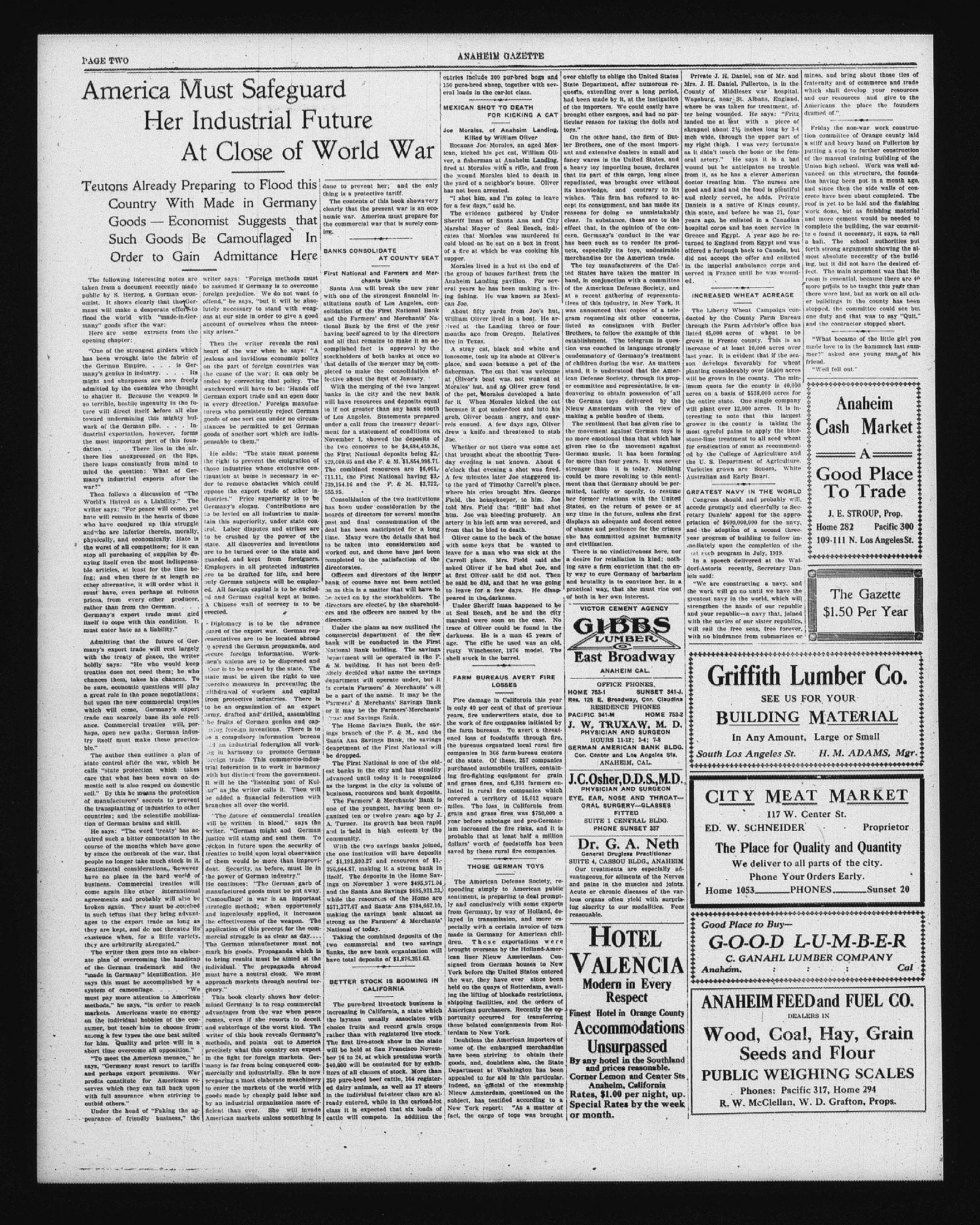
Searchable text
America Must Safeguard Her Industrial Future At Close of World
Teutons Already Preparing to Flood this Country With Made in Germany Goods — Economist Suggests that Such Goods Be Camouflaged In Order to Gain Admittance Here
The following interesting notes are taken from a document recently made public by S. Herzog, a German economist. It shows clearly that the Germans will make a desperate effort to flood the world with "made-in-Germany" goods after the war:
Here are some extracts from the opening chapter:
"One of the strongest girders which has been wrought into the fabric of the German Empire, . . . is Germany's genius in industry. . . Its might and sharpness are now freely admitted by the enemies who thought to shatter it. Because the weapon is so terrible, hostile ingenuity in the future will direct itself before all else toward undermining this mighty bulwark of the German pile. . . Industrial exportation, however, forms the most important part of this foundation. . . There lies in the air, there lies unexpressed on the lips,
writer says: "Foreign methods must be assumed if Germany is to overcome foreign prejudice. We do not want to offend," he says, "but it will be absolutely necessary to stand with weapons at our side in order to give a good account of ourselves when the necessity arises."
Then the writer reveals the real heart of the war when he says: "A jealous and invidious economic policy on the part of foreign countries was the cause of the war; it can only be ended by correcting that policy. The watchword will have to be: 'Hands off German export trade and an open door in every direction.' Foreign manufacturers who persistently reject German goods of one sort can under no circumstances be permitted to get German goods of another sort which are indispensable to them."
He adds: "The state must possess done to prevent thing is a prot.
The contents clearly that the nomic war. A the commercial ing.
BANKS CONS
First National ch
Santa Ana w with one of the situations south solidation of t and the Farm national Bank b having been ar and all that re complished fa stockholders c that details o pleted to make fective about t
With the m banks in the will have reso to if not great of Los Angeles under a call f ment for a sta November 1, the two conc
the German Empire, is Germany's genius in industry. Its might and sharpness are now freely admitted by the enemies who thought to shatter it. Because the weapon is so terrible, hostile ingenuity in the future will direct itself before all else toward undermining this mighty bulwark of the German pile. Industrial exportation, however, forms the most important part of this foundation. There lies in the air, there lies unexpressed on the lips, there leaps constantly from mind to mind the question: What of Germany's industrial exports after the war?
Then follows a discussion of "The World's Hatred as a Liability." The writer says: "For peace will come, yet hate will remain in the hearts of those who have conjured up this struggle and who are inferior therein, morally, physically, and economically. Hate is the worst of all competitors; for it can stop all purchasing of supplies by denying itself even the most indispensable articles, at least for the time being; and when there is at length no other alternative, it will order what it must have, even perhaps at ruinous prices, from every other producer, rather than from the German. Germany's export trade must gird itself to cope with this condition. It must enter hate as a liability."
Admitting that the future of Germany's export trade will rest largely with the treaty of peace, the writer boldly says: "He who would keep treaties does not need them; he who chances them, takes his chances. To be sure, economic questions will play a great role in the peace negotiations; but upon the new commercial treaties which will come, Germany's export trade can scarcely base its sole reliance. Commercial treaties will, perhaps, open new paths; German industry itself must make these practicable."
The author then outlines a plan of state control after the war, which he calls "state protection which takes care that what has been sown on domestic soil is also reaped on domestic soil." By this he means the protection of manufacturers' secrets to prevent the transplanting of industries to other countries; and the scientific mobilization of German brains and skill.
He says: "The word 'treaty' has acquired such a bitter connotation in the course of the months which have gone by since the outbreak of the war, that people no longer take much stock in it.
"The future of commercial treaties will be written in blood," says the writer. "German might and German justice will stamp and seal them. Toreckon in future upon the security of treaties to build upon loyal observance of them would be more than improvial and invasions economic policy on the part of foreign countries was the cause of the war; it can only be ended by correcting that policy. The watchword will have to be: 'Hands off German export trade and an open door in every direction.' Foreign manufacturers who persistently reject German goods of one sort can under no circumstances be permitted to get German goods of another sort which are indispensable to them."
He adds: "The state must possess the right to prevent the emigration of those industries whose exclusive continuation at home is necessary in order to remove obstacles which could oppose the export trade of other industries." Price superiority is to be Germany's slogan. Contributions are to be levied on all industries to maintain this superiority, under state control. Labor disputes and strikes are to be crushed by the power of the state. All discoveries and inventions are to be turned over to the state and guarded, and kept from foreigners. Employers in all protected industries are to be drafted for life, and here only German subjects will be employed. All foreign capital is to be excluded and German capital kept at home. A Chinese wall of secrecy is to be erected.
Diplomacy is to be the advance guard of the export war. German representatives are to be located abroad to spread the German propaganda, and secure foreign information. Workmen's unions are to be dispersed and labor is to be owned by the state. The state must be given the right to use coercive measures in preventing the withdrawal of workers and capital from protective industries. There is to be an organization of an export army, drafted and drilled, assembling the fruits of German genius and capturing foreign inventions. There is to be a compulsory information bureau and an industrial federation all working in harmony to promote German foreign trade. This commercio-industrial federation is to work in harmony with but distinct from the government. It will be the "listening post of Kultur" as the writer calls it. Then will be added a financial federation with branches all over the world.
"The future of commercial treaties will be written in blood," says the writer. "German might and German justice will stamp and seal them. Toreckon in future upon the security of treaties to build upon loyal observance of them would be more than improvi-
calls "state protection which takes care that what has been sown on domestic soil is also reaped on domestic soil." By this he means the protection of manufacturers' secrets to prevent the transplanting of industries to other countries; and the scientific mobilization of German brains and skill.
He says: "The word 'treaty' has acquired such a bitter connotation in the course of the months which have gone by since the outbreak of the war, that people no longer take much stock in it. Sentimental considerations," however have no place in the hard world of business. Commercial treaties will come again like other international agreements and probably will also be broken again. They must be couched in such terms that they bring advantages to the export trade as long as they are kept, and do not threaten its existence when, for a little variety, they are arbitrarily abrogated."
The writer then goes into an elaborate plan of overcoming the handicap of the German trademark and the "made in Germany" identification. He says this must be accomplished by a system of camouflage. "We must pay more attention to American methods," he says, "in order to reach markets. Americans waste no energy on the individual hobbies of the consumer, but teach him to choose from among a few types the one best suited for him. Quality and price will in a short time overcome all opposition."
"To meet the American menace," he says, "Germany must resort to tariffs and perhaps export premiums. War profits constitute for Americans reserves which they can fall back upon with full assurance when striving to outbid others."
Under the head of "Faking the appearance of friendly business," the
"The future of commercial treaties will be written in blood," says the writer. "German might and German justice will stamp and seal them. To reckon in future upon the security of treaties to build upon loyal observance of them would be more than improvident. Security, as before, must lie in the power of German industry."
He continues: "The German garb of manufactured goods must be put away. Camouflage' in war is an important strategic method; when opportunely and ingeniously applied, it increases the effectiveness of the weapon. The application of this precept for the commercial struggle is as clear as day.... The German manufacturer must not mark his goods. Propaganda which is to bring results must be aimed at the individual. The propaganda abroad must have a neutral cloak. We must approach markets through neutral territory."
This book clearly shows how determined Germany is to reap commercial advantages from the war when peace comes, even if she resorts to deceit and subterfuge of the worst kind. The writer of this book reveals Germany's methods, and points out to America precisely what this country can expect in the fight for foreign markets. Germany is far from being conquered commercially and industrially. She is now preparing a most elaborate meachinery to enter the markets of the world with goods made by cheaply paid labor and by an industrial organization more efficient than ever. She will invade American markets unless something is
guard of World War
done to prevent her; and the only thing is a protective tariff.
The contents of this book shows very clearly that the present war is an economic war. America must prepare for the commercial war that is surely coming.
BANKS CONSOLIDATE AT COUNTY SEAT
First National and Farmers and Merchants Unite
Santa Ana will break the new year with one of the strongest financial institutions south of Los Angeles, consolidation of the First National Bank and the Farmers' and Merchants' National Bank by the first of the year having been agreed to by the directors and all that remains to make it an accomplished fact is approval by the stockholders of both banks at once so that details of the merger may be completed to make the consolidation effective about the first of January.
With the merging of the two largest banks in the city and the new bank will have resources and deposits equal to if not greater than any bank south of Los Angeles. Statements prepared under a call from the treasury department for a statement of conditions on November 1, showed the deposits of the two concerns to be $4,684,459.36, the First National deposits being $2.
entries include 300 pur-bred hogs and 150 pure-bred sheep, together with several loads in the car-lot class.
MEXICAN SHOT TO DEATH FOR KICKING A CAT
Joe Morales, of Anaheim Landing, Killed by William Oliver
Because Joe Morales, an aged Mexican, kicked his pet cat, William Oliver, a fisherman at Anaheim Landing, fired at Morales with a rifle, and from the wound Morales bled to death in the yard of a neighbor's house. Oliver has not been arrested.
"I shot him, and I'm going to leave for a few days," said he.
The evidence gathered by Under Sheriff Iman of Santa Ana and City Marshal Mayer of Seal Beach, indicates that Morales was murdered in cold blood as he sat on a box in front of a fire at which he was cooking his supper.
Morales lived in a hut at the end of the group of houses farthest from the Anaheim Landing pavilion. For several years he has been making a living fishing. He was known as Mexican Joe.
About fifty yards from Joe's hut, William Oliver lived in a boat. He arrived at the Landing three or four months ago from Oregon. Relatives live in Texas.
A stray cat, black and white and lonesome, took up its abode at Oliver's place, and soon became a pet of the fisherman. The cat that was welcome at Oliver's boat was not wanted at Morales' hut, and as Oliver grew fond of the pet, Morales developed a hate for it. When Morales kicked the cat because it got under-foot and into his grub, Oliver became angry, and quarrels ensued. A few days ago, Oliver drew a knife and threatened to stab Joe.
Whether or not there was some act that brought about the shooting Tuesday over chiefly to oblige the United States State Department, after numerous requests, extending over a long period, had been made by it, at the instigation of the importers. We could easily have brought other cargoes, and had no particular reason for taking the dolls and toys."
On the other hand, the firm of Butler Brothers, one of the most important and extensive dealers in small and fancy wares in the United States, and a heavy toy importing house, declares that its part of this cargo, long since repudiated, was brought over without its knowledge, and contrary to its wishes. This firm has refused to accept its consignment, and has made its reasons for doing so unmistakably clear. In substance, these are to the effect that, in the opinion of the concern, Germany's conduct in the war has been such as to render its products, especially its toys, undesirable merchandise for the American trade.
The toy manufacturers of the United States have taken the matter in hand, in conjunction with a committee of the American Defense Society, and at a recent gathering of representatives of this industry, in New York, it was announced that copies of a telegram requesting six other concerns, listed as consignees with Butler Brothers, to follow the example of this establishment. The telegram in question was couched in language strongly condemnatory of Germany's treatment of children during the war. As matters stand, it is understood that the American Defense Society, through its proper committee and representative, is endeavoring to obtain possession of all the German toys delivered by the Nieuw Amsterdam with the view of making a public bonfire of them.
The sentiment that has given rise to the movement against German toys is no more emotional than that which has given rise to the movement against German music. It has been forming
With the merging of the two largest banks in the city and the new bank will have resources and deposits equal to if not greater than any bank south of Los Angeles. Statements prepared under a call from the treasury department for a statement of conditions on November 1, showed the deposits of the two concerns to be $4,684,459.36, the First National deposits being $2,829,460.65 and the F. & M. $1,854,998.71. The combined resources are $6,461,711.11, the First National having $3,739,154.16 and the F. & M. $2,722,555.95.
Consolidation of the two institutions has been under consideration by the boards of directors for several months past and final consummation of the deal has been anticipated for a long time. Many were the details that had to be taken into consideration and worked out, and these have just been completed to the satisfaction of the directorates.
Officers and directors of the larger bank of course have not been settled on this is a matter that will have to be acted on by the stockholders. The directors are elected by the shareholders and the officers are named by the directors.
Under the plans as now outlined the commercial department of the new bank will be conducted in the First National Bank building. The savings department will be operated in the F. & M. building. It has not been definitely decided what name the savings department will operate under, but it is certain Farmers' & Merchants' will be a part of the name. It may be the Farmers' & Merchants' Savings Bank or it may be the Farmers' Merchants' Trust and Savings Bank.
The Home Savings Bank, the savings branch of the F. & M., and the Santa Ana Savings Bank, the savings department of the First National will be dropped.
The First National is one of the oldest banks in the city and has steadily advanced until today it is recognized as the largest in the city in volume of business, resources and bank deposits.
The Farmers' & Merchants' Bank is one of the youngest, having been organized ten or twelve years ago by J. A. Turner. Its growth has been rapid and is held in high esteem by the community.
With the two savings banks joined, the one institution will have deposits of $1,191,890.27 and resources of $1,-
FARM BUREAUS AVERT FIRE LOSSES
Fire damage in California this year is only 40 per cent of that of previous years, fire underwriters state, due to the work of fire companies initiated by the farm bureaus. To avert a threatened loss of foodstuffs through fire, the bureaus organized local rural fire companies in 366 farm-bureau centers of the state. Of these, 257 companies purchased automobile trailers, containing fire-fighting equipment for grain and grass fires, and 6,391 farmers enlisted in rural fire companies which covered a territory of 15,012 square miles. The loss in California from grain and grass fires was $750,000 a year before sabotage and pro-Germanism increased the fire risks, and it is probable that at least half a million dollars' worth of foodstuffs has been saved by these rural fire companies.
The sentiment that has given rise to the movement against German toys is no more emotional than that which has given rise to the movement against German music. It has been forming for more than four years. It was never stronger than it is today. Nothing could be more revolting to this sentiment than that Germany should be permitted, tacitly or openly, to resume her former relations with the United States, on the return of peace or at any time in the future, unless she first displays an adequate and decent sense of shame and penitence for the crimes she has committed against humanity and civilization.
There is no vindictiveness here, nor a desire for retaliation in kind; nothing save a firm conviction that the only way to cure Germany of barbarism and brutality is to convince her, in a practical way, that she must rise out of both in her own interest.
VICTOR CEMENT AGENCY
GIBBS LUMBER
East Broadway
ANAHEIM CAL.
OFFICE PHONES.
HOME 753-1
SUNSET 341-J.
Res. 125 E. Broadway, Cor. Claudina RESIDENCE PHONES
PACIFIC 341-M
HOME 753-2
J. W. TRUXAW. M.D.
PHYSICIAN AND SURGEON
HOURS 11-12; 2-4; 7-8
GERMAN AMERICAN BANK BLDG.
Cor. Center and Los Angeles Sts.
ANAHEIM, CAL.
J.C.Osher,D.D.S.,M.D.
PHYSICIAN AND SURGEON
EYE, EAR, NOSE AND THROAT—ORAL SURGERY—GLASSES FITTED
SUITE 1 CENTRAL BLDG.
PHONE SUNSET 337
Dr. G. A. Neth
General Drugless Practitioner
SUITE 4, CASSOU BLDG., ANAHEIM
BETTER STOCK IS BOOMING IN CALIFORNIA
The pure-bred live-stock business is increasing in California, a state which the layman usually associates with choice fruits and record grain crops rather than with registered live stock. The first live-stock show in the state will be held at San Francisco November 16 to 24, at which premiums worth $40,000 will be contested for by exhibitors of all classes of stock. More than 250 pure-bred beef cattle, 164 registered dairy animals, as well as 17 steers in the individual fat-steer class are already entered, while in the carload-lot class it is expected that six loads of cattle will compete. In addition the purchased automobile tractors, containing fire-fighting equipment for grain and grass fires, and 6,391 farmers enlisted in rural fire companies which covered a territory of 15,012 square miles. The loss in California from grain and grass fires was $750,000 a year before sabotage and pro-Germanism increased the fire risks, and it is probable that at least half a million dollars' worth of foodstuffs has been saved by these rural fire companies.
THOSE GERMAN TOYS
The American Defense Society, responding simply to American public sentiment, is preparing to deal promptly and conclusively with some exports from Germany, by way of Holland, delayed in transmission, and more especially with a certain invoice of toys made in Germany for American children. These exportations were brought overseas by the Holland-American liner Nieuw Amsterdam. Consigned from German houses to New York before the United States entered the war, they have ever since been held on the quays of Rotterdam, awaiting the lifting of blockade restrictions, shipping facilities, and the orders of American purchasers. Recently the opportunity occurred for transferring these belated consignments from Rotterdam to New York.
Doubtless the American importers of some of the embargoed merchandise have been striving to obtain their goods, and, doubtless also, the State Department at Washington has been appealed to for aid in this particular. Indeed, an official of the steamship Nieuw Amsterdam, questioned on the subject, has testified according to a New York report: "As a matter of fact, the cargo of tops was brought...
Private J. H. Daniel, son of Mr. and Mrs. J. H. Daniel, Fullerton, is in the County of Middlesex war hospital, Wapsburg, near St. Albans, England, where he was taken for treatment after being wounded. He says: "Fritz landed me at last with a piece of shrapnel about 2½ inches long by 3-4 inch wide, through the upper part of my right thigh. I was very fortunate as it didn't touch the bone or the femoral artery." He says it is a bad wound but he anticipates no trouble from it, as he has a clever American doctor treating him. The nurses are good and kind and the food is plentiful and nicely served, he adds. Private Daniels is a native of Kings county, this state, and before he was 21, four years ago, he enlisted in a Canadian hospital corps and has seen service in Greece and Egypt. A year ago he returned to England from Egypt and was offered a furlough back to Canada, but did not accept the offer and enlisted in the imperial ambulance corps and served in France until he was wounded.
INCREASED WHEAT ACREAGE
The Liberty Wheat Campaign conducted by the County Farm Bureau through the Farm Advisor's office has listed 45,000 acres of wheat to be grown in Fresno county. This is an increase of at least 10,000 acres over last year. It is evident that if the season develops favorably for wheat planting considerably over 50,000 acres will be grown in the county. The minimum quota for the county is 40,000 acres on a basis of $538,000 acres for the entire state. One single company will plant over 12,000 acres. It is interesting to note that this largest grower in the county is taking the most careful pains to apply the blue-stone-lime treatment to all seed wheat for eradication of smut as recommended by the College of Agriculture and mines, and bring about those ties of fraternity and of commerce and trade which shall develop your resources and our resources and give to the Americans the place the founders dramed of."
Friday the non-war work construction committee of Orange county laid a stiff and heavy hand on Fullerton by putting a stop to further construction of the manual training building of the Union high school. Work was well advanced on this structure, the foundation having been put in a month ago, and since then the side walls of concrete have been about completed. The roof is yet to be laid and the finishing work done, but as finishing material and more cement would be needed to complete the building, the war committte found it necessary, it says, to call a halt. The school authorities put forth strong arguments showing the almost absolute necessity of the building, but it did not have the desired effect. The main argument was that the room is essential, because there are 40 more pupils to be taught this year than there were last, but as work on all other buildings in the county has been stopped, the committee could see but one duty and that was to say "Quit," and the contractor stopped short.
"What became of the little girl you made love to in the hammock last summer?" asked one young man of his friend.
"Well fell out."
Anaheim Cash Market
A Good Place To Trade
J. E. STROUP, Prop.
Home 282 Pacific 300
109-111 N. Los Angeles St.
GREATEST NAVY IN THE WORLD
Congress should, and probably will,
accede promptly and cheerfully to Secretary Daniels' appeal for the appropriation of $600,000,000 for the navy,
and the adoption of a second three-year program of building to follow immediately upon the completion of the set such program in July, 1919.
In a speech delivered at the Waldorf-Astoria recently, Secretary Daniels said:
"We are constructing a navy, and the work will go no until we have the greatest navy in the world, which will strengthen the hands of our republic and your republic—a navy that, joined with the navies of our sister republics, will sail the free seas, free forever, with no hindrance from submarines or
The Gazette
$1.50 Per Year
Griffith Lumber Co.
SEE US FOR YOUR BUILDING MATERIAL
In Any Amount, Large or Small
South Los Angeles St. H. M. ADAMS, Mgr.
CITY MEAT MARKET
117 W. Center St.
ED. W. SCHNEIDER Proprietor
The Place for Quality and Quantity
We deliver to all parts of the city.
CITY MEAT MARKET
117 W. Center St.
ED. W. SCHNEIDER Proprietor
The Place for Quality and Quantity
We deliver to all parts of the city.
Phone Your Orders Early.
Home 1053___PHONES___Sunset 20
Good Place to Buy—
G-O-O-D L-U-M-B-E-R
C. GANAHL LUMBER COMPANY
Anaheim. : : : Cal
ANAHEIM FEED and FUEL CO.
DEALERS IN
Wood, Coal, Hay, Grain Seeds and Flour
PUBLIC WEIGHING SCALES
Phones: Pacific 317, Home 294
R. W. McClellan, W. D. Grafton, Props.