anaheim-gazette 1918-11-07
Scanned page
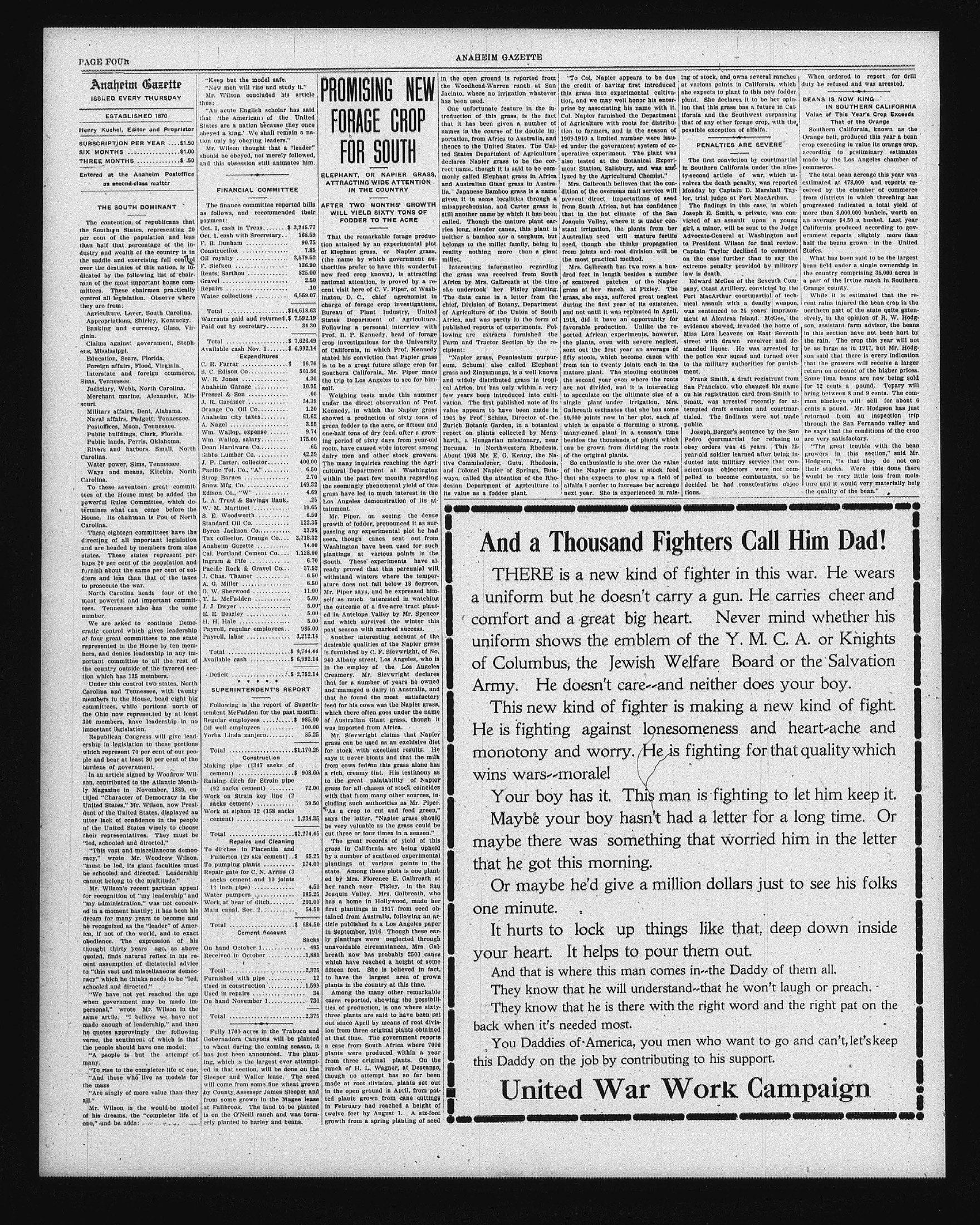
Searchable text
Anaheim Gazette
ISSUED EVERY THURSDAY
ESTABLISHED 1870
Henry Kuchel, Editor and Proprietor
SUBSCRIPTION PER YEAR ... $1.50
SIX MONTHS ... $1.00
THREE MONTHS ... $ .50
Entered at the Anaheim Postoffice as second-class matter
THE SOUTH DOMINANT
The contention of republicans that the Southern States, representing 20 per cent of the population and less than half that percentage of the industry and wealth of the country is in the saddle and exercising full control over the destinies of this nation, is indicated by the following list of chairmen of the most important house committees. These chairmen practically control all legislation. Observe where they are from:
Agriculture, Lever, South Carolina.
Appropriations, Shirley, Kentucky.
Banking and currency, Glass, Virginia.
Claims against government, Stephens, Mississippi.
Education, Sears, Florida.
Foreign affairs, Flood, Virginia.
Interstate and foreign commerce, Sims, Tennessee.
Judiciary, Webb, North Carolina.
Merchant marine, Alexander, Missouri.
Military affairs, Dent, Alabama.
Naval affairs, Padgett, Tennessee.
Postoffices, Moon, Tennessee.
Public buildings, Clark, Florida.
Public lands, Ferris, Oklahoma.
Rivers and harbors, Small, North Carolina.
"Keep but the model safe.
'New men will rise and study it.'
Mr. Wilson concluded his article thus:
"An acute English scholar has said that 'the American of the United States are a nation because they once obeyed a king.' We shall remain a nation only by obeying leaders."
Mr. Wilson thought that a "leader" should be obeyed, not merely followed, and this obsession still animates him.
FINANCIAL COMMITTEE
The finance committee reported bills as follows, and recommended their payment:
Oct. 1, cash in Treas... $ 3,245.77
Oct. 1, cash with Secretary... 168.59
F. B. Dunham ... 90.75
Construction ... 7.85
Oil royalty ... 3,579.52
F. Siefken ... 136.90
Rents; Sarthou ... 825.00
Gravel ... 2.50
Repairs ... 1.0
Water collections ... 6,559.07
Total ... $14,618.63
Warrants paid and returned... $ 7,592.19
Paid out by secretary ... 34.30
Total ... $ 7,626.49
Available cash Nov. 1... $ 6,992.14
Expenditures
C. R. Farrar ... $ 16.76
S. C. Edison Co... 501.50
W. R. Jones ... 4.30
Anaheim Garage ... 10.95
Pressel & Son ... 6.0
J. R. Gardiner ... 34.39
Orange Co. Oil Co... 1.20
Anaheim city taxes ... 61.62
A. Nagel ... 3.55
Wm. Wallop, expense ... 9.74
Wm. Wallop, salary ... 175.00
Dean Hardware Co... 65
Gibbs Lumber Co... 42.39
That the remission attained by of Elephant grief (the name by thorities prefer new feed crop national attention) cent visit hereington, D. C., charge of former Bureau of Public States Department Following a prof. B. P. Kemp investigation of California, he stated to be a great Southern Californiac trip to Los self.
Weighing teeth under the direct Kennedy, in view showed a prod green fodder to one-half tons owing period of six roots, have caused dairy men an
Foreign affairs, Flood, Virginia.
Interstate and foreign commerce,
Sims, Tennessee.
Judiciary, Webb, North Carolina.
Merchant marine, Alexander, Missouri.
Military affairs, Dent, Alabama.
Naval affairs, Padgett, Tennessee.
Postoffices, Moon, Tennessee.
Public buildings, Clark, Florida.
Public lands, Ferris, Oklahoma.
Rivers and harbors, Small, North Carolina.
Water power, Sims, Tennessee.
Ways and means, Kitchin, North Carolina.
To these seventeen great committees of the House must be added the powerful Rules Committee, which determines what can come before the House. Its chairman is Pou of North Carolina.
These eighteen committees have the directing of all important legislation and are headed by members from nine states. These states represent perhaps 20 per cent of the population and furnish about the same per cent of soldiers and less than that of the taxes to prosecute the war.
North Carolina heads four of the most powerful and important committees. Tennessee also has the same number.
We are asked to continue Democratic control which gives leadership of four great committees to one state represented in the House by ten members, and denies leadership in any important committee to all the rest of the country outside of the favored section which has 135 members.
Under this control two states, North Carolina and Tennessee, with twenty members in the House, head eight big committees, while portions north of the Ohio now represented by at least 300 members, have leadership in no important legislation.
Republican Congress will give leadership in legislation to those portions which represent 70 per cent of our people and bear at least 80 per cent of the burdens of government.
In an article signed by Woodrow Wilson, contributed to the Atlantic Monthly Magazine in November, 1889, entitled "Character of Democracy in the United States," Mr. Wilson, now President of the United States, displayed an utter lack of confidence in the people of the United States wisely to choose their representatives. They must be "led, schooled and directed."
"This vast and miscellaneous democracy," wrote Mr. Woodrow Wilson, "must be led its giant facilities must be C. R. Farrar $16.76
S. C. Edison Co. $501.50
W. R. Jones $4.30
Anaheim Garage $10.95
Pressel & Son .60
J. R. Gardiner $34.39
Orange Co. Oil Co. $1.20
Anaheim city taxes $61.62
A. Nagel $3.55
Wm. Wallop, expense $9.74
Wm. Wallop, salary $175.00
Dean Hardware Co. .65
Gibbs Lumber Co. $42.39
J. P. Carter, collector $400.00
Pacific Tel. Co., "A" $6.50
Strop Barnes $2.70
Snow Mfg. Co. $149.32
Edison Co., "W" $4.69
L. A. Trust & Savings Bank .25
W. M. Martinet $19.65
S. E. Woodworth $6.50
Standard Oil Co. $122.35
Byron Jackson Co. $23.95
Tax collector, Orange Co...2,718.32
Anaheim Gazette $14.00
Cal. Portland Cement Co...1,128.00
Ingram & Fife $6.70
Pacific Rock & Gravel Co...37.52
J. Chas. Thamer $6.50
A. G. Miller $6.50
G.W.Sherwood $11.00
T.L.McFadden $5.00
J.J.Dwyer $5.00*
E.E.Beazley $5.00
H.H.Hale $5.00
Payroll, regular employees...985.00
Payroll, labor ...3,212.14
Total $9,744.44
Available cash $6,992.14
Deficit $2,752.14
SUPERINTENDENT'S REPORT
Following is the report of Superintendent McFadden for the past month:
Regular employees $985.00
Oil well employees 100.00
Yorba Linda zanjero 85.25
Total $1,170.25
Construction
Making pipe (1347 sacks of cement) $908.60
Raising ditch for Strain pipe (92 sacks cement) 72.00
Work on Strain key line (2 sacks cement) 59.50
Work at siphon 12 (158 sacks cement) 1,234.35
Total $2,274.45
Repairs and Cleaning
To ditches in Placentia and Fullerton (29 sks cement) $65.25
To pumping plants 174.00
Weighing tests under the direct Kennedy, in which showed a product green fodder to one-half tons of ing period of roots, have caused dairy men and cultural Departments within the pass through the seemingly grass have led Los Angeles to attainment.
Mr.Piper growth of fodder passing any ex-seen though Washington has plantings at South.These ready proved withstand wind nature does not Mr.Piper says self as much the outcome owed in Antelope and which superspast season we.
Another intends desirable quality is furnished by 940 Albany street in the employ Creamery.M that for a nurse and managed that he found feed for his coats which there owed of Australian was imported Mr.Sievwr grass can be used for stock with says it never rises from cows fed a rich, creamy to the great grass for all coats with that from cluding such as "As a crop says the latter be very valuable cut three or four The great grass in California by a number of plantings at
In an article signed by Woodrow Wilson, contributed to the Atlantic Monthly Magazine in November, 1889, entitled "Character of Democracy in the United States," Mr. Wilson, now President of the United States, displayed an utter lack of confidence in the people of the United States wisely to choose their representatives. They must be "led, schooled and directed."
"This vast and miscellaneous democracy," wrote Mr. Woodrow Wilson, "must be led, its giant faculties must be schooled and directed. Leadership cannot belong to the multitude."
Mr. Wilson's recent partisan appeal for recognition of "my leadership" and "my administration," was not conceived in a moment hastily; it has been his dream for many years to become and be recognized as the "leader" of America, if not of the world, and to exact obedience. The expression of his thought thirty years ago, as above quoted, finds natural reflex in his recent assumption of dictatorial advice to "this vast and miscellaneous democracy" which he thinks needs to be "led, schooled and directed."
"We have not yet reached the age when government may be made impersonal," wrote Mr. Wilson in the same article. "I believe we have not made enough of leadership," and then he quotes approvingly the following verse, the sentiment of which is that the people should have one model:
"A people is but the attempt of many.
To rise to the completer life of one,
And those who live as models for the mass
Are singly of more value than they all."
Mr. Wilson is the would-be model of his dreams, the "completer life of one," and he adds:
PROMISING NEW FORAGE CROP FOR SOUTH
ELEPHANT, OR NAPIER GRASS, ATTRACTING WIDE ATTENTION IN THE COUNTRY
AFTER TWO MONTHS' GROWTH WILL YIELD SIXTY TONS OF FODDER TO THE ACRE
That the remarkable forage production attained by an experimental plot of Elephant grass, or Napier grass, (the name by which government authorities prefer to have this wonderful new feed crop known), is attracting national attention, is proved by a recent visit here of C. V. Piper, of Washington, D. C., chief agronomist in charge of forage crop investigations, Bureau of Plant Industry, United States Department of Agriculture. Following a personal interview with Prof. B. P. Kennedy, head of forage crop investigations for the University of California, in which Prof. Kennedy stated his conviction that Papier grass is to be a great future silage crop for Southern California, Mr. Piper made the trip to Los Angeles to see for himself.
Weighing tests made this summer under the direct observation of Prof. Kennedy, in which the Napier grass showed a production of sixty tons of green fodder to the acre, or fifteen and one-half tons of dry feed, after a growing period of sixty days from year-old roots, have caused wide interest among dairy men and other stock growers.
in the open ground is reported from the Woodhead-Warren ranch at San Jacinto, where no irrigation whatever has been used.
One unfortunate feature in the introduction of this grass, is the fact that it has been given a number of names in the course of its double importation, from Africa to Australia, and thence to the United States. The United States Department of Agriculture declares Napier grass to be the correct name, though it is said to be commonly called Elephant grass in Africa and Australian Giant grass in Australia. Japanese Bamboo grass is a name given it in some localities through a misapprehension, and Carter grass is still another name by which it has been called. Though the mature plant carries long, slender canes, this plant is neither a bamboo nor a sorghum, but belongs to the millet family, being in reality nothing more than a giant millet.
Interesting information regarding the grass was received from South Africa by Mrs. Galbreath at the time she undertook her Pixley planting. The data came in a letter from the chief, Division of Botany, Department of Agriculture of the Union of South Africa, and was partly in the form of published reports of experiments. Following are extracts furnished the Farm and Tractor Section by the recipient:
"Napier grass, Pennisetum purpureum, Schum) also called Elephant grass and Zinyamunga, is a well known and widely distributed grass in tropical Africa, but has only within a very few years been introduced into cultivation. The first published note of its value appears to have been made in 1905 by Prof. Schinz, Director of the Zurich Botanic Garden, in a botanical report on plants collected by Menyharth, a Hungarian missionary, near Boruma, in Northwestern Rhodesia. About 1908 Mr. E. G. Kenny, the Na
"To Col. Napier appears to be due the credit of having first introduced this grass into experimental cultivation, and we may well honor his enterprise by associating his name with it. Col. Napier furnished the Department of Agriculture with roots for distribution to farmers, and in the season of 1909-1910 a limited number were issued under the government system of cooperative experiment. The plant was also tested at the Botanical Experiment Station, Salisbury, and was analyzed by the Agricultural Chemist."
Mrs. Galbreath believes that the condition of the overseas mail service will prevent direct importations of seed from South Africa, but has confidence that in the hot climate of the San Joaquin Valley, where it is under constant irrigation, the plants from her Australian seed will mature fertile seed, though she thinks propagation from joints and root division will be the most practical method.
Mrs. Galbreath has two rows a hundred feet in length besides a number of scattered patches of the Napier grass at her ranch at Pixley. The grass, she says, suffered great neglect during the first year of its existence, and not until it was replanted in April, 1918, did it have an opportunity for favorable production. Unlike the reported African experiments, however, the plants, even with severe neglect, sent out the first year an average of fifty stools, which become canes with from ten to twenty joints each in the mature plant. The stooling continues the second year even where the roots are not divided, and it is interesting to speculate on the ultimate size of a single plant under irrigation. Mrs. Galbreath estimates that she has some 50,000 joints now in her plot, each of which is capable o forming a strong many-caned plant in a season's time besides the thousands of plants which can be grown from dividing the roots of the original plants.
is to be a great future silage crop for Southern California, Mr. Piper made the trip to Los Angeles to see for himself.
Weighing tests made this summer under the direct observation of Prof. Kennedy, in which the Napier grass showed a production of sixty tons of green fodder to the acre, or fifteen and one-half tons of dry feed, after a growing period of sixty days from year-old roots, have caused wide interest among dairy men and other stock growers.
The many inquiries reaching the Agricultural Department at Washington within the past few months regarding the seemingly phenomenal yield of this grass have led to much interest in the Los Angeles demonstration of its attainment.
Mr. Piper, on seeing the dense growth of fodder, pronounced it as surpassing any experimental plot he had seen, though canes sent out from Washington have been used for such plantings at various points in the South. These experiments have already proved that this perennial will withstand winters where the temperature does not fall below 18 degrees, Mr. Piper says, and he expressed himself as much interested in watching the outcome of a five-acre tract planted in Antelope Valley by Mr. Spencer and which survived the winter this past season with marked success.
Another interesting account of the desirable qualities of the Napier grass is furnished by C. F. Sievwright, of No. 940 Albany street, Los Angeles, who is in the employ of the Los Angeles Creamery. Mr. Sievwright declares that for a number of years he owned and managed a dairy in Australia, and that he found the most satisfactory feed for his cows was the Napier grass, which there often goes under the name of Australian Giant grass, though it was imported from Africa.
Mr. Sievwright claims that Napier grass can be used as an exclusive diet for stock with excellent results. He says it never bloats and that the milk from cows fed on this grass alone has a rich, creamy tint. His testimony as to the great palatability of Napier grass for all classes of stock coincides with that from many other sources, including such authorities as Mr. Piper.
As a crop to cut and feed green," says the latter, "Napier grass should be very valuable as the grass could be cut three or four times in a season."
The great records of yield of this grass in California are being upheld by a number of scattered experimental plantings at various points in the eum, Schum) also called Elephant grass and Zinyamunga, is a well known and widely distributed grass in tropical Africa, but has only within a very few years been introduced into cultivation. The first published note of its value appears to have been made in 1905 by Prof. Schinz, Director of the Zurich Botanic Garden, in a botanical report on plants collected by Menharth, a Hungarian missionary, near Boruma, in Northwestern Rhodesia. About 1908 Mr. E. G. Kenny, the Native Commissioner, Gutu, Rhodesia, and Colonel Napier of Springs, Bulawayo, called the attention of the Rhodesian Department of Agriculture to its value as a fodder plant.
So enthusiastic is she over the value of the Napier grass as a stock feed that she expects to plow up a field of alfalfa i norder to increase her acreage next year. She is experienced in rais-
And a Thousand Fight
THERE is a new kind of fruit a uniform but he doesn’t carry comfort and a great big heart. uniform shows the emblem of Columbus, the Jewish Wel Army. He doesn’t care--and n This new kind of fighter is He is fighting against lonesome monotony and worry. He is fr wins wars--moralel Your boy has it. This man Maybe your boy hasn’t had maybe there was something th that he got this morning.
Your boy has it. This man
Maybe your boy hasn't had
maybe there was something t
that he got this morning.
Or maybe he'd give a million
one minute.
It hurts to lock up things
your heart. It helps to pour th
And that is where this man comes in
They know that he will understand
They know that he is there with the
back when it's needed most.
You Daddies of America, you men
this Daddy on the job by contributing
United War W
appears to be due
being first introduced
experimental cultivawell honor his entering his name with it.
hoped the Department
with roots for distribuand in the season of
number were issument system of coment. The plant was
the Botanical Experisisbury, and was anacultural Chemist."
believes that the connees mail service will
importations of seed,
but has confidence
eliminate of the San
there it is under conthe plants from her
will mature fertile
thinks propagation
root division will be
real method.
has two rows a hunth besides a number
mches of the Napier
bench at Pixley. The
suffered great neglect
year of its existence,
was replanted in April,
an opportunity for
tion. Unlike the reexperiments, however,
with severe neglect,
at year an average of
which become canes with
any joints each in the
stooling continues
even where the roots
and it is interesting
the ultimate size of a
older irrigation. Mrs.
notes that she has some
in her plot, each of
o forming a strong,
it in a season's time
lands, of plants which
from dividing the roots
ants.
ing of stock, and owns several ranches
at various points in California, which
she expects to plant to this new fodder plant. She declares it to be her opinion that this grass has a future in Caliifornia and the Southwest surpassing
that of any other forage crop, with the
possible exception of alfalfa.
PENALTIES ARE SEVERE
The first conviction by courtmartial
in Southern California under the ninety-second article of war, which involves the death penalty, was reported Monday by Captain D. Marshall Taylor, trial judge at Fort MacArthur.
The findings in this case, in which Joseph E. Smith, a private, was convicted of an assault upon a young girl, a minor, will be sent to the Judge Advocate-General at Washington and to President Wilson for final review. Captain Taylor declined to comment on the case further than to say the extreme penalty provided by military law is death.
Edward McGee of the Seventh Company, Coast Artillery, convicted by the Fort MacArthur courtmartial of technical assault with a deadly weapon, was sentenced to 25 years' imprisonment at Alcatraz Island. McGee, the evidence showed, invaded the home of Miss Lora Leavens on East Seventh street with drawn revolver and demanded liquor. He was arrested by the police war squad and turned over to the military authorities for punishment.
Frank Smith, a draft registrant from San Francisco, who changed his name on his registration card from Smith to Smatt, was arrested recently for attempted draft evasion and courtmar-tialed. The findings were not made public.
Joseph Berger's sentence by the San Pedro courtmartial for refusing to obey orders was 45 years. This 25-year-old soldier learned after being in
When ordered to report for drill duty he refused and was arrested.
BEANS IS NOW KING
IN SOUTHERN CALIFORNIA
Value of This Year's Crop Exceeds That of the Orange
Southern California, known as the Orange belt, produced this year a bean crop exceeding in value its orange crop, according to preliminary estimates made by the Los Angeles chamber of commerce.
The total bean acreage this year was estimated at 478,000 and reports received by the chamber of commerce from districts in which threshing has progressed indicated a total yield of more than 8,000,000 bushels, worth on an average $4.50 a bushel. Last year California produced according to government reports slightly more than half the beans grown in the United States.
What has been said to be the largest bean field under a single ownership in the country comprising 35,000 acres is a part of the Irvine ranch in Southern Orange county.
While it is estimated that the recent rains injured the bean crop in the northern part of the state quite extensively, in the opinion of R. W. Hodgson, assistant farm advisor, the beans in this section have not been hurt by the rain. The crop this year will not be as large as in 1917, but Mr. Hodgson said that there is every indication that the growers will receive a larger return on account of the higher prices. Some lima beans are now being sold for 12 cents a pound. Tepary will bring between 8 and 9 cents. The common blackeye will sell for about 6 cents a pound. Mr. Hodgson has just returned from an inspection trip through the San Fernando valley and he says that the conditions of the crop are very satisfactory.
"The great trouble with the bean growers in this section," said Mr.
and Fighters Call Him Dad!
A new kind of fighter in this war. He wears
doesn't carry a gun. He carries cheer and
big heart. Never mind whether his
emblem of the Y. M. C. A. or Knights
Jewish Welfare Board or the Salvation
care—and neither does your boy.
The fighter is making a new kind of fight.
must lonesomeness and heart-ache and
erry. He is fighting for that quality which
This man is fighting to let him keep it.
hasn't had a letter for a long time. Or
something that worried him in the letter
This man is fighting to let him keep it.
hasn't had a letter for a long time. Or
something that worried him in the letter
warning.
give a million dollars just to see his folks
up things like that, deep down inside
to pour them out.
man comes in--the Daddy of them all.
will understand--that he won't laugh or preach.
there with the right word and the right pat on the
ost.
rica, you men who want to go and can't, let'skeep
contributing to his support.
War Work Campaign