anaheim-gazette 1918-10-24
Scanned page
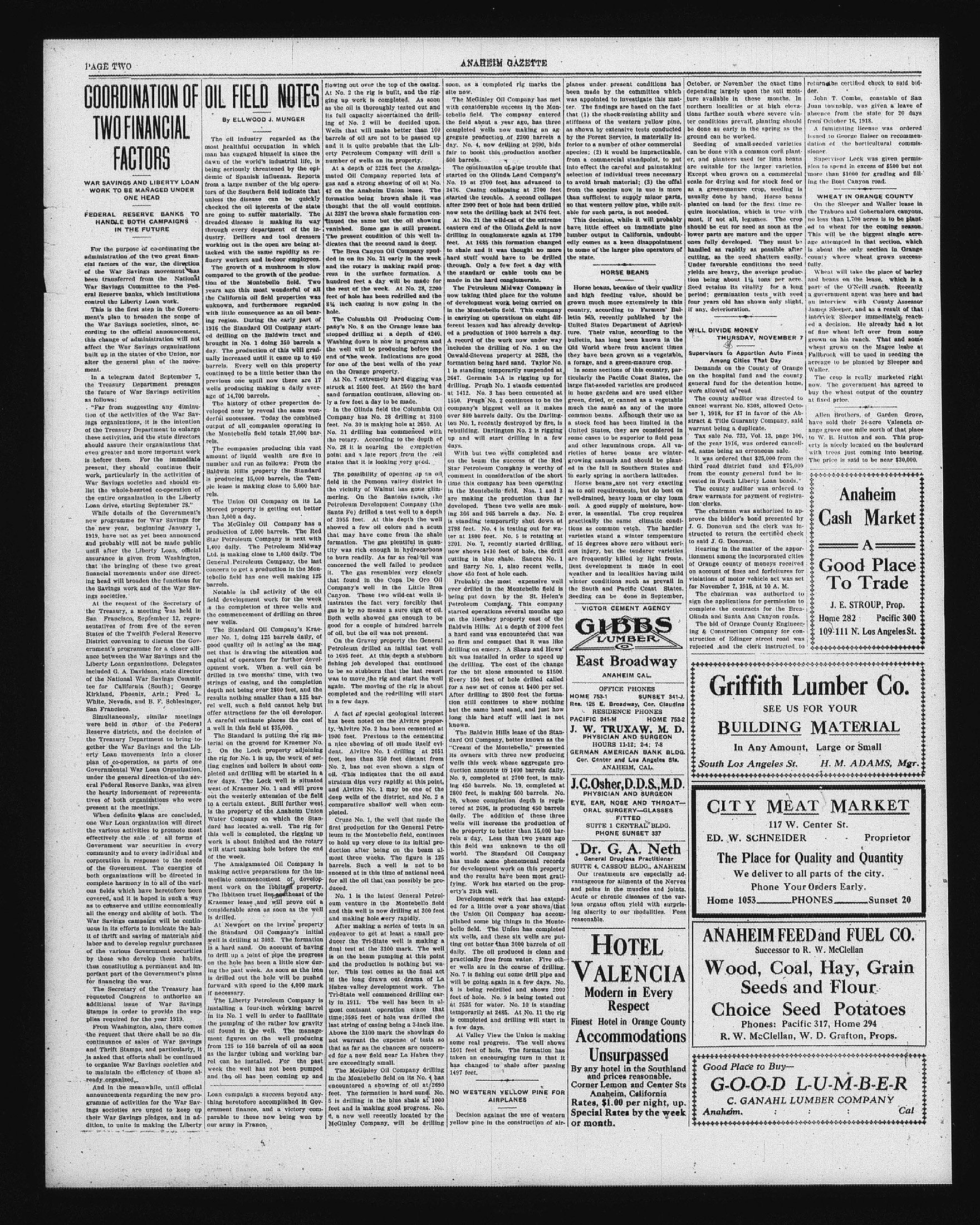
Searchable text
GOORDINATION OF
TWO FINANCIAL
FACTORS
WAR SAVINGS AND LIBERTY LOAN
WORK TO BE MANAGED UNDER
ONE HEAD
FEDERAL RESERVE BANKS TO
HANDLE BOTH CAMPAIGNS
IN THE FUTURE
For the purpose of co-ordinating the administration of the two great financial factors of the war, the direction of the War Savings movement has been transferred from the National War Savings Committee to the Federal Reserve banks, which institutions control the Liberty Loan work.
This is the first step in the Government's plan to broaden the scope of the War Savings societies, since, according to the official announcement, this change of administration will not affect the War Savings organizations built up in the states of the Union, nor alter the general plan of the movement.
In a telegram dated September 7, the Treasury Department presages the future of War Savings activities as follows:
"Far from suggesting any diminution of the activities of the War Savings organizations, it is the intention of the Treasury Department to enlarge these activities, and the state directors should assure their organizations that even greater and more important work
OIL FIELD NOTES
By ELLWOOD J. MUNGER
The oil industry regarded as the most healthful occupation in which man has engaged himself in since the dawn of the world's industrial life, is being seriously threatened by the epidemic of Spanish influenza. Reports from a large number of the big operators of the Southern field indicate that unless the disease can be quickly checked the oil interests of the state are going to suffer materially. The dreaded disease is making its way through every department of the industry. Drillers and tool dressers working out in the open are being attacked with the same rapidity as refinery workers and in-door employees.
The growth of a mushroom is slow compared to the growth of the production of the Montebello field. Two years ago this most wonderful of all the California oil field properties was unknown, and furthermore regarded with little consequence as an oil bearing region. During the early part of 1916 the Standard Oil Company started drilling on the Baldwin tract and brought in No. 1 doing 350 barrels a day. The production of this well gradually increased until it came up to 450 barrels. Every well on this property continued to be a little better than the previous one until now there are 17 wells producing a daily average of 14,700 barrels.
The history of other properties developed near by reveal the same wonderful successes. Today the combined output of all companies operating in the Montebello field totals 27,000 barrels.
The companies producing this vast amount of liquid wealth are five in flowing out over At No. 2 the growing up work as the oil is its full capacity of No. 2 Wells that we barrels of oil and it is quite fertile Petroleum number of wells.
At a depth mated Oil Gas and a strand 42 on the An formation being thought that At 3297 the brine used the seawashed. So The present indicates that The Brea Company's No. 8 stopped drilling Washing down the well will end of the week for one of them on the Orange.
At No. 7 ex struck at 250 sand formation ly a few feet In the Ollin Company has feet. No. 30 is No. 31 drilling the rotary. A No. 28 it is a point and a
In a telegram dated September 7, the Treasury Department presages the future of War Savings activities as follows:
"Far from suggesting any diminution of the activities of the War Savings organizations, it is the intention of the Treasury Department to enlarge these activities, and the state directors should assure their organizations that even greater and more important work is before them. For the immediate present, they should continue their work, particularly in the activities of War Savings societies and should enlist the whole-hearted co-operation of the entire organization in the Liberty Loan drive, starting September 28."
While details of the Government's new programme for War Savings for the new year, beginning January 1, 1919, have not as yet been announced and probably will not be made public until after the Liberty Loan, official assurance is given from Washington, that the bringing of these two great financial movements under one directing head will broaden the functions for the Savings work and of the War Savings societies.
At the request of the Secretary of the Treasury, a meeting was held in San Francisco, September 12, representatives of from five of the seven States of the Twelfth Federal Reserve District convening to discuss the Government's programme for a closer alliance between the War Savings and the Liberty Loan organizations. Delegates included G. A. Davidson, state director of the National War Savings Committee for California (South); George Kirkland, Phoenix, Ariz.; Fred L. White, Nevada, and B. F. Schlesinger, San Francisco.
Simultaneously, similar meetings were held in other of the Federal Reserve districts, and the decision of the Treasury Department to bring together the War Savings and the Liberty Loan movements into a closer plan of co-operation, as parts of one Governmental War Loan Organization, under the general direction of the several Federal Reserve Banks, was given the hearty endorsement of representatives of both organizations who were present at the meetings.
When definite plans are concluded, one War Loan organization will direct the various activities to promote most effectively the sale of all forms of Government war securities in every community and to every individual and corporation in response to the needs
Governmental War Loan Organization,
under the general direction of the several Federal Reserve Banks, was given
the hearty indorsement of representatives of both organizations who were
present at the meetings.
When definite plans are concluded,
one War Loan organization will direct
the various activities to promote most
effectively the sale of all forms of
Government war securities in every
community and to every individual and
corporation in response to the needs
of the Government. The energies of
both organizations will be directed in
complete harmony in to all of the various fields which have heretofore been
covered, and it is hoped in such a way
as to conserve and utilize economically
all the energy and ability of both. The
War Savings campaign will be continuous in its efforts to inculcate the habit of thrift and saving of materials and
labor and to develop regular purchases
of the various Government securities by those who develop these habits,
thus constituting a permanent and important part of the Government's plans for financing the war.
The Secretary of the Treasury has requested Congress to authorize an additional issue of War Savings Stamps in order to provide the supplies required for the year 1919.
From Washington, also, there comes
the request that there shall be no discontinuance of sales of War Savings
and Thrift Stamps, and particularly, it
is asked that efforts shall be continued
to organize War Savings societies and
to maintain the efficiency of those already organized.
And in the meanwhile, until official
announcements regarding the new programme of activities for the War Savings societies are urged to keep up
their War Savings pledges, and in addition, to unite in making the Liberty
Loan campaign a success beyond anything heretofore accomplished in Government finance, and a victory comparable to those now being won by our army in France.
NOTES
HANGER
As in which since the material life, is by the epilogue. Reports big operative that be quickly of the state finally. The ing its way of the indress being at reddy as reddy employees. Soon is slow the produc field. Two of all properties was regarded than oil bearer part of company start tract and 50 barrels a well grade up to 450 oils property more than the there are 17 daily averages same won be combined operating in 27,000 barring this vast are five in flowing out over the top of the casing. At No. 2 the rig is built, and the rigging up work is completed. As soon as the oil is thoroughly tested out and its full capacity ascertained the drilling of No. 2 will be decided upon. Wells that will make better than 100 barrels of oil are not to be passed up and it is quite probable that the Liberty Petroleum Company will drill a number of wells on its property.
At a depth of 3228 feet the Amalgamated Oil Company reported lots of gas and a strong showing of oil at No. 42 on the Anaheim Union lease. The formation being brown shale it was thought that the oil would continue. At 3297 the brown shale formation continued the same but the oil showing vanished. Some gas is still present. The present condition of this well indicates that the second sand is deep.
The Brea Canyon Oil Company spudded in on its No. 31 early in the week and the rotary is making rapid progress in the surface formation. A hundred feet a day will be made for the rest of the week. At No. 28, 2200 feet of hole has been redrilled and the 8% inch casing is now going in the hole.
The Columbia Oil Producing Company's No. 8 on the Orange lease has stopped drilling at a depth of 4240. Washing down is now in progress and the well will be producing before the end of the week. Indications are good for one of the best wells of the year on the Orange property.
At No. 7 extremely hard digging was struck at 2500 feet. At 2560 the hard sand formation continues, allowing only a few feet a day to be made.
In the Olinda field the Columbia Oil Company has No. 28 drilling at 3100 feet. No. 30 is making hole at 2650. At No. 31 drilling has commenced with the rotary. According to the depth of No. 28 it is nearing the completion point and a late report from the well soon, as a completed rig marks the site now.
The McGinley Oil Company has met with considerable success in the Montebello field. The company entered the field about a year ago, has three completed wells now making an aggregate production of 2200 barrels a day. No. 4, now drilling at 2690, bids fair to boost this production another 500 barrels.
The continuation of pipe trouble that started on the Olinda Land Company's No. 19 at 2700 feet has advanced to 2476. Casing collapsing at 2700 feet started the trouble. A second collapse after 2900 feet of hole had been drilled now sets the drilling back at 2476 feet.
At No. 21 the wild-cat of the extreme eastern end of the Olinda field is now drilling in conglomerate again at 1790 feet. At 1685 this formation changed to shale and it was thought no more hard stuff would have to be drilled through. Only a few feet a day with the standard or cable tools can be made in the hard conglomerate.
The Petroleum Midway Company is now taking third place for the volume of development work being carried on in the Montebello field. This company is carrying on operations on eight different leases and has already developed a production of 1000 barrels a day. A record of the work now under way includes the drilling of No. 1 on the Oswald-Stevens property at 2628, the formation being hard sand. Taylor No. 1 is standing temporarily suspended at 2647. Germain 1-A is rigging up for drilling. Prugh No. 1 stands cemented at 1412. No. 3 has been cemented at 1550. Prugh No. 2 continues to be the company's biggest well as it makes over 800 barrels daily. On the Darlington No. 1, recently destroyed by fire, is rebuilding. Darlington No. 2 is rigging up and will start drilling in a few days.
With but two wells completed and planes under present conditions has been made by the committee which was appointed to investigate this matter. The findings are based on the fact that (1) the shock-resisting ability and stiffness of the western yellow pine, as shown by extensive tests conducted by the Forest Service, is materially inferior to a number of other commercial species; (2) it would be impracticable, from a commercial standpoint, to put into effect the careful and painstaking selection of individual trees necessary to avoid brash material; (3) the offal from the species now in use is more than sufficient to supply minor parts, so that western yellow pine, while suitable for such parts, is not needed.
This decision, while it will probably have little effect on immediate pine lumber output in California, undoubtedly comes as a keen disappointment to some of the larger pine operators of the state.
HORSE BEANS
Horse beans, because of their quality and high feeding value, should be grown much more extensively in this country, according to Farmers' Bulletin 969, recently published by the United States Department of Agriculture. Their value, according to the bulletin, has long been known in the Old World where from ancient times they have been grown as a vegetable, a forage, and a green-manure crop.
In some sections of this country, particularly the Pacific Coast States, the large flat-seeded varieties are produced in home gardens and are used either green, dried, or canned as a vegetable much the same as any of the more common beans. Although their use as a stock feed has been limited in the United States, they are considered in some cases to be superior to field peas and other leguminous crops. All varieties of horse beans are winter-
this vast company has 5,000 barrels on its La out better property is five in From the Standard, the Tem-
company has a. The Red next with Midway 10 daily. The last in the Mon-
any's Krae-ells daily, of the week well and ing on three company is the rig ma-
the mag-ention and further devell can be, with two completion feet, and the on a 125 bar-ot help but developer. the cost of 500.
the rig ma-
the mag-ention and further devell can be, with two completion feet, and the on a 125 bar-ot help but developer. the cost of 500.
the rig ma-
the mag-ention and further devell can be, with two completion feet, and the on a 125 bar-ot help but developer. the cost of 500.
The possibility of opening up an oil field in the Pomona valley district in the vicinity of Walnut has gone glimmering. On the Santouis ranch, the Petroleum Development Company (the Santa Fe) drilled a test well to a depth of 3955 feet. At this depth the well showed a few oil colors and a scum that may have come from the shale formation. The gas plentiful in quantity was rich enough in hydrocarbons to burn readily. As far as real oil was concerned the well failed to produce it. The gas resembles very closely that found in the Copa De Oro Oil Company's well in the Little Brea Canyon. These two wild-cat wells illustrates the fact very forcibly that gas is by no means a sure sign of oil. Both wells showed gas enough to be good for a couple of hundred barrels of oil, but the oil was not present.
On the Gravey property the General Petroleum drilled an initial test well to 1695 feet. At this depth a stubborn fishing job developed that continued to be so stubborn that the last resort was to move the rig and start the well again. The moving of the rig is about completed and the redrilling will start in a few days.
A fact of special geological interest has been noted on the Alvitre property. Alvitre No. 2 has been cemented at 1900 feet. Previous to the cementing a nice showing of oil made itself evident. Alvitre No. 1 drilling at 2651 feet, less than 350 feet distant from No. 2, has not even shown a sign of oil. This indicates that the oil sand stratum dips very rapidly at this point, and Alvitre No. 1 may be one of the deep wells of the district, and No. 2 a comparative shallow well when completed.
Cruze No. 1, the well that made the first production for the General Petroleum in the Montebello field, continues to hold up very close to its initial production after being on the beam almost three weeks. The figure is 125 barrels. Such a well is not to be formation being hard sand. Taylor No. 1 is standing temporarily suspended at 2647. Germain I-A is rigging up for drilling. Prugh No. 1 stands cemented at 1412. No. 3 has been cemented at 1550. Prugh No. 2 continues to be the company's biggest well as it makes over 800 barrels daily. On the Darlington No. 1, recently destroyed by fire, is rebuilding. Darlington No. 2 is rigging up and will start drilling in a few days.
With but two wells completed and on the beam the success of the Red Star Petroleum Company is worthy of comment in consideration of the short time this company has been operating in the Montebello field. Nos. 1 and 3 are making the production thus far developed. These two wells are making 366 and 965 barrels a day. No. 2 is standing temporarily shut down at 2798 feet. No. 4 is testing out for water at 1800 feet. No. 5 is rotating at 2201. No. 7, recently started drilling, now shows 1410 feet of hole, the drill cutting in blue shale. Sancez No. 1 and Barry No. 1, also recent wells, show 450 feet of hole each.
Probably the most expensive well ever drilled in the Montebello field is being put down by the St. Helen's Petroleum Company. This company started operations several months ago on the Hershey property east of the Baldwin Hills. At a depth of 2000 feet a hard sand was encountered that was so firm and compact that it was like drilling on emery. A Sharp and Hews' bit was installed in order to speed up the drilling. The cost of the change for the bit alone amounted to $1500. Every 150 feet of hole drilled called for a new set of cones at $400 per set. After drilling to 2800 feet the formation still continues to show nothing but the same hard sand, and just how long this hard stuff will last is not known.
The Baldwin Hills lease of the Standard Oil Company, better known as the "Cream of the Montebello," presented its owners with three new producing wells this week whose aggregate production amounts to 1400 barrels daily. No. 9, completed at 2700 feet, is making 450 barrels. No. 19, completed at 2800 feet, is making 500 barrels. No. 20, whose completion depth is registered at 2696, is producing 450 barrels daily. The addition of these three wells will increase the production of the property to better than 15,000 barrels a day. Less than two years ago this field was unknown to the oil world. The Standard Oil Company has made some phenomenal records for one of the best wells of the year on the Orange property.
At No. 7 extremely hard digging was struck at 2500 feet. At 2560 the hard sand formation continues, allowing only a few feet a day to be made.
In the Olinda field the Columbia Oil Company has No. 28 drilling at 3100 feet. No. 30 is making hole at 2650. At No. 31 drilling has commenced with the rotary. According to the depth of No. 28 it is nearing the completion point and a late report from the soil states that it is looking very good.
The possibility of opening up an oil field in the Pomona valley district in the vicinity of Walnut has gone glimmering. On the Santouis ranch, the Petroleum Development Company (the Santa Fe) drilled a test well to a depth of 3955 feet. At this depth the well showed a few oil colors and a scum that may have come from the shale formation. The gas plentiful in quantity was rich enough in hydrocarbons to burn readily. As far as real oil was concerned the well failed to produce it. The gas resembles very closely that found in the Copa De Oro Oil Company's well in the Little Brea Canyon.
These two wild-cat wells illustrate the fact very forcibly that gas is by no means a sure sign of oil. Both wells showed gas enough to be good for a couple of hundred barrels of oil, but the oil was not present.
On the Gravey property the General Petroleum drilled an initial test well to 1695 feet. At this depth a stubborn fishing job developed that continued to be so stubborn that the last resort was to move the rig and start the well again. The moving of the rig is about completed and the redrilling will start in a few days.
A fact of special geological interest has been noted on the Alvitre property. Alvitre No. 2 has been cemented at 1900 feet. Previous to the cementing a nice showing of oil made itself evident. Alvitre No. 1 drilling at 2651 feet, less than 350 feet distant from No. 2, has not even shown a sign of oil. This indicates that the oil sand stratum dips very rapidly at this point, and Alvitre No. 1 may be one of the deep wells of the district, and No. 2 a comparative shallow well when completed.
Cruze No. 1, the well that made the first production for the General Petroleum in the Montebello field, continues to hold up very close to its initial production after being on the beam almost three weeks. The figure is 125 barrels Such a well is not to be formation being hard sand.Taylor No.1 is standing temporarily suspended at 2647.Germain I-A is rigging up for drilling.Prugh No.1 stands cemented at 1412.No.3 has been cemented at 1550.Prugh No.2 continues to be the company's biggest well as it makes over 800 barrels daily.On the Darlington No.1, recently destroyed by fire, is rebuilding.Darlington No.2 is rigging up and will start drilling in a few days.
With but two wells completed and on the beam the success of the Red Star Petroleum Company is worthy of comment in consideration of short time this company has been operating in the Montebello field.Nos.1 and3 are making the production thus far developed。这些两 Wells are making366and965barrelsdaily.Thestandingtemporarilyshutdownat2798feet.No4istestingoutforwaterat1800feet.No5isrotatingat2201.No7,recentlystarteddrilling,nowshows1410feetofhole,thedrillcuttinginblueshale.SancezNo.IandBarryNo.Ialso recentwells.show450feetofholeeach.
ProbablythemostexpensivewelleverdrilledintheMontebellofieldisbeingputdownbytheSt.Helen'sPetroleumCompanyThiscompanystartedoperationssevermonthagoontheHersheypropertyeastoftheBaldwinHills.Atadepositionof2000feetahard砂wasencounteredthatsofirmandcompactthatitwaslikedrillingonemery.ASharpandHewsbittwasinstalledinordertop速upthedrilling.Thecostofthechangeforthebitaloneamounttedto$1500.Every150feetofholedrilledcalledforanewsetofconesat$400perset.Afterdrillingto2800feettheformationstillcontinuestoshownothingbutthe samehard沙,andjusthowlongthishardstuffwilllastisnotknown.
TheBaldwinHillsleaseoftheStandardOilCompany,betterknownasthe"CreamoftheMontebello,"presenteditsownerswiththreenewproducingwellssthisweekwhoseaggregateproductionamountsto1400barrelsdaily.No9.completedat2700feet,making450barrels.No19.completedat2800feet,making500barrels.No20,whosecompletiondepthisregisteredat2696,introducing450barrelsdaily.Theadditionofthesethreewellswillincreasetheproductionofthepropertytobetherthan15,000barrelsaday.Lessthantwoyearsagethisfieldwassunknowntootheoilworld.TheStandardOilCompanyhasmadesomephenomenalrecordsforoneofthebestwellsfollday.TaylorNo.Iisstandingtemporarily Suspendedat2647.GermainI-Aisriggingupfordrilling.PrughNo.Istandsedimentatedat1412.No3hasbeencementedat1550.PrughNo.Icontinuedtobeethecompany'sbiggestwellasitmakesover800barrelsdaily.OntheDarlingtonNo.I,recentlydestroyedbyfire,isrebuilding.DarlingtonNo.I2istriggingupandwillstartdrillinginafewdays.
AfactofspecialgeologicalinteresthasbeennoticedontheAlvitreproperty.AlvitreNo.Ihasbeencementedat1900feet.Previouslytothecementinganiceshowingofoilmadeitselfevident.AlvitreNo.Idrillingat2651feetlessthan350feetdistantfromNo.IhasnotevenshownassignofoilThisindicatesthattheoil砂stratumdipsveryrapidlyatthispoint,andAlvitreNo.Imaybeoneofthedeepwellsofthedistrict,andNo.I2comparativeshallowwellwhencompleted.
CruzeNo.I,thewellthatmadethefirstproductionfortheGeneralPetroleumintheMontebellofield,continuestoholdupveryclosetoitsinitialproductionafterbeingonthebeamalmostthreeweeks.Thefigureis125barrelsSuchawellisnottobeformationbeinghard sand.TaylorNo.IisstandingtemporarilySuspendedat2647.GermainI-Aisriggingupfordrilling.PrughNo.Istandsedimentatedat1412.No3hasbeencementedat1550.PrughNo.Icontinuedtobeethecompany'sbiggestwellasitmakesover800barrelsdaily.OntheDarlingtonNo.I,recentlydestroyedbyfire,isrebuilding.DarlingtonNo.I2istriggingupandwillstartdrillinginafewdays.
VICTORCEMENTAGENCYGIBBSLUMBEREASTBroadwayANAHEIMCAL.
OFFICEPHONESHOME753-1SUNSET341-J.Resl.E:E.Broadway,Cor.ClaudinaRESIDENCEPHONESPACIFIC341-MHOME753-2J.W.TRUXAW.M.D.PHYSICIANANDSURGEONHOURS11-12;2-4;7-8GERMANAMERICANBANKBLDG.Cor.CenterandLosAngelesSts.ANAHEIMCAL.
J.C.Oshher,D.D.S.,M.D.PHYSICIANANDSURGEONEYE,EAR,NOSEANDTHROAT—ORALSURGERY—GLASSES FITTEDSUITE1CENTRALBLDG.PHONESUNSET337
Dr.G.A.NethGeneralDruglessPractitionerSUITE4CASSOULBLDG.ANAHEIMCAL
This indicates that the oil sand stratum dips very rapidly at this point, and Alvitre No. 1 may be one of the deep wells of the district, and No. 2 a comparative shallow well when completed.
Cruze No. 1, the well that made the first production for the General Petroleum in the Montebello field, continues to hold up very close to its initial production after being on the beam almost three weeks. The figure is 125 barrels. Such a well is not to be sneezed at in this time of national need for all the oil that can possibly be produced.
No. 1 is the latest General Petroleum venture in the Montebello field and this well is now drilling at 300 feet and making hole very rapidly.
After making a series of tests in an endeavor to get at least a small producer the Tri-State well is making a final test at the 3100 mark. The well is on the beam pumping at this point and the production is nothing but water. This test comes as the final act in the long drawn out drama of La Habra valley development work. The Tri-State well commenced drilling early in 1911. The well has been in almost constant operation since that time; 3595 feet of hole was drilled the last string of casing being a 3-inch line. Above the 3100 mark the showings do not warrant the expense of tests so that as far as the chances are concerned for a new field near La Habra they are exceedingly small.
The McGinley Oil Company drilling in the Montebello field on its No. 4 has encountered a showing of oil at 2690 feet. The formation is hard sand. No. 5 is drilling in the blue shale at 1000 feet and is making good progress. No. 6, a new well recently located by the McGinley Company, will be drillingduction amounts to 1400 barrels daily. No. 9, completed at 2700 feet, is making 450 barrels. No. 19, completed at 2800 feet, is making 500 barrels. No. 20, whose completion depth is registered at 2696, is producing 450 barrels daily. The addition of these three wells will increase the production of the property to better than 15,000 barrels a day. Less than two years ago this field was unknown to the oil world. The Standard Oil Company has made some phenomenal records for development work on this property and the results have been most gratifying. Work has started on the property's 29th well.
Development work that has extended for a little over a year shows that the Union Oil Company has accomplished some big things in the Montebello field. The Union has completed six wells, and these six wells are putting out better than 3000 barrels of oil daily. The oil produced is clean and practically free from water. Five other wells are in the course of drilling. No. 7 is fishing out some drill pipe and will be going again in a few days. No. 8 is being redrilled and shows 2000 feet of hole. No. 9 is being tested out at 2535 for water. No. 10 is standing temporarily at 2485. At No. 11 the rig is completed and drilling will start in a few days.
At Valley View the Union is making some real progress. The well shows 1501 feet of hole. The formation has taken an encouraging turn in that it has changed to shale after passing 1497 feet.
NO WESTERN YELLOW PINE FOR AIRPLANES
Decision against the use of western yellow pine in the construction of air-
present conditions has
the committee which
to investigate this matter are based on the fact
rock-resisting ability and
western yellow pine,
intensive tests conducted
service, is materially infer of other commercial
should be impracticable,
special standpoint, to put
careful and painstaking
individual trees necessary
material; (3) the offal
is now in use is more
to supply minor parts,
yellow pine, while suitarts, is not needed.
while it will probably
act on immediate pine
in California, undoubta keen disappointment
larger pine operators of
RSE BEANS
because of their quality
ing value, should be
more extensively in this
going been known in the
recent from ancient times
grown as a vegetable,
green-manure crop.
tons of this country, parcific Coast States, the
varieties are produced
and are used either
canned as a vegetable
as any of the more
Although their use as
has been limited in the
they are considered in
the superior to field peas
minous crops. All vabeans are winter-
October, or November the exact time
depending largely upon the soil moiture available in these months. In northern localities or at high elevations farther south where severe winter conditions prevail, planting should be done as early in the spring as the ground can be worked.
Seeding of small-seeded varieties can be done with a common corn planter, and planters used for lima beans are suitable for the larger varieties. Except when grown on a commercial scale for drying and for stock feed or as a green-manure crop, seeding is usually done by hand. Horse beans planted on land for the first time require inoculation, which is true with most, if not all, legumes. The crop should be cut for seed as soon as the lower parts are mature and the upper ones fully developed. They must be handled as rapidly as possible after cutting, as the seed shatters easily. Under favorable conditions the seed yields are heavy, the average production being about 1½ tons per acre. Seed retains its vitality for a long period; germination tests with seed four years old has shown only slight, if any, deterioration.
WILL DIVIDE MONEY
THURSDAY, NOVEMBER 7
Supervisors to Apportion Auto Fines Among Cities That Day
Demands on the County of Orange on the hospital fund and the county general fund for the detention home, were allowed as read.
The county auditor was directed to cancel warrant No. 8308, allowed October 1, 1918, for $7 in favor of the Abstract & Title Guaranty Company, said warrant being a duplicate.
Tax sale No. 733, Vol. 13, page 100, of the year 1916, was ordered cancelled, same being an erroneous sale.
return the certified check to said bidder.
John T. Combs, constable of San Juan township, was given a leave of absence from the state for 20 days from October 16, 1918.
A fumigating license was ordered issued to George Baiser on recommendation of the horticultural commissioner.
Supervisor Leck was given permission to spend in excess of $500 but not more than $1000 for grading and filling the Boat Canyon road.
WHEAT IN ORANGE COUNTY
On the Sleeper and Waller lease in the Trabuco and Gobernalora canyons, no less than 1,700 acres is to be planted to wheat for the coming season. This will be the biggest single acreage attempted in that section, which is about the only section in Orange county where wheat grows successfully.
Wheat will take the place of barley and beans on the lease, which is a part of the O'Neill ranch. Recently a government agent was here and had an interview with County Assessor James Sleeper, and as a result of that interview Sleeper immediately reached a decision. He already had a lot of fine wheat left over from some grown on his ranch. That and some wheat grown on the Magee lease at Fallbrook will be used in seeding the acreage to be planted by Sleeper and Waller.
The crop is really marketed right now. The government has agreed to buy the wheat output of the country at fixed price.
Allen Brothers, of Garden Grove, have sold their 24-acre Valencia orange grove one mile north of that place to W. B. Hutton and son. This property is nicely located on the boulevard with trees just coming into bearing.
Among Cities That Day
Demands on the County of Orange
on the hospital fund and the county
general fund for the detention home,
were allowed as read.
The county auditor was directed to cancel warrant No. 8308, allowed October 1, 1918, for $7 in favor of the Abstract & Title Guaranty Company, said warrant being a duplicate.
Tax sale No. 733, Vol. 13, page 100,
of the year 1916, was ordered cancelled, same being an erroneous sale.
It was ordered that $25,000 from the third road district fund and $75,000 from the county general fund be invested in Fourth Liberty Loan bonds.
The county auditor was ordered to draw warrants for payment of registration clerks.
The chairman was authorized to approve the bidder's bond presented by J. G. Donovan and the clerk was instructed to return the certified check to said J. G. Donovan.
Hearing in the matter of the apportionment among the incorporated cities of Orange county of moneys received on account of fines and forfeitures for violations of motor vehicle act was set for November 7, 1918, at 10 A.M.
The chairman was authorized to sign the applications for permission to complete the contracts for the Brea-Olinda and Santa Ana Canyon roads.
The bid of Orange County Engineering & Construction Company for construction of Edinger street road was rejected, and the clerk instructed to
Anaheim Cash Market
A Good Place To Trade
J. E. STROUP, Prop.
Home 282 Pacific 300
109-111 N. Los Angeles St.
Griffith Lumber Co.
SEE US FOR YOUR BUILDING MATERIAL
In Any Amount, Large or Small
South Los Angeles St. H. M. ADAMS, Mgr.
CITY MEAT MARKET
117 W. Center St.
ED. W. SCHNEIDER Proprietor
The Place for Quality and Quantity
CITY MEAT MARKET
117 W. Center St.
ED. W. SCHNEIDER Proprietor
The Place for Quality and Quantity
We deliver to all parts of the city.
Phone Your Orders Early.
Home 1053_PHONES_Sunset 20
ANAHEIM FEED and FUEL CO.
Successor to R. W. McClellan
Wood, Coal, Hay, Grain Seeds and Flour
Choice Seed Potatoes
Phones: Pacific 317, Home 294
R. W. McClellan, W. D. Grafton, Props.
Good Place to Buy—
G-O-O-D L-U-M-B-E-R
C. GANAHL LUMBER COMPANY
Anaheim. : : : Cal