anaheim-gazette 1918-10-17
Scanned page
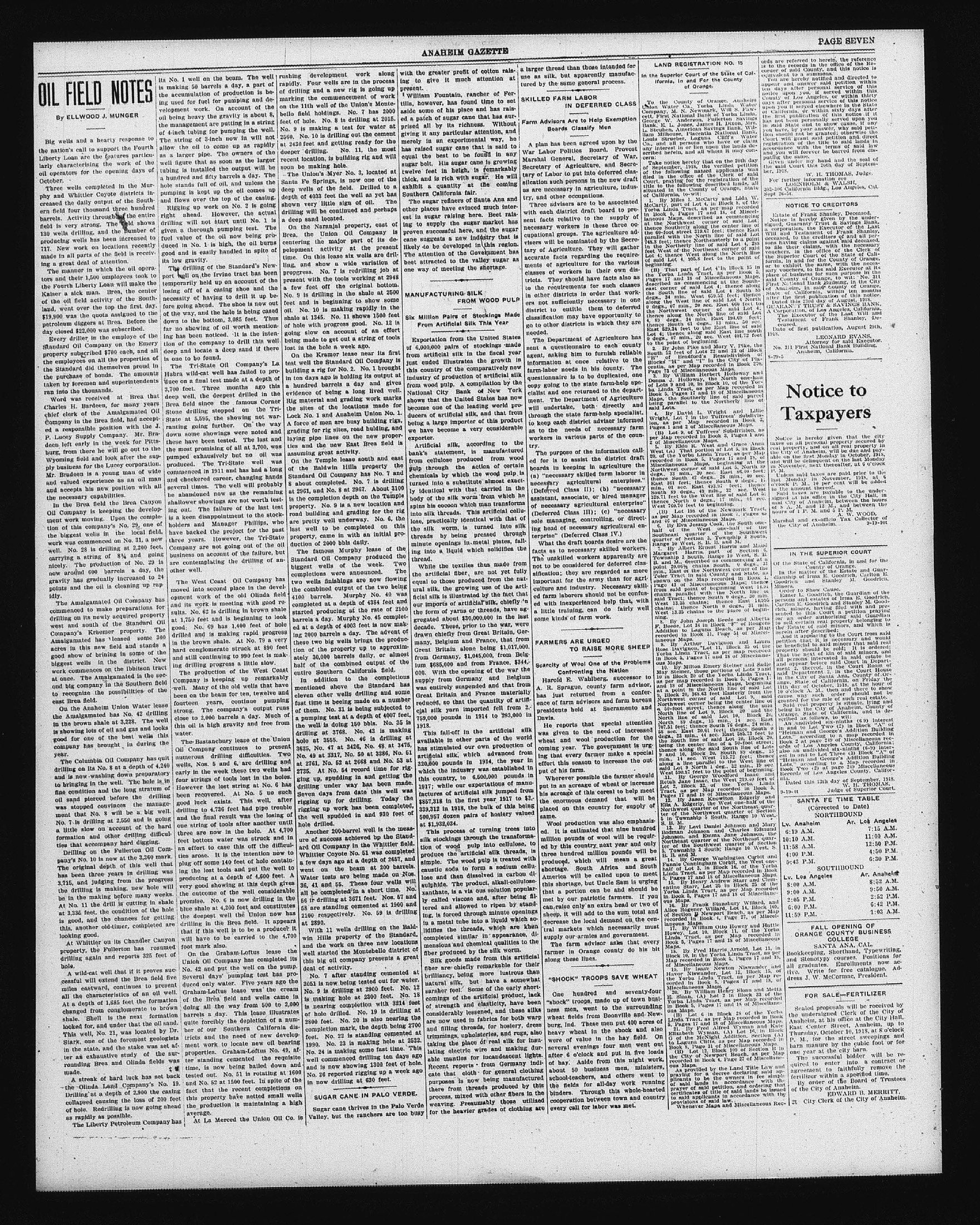
Searchable text
OIL FIELD NOTES
BY ELLWOOD J. MUNGER
Big wells and a hearty response to the nation's call to support the Fourth Liberty Loan are the features particularly characterising the work of the oil operators for the opening days of October.
Three wells completed in the Murphy and Whittier Coyote districts increased the daily output of the Southern field four thousand three hundred barrels. Activity throughout the entire field is very strong. The field shows 130 wells drilling, and the number of producing wells has been increased to 717. New work on locations recently made in all parts of the field is receiving a great deal of attention.
The manner in which the oil operators and their 1,500 employees took to the Fourth Liberty Loan will make the Kaiser a sick man. Brea, the center of the oil field activity of the Southland, went over the top the first day. $19,900 was the quota assigned to the petroleum diggers at Brea. Before the day closed $22,000 was subscribed.
Every driller in the employee of the Standard Oil Company on the Emery property subscribed $700 each, and all the employees on all the properties of the Standard did themselves proud in the purchase of bonds. The amounts taken by foremen and superintendents ran into the thousands.
Word was received at Brea that Charles H. Bardeen, for many years chief clerk of the Amalgamated Oil Company in the Brea field, had accepted a responsible position with the J. P. Lucey Supply Company. Mr. Braden left early in the week for Pittsburg, from there he will go out to the sun and look after the sun.
Its No. 1 well on the beam. The well is making 50 barrels a day, a part of the accumulation of production being used for fuel for pumping and development work. On account of the oil being heavy the gravity is about 8, the management are putting in a string of 4-inch tubing for pumping the well. The string of 3-inch now in will not allow the oil to come up as rapidly as a larger pipe. The owners of the well figure that as soon as the larger tubing is installed the output will be a hundred and fifty barrels a day. The hole stands full of oil, and unless the pumping is kept up the oil comes up and flows over the top of the casing.
Rigging up work on No. 2 is going right ahead. However, the actual drilling will not start until No. 1 is given a thorough pumping test. The fuel value of the oil now being produced in No. 1 is high, the oil burns good and is easily handled in spite of its low gravity.
The drilling of the Standard's Newport well on the Irvine tract has been temporarily held up on account of the losing off of a casing shoe and the necessity of having to drill it up before going ahead. The shoe is now out of the way, and the hole is being cased down to the bottom, 3,085 feet. Thus far no showing of oil worth mentioning has been noticed. It is the intention of the company to drill this well deep and locate a deep sand if there is one to be found.
The Tri-State Oil Company's La Habra wild-cat well has failed to produce on a final test made at a depth of 3,700 feet. Three months ago this deep well, the deepest drilled in the Brea field since the famous Corner Stone drilling stopped on the Tri-State at 5,595, the showing not warranting going further. On the way down some showings were noted and these have been tested. The last and the most promising of all at 3,700, was pumped exhaustively but no oil was rushing development work rapidly. Four wells are in thickness of drilling and a new rig is marking the commencement on the 11th well of the Union bello field holdings. No. 7 feet of hole. No. 8 is drilling No. 9 is making a test for 2560. No. 10 is drilling out that at 2430 feet and getting ready deeper drilling. No. 11, recent location, is building righ so be making hole.
The Union's Myer No. 3, Santa Fe Springs, is now on deep wells of the field. Depth of 4033 feet the well shown very little sign of oil drilling will be continued and a deep sand located.
On the Naranjal property, Brea, the Union Oil Co., centering the major part of development activity at this time. On this lease six wells, and show a wide range. No. 7 is redrill present with the tools working a few feet off the original No. 9 is drilling in the shallow feet and beginning to run oil. No. 10 is making rapale at 1345. No. 11 shows of hole with progress good, going slow on account of being made to get out a stright lost in the hole a week ago.
On the Kramer lease new test well the Standard Oil Co., building a rig for No. 2. In ten days ago is holding in a hundred barrels a day evidence of being a long Rig material and grading on the sites of the locations Lock No. 1 and Anaheim UA force of men are busy grading for rig sites, road laying pipe lines on the ties and the new East Bay assuming great activity.
the employees on all the properties of the Standard did themselves proud in the purchase of bonds. The amounts taken by foremen and superintendents ran into the thousands.
Word was received at Brea that Charles H. Bardeen, for many years chief clerk of the Amalgamated Oil Company in the Brea field, had accepted a responsible position with the J. P. Lucey Supply Company. Mr. Bradeen left early in the week for Pittsburg, from there he will go out to the Wyoming field and look after the supply business for the Lucey corporation. Mr. Bradeen is a young man of wide and valued experience as an oil man and accepts his new position with all the necessary capabilities.
In the Brea field the Brea Canyon Oil Company is keeping the development work moving. Upon the completion of this company's No. 29, one of the biggest wells in the local field, work was commenced on No. 31, a new well. No. 28 is drilling at 2,200 feet, carrying a string of 8¼ and going nicely. The production of No. 29 is now around 600 barrels a day, the gravity has gradually increased to 24 points and the oil is cleaning up rapidly.
The Amalgamated Oil Company has commenced to make preparations for drilling on its newly acquired property west and south of the Standard Oil Company's Kraemer property. The Amalgamated has leased some 300 acres in this new field and stands a good show of brining in some of the biggest wells in the district. New work commences on the Ibbitson tract at once. The Amalgamated is the second big company in the Southern field to recognize the possibilities of the east Brea field.
On the Anaheim Union Water lease the Amalgamated has No. 42 drilling in the brown shale at 3,228. The well is showing lots of oil and gas and looks good for one of the best wells this company has brought in during the year.
The Columbia Oil Company has quit drilling on its No. 8 at a depth of 4,240 and is now washing down preparatory to bringing in the well. The hole is in fine condition and the long stratum of oil sand pierced before the drilling was stopped convinces the management that No. 8 will be a big well. No. 7 is drilling at 2,550 and is going a little slow on account of the hard formation and other drilling difficulties that accompany hard digging.
Drilling on the Fullerton Oil Company's No. 10 is now at the 3,360 mark. This depth of this well that The Tri-State Oil Company's La Habra wild-cat well has failed to produce on a final test made at a depth of 3,700 feet. Three months ago this deep well, the deepest drilled in the Brea field since the famous Corner Stone drilling stopped on the Tri-State at 5,595, the showing not warranting further. On the way down some showings were noted and these have been tested. The last and the most promising of all at 3,700, was pumped exhaustively but no oil was produced. The Tri-State well was commenced in 1911 and has had a long and checkered career, changing hands several times. The well will probably be abandoned now as the remaining shallower showings are not worth testing out. The failure of the last test is a keen disappointment to the stockholders and Manager Phillips, who have backed the project for the past three years. However, the Tri-State Company are not going out of the oil business on account of the failure, but are contemplating the drilling of another well.
The West Coast Oil Company has moved into second place in the development work of the old Olinda field and its work is meeting with good results. No. 62 is drilling in brown shale at 1,750 feet and is beginning to look good. No. 69 has 1,400 feet of hole drilled and is making rapid progress in the brown shale. At No. 79 a very hard conglomerate struck at 890 feet and still continuing to 990 feet is making drilling progress a little slow.
The production of the West Coast Company is keeping up remarkably well. Many of the old wells that have been on the beam for ten, twelve and fourteen years, continue pumping strong. The company's output runs close to 2,000 barrels a day. Much of this oil is high gravity and free from water.
The Bastanchury lease of the Union Oil Company continues to present numerous drilling difficulties. Two wells, Nos. 5 and 6, are drilling and early in the week these two wells had four strings of tools lost in the holes. However the lost string at No. 6 has been recovered. At No. 5 no such good luck exists. This well, after drilling to 4,736 feet had pipe trouble and the final result was the losing of one string of tools after another until three are now in the hole. At 4,700 feet bottom water was struck and in an effort to case this off the difficulties arose. It is the intention now to plug off some 140 feet of hole contain-test well the Standard Oil building a rig for No. 2. No in ten days ago is holding it in a hundred barrels a day evidence of being a long Rig material and grading on the sites of the locations Lock No.1 and Anaheim UA force of men are busy b grading for rig sites, road laying pipe lines on the ties and the new East EA assuming great activity.
On the Temple lease south of the Baldwin Hills p Standard Oil Company has about completed. No.at 2961, and No.at 8 at 2967.is the completion depth on property. No.9 is a new road building and grading are pretty well underway last well to be complete property, came in with a duction of 2000 bbls daily.
The famous Murphy Standard Oil Company has biggest wells of the completions were announced two wells finishings are combined output of 4100 barrels. Murphy completed at a depth of started producing at the barrels a day. Murphy N ed at a depth of 4003 feeding 2000 barrels a day these two big wells bring tion of the property upately 30,000 barrels daily half of the combined entire Southern California.
In addition to the mentioned above eleven other wells drill fast time is beeing made of them. No.31 is being a pumping test at a depth well is doing 150 b drilling at 3768. No.hole at 3555. No.46325, No.47 at 3426,MNo.49 at 3317,No.50 at 2761,No.52 at 26882735.At No.54 recording up, spudding in a drilling under way he Seven days from date rigging up for drilling rigging up work has be well spudded in a hole drilled.
Another 200-barrel w ure of success achieved oil Company in Whittier Coyote No.5a few days ago at a de
drilling and is now-washing down preparatory to bringing in the well. The hole is in fine condition and the long stratum of oil sand pierced before the drilling was stopped convinces the management that No. 8 will be a big well. No. 7 is drilling at 2,550 and is going a little slow on account of the hard formation and other drilling difficulties that accompany hard digging.
Drilling on the Fullerton Oil Company's No. 10 is now at the 3,360 mark. The original depth of this well that has been three years in drilling was 3,715, and judging from the progress the drilling is making, new hole will be in the making before many weeks. At No. 11 the drill is cutting in shale at 3,335 feet, the condition of the hole is good, and the chances for getting this, another old-timer, completed are looking good.
At Whittier on its Chandler Canyon property, the Fullerton has resumed drilling again and reports 325 feet of hole.
A wild-cat well that if it proves successful will extend the Brea field five miles eastward, continues to present all the characteristics of an oil well. At a depth of 1,685 feet the formation changed from conglomerate to brown shale. Shell is the next formation looked for, and under that the oil sand. This well, No. 21, was located by Dr. Stark, one of the foremost geologists in the state, and the stake was set after an exhaustive study of the surrounding Brea and Olinda fields was made.
A streak of hard luck has set back the Olinda Land Company's No. 19. Drilling at a depth of 2,900 the casing collapsed causing the loss of 200 feet of hole. Redrilling is now going ahead as rapidly as possible.
The Liberty Petroleum Company has early in the week these two wells had four strings of tools lost in the holes. However the lost string at No. 6 has been recovered. At No. 5 no such good luck exists. This well, after drilling to 4,736 feet had pipe trouble and the final result was the losing of one string of tools after another until three are now in the hole. At 4,700 feet bottom water was struck and in an effort to case this off the difficulties arose. It is the intention now to plug off some 140 feet of hole containing the lost tools and put the well to producing at a depth of 4,600 feet. A very good showing at this depth gives the outcome of the well considerable promise. No. 6 is now drilling in the blue shale at 4,200 feet and constitutes the deepest well the Union now has drilling in the Brea field. It appears that if this well is to be a producer it will have to be carried to the 4,700 foot mark also.
On the Graham-Loftus lease the Union Oil Company has completed its No. 42 and put the well on the pump. Several days' pumping test has produced only water. Five years ago the Graham-Loftus lease was the cream of the Brea field and wells came in doing all the way from 500 to 2,000 barrels a day. This lease illustrates quite forcibly the depletion of a number of our Southern California districts and the need of new development work to locate new oil bearing properties. Graham-Loftus No. 49, after standing cemented the requisite time, is now being bailed down and tested out. No. 51 is rotating at 1600 and No. 52 at 1500 feet. In spite of the fact that the recent completions on this property have netted small wells the production is maintaining a high average.
At La Merced the Union Oil Co. is
Washing development work along holdly. Four wells are in the process drilling and a new rig is going up marking the commencement of work at the 11th well of the Union's Monte-Valle field holdings. No. 7 has 2000 lot of hole. No. 8 is drilling at 2015. No. 9 is making a test for water at 250. No. 10 is drilling out the cement 2430 feet and getting ready for the deeper drilling. No. 11, the most recent location, is building rig and will be making hole.
The Union's Myer No. 3, located at Santa Fe Springs, is now one of the deep wells of the field. Drilled to a depth of 4033 feet the well as yet has grown very little sign of oil. The drilling will be continued and perhaps deep sand located.
On the Naranjal property, east of Area, the Union Oil Company is entering the major part of its development activity at the present time. On this lease six wells are drilling, and show a wide variation of progress. No. 7 is redrilling job at present with the tools working at 2948 or few feet off the original bottom. No. 9 is drilling in the shale at 2500 feet and is beginning to show some ill. No. 10 is making rapidly in the shale at 1345. No. 11 shows 1500 feet of hole with progress good. No. 12 is slow on account of an effort being made to get out a string of tools lost in the hole a week ago.
On the Kramer lease near its first best well the Standard Oil Company is building a rig for No. 2. No. 1 brought ten days ago is holding its output at a hundred barrels a day and gives evidence of being a long lived well. Rig material and grading work marks the sites of the locations made for Lock No. 1 and Anaheim Union No. 1.
A force of men are busy building rigs, upgrading for rig sites, road building, and laying pipe lines on the new properties and the new East Brea field is assuming great activity.
With the greater profit of cotton raising to give it much attention at present.
William Fountain, rancher of Fertilla, however, has found time to set aside some of his place and has raised a patch of sugar cane that has surprised all by its richness. Without giving it any particular attention, and merely in an experimental way, he has raised sugar cane that is said to equal the best to be found in any sugar belt. His sugar cane is growing twelve feet in height, is remarkably thick, and is rich with sugar. He will exhibit a quantity at the coming Southern California fair.
The sugar refiners of Santa Ana and other places have evinced much interest in sugar raising here. Beet raising to supply the sugar market has proven successful here, and the sugar cane suggests a new industry that is likely to be developed in this region. The attention of the Government has beet attracted to the valley sugar as one way of meeting the shortage.
MANUFACTURING SILK FROM WOOD PULP
Six Million Pairs of Stockings Made From Artificial Silk This Year
Exportation from the United States of 6,000,000 pairs of stockings made from artificial silk in the fiscal year just ended illustrates the growth in this country of the comparatively new industry of production of artificial silk from wood pulp. A compilation by the National City Bank of New York shows that the United States has now become one of the leading world producers of artificial silk, and that from being a large importer of this product we have become a very considerable exporter.
Artificial silk, according to the bank's statement, is manufactured with the greater profit of cotton raising to give it much attention at present.
William Fountain, rancher of Fertilia, however, has found time to set aside some of his place and has raised a patch of sugar cane that has surprised all by its richness. Without giving it any particular attention, and merely in an experimental way, he has raised sugar cane that is said to equal the best to be found in any sugar belt. His sugar cane is growing twelve feet in height, is remarkably thick, and is rich with sugar. He will exhibit a quantity at the coming Southern California fair.
The sugar refiners of Santa Ana and other places have evinced much interest in sugar raising here. Beet raising to supply the sugar market has proven successful here, and the sugar cane suggests a new industry that is likely to be developed in this region. The attention of the Government has beet attracted to the valley sugar as one way of meeting the shortage.
The Department of Agriculture has sent a questionnaire to each county agent, asking him to furnish reliable information at once relative to the farm-labor needs in his county. The questionnaire is to be duplicated, one copy going to the state farm-help specialist and one returned to the department. The Department of Agriculture will undertake, both directly and through the state farm-help specialist, to keep each district adviser informed as to the needs of necessary farm workers in various parts of the country.
The purpose of the information call-a larger thread than those intended for use as silk, but apparently manufactured by the same general process.
SKILLED FARM LABOR IN DEFERRED CLASS
Farm Advisors Are to Help Exemption Boards Classify Men
A plan has been agreed upon by the War Labor Policies Board, Provost Marshal General, Secretary of War, Secretary of Agriculture, and Secretary of Labor to put into deferred classification such persons in the new draft as are necessary in agriculture, industry, and other occupations.
Three advisers are to be associated with each district draft board to present facts relative to the supply of necessary workers in these three occupational groups. The agriculture advisers will be nominated by the Secretary of Agriculture. They will gather accurate facts regarding the requirements of agriculture for the various classes of workers in their own districts. They should have facts also as to the requirements for such classes in other districts in order that workers not sufficiently necessary in one district to entitle them to deferred classification may have opportunity to go to other districts in which they are needed.
The Department of Agriculture has sent a questionnaire to each county agent, asking him to furnish reliable information at once relative to the farm-labor needs in his county. The questionnaire is to be duplicated, one copy going to the state farm-help specialist and one returned to the department. The Department of Agriculture will undertake, both directly and through the state farm-help specialist, to keep each district adviser informed as to the needs of necessary farm workers in various parts of the country.
The purpose of the information call-a larger thread than those intended for use as silk, but apparently manufactured by the same general process.
LAND REGISTER
In the Superior Court California, in an office
To the County Union Water Co., Company, M. N. Nettett, First National George W. Anderson Bank, E. L. Jones, L. Steuben, Ameri am Millhouse, Plu Louis Strueber, I Co., and all persons any interest in or cured herein or situated in the C Co., California to view:
1. By Miles J.
McCarty, part of Yorba Linda Trace in Book 5.
Pages lanceous Maps, dealt at the Northwest thence Southwesterthence Southwesterthence Southwesterthence Southwesterthence Southwesterthence Southwesterthence Southwesterthence Southwesterthence Southwesterthence Southwesterthence Southwesterthence Southwesterthence Southwesterthence Southwesterthence Southwesterthence Southwesterthence Southwesterthence Southwesterthence Southwesterthence Southwesterthence Southwesterthence Southwesterthence Southwesterthence Southwesterthence Southwesterthence Southwesterthence Southwesterthence Southwesterthence Southwesterthence Southwesterthence Southwesterthence Southwesterthence Southwesterthence Southwesterthence Southwesterthence Southwesterthence Southwesterthence Southwesterthence Southwesterthence Southwesterthence Southwesterthence Southwesterthence Southwesterthence SouthwesterthenceSouthwestertheneSouthwestertheneSouthwestertheneSouthwestertheneSouthwestertheneSouthwestertheneSouthwestertheneSouthwestertheneSouthwestertheneSouthwistertheneSouthwistertheneSouthwistertheneSouthwistertheneSouthwistertheneSouthwistertheneSouthwistertheneSouthwistertheneSouthwistertheneSouthwistertheneSouthwisertheneSouthwisertheneSouthwisertheneSouthwisertheneSouthwisertheneSouthwisertheneSouthwisertheneSouthwisertheneSouthwisertheneSouthwisertheneSouthwisertheneSouthwisertheneSouthwisertheneSouthwisertheneSouthwisertheneSouthwisertheneSouthwisertheneSouthwisertheneSouthwisertheneSouthwisertheneSouthwisertheneSouthweretheneSouthweretheneSouthweretheneSouthweretheneSouthweretheneSouthweretheneSouthweretheneSouthweretheneSouthweretheneSouthweretheneSouthweretheneSouthweretheneSouthweretheneSouthweretheneSouthwerethieneSouthwerethieneSouthwerethieneSouthwerethieneSouthwerethieneSouthwerethieneSouthwerethieneSouthwerethieneSouthwerethieneSouthwerethieneSouthwerethieneSouthwerethieneSouthwerethieneSouthwerethieneSouthwerethieneSouthwerethieneSouthwerethieneSouthwerethieneSouthwerethieneSouthwerethieneSouthwerethieneSouthwerethieneSouthwerethieneSouthwerethieneSouthwerethieneSouthwerethienesouthwerethienenesouthwerETHENESOHTHENESOHTHENESOHTHENESOHTHENESOHTHENESOHTHENESOHTHENESOHTHENESOHTHENESOHTHENESOHTHENESOHTHENESOHTHENESOHTHENESOHTHENESOHTHENESOHTHENESOHTHENESOHTHENESOHTHENESOHTHENESOHTHENESOHTHENESOHTHENESOHTHENESOHTHENESOHTHENESOHTHENESOHTHENESOHTHENESOHTHENESOHTHENESOHTHENESOHTHENESOHTHENESOHTHENESOHTHENESOHTHENESOHTHENESOHTHENESOHTHENESOHTHENESOHTHENESOHTHENESOHTHENESOHTHENESOHTHENESOH THENESОНТНЕСОНТНЕСОНТНЕСОНТНЕСОНТНЕСОНТНЕСОНТНЕСОНТНЕСОНТНЕСОНТНЕСОНТНЕСОНТНЕСОНТНЕСОНТНЕСОНТНЕСОНТНЕСОНТНЕСОНТНЕСОНТНЕСОНТНЕСОHТНЕСОHТНЕСОHТНЕСОHТНЕСОHТНЕСОHТНЕСОHТНЕСОHТНЕСОHТНЕСОHТНЕСОHТНЕСОHТНеСОHтнеСоHтнеСоHтнеСоHтнеСоHтнеСоHтнеСоHтнеСоHтнеСоHтнеСоHтнеСоHтнеСоHтнеСоHтнеСоHтне СоHтнеСоHтнеСоHтнеСоHтнеСоHтнеСоHтнеСоHтнеСоHтнеСоHтнеСоHтнеСоHтнеСоHтне СоHтне СоHтне СоHтне СоHтне СоHтне СоHтне СоHтне СоHтнтне СоHтнтне СоHтнтнтне СоHтнтнтнтнтнтнтнтнтнтнтнтнтнтнтнтнтнтнтнтнтнтнтнтнтнтнтнтнтнтнтнтнтнтнтнтнтнтнтнтнтнтнтнтнтнтнтнтنتنتنتنتنتنتنتنتنتنتنتنتنتنتنتنتنتنتنتنتنتنتنتنتنتنتنتنتنتنتنتنتنتنتنتنتنتنتنتنتنتنتنتنتنتنتنتنتنتنتنتنتنتنتنتنتنتنتنتنتuntuuntuuntuuntuuntuuntuuntuuntuuntuuntuuntuuntuuntuuntuuntuuntuuntuuntuuntuuntuuntuuntuuntuuntuuntuuntuuntuuntuuntuuntuuntuuntuuntuuntuuntuuntuuntuuntuuntuuntuuntuuntuuntuuntuuntuuntuuntuuntuuntuuntuuntuuntuuntuuntuuntuuntuuntuuntuuntuuntubuntuubuntuubuntuubuntuubuntuubuntuubuntuubuntuubuntuubuntuubuntuubuntuubuntuubuntuubuntuubuntuubuntuubuntuubuntuubuntuubuntuubuntuubuntuubuntuubuntuubuntuubuntuubuntuubuntuubuntuubuntuubuntuubuntuubuntuubuntuubuntuubuntuubuntuubuntuubuntuubuntuubuntuubuntuubuntuubuntu ubuntuubuntuubuntuubuntuubuntuubuntuubuntuubuntuubuntu ubuntuubuntu ubuntu ubuntu ubuntu ubuntu ubuntu ubuntu ubuntu ubuntu ubuntu ubuntu ubuntu ubuntu ubuntu ubuntu ubuntu ubuntu ubuntu ubuntu ubuntu ubuntu ubuntu ubuntu ubuntu ubuntu ubuntu ubuntu ubuntu ubuntu ubuntu ubuntu ubuntu ubuntu ubuntu ubuntu Ubuntu Ubuntu Ubuntu Ubuntu Ubuntu Ubuntu Ubuntu Ubuntu Ubuntu Ubuntu Ubuntu Ubuntu Ubuntu Ubuntu Ubuntu Ubuntu Ubuntu Ubuntu Ubuntu Ubuntu Ubuntu Ubuntu Ubuntu Ubuntu Ubuntu Ubuntu Ubuntu Ubuntu Ubuntu Ubuntu Ubuntu Ubuntu Ubuntu Ubuntu Ubuntu Ubuntu Ubuntu Ubuntu Ubuntu Ubuntu Ubuntu Ubuntu Ubuntu Ubuntu Ubuntu Ubuntu Ubuntu Ubuntu Ubuntu Ubuntu Ubuntu Ubuntu Ubuntu Ubuntu Ubuntu Ubuntu Ubuntu Ubuntu Ubuntu Ubuntu Ubuntu Ubuntu Ubuntu Ubuntu Ubuntubuntu Ubuntubuntu Ubuntubuntu Ubuntubuntu Ubuntubuntu Ubuntubuntu Ubuntubuntu Ubuntubuntu Ubuntubuntu Ubuntubuntu Ubuntubuntu Ubuntubuntu Ubuntubuntu Ubuntubuntu Ubuntubuntu Ubuntubuntu Ukraine Ukraine Ukraine Ukraine Ukraine Ukraine Ukraine Ukraine Ukraine Ukraine Ukraine Ukraine Ukraine Ukraine Ukraine Ukraine Ukraine Ukraine Ukraine Ukraine Ukraine Ukraine Ukraine Ukraine Ukraine Ukraine Ukraine Ukraine Ukraine Ukraine Ukraine Ukraine Ukraine Ukraine Ukraine Ukraine Ukraine Ukraine Ukraine Ukraine Ukraine Ukraine Ukraine Ukraine Ukraine Ukraine Ukraine Ukraine Ukraine Ukraine Ukraine Ukraine Ukraine Ukraine Ukraine Ukraine Ukraine Ukraine Ukraine Ukraine Ukraine Ukraine Ukraine Ukraine Ukraine Ukraine Ukrainia Ukrainia Ukrainia Ukrainia Ukrainia Ukrainia Ukrainia Ukrainia Ukrainia Ukrainia Ukrainia Ukrainia Ukrainia Ukrainia Ukrainia Ukrainia Ukrainia Ukrainia Ukrainia Ukrainia Ukrainia Ukrainia Ukrainia Ukrainia Ukrainia Ukrainia Ukrainia Ukrainia Ukrainia Ukrainia Ukrainia Ukrainia Ukrainia Ukrainia Ukrainia Ukrainia Ukrainia乌克兰乌克兰乌克兰乌克兰乌克兰乌克兰乌克兰乌克兰乌克兰乌克兰乌克兰乌克兰乌克兰乌克兰乌克兰乌克兰乌克兰乌克兰乌克兰乌克兰乌克兰乌克兰乌克兰乌克兰乌克兰乌克兰乌克兰乌克兰乌克兰乌克兰乌克兰乌克兰乌克兰乌克兰乌克兰乌克兰乌克兰乌克兰乌克兰乌克兰乌克兰乌克兰乌克兰乌克兰乌克兰乌克兰乌克兰乌克兰乌克兰乌克兰乌克兰乌克兰乌克兰乌克兰乌克兰乌克兰乌克兰乌克兰乌克兰乌克兰乌克兰乌克兰乌克兰乌克兰乌克兰乌克兰乌克兰乌克兰乌克兰乌克兰乌克兰乌克兰乌克兰乌克兰乌克兰乌克兰俄罗斯俄罗斯俄罗斯俄罗斯俄罗斯俄罗斯俄罗斯俄罗斯俄罗斯俄罗斯俄罗斯俄罗斯俄罗斯俄罗斯俄罗斯俄罗斯俄罗斯俄罗斯俄罗斯俄罗斯俄罗斯俄罗斯俄罗斯俄罗斯俄罗斯俄罗斯俄罗斯俄罗斯俄罗斯俄罗斯俄罗斯俄罗斯俄罗斯俄罗斯俄罗斯俄罗斯俄罗斯俄罗斯俄罗斯俄罗斯俄罗斯俄罗斯俄罗斯俄罗斯俄罗斯俄罗斯俄罗斯俄罗斯俄罗斯俄罗斯俄罗斯俄罗斯俄罗斯 Russia Russia Russia Russia Russia Russia Russia Russia Russia Russia Russia Russia Russia Russia Russia Russia Russia Russia Russia Russia Russia Russia Russia Russia Russia Russia Russia Russia Russia Russia Russia Russia Russia Russia Russia Russia Russia Russia Russia Russia Russia Russia Russia Russia Россия Россия Россия Россия Россия Россия Россия Россия Россия Россия Россия Россия Россия Россия Россия Россия Россия Россия Россия Россия Россия Россия Россия Россия Россия Россия Россия Россия Россия Россия Россия Россия Россия Россия России Россий Россий Россий Россий Россий Россий Россий Россий Российской Российской Российской Российской Российской Российской Российской Российской Российской Российской Российской Российской Российской Российской Российской Российской Российской Российской Российской Российской Российской Российской Российской Российской Российской Российской Российской Российской Российской Российской Российской Российской Российской Российской Российской Российской Российской Российской Российской Российской Россий Россий Россий Россий Россий Россий Россий Россий Россий Россий Россий Россий Россий Россий Россий Россий Россий Россий Россий Россий Россий Россий Россий Россий Россий Россий Россий Россий Россий Россий Россий Россий Россий Россий Россий Россий Москов Москов Москов Москов Москов Москов Москов Москов Москов Москов Москов Москов Москов Москов Москов Москов Москов Москов Москов Москов Москов Москов Москов Москов Москов Москов Москов Москов Москов Москов Москов Москов Москов Москов Москов Москов Москов Москов Москов Москов Москов Москов Москов Москва Москва Москва Москва Москва Москва Москва Москва Москва Москва Москва Москва Москва Москва Москва Москва Москва Москва Москва Москва Москва Москва Москва Москва Москва Москва Москва Москва Москва Москва Москве Москвы Москвы Москвы Москвы Москвы Москвы Москвы Москвы Москвы Москвы Москвы Москвы Москвы Москвы Москвы Москвы Москвы Москвы Москвы Москвы Москвы Москве Москве Москве Москве Москве Москве Москве Москве Москве Москве Москве Москве Москве Москве Москве Москве Москве Москве Москве Москве Москву Москву Москву Москву Москву Москву Москву Москву Москву Москву Москву Москву Москву Москву Москву Москву Москув Москув Москув Москув Москув Москув Москув Москув Москув Москув Москув Москув Москув Москув Москув Москув Москув Москув Москув Москув Москув Москув Москув Москув Москув Москув смсмсмсмсмсмсмсмсмсмсмсмсмсмсмсмсмсмсмсмсмсмсмсмсмсмсмсмсмсмсмсмсмсмсмсмсмсмсмсмсмсмсмсмсмсмсмсмсмссмссмссмессмессмессмессмессмессмессмессмессмессмессмессмессмессмессмессмессмессмессмессмессмессмессмессмессмессмессмессмессмессмессмессмессмессмессмессмессмессмессмессмеcssмеcssмеcss.me.css.me.css.me.css.me.css.me.css.me.css.me.css.me.css.me.css.me.css.me.css.me.css.me.css.me.css.me.css.me.css.me.css.me.css.me.css.me.css.me.css.me.css.me.css.me.css.me css.csscsscsscsscsscsscsscsscsscsscsscsscsscsscsscsscsscsscsscsscsscsscsscsscsscssCSSCSSCSSCSSCSSCSSCSSCSSCSSCSSCSSCSSCSSCSSCSSCSSCSSCSSCSSCSSCSSCSSCSSCSSCSSCSSCSSCSSCSSCSSCSSCSSCSSCSSCSSCSSCSSCSSCSS CSS CSS CSS CSS CSS CSS CSS CSS CSS CSS CSS CSS CSS CSS CSS CSS CSS CSS CSS CSS CSS CSS CSS CSS CSS CSS CSS CSS CSS CSS CSS CSS CSS CSS CSS CSS CSS CSS CSS CSS CSS CSS CSS CSS CSS CSS CSS CSS CSS CSS CSS CSS CSS CSS CSS CSS CSS CSS CSS CSS CSS CSS CSS CSS CSS CSS CSS CSS CSS CSS CSS CSS CSS CSS CSS CSS CSS CSS CSS CSS CSS CSS CSS CSS CSS CSS CSSCSSCSSCSSCSSCSSCSSCSSCSSCSSCSSCSSCSSCSSCSSCSSCSSCSSCSSCSSCSSCSSCSSCSSCSSCSSCSSCSSCSSCSSCSSCSSCSSCSSCSSCSSCSSCSSCSSSSССССССССССССССССССССССССССССССССССССССССССССССССССССССССССССССССССССССССССССССССССССССССССССССССССССССССССССССССССССССССССССССССССССССССССССССССССССССССCCSSCCSSCCSSCCSSCCSSCCSSCCSSCCSSCCSSCCSSCCSSCCSSCCSSCCSSCCSSCCSSCCSSCCSSCCSSCCSSCCSSCCSSCCSSCCSSCCSSCCSSCCSSCCSSCCSSCCSSCCSSCCSSCCSSCCSSCCSSCCSSCCSSCCSSCCSSCCSSCCSSCCSSCCSSCCSSCCSSCCSSCCSSCCSSCCSSCCSSCCSSCCSSCCSSCCSSCCSSCCSSCCSSCCSSCCSSCCSSCCSSCCSSCCSSCCSSCCSSCCSSCCSSCCSSCCSSCCSSCCSSCCSSCCSSCCSSCCSSCCSSCCSSCCSS.ccss.ccss.ccss.ccss.ccss.ccss.ccss.ccss.ccss.ccss.ccss.ccss.ccss.ccss.ccss.ccss.ccss.ccss.ccss.ccss.ccss.ccss.ccss.ccss.ccss.ccss.ccss.ccss.ccss.ccss.ccss.ccss.ccss.ccss.ccss.ccss.ccss.ccss.ccss.ccss.ccss.ccss.ccss.ccss.ccss.ccss.ccss.ccss.ccssccccccccccccccccccccccccccccccccccccccccccccccccccccccccccccccccccccccccccccccccccccccccccccccccccccccccccccccccccccccccccccccccccccccccccccccccccccccccccccccccccccccccccc
By John P.
Smith 57 feet 0 feet 0 feet 0 feet 0 feet 0 feet 0 feet 0 feet 0 feet 0 feet 0 feet 0 feet 0 feet 0 feet 0 feet 0 feet 0 feet 0 feet 0 feet 0 feet 0 feet 0 feet 0 feet 0 feet 0 feet 0 feet 0 feet 0 feet 0 feet 0 feet 0 feet 0 feet 0 feet 0 feet
By William J.
Donna I.
John L.
Linda L.
Linda L.
Linda L.
Linda L.
Linda L.
Linda L.
Linda L.
Linda L.
Linda L.
Linda L.
Linda L.
Linda L.
Linda L.
Linda L.
Linda L.
Linda L.
Linda L.
Linda L.
Linda L.
Linda L.
Linda L.
Linda L.
Linda L.
Linda L.
Linda L.
Linda L.
Linda L.
Linda L.
Linda L.
Linda L.
Linda L.
Linda L.
Linda L.
Linda L.
Linda L.
Linda L.
Linda L.
Linda L.
Linda L.
Linda L.
Linda L.
Linda L.
Linda L.
Linda L.
Linda L.
Linda L.
Linda L.
Linda L.
Linda L.
Linda L.
Linda L.
Linda L.
Linda L.
Linda L.
Linda L.
Linda L.
Linda L.
Linda L.
Linda L.
Linda L.
Linda L.
Linda L.
Linda L.
Linda L.
Linda L.
Linda L.
Linda L.
Linda L.
Linda L.
Linda l
By William J.
Donna I.
John L.
Lindi l
Lindi l
Lindi l
Lindi l
Lindi l
Lindi l
Lindi l
Lindi l
Lindi l
Lindi l
Lindi l
Lindi l
Lindi l
Lindi l
Lindi l
Lindi l
Lindi l
Lindi l
Lindi l
Lindi l
Lindi l
lindi l
lindi l
lindi l
lindi l
lindi l
lindi l
lindi l
lindi l
lindi l
lindi l
lindi l
lindi l
lindi l
lindi l
lindi l
lindi l
lindi l
lindi l
lindi l
lindi l
lindi l
lindi l
lindi l
lindi l
lindi ll
lindi ll
lindi ll
lindi ll
lindi ll
lindi ll
lindi ll
lindi ll
lindi ll
lindi ll
lindi ll
lindi ll
lindi ll
lindi ll
lindi ll
lindi ll
lindi ll
lindi ll
lindi ll
lindi ll
lindi ll
lindi ll
lindi ll
lindi ll
lindii ll
lindii ll
lindii ll
lindii ll
lindii ll
lindii ll
lindii ll
lindii ll
lindii ll
lindii ll
lindii ll
lindii ll
lindii ll
lindii ll
lindii ll
lindii ll
lindii ll
lindii ll
lindii ll
best well the Standard Oil Company is building a rig for No. 2. No.1 brought ten days ago is holding its output at a hundred barrels a day and gives evidence of being a long lived well. Rig material and grading work marks the sites of the locations made for Lock No.1 and Anaheim Union No.1. A force of men are busy building rigs, grading for rig sites, road building, and laying pipe lines on the new properties and the new East Brea field is assuming great activity.
On the Temple lease south and east of the Baldwin Hills property the Standard Oil Company has No.7 and about completed. No.7 is drilling at 2961, and No.8 at 2967. About 3100 is the completion depth on the Tample property. No.9 is a new location and road building and grading for the rig are pretty well underway. No.6, the last well to be completed on this property, came in with an initial production of 2000 bbls daily.
The famous Murphy lease of the Standard Oil Company produced the biggest wells of the week. Two completions were announced. The two wells finishings are now flowing the combined output of the two being 4100 barrels. Murphy No.40 was completed at a depth of 4384 feet and started producing at the rate of 2100 barrels a day. Murphy No.45 completed at a depth of 4003 feet is now making 2000 barrels a day. The advent of these two big wells brings the production of the property up to approximately 30,000 barrels daily, or almost half of the combined output of the entire Southern California field.
In addition to the completions mentioned above the Standard has eleven other wells drilling and some fast time is being made on a number of them. No.31 is being subjected to a pumping test at a depth of 4007 feet, the well is doing 150 bbls. No.35 is drilling at 3768. No.43 is making hole at 3555. No.46 is drilling at 3625, No.47 at 3426, No.48 at 3475, No.49 at 3317, No.50 at 3286, No.51 at 2761, No.52 at 2668 and No.53 at 2735. At No.54 record time for rigging up, spudding in and getting the drilling under way has been made. Seven days from date this well was rigging up for drilling. Today the rigging up work has been completed, the well spudded in and 930 feet of hole drilled.
Another 200-barrel well is the measure of success achieved by the Standard Oil Company in the Whittier field. Whittier Coyote No.51 was completed a few days ago at a depth of 2657, and 2600 barrels.
This process of turning trees into silk stockings through the transformation of wood pulp into cellulose, to produce the artificial silk threads, is simple. The wood pulp is treated with just ended illustrates the growth in this country of the comparatively new industry of production of artificial silk from wood pulp. A compilation by the National City Bank of New York shows that the United States has now become one of the leading world producers of artificial silk, and that from being a large importer of this product we have become a very considerable exporter.
Artificial silk, according to the bank's statement, is manufactured from cellulose produced from wood pulp through the action of certain chemicals by which the wood pulp is turned into a substitute almost exactly identical with that carried in the body of the silk worm from which he spins his cocoon which man transforms into silk threads. This artificial cellulose, practically identical with that of the silk worm, is turned into silk threads by being pressed through minute openings in metal plates, falling into a liquid which solidifies the thread.
While the textiles thus made from the artificial fiber are not yet fully equal to those produced from the natural silk, the growing use of the artificial silk is illustrated by the fact that our imports of artificial silk, chiefly 'n form of yarns or threads, have aggregated about $30,000,000 in the last decade. These, prior to the war, were drawn chiefly from Great Britain, Germany, Belgium and France, that from Great Britain alone being $1,017,000, from Germany, $1,045,000, from Belgium $685,000 and from France, $344,000. With the opening of the war the supply from Germany and Belgium was entirely suspended and that from Great Britain and France materially reduced, so that the quantity of artificial silk yarn imported fell from 2.759,000 pounds in 1914 to 293,000 in 1918.
This fall-off in the artificial silk available in other parts of the world has stimulated our own production of artificial silk, which advanced from 320,000 pounds in 1914, the year in which the industry was established in this country, to 6,500,000 pounds in 1917; while our exportations of manufactures of artificial silk jumped from $857,318 in the first year 1917 to $2,339,312 in 1918, the bulk of this being 500,957 dozen pairs of hoslery valued at $1,932,034.
This process of turning trees into silk stockings through the transformation of wood pulp into cellulose, to produce the artificial silk threads, is simple. The wood pulp is treated with just ended illustrates the growth in this country of the comparatively new industry of production of artificial silk from wood pulp. A compilation by the National City Bank of New York shows that the United States has now become one of the leading world producers of artificial silk, and that from being a large importer of this product we have become a very considerable exporter.
Artificial silk, according to the bank's statement, is manufactured from cellulose produced from wood pulp through the action of certain chemicals by which the wood pulp is turned into a substitute almost exactly identical with that carried in the body of the silk worm from which he spins his cocoon which man transforms into silk threads. This artificial cellulose, practically identical with that of the silk worm, is turned into silk threads by being pressed through minute openings in metal plates, falling into a liquid which solidifies the thread.
While the textiles thus made from the artificial fiber are not yet fully equal to those produced from the natural silk, the growing use of the artificial silk is illustrated by the fact that our imports of artificial silk, chiefly 'n form of yarns or threads, have aggregated about $30,000,000 in the last decade. These, prior to the war, were drawn chiefly from Great Britain, Germany, Belgium and France, that from Great Britain alone being $1,017,000, from Germany, $1,045,000, from Belgium $685,000 and from France, $344,000.With the opening of the war the supply from Germany and Belgium was entirely suspended and that from Great Britain and France materially reduced, so that the quantity of artificial silk yarn imported fell from 2.759,000 pounds in 1914 to 293,000 in 1918.
This fall-off in the artificial silk available in other parts of the world has stimulated our own production of artificial silk which advanced from 320,000 pounds in 1914,the year in which the industry was established in this country,to 6,500,000 pounds in 1917;while our exportations of manufactures of artificial silk jumped from $857,318 in the first year 1917 to $2,339,312 in 1918,the bulk of this being 500,957 dozen pairs of hoslery valued at $1,932,034.
This process of turning trees into silk stockings through the transformation of wood pulp into cellulose,to producethe artificalsilkthreads,issimple.Thewood pulpisreatedwithjustendedillustratesthegrowthinthiscountryofthecomparativelynewindustryofproductionofartificialsilkworldowoodpulp.AcompilationbytheNationalCityBankofNewYorkshowsthattheUnitedStateshasnowbecomeoneoftheleadingworldproducersoftheartialsilkworldowoodpulp.AcompilationbytheNationalCityBankofNewYorkshowsthattheUnitedStateshasnowbecomeoneoftheleadingworldproducersoftheheartialsilkworldowoodpulp.AcompilationbytheNationalCityBankofNewYorkshowsthattheUnitedStateshasnowbecomeoneoftheleadingworldproducersoftheheartialsilkworldowoodpulp.AcompilationbytheNationalCityBankofNewYorkshowsthattheUnitedStateshasnowbecomeoneoftheleadingworldproducersoftheheartialsilkworldowoodpulp.AcompilationbytheNationalCityBankofNewYorkshowsthattheUnitedStateshasnowbecomeoneoftheleadingworldproducersoftheheartialsilkworldowoodpulp.AcompilationbytheNationalCityBankofNewYorkshowsthattheUnitedStateshasnowbecomeoneoftheleadingworldproducersoftheheartialsilkworldowoodpulp.AcompilationbytheNationalCityBankofNewYorkshowsthattheUnitedStateshasnowbecomeoneoftheleadingworldproducersoftheheartialsilkworldowoodpulp.AcompilationbytheNationalCityBankofNewYorkshowsthattheUnitedStateshasnowbecomeoneoftheleadingworldproducer softheheartialsilkworldowoodpulp.AcompilationbytheNationalCityBankofNewYorkshowsthattheUnitedStateshasnowbecomeoneoftheleadingworldproducer softheheartialsilkworldowoodpulp.AcompilationbytheNationalCityBankofNewYorkshowsthattheUnitedStateshasnowbecomeoneoftheleadingworldproducer softheheartialsilkworldowoodpulp.AcompilationbytheNationalCityBankofNewYorkshowsthattheUnitedStateshasnowbecomeoneoftheleadingworldproducer softheheartialsilkworldowoodpulp.AcompilationbytheNationalCityBankofNewYorkshowsthattheUnitedStateshasnowbecomeoneoftheleadingworldproducer softheheartialsilkworldowoodpulp.AcompilationbytheNationalCityBankofNewYorkshowsthattheUnitedStateshasnowbecomeoneoftheleadingworldproducer softheheartialsilkworldowoodpulp.AcompilationbytheNationalCityBankofNewYorkshowsthattheUnitedStateshasnowbecomeoneoftheleadingworldproducer softheheartialsilkworldowoodpulp.AcompilationbytheNationalCityBankofNewYorkshowsthattheUnitedStateshasnowbecomeoneoftheleadingworldproducer softheheartialsilkworldowoodpulp.AcompilationbytheNationalCityBankofNewYorkshowsthattheUnited Stateshasnowbecomeoneoftheleadingworldproducer softheheartialsilkworldowoodpulp.AcompilationbytheNationalCityBankofNewYorkshowsthatthe United Stateshasnowbecomeoneoftheleadingworldproducer softheheartialsilkworldowoodpulp.AcompilationbytheNationalCityBankofNewYorkshowsthatthe United Stateshasnowbecomeoneoftheleadingworldproducer softheheartialsilkworldowoodpulp.AcompilationbytheNationalCityBankofNewYorkshowsthatthe United Stateshasnowbecomeoneoftheleadingworldproducer softheheartialsilkworldowoodpulp.AcompilationbytheNationalCityBankofNewYorkshowsthatthe United Stateshasnowbecomeoneoftheleadingworldproducer softheheartialsilkworldowoodpulp.AcompilationbytheNationalCityBankofNewYorkshowsthatthe United Stateshasnowbecomeoneoftheleadingworldproducer softheheartialsilkworldowoodpulp.AcompilationbytheNationalCityBankofNewYorkshowsthatthe United Stateshasnowbecomeoneoftheleadingworldproducer softheheartialsilkworldowoodpulp.AcompilationbytheNationalCityBankofNewYorkshowsthatthe United Stateshasnowbecomeoneofthreedirectorsofnearingenterprise"(Deferred Class IV.)
What the draft boards desire are the facts as to necessary skilled workers.The unskilled workers apparently are not to be considered for deferred classification; they are regarded as more important for the army than for agriculture and industry.Necessary skilled farm laborers should not be confused with inexperienced help that with a little training can do fairly well some kinds of farm work.
FARMERS ARE URGED TO RAISE MORE SHEEP
Scarcity of Wool One of the Problems Confronting The Nation
Harold E.Wahlberg,successor to A.R.Spague,county farm advisor,has just returned from a conference of farm advisors and farm bureau presidents held at Sacramento and Davis.
He reports that special attention was given to the need-of increased wheat and wool production for the coming year.The government is urging that every farmer make a special effort this season to increase the output of his farm.
Wherever possible the farmer should put in an acreage of wheat or increase his acreage of this cereal to help meet the enormous demand that will be placed on this country for supply of same.
Wool production was also emphasized. It is estimated that nine hundred million pounds of wool will be required by this country next year and only three hundred million pounds will be produced which will mean a great blocks,"H"and census,"M"and page 73 of Miscellaneous Northwest corn mills."Minence,"South 361 meter,"mince,"South 89 meter,"mince,"West 69 meter,"mince,"West 79 meter,"mince,"West 89 meter,"mince,"West 89 meter,"mince,"West 89 meter,"mince,"West 89 meter,"mince,"West 89 meter,"mince,"West 89 meter,"mince,"West 89 meter,"mince,"West 89 meter,"mince,"West 89 meter,"mince,"West 89 meter,"mince,"West 89 meter,"mince,"West 89 meter,"mince,"West 89 meter,"mince,"West
At No. 54 record time for rigging up, spudding in and getting the drilling under way has been made. Seven days from date this well was rigging up for drilling. Today the rigging up work has been completed, the well spudded in and 930 feet of hole drilled.
Another 200-barrel well is the measure of success achieved by the Standard Oil Company in the Whittier field. Whittier Coyote No. 51 was completed a few days ago at a depth of 2657, and went on the beam at 200 barrels. Water tests are being made on Nos. 36, 41 and 55. These four wells will be completed in a short time. No. 56 ir drilling at 3671 feet. Nos. 57 and 58 are standing cemented at 1900 and 2100 respectively. No. 59 is drilling at 2890.
With 11 wells drilling on the Baldwin Hills property of the Standard, and the work on three new locations well started the Montebello district of this big oil company presents a great deal of activity.
No. 7 after standing cemented at 3051 is now being tested out for water. No. 9 is drilling at 2900 feet. No. 12 is making hole at 2300 feet. No. 18 is nearing completion with 3214 feet of hole drilled. No. 19 is drilling at 2800 feet. No. 20 is also nearing the completion mark, the depth being 2700 feet. No. 22 is standing cemented at 1990. No. 23 is making hole at 2522. No. 24 is making some fast time. This well commenced drilling ten days ago and is now showing 1300 feet of hole. No. 26 reported rigging up a week ago in now drilling at 630 feet.
SUGAR CANE IN PALO VERDE.
Sugar cane thrives in the Palo Verde Valley, but the ranchers are too busy which the industry was established in this country, to 6,500,000 pounds in 1917; while our exportations of manufactures of artificial silk jumped from $857,318 in the first year 1917 to $2,339,312 in 1918, the bulk of this being 500,957 dozen pairs of hoslery valued at $1,932,034.
This process of turning trees into silk stockings through the transformation of wood pulp into cellulose, to produce the artificial silk threads, is simple. The wood pulp is treated with caustic soda to form a sodium cellulose and then dissolved in carbon dioxide. The product, alkali-cellulose xanthate, is a visous solution popularly called viscose and, after being filtered and allowed to ripen by standing, is forced through minute openings in a metal tube into a liquid which solidifies the threads, which are then completed similar in appearance, dimensions and chemical qualities to the fiber produced by the silk worm.
Silk goods made from this artificial fiber are chiefly remarkable for their brilliancy, being more lustrous than natural silk, but have a somewhat sarsher feel. Some of the early shortcomings of the artificial product, lack of strength and elasticity, have been considerably lessened, and these silks are now used in fabrics for both warp and filling threads, for hoslery, dress trimmings, upholsteries, and rugs, also taking the place of real silk for insulating electric wire and making durable mantles for incandescent lights.
Recent reports from Germany indicate that cloth for general clothing purposes is now being manufactured there from threads produced by this process, mixed with other fibers in the weaving. Presumably those utilized for the heavier grades of clothing are
"SHOCK" TROOPS SAVE WHEAT
One hundred and seventy-four "shock" troops, made up of town business men, went to the surrounding wheat fields from Boonville and Newburg, Ind. These men put 400 acres of heavy wheat in the shock and also were of value in the hay field. On several evenings four men went out after 6 o'clock and put in five loads of hay. Aside from this night work, about 50 business men, ministers, school-teachers, and others went to the fields for all-day work running binders. Through this whole-hearted cooperation between town and country every call for labor was met.
Wool production was also emphasized. It is estimated that nine hundred million pounds of wool will be required by this country next year and only three hundred million pounds will be produced, which will mean a great shortage. South Africa and South America will be called upon to meet this shortage, but Uncle Sam is urging that a portion can be and should be met by our patriotic farmers. If you can raise only an extra head or two of sheep, it will add to the sum total and decrease the local demand on the central markets which necessarily must supply our armies and government.
The farm advisor asks that every farmer in Orange county do his bit along these lines.
Havor Near the Yorba corded in Miscellanea.
By E.Shorn Lot 2.Block Tract, as per Pages 17 and 18.
By J.Allia A.Edge Northwest corner of the fifth in Towns.
By L.Doddman John Johnson, an Northeast corner of the fifth in Towns.
By L.Fannie Cunce half of Low Linda Trace.
Pages 17 and 18.
By Hentine Stanton Yorba Linda in Book F.
Pages 18.
By Alice Rogers of Section I recorded in Laguna Mills.
By Howey L.Linda Trace Book F.
Pages 18.
By Block K10.
Map records of Miscellanea.
By Havor Near the Yorba corded in Miscellanea.
By E.Shorn Lot 2.Block Tract, as per Pages 17 and 18.
By J.Allia A.Edge Northwest corner of the fifth in Towns.
By L.Doddman John Johnson, an Northeast corner of the fifth in Towns.
By L.Fannie Cunce half of Low Linda Trace.
Pages 17 and 18.
By Hentine Stanton Yorba Linda in Book F.
Pages 18.
By Alice Rogers of Section I recorded in Laguna Mills.
By Howey L.Linda Trace Book F.
Pages 18.
By Block K10.
Map records of Miscellanea.
By Havor Near the Yorba corded in Miscellanea.
By E.Shorn Lot 2.Block Tract, as per Pages 17 and 18.
By J.Allia A.Edge Northwest corner of the fifth in Towns.
By L.Doddman John Johnson, an Northeast corner of the fifth in Towns.
By L.Fannie Cunce half of Low Linda Trace.
Pages 17 and 18.
By Hentine Stanton Yorba Linda in Book F.
Pages 18.
By Alice Rogers of Section I recorded in Laguna Mills.
By Howey L.Linda Trace Book F.
Pages 18.
By Block K10.
Map records of Miscellanea.
By Havor Near the Yorba corded in Miscellanea.
By E.Shorn Lot 2.Block Tract, as per Pages 17 and 18.
By J.Allia A.Edge Northwest corner of the fifth in Towns.
By L.Doddman John Johnson, an Northeast corner of the fifth in Towns.
By L.Fannie Cunce half of Low Linda Trace.
Pages 17 and 18.
By Hentine Stanton Yorba Linda in Book F.
Pages 18.
By Alice Rogers of Section I recorded in Laguna Mills.
By Howey L.Linda Trace Book F.
Pages 18.
By Block K10.
Map records of Miscellanea.
By Havor Near the Yorba corded in Miscellanea.
By E.Shorn Lot 2.Block Tract, as per Pages 17 and 18.
By J.Allia A.Edge Northwest corner of the fifth in Towns.
By L.Doddman John Johnson, an Northeast corner of the fifth in Towns.
By L.Fannie Cunce half of Low Linda Trace.
Pages 17 and 18.
By Hentine Stanton Yorba Linda in Book F.
Pages 18.
By Alice Rogers of Section I recorded in Laguna Mills.
By Howey L.Linda Trace Book F.
Pages 18.
By Block K10.
Map records of Miscellanea.
By Havor Near the Yorba corded in Miscellanea.
By E.Shorn Lot 2.Block Tract, as per Pages 17 and 18.
By J.Allia A.Edge Northwest corner of the fifth in Towns.
By L.Doddman John Johnson, an Northeast corner of the fifth in Towns.
By L.Fannie Cunce half of Low Linda Trace。
Pages 17和18。
by Hentine Stanton Yorba Linda在Book F。
pages17和18。
by Alice RogersofSectionIrecordedinLagunaMills。
byHoweyL.LindaTraceBookF。
pages17和18。
byBlockK10。
maprecordsofMiscellanea。
byHavorNeartheYorbacordedinMiscellanea。
byE.ShornLot2.BlockTract,asperPages17and18。
byJ.AlliaA.EdgeNorthwestcornerofthefifthinTowns。
byL.DoddmanJohnJohnson,anNortheastcornerofthefifthinTowns。
byL.FannieCuncehalfofLowLindaTrace。
pages17和18。
byHentineStantonYorbaLinda在BookF。
pages17和18。
byAliceRogersofSectionIrecordedinLagunaMills。
byHoweyL.LindaTraceBookF。
pages17和18。
byBlockK10。
maprecordsofMiscellanea。
byHavorNeartheYorbacordedinMiscellanea。
byE.ShornLot2.BlockTract,asperPages17and18。
byJ.AlliaA.EdgeNorthwestcornerofthefifthinTowns。
LAND REGISTRATION NO. 15
In the Superior Court of the State of California, In and For the County of Orange.
To the County of Orange, Anaheim Union Water Co., Yorba Linda Water Company, M. N. Newmark, Will S. Fawcett, First National Bank of Yorba Linda, George W. Anderson, Fullerton Savings Bank, E. L. Jones, James H. Dixon, Mrs. L. Steuben, American Savings Bank, William Milhouse, Placentia National Bank, Louis Strueber, Laguna Cliff's Water Co., and all persons who have on claim any interest in or lien upon the lands described herein, and all whom it may concern:
Take notice hereby that on the 29th day of September, 1918, the verified petition of the following named applicants was filed in the office of the Clerk of said Court, praying for the registration of the title to the following described lands, all situated in the County of Orange, State of California, to-wit:
1. By Miles I. McCarty and Lida W. McCarty part of Lot 4, in Block 8, of the Yorba Linda Tract, as per map recorded in Book 5, Pages 17 and 18, of Miscellaneous Maps, described as commencing at the Northwest corner of said Lot; thence Southerly along the center line of the 60-foot street 319.67 feet; thence East parallel with the North line of said Lot 748.8 feet; thence Northeasterly to a point in the Northerly line of said Lot 4; 285 feet West of the Northeast corner of said Lot 4; thence West along the North line of said Lot 4, 995.8 feet to the point of beginning.
(B) That part of Lot 4 in Block 15 in the Yorba Linda Tract, as per Book 5, Pages 17 and 18 of Miscellaneous Maps, described as commencing at the Southeast corner of said Lot 4; thenced along the South lines of said Lot 4 South 89 degs., 34 min. West 659.52 feet; thence along the West line of said Lot 4 North degs., 07 min., 20 sec. East 660 feet to the Northwest corner of said Lot 4; thence along the North line of said Lot 4, 89 degs., 34 min. East 194.69 feet; thence South 91 degs., 13 min., 50 sec. East 529.34 feet to the East line of said Lot 4; thence along said East line south 0 degs., 07 min., 20 sec. West 401.72 feet to the point of beginning.
2. By John Pike and Mary V. Pike, the South 52 feet of Lots 22 and 23 of Block "B" of Bradford's Resubdivision of Blocks "H" and "I" in the City of Placentia, as per Map recorded in Book 270, Page 73 of Miscellaneous Maps.
3. By William Herbert Holloway and Donna J. Holloway, the North one-hair of Lots 9 and 10, in Block 10, of the Yorba Linda Tract, as per Map recorded in Book 5, Pages 17 and 18 of Miscellaneous Maps, the Southerly line of said parcel being parallel to the Northerly line of said Lots.
4. By David L. Wright and Lillie Wright, lot 7 in the Tuffrees' Subdivision, as per Map recorded in Book 3, Pages 1 and 2 of Miscellaneous Maps.
(B) Lot 9, of Tuffrees' Subdivision, as per Map recorded in Book 3, Pages 1 and 2 of Miscellaneous Maps.
5. By Eldo R. K. West and Grace Anna West (A) That portion of Lot 5, in Block 20, of the Yorba Linda Tract, as per Map recorded in Book 3, Pages 1 and 2 of Miscellaneous Maps.
ords are referred to herein, the reference is to the records in the office of the Recorder of said County, and this notice is equivalent to a summons.
You are hereby notified and directed to appear and answer said petition within ten days after personal service of this notice upon you if served within this County of Los Angeles, or within thirty days after personal service of this notice upon you if served elsewhere in the State of California, or within sixty days after the first publication of this notice if it has not been personally served upon you in said State and to show cause, if any you have by your answer, why said petition should not be granted; otherwise the Court will grant said petition and direct registration of the title to said lands in accordance with the terms of said law and you will forever be barred from disputing the same.
Given under my hand and the seal of the said Court this 29th day of September, 1918.
W. H. THOMAS, Judge.
For further information see LOENHOLM & WALSH,
303-306 California Bldg., Los Angeles, Cal.
Sept 26-5t.
NOTICE TO CREDITORS
Estate of Frank Shanley, Deceased.
Notice is hereby given by the undersigned, Guaranty Trust & Savings Bank, a corporation, the Executor of the Last Will and Testament of Frank Shanley, deceased, to the creditors of and all persons having claims against said deceased, to file their claims, with the necessary vouchers, in the office of the Clerk of the Superior Court of the State of California, in and for the County of Orange,
or to exhibit the same, with the necessary vouchers, to the said Executor nx its place of business for suen purpose in the county of Orange.
To wit: No. 311 First National Bank Building, In the City of Anaheim, In safe county of Orange State of California, within ten months after the first publication of this notice.
Dated this 23rd day of August, 1918.
GUARANTY TRUST & SAVINGS BANK,
A Corporation, of Los Angeles, California,
The Executor of the Last Will and Testament of Frank Shanley, Deceased.
Date of first publication, August 29th, 1918.
LEONARD EVANS,
Attorney for said Executor.
Anaheim, California.
8-29-5
Notice to Taxpayers
Notice is hereby given that the city taxes on all personal property secured by real property, and on all real property in the City of Anaheim, will be due and payable on the first Monday in October, 1918, but will be delinquent on the last Monday in November, next thereafter, at 6 o'clock P.M.
Unless said taxes are paid prior to the last Monday in November, 1918, at 6 o'clock P.M., 10 per cent will be added to the amount thereof.
Said taxes are payable to the undersigned at his office in the City Hall, in City of Anaheim, between the hours of 8 A.M. and 12 M., and between the hours of 1 P.M. and 5 P.M.
Marshal and ex-officio Tax Collector of the City of Anaheim.
IN THE SUPERIOR COURT
Of the State of California, in and for the County of Orange.
In the matter of the Estate and Guardianship of Irma E. Goodrich, Carlton E. Goodrich, Stanley M. Goodrich, Minors.
Order to Show Cause.
Eimer L. Goodrich, the Guardian of the persons and estates of Irma E. Goodrich, Carlton E. Goodrich, Stanley M. Goodrich, having filed with and presented to this Court a petition praying for an order authorizing said Guardian to sell certain real property belonging to the Estate of said minors, and which is herein after described:
And it appearing to the Court from said petition that it is necessary and would be beneficial to said minors that said real property should be sold; It is ordered that the next of kin of said minors, and all persons interested in said estate be and appear before said Court in Department 2, thereof, in the Court Room of the City of Santa Ana, County of Orange, State of California, on Friday the 11th day of October, 1918, at the hour of 10 o'clock A.M., then there to show cause such order should not be granted for the sale of such real estate.
Said real property is situate, lying and being in the City of Anaheim, County of Orange, State of California, and is described as follows, to wit:
An undivided six-ninths (6-9) interest in and to Lot Two (2) in Block "A" of Heiman and George's Addition Building Lots," according to a map recorded in Book 2 at page 249 of Miscellaneous records of Los Angeles County, California; also an undivided six-ninths (6-9) interest in and to Lot Three (3) Block "A" of Heiman and George's Addition Building Lots," according to a Map recorded in Book Two (2) at page 249 Miscellaneous Records of Los Angeles County, California.
Dated this 13th day of September, 1918.
W. H. THOMAS.
Judge of Superior Court.
SANTA FE TIME TABLE
(Corrected to Date)
NORTHBOUND
Lv. Anaheim
Ar. Loa Angeles
6:19 A.M.
7:15 A.M.
10:10 A.M.
11:00 A.M.
11:58 A.M.
12:50 P.M.
4:00 P.M.
4:50 P.M.
5:43 P.M.
6:30 P.M.
farmer should not or increase to help meet that will be for supply of also emphasize nine hundred will be requir year and only bounds will be mean a great Sam is urging and should be farmers. If you head or two of sum total and stand on the cesscessarily must government.asks that every county do his bit.
SAVE WHEAT
seventy-four map of town busihe surroundingville and New-output 400 acres of shack and also hay field. On men went out in five loads this night work, men, ministers, others went to work running whole-hearted town and country as met.
By George Woodford Isaac and Retah Jane Isaac, the West 219.40 feet of Lot 2, Block 32, of the Yorba Linda Tract, as per Map recorded in Book 5, Pages 17 and 18 of Miscellaneous Maps.
By Jason Knowlton Edgery and Ella Edgerly, the West one-half of the Northwest quarter of the Northeast quarter of the Northwest quarter of Section 5 in Township 5 South, Range 10 West, S. B. M.
By Levi Daniel Johnson and Mary Bodman Johnson and Charles Edmund Johnson, and Emma Jane Johnson, the Northeast quarter of the Northeast quarter of the Southwest quarter of Section 5, Township 3 South; Range 10 West, S. B. B. and M.
By George Washington Corbit and Fannie Cunningham Corbit, the West one-half of Lot 3, in Block 16, of the Yorba Linda Tract, as per Map recorded in Book 5, Pages 17 and 18 of Miscellaneous Maps.
By Henry Andrew Starr and Clentine Starr, Lot 25 in Block 25 of the Yorba Linda Tract, as per Map recorded in Book 5, Pages 17 and 18 of Miscellaneous Maps.
By Frank Stanbury Willard, and Alice Rogener Willard, Lot 14, Block 109, of Section B Newport Beach, as per Map recorded in Book 4, Page 27, of Miscellaneous Maps.
By William Otto Howey and Hattle Howey, Lot 10, Block 11, of the Yorba Linda Tract, as per Map recorded in Book 5, Pages 17 and 18 of Miscellaneous Maps.
By Fred Harris Arnold, Lot 11, in Block 10, in the Yorba Linda Tract, as per Map recorded in Book 5, Pages 17 and 18 of Miscellaneous Maps.
By Isaac Newton Niswander and Havor Niswander, Lot 12, Block 15, of the Yorba Linda Tract, as per Map recorded in Book 5, Pages 17 and 18, of Miscellaneous Maps.
By William Henry Sloan and Metta B Sloan (A) Lot 2 in Block 33 of the Yorba Linda Tract, as per Map recorded in Book 5, Pages 17 and 18 of Miscellaneous Maps.
(B) Lot 6 in Block 28 of the Yorba Linda Tract, as per Map recorded in Book 5, Pages 17 and 18 of Miscellaneous Maps.
By Fred Alfred Wyman and Kate Elizabeth Wyman (A) Lot 16, in Block G of the McNight Addition, Section (A) to Laguna Cliffs, as per Map recorded in Book 8, Page 31 of Miscellaneous Maps.
(B) Lot 12. Block 109 of Section B in the City of Newport Beach, as per Map recorded in Book 4, Page 27 of Miscellaneous Maps.
As provided by the Land Title Law and praying for a decree declaring said applicants to be the owners in fee simple of said lands in accordance with the prayer of said petition, and ordering that certificates of title of said lands be issued to said applicants in accordance with the provisions of said law.
Whenever Maps and Miscellaneous Rec-
SANTA FE TIME TABLE
(Corrected to Date)
NORTHBOUND
Lv. Anaheim Ar. Los Angeles
6:19 A.M. 7:15 A.M.
10:10 A.M. 11:00 A.M.
11:58 A.M. 12:50 P.M.
4:00 P.M. 4:50 P.M.
5:43 P.M. 6:30 P.M.
SOUTHBOUND
Lv. Los Angeles Ar. Anaheim
8:00 A.M. 8:52 A.M.
9:00 A.M. 9:50 A.M.
2:05 P.M. 2:52 P.M.
6:00 P.M. 6:42 P.M.
11:59 P.M. 1:03 A.M.
FALL OPENING OF ORANGE COUNTY BUSINESS COLLEGE
SANTA ANA, CAL.
Bookkeeping, Shorthand, Typewriting,
and Stenotypy courses. Positions for all graduates. Enrollments now active. Write for free catalogue. Address J. W. McCormac, President.
FOR SALE—FERTILIZER
Sealed proposals will be received by the undersigned Clerk of the City of Anaheim, at his office at the City Hall, East Center Street, Anaheim, up to Thursday, October 10, 1918, at 8 o'clock P. M., for the street sweepings and barn manure by the cubic foot or for one year at the city barn.
The successful bidder will be required to enter into a contract or agreement to faithfully remove the fertilizer within a specified time.
By order of the Board of Trustees of the City of Anaheim.
EDWARD B. MERRITT,
2t City Clerk of the City of Anaheim.