anaheim-gazette 1918-10-17
Scanned page
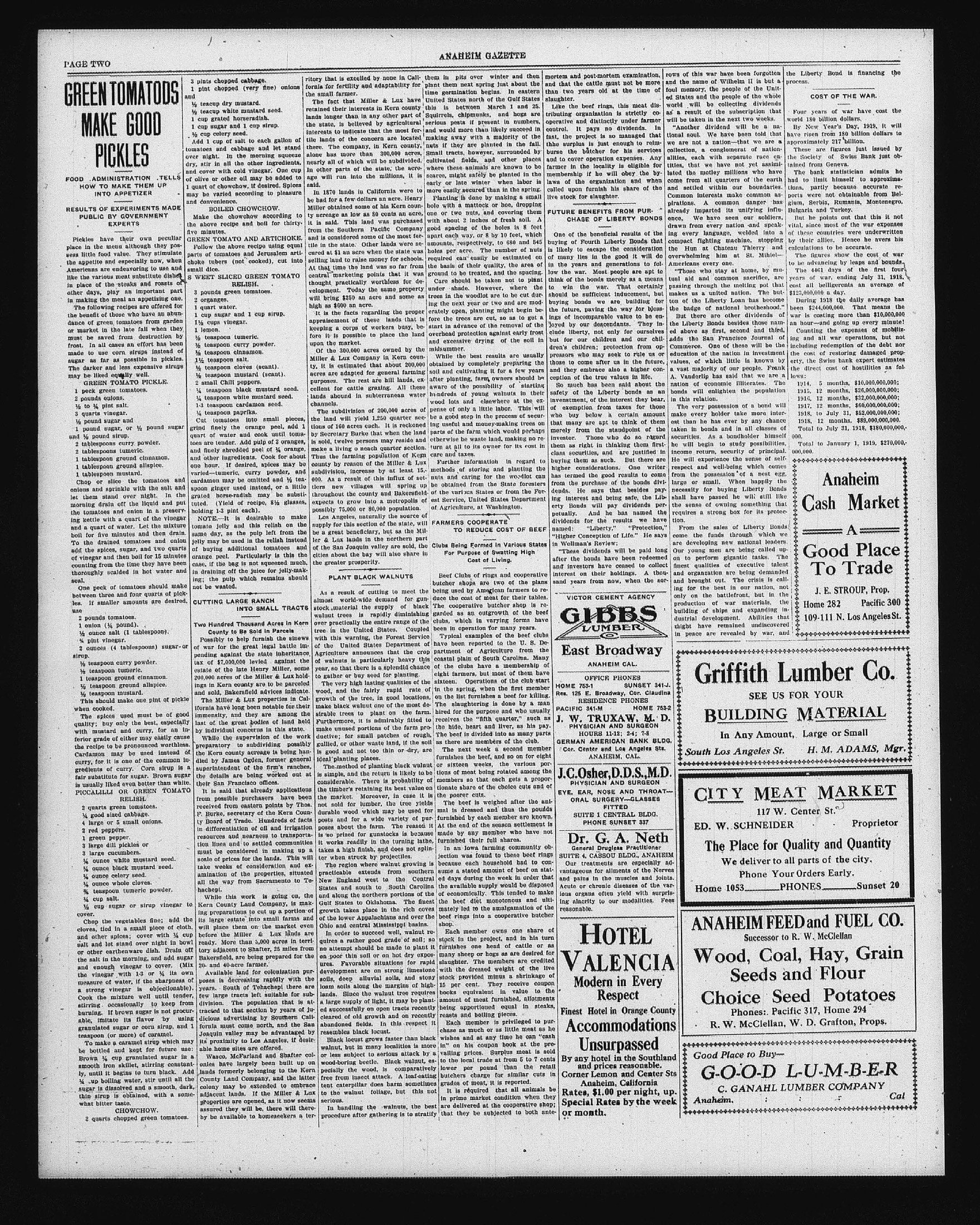
Searchable text
GREEN TOMATOES MAKE GOOD PICKLES
FOOD . ADMINISTRATION . TELLS HOW TO MAKE THEM UP INTO APPETIZER
RESULTS OF EXPERIMENTS MADE PUBLIC BY GOVERNMENT EXPERTS
Pickles have their own peculiar place in the menu although they possess little food value. They stimulate the appetite and especially now, when Americans are endeavoring to use and like the various meat substitute dishes in place of the steaks and roasts of other days, play an important part in making the meal an appetizing one.
The following recipes are offered for the benefit of those who have an abundance of green tomatoes from garden or market in the late fall when they must be saved from destruction by frost. In all cases an effort has been made to use corn sirups instead of sugar as far as possible in pickles. The darker and less expensive sirups may be liked equally well.
GREEN TOMATO PICKLE.
1 peck green tomatoes.
2 pounds onions.
½ to ¼ pint salt.
3 quarts vinegar.
½ pound sugar and
1 pound sugar, or ½ pound sugar and ½ pound sirup.
2 tablespoons curry powder.
2 tablespoons tumeric.
3 pints chopped cabbage.
1 pint chopped (very fine) onions and
½ teacup dry mustard.
½ teacup white mustard seed.
1 cup grated horseradish.
1 cup sugar and 1 cup sirup.
½ cup celery seed.
Add 1 cup of salt to each gallon of tomatoes and cabbage and let stand over night. In the morning squeeze dry, stir in all the other ingredients, and cover with cold vinegar. One cup of olive or other oil may be added to 1 quart of chowchow, if desired. Spices may be varied according to pleasure and convenience.
BOILED CHOWCHOW.
Make the chowchow according to the above recipe and boil for thirty-five minutes.
GREEN TOMATO AND ARTICHOKE.
Follow the above recipe using equal parts of tomatoes and Jerusalem artichoke tubers (not cooked), cut into small dice.
S WEET SLICED GREEN TOMATO RELISH.
3 pounds green tomatoes.
2 organges.
1 quart water.
1 cup sugar and 1 cup sirup.
1½ cups vinegar.
1 lemon.
½ teaspoon turmeric.
½ teaspoon curry powder.
½ teaspoon cinnamon.
1½ teaspoon salt.
½ teaspoon cloves (scant).
½ teaspoon mustard (scant).
2 small Chili peppers.
¼ teaspoon black mustard seed.
¼ teaspoon white mustard seed.
1-3 teaspoon cardamom seed.
¼ teaspoon paprika.
Cut tomatoes into small pieces, grind finely the orange peel, add 1 quart of water and cook until tomatoes are tender. Add pulp of 2 oranges, and finely shredded peel of ¼ orange, and other ingredients. Cook for about ritory that is excellent for fertility and the small farmer.
The fact that Miller retained their interest lands longer than in the state, is believed interests to indicate tile lands of the country there. The company alone has more than nearly all of which In other parts of the age will run into said.
In 1870 lands in be had for a few dollars Miller obtained some acreage as low as it is said. This land from the Southern and is considered so tile in the state. Ocured at $1 an acre selling land to raise At that time the last central marketing thought practically velopment. Today will bring $250 and high as $600 an acre.
It is the facts reappraisement of keeping a corps of fore it is possible upon the market.
Of the 300,000 acres are adapted purposes. The resellent for cattle lands abound in channels.
The subdivision the land will yield tions of 160 acres by Secretary Burke is sold, twelve per make a living no thus the farming
GREEN TOMATO PICKLE.
1 peck green tomatoes.
2 pounds onions.
½ to ¼ pint salt.
3 quarts vinegar.
½ pound sugar and
1 pound sugar, or ½ pound sugar and ½ pound sirup.
2 tablespoons curry powder.
2 tablespoons tumeric.
1 tablespoon ground cinnamon.
1 tablespoon ground allspice.
1 tablespoon mustard.
Chop or slice the tomatoes and onions and sprinkle with the salt and let them stand over night. In the morning drain off the liquid and put the tomatoes and onion in a preserving kettle with a quart of the vinegar and a quart of water. Let the mixture boil for five minutes and then drain. To the drained tomatoes and onion add the spices, sugar, and two quarts of vinegar and then boil for 15 minutes counting from the time they have been thoroughly scalded in hot water and seal.
One peck of tomatoes should make between three and four quarts of pickles. If smaller amounts are desired, use
2 pounds tomatoes.
1 onion (¼ pound).
½ ounce salt (1 tablespoon).
¼ pint vinegar.
2 ounces (4 tablespoons) sugar-or sirup.
½ teaspoon curry powder.
½ teaspoon tumeric.
1 teaspoon ground cinnamon.
½ teaspoon ground allspice.
½ teaspoon mustard.
This should make one pint of pickle when cooked.
The spices used must be of good quality; buy only the best, especially with mustard and curry, for an inferior grade of either may easily cause the recipe to be pronounced worthless. Cardamon may be used instead of curry, for it is one of the common ingredients of curry. Corn sirup is a fair substitute for sugar. Brown sugar is usually liked even better than white. PICCALILLI OR GREEN TOMATO RELISH.
2 quarts green tomatoes.
¼ good sized cabbage.
4 large or 5 small onions.
2 red peppers.
1 green pepper.
3 large dill pickles or
3 large cucumbers.
¼ ounce white mustard seed.
CUTTING LARGE RANCH INTO SMALL TRACTS
Two Hundred Thousand Acres in Kern County to Be Sold in Parcels
Possibly to help furnish the sinews of war for the great legal battle impending against the state inheritance, tax of $7,000,000 levied against the estate of the late Henry Miller, some 200,000 acres of the Miller & Lux holdings in Kern county are to be parceled and sold, Bakersfield advices indicate.
The Miller & Lux properties in California have long been notable for their immensity, and they are among the last of the great bodies of land held by individual concerns in this state.
While the supervision of the work preparatory to subdividing possibly the Kern county acreage is being handled by James Ogden, former general superintendent of the firm's ranches, the details are being worked out at their San Francisco offices.
It is said that already applications from possible purchasers have been received from eastern points by Thos F. Burke, secretary of the Kern County Board of Trade. Hundreds of facts in differentiation of oil and irrigation resources and nearness to transportation lines and to settled communities must be considered in making up a scale of prices for the lands. This will take weeks of consideration and ex-
As a result of almost world-wide stock material thawing trees is over practically tree in the United States with this warning of the United States Agriculture annuity of walnuts is paid year, so that there to gather or buy The very high wood, and the first growth of the tree make black walnutsirable trees to Furthermore, it make unused porous ductive; for small guilled, or other is good and not ideal planting plan.
The method of is simple, and the considerable. The timber's retaining market. M not sold for lurid durable wood w posts and for poses about these is so prized for it works readily takes a high finter when struck
gredients of curry. Corn syrup is a fair substitute for sugar. Brown sugar is usually liked even better than white. PICCALILLI OR GREEN TOMATO RELISH.
2 quarts green tomatoes.
1¼ good sized cabbage.
4 large or 5 small onions.
2 red peppers.
1 green pepper.
3 large dill pickles or
3 large cucumbers.
1¼ ounce white mustard seed.
1¼ ounce black mustard seed.
1¼ ounce celery seed.
1¼ ounce whole cloves.
1¼ teaspoon turmeric powder.
1¼ cup salt.
½ cup sugar or sirup vinegar to cover.
Chop the vegetables fine; add the cloves, tied in a small piece of cloth, and other spices; cover with ¼ cup salt and let stand over night in bowl or other earthenware dish. Drain off the salt in the morning, and add sugar and enough vinegar to cover. (Mix the vinegar with 1-3 or ¼ its own measure of water, if the sharpness of a strong vinegar is objectionable). Cook the mixture well until tender, stirring occasionally to keep from burning. If brown sugar is not procurable, imitate its flavor by using granulated sugar or corn sirup, and 1 teaspoon (or more) of caramel.
To make a caramel sirup which may be bottled and kept for future use: Brown ¼ cup granulated sugar in a smooth iron skillet, stirring constantly, until it begins to turn black. Add ¼ up boiling water, stir until all the sugar is dissolved and a smooth, dark, thin sirup is obtained, with some what bitter taste.
CHOWCHOW.
2 quarts chopped green tomatoes.
It is said that already applications from possible purchasers have been received from eastern points by Thos. F. Burke, secretary of the Kern County Board of Trade. Hundreds of facts in differentiation of oil and irrigation resources and nearness to transportation lines and to settled communities must be considered in making up a scale of prices for the lands. This will take weeks of consideration and examination of the properties, situated all the way from Sacramento to Tehachepi.
While this work is going on, the Kern County Land Company, is making preparations to cut up a portion of its large estate into small farms and will place them on the market even before the Miller & Lux lands are ready. More than 3,000 acres in territory adjacent to Shafter, 25 miles from Bakersfield, are being prepared for the 20- and 40-acre farmer.
Available land for colonization purposes is decreasing rapidly with the years. South of Tehachepi there are few large tracts left suitable for subdivision. The population that is attracted to that section by years of judicious advertising by Southern California must come north, and the San Joaquin valley may be advantaged by its proximity to Los Angeles, if desirable home sites are offered.
Wasco, McFarland and Shafter colonies have largely been built up on lands formerly belonging to the Kern County Land Company, and the latter colony may be extended to embrace adjacent lands. If the Miller & Lux properties are opened, as it now seems assured they will be, there will thereby be available to homeseekers a ter-
The region where practicable extents New England states and souls and along the new Gulf States to growth takes place of the lower Appalachia and central United States. In order to suquire a rather no attempt should be made on poor thin soils. Favorable development and soils, deep all loam soils along lands. Since that a large supply can be cleared of old gravel abandoned fields resembles black soil.
Black locust walnut, but in no or less subject wood-boring be especially the ww free from insect tent caterpillars to the walnut serious.
In handling procedure after
ANAHEIM GAZETTE
Mollons
of land and freeze events, cup and to spices measure
ing to thirtyOKE, equal arti-into
ATO
need. old.
pieces, add 1 tomatoanges, orange, about
the subdivision of 200,000 acres of the land will yield 1,250 quarter sections of 160 acres each. It is reckoned by Secretary Burke that when the land is sold, twelve persons may reside and make a living on neach quarter section. Thus the farming population of Kern
ritory that is excelled by none in California for fertility and adaptability for the small farmer.
The fact that Miller & Lux have retained their interests in Kern county lands longer than in any other part of the state, is believed by agricultural interests to indicate that the most fertile lands of the concern are located there. The company, in Kern county, alone has more than 300,000 acres, nearly all of which will be subdivided. In other parts of the state, the acreage will run into the millions, it is said.
In 1870 lands in California were to be had for a few dollars an acre. Henry Miller obtained some of his Kern county acreage as low as 80 cents an acre, it is said. This land was purchased from the Southern Pacific Company and is considered some of the most fertile in the state. Other lands were secured at $1 an acre when the state was selling land to raise money for schools. At that time the land was so far from central marketing points that it was thought practically worthless for development. Today the same property will bring $250 an acre and some as high as $600 an acre.
It is the facts regarding the proper appraisal of these lands that is keeping a corps of workers busy, before it is possible to place the land upon the market.
Of the 300,000 acres owned by the Miller & Lux Company in Kern county, it is estimated that about 200,000 acres are adapted for general farming purposes. The rest are hill lands, excellent for cattle grazing. All these lands abound in subterranean water channels.
The subdivision of 200,000 acres of the land will yield 1,250 quarter sections of 160 acres each. It is reckoned by Secretary Burke that when the land is sold, twelve persons may reside and make a living on neach quarter section. Thus the farming population of Kern them in pits over winter and then plant them next spring just about the time germination begins. In eastern United States north of the Gulf States this is between March 1 and 25. Squirrels, chipmunks, and hogs are serious pests if present in numbers, and would more than likely succeed in making away with a majority of the nuts if they are planted in the fall. Small tracts, however, surrounded by cultivated fields, and other places where these animals are known to be scarce, might safely be planted in the early or late winter when labor is more easily secured than in the spring.
Planting is done by making a small hole with a mattock or hoe, dropping one or two nuts, and covering them with about 2 inches of fresh soil. A good spacing of the holes is 8 feet apart each way, or 8 by 10 feet, which amounts, respectively, to 680 and 545 holes per acre. The number of nuts required can easily be estimated on the basis of their quality, the area of ground to be treated, and the spacing.
Care should be taken not to plant under shade. However, where the trees in the woodlot are to be cut during the next year or two and are moderately open, planting might begin before the trees are cut, so as to get a start in advance of the removal of the overhead protection against early frost and excessive drying of the soil in midsummer.
While the best results are usually obtained by completely preparing the soil and cultivating it for a few years after planting, farm owners should be aware of the possibility of starting hundreds of young walnuts in their wood lots and elsewhere at the expense of only a little labor. This will be a good step in the process of securing useful and money-making trees on parts of the farm which would perhaps otherwise be waste land, making no return at all to its owner for its cost in care and taxes.
mortem and post-mortem examination, and that the cattle must not be more than two years old at the time of slaughter.
Like the beef rings, this meat distributing organization is strictly cooperative and distinctly under farmer control. It pays no dividends. In fast, the project is so managed that the surplus is just enough to reimburse the butcher for his services and to cover operation expenses. Any farmer in the locality is eligible for membership if he will obey the bylaws of the organization and when called upon furnish his share of the live stock for slaughter.
FUTURE BENEFITS FROM PURCHASE OF LIBERTY BONDS
One of the beneficial results of the buying of Fourth Liberty Bonds that is likely to escape the consideration of many lies in the good it will do in the years and generations to follow the war. Most people are apt to think of the bonds merely as a means to win the war. That certainly should be sufficient inducement, but buying bonds we are building for the future, paving the way for blessings of incomparable value to be enjoyed by our descendants. They include liberty, not only ourselves but for our children and our children's children; protection from oppressors who may seek to rule us or those to come after us in the future, and they embrace also a higher conception of the true values in life.
So much has been said about the safety of the Liberty bonds as an investment, of the interest they bear, of exemption from taxes for those who buy below a certain amount that many are apt to think of them merely from the standpoint of the investor. Those who do so regard them as right in thinking them first-class securities, and are justified in rows of them and the foul memorial States world as a result will be traced.
"Another national solution we are now collecting alities, etc., titles, that lated them come from and set forth Common inspirations already enceased, drawn from existing compacties, the Hut overwhelmed America."
"Those total aid passing makes weight of ton of bad faith."
But to the Liberty ed above adds that Commerce education values, a vast range of A. Vance nation bonds in this bad faith.
The writer make even less than taken from security he will income from
it is estimated that about 200,000 acres are adapted for general farming purposes. The rest are hill lands, excellent for cattle grazing. All these lands abound in subterranean water channels.
The subdivision of 200,000 acres of the land will yield 1,250 quarter sections of 160 acres each. It is reckoned by Secretary Burke that when the land is sold, twelve persons may reside and make a living on each quarter section. Thus the farming population of Kern county by reason of the Miller & Lux subdivision, increase by at least 15,000. As a result of this influx of settlers new villages will spring up throughout the county and Bakersfield expects to grow into a metropolis of possibly 75,000 or 80,000 population.
Los Angeles, naturally the source of supply for this section of the state, will be a great beneficiary, but as the Miller & Lux lands in the northern part of the San Joaquin valley are sold, the cities about the bay will also share in the greater prosperity.
PLANT BLACK WALNUTS
As a result of cutting to meet the almost world-wide demand for gunstock material the supply of black walnut trees is rapidly diminishing over practically the entire range of the tree in the United States. Coupled with this warning, the Forest Service of the United States Department of Agriculture announces that the crop of walnuts is particularly heavy this year, so that there is a splendid chance to gather or buy seed for planting.
The very high lasting qualities of the wood, and the fairly rapid rate of growth of the tree, in good locations, make black walnut one of the most desirable trees to plant on the farm. Furthermore, it is admirably fitted to make unused portions of the farm productive; for small patches of rough, gullied, or other waste land, if the soil is good and not too thin or dry, are ideal planting places.
The method of planting black walnut is simple, and the return is likely to be considerable. There is probability of the timber's retaining its best value on the market. Moreover, in case it is not sold for lumber, the tree yields durable wood which may be used for posts and for a wide variety of purposes about the farm. The reason it is so prized for gunstocks is because it works readily in the turning lathe, takes a high finish, and does not splinter when struck by projectiles.
The region where walnut growing is obtained by completely preparing the soil and cultivating it for a few years after planting, farm owners should be aware of the possibility of starting hundreds of young walnuts in their wood lots and elsewhere at the expense of only a little labor. This will be a good step in the process of securing useful and money-making trees on parts of the farm which would perhaps otherwise be waste land, making no return at all to its owner for its cost in care and taxes.
Further information in regard to methods of storing and planting the nuts and caring for the woodlot can be obtained from the State foresters of the various States or from the Forest Service, United States Department of Agriculture, at Washington.
FARMERS COOPERATE TO REDUCE COST OF BEEF
Clubs Being Formed in Various States For Purpose of Swatting High Cost of Living.
Beef Clubs of rings and cooperative butcher shops are two of the plans being used by American farmers to reduce the cost of meat for their tables. The cooperative butcher shop is regarded as an outgrowth of the beef clubs, which in varying forms have been in operation for many years.
Typical examples of the beef clubs have been reported to the U.S. Department of Agriculture from the coastal plain of South Carolina. Many of the clubs have a membership of eight farmers, but most of them have sixteen. Operations of the club-start in the spring, when the first member on the list furnishes a beef for killing. The slaughtering is done by a man hired for the purpose and who usually receives the "fifth quarter," such as hide, heart and liver, as his pay. The beef is divided into as many parts as there are members of the club.
The next week a second member furnishes the beef, and so on for eight or sixteen weeks, the various portions of meat being rotated among the members so that each gets a proportionate share of the choice cuts and of the poorer cuts.
The beef is weighed after the animal is dressed and thus the pounds furnished by each member are known. At the end of the season settlement is made by any member who have not furnished their full shares.
In an Iowa farming community objection was found to these beef rings because each household had to con-
is simple, and the return is likely to be considerable. There is probability of the timber's retaining its best value on the market. Moreover, in case it is not sold for lumber, the tree yields durable wood which may be used for posts and for a wide variety of purposes about the farm. The reason it is so prized for gunstocks is because it works readily in the turning lathe, takes a high finish, and does not splinter when struck by projectiles.
The region where walnut growing is practicable extends from southern New England west to the Central States and south to South Carolina and along the northern portions of the Gulf States to Oklahoma. The finest growth takes place in the rich coves of the lower Appalachians and over the Ohio and central Mississippi basins.
In order to succeed well, walnut requires a rather good grade of soil; so no attempt should be made to plant it on poor thin soil or on hot dry exposures. Favorable situations for rapid development are on strong limestone soils, deep alluvial soils, and stony loam soils along the margins of highlands. Since the walnut tree requires a large supply of light, it may be planted successfully on open tracts recently cleared of old growth and on recently abandoned fields. In this respect it resembles black locust.
Black locust grows faster than black walnut, but in many localities is more or less subject to serious attack by a wood-boring beetle. Black walnut, especially the wood, is comparatively free from insect attack. A leaf-eating tent caterpillar does harm sometimes to the walnut foliage, but this not serious.
In handling the walnuts, the best procedure after gathering is to stratify tions of meat being rotated among the members so that each gets a proportionate share of the choice cuts and of the poorer cuts.
The beef is weighed after the animal is dressed and thus the pounds furnished by each member are known. At the end of the season settlement is made by any member who have not furnished their full shares.
In an Iowa farming community objection was found to these beef rings because each household had to consume a stated amount of beef on stated days during the week in order that the available supply would be disposed of economically. This tended to make the beef diet monotonous and ultimately led to the amalgamation of the beef rings into a cooperative butcher shop.
Each member owns one share of stock in the project, and in his turn furnishes one head of cattle or as many sheep or hogs as are desired for slaughter. The members are credited with the dressed weight of the live stock provided minus a shrinkage of 15 per cent. They receive coupon books equivalent in value to the amount of meat furnished, allotments being apportioned equal in steaks, reasts and boiling pieces.
Each member is privileged to purchase as much or as little meat as he wishes and at any time he can "cash in" on his coupon book at the prevailing prices. Surplus meat is sold to the local trade at from 5 to 7 cents lower per pound than the retail butchers charge for similar cuts in grades of meat, it is reported.
It is required that all animals be in prime market condition when they are delivered at the cooperative shop; that they be subjected to both ante-
HOTEL VALENCIA Modern in Every Respect
Finest Hotel in Orange County Accommodations Unsurpassed
By any hotel in the Southland and prices reasonable.
Corner Lemon and Center Sts Anaheim, California
Rates, $1.00 per night, up.
Special Rates by the week or month.
FROM PURLIBERTY BONDS
The results of the Liberty Bonds that the consideration good it will do operations to follow are apt to merely as a means that certainly inducement, but are building for the way for blessing value to be enlisted. They imply for ourselves and our chil-connection from op-tek to rule us or us in the future, also a higher con-values in life.
I said about the liberty bonds as an interest they bear, taxes for those certain amount so think of them handpoint of the do so regard making them first are justified in rows of this war have been forgotten and the name of Wilhelm II is but a foul memory, the people of the United States and the people of the whole world will be collecting dividends as a result of the subscription that will be taken in the next two weeks.
"Another dividend will be a national soul. We have been told that we are not a nation—that we are a collection, a conglomerat of nationalities, each with separate race entities, that we have not yet assimilated the motley millions who have come from all quarters of the earth and settled within our boundaries. Common interests make common aspirations. A common danger has already imparted its unifying influence. We have seen our soldiers, drawn from every nation and speaking every language, welded into a compact fighting machine, stopping the Hun at Chateau Thierry and overwhelming him at St. Mihiel—Americans every one.
"Those who stay at home, by mutual aid and common sacrifice, are passing through the melting pot that makes us a united nation. The button of the Liberty Loan has become the badge of national brothehood."
But there are other dividends of the Liberty Bonds besides those named above as first, second and third, adds the San Francisco Journal of Commerce. One of these will be the education of the nation in investment values, of which little is known by a vast majority of our people. Frank A. Vanderlip has said that we are a nation of economic illiterates. The bonds will enlighten the population in this relation.
The very possession of a bond will make every holder take more interest than he has ever by any chance taken in bonds and in all classes of securities. As a bondholder himself he will begin to study possibilities, income return, security of principal.
the Liberty Bond is financing the process.
COST OF THE WAR.
Four years of war have cost the world 180 billion dollars.
By New Year's Day, 1919, it will have risen from 180 billion dollars to approximately 217 billion.
These are figures just issued by the Society of Swiss Bank just obtained from Geneva.
The bank statistician admits he had to limit himself to approximations, partly because accurate reports were not obtainable from Belgium, Serbia, Rumania, Montenegro, Bulgaria and Turkey.
But he points out that this it not vital, since most of the war expenses of these countries were underwritten by their allies. Hence he avers his calculations to be accurate.
The figures show the cost of war to be advancing by leaps and bounds.
The 4461 days of the first four years of war, ending July 31, 1918, cost all belligerents an average of $123,000,000 a day.
During 1918 the daily average has been $244,000,000. That means the war is costing more than $10,000,000 an hour—and going up every minute!
Counting the expenses of mobilizing and all war operations, but not including redemption of the debt nor the cost of restoring damaged property, the Swiss bank expert estimates the direct cost of hostilities as follows:
1914, 5 months, $10,000,000,000;
1915, 12 months, $26,000,000,000;
1916, 12 months, $32,000,000,000;
1917, 12 months, $60,000,000,000;
1918, to July 31, $52,000,000,000;
1918, 12 months, $89,000,000,000.
Total to July 31, 1918, $180,000,000,-
Total to January 1, 1919, $270,000,-
ooo,ooo.
values, of which little is known by a vast majority of our people. Frank A. Vanderlip has said that we are a nation of economic illiterates. The bonds will enlighten the population in this relation.
The very possession of a bond will make every holder take more interest than he has ever by any chance taken in bonds and in all classes of securities. As a bondholder himself he will begin to study possibilities, income return, security of principal. He will experience the sense of self-respect and well-being which comes from the possession of a nest egg, large or small. When happily the necessity for buying Liberty Bonds shall have passed he will still like the sense of owning something that requires a strong box for its protection.
From the sales of Liberty Bonds come the funds through which we are developing new national leaders. Our young men are being called upon to perform gigantic tasks. The finest qualities of executive talent and organization are being demanded and brought out. The crisis is calling for the best in our nation, not only on the battlefront, but in the production of war materials, the building of ships and expanding industrial development. Abilities that might have remained undiscovered in peace are revealed by war, and
Anaheim Cash Market
A Good Place To Trade
J. E. STROUP, Prop.
Home 282 Pacific 300
109-111 N. Los Angeles St.
Griffith Lumber Co.
SEE US FOR YOUR BUILDING MATERIAL
In Any Amount, Large or Small
South Los Angeles St. H. M. ADAMS, Mgr.
CITY MEAT MARKET
117 W. Center St.
ED. W. SCHNEIDER Proprietor
The Place for Quality and Quantity
We deliver to all parts of the city.
CITY MEAT MARKET
117 W. Center St.
ED. W. SCHNEIDER Proprietor
The Place for Quality and Quantity
We deliver to all parts of the city.
Phone Your Orders Early.
Home 1053 PHONES Sunset 20
ANAHEIM FEED and FUEL CO.
Successor to R. W. McClellan
Wood, Coal, Hay, Grain Seeds and Flour
Choice Seed Potatoes
Phones: Pacific 317, Home 294
R. W. McClellan, W. D. Grafton, Props.
Good Place to Buy—
G-O-O-D L-U-M-B-E-R
C. GANAHL LUMBER COMPANY
Anaheim. Cal