anaheim-gazette 1918-10-03
Scanned page
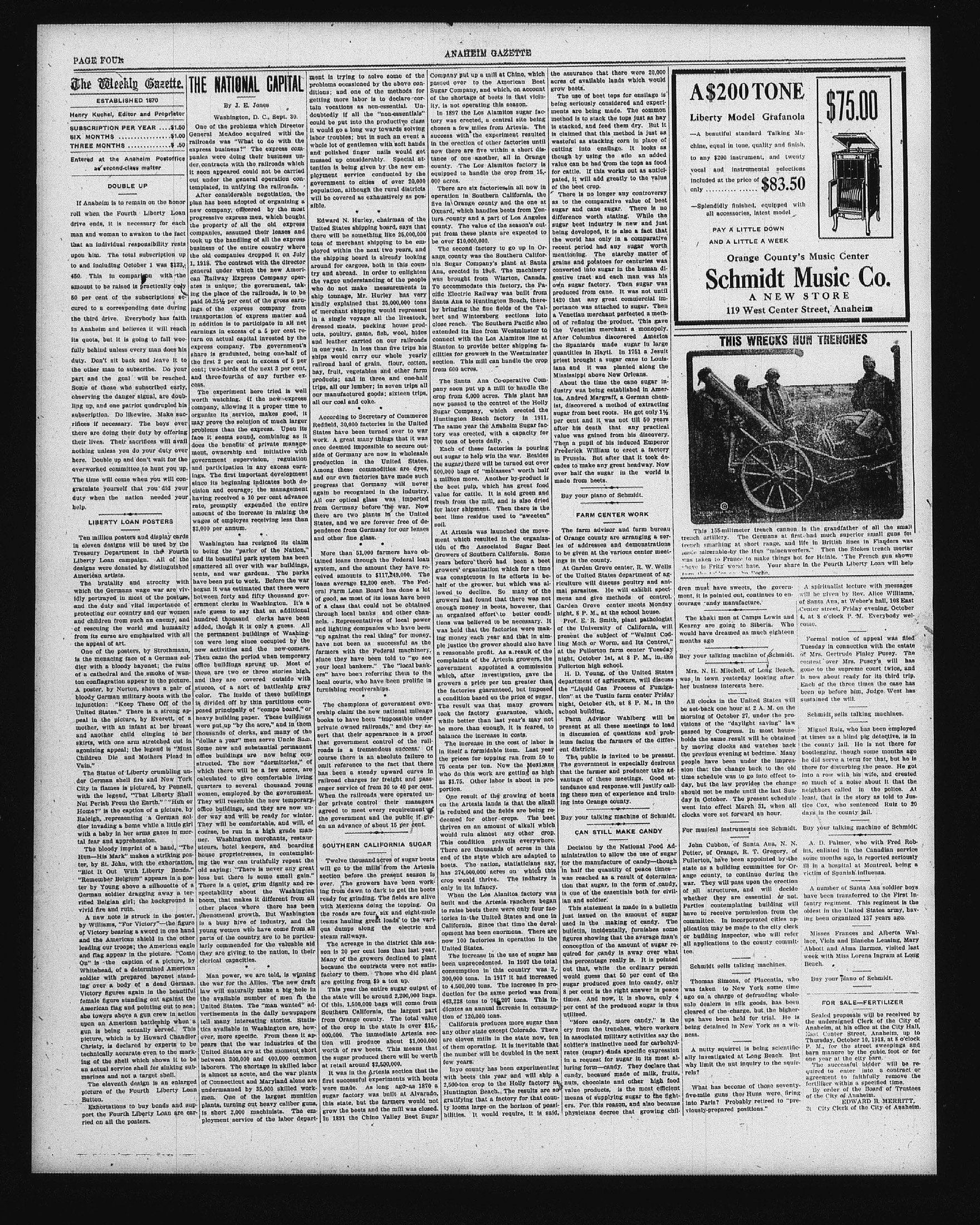
Searchable text
The Weekly Gazette.
ESTABLISHED 1870
Henry Kuchel, Editor and Proprietor
SUBSCRIPTION PER YEAR ... $1.50
SIX MONTHS ... $1.00
THREE MONTHS ... $ .50
Entered at the Anaheim Postoffice as second-class matter
DOUBLE UP
If Anaheim is to remain on the honor roll when the Fourth Liberty Loan drive ends, it is necessary for each man and woman to awaken to the fact that an individual responsibility rests upon him. The total subscription up to and including October 1 was $123;450. This in comparison with the amount to be raised is practically only 50 per cent of the subscriptions secured to a corresponding date during the third drive. Everybody has faith in Anaheim and believes it will reach its quota, but it is going to fall woefully behind unless every man does his duty. Don't sit back and leave it to the other man to subscribe. Do your part and the goal will be reached. Some of those who subscribed early, observing the danger signal, are doubling up, and one patriot quadrupled his subscription. Do likewise. Make sacrifices if necessary. The boys over there are doing their duty by offering their lives. Their sacrifices will avail nothing unless you do your duty over
THE NATIONAL CAPITAL
By J. E. Jones
Washington, D. C., Sept. 30.
One of the problems which Director General McAdoo acquired with the railroads was "What to do with the express business?" The express companies were doing their business under contracts with the railroads which it soon appeared could not be carried out under the general operation contemplated, in unifying the railroads.
After considerable negotiation, the plan has been adopted of organizing a new company, officered by the most progressive express men, which bought the property of all the old express companies, assumed their leases and took up the handling of all the express business of the entire country where the old companies dropped it on July 1, 1918. The contract with the director general under which the new American Railway Express Company operates is unique; the government, taking the place of the railroads, is to be paid 50.25½ per cent of the gross earnings of the express company from transportation of express matter and in addition is to participate in all net earnings in excess of a 5 per cent return on actual capital invested by the express company. The government's share is graduated, being one-half of the first 2 per cent in excess of 5 per cent; two-thirds of the next 3 per cent, and three-fourths of any further excess.
The experiment here tried is well worth watching. If the new express company, allowing it a proper time to organize its service, makes good, it may prove the solution of much larger problems than the express. Upon its face it seems sound, combining as it does the benefits of private management, ownership and initiative with ment is trying to solve problems occasioned; and one can get more labor vocations as doubtedly if all they could be put into it would go a long way to labor troubles; but whole lot of gentlemen and polished fingers mussed up consideration is being given employment service government to city population, although will be covered as sible.
Edward N. Hurley United States shipping there will be some tons of merchant played within the shipping board around for cargoes try and abroad. In the vague understand who do not make ship tonnage, Mr. kindly explained of merchant shipping in a single voyage dressed meats, products, poultry, game and leather carrier in one year. In less ships would carry railroad haul of hay, fruit, vegetal products; and in trips, all our lumber our manufactured all our coal and coals.
According to Seedfield, 30,000 factions have been work. A great many once deemed important side of Germany
LIBERTY LOAN POSTERS
Ten million posters and display cards in eleven designs will be used by the Treasury Department in the Fourth Liberty Loan campaign. All of the designs were donated by distinguished American artists.
The brutality and atrocity with which the Germans wage war are vividly portrayed in most of the posters, and the duty and vital importance of protecting our country and our women and children from such an enemy, and of rescuing the world and humanity from its curse are emphasized with all the appeal of art.
One of the posters, by Strothmann, is the menacing face of a German soldier with a bloody bayonet; the ruins of a cathedral and the smoke of wan'ton conflagration appear in the picture. A poster, by Norton, shows a pair of bloody German military boots with the injunction: "Keep These Off of the United States." There is a strong appeal in the picture, by Everett, of a mother, with an infant at her breast and another child clinging to her skirts, with one arm stretched out in agonizing appeal; the legend is "Must Children Die and Mothers Plead in Vain."
The Statue of Liberty crumbling under German shell fire and New York City in flames is pictured, by Pennell, with the legend, "That Liberty Shall Not Perish From the Earth." "Hun or Home?" is the caption of a picture, by Raleigh, representing a German soldier invading a home while a little girl with a baby in her arms gazes in mortal fear and apprehension.
The bloody imprint of a hand, "The Hun—His Mark" makes a striking poster by St. John, with the exhortation, the first 2 per cent in excess of 6 per cent; two-thirds of the next 3 per cent, and three-fourths of any further excess.
The experiment here tried is well worth watching. If the new express company, allowing it a proper time to organize its service, makes good, it may prove the solution of much larger problems than the express. Upon its face it seems sound, combining as it does the benefits of private management, ownership and initiative with government supervision, regulation and participation in any excess earnings. The first important development since its beginning indicates both decision and courage; the management having received a 10 per cent advance rate, promptly expended the entire amount of the increase in raising the wages of employees receiving less than $2,000 per annum.
Washington has resigned its claim to being the "parlor of the Nation," and its beautiful park system has been smattered all over with war buildings, tents, and war gardens. The parks have been put to work. Before the war began it was estimated that there were between forty and fifty thousand government clerks in Washington. It's a safe guess to say that an additional hundred thousand clerks have been added, though it is only a guess. All the permanent buildings of Washington were long since occupied by the new activities and the new-comers. Then came the period when temporary office buildings sprung up. Most of these are two or three stories high, and they are covered outside with stucco, of a sort of battleship gray color. The inside of these buildings is divided off by thin partitions composed principally of "compo board," or heavy building paper. These buildings were put up "by the acre," and in them thousands of clerks, and many of the "dollar a year" men serve Uncle Sam. Some new and substantial permanent office buildings are now being constructed. The new "dormitories," of which there will be a few acres, are calculated to give comfortable living quarters to several thousand young women, employed by the government. They will resemble the new temporary office buildings, and they are now under way and will be ready for winter. They will be comfortable, and will, of course, be run in a high grade manner. Washington merchants, restaurants, hotel keepers, and boarding house proprietresses, in contemplating the war can truthfully repeat the
The Statue of Liberty crumbling under German shell fire and New York City in flames is pictured, by Pennell, with the legend, "That Liberty Shall Not Perish From the Earth." "Hun or Home?" is the caption of a picture, by Raleigh, representing a German soldier invading a home while a little girl with a baby in her arms gazes in mortal fear and apprehension.
The bloody imprint of a hand, "The Hun—His Mark" makes a striking poster, by St. John, with the exhortation, "Blot It Out With Liberty Bonds." "Remember Belgium" appears in a poster by Young above a silhouette of a German soldier dragging away a terrified Belgian girl; the background is vivid fire and ruin.
A new note is struck in the poster, by Williams, "For Victory"—the figure of Victory bearing a sword in one hand and the American shield in the other leading our troops; the American eagle and flag appear in the picture. "Come On" is the caption of a picture, by Whitehead, of a determined American soldier with prepared bayonet standing over a body of a dead German. Victory figures again in the beautiful female figure standing out against the American flag and pointing out to sea; she towers above a gun crew in action upon an American battleship when a gun is being actually served. This picture, which is by Howard Chandler Christy, is declared by experts to be technically accurate even to the marking of the shell which shows it to be an actual service shell for sinking submarines and not a target shell.
The eleventh design is an enlarged picture of the Fourth Liberty Loan Button.
Exhortations to buy bonds and support the Fourth Liberty Loan are carried on all the posters.
Man power, we are told, is winning the war for the Allies. The new draft law will naturally make a big hole in the available number of men fh the United States. The "man wanted" advertisements in the daily newspapers tell many interesting stories. Statistics available in Washington are, however, more specific. From these it appears that the war industries of the United States are at the moment short between 300,000 and 400,000 common laborers. The shortage in skilled labor is almost as acute, and the war plants of Connecticut and Maryland alone are undermanned by 35,000 skilled workmen. One of the largest munition plants, turning out heavy caliber guns, is short 2,000 machinists. The employment service of the labor department there will be a few acres, are calculated to give comfortable living quarters to several thousand young women, employed by the government. They will resemble the new temporary office buildings, and they are now under way and will be ready for winter. They will be comfortable, and will, of course, be run in a high grade manner. Washington merchants, restaurants, hotel keepers, and boarding house proprietresses, in contemplating the war can truthfully repeat the old saying: "There is never any great loss but there is some small gain." There is a quiet, grim dignity and respectability about the Washington boom, that makes it different from all other places where there has been phenomenal growth. But Washington is a busy hive of industry, and the young women who have come from all parts of the country are to be particularly commended for the valuable aid they are giving to the nation, in their clerical capacities.
Twelve thousands will go to the section before over. The growing from dawn to ready for grinding with Mexicans is the roads are five teams hauling gus dumps along steam railways.
The acreage son is 20 per cent Many of the grow because the co factory to them are getting from this year that the state will be Of this, 1,500,000 Southern California from Orange county of the crop in 000,000. The tion will profit worth of raw b the sugar product at retail around it was in the first successful were made. A sugar factory this state, but grow the beets In 1891 the C
ment is trying to solve some of the problems occasioned by the above conditions; and one of the methods for getting more labor is to declare certain vocations as non-essential. Undoubtedly if all the "non-essentials" could be put into the productive class it would go a long way towards solving labor troubles; but in such an event a whole lot of gentlemen with soft hands and polished finger nails would get mussed up considerably. Special attention is being given by the new employment service conducted by the government to cities of over 20,000 population, although the rural districts will be covered as exhaustively as possible.
Edward N. Hurley, chairman of the United States shipping board, says that there will be something like 25,000,000 tons of merchant shipping to be employed within the next two years, and the shipping board is already looking around for cargoes, both in this country and abroad. In order to enlighten the vague understanding of the people who do not make measurements in ship tonnage, Mr. Hurley has very kindly explained that 25,000,000 tons of merchant shipping would represent in a single voyage all the livestock, dressed meats, packing house products, poultry, game, fish, wool, hides and leather carried on our railroads in one year. In less than five trips his ships would carry our whole yearly railroad haul of grain, flour, cotton, hay, fruit, vegetables and other farm products; and in three and one-half trips, all our lumber; in seven trips all our manufactured goods; sixteen trips, all our coal and coke.
According to Secretary of Commerce Redfield, 30,000 factories in the United States have been turned over to war work. A great many things that it was once deemed impossible to secure outside of Germany are now in wholesale company put up a mill at Chino, which passed over to the American Beet Sugar Company, and which, on account of the shortage of beets in that vicinity, is not operating this season.
In 1897 the Los Alamitos sugar factory was erected, a central site being chosen a few miles from Artesia. The success with the experiment resulted in the erection of other factories until now there are five within a short distance of one another, all in Orange county. The Los Alamitos factory is equipped to handle the crop from 15,000 acres.
There are six factories in all now in operation in Southern California, the five in Orange county and the one at Oxnard, which handles beets from Yentura county and a part of Los Angeles county. The value of the season's output from these plants are expected to be over $10,000,000.
The second factory to go up in Orange county was the Southern California Sugar Company's plant at Santa Ana, erected in 1908. The machinery was brought from Wiarton, Canada. To accommodate this factory, the Pacific Electric Railway was built from Santa Ana to Huntington Beach, thereby bringing the fine fields of the Talbert and Wintersberg sections into close reach. The Southern Pacific also extended its line from Westminster to connect with the Los Alamitos line at Stanton to provide better shipping facilities for growers in the Westminster section. This mill can handle the crop from 600 acres.
The Santa Ana Co-operative Company soon put up a mill to handle the crop from 6,000 acres. This plant has now passed to the control of the Holly Sugar Company, which erected the Huntington Beach factory in 1911. The same year the Arnheim Sugar factory was erected, with a capacity for 700 tons of beets daily.
Each of these factories is pouring out sugar to help win the war. Besides the assurance that there were 20,000 acres of available lands which would grow beets.
The use of beet tops for ensilage is being seriously considered and experiments are being made. The common method is to stack the tops just as hay is stacked, and feed them dry. But it is claimed that this method is just as wasteful as stacking corn in place of cutting into ensilage. It looks as though by using the silo an added value can be had from the tops as food for cattle. If this works out as anticipated, it will add greatly to the value of the beet crop.
There is no longer any controversy as to the comparative value of beet sugar and cane sugar. There is no difference worth stating. While the sugar beet industry is new and just being developed, it is also a fact that the world has only in a comparative recent period had any sugar worth mentioning. The starchy matter of grains and potatoes for centuries was converted into sugar in the human digestive tract and each man was his own sugar factory. Then sugar was produced from cane. It was not until 1420 that any great commercial importance was attached to sugar. Then a Venetian merchant perfected a method of refining the product. This gave the Venetian merchant a monopoly. After Columbus discovered America the Spaniards made sugar in large quantities in Haytli. In 1751 a Jesuit priest brought a sugar cane to Louisiana and it was planted along the Mississippi above New Orleans.
About the time the cane sugar industry was being established in America, Andred Margraff, a German chemist, discovered a method of extracting sugar from beet roots. He got only 1½ per cent and it was not till 50 years after his death that any practical value was gained from his discovery. Then a pupil of his induced Emperor Frederick William to erect a factory...
According to Secretary of Commerce Redfield, 30,000 factories in the United States have been turned over to war work. A great many things that it was once deemed impossible to secure outside of Germany are now in wholesale production in the United States. Among these commodities are dyes, and our own factories have made such progress that Germany will never again be recognized in the industry. All our optical glass was imported from Germany before the war. Now there are two plants in the United States, and we are forever free of dependence from Germany for our lenses and other fine glass.
More than 51,000 farmers have obtained loans through the Federal loan system, and the amount they have received amounts to $117,249,000. The loans average $2,200 each. The Federal Farm Loan Board has done a lot of good, as most of its loans have been of a class that could not be obtained through local banks and other channels. Representatives of local power and lighting companies who have been "up against the real thing" for money, have not been as successful as the farmers with the Federal machinery, since they have been told to "go see your local bankers." The "local bankers" have been referring them to the local courts, who have been prolific in furnishing receiverships.
The champions of government ownership claim the new national mileage books to have been "impossible under private owned railroads," and they assert that their appearance is a proof that government control of the railroads is a tremendous success. Of course there is an absolute failure to omit reference to the fact that there has been a steady upward curve in railroad charges for freight and passenger service of from 30 to 40 per cent. When the railroads were operated under private control their managers agreed to meet every requirement of the government and the public if given an advance of about 15 per cent.
SOUTHERN CALIFORNIA SUGAR
Twelve thousand acres of sugar beets section. This mill can handle the crop from 600 acres.
The Santa Ana Co-operative Company soon put up a mill to handle the crop from 6,000 acres. This plant has now passed to the control of the Holly Sugar Company, which erected the Huntington Beach factory in 1911. The same year the Amaheim Sugar factory was erected, with a capacity for 700 tons of beets daily.
Each of these factories is pouring out sugar to help win the war. Besides the sugar, there will be turned out over 500,000 bags of "molasses" worth half a million more. Another by-product is the beet pulp, which has great food value for cattle. It is sold green and fresh from the mill, and is also dried for later shipment. Then there is the beet lime residue used to "sweeten" soil.
At Artesia was launched the movement which resulted in the organization of the Associated Sugar Beet Growers of Southern California. Some years before there had been a beet growers' organization which for a time was conspicuous in its efforts in behalf of the grower, but which was allowed to decline. So many of the growers had found that there was not enough money in beets, however, that an organized effort to better conditions was believed to be necessary. It was held that the factories were making money each year and that in simple justice the grower should also have a reasonable profit. As a result of the complaints of the Artesia growers, the government appointed a commission which, after investigation, gave the growers a price per ton greater than the factories guaranteed, but imposed a condition based on the price of sugar. The result was that many growers took the factory guarantee, which, while better than last year's may not be more than enough, it is feared, to balance the increase in costs.
The increase in the cost of labor is in itself a formidable item. Last year the prices for topping ran from 50 to 75 cents per ton. Now the Mexicans who do this work are getting as high as $1.75. Other labor is about in proportion.
One result of the growing of beets on the Artesia lands is that the alkali is reduced and the fields are being redeemed for other crops. The beet thrives on an amount of alkali which would ruin almost any other crop. This condition prevails everywhere. There are thousands of acres in this end of the state which are adapted to beets. The nation, statisticians say,
priest brought a sugar cane to Louisiana and it was planted along the Mississippi above New Orleans.
About the time the cane sugar industry was being established in America, Andred Margraff, a German chemist, discovered a method of extracting sugar from beet roots. He got only 1½ per cent and it was not till 50 years after his death that any practical value was gained from his discovery. Then a pupil of his induced Emperor Frederick William to erect a factory in Prussia. But after that it took decades to make any great headway. Now over half the sugar in the world is made from beets.
Buy your piano of Schmidt.
FARM CENTER WORK
The farm advisor and farm bureau of Orange county are arranging a series of addresses and demonstrations to be given at the various center meetings in the county.
At Garden Grove center, R. W. Wells of the United States department of agriculture will discuss poultry and animal parasites. He will exhibit specimens and give methods of control. Garden Grove center meets Monday night, 8 P.M., at the school house.
Prof. E. R. Smith, plant pathologist of the University of California, will present the subject of "Walnut Codling Moth or Worm, and Its Control," at the Fullerton farm center Tuesday night, October 1st, at 8 P.M., in the Fullerton high school.
H. D. Young, of the United States department of agriculture, will discuss the "Liquid Gas Process of Fumigation" at the Tustin farm center Friday night, October 4th, at 8 P.M., in the school building.
Farm Advisor Wahlberg will be present at all these meetings to lead in discussion of questions and problems facing the farmers of the different districts.
The public is invited to be present. The government is especially desirous that the farmer and producer take advantage of these meetings. Good attendance and response will justify calling these men of experience and training into Orange county.
Buy your talking machine of Schmidt.
CAN STILL MAKE CANDY
Decision by the National Food Administration to allow use of sugar for the manufacture of candy—though
has been a steady upward curve in railroad charges for freight and passenger service of from 30 to 40 per cent. When the railroads were operated under private control their managers agreed to meet every requirement of the government and the public if given an advance of about 15 per cent.
SOUTHERN CALIFORNIA SUGAR
Twelve thousand acres of sugar beets will go to the mills from the Artesia section before the present season is over. The growers have been working from dawn to dark to get the beets ready for grinding. The fields are alive with Mexicans doing the topping. On the roads are four, six and eight-mule teams hauling great loads to the various dumps along the electric and steam railways.
The acreage in the district this season is 20 per cent less than last year. Many of the growers declined to plant because the contracts were not satisfactory to them. Those who did plant are getting from $9 a ton up.
This year the entire sugar output of the state will be around 2,200,000 bags. Of this, 1,500,000 bags will come from Southern California, the largest part from Orange county. The total value of the crop in the state is over $15,000,000. The immediate Artesia section will produce about $1,000,000 worth of raw beets. This means that the sugar produced there will be worth at retail around $2,500,000.
It was in the Artesia section that the first successful experiments with beets were made. As long ago as 1870 a sugar factory was built at Alvarado, this state, but the farmers would not grow the beets and the mill was closed. In 1891 the Chino Valley Beet Sugar company has been experimenting with beets this year and will ship a 2,500-ton crop to the Holly factory at Huntington Beach. The results are so gratifying that a factory for that county looms large on the horizon of possibilities. It would require, it is said, who do this work are getting as high as $1.75. Other labor is about in proportion.
One result of the growing of beets on the Artesia lands is that the alkali is reduced and the fields are being redeemed for other crops. The beet thrives on an amount of alkali which would ruin almost any other crop. This condition prevails everywhere. There are thousands of acres in this end of the state which are adapted to beets. The nation, statisticians say, has 274,000,000 acres on which this crop would thrive. The indhstry is only in its infancy.
When the Los Alanitos factory was built and the Artesia ranchers began to raise beets there were only four factories in the United States and one in California. Since that time the development has been enormous. There are now 100 factories in operation in the United States.
The increase in the use of sugar has been unprecedented. In 1907 the total consumption in this country was 3,300,000 tons. In 1917 it had increased to 4,500,000 tons. The increase in production for the same period was from 463,228 tons to 765,207 tons. This indicates an annual increase in consumption of 120,000 tons.
California produces more sugar than any other state except Colorado. There are eleven mills in the state now, ten of them operating. It is inevitable that the number will be doubled in the next few years.
Inyo county has been experimenting with beets this year and will ship a 2,500-ton crop to the Holly factory at Huntington Beach. The results are so gratifying that a factory for that county looms large on the horizon of possibilities. It would require, it is said, who do this work are getting as high as $1.75. Other labor is about in proportion.
Decision by the National Food Administration to allow the use of sugar for the manufacture of candy—though in half the quantity of peace times—was reached as a result of determination that sugar, in the form of candy, is one of the essentials both for civilian and soldier.
This statement is made in a bulletin just issued on the amount of sugar used in the making of candy. The bulletin, incidentally, furnishes some figures showing that the average man's conception of the amount of sugar required for candy is away over what the percentage really is. It is pointed out that, while the ordinary person would guess that 50 per cent of the sugar produced goes into candy, only 8 per cent is the right answer in peace times. And now, it is shown, only 4 per cent of the produced sugar is thus utilized.
"More candy, more candy," is the cry from the trenches, where workers in associated military activities say the soldier's instinctive need for carbohydrates (sugar) finds specific expression in a request for sugar in its most alluring form—candy. They declare that candy, because made of milk, fruits, nuts, chocolate and other high food value products, is the most efficient means of supplying sugar to the fighters. For this reason, and also because physicians decree that growing chil-
A$200 TONE
Liberty Model Grafanola
—A beautiful standard Talking Machine, equal in tone, quality and finish,
to any $200 instrument, and twenty vocal and instrumental selections
included at the price of only $83.50
—Splendidly finished, equipped with all accessories, latest model
PAY A LITTLE DOWN
AND A LITTLE A WEEK
Orange County's Music Center
Schmidt Music Co.
A NEW STORE
119 West Center Street, Anaheim
THIS WRECKS NUN TRENCHES
This 155-millimeter trench cannon is the grandfather of all the small trench artillery. The Germans at first had much superior small guns for trench smashing at short range, and life in British lines in Flanders was made miserable by the Hun "minenwerfers." Then the Stokes trench mortar was taken to France to make things hot for Heinle. The French gun shown above is Fritz' worst hate. Your share in the Fourth Liberty Loan will help them must have sweets, the government, it is pointed out, continues to encourageandy manufacture.
The khaki men at Camps Lewis and Kearny are going to Siberia. Who would have dreamed as much eighteen months ago
Buy your talking machine of Schmidt.
Mrs. N. H. Mitchell, of Long Beach, was, in town yesterday looking after her business interests here.
All clocks in the United States will be set-back one hour at 2 A.M. on the morning of October 27, under the provisions of the "daylight saving" law passed by Congress. In most households the same result will be obtained by moving clocks and watches back the previous evening at bedtime. Many people have been under the impression that the change back to the old time schedule was to go into effect today, but the law provides the change should not be made until the last Sunday in October. The present schedule went into effect March 31, when all clocks were set forward an hour.
For musical instruments see Schmidt.
John Cubbon, of Santa Ana, N. N. Potter, of Orange, R. T. Gregory, of Fullerton, have been appointed by the committee for Orkney.
A spiritualist lecture with messages will be given by Rev. Alice Williams, of Santa Ana, at Weber's hall, 108 East Center street, Friday evening, October 4, at 8 o'clock P.M. Everybody welcome.
Formal notice of appeal was filed Tuesday in connection with the estate of Mrs. Gertrude Finley Pusey. The contest over Mrs. Pusey's will has gone to the supreme court twice, and is now about ready for its third trip. Each of the three times the case has been up before him, Judge West has sustained the will.
Schmidt sells talking machines.
Miguel Ruiz, who has been employed at times as a blind pig detective, is in the county jail. He is not there for bootlegging, though some months ago he did serve a term for that, but he is there for disturbing the peace. He got into a row with his wife, and created so much of a noise about it that the neighbors called in the police. At least, that is the story as told to Justice Cox, who sentenced Ruiz to 30 days in the county jail.
Buy your talking machine of Schmidt:
A. D. Palmer, who with Fred Robins, enlisted in the Canadian service some months ago, is reported seriously ill in a hospital at Montreal, being a
National Food Adoption the use of sugar in making candy. The usually furnishes some that the average man's amount of sugar remains away over what really is. It is pointed at the ordinary person at 50 per cent of the goes into candy, only right answer in peace it is shown, only 4 produced sugar is thus more candy," is theanches, where workers military activities say the need for carbohydrates specific expression sugar in its most ally. They declare that made of milk, fruits, and other high food is the most efficient ing sugar to the fight-ason, and also because that growing chil-
For musical instruments see Schmidt.
John Cubbon, of Santa Ana, N. N. Potter, of Orange, R. T. Gregory, of Fullerton, have been appointed by the state as a building committee for Orange county, to continue during the war. They will pass upon the erection of all structures, and will decide whether they are essential or not. Parties contemplating building will have to receive permission from the committee. In incorporated cities application may be made to the city clerk or building inspector, who will refer all applications to the county committee.
Schmidt sells talking machines.
Thomas Simons, of Placentia, who was taken to New York some time ago on a charge of defrauding wholesale dealers in silk goods, has been cleared of the charge, but the higher-ups have been held for trial. He is being detained in New York as a witness.
A nutty squirrel is being scientifically investigated at Long Beach. But why limit the nut inquiry to the squirrels?
What has become of those seventy-five-mile guns the Huns were firing into Paris? Probably retired to "previously-prepared positions."
Buy your talking machine of Schmidt:
A. D. Palmer, who with Fred Robins, enlisted in the Canadian service some months ago, is reported seriously ill in a hospital at Montreal, being a victim of Spanish influenza.
A number of Santa Ana soldier boys have been transferred to the First Infantry regiment. This regiment is the oldest in the United States army, having been organized 137 years ago.
Misses Frances and Alberta Wallace, Viola and Blanche Lensing, Mary Abbott and Alma Barmes, visited last week with Miss Lorena Ingram at Long Beach.
Buy your piano of Schmidt.
FOR SALE—FERTILIZER
Sealed proposals will be received by the undersigned Clerk of the City of Anaheim, at his office at the City Hall, East Center Street, Anaheim, up to Thursday, October 10, 1918, at 8 o'clock P.M., for the street sweepings and barn manure by the cubic foot or for one year at the city barn.
The successful bidder will be required to enter into a contract or agreement to faithfully remove the fertilizer within a specified time.
By order of the Board of Trustees of the City of Anaheim.
EDWARD B. MERRITT,
2t City Clerk of the City of Anaheim.