anaheim-gazette 1918-09-26
Scanned page
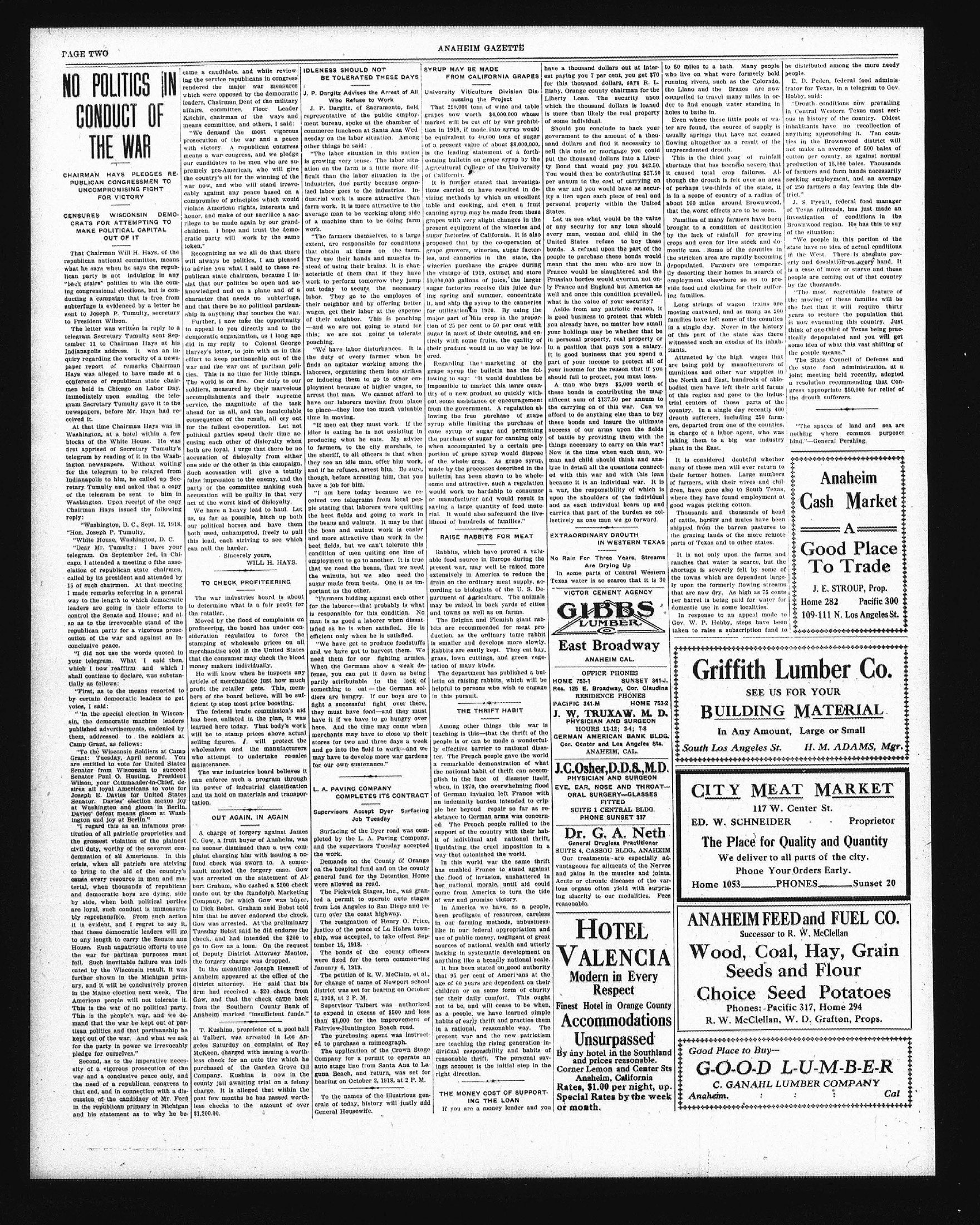
Searchable text
NO POLITICS IN CONDUCT OF THE WAR
CHAIRMAN HAYS PLEDGES REPUBLICAN CONGRESSMEN TO UNCOMPROMISING FIGHT FOR VICTORY
CENSURES WISCONSIN DEMOCRATS FOR ATTEMPTING TO MAKE POLITICAL CAPITAL OUT OF IT
That Chairman Will H. Hays, of the republican national committee, means what he says when he says the republican party is not indulging in any "back stairs" politics to win the coming congressional elections, but is conducting a campaign that is free from subterfuge is evidenced by a letter he sent to Joseph P. Tumulty, secretary to President Wilson.
The letter was written in reply to a telegram Secretary Tumulty sent September 11 to Chairman Hays at his Indianapolis address. It was an inquiry regarding the veracity of a newspaper report of remarks Chairman Hays was alleged to have made at a conference of republican state chairmen held in Chicago on Labor Day. Immediately upon sending the telegram Secretary Tumulty gave it to the newspapers, before Mr. Hays had received it.
At that time Chairman Hays was in Washington, at a hotel within a few blocks of the White House. He was first apprised of Secretary Tumulty's telegram by reading of it in the Wash-
come a candidate, and while reviewing the service republicans in congress rendered the major war measures which were opposed by the democratic leaders, Chairman Dent of the military affairs, committee, Floor Leader Kitchin, chairman of the ways and means committee, and others, I said:
"We demand the most vigorous prosecution of the war and a peace with victory. A republican congress means a war-congress, and we pledge our candidates to be men who are supremely pro-American, who will give the country's all for the winning of the war now, and who will stand irrevocably against any peace based on a compromise of principles which would violate American rights, interests and honor, and make of our sacrifice a sacrilege to be made again by our grandchildren. I hope and trust the democratic party will work by the same token."
Recognizing as we all do that there will always be politics, I am pleased to advise you what I said to these republican state chairmen, because I insist that our politics be open and acknowledged and on a plane and of a character that needs no subterfuge, and that there be no political partisanship in anything that touches the war.
Further, I now take the opportunity to appeal to you directly and to the democratic organization, as I long ago did in my reply to Colonel George Harvey's letter, to join with us in this effort to keep partisanship out of the war and the war out of partisan politics. This is no time for little things. The world is on fire. Our duty to our soldiers, measured by their marvelous accomplishments and their supreme service, the magnitude of the task ahead for us all, and the incalculable consequence of the result, all cry out for the fullest co-operation. Let not political parties spend their time accusing each other of disloyalty when both are loyal. I urge that there be no accusation of disloyalty from either
IDLENESS SHOULD BE TOLERATE
J. P. Dargitz Advises Who Refuse
J. P. Dargitz, of representative of the ment bureau, spoke at commerce luncheon on Wednesday on the labor other things he said:
"The labor situation is growing very tension on the farm is fictitious than the labor industries, due partizanized labor goes to the dustrial work is more farm work. It is more average man to be w of a machine than work.
"The farmers them extent, are responsible that obtain at time They use their hand stead of using their acteristic of them work to perform tonight out today to secure labor. They go to their neighbor and wages, get their lab of their neighbor.
—and we are not here; we are not poaching.
"We have labor due the duty of every finds an agitator who laborers, organizing or inducing them to ployment because of arrest that man. We have our laborers ready to place—they lose time in moving.
“If men eat they idler is eating he producing what he to farmers, to the sheriff, to all o
At that time Chairman Hays was in Washington, at a hotel within a few blocks of the White House. He was first apprised of Secretary Tumulty's telegram by reading it in the Washington newspapers. Without waiting for the telegram to be relayed from Indianapolis to him, he called up Secretary Tumulty and asked that a copy of the telegram be sent to him in Washington. Upon receipt of the copy Chairman Hays issued the following reply:
"Washington, D. C., Sept. 12, 1918.
Hon. Joseph P. Tumulty,
White House, Washington, D. C.
Dear Mr. Tumulty: I have your telegram. On September 2rd, in Chicago, I attended a meeting of the association of republican state chairmen, called by its president and attended by 15 of such chairmen. At that meeting I made remarks referring in a general way to the length to which democratic leaders are going in their efforts to control the Senate and House; and also as to the irrevocable stand of the republican party for a vigorous prosecution of the war and against an inconclusive peace.
"I did not use the words quoted in your telegram. What I said then, which I now reaffirm and which I shall continue to declare, was substantially as follows:
"First, as to the means resorted to by certain democratic leaders to get votes, I said:
"In the special election in Wisconsin, the democratic machine leaders published advertisements, undeniated by them, addressed to the soldiers at Camp Grant, as follows:
"To the Wisconsin Soldiers at Camp Grant: Tuesday, April second. You are entitled to vote for United States Senator from Wisconsin to succeed Senator Paul O. Husting. President Wilson, your Commander-in-Chief, desires all loyal Americans to vote for Joseph E. Davies for United States Senator. Davies' election means joy at Washington and gloom in Berlin. Davies' defeat means gloom at Washington and joy at Berlin."
"I regard this as an infamous prostitution of all patriotic proprieties and the grossest violation of the plainest civil duty, worthy of the severest condemnation of all Americans. In this crisis, when all patriots are striving
to keep partisanship out of war and the war out of partisan politics. This is no time for little things. The world is on fire. Our duty to our soldiers, measured by their marvelous accomplishments and their supreme service, the magnitude of the task ahead for us all, and the incalculable consequence of the result, all cry out for the fullest co-operation. Let not political parties spend their time accusing each other of disloyalty when both are loyal. I urge that there be no accusation of disloyalty from either one side or the other in this campaign. Such accusation will give a totally false impression to the enemy, and the party or the committee making such accusation will be guilty in that very act of the worst kind of disloyalty.
We have a heavy load to haul. Let us, as far as possible, hitch up both our political horses and have them both used, unhampered, freely to pull this load, each striving to see which can pull the harder.
Sincerely yours,
WILL H. HAYS.
TO CHECK PROFITEERING
The war industries board is about to determine what is a fair profit for the retailer.
Moved by the flood of complaints on profiteering, the board has under consideration regulation to force the stamping of wholesale prices on all merchandise sold in the United States that the consumer may check the blood money makers individually.
He will know when he inspects any article of merchandise just how much profit the retailer gets. This, members of the board believe, will be sufficient to stop most price boosting.
The federal trade commission's aid has been enlisted in the plan, it was learned here today. That body's work will be to stamp prices above actual selling figures. I will protect the wholesalers and the manufacturers who attempt to undertake re-sales maintenance.
The war industries board believes it can enforce such a program through its power of industrial classification and its hold on materials and transportation.
OUT AGAIN, IN AGAIN
A charge of forgery against James C. Gow, a fruit buyer of Anaheim, was no sooner dismissed than a new complaint charging him with issuing a no-fund check was sworn to. A somer
Senator from Wisconsin to succeed Senator Paul O. Husting. President Wilson, your Commander-in-Chief, desires all loyal Americans to vote for Joseph E. Davies for United States Senator. Davies' election means joy at Washington and gloom in Berlin. Davies' defeat means gloom at Washington and joy at Berlin."
"I regard this as an infamous prostitution of all patriotic proprieties and the grossest violation of the plainest civil duty, worthy of the severest condemnation of all Americans. In this crisis, when all patriots are striving to bring to the aid of the country's cause every resource in men and material, when thousands of republican and democratic boys are dying, side by side, when both political parties are loyal, such conduct is immeasurably reprehensible. From such action it is evident, and I regret to say it, that these democratic leaders will go to any length to carry the Senate and House. Such unpatriotic efforts to use the war for partisan purposes must fail. Such inevitable failure was indicated by the Wisconsin result, it was further shown in the Michigan primary, and it will be conclusively proven in the Maine election next week. The American people will not tolerate it. This is the war of no political party. This is the people's war, and we demand that the war be kept out of partisan politics and that partisanship be kept out of the war. And what we ask for the party in power we irrevocably pledge for ourselves."
Second, as to the imperative necessity of a vigorous prosecution of the war and a conclusive peace only, and the need of a republican congress to that end, and in connection with a discussion of the candidacy of Mr. Ford in the republican primary in Michigan and his statement as to why he be-
The war industries board believes it can enforce such a program through its power of industrial classification and its hold on materials and transportation.
OUT AGAIN, IN AGAIN
A charge of forgery against James C. Gow, a fruit buyer of Anaheim, was no sooner dismissed than a new complaint charging him with issuing a non-fund check was sworn to. A somersault marked the forgery case. Gow was arrested on the statement of Albert Graham, who cashed a $200 check made out by the Randolph Marketing Company, for which Gow wasbuyer, to Dick Bobst. Graham said Bobst told him that he never endorsed the check. Gow was arrested. At the preliminary Tuesday Bobst said he did endorse the check, and had intended the $200 to go to Gow as a loan. On the request of Deputy District Attorney Menton, the forgery charge was dropped.
In the meantime Joseph Hessell of Anaheim appeared at the office of the district attorney. He said that his firm had received a $20 check from Gow, and that the check came back from the Southern County Bank of Anaheim marked "insufficient funds."
T. Kushina, proprietor of a pool hall at Talbert, was arrested in Los Angeles Saturday on complaint of Roy McKeen, charged with issuing a worthless check for an auto tire which he purchased of the Garden Grove Oil Company. Kushina is now in the county jail awaiting trial on a felony charge. It is alleged that within the past few months he has passed worthless checks to the amount of over $1,200.00.
Surfacing of the pledged by the L.A. and the supervisory work.
Demands on the hospital fund general fund for were allowed as to The Pickwick Station a permit to from Los Angeles turn over the coa
The resignation justice of the peace ship, was accepted December 15, 1918.
The bonds of were fixed for the January 6, 1919.
The petition of for change of name district was set for 2, 1918, at 2 P.M.
Supervisor Tall to expend in excess than $1,000 for Fairview-Hunting.
The purchasing ed to purchase a
The application Company for a p auto stage line from guna Beach, and hearing on October-
To the names erals of today, h General Housewis
ANAHEIM GAZETTE
IDLENESS SHOULD NOT BE TOLERATED THESE DAYS
J. P. Dargitz Advises the Arrest of All Who Refuse to Work
J. P. Dargitz, of Sacramento, field representative of the public employment bureau, spoke at the chamber of commerce luncheon at Santa Ana Wednesday on the labor situation. Among other things he said:
"The labor situation in this nation is growing very tense. The labor situation on the farm is a little more difficult than the labor situation in the industries, due partly because organized labor goes to the industries. Industrial work is more attractive than farm work. It is more attractive to the average man to be working along side of a machine than to be doing farm work.
"The farmers themselves, to a large extent, are responsible for conditions that obtain at times on the farm. They use their hands and muscles instead of using their brains. It is characteristic of them that if they have work to perform tomorrow they jump out today to secure the necessary labor. They go to the employes of their neighbor and by offering better wages, get their labor at the expense of their neighbor. This is poaching—and we are not going to stand for this; we are not going to tolerate poaching.
"We have labor disturbances. It is the duty of every farmer when he finds an agitator working among the laborers, organizing them into strikes or inducing them to go to other employment because of higher wages, to arrest that man. We cannot afford to have our laborers moving from place to place—they lose too much valuable time in moving.
"If men eat they must work. If the idler is eating he is not assisting in producing what he eats. My advice to farmers, to the city marshals, to the sheriff, to all officers is that when new press issues arise and supersize news coverage, it should be supersized.
University Viticulture Division Discussing the Project
That 250,000 tons of wine and table grapes now worth $4,000,000 whose market will be cut off by war prohibition in 1919, if made into syrup would be equivalent to 40,000 tons of sugar of a present value of about $8,000,000 is the leading statement of a forthcoming bulletin on grape syrup by the Agricultural College of the University of California.
It is further stated that investigations carried on have resulted in devising methods by which an excellent table and cooking, and even a fruit canning syrup may be made from these grapes with very slight changes in the present equipment of the wineries and sugar factories of California. It is also proposed that by the co-operation of grape growers, wineries, sugar factories, and canneries in the state, the wineries purchase the grapes during the vintage of 1919, extract and store 50,000,000 gallons of juice, the larger sugar factories receive this juice during spring and summer, concentrate it, and ship the syrup to the canneries for utilization in 1920. By using the major part of this crop in the proportion of 25 per cent to 50 per cent with sugar in most of their canning, and entirely with some fruits, the quality of their product would in no way be lowered.
Regarding the marketing of the grape syrup the bulletin has the following say: "It would doubtless be impossible to market this large quantity of a new product so quickly without some assistance or encouragement from the government. A regulation allowing the free purchase of grape syrup while limiting the purchase of cane syrup or sugar and permitting the purchase of sugar for canning only when accompanied by a certain proportion of grape syrup would dispose have a thousand dollars out at interest paying you 7 per cent, you get $70 for this thousand dollars, says R. L. Bisby. Orange county chairman for the Liberty Loan. The security upon which the thousand dollars is loaned is more than likely the real property of some individual.
Should you conclude to back your government to the amount of a thousand dollars and find it necessary to sell this note or mortgage you could put the thousand dollars into a Liberty Bond that would pay you $42.50. You would then be contributing $27.50 per annum to the cost of carrying on the war and you would have as security a lien upon each piece of real and personal property within the United States.
Let us see what would be the value of any security for any loan should every man, woman and child in the United States refuse to buy these bonds. A refusal upon the part of the people to purchase these bonds would mean that the men who are now France would be slaughtered and the Prussian hordes would overrun not only France and England but America as well and once this condition prevailed, what is the value of your security?
Aside from any patriotic reason, it is good business to protect that which you already have, no matter how small your holdings may be whether that be in personal property, real property or in a position that pays you a salary. It is good business that you spend a part of your income to protect all of your income for the reason that if you should fail to protect, you must lose.
A man who buys $5,000 worth of these bonds is contributing the magnificent sum of $137.50 per annum to the carrying on of this war. Can we afford to do anything else than to buy these bonds and insure the ultimate success of our arms upon the fields of battle by providing them with the things necessary to carry on this war? Now is the time when each man, wo-
to 50 million who live running ranchs in the Llander compelled der to finish holes to build.
Even worse are for usually small flowering unprecedented.
This is shortage it caused though that of perhaps is in a sense about 10% that they.
Families brought by by the lords crops and mestic ue the strickly depopulatedly deserved employment vide food families.
Long moving o families in a single witness itants.
Attractive are being munitions for North country country drouth o ers, department in charge taking plant in
finds an agitator working among the laborers, organizing them into strikes or inducing them to go to other employment because of higher wages, to arrest that man. We cannot afford to have our laborers moving from place to place—they lose too much valuable time in moving.
"If men eat they must work. If the idler is eating he is not assisting in producing what he eats. My advice to farmers, to the city marshals, to the sheriff, to all officers is that when they see an idle man, offer him work, and if he refuses, arrest him. Be sure, though, before arresting him, that you have a job for him.
"I am here today because we received two telegrams from local people stating that laborers were quitting the beet fields and going to work in the beans and walnuts. It may be that the bean and walnut work is easier and more attractive than work in the beet fields, but we can't tolerate this condition of men quiting one line of employment to go to another. It is true that we need the beans, that we need the walnuts, but we also need the sugar made from beets. One is as important as the other.
"Farmers bidding against each other for the laborer—that probably is what is responsible for this condition. No man is as good a laborer when dissatisfied as he is when satisfied. He is efficient only when he is satisfied.
"We have got to produce foodstuffs and we have got to harvest them. We need them for our fighting armies. When the Germans show a weak defense, you can put it down as being partly attributable to the lack of something to eat—the German soldiers are hungry. If our boys are to fight a successful fight over there, they must have food—and they must have it if we have to go hungry over here. And the time may come when merchants may have to close up their stores for two and three days a week and go into the field to work—and we may have to develop more war gardens for our own sustenance."
L. A. PAVING COMPANY COMPLETES ITS CONTRACT
Supervisors Accept Dyer Surfacing Job Tuesday
Surfacing of the Dyer road was completed by the L. A. Paving Company, and the supervisors Tuesday accepted the work.
Demands on the County of Orange
Regarding the marketing of the grape syrup the bulletin has the following to say: "It would doubtless be impossible to market this large quantity of a new product so quickly without some assistance or encouragement from the government. A regulation allowing the free purchase of grape syrup while limiting the purchase of cane syrup or sugar and permitting the purchase of sugar for canning only when accompanied by a certain proportion of grape syrup would dispose of the whole crop. As grape syrup, made by the processes described in the bulletin, has been shown to be wholesome and attractive, such a regulation would work no hardship to consumer or manufacturer and would result in saving a large quantity of food material. It would also safeguard the livelihood of hundreds of families."
RAISE RABBITS FOR MEAT
Rabbits, which have proved a valuable food source in Europe during the present war, may well be raised more extensively in America to reduce the drain on the ordinary meat supply, according to biologists of the U.S. Department of Agriculture. The animals may be raised in back yards of cities and towns as well as on farms.
The Belgian and Flemish giant rabbits are recommended for meat production, as the ordinary tame rabbit is smaller and develops more slowly. Rabbits are easily kept. They eat hay, grass, lawn cuttings, and green vegetation of many kinds.
The department has published a bulletin on raising rabbits, which will be helpful to persons who wish to engage in this pursuit.
THE THRIFT HABIT
Among other things this war is teaching is this—that the thrift of the people is or can be made a wonderfully effective barrier to national disaster. The French people gave the world a remarkable demonstration of what the national habit of thrift can accomplish in the face of disaster itself, when, in 1870, the overwhelming flood of German invasion left France with an indemnity burden intended to cripple her beyond repair so far as resistance to German arms was concerned. The French people rallied to the support of the country with their habitat of individual and national thrift, liquidating the cruel imposition in a way that astonished the world.
In this world war the same thrift part of your income to protect all of your income for the reason that if you should fail to protect, you must lose.
A man who buys $5,000 worth of these bonds is contributing the magnificent sum of $137.50 per annum to the carrying on of this war. Can we afford to do anything else than to buy these bonds and insure the ultimate success of our arms upon the fields of battle by providing them with the things necessary to carry on this war? Now is the time when each man, woman and child should think and analyze all the questions connected with this war and with this loan because it is an individual war. It is a war, the responsibility of which is upon the shoulders of the individual and as each individual bears up and carries that part of the burden so collectively as one man we go forward.
EXTRAORDINARY DROUTH IN WESTERN TEXAS
No Rain For Three Years, Streams Are Drying Up
In some parts of Central Western Texas water is so scarce that it is 30 VICTOR CEMENT AGENCY GIBBS LUMBER
East Broadway ANAHEIM CAL.
OFFICE PHONES HOME 753-1 SUNSET 341-J.
Res. 125 E. Broadway, Cor. Claudina RESIDENCE PHONES PACIFIC 341-M HOME 753-2 J. W. TRUXAW, M.D.
PHYSICIAN AND SURGEON HOURS 11-12; 2-4; 7-8 GERMAN AMERICAN BANK BLDG.
Cor. Center and Los Angeles Sts.
ANAHEIM, CAL.
J.C.Osher,D.D.S,M.D.
PHYSICIAN AND SURGEON EYE, EAR, NOSE AND THROAT—ORAL SURGERY—GLASSES FITTED SUITE 1 CENTRAL BLDG.
PHONE SUNSET 337
Dr. G. A. Neth General Drugless Practitioner SUITE 4, CASSOU BLDG., ANAHEIM Our treatments—are especially advantageous for alliments of the Nerves
L. A. PAVING COMPANY
COMPLETES ITS CONTRACT
Supervisors Accept Dyer Surfacing Job Tuesday
Surfacing of the Dyer road was completed by the L. A. Paving Company, and the supervisors Tuesday accepted the work.
Demands on the County of Orange on the hospital fund and on the county general fund for the Detention Home were allowed as read.
The Pickwick Stages, Inc., was granted a permit to operate auto stages from Los Angeles to San Diego and return over the coast highway.
The resignation of Henry O. Price, justice of the peace of La Habra township, was accepted, to take effect September 15, 1918.
The bonds of the county officers were fixed for the term commencing January 6, 1919.
The petition of R. W. McClain, et al., for change of name of Newport school district was set for hearing on October 2, 1918, at 2 P.M.
Supervisor Talbert was authorized to expend in excess of $500 and less than $1,000 for the improvement of Fairview-Huntington Beach road.
The purchasing agent was instructed to purchase a mimeograph.
The application of the Crown Stage Company for a permit to operate an auto stage line from Santa Ana to Laguna Beach, and return, was set for hearing on October 2, 1918, at 2 P.M.
To the names of the illustrious generals of today, history will justly add General Housewife.
the national habit of thrift can accomplish in the face of disaster itself when, in 1870, the overwhelming flood of German invasion left France with an indemnity burden intended to cripple her beyond repair so far as resistance to German arms was concerned. The French people rallied to the support of the country with their habitat of individual and national thrift, liquidating the cruel imposition in a way that astonished the world.
In this world war the same thrift has enabled France to stand against the flood of invasion, unshattered in her national morale, until aid could come from America to turn the tide of war and promise victory.
In America we have, as a people, been profligate of resources, careless in our farming methods, unbusinesslike in our federal appropriation and use of public money, negligent of great sources of national wealth and utterly lacking in systematic development on anything like a broadly national scale.
It has been stated on good authority that 95 per cent of Americans at the age of 60 years are dependent on their children or on some form of charity for their daily comfort. This ought not to be, and will cease to be when, as a people, we have learned simple habits of early thrift and practice them in a rational, reasonable way. The present war and the new patriotism are teaching the rising generation individual responsibility and habits of reasonable thrift. The personal savings account is the initial step in the right direction.
THE MONEY COST OF SUPPORTING THE LOAN
If you are a money lender and you
to back your count of a thousand necessary to engage you could come into a Liber-day you $42.50. Distributing $27.50 of carrying on have as security of real and within the United States be the value many loan should lend child in the part of the case bonds would who are now in lightered and the overrun not on but America as condition prevailed, our security? Rototic reason, it protect that which matter how small whether that be real property or says you a salary. What you spend a too protect all of season that if you you must lose $5,000 worth of deducting the mag-100 per annum to this war. Can we else than to buy sure the ultimate upon the fields bring them with the carry on this war? In each man, wo-
to 50 miles to a bath. Many people who live on what were formerly bold running rivers, such as the Colorado, the Llano and the Brazos are now compelled to travel many milds in order to find enough water standing in holes to bathe in.
Even where these little pools of water are found, the source of supply is usually springs that have not ceased flowing altogether as a result of the unprecedented drought.
This is the third year of rainfall shortage that has been so severe that it caused total crop failures. Although the drought is felt over an area of perhaps two-thirds of the state, it is in a scope of country of about 100 miles around Brownwood, that the worst effects are to be seen.
Families of many farmers have been brought to a condition of destitution by the lack of rainfall for growing crops and even for live stock and domestic use. Some of the counties in the stricken area are rapidly becoming depopulated. Farmers are temporarily deserting their homes in search of employment elsewhere so as to provide food and clothing for their suffering families.
Long strings of wagon trains are moving eastward, and as many as 200 families have left some of the counties in a single day. Never in the history of this part of the state was there witnessed such an exodus of its inhabitants.
Attracted by the high wages that are being paid by manufacturers of munitions and other war supplies in the North and East, hundreds of able-bodied men have left their arid farms of this region and gone to the industrial centers of those parts of the country. In a single day recently 400 drouth sufferers, including 250 farmers, departed from one of the counties, in charge of a labor agent, who was taking them to a big war industry plant in the East.
be distributed among the more needy people.
E. D. Peden, federal food administrator for Texas, in a telegram to Gov. Hobby, said:
"Drought conditions now prevailing in Central Western Texas most serious in history of the country. Oldest inhabitants have no recollection of anything approaching it. Ten counties in the Brownwood district will not make an average of 500 bales of cotton per county, as against normal production of 15,000 bales. Thousands of farmers and farm hands necessarily seeking employment, and an average of 250 farmers a day leaving this district."
J. S. Pyeatt, federal food manager of Tevas railroads, has just made an investigation of conditions in the Brownwood region. He has this to say of the situation:
"We people in this portion of the state have no idea of actual conditions in the West. There is absolute poverty and desolation on every hand. It is a case of move or starve and those people are coming out of that country by the thousands.
"The most regrettable feature of the moving of these families will be the fact that it will require thirty years to restore the population that is now evacuating this country. Just think of one-third of Texas being practically depopulated and you will get some idea of what this vast shifting of the people means."
The State Council of Defense and the state food administration, at a joint meeting held recently, adopted a resolution recommending that Congress appropriate $50,000 for relief of the drouth sufferers.
"The spaces of land and sea are nothing where common purposes bind."—General Pershing.
protect all of season that if you you must lose.
$5,000 worth of distributing the mag10 per annum to this war. Can we else than to buy
upon the fields them with the harry on this war?
each man, wo think and ana-questions connectwith this loan individual war. It is ability of which is
of the individual bears up and burden so colwe go forward.
ROUTH WESTERN TEXAS
Years, Streams Up
Central Western source that it is 30
AGENCY
BS BER
roadway
CAL.
PHONES SUNSET 341-J.
Day, Cor. Claudina PHONES HOME 753-2
AW. M. D.
D SURGEON
2; 2-4; 7-8
AN BANK BLDG.
Los Angeles Sts.
M, CAL.
D.D.S., M.D.
AND SURGEON
AND THROAT—GLASSES
ED
TRAL BLDG.
NSET 337
A. Neth Practitioner
BLDG., ANAHEIM are especially adents of the Nerves
being paid by manufacturers of munitions and other war supplies in the North and East, hundreds of able-bodied men have left their arid farms of this region and gone to the industrial centers of those parts of the country. In a single day recently 400 drouth sufferers, including 250 farmers, departed from one of the counties, in charge of a labor agent, who was taking them to a big war industry plant in the East.
It is considered doubtful whether many of these men will ever return to their former homes. Large numbers of farmers, with their wives and children, have gone also to South Texas, where they have found employment at good wages picking cotton.
Thousands and thousands of head of cattle, horses and mules have been shipped from the barren pastures to the grazing lands of the more remote parts of Texas and to other states.
It is not only upon the farms and ranches that water is scarce, but the shortage is severely felt by some of the towns which are dependent largely upon the formerly flowing streams that are now dry. As high as 75 cents per barrel is being paid for water for domestic use in some localities.
In response to an appeal made to Gov. W. P. Hobby, steps have been taken to raise a subscription fund to
Anaheim Cash Market
A Good Place To Trade
J. E. STROUP, Prop.
Home 282 Pacific 300
109-111 N. Los Angeles St.
Griffith Lumber Co.
SEE US FOR YOUR BUILDING MATERIAL
In Any Amount, Large or Small
South Los Angeles St. H. M. ADAMS, Mgr.
CITY MEAT MARKET
117 W. Center St.
ED. W. SCHNEIDER Proprietor
The Place for Quality and Quantity
We deliver to all parts of the city.
CITY MEAT MARKET
117 W. Center St.
ED. W. SCHNEIDER Proprietor
The Place for Quality and Quantity
We deliver to all parts of the city.
Phone Your Orders Early.
Home 1053 PHONES Sunset 20
ANAHEIM FEED and FUEL CO.
Successor to R. W. McClellan
Wood, Coal, Hay, Grain
Seeds and Flour
Choice Seed Potatoes
Phones: Pacific 317, Home 294
R. W. McClellan, W. D. Grafton, Props.
Good Place to Buy—
G-O-O-D L-U-M-B-E-R
C. GANAHL LUMBER COMPANY
Anaheim. : : : Cal